AI Property Management Statistics 2026: From Adoption to ROI
Explore AI Property Management Statistics 2026: adoption hit 58%, automation handles up to 70% of inquiries, and ROI rises 3–7%. Get key trends and next steps.

Artificial intelligence isn’t just a buzzword from a tech conference anymore. By 2026, AI has become a mission critical tool for property managers looking to work smarter, not harder. What started as an experiment is now unlocking new levels of efficiency, helping teams automate routine tasks, and delivering better experiences for residents and owners alike.
If you’re wondering how AI is truly shaking up the industry, you’ve come to the right place. We’re diving into the essential trends and the most important AI property management statistics 2026 to show you what’s happening right now. Let’s look at the data behind the transformation.
The Economic Scale of AI in Real Estate
The financial momentum behind AI is no longer speculative. By 2026, the global generative AI market in real estate has reached an estimated $1 billion, growing at a compound annual rate (CAGR) of over 30%. This surge is driven by a shift from "experimental pilots" to "enterprise-scale integration" as firms chase efficiency to combat rising operational costs.
AI Adoption Skyrockets in Property Management
Just a few years ago, AI was on the fringe. Today, it’s at the core of modern operations. The rate of adoption tells a story of an industry in rapid transition.
Consider this jump: AI adoption among property management companies soared from about 20% in 2024 to an incredible 58% in 2025. This means well over half of all firms now use some form of AI. The momentum is undeniable, with adoption growing at a compound annual rate of around 35%.
While full, end to end automation is still emerging, the experimentation phase is in full swing. By late 2025, over 53% of property management professionals were already using generative AI tools like ChatGPT in their daily work. The hesitation isn’t about whether AI works. Most managers believe it can help. The real question has shifted from “if” to “how” to best implement it. These adoption figures are some of the most telling AI property management statistics 2026 available.
AI Officially Goes Mainstream
The conversation has changed. AI is no longer a niche tool for early adopters. it is now a standard part of the property management playbook for companies of all sizes, from large enterprises to smaller boutique firms.
The proof is in the usage patterns. A late 2025 survey found that 53% of property managers were using general purpose AI tools, while 43% were using AI features already embedded in their property management software. With a majority of professionals leveraging AI, it has clearly hit the mainstream.
Industry leaders saw this coming. A stunning 89% of real estate executives expected AI to significantly disrupt the industry. By 2026, that disruption has become the new normal. AI is now essential for meeting modern expectations, like providing the instant answers and 24/7 support that today’s tenants demand.
Automating Workflows: The New Frontier
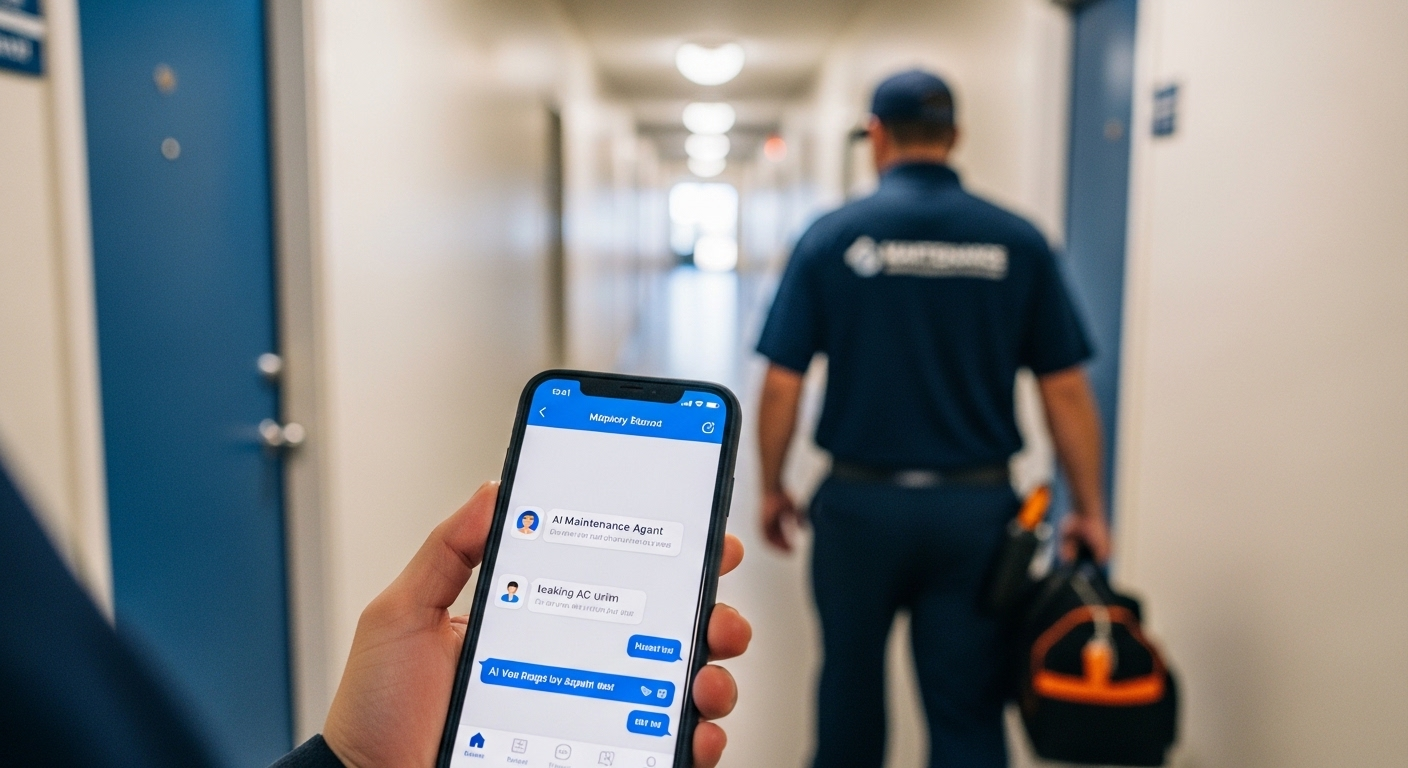
Beyond simple tasks, AI is now automating entire workflows. This means connecting multiple steps in a process, like handling a maintenance request from start to finish, with minimal human input.
The potential here is massive. Studies show that over 80% of the questions property managers receive are repetitive and procedural. Think “How do I pay rent?” or “My sink is leaking”. These are perfect for AI automation. While only 8% of companies had fully automated a single process by 2025, the push toward workflow automation is a dominant trend.
A layered approach is proving effective:
Layer 1 (Intelligent Triage): AI can handle 40% to 50% of simple, high volume communications automatically.
Layer 2 (Context Aware Automation): AI can manage another 15% to 20% of tasks that require basic context.
Combined, these layers can automate up to 70% of all inquiries. For example, an advanced solution like Haven’s Maintenance AI agent can intake a request, triage it for emergencies, create a work order, dispatch a vendor, and follow up, all without a human touching the keyboard.
Beyond Efficiency: AI as a Gatekeeper
In 2026, AI's role has expanded from a "helper" to a "protector." With rental fraud and sophisticated identity theft on the rise, AI-driven fraud detection has become a standard requirement. These systems use image forensics and bank link checks to verify applicants in real-time.
The Stat: AI-powered screening now reduces discriminatory outcomes by ensuring 100% consistent algorithmic evaluation, while simultaneously flagging high-risk patterns that manual reviews often miss.
Real Results: AI Driven Performance Improvements
Adopting AI isn’t just about efficiency, it’s about measurable results. The data shows that companies using AI are seeing tangible gains across their business. In fact, about 77% of companies report overall performance improvements after implementing AI.
Table: AI Impact Benchmarks 2026
Feature | Primary Benefit | Typical ROI / Impact |
Predictive Maintenance | Prevents equipment failure | 40%–60% reduction in emergency repairs |
AI Tenant Screening | Reduces rental fraud | 30%–50% decrease in bad debt |
Dynamic Pricing | Revenue optimization | 3%–7% increase in annual rental income |
AI Chatbots | Lead engagement | 60%–80% of inquiries handled without staff |
Leasing Assistants | Conversion speed | 23% jump in lead-to-lease rates |
Here are a few standout AI property management statistics 2026 that show the impact:
Increased Revenue: AI powered dynamic pricing algorithms have been shown to increase rental income by 3% to 7% annually.
Faster Leasing: One firm saw its lead to lease conversion rate jump 23% and filled vacancies 11 days faster after deploying an AI leasing assistant, adding an estimated $140,000 in annual revenue.
Happier Residents: Around 80% of property management companies report higher customer satisfaction after implementing AI solutions, thanks to instant responses and 24/7 availability.
Lower Costs: AI powered invoice processing can reduce accounts payable processing time by up to 70%, turning days of work into minutes.
These aren’t just small tweaks. They represent significant improvements to both the top and bottom lines.
The Growing Gap: AI Adopters vs. Non Adopters
A clear divide is emerging between firms that embrace AI and those that do not. The difference often comes down to one word: scalability.
Before AI, growth was a challenge. One property manager noted that 65% of their team’s time was spent answering the same 20 questions repeatedly. In that model, doubling your portfolio meant you practically had to double your support staff. This linear growth model is a major bottleneck.
AI shatters that bottleneck. With AI agents offloading 60% to 70% of daily communications, teams can take on more units without a proportional increase in headcount. AI acts as a force multiplier, allowing one person to manage a much larger portfolio. Companies that use AI can scale their operations efficiently, while non adopters risk getting stuck, unable to grow without massive hiring sprees. The latest AI property management statistics 2026 clearly show this trend accelerating.
How AI is Reshaping Property Management Teams
The staffing impact of AI is not about replacing people, it’s about empowering them. Property management professionals spend an estimated 66% of their time on routine, low value operational tasks. This leaves only a third of their time for strategic work like building owner relationships or improving resident retention.
AI flips that ratio. By automating the repetitive tasks, AI frees up human staff to focus on what they do best: problem solving, empathy, and strategy. An AI assistant can handle after hours calls or answer emails at 3 AM, tasks that would otherwise require on call staff or an expensive call center.
One company using an AI assistant was able to cut its support costs by $3,200 per month. Instead of hiring more people to answer phones, they reallocated their team to higher value activities. The goal is to use AI as a copilot, not a replacement, creating leaner, more effective, and less burned out teams.
The Trust Factor: Legacy Software vs. Specialized AI

As AI has become popular, many legacy property management software (PMS) platforms have added their own AI features. But are property managers using them? The data suggests there’s a trust gap.
A 2025 survey found that while 53% of professionals use general tools like ChatGPT, only 43% use the AI features built into their PMS. This indicates that many users prefer external or specialized AI tools over the ones bundled with their core software.
Why the hesitation? Legacy AI features can sometimes feel like a “black box,” offering recommendations without clear reasoning. Managers are understandably cautious about handing over critical decisions without transparency. As a result, many are turning to specialized providers whose sole focus is creating reliable, purpose built AI. An AI agent from a dedicated company like Haven is often perceived as more advanced and trustworthy for critical workflows like maintenance and leasing.
Simplifying the Tech Stack
Historically, property managers have juggled a dozen different software tools, one for accounting, another for marketing, a third for maintenance, and so on. This fragmented approach creates data silos and inefficiencies.
Today, the trend is moving toward consolidation. A significant 67% of property management executives agree that consolidating data and workflows onto a single platform is key to improving performance. They are looking for unified systems that provide one source of truth for their business.
AI is accelerating this trend. For AI to work its best, it needs access to integrated data. Therefore, managers are seeking AI solutions that plug seamlessly into their core PMS, rather than adding yet another disconnected app to their stack. The goal is a streamlined, powerful, and easy to manage technology ecosystem. The focus on integrated platforms is a major theme within the broader AI property management statistics 2026.
The Future is Now
The AI property management statistics 2026 paint a clear picture. AI is no longer a futuristic idea but a practical tool that is delivering real value today. Companies that leverage AI are scaling faster, operating more efficiently, and providing superior service.
Embracing this technology doesn’t mean losing the human touch. It means elevating it. By letting AI handle the repetitive work, you empower your team to focus on building relationships and growing the business. If you’re ready to see how AI can transform your operations, discover how Haven’s AI agents can work for you. The revolution is here, and the property managers who adapt will be the ones who thrive.
Frequently Asked Questions (FAQ)
What are the key AI property management statistics for 2026?
The most important AI property management statistics 2026 show rapid adoption (over 58% of firms), significant performance gains (77% of companies report improvements), and a major impact on efficiency (AI can automate up to 70% of repetitive communications).
How is AI changing property management jobs?
AI is shifting job roles from repetitive task execution to strategic oversight. It automates about 66% of low value tasks, allowing staff to focus on high value activities like resident relations, strategic planning, and complex problem solving, effectively making them more productive.
Can AI really improve a property’s financial performance?
Absolutely. Data shows AI can increase rental income by 3% to 7% through dynamic pricing, boost lead to lease conversion rates by over 20%, and significantly cut operational costs related to support staff and manual processing.
What is the biggest barrier to AI adoption in property management?
The primary barrier is shifting from “if” to “how”. While most managers believe in AI’s potential, challenges include knowing where to start, integrating new tools with existing systems, and building trust in the AI’s reliability, especially with features embedded in older legacy software.
Why are property managers consolidating their tech stacks in 2026?
Managers are consolidating to improve efficiency and eliminate data silos. A unified platform where all tools communicate seamlessly reduces manual work, prevents errors, and provides better business insights. About 67% of executives see consolidation as critical for performance.