Maintenance AI ROI: 2026 Guide to Triage, Costs & Retention
Calculate Maintenance AI ROI for properties in 2026. See savings from triage, after-hours intake, PMS integration, and smarter dispatch. Use our 4-step model.

For many landlords, maintenance is the single most challenging part of the job. In fact, a staggering 61% of them rate it as the worst aspect of property management. It’s a constant drain on time, resources, and budget. But what if you could turn your biggest headache into a source of efficiency and profit? Emerging AI solutions are transforming property maintenance, and understanding the maintenance AI ROI is the first step to modernizing your operations.
Quick Summary: The Maintenance AI ROI Formula
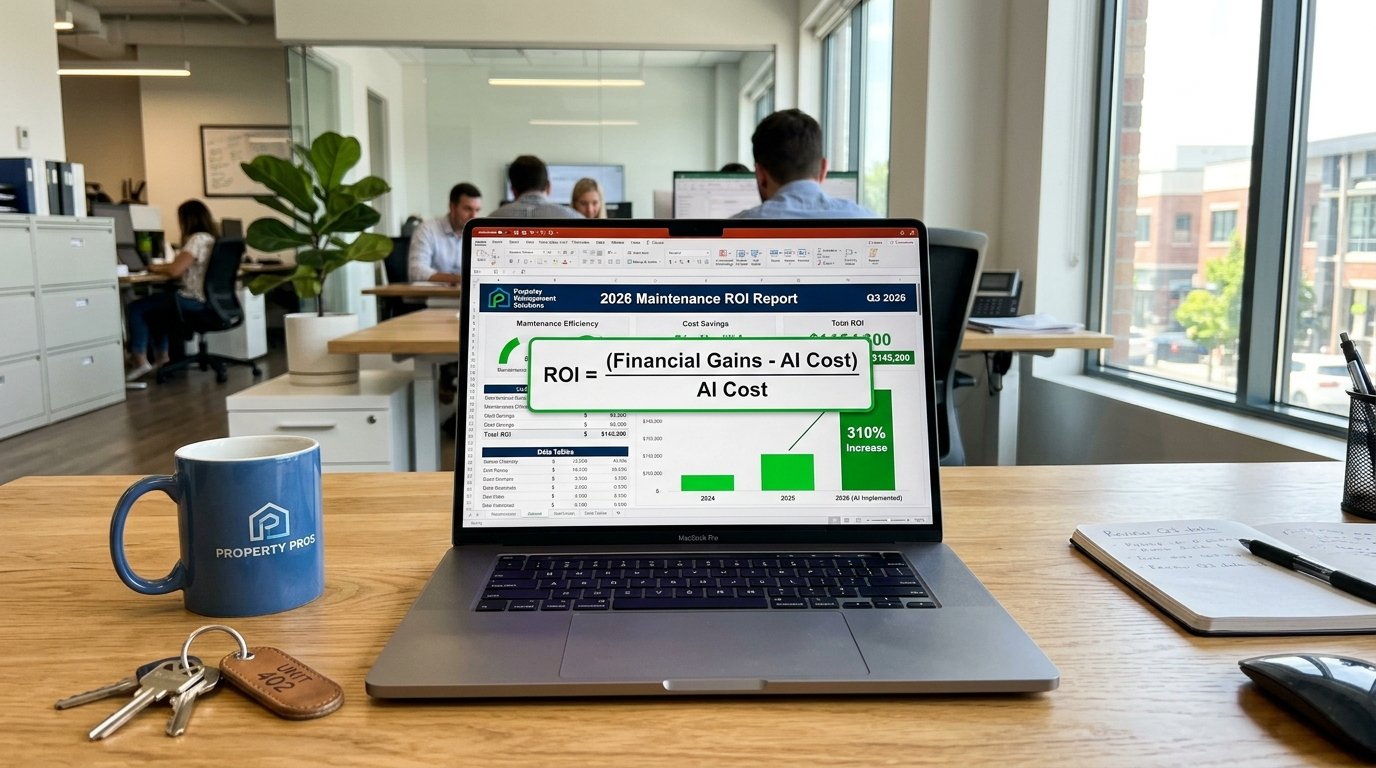
In 2026, the ROI of AI in property maintenance is calculated by the formula: ROI = (Financial Gains - AI Cost) / AI Cost.
Direct Gains: 30% reduction in labor costs and 25-30% lower maintenance spend via emergency avoidance.
Operational Gains: 45% faster response times and a 15% increase in first-time fix rates.
Retention Gains: Average savings of $1,800–$3,000 per avoided tenant turnover. Key Takeaway: Most property managers see a 310% ROI by automating triage, intake, and work order entry.
This guide breaks down exactly how AI delivers a powerful return on investment. We will explore everything from immediate cost savings to long term value creation, giving you a clear framework for calculating the maintenance AI ROI for your own portfolio. At its core, the calculation is a straightforward formula: ROI = (Total Financial Gains - AI Solution Cost) / AI Solution Cost. The key is to accurately identify all the financial gains, which include direct labor savings, avoided emergency repair costs, operational efficiencies, and the significant value of increased tenant retention.
The Foundation of Savings: Smart Triage and Classification
The journey to a positive maintenance AI ROI begins the moment a tenant reports an issue. How you handle that initial request sets the stage for everything that follows.
Mastering Maintenance Request Triage
Maintenance request triage is the process of evaluating and prioritizing incoming issues. An AI system can perform this task instantly and consistently, 24/7. It asks the right questions to understand the problem’s severity, ensuring the most critical issues get immediate attention while routine problems are scheduled efficiently. Without good triage, you risk wasting resources on low priority tasks or, even worse, delaying action on a real emergency.
Emergency Versus Routine Classification
A core part of triage is classifying issues as either an emergency or a routine matter. An emergency, like a gas leak or a burst pipe, poses a risk to safety or property and needs an immediate response. A routine issue, such as a dripping faucet, can wait for normal business hours.
This distinction is crucial for cost control. Emergency repairs can cost three to five times more than planned, daytime repairs. The good news is that very few calls are true emergencies. Industry data shows just 6.2% of all contractor maintenance calls fall into this category. An AI can accurately identify that small fraction with emergency maintenance triage, preventing unnecessary and expensive emergency dispatches for problems that can safely wait until morning.
The Cost of Manual vs. AI-Driven Maintenance
Feature | Manual Management | AI-Powered Management | ROI Impact |
Response Time | 2–4 Hours (Average) | Instant (24/7) | High Tenant Retention |
Emergency Dispatch | High (Human Error/Fear) | Low (Data-Driven Triage) | 3x–5x Cost Savings |
Troubleshooting | Rarely Done via Phone | 30% Resolution Rate | Eliminates Truck Rolls |
Data Entry | Manual (10–15 mins/task) | Automated (Instant) | Lower Admin Payroll |
Conquering After Hours Triage
A significant portion of maintenance calls, Roughly 25% of property maintenance calls come in after hours, between 5 PM and 9 AM. Manually handling these can lead to staff burnout and high overtime costs. AI powered after hours triage ensures every call is answered and assessed correctly, no matter the time. This immediate response not only keeps tenants happy but also prevents them from seeking outside help. Many urgent callers will not even leave a voicemail if they reach an answering machine, which can lead to tenants taking matters into their own hands.
From Call to Resolution: Automating the Entire Workflow
Once an issue is triaged, the real work begins. AI streamlines the entire process, from initial contact to vendor dispatch, all while keeping your systems perfectly in sync.
Voice AI for Flawless Maintenance Intake
Most maintenance requests still start with a phone call. The problem is that multifamily professionals miss nearly 49% of calls to their properties because they are busy or it is after hours. Voice AI for maintenance intake solves this by ensuring every call is answered instantly. This AI assistant converses naturally with tenants to gather all the necessary details, understand the issue, and even walk them through simple troubleshooting steps. This initial troubleshooting alone can have a significant impact. At Latchel, 30% of maintenance requests are able to be resolved through troubleshooting over the phone without dispatching a vendor, avoiding a technician visit entirely.
Automated Work Order Entry and PMS Integration
After gathering the details, the AI performs a critical, time saving step: automated work order entry. The AI instantly creates a detailed work order inside your Property Management System (PMS) like AppFolio or Yardi. This seamless PMS integration for maintenance AI is a game changer, cutting administrative labor by eliminating manual data entry.
Because the AI is connected to your PMS, it recognizes the caller, knows their unit number, and logs every detail accurately. This creates a single source of truth, so your team can see the status of any request in real time. For property managers looking to scale, solutions like Haven’s AI agents make this integration feel like having a virtual assistant working directly within your existing software.
Optimizing Vendor Dispatch
With an accurate work order created, the final step is getting the right person to the job. Vendor dispatch optimization uses intelligence to assign the best technician or contractor. The AI can automatically contact your preferred vendors based on the issue type, location, and urgency. This ensures a qualified expert is sent the first time, which is key to improving your first time fix rate. Sending the wrong person often leads to repeat visits and frustrated residents.
How Maintenance AI Integrates with Your Tech Stack
To achieve maximum ROI, the AI must act as a bridge between your tenants and your Property Management System (PMS). The workflow follows these steps:
Omnichannel Intake: AI captures requests via Voice, SMS, or Web Portal.
Intent Recognition: NLP (Natural Language Processing) identifies the specific issue (e.g., "leaking pipe" vs. "clogged drain").
Conflict Checking: The AI checks your PMS (AppFolio/Yardi) for duplicate work orders.
Instant Dispatch: Using your pre-approved vendor list, the AI sends a work order via API.
The Financial Wins: How AI Directly Impacts Your Bottom Line
Automating your workflow leads to significant and measurable financial benefits. These direct savings are a huge component of your overall maintenance AI ROI.
Labor Cost Reduction: Property managers spend a lot of time on maintenance coordination. Automation hands these repetitive duties over to AI, freeing up your team for higher value work. This also leads to direct savings, as AI can replace expensive after hours call centers, with some property managers reporting significant savings.
Maintenance Cost Avoidance: Early and effective triage helps you fix small problems before they become catastrophes. By addressing a minor leak today, you avoid a major ceiling collapse tomorrow. This proactive approach can reduce maintenance costs by 25% to 30%. The positive maintenance AI ROI becomes obvious when you realize preventing a single major flood can pay for the system for years.
Predictive Maintenance ROI: Looking ahead, AI can use data to predict when equipment will fail before it happens. While this technology is more common in industrial settings, it is coming to property management. The returns are massive, with the U.S. Department of Energy finding a typical ROI for predictive maintenance is 10 times.
Boosting Operations for Better Performance
Beyond direct savings, AI drives improvements across key operational metrics. These efficiencies contribute heavily to your maintenance AI ROI by making your entire operation run smoother.
Slashing Response Times
Tenants expect a fast response. AI makes this possible by eliminating delays in the intake and dispatch process. One study showed that an AI driven system improved maintenance response times by an average of 45%. This speed not only satisfies residents but also limits potential property damage.
Improving Data Capture and Diagnosis Quality
Roughly 30% of maintenance requests require multiple visits because the initial information was incomplete. AI improves data capture and diagnosis quality by asking detailed, scripted questions every single time. It doesn’t forget to ask if the whole unit lost power or just one room, ensuring the technician arrives with the right tools and context.
Increasing First Time Fix Rates
Better data leads directly to first time fix rate improvement. The average fix rate is about 76% across all companies (measured at 30 days), meaning one in four jobs requires a costly second visit. Each extra truck roll costs about $200 to $300 (all in). By ensuring the right information is gathered and the right vendor is dispatched, AI significantly increases the chances of fixing it right the first time, boosting tenant satisfaction.
The Ultimate Prize: Boosting Tenant Retention

All these improvements lead to the most important outcome: happier tenants who stay longer.
Poor communication and slow maintenance are leading reasons why renters move out. Tenant communication automation, powered by AI, keeps residents in the loop with automatic updates about their work orders. This transparency builds trust and makes tenants feel valued.
Considering that tenant turnover can average about $1,800 per unit and can easily rise to $3,000, even a small improvement in retention has a massive impact. If an efficient, communicative maintenance process convinces just a few extra residents to renew their leases each year, the savings can be substantial. This is perhaps the most powerful, if sometimes overlooked, aspect of maintenance AI ROI.
Putting It All Together: Your Maintenance AI ROI Calculation
Calculating your maintenance AI ROI involves looking at both direct savings and operational gains. A comprehensive analysis found that integrating AI into maintenance operations can deliver an incredible 310% ROI.
To calculate the maintenance AI ROI for your portfolio, sum up the value you gain in these key areas:
Direct Labor Savings: Calculate the cost of staff hours spent on maintenance calls and coordination, plus any money spent on after hours answering services.
Emergency Cost Avoidance: Estimate the savings from avoiding just a few expensive, after hours emergency dispatches each year.
Operational Efficiency: Quantify the savings from fewer repeat vendor visits and reduced property damage due to faster response times.
Increased Tenant Retention: Calculate the money saved by preventing tenant turnover, even for just a handful of units.
When you weigh these benefits against the cost of an AI service, the financial case becomes clear. If you want to see what these numbers could look like for your specific properties, it may be useful to get a personalized analysis from Haven, who can help model the savings based on your call volume.
Frequently Asked Questions About Maintenance AI ROI
What is the fastest way to see maintenance AI ROI?
The most immediate return often comes from labor cost reduction, specifically by replacing or augmenting expensive after hours call centers. Automating call intake and work order creation also frees up significant staff time right away.
How does AI actually improve tenant satisfaction?
AI improves satisfaction by providing instant responses 24/7, ensuring no call is ever missed. It also powers automated communications, keeping tenants informed at every step of the repair process, which builds trust and reduces frustration.
Will maintenance AI replace my existing staff?
No, the goal is to augment your team, not replace it. AI acts as a virtual assistant that handles the repetitive, time consuming tasks. This allows your skilled human staff to focus on complex problem solving, vendor relationships, and resident experience.
Can a maintenance AI integrate with my current PMS software?
Yes, and this is a critical feature. Leading solutions like Haven are designed for deep PMS integration with platforms like AppFolio and Yardi. This ensures all information flows seamlessly into the system your team already uses every day.
How does better data capture contribute to maintenance AI ROI?
Better data capture ensures technicians arrive prepared with the right tools and parts, dramatically increasing the first time fix rate. This reduces the number of expensive repeat visits, directly saving money on labor and fuel, which is a key part of your maintenance AI ROI.
Is a voice AI system difficult for tenants to use?
Modern voice AI is incredibly advanced and conversational. Tenants can speak naturally, and the AI is trained to understand various accents and phrasings. You can even book a demo with Haven to hear for yourself how natural and effective the interaction is.