Voice AI FAQs for Property Management: 2026 Checklist
Voice AI FAQs for property managers: understand terms, 24/7 maintenance/leasing use cases, safety risks, and PMS integration. 2026-ready checklist.

TL;DR
Voice AI for property management is software that answers phone calls, understands what callers need, and can take approved actions such as creating maintenance work orders, scheduling tours, updating leads, and escalating emergencies. The most important evaluation criteria are PMS/CRM integration, action verification, emergency triage, Fair Housing controls, human handoff, call quality, and measurable workflow outcomes.
Direct Answer: What Should Property Managers Look for in Voice AI?
Property managers should evaluate voice AI based on what it can safely complete, not simply how natural the voice sounds. A useful system should capture structured information, retrieve current property data, write confirmed actions into the PMS or CRM, escalate sensitive calls to staff, and clearly tell callers when an action could not be completed. Start with one defined workflow, such as after-hours maintenance intake or leasing lead capture, then expand after measuring accuracy, escalation quality, staff rework, and caller outcomes.
Voice AI for Property Management: Quick Answers
Question | Short answer |
|---|---|
What is voice AI in property management? | An AI phone system that understands spoken calls and can answer questions, capture information, route calls, or complete approved workflows. |
Can voice AI create maintenance work orders? | Yes, when it has a reliable PMS integration and the system confirms that the write-back succeeded. |
Can voice AI schedule property tours? | Yes, if it can access approved availability and calendar data and is authorized to book tours. |
Can voice AI handle emergencies? | It can perform configured triage and escalation, but emergency rules should be portfolio-specific and include human escalation paths. |
Can voice AI replace property management staff? | It can automate selected call-handling tasks, but sensitive decisions, exceptions, disputes, and other judgment-heavy workflows generally require human oversight. |
Does voice AI integrate with PMS software? | Some systems can read from and write to PMS platforms. The important question is exactly which actions the integration supports. |
Is voice AI Fair Housing compliant? | The technology itself is not automatically compliant. Leasing workflows, scripts, data use, automated decisions, and escalation rules must be designed and reviewed for applicable housing laws. |
Should callers be told they are speaking with AI? | Transparency is a practical trust and compliance consideration, and specific disclosure requirements can depend on the jurisdiction and use case. |
What should property managers automate first? | A narrow, measurable workflow such as after-hours maintenance intake or leasing lead capture is a practical starting point. |
What should a vendor demo include? | Test emergency calls, failed PMS actions, Fair Housing-sensitive questions, interruptions, wrong information, multilingual calls, and human handoffs rather than only scripted demos. |
Why Property Managers Are Asking Voice AI FAQs Right Now
Property management phones carry everything: leasing inquiries from Zillow, 2 a.m. maintenance emergencies, rent questions, vendor confirmations, owner requests, and frustrated tenants with open tickets. The phone is where routine work, urgent work, revenue, and resident frustration all collide at once.
The pressure is real. According to a 2025 NAA/AppFolio report, property management teams spend 42% of their week on routine operational tasks like paperwork and data entry, plus another 24% on reactive work such as troubleshooting and urgent requests. Nearly 60% log into three or more separate software systems daily, and 67% believe consolidating data into a single system would improve performance. Source
Meanwhile, leasing speed directly affects revenue. Zillow’s rental lead guidance says responding within one to two minutes makes teams 40% more likely to engage a prospect, while waiting 30 minutes drops the likelihood of connection to roughly 10%. About 20% of renters simply move on to another listing. Source
That combination of overloaded staff, missed after-hours calls, slow leasing response, and clunky maintenance intake is exactly why voice AI FAQs have moved from curiosity to operational priority.
Explore Haven’s AI agents built for property management maintenance and leasing workflows.
What Is Voice AI?
Voice AI is software that understands spoken language, decides what the caller needs, and responds by voice. In property management, a useful voice AI system goes beyond talking. It captures structured information, checks approved data sources, classifies urgency, and takes actions like creating work orders, scheduling tours, updating leads, or escalating emergencies to the right person.
Under the hood, voice AI is a pipeline, not a single model. Twilio describes the typical AI voice agent architecture as speech-to-text (the system hears the caller), then a large language model (the system reasons and forms a response), then text-to-speech (the system speaks back). Latency, the delay between each step, is a defining constraint because even a two-second pause makes callers talk over the AI or hang up. Source
The key distinction for property managers: a pleasant AI voice is not the same as a useful AI workflow. The question is not “can it answer calls?” but “what can it safely finish without staff rework?”
What Can Voice AI Actually Do in Property Management?
Voice AI can support several property-management workflows, but capabilities vary by vendor and PMS integration. The key distinction is between answering a question, capturing information, and completing an action.
Workflow | Answer | Capture | Take action | Human oversight |
|---|---|---|---|---|
Leasing inquiry | Yes | Yes | Often | Sometimes |
Tour scheduling | Yes | Yes | Yes with calendar integration | Exception handling |
Maintenance intake | Yes | Yes | Yes with PMS integration | Emergency/complex cases |
Work-order status | Yes with live PMS data | Yes | Usually read-only | Escalation when unclear |
Emergency triage | Limited to approved rules | Yes | Escalate according to workflow | Recommended for exceptions |
Rent questions | Yes with current data | Yes | Depends on integration | Sensitive/account issues |
Vendor coordination | Yes | Yes | Possible | Approval exceptions |
Lease questions | Approved information only | Yes | Limited | Legal/complex questions |
Application decisions | No | Yes | Should not autonomously decide | Human decision |
Fair Housing-sensitive questions | Approved response | Yes | Escalate when appropriate | Human review |
Owner approvals | Limited | Yes | Only within authorized rules | Required for exceptions |
Important: A vendor saying “our AI can handle maintenance” does not necessarily mean it can create, update, verify, and close work orders in your PMS. Ask which actions are actually supported and how failed actions are handled.
Voice AI Glossary: Terms Property Managers Should Know
These are the terms you will hear during demos and sales calls. Each one matters for evaluating whether a vendor’s product actually fits property management.
Term | Plain-English Definition | Property Management Example |
|---|---|---|
Voice AI | Software that understands spoken calls and responds by voice. | A tenant calls about a broken heater; the AI asks triage questions and routes the issue. |
AI voice agent | A voice AI system designed to complete a workflow, not just chat. | Creates a work order, schedules a tour, or escalates a maintenance emergency. |
AI receptionist | A front-desk-style AI that answers calls, routes callers, and captures messages. | Answers the main office line during lunch or after hours. |
ASR / STT | Automatic speech recognition or speech-to-text; turns caller speech into text. IBM defines this as the capability that lets a program process human speech into written format. | Transcribes “water is coming through my ceiling” into text the AI can process. |
NLU | Natural language understanding; identifies meaning and intent from text. | Recognizes that “my apartment is flooding” is an emergency maintenance issue, not a general question. |
LLM | Large language model; generates or reasons over language. | Helps the agent ask the next triage question or summarize a call. |
TTS | Text-to-speech; converts the AI’s written response into spoken audio. | Speaks the confirmation back to the tenant in a natural voice. |
Latency | Delay between the caller finishing a sentence and the AI responding. | A long pause makes residents talk over the AI or hang up. |
Barge-in | When the caller interrupts the AI while it is still speaking. Twilio explains this matters because callers need to correct, interrupt, or add details naturally. | A tenant interrupts to say, “No, it is not a drip, it is a burst pipe.” |
Tool call | A controlled action the AI triggers in another system. | Create a work order in AppFolio or add a note in the CRM. |
PMS integration | Connection to the property management system for reading and writing data. | Pulls unit data, checks availability, or writes a maintenance ticket. |
Work-order write-back | Creating or updating a maintenance record inside the PMS after an intake call. | AI captures the issue, category, unit, access notes, and urgency, then writes it directly into the system of record. |
Human handoff | Transfer or escalation from AI to a staff member. | AI transfers a Fair Housing-sensitive leasing question to staff with full context. |
Emergency triage | Classifying whether a maintenance issue needs immediate action. | Gas smell, active flood, no heat in freezing weather, fire, lockout in unsafe conditions. |
Hallucination / confabulation | When AI confidently generates false information. NIST uses “confabulation” for this. Source | AI tells a resident a work order exists when the system call actually failed. |
Guardrail | A rule or technical control that limits unsafe AI behavior. | AI cannot quote rent prices unless it pulls current data from the PMS. |
Approved knowledge base | Verified policies, scripts, property facts, and workflows the AI is allowed to use. | Pet policy, parking rules, approved vendor list, emergency definitions. |
Conversation memory | Ability to remember prior interactions with the same caller. | Resident does not need to re-explain a recurring leak every time they call. |
Containment rate | Share of calls handled without human involvement. | Useful only if quality and safety metrics are also tracked. |
AI disclosure | Telling callers they are interacting with AI. | Helps avoid tenant trust issues and may be legally required depending on context. |
For a deeper breakdown of the technical voice AI stack, see this voice AI glossary guide.
What Voice AI Can Do for Maintenance
Maintenance calls are where voice AI FAQs get most practical. After-hours maintenance is widely considered the cleanest first use case because the calls follow predictable patterns and the alternative (waking the on-call tech for every garbage disposal complaint) burns out staff fast.
Practitioners on Reddit describe a common triage shorthand: “fire, flood, or blood” is an emergency, while a broken garbage disposal or flickering light waits until morning. Voice AI can apply that same logic, automatically, around the clock.
A property-management-specific voice AI can:
Answer maintenance calls 24/7.
Identify the caller by name, phone number, property, and unit.
Ask structured triage questions about the issue, severity, and location.
Classify urgency as emergency or routine based on configured rules.
Create work orders in the PMS with the right fields (unit, category, urgency, access instructions, callback number).
Escalate true emergencies to the on-call person or preferred vendor.
Send confirmation to the resident by SMS or email.
Follow up after work is completed.
The critical detail: the AI should never tell a resident “your work order has been submitted” unless the PMS confirms it. One developer who built an AI phone agent for a property management company described this exact failure mode on Reddit. The AI claimed a maintenance ticket was filed when the tool call had errored. The fix was a hard rule requiring server-side confirmation before the AI could claim success, not just prompt-level instructions.
This “action-success gate” separates useful systems from risky ones. For more on this topic, read about emergency maintenance triage with AI.
See how Haven’s Maintenance AI handles intake, triage, work-order creation, vendor dispatch, and follow-up.
What Voice AI Can Do for Leasing


Leasing is the revenue side of voice AI FAQs. When a prospect calls about an apartment and nobody answers, the odds of converting that lead drop fast.
Zillow’s “Living Lab” analyzed more than 120,000 multifamily leads and found that 65% to 70% of renters who scheduled a tour did so within three hours of submitting a web lead. Proactive phone follow-up within three hours increased lead-to-tour conversion by 82% among otherwise unresponsive renters. Source
Voice AI can protect leasing speed by:
Answering leasing calls within seconds, any time of day.
Responding to approved questions about availability, rent, pet policy, parking, amenities, and application steps using current data from the PMS or approved knowledge base.
Capturing contact information and qualifying leads.
Scheduling tours based on calendar availability.
Following up with prospects by SMS or email.
Capturing leads from listing sites like Zillow and Apartments.com.
The key constraint: the AI should only answer with data it can verify. If pricing changes and the AI’s data source is stale, it will give wrong answers with confidence. That is why PMS integration matters for leasing just as much as for maintenance.
Renter behavior supports this shift. About two-thirds of recent renters prefer to apply online, and Apartments.com reports that 70% of searches happen on mobile. The phone-side experience should match the digital expectations renters already have.
For teams evaluating leasing-specific capabilities, Haven’s Leasing AI handles phone, SMS, and email inquiries, lead qualification, tour scheduling, and listing-site lead capture.
What Voice AI Should Not Do
This is where voice AI FAQs get serious. Most vendor pages focus on what their product can do. The more important question is what the AI should never attempt.
Voice AI should not:
Approve or deny rental applications. This requires human judgment and Fair Housing compliance.
Negotiate rent or make concession offers. Policy exceptions need authorized staff.
Make eviction-related decisions. Legal and procedural risk is too high.
Promise repairs beyond approved workflows. The AI cannot commit to timelines or scope it has no authority over.
Say a work order was created unless the PMS confirms it. False confirmation creates resident frustration and operational gaps.
Answer Fair Housing-sensitive questions casually. Questions about demographics, family composition, or disability accommodations need approved language or human escalation.
Override owner spending thresholds. Vendor dispatch above a dollar limit needs approval.
Invent policy, pricing, availability, or lease terms. If the data is not in the approved knowledge base, the AI should say so.
A property management worker on Reddit described what happens when these boundaries are missing: an untested AI chatbot was rolled out to a 700+ unit community, residents thought the bot had created work orders when it had not, and angry tenants showed up at the leasing office, increasing workload instead of reducing it.
The lesson is straightforward. AI that promises actions it cannot verify creates more work than it saves. For a full list of common failure modes, read about AI mistakes in property management.
How Does Voice AI Connect to PMS and CRM Systems?
PMS integration is the difference between a voice AI that takes messages and one that takes action. Without it, every call generates a note that someone still has to retype into the system of record.
There are meaningful levels of integration:
Read-only integration: The AI can look up unit availability, tenant records, or ticket status, but cannot change anything.
Write-back integration: The AI can create or update records, like writing a work order or adding a guest card.
Action integration: The AI can trigger workflows like vendor dispatch, tour scheduling, or automated follow-up messages.
Bi-directional integration: The AI both retrieves context before responding and updates the system after the call ends.
Practitioners on Reddit emphasize that the failure mode for angry tenants is often that the AI cannot see the PMS, ticket history, or prior commitments. One commenter said the key test is whether the AI can pull tenant records mid-call and what the human handoff looks like when context needs to carry over.
This connects to a broader operational pain. The NAA/AppFolio report found that 67% of property management professionals believe a single consolidated system would improve performance, yet nearly 60% use three or more separate logins daily. Voice AI that writes into the system of record reduces fragmentation. Voice AI that creates “another dashboard” adds to it.
When evaluating integration depth, learn about PMS error handling and what should happen when write-back fails.
How Does Voice AI Handle Emergency Maintenance?
Emergency triage is the highest-stakes voice AI FAQ for property managers. Getting it wrong in either direction is costly: a false negative (treating a gas leak as routine) puts residents at risk, while a false positive (waking the on-call tech for a dripping faucet) burns out staff and drives up after-hours costs.
A well-configured voice AI emergency workflow looks like this:
Caller reports an issue.
AI identifies the resident, property, and unit.
AI asks approved triage questions (what is happening, when did it start, is anyone in danger).
AI classifies urgency based on configured emergency definitions.
AI creates a work order in the PMS.
For true emergencies, AI escalates to the on-call person or vendor immediately.
AI confirms next steps with the resident.
AI logs the full transcript, summary, urgency classification, and actions taken.
Examples of typical emergencies: active flooding, fire or smoke, gas smell, no heat in freezing weather, no water, electrical hazard, lockout in unsafe conditions, and security threats.
A critical point: emergency rules vary by portfolio, geography, season, and owner preferences. “No heat” is an emergency in January in Chicago. It is not an emergency in July in Phoenix. The AI needs configurable emergency definitions, not generic rules. For detailed guidance, see this after-hours maintenance AI guide.
NAA’s 2024 Voice of the Property Manager survey found that 16% of nearly 1,000 respondents cited inability to disconnect after working hours as a top challenge, and 68% reported negative mental-health impacts from the job. Source Proper after-hours triage is not just an operational efficiency play. It protects staff well-being too.
Will Tenants Hate Talking to AI?
This is one of the most common voice AI FAQs, and the honest answer is: it depends on the implementation.
Tenants are more likely to accept voice AI when it:
Answers instantly, especially after hours when the alternative is voicemail.
Captures their issue accurately on the first call.
Confirms next steps clearly.
Sends a follow-up by text or email.
Offers a clear path to a human when needed.
Tenants are more likely to reject voice AI when it:
Pretends to be a human staff member.
Loops them without resolution.
Claims actions were taken when they were not.
Makes escalation to a real person unclear or impossible.
Feels like a wall between them and the management team.
A tenant on Reddit described feeling stressed after realizing a realistic-sounding voice was AI, especially because it seemed designed to simulate a human call center. The same tenant feared that the emergency line might also be AI with no way to reach a real person. This tracks with a broader pattern: tenants do not object to efficiency, but they object to deception and inaccessibility.
The practical recommendations: disclose that the caller is interacting with AI, keep human escalation available for sensitive or complex situations, and confirm actions with a follow-up message. For more on this topic, read about AI and resident experience.
Is Voice AI Compliant with Fair Housing Rules?
Voice AI can be used in leasing workflows, but Fair Housing compliance requires careful configuration. The Fair Housing Act protects people from discrimination based on race, color, national origin, religion, sex, familial status, and disability. Source
HUD’s 2024 guidance made clear that third-party tools using AI or advanced technologies must comply with the Fair Housing Act, and that ad targeting or delivery functions can create violations if they deny housing opportunity information based on protected characteristics.
For voice AI, the practical implications are:
The AI should use approved, consistent language for all leasing questions.
It should never steer prospects toward or away from properties based on demographics.
Questions about who lives in the building, neighborhood composition, or family suitability should be handled with neutral approved responses or escalated to trained staff.
Application decisions (approve, deny, waitlist) must stay with humans.
All leasing calls should be logged with transcripts for audit purposes.
Beyond Fair Housing, other compliance areas matter for voice AI FAQs:
Call recording consent. Most U.S. states require only one-party consent, but some require all-party consent. Cross-state calls may warrant following the most restrictive applicable rule. Source
AI disclosure. Telling callers they are speaking with AI helps with transparency and may be required in some contexts.
Outbound calls. The FCC ruled in 2024 that AI-generated voices are “artificial” under the TCPA, which means consent requirements apply to outbound AI voice calls.
This is not legal advice. Property managers should review scripts, escalation rules, and recording practices with counsel. For a full treatment, see this AI and Fair Housing glossary.
How to Evaluate Voice AI Vendors
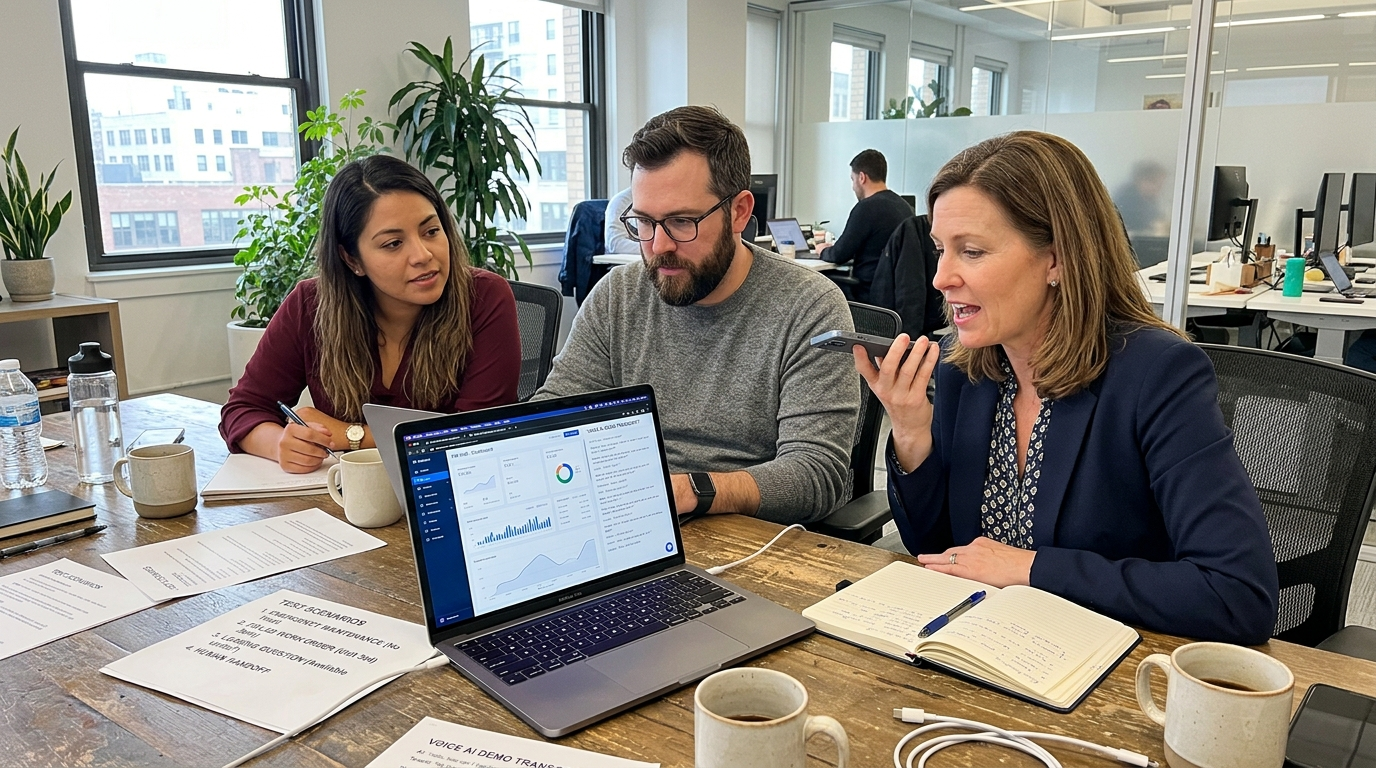
Most vendor demos show the easy calls: a friendly prospect asking about rent, a polite maintenance request for a dripping faucet. Practitioners on Reddit argue that edge cases, not “nice voice” demos, determine vendor quality. The passing standard is not sounding calm. It is verifying the property and unit, avoiding lease negotiation, capturing prior-ticket context, and creating a clean human handoff.
Workflow Questions to Ask
Which call types can your voice AI fully resolve without staff involvement?
Which call types does it only summarize or route?
Can it create work orders inside our PMS?
Can it update existing tickets?
Can it schedule tours directly from calendar data?
Can it dispatch vendors from our preferred vendor list?
Can it send resident follow-ups by SMS or email?
Data and Integration Questions
What systems can it read from? What can it write to?
How does it prevent stale pricing or availability answers?
What happens if the PMS API fails mid-call?
Does the AI tell the caller the action failed, or pretend it succeeded?
Safety and Compliance Questions
How are Fair Housing-sensitive questions handled?
Does the AI disclose that it is AI?
How is call recording consent handled across states?
What audit logs are available?
What are the escalation rules, and can we configure them?
Demo Stress Tests
Do not settle for scripted demos. Bring these test calls:
An angry tenant with a three-week-old unresolved ticket.
An active leak reported at 2 a.m.
A prospect asking “Do families live there?” (Fair Housing test).
A caller who gives the wrong unit number.
A resident who interrupts the AI mid-sentence.
A vendor asking for spend approval above the owner’s threshold.
A PMS write-back that fails. Watch what the AI says next.
A prospect who starts on the phone and wants to switch to text.
A caller who changes the subject three times.
A caller speaking Spanish or another non-English language.
For a detailed evaluation framework, read this voice AI demo guide.
The Voice AI Maturity Ladder
Not all voice AI products are equivalent. This framework helps property managers compare what they are actually buying.
Level 1: Answering AI. Answers FAQs, takes messages, routes calls. May email a transcript. Often useful but limited.
Level 2: Intake AI. Collects structured details. Identifies caller, property, unit, and issue. Categorizes by type and urgency. Creates a summary or ticket draft.
Level 3: Action AI. Creates work orders, updates lead status, schedules tours, dispatches vendors, sends follow-ups, and writes back to PMS/CRM. Escalates with context.
Level 4: Operational AI agent. Maintains memory across conversations. Handles multi-channel continuity across phone, SMS, and email. Applies portfolio-specific policies. Works across leasing, maintenance, and other workflows. Requires stronger QA, permissions, and audit trails.
The right question during evaluation: “Which level does your product actually operate at for our call types, and which levels are on the roadmap?”
What Metrics Should Property Managers Track?
After launching voice AI, track outcomes, not just activity. Here are the metrics that matter most.
Metric | Why It Matters |
|---|---|
Answered-call rate | Are calls getting picked up? |
After-hours answered-call rate | Coverage outside office hours. |
Average response latency | Slow AI feels broken to callers. |
Work-order creation accuracy | Prevents missing or duplicate tickets. |
Emergency false positive rate | Routine issues waking the on-call tech. |
Emergency false negative rate | True emergencies treated as routine. Dangerous. |
Human escalation rate | Indicates whether the AI is appropriately scoped. |
Lead-to-tour conversion | Direct leasing revenue impact. |
Speed to lead | Critical for Zillow and Apartments.com leads. |
PMS write-back success rate | Confirms actions landed in the system of record. |
Staff rework rate | Measures whether AI reduced or just shifted workload. |
Abandonment / hang-up rate | Indicates caller frustration or latency problems. |
Call QA pass rate | Ensures approved processes and language are followed. |
For a deeper look at AI performance tracking, read about AI KPIs and benchmarks for property management.
Where to Start: A Practical Rollout Plan
Rolling out voice AI across every call type at once is the most common mistake. Start narrow, prove value, then expand.
Phase 1: After-hours maintenance intake. The calls are structured, the alternative is voicemail or an answering service, and the stakes are clear. QA by reviewing emergency classifications weekly.
Phase 2: Leasing inquiry capture and tour scheduling. Speed to lead matters. Start with listing-site leads and phone inquiries during overflow or off-hours.
Phase 3: Maintenance status updates and follow-ups. The AI can look up ticket status and handle “what is happening with my work order?” calls.
Phase 4: Vendor coordination. Capturing vendor ETAs, confirming appointment windows, and routing approvals.
Phase 5: Broader resident support. Rent questions, policy inquiries, and other high-volume call types, each with their own guardrails and QA.
The goal in every phase: the AI should leave the PMS cleaner than it found it, not create cleanup work for staff.
Good vs. Bad Implementation
Bad Implementation | Good Implementation |
|---|---|
AI pretends to be a human staff member. | AI is transparent about being AI and is genuinely useful. |
AI takes vague messages that staff must re-interpret. | AI captures structured data: unit, issue, category, urgency, callback number. |
AI says “your work order was created” without PMS confirmation. | AI waits for system-of-record success before confirming to the caller. |
AI answers Fair Housing-sensitive questions freely. | AI uses approved language or escalates to trained staff. |
AI writes to a separate dashboard nobody opens. | AI writes directly into PMS/CRM workflows. |
AI launches across all call types on day one. | AI starts with one high-volume workflow and adds scope after QA. |
Voice AI vs. Answering Service vs. IVR
Voice AI, traditional answering services, and IVR systems solve different parts of the property-management phone workflow.
Capability | Voice AI | Answering service | Traditional IVR |
|---|---|---|---|
Answers calls 24/7 | Yes | Usually | Yes |
Natural-language conversation | Yes | Human conversation | Limited |
Collects structured maintenance data | Yes | Yes | Limited |
Creates PMS work orders | Depends on integration | Usually requires staff/system process | Usually no |
Schedules tours | Possible with integration | Possible with staff | Usually limited |
Emergency triage | Configured rules + escalation | Human judgment | Menu-based routing |
Handles interruptions | Yes | Yes | No natural conversation |
Consistent scripted responses | Yes | Depends on agent | Yes |
Human judgment | No | Yes | No |
Audit trail | Usually available | Depends on provider | Usually call-routing records |
Scaling call volume | Software-based | Staff-dependent | High |
Best fit | Repeatable workflows with integrations | Calls requiring human judgment | Simple routing and menus |
The decision should be based on the type of calls your portfolio receives and how much of the workflow you want automated. Many teams can also use these technologies together rather than choosing only one.
FAQs
Is voice AI the same as a chatbot on the phone?
No. A chatbot usually handles typed messages on a website or app. Voice AI must handle speech recognition, real-time turn-taking, interruptions, background noise, accents, latency, and spoken confirmations. The technical requirements are different, and the quality bar is higher because callers cannot “re-read” what the AI said.
Can voice AI replace an answering service?
It can replace or reduce parts of an answering service when the calls are routine, structured, and governed by clear rules. After-hours maintenance intake is often the strongest starting point. Voice AI should not replace human judgment for disputes, legally sensitive calls, or ambiguous emergencies. For a full comparison, read about answering services vs. AI.
How is voice AI different from IVR?
Traditional IVR (interactive voice response) uses fixed phone menus: “Press 1 for maintenance, press 2 for leasing.” Voice AI uses natural language, so callers speak normally instead of navigating a phone tree. A good voice AI also takes action, while IVR typically just routes calls.
What happens if the AI gets confused?
A well-built system hands off to a human with full context: transcript, caller identity, issue summary, and any actions attempted. A poorly built system either loops the caller, makes something up, or drops the call. This is exactly why stress-testing ugly calls during the demo matters.
Can voice AI handle calls in languages other than English?
Some systems support multiple languages. The important follow-up question is whether the AI uses approved policy language in each supported language, not just generic translations. Multilingual support is especially valuable in diverse resident communities but needs the same guardrails as English-language calls.
How long does implementation take?
It varies by vendor, portfolio size, PMS integration complexity, and how many call types you are automating. Ask vendors for a specific timeline and what is required from your team during setup. Phased rollouts (starting with one call type) reduce risk and shorten time to value.
What if our PMS integration breaks during a call?
The AI should not pretend everything worked. It should inform the caller in approved language, capture the issue safely, escalate or notify staff based on severity, and log the failure for review. This is a non-negotiable vendor test.
What should we automate first?
After-hours maintenance intake. The calls are predictable, the alternative is expensive or unreliable, and you can measure success by comparing work-order accuracy, emergency classification, and staff callback volume against your current setup.
Ready to see voice AI tested on real property management workflows? Explore Haven’s AI maintenance coordinator or book a demo and bring your hardest calls: emergency maintenance, listing-site leads, PMS work-order creation, and human handoff.