Voice AI Performance Metrics: 2026 Property Management Guide
Learn the Voice AI Performance Metrics that matter in 2026: latency percentiles, entity accuracy, task success, FCR, and repeat contact. Get the framework.

TL;DR
Voice AI performance should be evaluated by whether the agent completes the right outcome, not simply whether it sounds natural or avoids a human transfer. For property management, track technical metrics such as latency and speech recognition accuracy alongside operational metrics such as task success, work-order accuracy, emergency detection recall, PMS update success, first contact resolution, repeat contact rate, lead response time, handoff completeness, and cost per resolved interaction.What Voice AI Performance Metrics Should Property Managers Track?
Property managers should measure voice AI across five areas: speed, accuracy, conversation handling, workflow execution, and business outcomes. The most useful property-management metrics include P50/P95 response latency, speech recognition and entity accuracy, task success rate, work-order creation accuracy, emergency detection recall, PMS/CRM update success, first contact resolution, repeat contact rate, lead response time, handoff completeness, and cost per resolved interaction.
The key distinction is between activity metrics and outcome metrics. A voice AI agent can answer calls quickly and achieve a high containment rate while still creating incorrect work orders, missing emergencies, or causing residents to call back. For property managers, performance should therefore be measured from the caller's first utterance through the final operational outcome.
What Are Voice AI Performance Metrics for Property Management?
Voice AI performance metrics are measurements used to determine whether an AI phone agent understands callers, responds quickly, completes assigned tasks, uses connected systems correctly, and escalates conversations when human intervention is required.
For property management, these metrics extend beyond traditional call-center measurements. A property-management voice agent may need to identify a resident, confirm a unit number, classify a maintenance issue, determine whether an emergency is present, create a work order in the property management system (PMS), schedule a leasing tour, or transfer the conversation with enough context for a human employee to continue.
That means a useful evaluation framework should connect conversation quality to operational outcomes:
Caller speaks → AI understands → AI decides → AI uses tools → AI completes the task → PMS/CRM updates → human escalation when necessary → issue resolved.
A voice agent should therefore be evaluated at both the conversation level and the workflow level. A technically fast agent can still perform poorly if it captures the wrong unit number or fails to update the PMS.
Voice AI Technical and Conversation Metrics
Metric | What it measures | Basic calculation | Property management example |
|---|---|---|---|
Call pickup time | How quickly the AI answers | Answer time − call arrival | After-hours maintenance call answered immediately |
Response latency | Time between caller turn and AI response | AI speech start − caller end | AI responds promptly after a resident reports a leak |
P50 latency | Median response latency | 50th percentile | Typical conversational response |
P95 latency | Response latency for 95% of turns | 95th percentile | Reveals slow responses that averages hide |
P99 latency | Response latency for 99% of turns | 99th percentile | Identifies extreme delays |
Word error rate | Speech recognition errors | (S + D + I) / reference words | Correctly hearing a unit number and maintenance issue |
Entity accuracy | Accuracy of critical fields | Correct fields / required fields | Unit, resident, property, issue type |
Intent accuracy | Correct classification of caller purpose | Correct intents / evaluated calls | Maintenance vs. leasing vs. emergency |
Barge-in recovery | Response to caller interruptions | Successful recoveries / interruptions | Resident interrupts to report escalating danger |
Reprompt rate | How often the AI asks for clarification | Reprompts / eligible turns | Resident repeatedly asked to repeat unit number |
Context retention | Whether earlier information is retained | Correct retained details / tested details | AI remembers the bathroom location later in the call |
Voice AI Operational and Business Metrics
Metric | What it measures | Basic calculation | Property management example |
|---|---|---|---|
Task success rate | Whether the intended task was completed | Successful tasks / attempted tasks | Work order created correctly |
Tool-call success | Whether system actions completed | Successful calls / attempted calls | PMS API successfully creates the work order |
Work-order accuracy | Whether the created record is correct | Correct required fields / required fields | Unit, issue, severity, and access details are correct |
Emergency detection recall | Percentage of known emergencies detected | True emergencies detected / all true emergencies | Gas leak or active flooding correctly escalated |
Emergency detection precision | Percentage of alerts that are actually emergencies | True emergencies detected / all emergency flags | Limits unnecessary emergency escalations |
PMS/CRM update success | Whether records were updated correctly | Successful valid updates / attempted updates | Lead or resident record updated |
First contact resolution | Whether the issue is resolved without another contact | First-contact resolutions / eligible issues | Resident does not need to call again |
Repeat contact rate | How often callers return about the same issue | Repeat contacts / eligible interactions | Resident calls again about an unresolved leak |
Lead response time | Time to first response | First response − lead arrival | Leasing inquiry answered quickly |
Lead-to-tour conversion | Leads that become scheduled tours | Scheduled tours / qualified leads | AI moves a prospect from inquiry to showing |
Handoff completeness | Whether escalation includes useful context | Complete handoffs / total handoffs | Human receives unit, issue, urgency, and actions already taken |
Cost per resolved interaction | Cost of producing a successful outcome | Total AI cost / successful resolutions | Compares AI economics with staffing costs |
Voice AI Metrics vs. KPIs: What's the Difference?
A metric is a measurable attribute of voice AI performance, such as latency, word error rate, or reprompt rate. A KPI is a metric selected because it reflects an important business or operational objective.
For example:
P95 latency is a technical metric.
Work-order accuracy is an operational metric and potential KPI.
First contact resolution is an outcome metric and potential KPI.
Cost per resolved interaction is a business KPI.
Containment rate is a metric that should be interpreted alongside resolution and repeat-contact data.
Property managers should not treat every available metric as a KPI. The dashboard should emphasize the measurements that correspond to the AI agent's actual responsibilities.
Speed Metrics: How Fast Does the AI Respond?
Speed in voice AI is not one number. It breaks into several distinct measurements, and confusing them leads to bad vendor evaluations.
Call pickup time is the gap between an inbound call arriving and the AI answering. This directly replaces missed calls, voicemail, and traditional after-hours answering services. For maintenance lines, track how quickly the AI picks up outside office hours compared to your prior setup.
Response latency (or turn latency) is the time between a caller finishing a sentence and the AI starting to speak. This is what callers actually feel. Report it by percentiles, not averages. P50 (median) latency might look acceptable while P95 latency creates multi-second pauses on your hardest calls. Hamming’s voice-agent evaluation guide recommends tracking turn latency by percentiles with production targets such as P50 under 1.5 seconds and P95 under 3.5 seconds.
Why do percentiles matter so much? Research on turn-taking reports that gaps in human conversation average around 200 milliseconds. Nobody expects AI to match that speed, but multi-second pauses feel broken. A tenant reporting a ceiling leak at 2 a.m. should not be met with dead air.
Component latency breaks down where delay comes from: voice activity detection, speech-to-text, language model processing, PMS lookups, text-to-speech, and telephony transport. LinkedIn practitioners describe production voice latency as a budget across all these stages. Each component should have its own P95 allowance, because swapping one model may not fix the true bottleneck if the delay actually comes from endpointing, tool calls, or streaming infrastructure. When evaluating vendors, ask them to show the latency budget by component.
Accuracy Metrics: Did the AI Understand the Caller?
Word error rate (WER) is the standard measure of speech-to-text accuracy, calculated as substitutions plus deletions plus insertions divided by total reference words. It gives a useful baseline, but it treats all words as equally important. In property management, mishearing “kitchen sink” as “bathroom sink” matters far more than dropping a filler word.
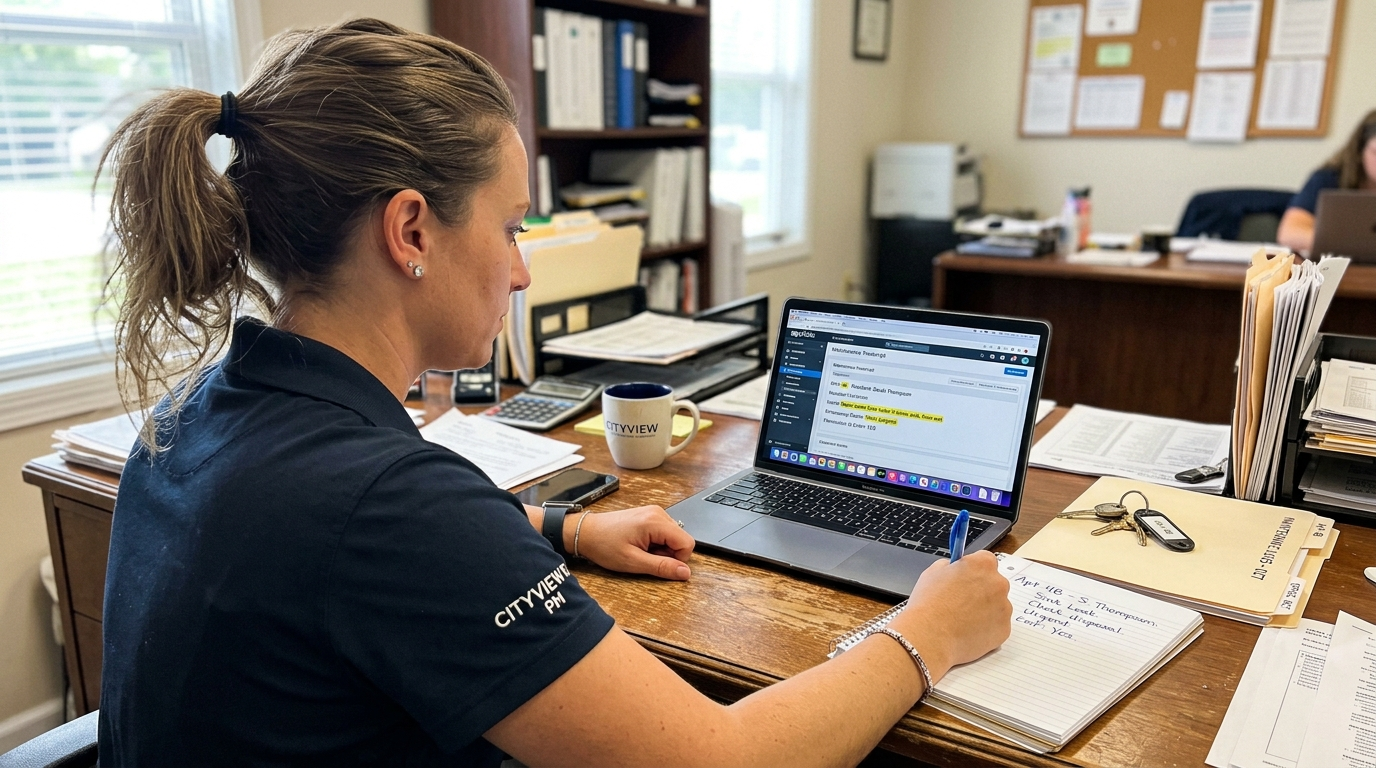
Entity accuracy is often more important than WER. It measures the percentage of critical fields the AI captures correctly: tenant name, phone number, unit number, property, issue type, emergency status, permission to enter, pets present, preferred availability, and more. If the AI hears 49 of 50 words correctly but gets “Unit 213” wrong, the work order may route to the wrong apartment entirely.
Accent and noise robustness matters in production. Tenants call from cars, job sites, hallways, and apartments with HVAC running or children in the background. Measure WER and entity accuracy by noise condition, accent group, and phone quality. Test with real recordings, not clean studio audio.
Conversation Metrics: Does the AI Handle Real Calls?
Barge-in recovery is one of the most underrated voice agent performance metrics. Real callers interrupt constantly. They correct themselves mid-sentence, escalate urgency, or talk over the AI’s instructions. The AI must stop speaking, process the new input, and respond appropriately.
Practitioners on Reddit report that improving barge-in handling improved call completion rates more than script changes, because people interrupt naturally and the agent needs to treat interruption as normal conversation, not an error. LinkedIn engineers describe barge-in as coordinated cancellation across playback, queued audio, backend generation, and turn management. It is not a simple front-end toggle. This is why barge-in failures often surface in production but never in scripted demos.
Here is the property management test case: the AI says, “I can help with that maintenance request. First, can you…” and the tenant cuts in with “Actually, there’s smoke now.” The AI must stop, reclassify the issue as an emergency, and escalate immediately. If it continues its original script, the result is an operational failure. Public benchmark work increasingly evaluates agents on interruption handling, response rate, and naturalness separately.
Reprompt rate tracks how often the AI asks callers to repeat or clarify. Some clarification is healthy. Too much means the AI cannot understand callers efficiently.
Context retention measures whether the AI remembers earlier details within a call. A tenant who says “the leak is in the upstairs bathroom” and later adds “it’s getting worse” should not be asked which room the issue is in.
See how Haven’s AI maintenance coordinator handles triage and dispatching.
Workflow Metrics: Did the AI Take the Right Action?
This is where voice AI KPIs diverge sharply from generic call-center metrics. A call center measures whether the call was handled. Property management measures whether the work got done.
Task success rate is the percentage of interactions where the AI completed the caller’s intended task. For maintenance, that means the request was captured, the issue triaged, the work order created in the PMS, and an emergency escalated if needed. For leasing, it means the lead was qualified, questions answered, a tour scheduled, and the CRM updated.
Tool-call success rate measures whether AI-triggered API calls to PMS or CRM systems actually complete. If the AI tells a tenant it created a work order but the API call failed, the interaction should be marked as failed. Common failures include timeouts, authentication errors, invalid parameters, and rate limits.
Work-order creation accuracy goes deeper. Did the work order contain the correct property, unit, resident, issue category, severity, emergency classification, permission to enter, pet notes, and vendor assignment? A “plumbing” work order that misses “active leak from ceiling” will route incorrectly because severity and response paths differ.
Emergency detection recall is the safety-critical metric. Recall measures what percentage of true emergencies the AI correctly flags. Missing a gas leak or flood is high risk. Precision matters too (too many false flags overload on-call staff), but recall must be the priority. For guidance on configuring these rules, see this overview of AI escalation rules.
PMS/CRM update success confirms that the AI actually wrote the correct record into your system. For leasing calls, success means the prospect record, lead source, qualification details, and appointment all landed in the CRM.
How to Measure Voice AI Emergency Detection
Emergency detection should be evaluated separately from general intent classification because false negatives and false positives have different operational consequences.
Track at least four measurements:
Metric | What it measures |
|---|---|
Emergency recall | How many true emergencies the AI correctly identifies |
Emergency precision | How many emergency alerts actually represent emergencies |
False-negative rate | How many true emergencies were missed |
Escalation completion rate | How often correctly identified emergencies reach the required human or operational endpoint |
Test the system with realistic scenarios rather than only obvious keywords. For example, evaluate variations of descriptions involving flooding, smoke, gas odors, fire, electrical hazards, loss of heat or cooling where relevant, and other property-specific emergency categories.
Also test indirect language. A resident may not say “This is an emergency.” They may describe symptoms of a dangerous situation in ordinary language.
For every emergency scenario, evaluate the full chain:
Caller description → intent classification → emergency determination → required questions → escalation → human notification → record creation.
The objective is not simply to detect a keyword. It is to complete the required safety workflow reliably.
The Voice AI Performance Hierarchy
Voice AI metrics should be interpreted from the lowest technical layer to the final business outcome:
1. Did the AI respond?
Measure call pickup time and latency.
2. Did it hear the caller correctly?
Measure WER, entity accuracy, and intent accuracy.
3. Did it manage the conversation?
Measure barge-in recovery, reprompt rate, and context retention.
4. Did it perform the required action?
Measure task success, tool-call success, and PMS/CRM update success.
5. Did the action produce the desired operational outcome?
Measure FCR, repeat contact rate, lead-to-tour conversion, and cost per resolved interaction.
6. Did it remain safe and compliant?
Measure emergency recall, unauthorized actions, policy violations, and appropriate escalation.
A failure at an earlier level can propagate downstream. For example, an incorrect unit number can cause an incorrect work order even when the API call itself succeeds. This is why dashboards should connect technical events to business outcomes rather than reporting isolated metrics.
Business Metrics: Did AI Improve Property Operations?
Containment Rate (and Why It Misleads)
Containment rate measures calls handled by the AI without human involvement. It is the most commonly reported voice AI metric, and the most commonly misunderstood.
Practitioners on Reddit repeatedly warn that containment can be gamed. Multiple threads describe how a call can be “contained” while leaving the customer completely unresolved. The tenant simply hangs up, gives up, or calls back the next day. Never report containment alone. Pair it with first contact resolution, repeat contact rate, and work-order accuracy.
First Contact Resolution
FCR measures whether the issue was resolved on the first contact so the caller does not need to reach out again. For maintenance, measure FCR against follow-up calls, duplicate work orders, and tenant confirmation, not just whether the AI ended the call politely.
Repeat Contact Rate
This is containment’s truth check. Track how many callers contact the property team again about the same issue. Use tight windows for emergencies (2 to 24 hours) and wider windows for routine maintenance (3 to 7 days). If repeat contact rises after deploying AI, the agent may be deflecting rather than resolving.
Lead Response Time and Conversion
Speed matters enormously in leasing. Zillow’s multifamily Living Lab studied over 120,000 leads and found that 65% to 70% of renters who scheduled a tour did so within three hours of submitting a web lead. Proactive phone follow-up within three hours increased lead-to-tour conversion by 82% among unresponsive renters. A leasing AI that replies instantly but does not move prospects toward a showing may be answering questions without creating outcomes.
See how Haven’s Leasing AI qualifies and schedules.
Tenant Response Time
Buildium’s 2026 Renters’ Report found that 84% of renters expect a response from their property manager within 24 hours, and 24% say maintenance is the most stressful part of the resident experience. A maintenance AI can improve perceived responsiveness by immediately confirming an issue was received and explaining next steps, even before a technician is assigned.
Cost Per Resolved Interaction
Cost per minute is not useful alone. A cheaper agent that fails more often may cost more per successful outcome. The right formula is total voice AI cost divided by successful resolutions. Compare this against call-center cost, staff overtime, and avoided duplicate calls.
Compliance and Safety Metrics
Voice AI agents in property management must follow legal and operational policies on every call.
Fair Housing compliance is non-negotiable for leasing conversations. HUD has confirmed that AI and algorithmic tools in rental housing must comply with fair housing obligations. The AI should never steer prospects, make discriminatory statements, or offer unsupported promises about approval. For deeper coverage, see this AI and Fair Housing guide.
TCPA compliance applies to outbound AI voice calls. The FCC has stated that calls made with AI-generated voices are “artificial” under the Telephone Consumer Protection Act, which affects consent and robocall rules.
Hallucination rate tracks how often the AI states something not grounded in approved data or policy. The AI should not promise vendor arrival times, rent concessions, or lease approvals unless backed by system records.
Unauthorized action rate measures actions the AI was not permitted to take: creating work orders without required fields, canceling dispatches, scheduling outside allowed hours, or giving applicants guidance that should come from a human.
How to Build a Voice AI Performance Dashboard
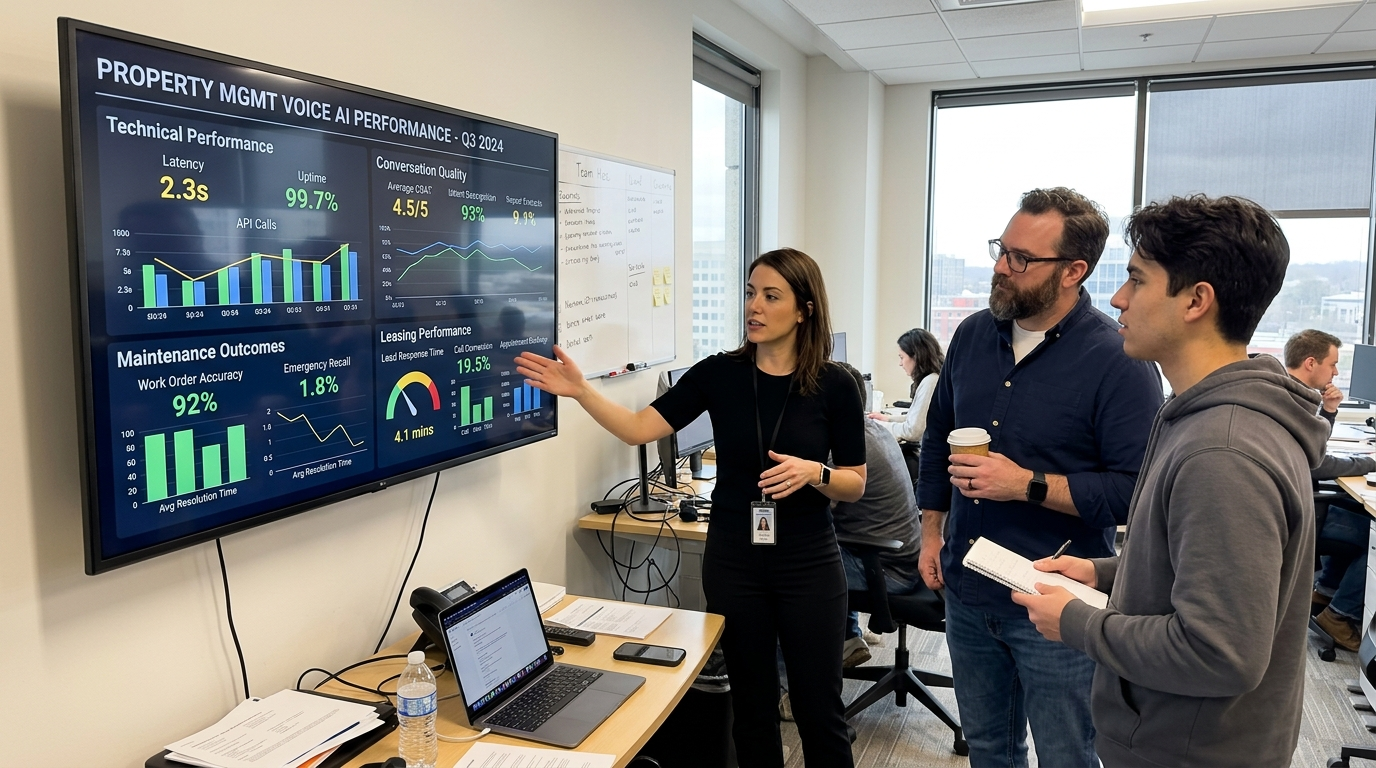
A practical dashboard for property management should have four panels.
Technical panel: Uptime, call pickup time, P50/P95/P99 latency, component latency breakdown, WER, barge-in recovery rate, error rate.
Conversation panel: Reprompt rate, sentiment trajectory, handoff rate, handoff completeness, abandon rate. For guidance on reviewing recordings and building a QA process, see this call recordings and QA guide.
Maintenance panel: Work-order creation accuracy, emergency recall, time to triage, vendor dispatch accuracy, repeat maintenance contacts, time to completion.
Leasing panel: Lead response time, qualification completion, tour scheduling rate, no-show rate, lead-to-tour conversion, tour-to-lease conversion.
Do not rely on portfolio-level averages alone. Practitioners running voice agents across multiple properties stress that average latency is weak unless tied to specific turns, intents, and outcomes. Dashboards should let operators drill into individual call traces.
The Weak Metric / Better Metric Swap
Weak Metric | Why It Misleads | Better Metric |
|---|---|---|
Average latency | Hides the slowest 5% of calls | P50 / P95 / P99 by intent |
Containment rate | Counts unresolved calls as wins | Containment + FCR + repeat contact |
Voice naturalness | Does not prove task completion | Task success + tool-call success |
WER alone | Misses critical field errors | Entity accuracy for key fields |
Transfer rate | Ignores transfer quality | Handoff completeness |
Calls answered | Does not prove operational action | Work-order or tour scheduling success |
Cost per minute | Ignores failure rate | Cost per resolved interaction |
Voice AI Vendor Evaluation Scorecard
When comparing voice AI vendors, request evidence for each category rather than relying on a live demonstration.
Evaluation area | Ask the vendor to provide |
|---|---|
Latency | P50, P95, and P99 production latency |
Speech recognition | WER and critical-entity accuracy |
Intent recognition | Accuracy by major call type |
Barge-in | Interruption tests and recovery results |
Workflow execution | Task success and tool-call success |
PMS/CRM integration | Successful and failed transaction examples |
Maintenance | Work-order accuracy by required field |
Emergency handling | Recall, precision, and false-negative testing |
Handoffs | Example handoff payloads and completeness metrics |
Leasing | Lead response and tour-scheduling performance |
Reliability | Uptime and error rates |
Compliance | Testing and monitoring procedures |
Reporting | Access to call recordings, transcripts, traces, and outcomes |
Continuous improvement | Process for identifying and correcting failure patterns |
A useful vendor comparison should focus on measured performance in representative workflows, not only the quality of the demo conversation.
Vendor Questions to Ask
When evaluating a voice AI vendor for property management, ask:
How do you measure latency, from system logs or from the caller’s audio experience?
Do you report P50, P95, and P99 latency?
Can we see latency by component: STT, LLM, tools, TTS, telephony?
How do you measure barge-in recovery?
How do you detect false containment?
Can you show task success by intent and call type?
How do you validate work-order accuracy in the PMS?
How do you measure emergency false negatives?
What does a human handoff include?
Can we audit recordings, transcripts, tool calls, and system actions?
How do you test accents, noisy calls, and multilingual callers?
How do you monitor Fair Housing and policy compliance?
Bottom Line
Voice AI performance metrics should measure outcomes, not just voice quality. The best scorecards combine speed, accuracy, conversation handling, workflow execution, and business results.
For property managers, the most important metrics are work-order accuracy, emergency detection recall, PMS update success, lead response time, tour scheduling success, first contact resolution, repeat contact rate, handoff completeness, and cost per resolved interaction. A high containment rate means nothing if tenants call back, emergencies get missed, or work orders land with wrong details.
Voice AI performance is not a call-center metric. It is an operations metric: did the agent answer, understand, triage, update the PMS, escalate correctly, and move the tenant or prospect to the right next step?
Explore Haven’s AI property management platform.
Frequently Asked Questions
What is the single most important voice AI metric for property management?
Task success rate. It measures whether the AI actually completed the caller’s intended task, whether that is creating a work order, scheduling a tour, or escalating an emergency. Speed and voice quality matter, but they are secondary to whether the job got done.
Why is containment rate misleading?
Containment counts calls that avoided human escalation, but it does not confirm the issue was resolved. A tenant who hangs up without escalating may still be unresolved. Always pair containment with first contact resolution and repeat contact rate.
What latency should a voice AI agent target?
Production targets vary by use case, but P50 latency under 1.5 seconds and P95 under 3.5 seconds are reasonable starting points. Report latency by percentiles, not averages, because averages hide the worst calls.
How do you measure emergency detection accuracy?
Use recall and precision. Emergency recall measures the percentage of true emergencies correctly identified. Emergency precision measures what share of flagged calls are actual emergencies. Recall is the priority: missing a gas leak or flood carries far more risk than over-flagging a routine call.
What is entity accuracy, and why does it matter more than WER?
Entity accuracy measures whether the AI captured critical fields correctly: unit number, tenant name, issue type, phone number, permission to enter. A transcript can have a low word error rate while still getting the unit number wrong, which breaks the entire downstream workflow.
Should voice quality be a primary voice AI metric?
No. Voice quality (measured as MOS, or mean opinion score) affects caller trust, but it should be a supporting metric. A natural-sounding voice that creates the wrong work order is worse than a slightly less polished voice that completes tasks accurately.
How do you measure handoff quality when the AI escalates?
Track handoff completeness: the percentage of escalations that include caller identity, property, unit, issue summary, actions already taken, urgency, and any promises the AI made. Practitioners on Reddit consistently argue that a clean handoff with context is entirely different from dumping a caller into a queue and forcing them to start over.