AI for Maintenance Requests Apartments: 5 Best Ways (2026)
AI for maintenance requests apartments cuts response time from 4-6 hours to under 30 seconds, with 24/7 intake, triage, and PMS dispatch. See how it works.

Property managers know the drill. A tenant calls at 2 AM about a burst pipe. Another emails about a flickering light. A third leaves a vague voicemail about a strange noise. Nearly a quarter of maintenance calls come in after hours, and traditional response times average 4 to 6 hours — long enough for a small leak to become a much bigger repair bill. But what if every one of those requests was captured, correctly prioritized, and acted on in under 30 seconds, day or night? That's where AI for maintenance requests apartments comes in, transforming the entire process from a reactive scramble into a streamlined, automated workflow.
Quick Summary: How AI Improves Apartment Maintenance
AI for maintenance requests streamlines property management through five core functions:
24/7 Intake: Captures requests via voice, SMS, and email instantly.
Automated Triage: Uses NLP to categorize urgency (e.g., distinguishing a leak from a loose handle).
PMS Integration: Syncs directly with software like AppFolio or Yardi to create work orders.
Instant Dispatch: Matches requests to available vendors in seconds.
Resident Updates: Sends automated status notifications to reduce "follow-up" inquiries by up to 55%.
Here are the top ways artificial intelligence is making life easier for property managers and residents alike.
1. Implement a Dedicated AI Maintenance Agent like Haven
The most effective way to overhaul your maintenance operations is to deploy a specialized AI agent designed for property management. Instead of piecing together different tools, a comprehensive platform like Haven provides a unified solution that acts as your team’s AI maintenance coordinator.
Haven’s AI agents work 24/7 across phone, SMS, and email to handle the entire maintenance lifecycle. When a tenant calls, the voice AI understands their issue, triages it for emergencies, and automatically creates a detailed work order directly in your PMS, such as AppFolio. This eliminates manual data entry and ensures no after-hours calls are ever missed. The system goes a step further by handling vendor dispatch from your preferred lists and even follows up with tenants after work is complete to ensure satisfaction. By implementing a dedicated AI worker, you solve the core challenges of missed calls, slow response times, and administrative overhead in one go, setting the foundation for a fully automated maintenance workflow.
2. Automate 24/7 Request Intake Across All Channels
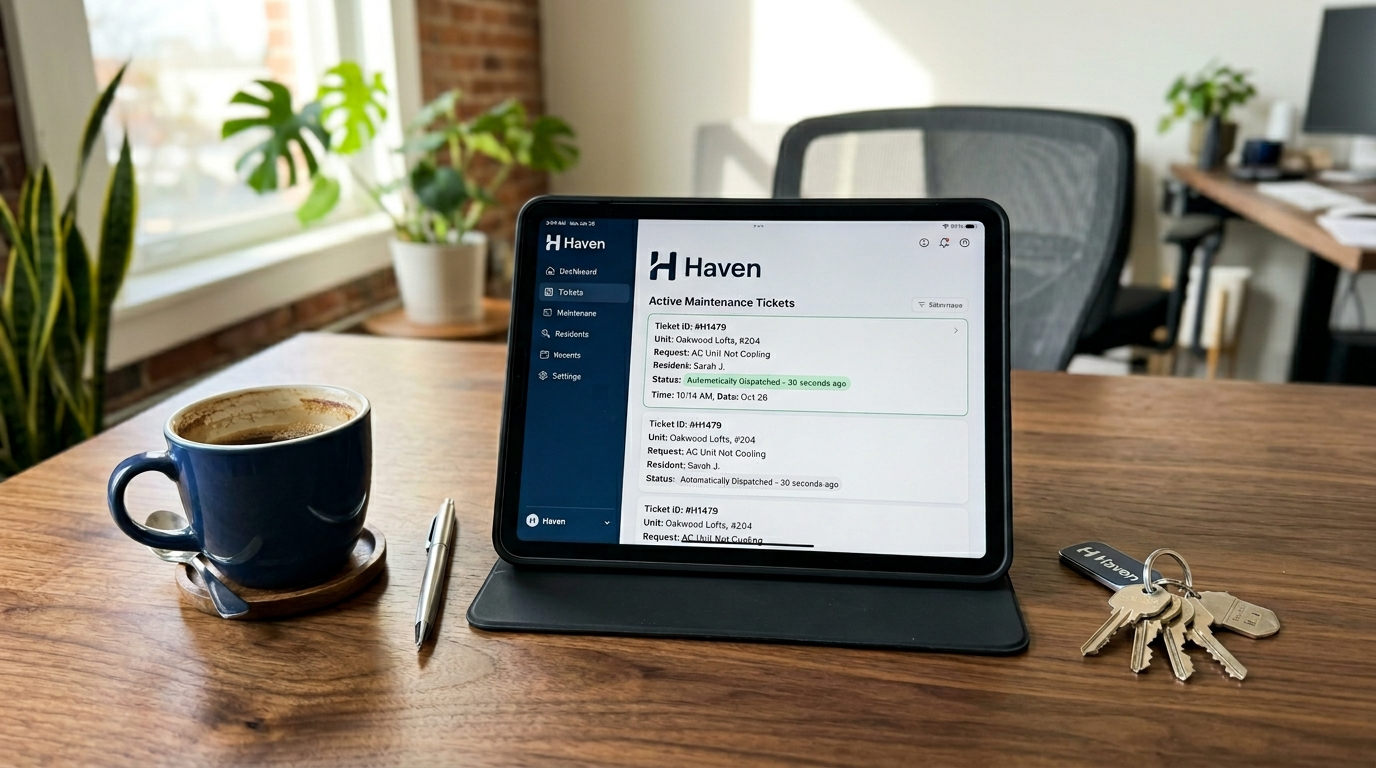
The first challenge in maintenance is simply catching every issue. A missed call or unread email can lead to frustrated tenants and costly damages. In fact, Philadelphia Insurance Companies reported an average loss related to frozen pipes of $27,000, based on 433 burst‑pipe claims. AI ensures nothing falls through the cracks.
Instead of relying on staff to answer phones during business hours, AI-powered systems work 24/7. This is crucial, as Roughly 25% of property maintenance calls come in after hours, between 5 PM and 9 AM. An AI agent can answer a call, transcribe the request, and log the issue immediately, even while you sleep. Modern residents expect convenience. Some will call, others will text, and many prefer to use an online portal or email. Multichannel request capture means your system can accept requests from all these sources and funnel them into one unified dashboard. This is a huge advantage over manual tracking, where an email could sit unread or a text might be missed. An AI can interpret these messages in real time, creating a work order without human intervention.
Feature | Manual Process | AI-Driven Process (2026) |
Availability | Business hours (usually 9-5) | 24/7/365 |
Response Time | 4–6 hours (average) | Under 30 seconds |
Data Entry | Manual typing into PMS | Automatic Sync |
Emergency Triage | Dependent on staff availability | Instant Keyword Detection |
Resident Sentiment | High frustration (black hole) | High (Real-time updates) |
3. Use AI for Instant Triage and Smart Prioritization
Once a request is captured, the next step is figuring out what it means and how urgent it is. This is where using AI for maintenance requests apartments truly shines.
Tenants describe problems in their own words. One might say “my AC is busted,” while another reports “the air conditioner is blowing hot air.” Natural language processing (NLP) allows an AI to understand the meaning behind this human language. It can listen to a voicemail or read an email, identify the core problem (like an HVAC cooling failure), and extract key details like location and urgency. This eliminates the bottleneck of a manager having to decipher vague messages.
Not all issues are created equal. A gas leak is an emergency; a loose cabinet handle is not. AI systems can perform request triage instantly, categorizing issues by urgency. The system can use keywords like “gushing water” or “sparking outlet” to flag a request as a high-priority emergency. This automated classification is vital, allowing AI to identify critical requests for immediate action while queuing routine tasks—see our AI maintenance coordinator guide for deeper walkthrough strategies. This ensures resources are sent where they're needed most, and it helps manage resident expectations by calmly informing them of the timeline for non-urgent issues. This same technology can even be applied to AI triage for resident issues such as noise complaints, routing them to the appropriate community manager or protocol.
4. Achieve Seamless Workflow Automation with PMS Integration
With the request understood and prioritized, the system gets to work. This is where integration and smart automation save countless hours of administrative work.
A core benefit of a modern AI for maintenance requests apartments is its ability to integrate with your existing Property Management Software (PMS). Instead of an employee manually retyping information, the AI assistant creates a work order directly in systems like AppFolio or Yardi. All the details, from the tenant's description to the priority level, are logged automatically. Companies like Haven focus on this deep integration, making their AI a seamless extension of your current workflow.
The work order creation flow in practice: When a tenant reports "pipes frozen in unit 204," the AI captures the call, transcribes it, and extracts: [tenant name] [unit 204] [frozen pipes] [triage level: urgent]. The system then automatically populates a work order in your PMS with these fields pre-filled. No data entry. No transcription delays. The work order lands in the dispatcher's queue seconds after the call ends—complete with tenant contact, unit location, maintenance history (any prior freeze incidents?), and flagged emergency status. This eliminates the manual steps that currently add 1–3 hours to the work order creation cycle.
Based on predefined rules, issue type, and urgency, the system can perform automated vendor dispatch. The AI doesn't just tag the issue—it actively routes it.
How vendor dispatch works: Once a work order is created and prioritized, the AI queries your vendor roster: which plumbers are available? Which has handled frozen pipes before? Which responded fastest on average? The system scores vendors by availability, historical performance (first-time fix rate), and proximity to the unit. For an emergency like a burst pipe, it bypasses the ranking and dispatches your fastest-responding plumber immediately—no human coordinator needed. For routine work, it might batch requests by vendor specialty or location to save dispatch costs. Auto-scheduling then reaches out to the selected vendor, confirms availability, and updates the tenant with an appointment window—all without a phone call from your office.
One platform using AI-based scheduling cut its average repair response time, with response time reduced from 4–6 hours to under 30 seconds.
5. Keep Residents Happy with Automated Communication
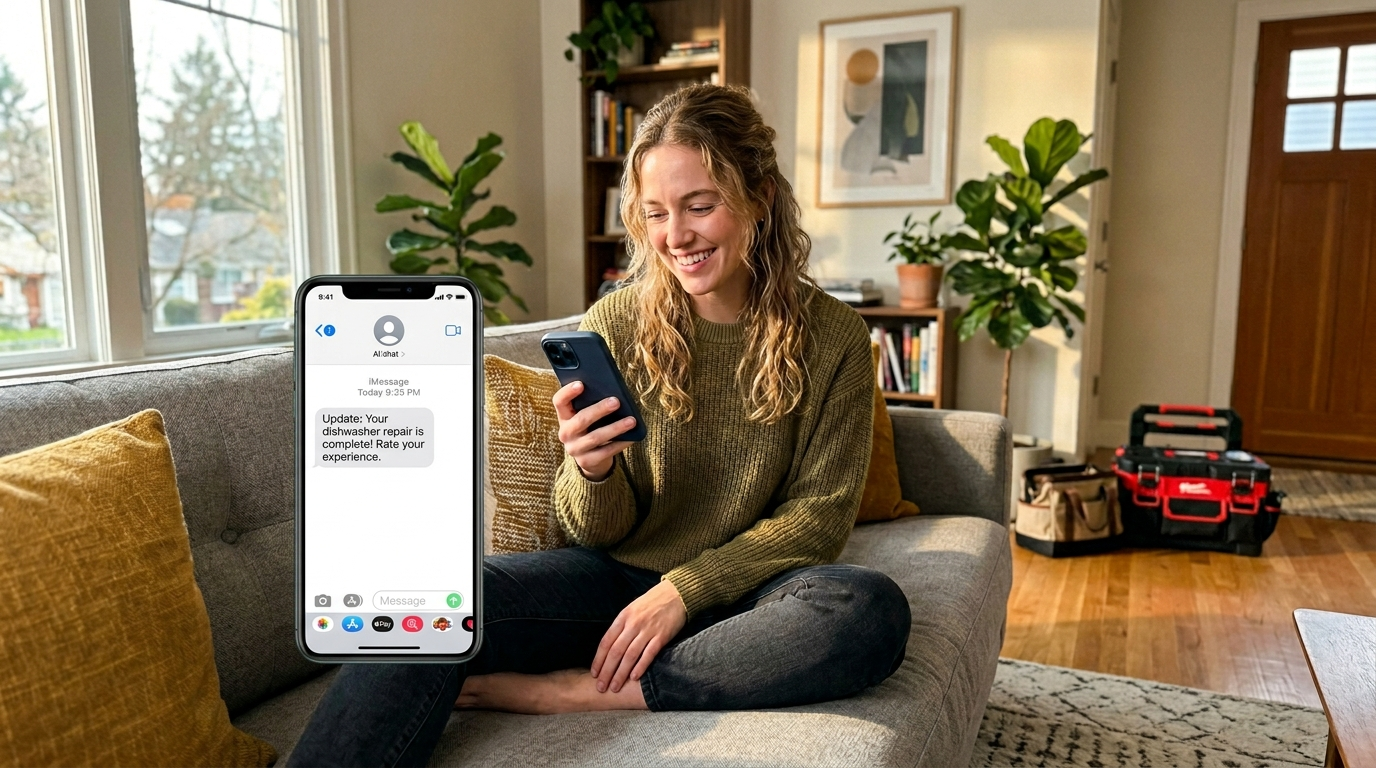
Communication is key to a positive resident experience. A tenant left in the dark is often a frustrated tenant, but automation can keep them in the loop effortlessly.
From the moment a request is submitted, the system can provide resident status update automation. The resident can receive automated texts or emails confirming their request was received, when a technician is assigned, and when the appointment is scheduled. This transparency provides peace of mind and drastically cuts down on follow-up calls to the office. 55% of renters prefer maintenance status updates to be handled digitally (fully automated).
No AI is perfect. For complex, sensitive, or unusual situations, the system needs a safety net. Escalation to human review ensures that when an AI is uncertain or a situation requires a human touch (like a tenant dispute or a high-cost repair), it gets flagged for a manager. This hybrid approach offers the best of both worlds: AI handles the high-volume, straightforward tasks, freeing up your team to focus on the exceptions where their expertise is most valuable.
The ROI of AI Maintenance Technology
Switching to an AI-driven model isn't just about convenience; it’s about protecting the asset's bottom line. By reducing the Total Time to Repair (TTTR), property managers see significant savings in two areas:
Reduced Property Damage: Since AI identifies "burst pipe" keywords instantly, the response time is cut from hours to minutes, potentially saving the average $27,000 loss associated with water damage.
Labor Cost Savings: Automating the intake and scheduling phases can save property managers an average of 10–15 hours per week in administrative tasks.
The Big Picture: Strategic Benefits of AI Maintenance
Implementing AI for maintenance requests in apartments does more than just speed up individual repairs. It provides strategic advantages that improve your entire operation.
Drastically Improving Response and Resolution Times
The ultimate goal is to fix problems faster. By eliminating delays at every step, from intake to dispatch, AI dramatically shortens both response time and the total time to resolution. An immediate AI response reassures tenants that their issue is being addressed, and automated workflows mean the problem gets solved in hours, not days.
Preventing Problems with Predictive Maintenance
The best maintenance is the kind you do before something breaks. Predictive maintenance uses AI to analyze data from IoT sensors and historical work orders to predict equipment failures before they happen. An AI might notice a pattern of minor AC repairs in one building and flag the units for a proactive overhaul, saving you from a wave of emergency calls during a summer heatwave.
Smarter Budgeting with Repair Cost Prediction
AI can analyze historical data to predict the likely cost of different types of repairs. This allows for more accurate repair cost prediction and budgeting. You can set aside appropriate reserves, plan for capital expenditures, and make smarter decisions about repairing versus replacing aging equipment.
Creating a Feedback Loop for Continuous Improvement
A great maintenance operation is always learning. By automatically sending a follow-up survey to tenants after a job is complete, you create a feedback loop. This data, combined with performance metrics like first-time fix rates, allows for continuous improvement. You can identify top-performing vendors, spot recurring issues, and constantly refine your processes.
Gaining Insight with Analytics and Reporting
Finally, maintenance analytics and reporting give you a clear view of your entire operation. Dashboards with key performance indicators (KPIs) show you average response times, costs per unit, and vendor performance at a glance. This data-driven approach helps you spot bottlenecks, control costs, and make informed decisions to optimize your maintenance strategy.
The Future of Apartment Maintenance is Here
The days of sticky notes, overflowing voicemails, and manual data entry are numbered. The strategic use of AI for maintenance requests apartments provides a powerful solution to streamline operations, reduce costs, and dramatically improve resident satisfaction. By automating the entire lifecycle of a request, property managers can stop firefighting and start focusing on what matters most: providing an excellent living experience.
If you're ready to see how an AI agent can revolutionize your maintenance workflow, the time to start is now. Every day without AI dispatch costs you missed calls, slow response times, and resident frustration. Take the next step and book a demo with Haven to see firsthand how AI maintenance coordination, work order automation, and vendor dispatch can work together in your properties. Our specialists will walk you through a live example matching your property type and scale.
Frequently Asked Questions
1. How does AI for maintenance requests apartments handle emergencies?
AI systems are trained to recognize keywords and phrases associated with emergencies, such as “flood,” “gas smell,” or “fire.” When it detects an emergency, it can immediately escalate the request by notifying an on-call technician or property manager and bypassing the routine queue, ensuring the fastest possible response.
2. Can an AI system integrate with my existing property management software?
Yes, leading AI solutions are designed for deep integration with popular PMS platforms like AppFolio, Yardi, and Entrata. This allows the AI to create and update work orders, access resident information, and log all communications directly in your system of record, eliminating manual data entry.
3. Will AI replace my maintenance staff or property managers?
No, the goal of AI in property management is to augment your human team, not replace it. It handles the repetitive, high-volume tasks like answering calls after hours and logging routine requests. This frees up your skilled staff to focus on complex problem-solving, hands-on repairs, and high-value resident interactions.
4. What kind of issues can an AI triage?
AI can triage a wide range of issues. It excels at standard repair requests like plumbing leaks, appliance malfunctions, and HVAC problems. More advanced AIs are also being trained to handle other resident issues, such as routing noise complaints or answering questions about amenities, directing them to the right person or protocol.
5. How difficult is it to set up an AI for our apartment communities?
Companies specializing in AI for maintenance requests apartments, such as Haven, typically offer a sales-led onboarding process. They work with you to configure the AI according to your specific properties, preferred vendors, and emergency protocols, ensuring it aligns perfectly with your operational needs.
6. How does the AI improve the resident experience?
AI improves the resident experience by providing 24/7 responsiveness, faster resolutions, and proactive communication. Tenants feel heard because their requests are acknowledged instantly, and they are kept informed with automated status updates, which leads to higher satisfaction and increased retention.