Top 10 AI Property Management Owner-Operator Tools For 2026
AI tools that help owner-operators save 35+ hours a month, cut lead loss to under 2%, and reduce after-hours costs by $900+. See the 2026 picks.

As an owner-operator in property management, you wear multiple hats. You are the leasing agent, the maintenance coordinator, the bookkeeper, and the CEO. But with tenant expectations rising and operational costs increasing, the traditional model is reaching its limit. This is where AI enters the picture, not as a complex future technology, but as a practical, accessible solution available today.
For the modern AI property management owner-operator, leveraging automation is no longer an advantage; it’s a necessity for survival and growth. It’s the key to handling a 350 unit portfolio like Luke Properties without burning out and to scaling your business without scaling your headcount.
What is AI Property Management Software for Owner-Operators?
AI property management software refers to tools that use artificial intelligence to automate the repetitive, time consuming tasks that bog down your day. Think of them not as simple chatbots, but as digital employees or AI agents. These agents can communicate with tenants, qualify leads, and even take direct action within your existing Property Management System (PMS).
For an AI property management owner-operator, this means having a system that can:
Handle Communications: Answer phone calls, respond to texts, and reply to emails 24/7, in multiple languages if needed.
Manage Maintenance: Take maintenance requests, triage them to identify emergencies, and create work orders in your PMS like AppFolio.
Automate Leasing: Capture leads from sites like Zillow and Apartments.com, answer prospect questions, qualify them, and schedule tours automatically.
Integrate and Act: Connect directly with your core systems to update records, assign tasks, and create notes, eliminating double data entry.
A great example is a voice first AI that can have a complete conversation with a tenant about a leak, understand it’s an emergency, and dispatch a plumber from your preferred vendor list, all while you’re asleep.
Why 2026 is the Year of the AI Owner-Operator
In 2026, the gap between "tech-forward" and "traditional" operators has become a canyon. With labor costs for virtual assistants and call centers at all-time highs, AI has transitioned from a luxury to a baseline requirement for maintaining Net Operating Income (NOI).
Voice AI Maturity: 2026 models now handle emotional nuances in tenant calls, reducing "bot frustration."
Predictive Maintenance: Tools no longer just react; they predict appliance failure before the tenant calls.
Market Volatility: AI revenue tools are now essential for adjusting rents in real-time against fluctuating 2026 market data.
Owner-Operator Benefits and Outcomes
Adopting AI isn’t just about new technology; it’s about tangible business outcomes. Owner-operators who embrace these tools see significant improvements across their portfolios. A Zillow study found that nearly half of renters expect a response to their initial inquiry within 24 hours. AI makes instant responses the standard.
Key benefits include:
Never Miss a Lead or Maintenance Call: With 24/7 availability, every inquiry and every emergency request gets an immediate, professional response. This improves tenant satisfaction and captures leads before competitors can.
Reclaim Your Time: Imagine automating the hours spent on phone tag with vendors or manually following up with prospective tenants. AI handles the repetitive tasks, freeing you to focus on high value activities like investor relations and strategic growth.
Reduce Operational Overhead: Many owner-operators can replace or significantly reduce their reliance on expensive after hours call centers. Customer testimonials often highlight immediate ROI by cutting these fixed costs. For example, Real Capital Group saw such strong results with an AI maintenance agent they expanded to use a leasing agent as well.
Enhance Tenant Experience: Fast, consistent communication builds trust and leads to higher retention rates. AI ensures every tenant gets the same high level of service, every time.
If $900 a month in savings sounds like real money for a 350-unit portfolio, see Haven in action before you scale to the next workflow.
High-Impact Workflows to Automate First
You don’t need to automate everything at once. The most successful AI property management owner-operator starts by targeting the workflows that cause the most friction and consume the most time.
Maintenance Coordination

This is often the biggest operational headache. A specialized maintenance AI can completely transform this process.
Intake: A tenant calls at 2 AM with a broken pipe. The AI answers, gathers details, and asks clarifying questions.
Triage: The AI understands the urgency, classifies it as an emergency, and accesses your PMS.
Action: It creates a detailed work order in AppFolio, assigns it, and dispatches your on call emergency plumber from a pre approved list.
Follow Up: After the work is done, the AI contacts the tenant to confirm the issue is resolved and closes the loop.
Leasing and Lead Management
Your growth depends on a full pipeline. Yet, manually responding to every Zillow, Apartments.com, and email lead is impossible for a small team. A leasing AI is the solution.
Capture: A prospect finds your listing online and asks a question. The AI responds in seconds via text, email, or a phone call.
Qualify: The AI asks pre qualification questions (move in date, pets, income) to ensure they are a good fit.
Nurture: It schedules a tour directly on your calendar and sends automated follow ups and reminders.
By automating these two areas first, you solve your biggest operational bottlenecks and create a foundation for scaling your portfolio.If you're looking to see how this works in real time, you can explore an AI demo to understand the conversational power.
Owner-Operator Use Cases: Which Tool for Which Problem
The fastest way to choose is to start from the scenario that's costing you the most right now.
Scenario 1 — The 2 a.m. burst pipe. A resident calls about water coming through the ceiling while your team is asleep. A maintenance-triage AI (Haven, Property Meld, or Mezo) answers on the first ring, classifies it as a true emergency, opens a work order in your PMS, and dispatches your on-call plumber — no missed call, no flooded unit, no answering-service bill.
Scenario 2 — The Saturday-night leasing surge. Three Zillow leads come in after office hours. A leasing AI (EliseAI, Knock, or AppFolio Realm-X) replies in seconds, pre-qualifies on budget and move-in date, and books two tours straight onto Monday's calendar — capturing demand your competitors let go to voicemail.
Scenario 3 — Scattered single-family doors across a metro. Managing 200 homes spread across a city means no two work orders look alike. Pairing dispatch automation with single-family rental AI keeps intake consistent, while scattered-site AI tools route each ticket to the nearest qualified vendor instead of one overloaded coordinator.
Scenario 4 — The application that smells off. A paystub looks doctored and the timeline doesn't add up. AI screening (RealPage Resident AI) runs identity and income verification, flags tampered documents, and returns a fast decision — protecting NOI from skips and evictions before the lease is signed.
How to Choose AI Tools (Owner-Operator 5-Step Method)
Navigating the market for AI tools can feel overwhelming. Use this simple five step method designed for the practical needs of an AI property management owner-operator.
Identify Your #1 Bottleneck: Is it after hours maintenance calls? Or is it the flood of unqualified leasing inquiries? Pinpoint your single biggest time sink. Your first AI tool should solve that problem directly.
Verify Deep PMS Integration: A tool that can’t read and write data in your PMS (like AppFolio, Yardi, or RentManager) is just a glorified answering machine. Demand true integration that allows the AI to create work orders, update guest cards, and add notes. Companies like Haven, a Y Combinator backed startup, specialize in this deep operational integration.
Choose a Property Management Specialist: Avoid generic, all purpose AI. The property management industry has unique needs, language, and compliance rules. Look for companies recognized as leaders in real estate tech, such as those on the Commercial Observer’s Top 50 AI Startups list.
Request a Live, Actionable Demo: Don’t settle for a pre recorded video. Ask for a live demonstration where you can see the AI handle a real life scenario, like a tenant call that leads to a work order.
Look for Social Proof from Peers: What are other owner-operators like you using? Seek out case studies, testimonials, and podcast interviews. Hearing from a peer like Matt Luke of Luke Properties about how they use their AI agents provides invaluable, real world insight.
Top 10 AI Property Management Owner-Operator Tools

Selecting the right technology is crucial for modern owner-operators looking to scale their portfolios efficiently while maintaining high service standards. The following list highlights the premier AI-driven tools currently transforming property management by automating workflows, optimizing revenue, and enhancing the resident experience. These industry-leading solutions represent the cutting edge of automation, specifically tailored to meet the complex demands of today’s real estate environment.
1. Haven Maintenance AI
Built for owner-operators who live in the chaos of after-hours calls and overflowing inboxes, Haven acts like a 24/7 virtual office for maintenance. Its AI listens, classifies, and coordinates so on-site teams can focus on fixes, not phone trees.
In practice, that shows up as:
24/7 voice and SMS triage: Detects issue type and urgency using portfolio-specific rules, not generic scripts.
Automated troubleshooting: Guides residents through self-fixes to avoid unnecessary truck rolls and fee disputes.
Bi-directional PMS actions: Creates, updates, and closes work orders in AppFolio, Yardi, or RealPage with full context.
Smart vendor dispatch: Pulls from preferred lists, checks availability, and books jobs instantly for approved categories.
Pricing & rollout: Per-unit, per-month SaaS; typical go-live in 2 to 4 weeks. Requires PMS API access and vendor SOPs to configure property workflows.
Best fit: Multifamily owner-operators with 500 to 20,000 units centralizing maintenance intake and replacing traditional call centers.
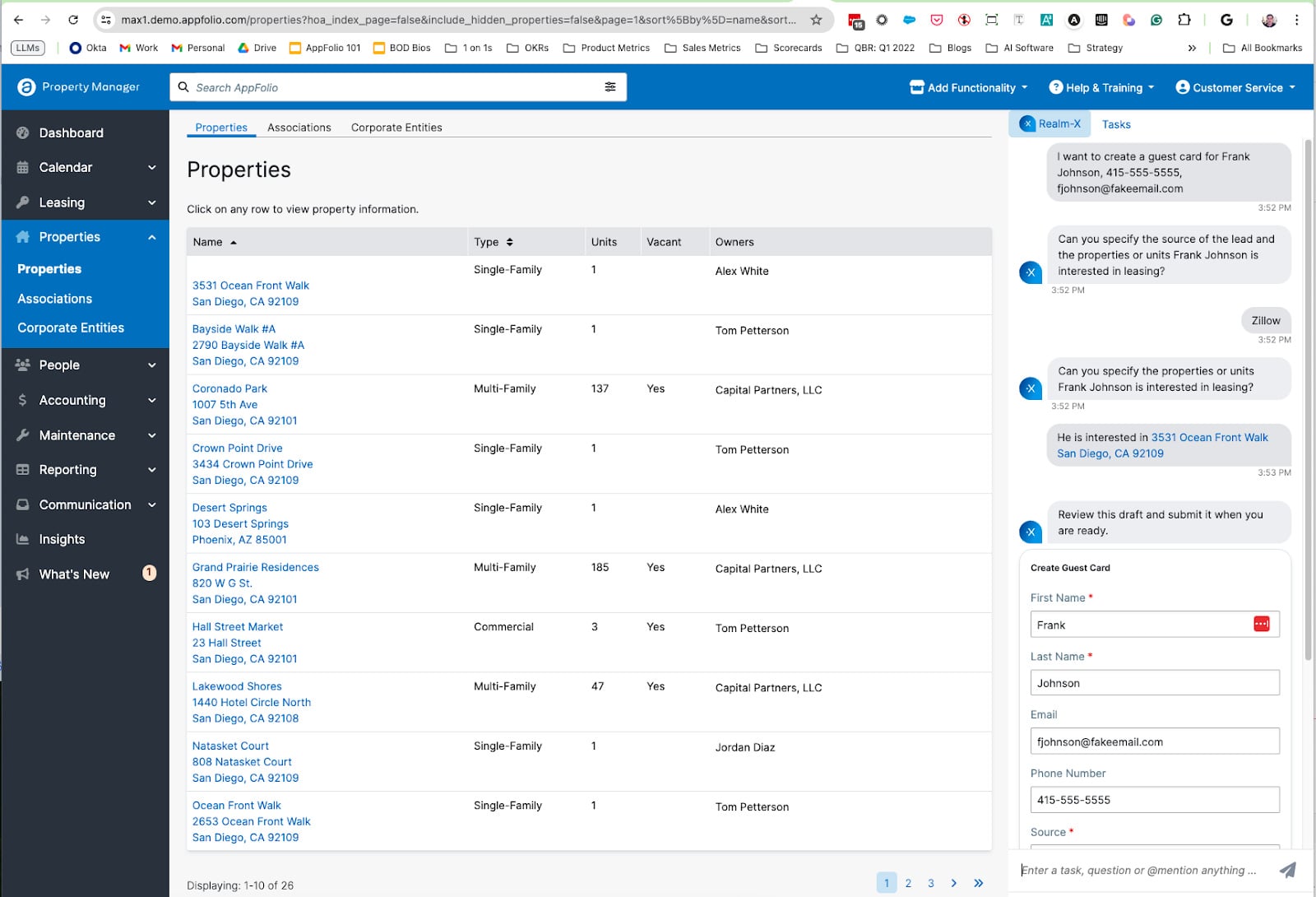
2. AppFolio Realm-X
Realm-X weaves AI directly into AppFolio’s core ledger and workflows, giving owner-operators an agentic co-pilot for leasing, maintenance, and accounting. It’s not a bolt-on; it’s the system thinking alongside your team in real time.
In practice, that shows up as:
Conversational analytics: Ask natural-language questions and get instant reports and visualizations on performance and spend.
Autonomous maintenance triage: Categorizes requests and drafts prioritized work orders with the right details.
Integrated leasing assistant: Fields leads 24/7, qualifies prospects, and schedules tours automatically.
Smart drafting: Generates resident, owner, and vendor communications using live PMS data.
Workflow suggestions: Surfaces next-best actions and preps documentation for quick approvals.
Pricing & rollout: Included in AppFolio Plus/Premium on a per-unit monthly basis. Native setup means fast onboarding without complex third-party integrations.
Best fit: Tech-forward operators running 500 to 20,000+ units who want AI embedded in a unified platform centered on the accounting ledger.
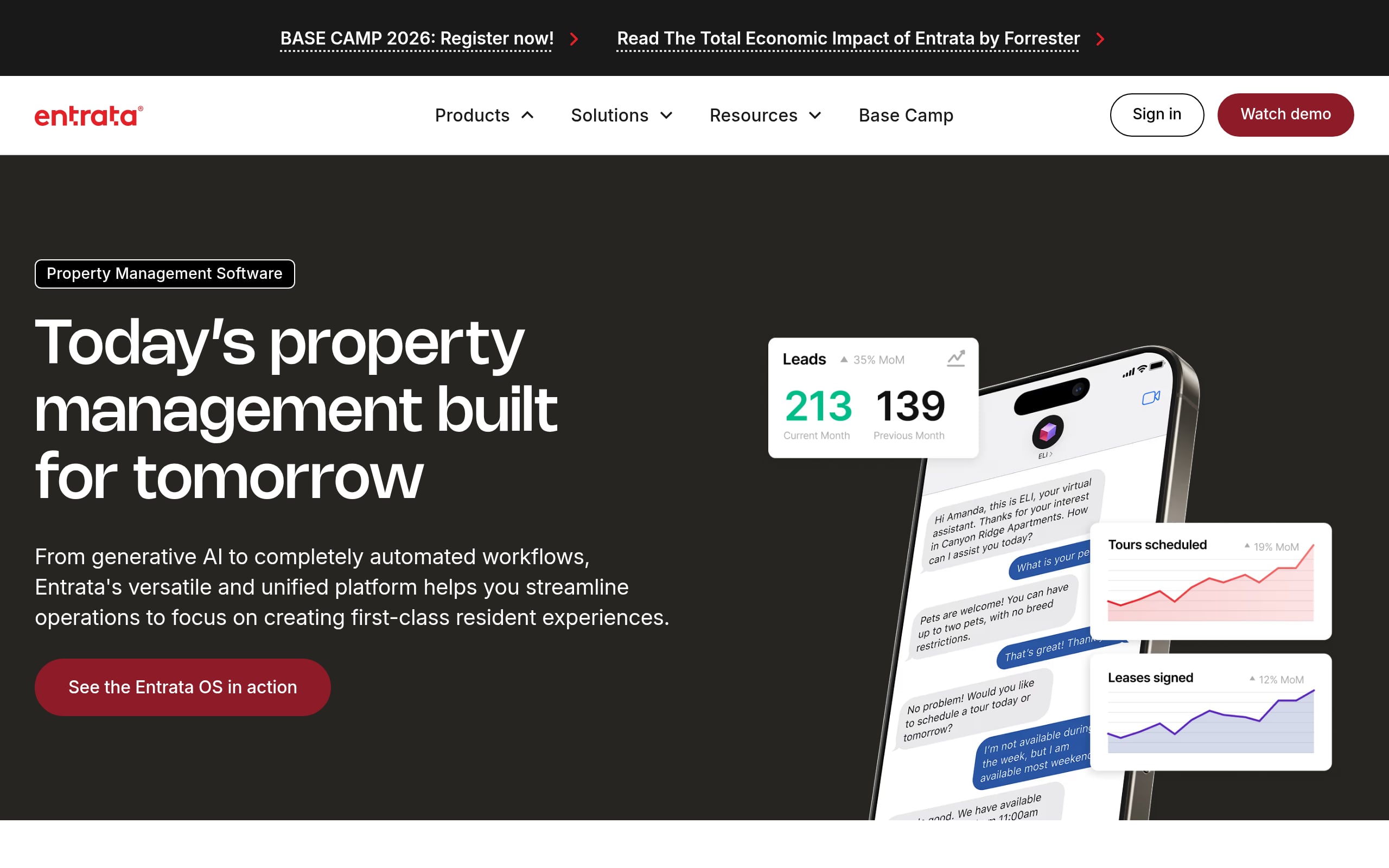
3. Entrata (AI Leasing & Operations)
Entrata’s operating system layers ELI+ intelligence across leasing, renewals, collections, and maintenance, turning repetitive portfolio tasks into autonomous flows. For owner-operators, it’s a single stack that learns and acts at scale.
In practice, that shows up as:
Autonomous rent collections: Negotiates plans and nudges proactively to lower bad debt.
ELI+ leasing assistant: Captures ILS leads, qualifies prospects, and books tours 24/7.
AI-driven renewals: Balances market data and lease terms to automate offers and negotiations.
Smart maintenance triage: Routes work orders and dispatches vendors with minimal human touch.
Sentiment analysis: Flags churn risks by scanning communications and reputation signals.
Pricing & rollout: Per-unit monthly with AI add-ons; typical 90 to 120 days for full-stack implementation, data migration, and training.
Best fit: Institutional operators with 1,000 to 100,000+ units consolidating tech into a single platform for autonomous financial and leasing workflows.
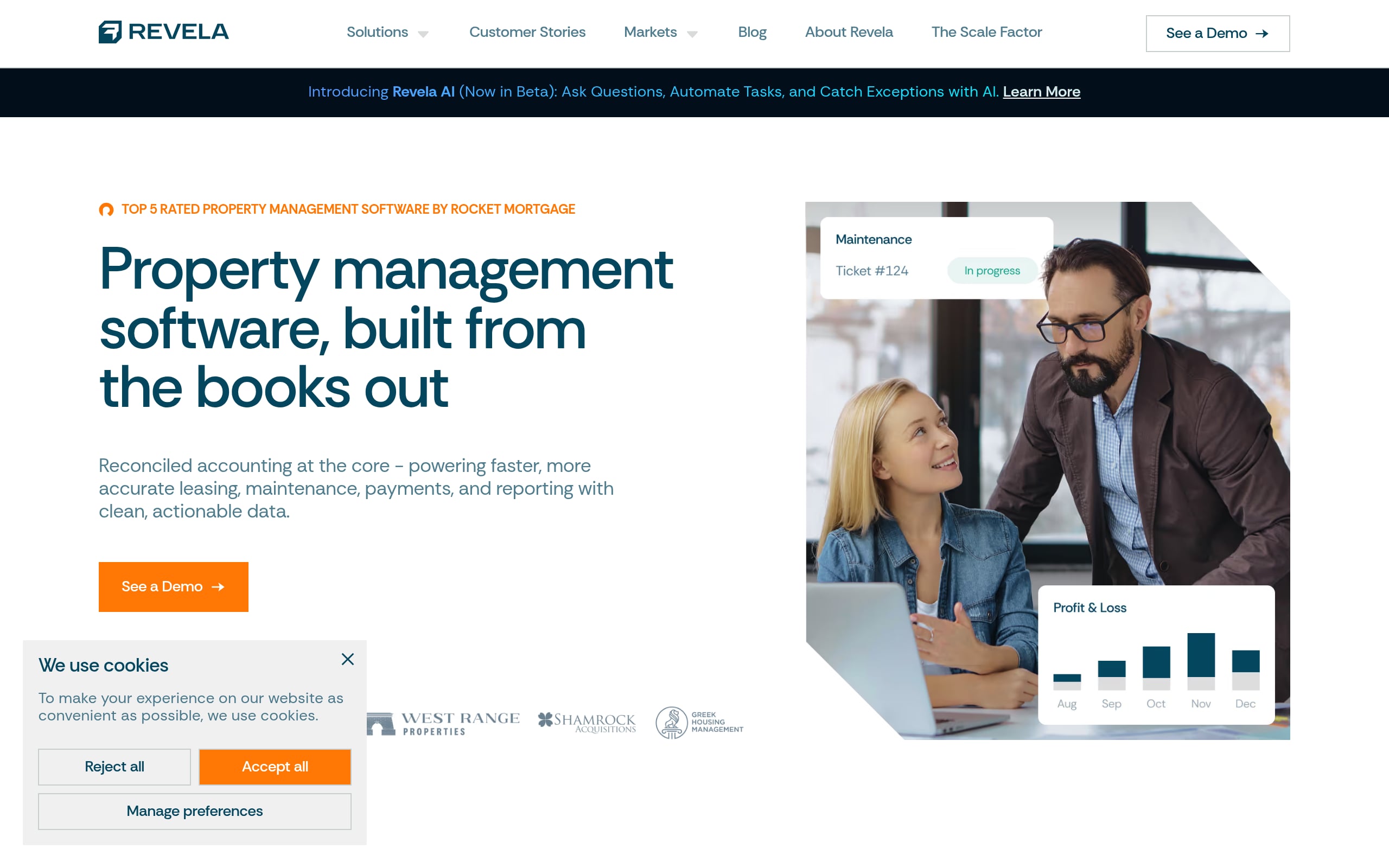
4. Revela AI
Revela brings a modern, AI-native backbone to property management, unifying banking, accounting, and operations so scaling owner-operators can automate close-the-books work and catch exceptions before they snowball.
In practice, that shows up as:
Conversational analytics: Query portfolio health and maintenance costs in plain English and get instant answers.
Automated reconciliation: Matches transactions to the ledger to speed month-end close.
Intelligent maintenance triage: Classifies severity and dispatches preferred vendors automatically.
OCR document extraction: Pulls fields from invoices and leases to populate the PMS.
Pricing & rollout: Per-unit monthly. Requires data migration from legacy systems; onboarding teams calibrate models to your accounting rules and ops.
Best fit: Tech-forward owner-operators with 500 to 20,000+ units consolidating systems and eliminating manual data entry.
5. EliseAI (AI Communication Platform)
EliseAI specializes in high-volume, human-like conversations across the prospect-to-resident journey. For owner-operators, it turns leasing and resident comms into a 24/7 machine that never misses a lead or a follow-up.
In practice, that shows up as:
Always-on lead capture: Responds across email, SMS, and web chat and logs qualified inquiries.
Tour scheduling: Syncs with Yardi, RealPage, or Entrata calendars to book and confirm automatically.
AI voice for phones: Answers calls, handles FAQs, and creates guest cards on the fly.
Maintenance and renewals: Triages requests and opens work orders within your PMS.
Pricing & rollout: Per-unit monthly with enterprise tiers; 30 to 60 days to implement, requiring PMS API access and policy alignment.
Best fit: Large multifamily portfolios (1,000+ units) centralizing leasing operations to eliminate lead leakage and manual back-and-forth.
6. Knock CRM (AI Leasing Intelligence)
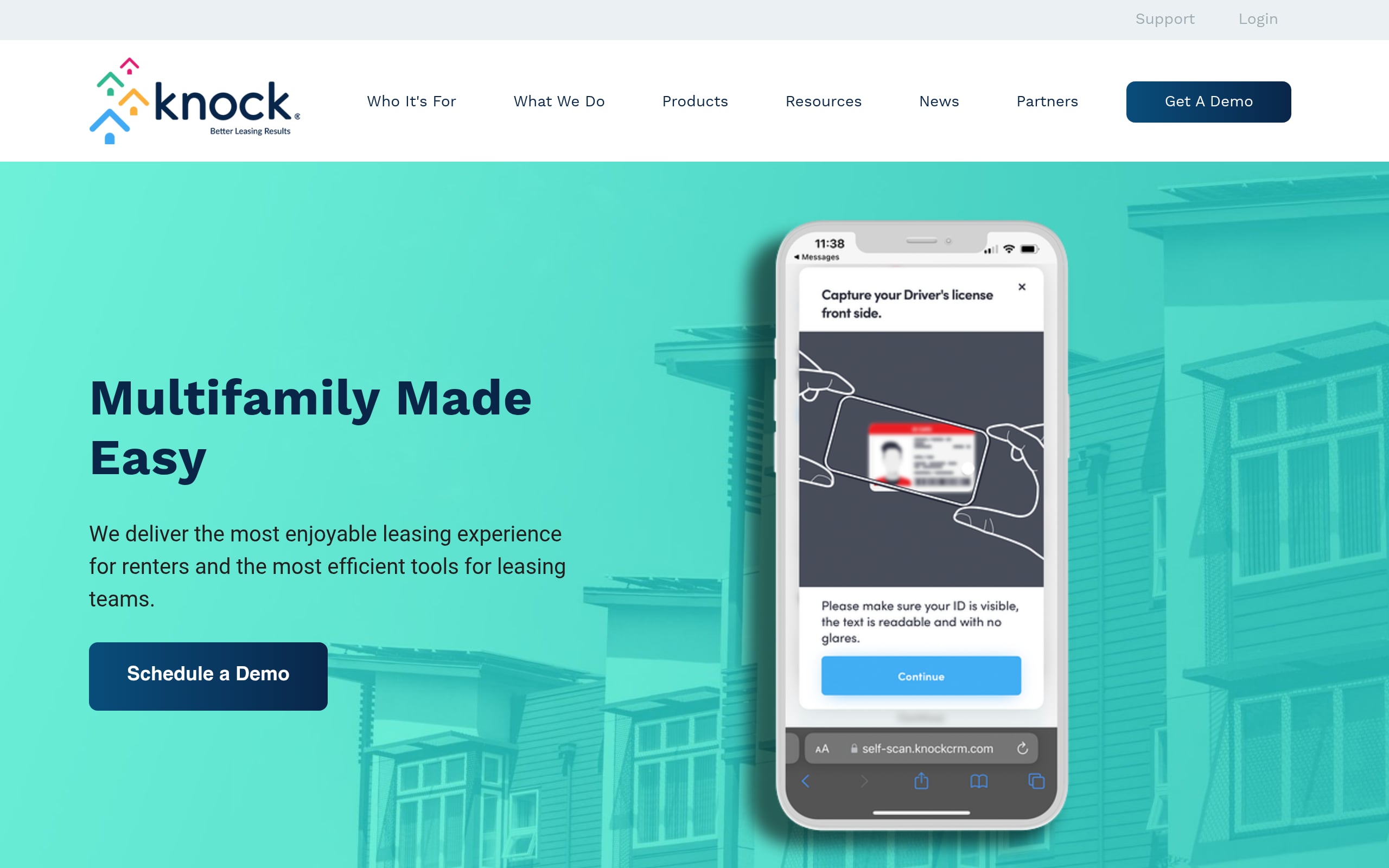
Knock is the CRM nerve center for multifamily leasing teams, now with embedded AI to triage inquiries, book tours, and surface the hottest prospects. Owner-operators get visibility, velocity, and fewer dropped balls.
In practice, that shows up as:
24/7 virtual assistant: Handles SMS and chat with natural-language responses.
Automated tour booking: Reads PMS availability and schedules or reschedules without staff.
AI voice intelligence: Transcribes calls and creates guest cards automatically.
Lead scoring: Prioritizes prospects based on sentiment and conversion likelihood.
Deep PMS integrations: Real-time sync with Yardi and RealPage for inventory and pricing.
Pricing & rollout: Per-unit, per-month tiers. Expect 30 to 60 days for PMS integration, data mapping, and team onboarding.
Best fit: Mid-market to enterprise portfolios (500+ units) needing centralized, data-driven leasing with minimal leakage.
7. RealPage (AI Revenue Management)
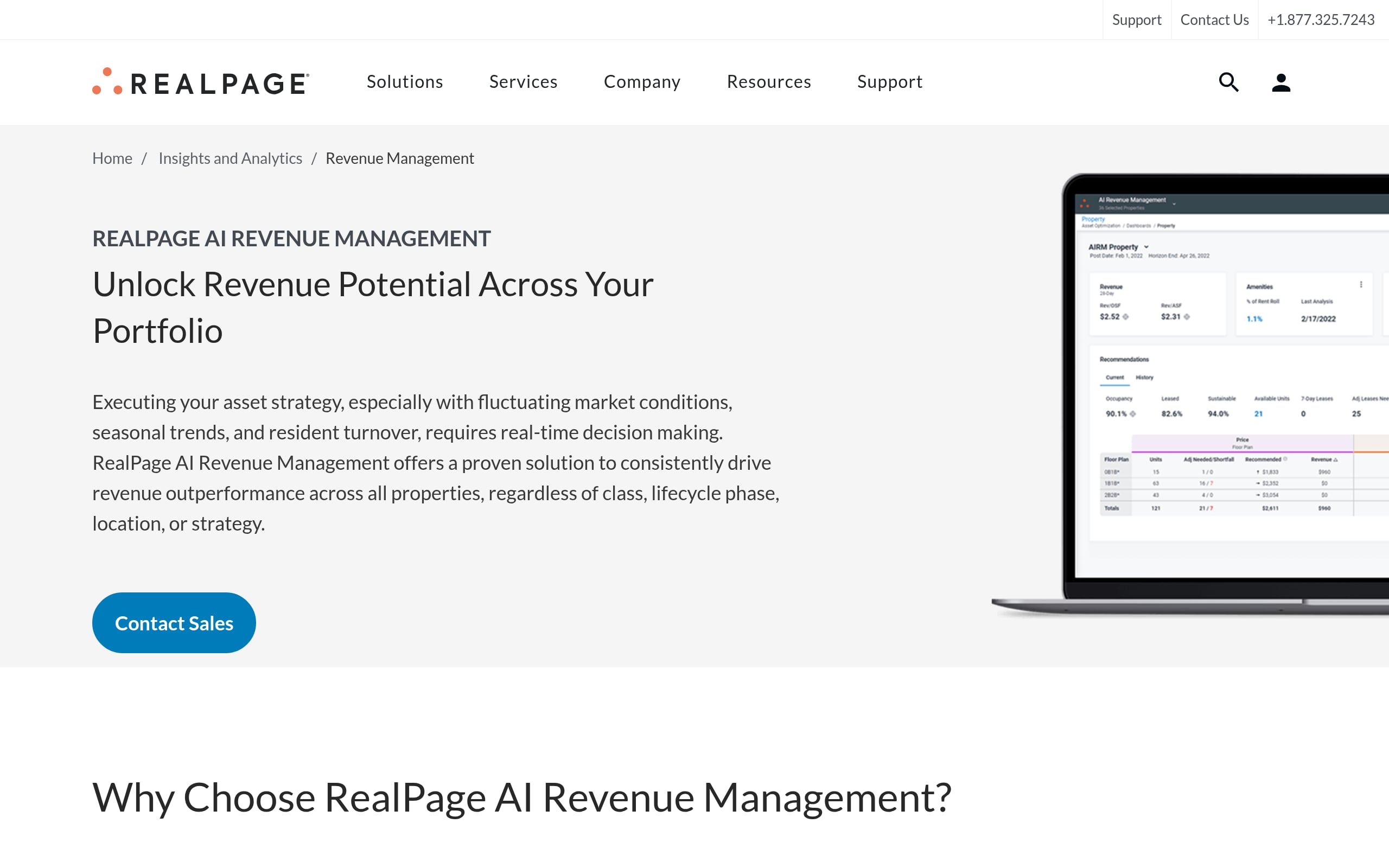
RealPage’s AI-driven revenue engine is the pricing command center for large operators. By forecasting demand and optimizing yield daily, it replaces gut-feel rent setting with disciplined, data-backed decisions.
In practice, that shows up as:
Predictive demand forecasting: Neural models project market shifts months ahead.
Holistic yield optimization: Balances occupancy and rate to maximize NOI.
Automated renewals: Generates personalized offers from real-time market and lease data.
Exposure management: Flags lease-end clusters to preempt vacancy spikes.
Competitive benchmarking: Leverages anonymized data from millions of units.
Pricing & rollout: Per-unit per month with high-touch enablement; 60 to 90 days for data prep and integration with OneSite or external PMS via API.
Best fit: Institutional portfolios of 5,000+ units seeking high-frequency, defensible pricing in volatile markets.
8. RealPage Resident AI Screening
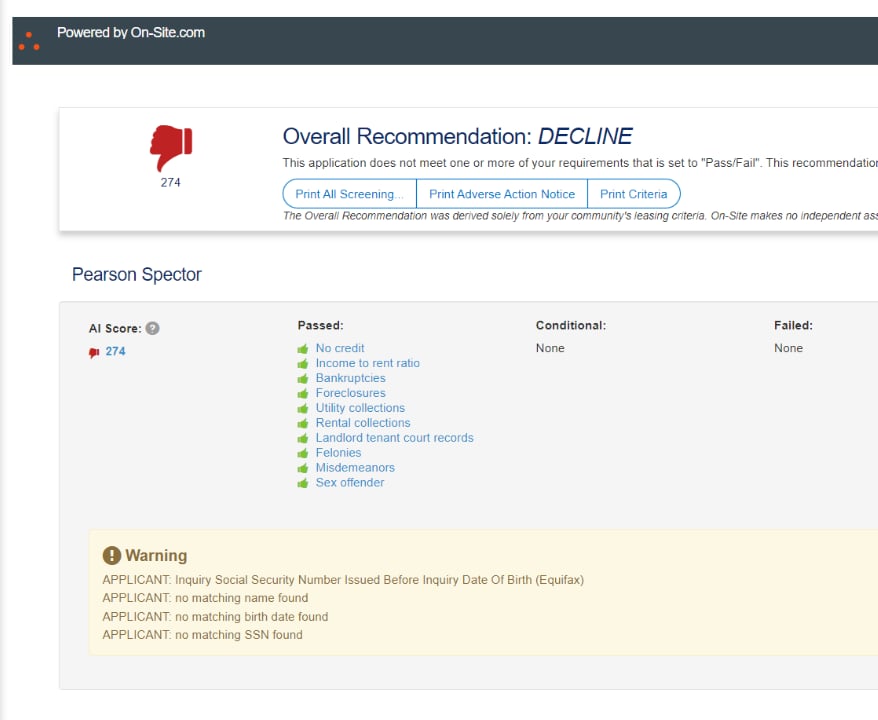
This screening engine goes beyond credit score, modeling real rental behavior to predict pay likelihood. For owner-operators, that means faster approvals, fewer evictions, and cleaner income streams.
In practice, that shows up as:
Predictive risk modeling: Scores applicants using millions of historical outcomes.
Fraud detection: Spots document tampering and identity theft patterns automatically.
Instant decisioning: Delivers real-time approvals and conditions for faster leasing.
PMS integration: Syncs with OneSite, Yardi, or Entrata to streamline lead-to-lease.
Pricing & rollout: Per-unit or per-screening. Connects to major PMS platforms; risk advisory support helps calibrate acceptance policies.
Best fit: Multifamily operators with 1,000+ units needing scalable, data-backed defenses against delinquency and sophisticated application fraud.
9. Property Meld
Property Meld turns maintenance into a measurable, proactive engine. Its MAX Intelligence features help owner-operators cut backlogs, move tickets faster, and deploy the right vendor for the job, every time.
In practice, that shows up as:
MAX Intelligence triage: Prioritizes emergencies and optimizes work order queues.
Resident troubleshooting: Guides simple self-fixes to reduce unnecessary dispatches.
Vendor recommendations: Ranks by historical speed, cost, and satisfaction to improve outcomes.
Automated comms: Keeps residents and vendors aligned without manual chasing.
Pricing & rollout: Per-unit monthly across tiers; 30 to 60 days to implement with integrations to AppFolio, Buildium, and Rent Manager.
Best fit: Mid-to-large operators (200 to 10,000+ units) managing high-volume maintenance who want faster cycles and happier residents.
10. Mezo
Mezo’s AI co-pilot, Max, meets residents at the point of need, diagnosing issues and prepping techs before they roll. For owner-operators, that translates to fewer wasted trips and better protection of asset health.
In practice, that shows up as:
Conversational triage: 24/7 diagnostics classify urgency and route accordingly.
Resident self-service: Reduces manual work orders by steering simple fixes at the source.
Visual intelligence: Reads photos to identify models and parts pre-dispatch.
PMS enrichment: Auto-fills Yardi or Entrata tickets with detailed toolkits.
Emergency escalation: Follows on-call protocols to fast-track critical work.
Pricing & rollout: Per-unit, per-month SaaS; 30 to 45 days to integrate with Yardi/Entrata and configure asset types and team workflows.
Best fit: Multifamily owner-operators with 1,000+ units, especially those with in-house maintenance aiming to cut OpEx and boost technician efficiency.
Implementation Playbook: Rollout, Training, and Change Management
Implementing AI is less about technical complexity and more about thoughtful integration into your existing operations.
Rollout
Start small. A phased rollout minimizes disruption and proves value quickly.
Phase 1: After Hours: Begin by having your AI agent handle only after hours maintenance calls. This provides an immediate win by covering a major gap without changing your team’s daytime workflow.
Phase 2: Full Time Maintenance: Once you’re comfortable, expand the AI to handle all inbound maintenance requests, freeing up your team to focus on vendor management and complex issues.
Phase 3: Leasing Automation: Finally, roll out the leasing AI to manage top of funnel inquiries and tour scheduling.
Training
Training isn’t for the AI, it’s for your team. The focus should be on how to work with their new digital teammate. Show them how the AI will create perfectly detailed work orders and schedule qualified tours directly on their calendar. The goal is to demonstrate that the AI handles the tedious work so they can focus on what humans do best: building relationships and solving complex problems.
Change Management
Communicate the “why” to your team and tenants. Frame the new system as a service upgrade. For tenants, it means 24/7 support and faster responses. For your team, it means less burnout and more manageable workloads. This proactive communication is crucial for smooth adoption. For any AI property management owner-operator, getting buy in is as important as the technology itself.
Measuring ROI, Risk, and Compliance
To justify the investment, you need to measure the return. Fortunately, the ROI for an AI property management owner-operator is often clear and immediate.
Measuring ROI
Track these key metrics:
Time Saved: Calculate the hours your team previously spent on tasks now handled by AI.
Cost Reduction: Compare the AI subscription cost to your previous answering service or call center bills.
Increased Revenue: Measure your lead to lease conversion rate and vacancy loss. Faster responses directly correlate to shorter vacancy periods. Companies like Real Capital Group report significant ROI improvements after implementation.
Tenant Retention: While harder to quantify, improved tenant satisfaction from faster service is a major long term financial benefit.
Risk and Compliance
Data Quality: AI is only as good as the data it can access. Ensure your PMS data, particularly your preferred vendor lists and property information, is clean and up to date.
Compliance: AI can be a compliance asset. Unlike humans, an AI agent will follow a Fair Housing compliant script every single time, reducing the risk of accidental discrimination. Ensure your chosen provider understands and builds for these requirements.
Future Outlook: Where AI in Property Management is Headed for Owner-Operators
The current wave of AI is focused on communication and coordination, but the future is even more integrated. The path forward for the AI property management owner-operator involves a fully connected ecosystem.
Look for the emergence of more specialized agents that handle workflows beyond maintenance and leasing. Companies are already building roadmaps that include:
Vendor AI: Agents that not only dispatch vendors but also handle invoice processing and compliance checks.
Collections AI: AI that automates rent reminders and manages delinquency communication in a firm but compliant manner.
Reporting AI: Systems that can analyze your operational data and provide strategic insights on portfolio performance.
The end goal is an automated operational backbone for your company, allowing you to scale your portfolio with minimal increases in overhead.
The Cost of Manual Operations vs. AI (Monthly Projections)
Based on 2026 industry benchmarks, here is how a 350-unit portfolio typically compares:
Expense Category | Manual/Traditional | AI-Enhanced | Monthly Savings |
After-Hours Call Center | $1,200 - $2,500 | $300 - $600 (SaaS) | $900+ |
Leasing Lead Leakage | 15% - 20% loss | < 2% loss | Variable (High) |
Manual Data Entry | 40 hours/mo | < 5 hours/mo | 35 Hours |
Unnecessary Truck Rolls | $150/visit (Avg 5/mo) | $150/visit (Avg 2/mo) | $450 |
What an Owner-Operator Should Actually Budget
For a 350-unit operator, the math usually favors AI within the first quarter. Most tools price per-unit per-month, so a single after-hours maintenance agent often costs less than the answering service it replaces — the table above shows ~$900/month in call-center savings alone. Two practical rules keep the budget honest: start with one workflow (your single biggest bottleneck) so you can attribute ROI cleanly, and don't pay for an enterprise stack you can't fill — a 350-door portfolio rarely needs an institutional revenue-management engine on day one. Add agents as each one proves payback, not before.
Conclusion: Start Small, Prove Value, Scale Across Your Portfolio
For the ambitious AI property management owner-operator, the time to act is now. The technology is mature, the benefits are proven, and the competitive advantage is significant. You don’t need a massive budget or an IT department to get started.
The key is to begin with your single biggest pain point, whether that’s missed maintenance calls or slow lead response times. Choose a specialized tool with deep PMS integration, prove the ROI on that one workflow, and then strategically expand automation across your operations. By doing so, you can build a more efficient, profitable, and scalable business while reclaiming your most valuable asset: your time.
Ready to see how an AI agent can transform your operations? Book a demo with Haven and discover what's possible.
FAQ
What is the main benefit of AI for a property management owner operator?
The primary benefit is leverage. AI allows a single owner operator or a small team to manage a larger portfolio more efficiently by automating repetitive communication and administrative tasks, such as answering tenant calls, scheduling tours, and creating work orders. This frees up the operator to focus on growth and high value resident interactions.
Can an AI property management owner-operator tool handle emergencies?
Yes. A key feature of advanced AI like Haven is emergency triage. The AI is trained to recognize keywords and context indicating an emergency (e.g., “flood,” “fire,” “no heat in winter”). It can then immediately escalate the issue by dispatching an emergency vendor and notifying you, ensuring critical situations are handled instantly, 24/7.
Do AI tools integrate with my existing PMS like AppFolio?
The best AI tools offer deep, two way integrations with major Property Management Systems. This is a critical feature to look for. An integrated AI can read property data and write new information back into your system, for instance, creating a new work order in AppFolio automatically after a tenant phone call, eliminating manual data entry.
Is AI difficult to implement for a smaller operator?
No. Modern AI solutions are designed for ease of use. Onboarding is typically sales led, where the provider works with you to configure the AI based on your properties, vendors, and specific workflows. The process for an AI property management owner-operator is about configuration, not coding, and can be up and running quickly.
How does AI leasing automation work with sites like Zillow?
AI leasing assistants integrate with listing sites to capture leads the moment they inquire. When a prospect contacts you through Zillow or Apartments.com, the AI can instantly engage them via text or email, answer their questions about the property, ask qualifying questions, and even schedule a showing, all without any manual intervention.
Will AI replace my job as an owner operator?
No, AI is a tool to enhance your capabilities, not replace you. It handles the high volume, repetitive tasks that cause burnout. This allows the AI property management owner-operator to shift their focus from being a reactive problem solver to a strategic business owner, focusing on acquisitions, tenant relationships, and portfolio growth.