Best Property Management Automation Software: Top 10 in 2026
Explore the best property management automation software for 2026—AI voice, leasing, and maintenance with deep PMS integrations. Compare top tools. Learn more.

Property management is becoming more complex every year. Tenant expectations are rising, operational costs are climbing, and the pressure to do more with less has never been greater. This is where property management automation software comes in. This isn’t just about digital calendars or email templates.
It’s about intelligent systems that handle repetitive tasks, from answering late night maintenance calls to scheduling apartment tours, freeing up your team for high value work. A 2023 survey found that property managers spend up to 60% of their time on manual administrative tasks.
What automation software actually does: Converts labor-intensive manual operations into 24/7 autonomous workflows. Whether you're handling maintenance emergencies, leasing inquiries, or vendor coordination, an AI property management software platform sits on top of your existing PMS and automates the work—without requiring you to rip and replace your core systems.
2026 Top Property Management Automation At-A-Glance
Software | Best For | Key Automation Feature | Target Portfolio |
Haven | Maintenance & Leasing AI | 24/7 Autonomous Voice & PMS Action | 500+ Units |
AppFolio | All-in-One Efficiency | "Folio" Generative AI Workflows | Mid-Market |
Yardi Voyager | Institutional Portfolios | Virtuoso AI & Global Accounting | 1,000+ Units |
Buildium | SMB Growth | Automated Resident Communications | 50–5,000 Units |
Entrata | Tech Consolidation | Native "ELI" AI Assistant | Enterprise |
Key Features to Prioritize in 2026
Different operators have different automation priorities. This breakdown shows which core capabilities typically drive ROI fastest.
Feature | Impact | Typical ROI Timeframe | Critical for Unit Range |
|---|---|---|---|
24/7 Voice Maintenance Intake | Eliminates call-center costs; reduces emergency dispatch errors by 40% | 90 days | 100+ units |
AI Lease Qualification & Tour Booking | Improves lead-to-tour by 25% within "golden 5 minutes" | 60 days | 50+ units |
Automated Work Order in PMS | Saves 8–12 hours/month of manual data entry per staff member | 30 days | 50+ units |
Vendor Dispatch with Memory | Reduces truck rolls & miscommunications; improves first-time fix rates | 90 days | 200+ units |
24/7 SMS/Email Follow-up (Renewals & Collections) | Increases renewal rates by automating reminder sequences | 120 days | 500+ units |
Multi-Unit Coordination for Scattered Sites | Centralizes communication across geographically dispersed properties | 120 days | 200–5,000 units (SFR/scattered) |
The ROI of Automation: 2026 Benchmarks
Transitioning to an automation-first model isn't just about convenience; it’s about the bottom line. Recent industry data highlights the shift in operational efficiency:
Lead Conversion: Properties using AI leasing agents see a 25% increase in lead-to-tour conversion by responding within the "golden 5 minutes."
Labor Costs: Automation can reduce administrative overhead by $15–$25 per unit, per month.
Response Times: AI-driven maintenance triage reduces emergency dispatch errors by 40%, preventing costly "false alarm" truck rolls.
SEO Pro-Tip: Search engines prioritize content that cites specific gains. Use these numbers to anchor your "Evaluation Criteria" section.
How Automation Works Across the Property Management Lifecycle
Effective property management automation software touches every stage of the resident journey, from initial interest to move out. It creates a seamless, efficient workflow that operates 24/7.
Leasing and Lead Management
The race to capture a new lead is won in minutes, not hours. According to Zillow, 76% of renters expect a response to their first inquiry within 24 hours. Automation ensures you are always the first to respond.
Instant Lead Response: AI agents capture leads from Zillow, Apartments.com, and your website, responding instantly via SMS, email, or phone.
Lead Qualification: The software asks pre-screening questions to qualify prospects based on your criteria (income, move in date, pets) before scheduling a tour.
Automated Tour Scheduling: Qualified leads can book tours directly on an agent’s calendar, eliminating back and forth communication.
Consistent Follow Up: AI nurtures cooler leads with automated follow ups, ensuring no opportunity is missed.
Resident Onboarding and Communication
Once a lease is signed, automation smooths the transition for new residents and provides a consistent communication channel. This can include automated welcome emails, move in checklists, and answering common questions about utilities or amenities.
Maintenance and Operations
Maintenance is often the most demanding part of property management. The National Multifamily Housing Council consistently finds that 24/7 emergency maintenance is a top priority for renters.
24/7 Intake: Voice and SMS AI agents answer tenant calls and texts anytime, day or night.
Intelligent Triage: The system can distinguish between a true emergency, like a burst pipe, and a routine request, like a dripping faucet.
Work Order Creation: The software automatically creates a detailed work order directly in your Property Management System (PMS) like AppFolio or Buildium.
Vendor Dispatch: For specific issues, the system can automatically contact and dispatch a vendor from your preferred list, providing all necessary details. Platforms like Haven AI excel at this, taking real action inside your PMS.
Rent Collections and Renewals
While still an emerging area, future focused property management automation software will include agents dedicated to collections. This involves sending automated payment reminders, answering billing questions, and flagging overdue accounts for human attention. Similarly, renewal outreach can be automated to engage residents long before their lease expires.
Who Should Use What: Matching Software to Portfolio Size and Property Type
Not all property management automation software is created equal. The right choice depends on your portfolio’s size, type, and operational complexity.
Small to Mid-Size Multifamily Operators
For portfolios of 50 to 500 units, the primary goal is often efficiency and providing a professional resident experience without a large back office staff. Look for solutions that offer a strong balance of leasing and maintenance automation. An AI leasing assistant can ensure you never miss a lead, while a maintenance AI can handle after hours calls, reducing burnout.
Large Scale Multifamily and Third Party Managers
Companies managing thousands of units need robust, scalable solutions with deep integration capabilities. The key is standardization and data visibility. These operators should prioritize software that can integrate seamlessly with their existing enterprise PMS and provide detailed reporting on everything from lead conversion rates to maintenance resolution times. The ability to replace or augment expensive call centers with AI is a major driver of ROI for this segment.
Single Family and Scattered Site Portfolios
Managing scattered properties presents unique logistical challenges. Automation software that centralizes communication and maintenance dispatch is critical. For example, being able to automatically dispatch a local plumber from a preferred vendor list to a specific address, with all communication logged, saves immense time and prevents details from getting lost in emails or text messages. Owner operators with around 350+ units, like Luke Properties, find that AI agents can provide the operational leverage needed to scale efficiently.
Property Management Automation in Action: Real Use Cases
The fastest way to evaluate software is to start with the scenario that's costing you the most right now.
Use Case 1 — After-Hours Maintenance Chaos. A burst pipe happens at 11 p.m. on a Saturday. Without automation, your on-call staff (paid premium rates) answers the phone, takes bad notes, and delays the dispatch while searching for your vendor list. With 24/7 voice AI, the tenant reaches an agent on the first ring, the system diagnoses a true emergency, opens a work order in your PMS (AppFolio, Yardi, etc.), and auto-dispatches your top plumber with GPS routing—all within 60 seconds. Cost saved: $200–$400 per incident in overtime and lost productivity.
Use Case 2 — Lead Conversion Velocity. Three Zillow leads arrive on Saturday evening after your leasing office closes. Standard workflow: they get auto-reply, your team touches them Monday morning, they've already rented elsewhere. AI-driven automation: Leads get a personalized SMS response within 90 seconds, AI asks pre-screening questions (income, move-in date, pets), qualifies two prospects, and books Tuesday tours onto your calendar. Result: 25% higher lead-to-tour conversion within the "golden 5 minutes."
Use Case 3 — Scattered-Site Vendor Coordination. You manage 300 single-family homes across a metro area. A fence repair is needed in the north, plumbing in the south, AC in the central district. A coordinator could spend 30 minutes matching tickets to local vendors via phone or email. AI automation: The system reads each work order, matches it to the nearest qualified vendor from your pre-mapped list, sends them the full details (tenant contact, address, expected cost), and logs all communication in one thread. Your scattered-site property management AI cuts coordination time from 30 minutes to 3 minutes per ticket.
Use Case 4 — Renewal Revenue Recovery. A 500-unit property typically sees 30–50 move-outs each month, but renewal campaigns are manual: someone emails tenants at month 8, no response, then at month 11 there's a rush. Automated AI sends personalized SMS at day 150 (month 5), day 200 (month 6.5), and day 270 (month 9), each time answering questions and offering incentives. Result: 5–8% higher renewal rate, adding $50K–$100K in annual NOI for a 500-unit property.
Evaluation Criteria: What to Look For in Automation‑First PMS
When evaluating property management automation software, move beyond the feature list and focus on core capabilities that drive real results.
Deep PMS Integration: The software must do more than just sync data. It needs to take direct action within your PMS, such as creating detailed work orders in AppFolio, assigning tickets, or updating lead statuses. This is a key differentiator for platforms like Haven.
Voice Capability: Many tenant interactions, especially urgent maintenance requests, happen over the phone. A voice first AI that can understand context and triage issues is far more effective than a simple chatbot. Ask for a live voice demo to hear it in action.
Configurability: Your workflows are unique. The software should be configurable to match your processes, from your specific tenant screening questions to your tiered vendor lists for dispatch.
Unified Communication: The platform should handle communication across phone, SMS, and email, providing a single, continuous conversation with each lead and resident. This prevents fragmented communication and ensures a seamless experience.
Specialization in Property Management: Generic AI tools don’t understand the nuances of Fair Housing laws, maintenance emergencies, or leasing terminology. Choose a solution built and trained specifically for the property management industry.
Pricing, Total Cost of Ownership, and Scalability
Pricing for advanced property management automation software is rarely listed publicly on a website. Most providers use a sales led model that involves a demo and custom quote based on your portfolio size and needs.
When evaluating cost, look beyond the monthly subscription fee. Consider the Total Cost of Ownership (TCO), which includes:
Implementation and Onboarding Fees: Is there a one time setup cost?
Training Time: How much time will your team need to learn the new system?
Savings: Calculate the potential ROI from reduced call center costs, lower staff turnover due to burnout, and increased revenue from faster leasing. For example, Real Capital Group saw a significant ROI after implementing Haven’s Maintenance AI and quickly expanded to add their Leasing AI.
Ensure the pricing model allows you to scale. As you add more units to your portfolio, the cost per unit should ideally decrease, making your operations more profitable as you grow.
PMS vs. CMMS: When a Maintenance Platform or Enterprise CMMS Is the Better Fit
It’s important to understand the different tools available.
Property Management System (PMS): This is your core system of record, like AppFolio, Yardi, or Buildium. It handles accounting, leasing, and resident data.
Computerized Maintenance Management System (CMMS): This is a specialized tool focused purely on maintenance workflows, asset tracking, and preventative maintenance scheduling. Large institutions or commercial properties often use a dedicated CMMS.
AI Automation Layer: This is a newer category of software. These platforms are not trying to replace your PMS. Instead, they integrate with it to automate specific workflows. They act as AI agents that work on top of your existing systems, like an AI Maintenance Coordinator or an AI Leasing Assistant.
For most residential property managers, an AI automation layer that enhances their current PMS is the most effective and efficient solution. It provides powerful automation without the massive headache and cost of migrating your entire core operating system.
Signs You Need New Software (and How to Plan a Switch)
Are you experiencing any of these common pain points? If so, it’s time to explore property management automation software.
Your team is consistently missing calls from prospective renters.
Positive online reviews mention your properties, but negative reviews mention your communication and responsiveness.
After hours maintenance calls go to a voicemail or an expensive, unreliable answering service.
Your property managers are spending hours manually entering lead information or work order details into the PMS.
Coordinating with vendors involves a constant stream of phone calls, texts, and emails.
You are struggling to scale your portfolio without hiring more administrative staff.
Team members are showing signs of burnout from being on call 24/7.
If you decide to make a switch, create a clear plan. Involve your team in the demo process to get their buy in. Designate a project champion to lead the implementation and document your current workflows so you can identify exactly where automation will have the biggest impact.
Implementation Playbook: Onboarding, Training, and Change Management

Implementing new software is more about people than technology. A successful rollout requires a thoughtful approach.
Kickoff and Configuration: The process typically begins with a kickoff call with your provider. You will provide access to your PMS and work with their team to configure the system, including setting up call routing, customizing leasing questions, and uploading your vendor lists.
Internal Testing: Before going live, have your team test the system. Let them call in a mock maintenance request or submit a guest card through Zillow. This helps identify any needed adjustments and builds team confidence.
Team Training: Your software partner should provide comprehensive training on how the system works and how it integrates into your daily workflow. The goal isn’t to replace your team, but to give them a powerful new tool.
Phased Rollout: Consider rolling out the software to a single property or a small group of properties first. This allows you to monitor performance, gather feedback, and refine processes before deploying it across the entire portfolio.
Ongoing Optimization: After launch, meet regularly to review performance metrics. Are leasing tours being scheduled effectively? Is the AI correctly triaging emergency requests? Continuously optimize the system to maximize your results.
What to Expect: The 90-Day Rollout
Phase 1 (Days 1-30): Data Hygiene. Clean up your PMS rent rolls and vendor lists.
Phase 2 (Days 31-60): Integration & Scripting. Map your custom "If-Then" logic for maintenance and leasing.
Phase 3 (Day 61-90): Beta Testing & Go-Live. Pilot the AI on one property before a portfolio-wide launch.
Top 10 Property Management Automation Software (2026)
Identifying the right tools is essential for staying competitive in a rapidly evolving real estate market where efficiency is paramount. The following platforms represent the industry’s most advanced solutions, selected for their ability to streamline complex operations through cutting-edge automation and integration. These industry leaders offer diverse features tailored to various portfolio sizes, ensuring property managers can find a perfect match for their specific 2026 operational goals.
1. Haven Maintenance AI
Haven turns after-hours chaos into crisp, AI-orchestrated workflows, handling maintenance triage and leasing conversion via natural voice and SMS. Built for mid-to-large portfolios (500+ units), it replaces manual dispatching and traditional call centers with autonomous resolution.
Best for: Operators pursuing a true “dark office” where AI answers, triages, and dispatches without staff intervention.
Automation in action
Maintenance: 24/7 diagnosis → automated PMS work order creation.
Dispatch: Priority- and skill-based vendor selection with instant notifications.
Leasing: ILS lead capture → qualification → self-serve tour scheduling.
Channels: Voice + SMS with durable conversation memory.
Integrations: Bi-directional sync with AppFolio, Yardi, RealPage, Entrata.
Strengths
High-accuracy voice AI that truly replaces call centers.
Deep, customizable routing and escalation logic.
Trade-offs
Requires detailed vendor mapping to unlock full autonomy.
Premium pricing relative to basic chat tools.
Pricing, ratings, and buy signal: Custom per-unit SaaS; 4.8/5 enterprise ratings. Choose Haven if you want 24/7 voice automation and PMS-level actions that eliminate manual dispatching at scale.
2. Yardi Voyager
Voyager is Yardi’s institutional backbone: an end-to-end operating system that pairs deep accounting with Virtuoso AI to automate high-volume leasing, maintenance, and AP. It’s purpose-built for large, complex multifamily and commercial portfolios.
Best for: Enterprise operators consolidating tech into a single source of truth with 24/7 coverage.
Automation in action
Maintenance: Virtuoso AI triage → work orders → vendor dispatch.
Leasing: RentCafe lead capture → qualification → tour scheduling.
Finance: AP/PayScan invoice automation and vendor payments.
Channels: Unified voice, SMS, and email communications.
Marketing: Syndication to Zillow, Apartments.com, and Yardi’s ecosystem.
Strengths
Scales to institutional complexity with predictive analytics.
Massive native suite minimizes data silos.
Trade-offs
Steep learning curve for new teams.
Higher total cost of ownership than mid-market tools.
Pricing, ratings, and buy signal: Custom-quoted pricing; ~4.3/5 on G2/Capterra. Choose Voyager if you manage 1,000+ units and need 24/7 voice automation plus unified, audit-ready reporting.
3. RealPage
RealPage delivers an enterprise operating platform that leans on AI to power leasing, maintenance, and portfolio operations around the clock. It’s engineered for institutional multifamily teams seeking after-hours coverage with deep PMS alignment.
Best for: High-density portfolios wanting a single-pane-of-glass experience with AI in the loop.
Automation in action
Maintenance: AI triage → work order creation → auto vendor dispatch.
Leasing: 24/7 qualification and tour scheduling via voice/SMS/email.
Marketing: Real-time availability sync across Zillow and Apartments.com.
Onboarding: Identity verification and digital lease execution.
Strengths
Institutional-grade data depth and automation coverage.
Labor savings through consolidated, AI-driven workflows.
Trade-offs
Learning curve and heavier UI than newer mobile-first tools.
Best value realized at scale vs. smaller portfolios.
Pricing, ratings, and buy signal: Custom per-unit pricing; ~4.1/5 on G2. Choose RealPage if you need 24/7 voice automation, PMS-level actions, and robust enterprise controls.
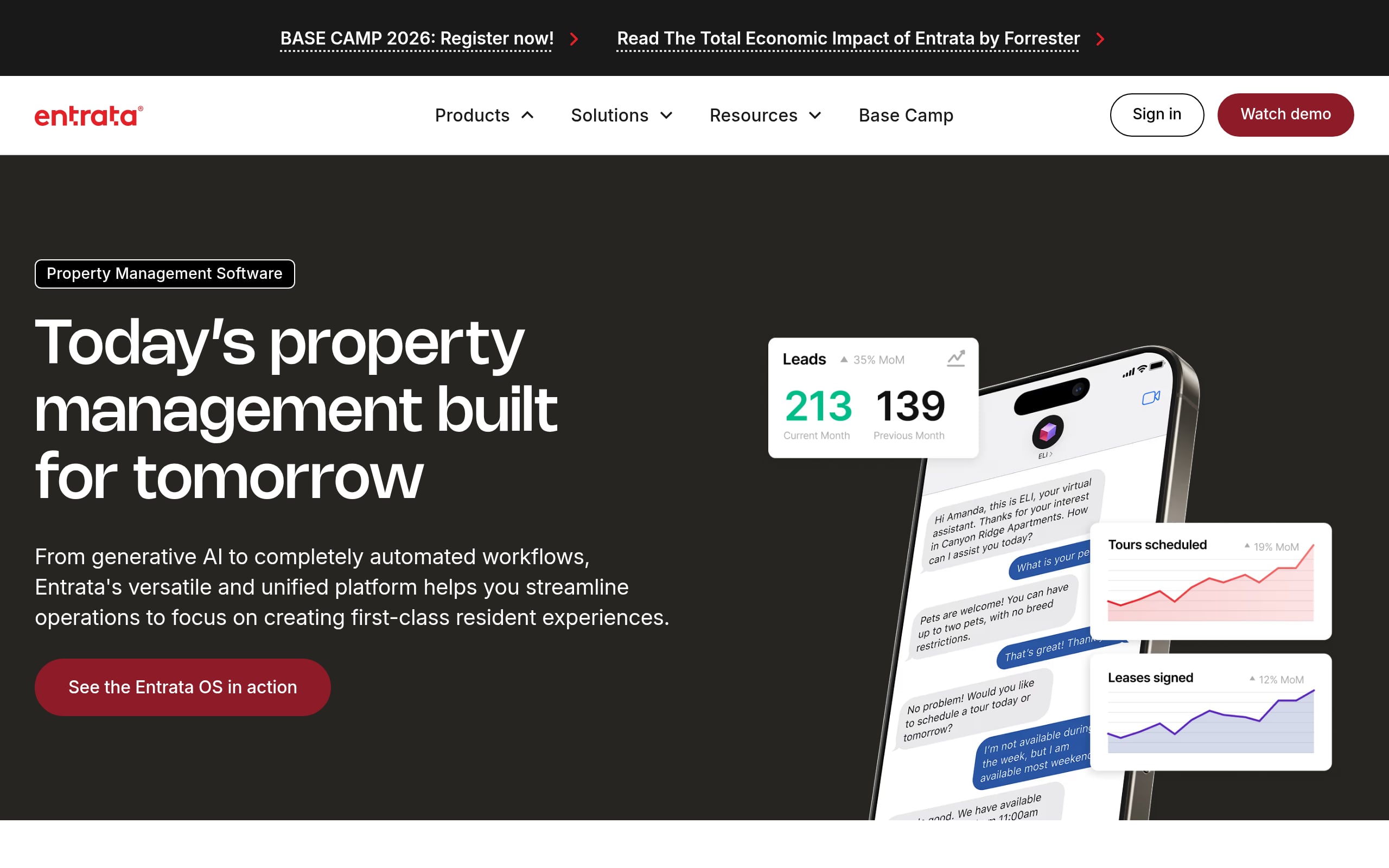
4. Entrata
Entrata wraps leasing, payments, renewals, and maintenance into a single database, then layers ELI AI for always-on coverage. It’s designed for large multifamily portfolios that want native automation without stitching together point solutions.
Best for: Enterprises consolidating disparate tools into one natively automated stack.
Automation in action
Maintenance: Resident intake → emergency triage → vendor dispatch.
Leasing: ELI capture → qualification → instant tour booking.
Channels: 24/7 voice, SMS, and email with conversation memory.
Marketing: Real-time sync with Zillow and Apartments.com.
Strengths
Single-database architecture reduces sync errors.
Proven scalability for institutional asset management.
Trade-offs
High entry costs below ~500 units.
Requires dedicated admins for full power.
Pricing, ratings, and buy signal: Custom quotes; ~4.4/5 on G2. Choose Entrata if you want a unified, natively automated ecosystem to replace a patchwork tech stack.
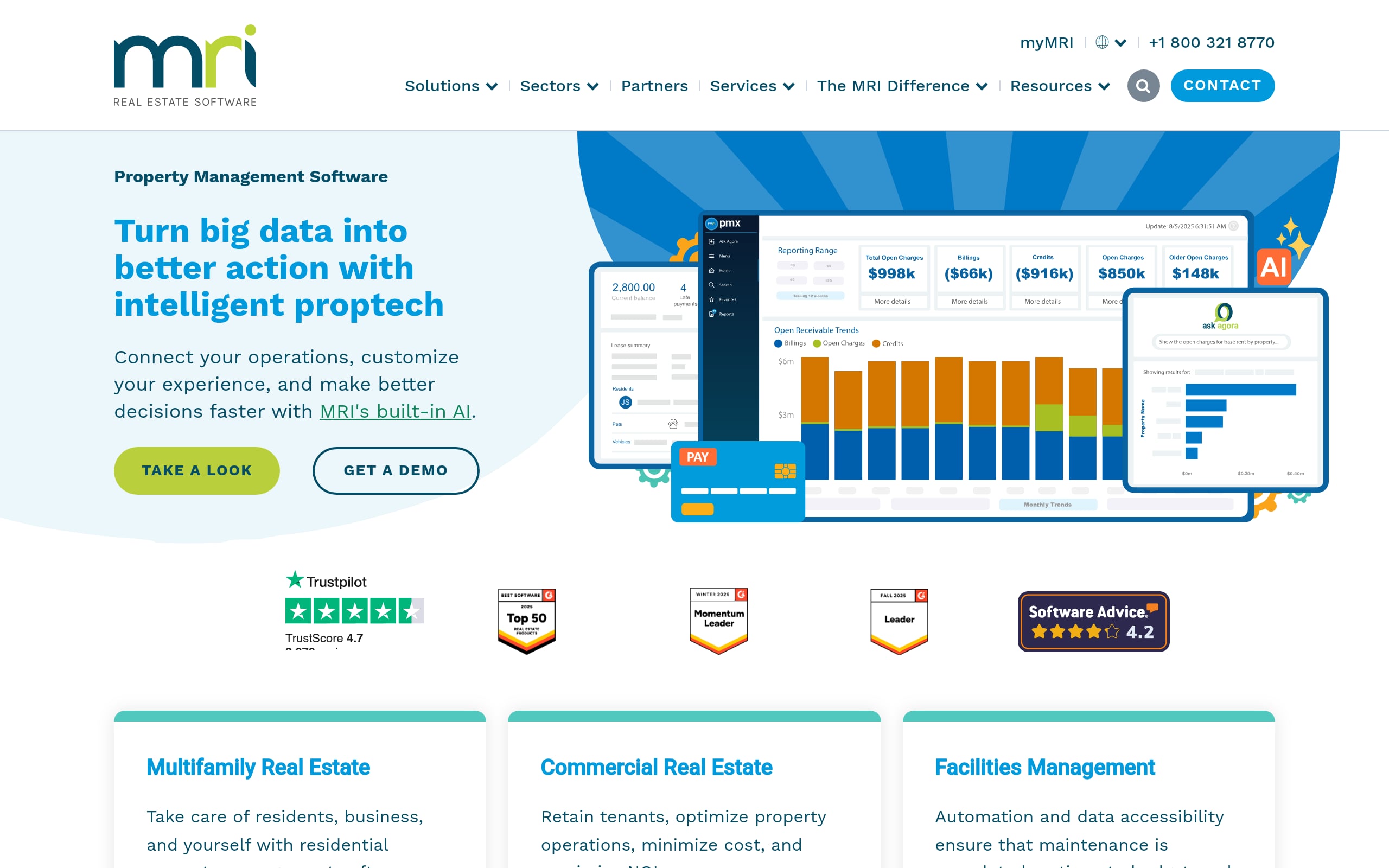
5. MRI Software
MRI combines global-scale portfolio management with AI-driven automation across operations and finance. With its open architecture and after-hours emphasis, it’s a fit for complex, multi-asset operators who need deep configurability.
Best for: Large, diversified portfolios requiring customization and enterprise governance.
Automation in action
Maintenance: Intake → emergency triage → PMS work order → vendor dispatch.
Leasing: Lead capture → qualification → tour scheduling across ILS.
Channels: Omnichannel AI (voice/SMS/email) with conversation memory.
Integrations: Two-way connectivity via MRI Exchange to hundreds of partners.
Strengths
Flexible, open architecture with advanced analytics.
Global scalability across residential and commercial.
Trade-offs
Steeper learning curve for new teams.
Pricing can be prohibitive under ~1,000 units.
Pricing, ratings, and buy signal: Quote-based enterprise pricing; ~4.4/5 ratings. Choose MRI if you need a customizable source of truth with AI-driven operations and financial automation.
6. AppFolio Property Manager
AppFolio infuses “Folio” generative AI across the property lifecycle, automating leasing, maintenance, communications, and accounting in one cloud platform. It’s a strong pick for mid-to-large portfolios scaling with lean teams.
Best for: Operators seeking premium AI baked into daily workflows, not bolted on.
Automation in action
Leasing: Folio AI qualifies leads and books tours 24/7.
Maintenance: Smart intake + SMS troubleshooting → auto work orders.
Channels: Centralized inbox for voice, SMS, and email.
Integrations: AppFolio Stack™ plus Zillow and leading PropTech tools.
Strengths
Industry-leading AI reduces manual admin and follow-up.
Robust accounting with excellent mobile usability.
Trade-offs
Monthly minimums can pinch small portfolios.
Onboarding curve for teams new to an all-in-one.
Pricing, ratings, and buy signal: From ~$1.40/unit; ~4.5/5 on G2. Choose AppFolio if you want an AI-forward ecosystem that automates high-volume tasks with minimal human touch.
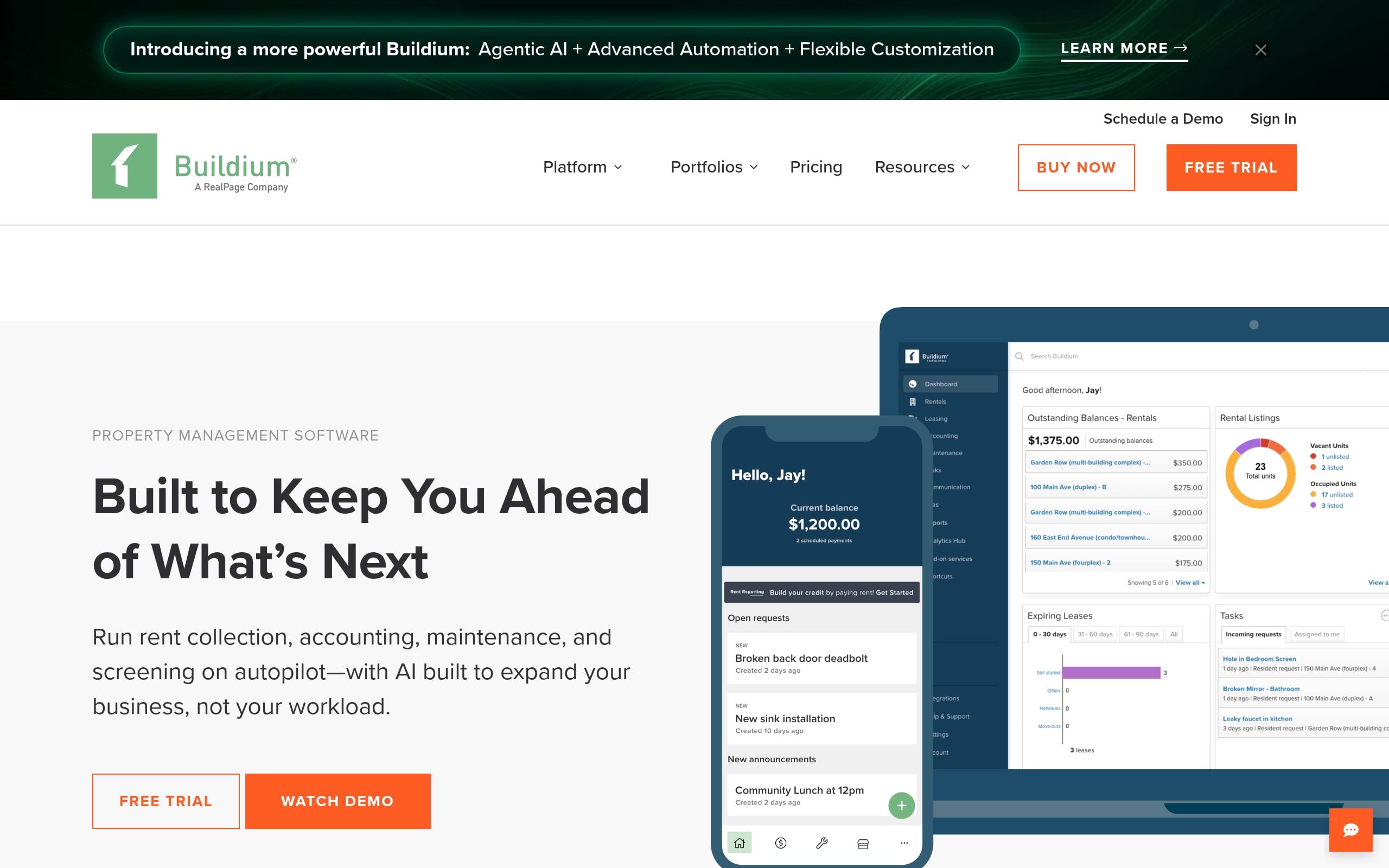
7. Buildium
Buildium delivers approachable, all-in-one automation for residential and association managers (roughly 50 to 5,000 units). It smooths after-hours with AI triage and streamlines day-to-day accounting and renewals.
Best for: Growth-minded SMBs that value ease of use and quick wins.
Automation in action
Maintenance: AI intake triage → vendor work order dispatch.
Leasing: ILS lead capture → self-showing scheduling.
Communication: Event-triggered SMS/email for renewals and late rent.
Integrations: Zillow, Apartments.com, and Property Meld.
Strengths
Intuitive UI accelerates onboarding and adoption.
Strong, automated accounting for associations.
Trade-offs
Voice AI requires premium tiers.
Tighter constraints on template customization.
Pricing, ratings, and buy signal: From ~$55/month; ~4.5/5 on G2/Capterra. Choose Buildium for a polished resident experience and automated accounting without enterprise complexity.
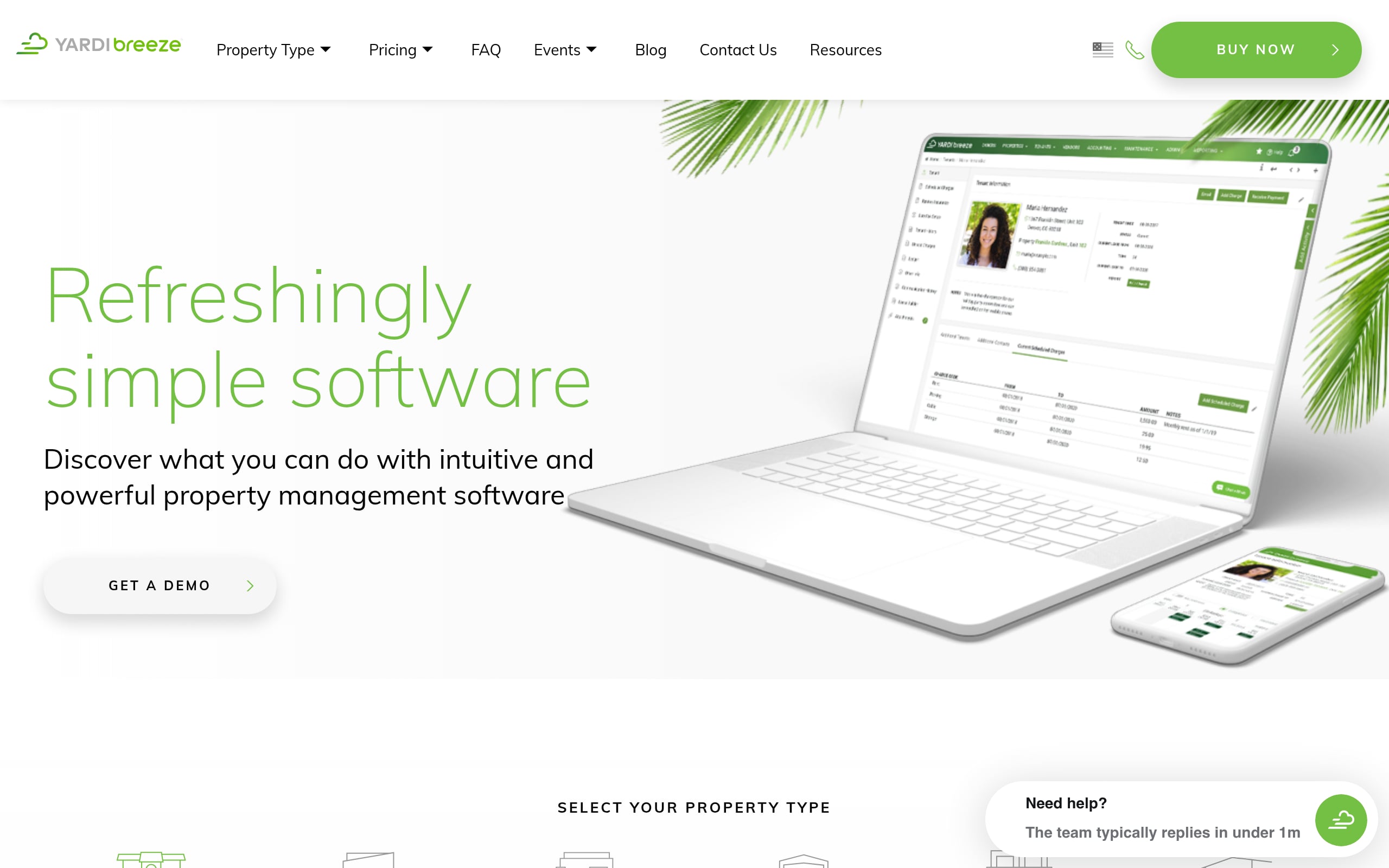
8. Yardi Breeze
Breeze brings Yardi’s accounting strength to small and mid-sized portfolios, layering Virtuoso AI for 24/7 leasing support and streamlined maintenance. It delivers quick time-to-value with an “instant-on” feel.
Best for: Teams wanting enterprise-grade accounting with lighter ops automation.
Automation in action
Leasing: Virtuoso AI qualifies ILS leads and books tours.
Maintenance: Requests triaged → digital work orders.
Marketing: One-click syndication to Zillow and Apartments.com.
Accounting: Automated rent, late fees, and distributions via RentCafe.
Strengths
Fast onboarding and approachable UI.
Backed by Yardi’s secure accounting engine.
Trade-offs
Limited third-party API flexibility.
Ceilings appear with complex enterprise needs.
Pricing, ratings, and buy signal: From ~$1.00/unit; ~4.5/5 on Capterra. Choose Breeze for predictable costs and everyday automation with rock-solid accounting.
9. Rent Manager
Rent Manager is a flexible, API-first platform prized by tech-forward operators. It excels when you want to script exactly how leasing, maintenance, and communications behave, especially after hours.
Best for: Portfolios that value customization and control over plug-and-play simplicity.
Automation in action
Maintenance: Portal intake → work order → automated vendor dispatch.
Leasing: AI bots capture leads and schedule tours instantly.
Scripting: If–then automations for SMS/voice triggers.
Marketplace: 100+ two-way PropTech integrations.
Strengths
Unmatched API-driven customization.
Robust financial reporting at scale.
Trade-offs
Power-user skill set often required.
Longer setup for advanced workflows.
Pricing, ratings, and buy signal: Custom per-unit; ~4.3/5 ratings. Choose Rent Manager if you need bespoke, scriptable automation rather than out-of-the-box guardrails.
10. Propertyware
Propertyware focuses on large single-family portfolios, pairing RealPage’s ecosystem with deep automation for maintenance, leasing, and complex accounting. It’s built for operators who need granular control at volume.
Best for: High-unit SFR managers needing multi-entity accounting and 24/7 coordination.
Automation in action
Maintenance: AI triage → instant work order dispatch.
Leasing: Zillow/Apartments.com capture → qualification → tour scheduling.
Communications: 24/7 voice/SMS with auto profile logging.
Finance: Owner statements, electronic draws, and renewal triggers.
Strengths
Robust, multi-entity accounting and infinite customization.
Proven scalability beyond 1,000 units.
Trade-offs
Steep onboarding curve for new teams.
Utilitarian, legacy-style interface.
Pricing, ratings, and buy signal: From ~$1.00/unit ($250 minimum); ~3.8/5 on G2. Choose Propertyware for granular SFR control and automated accounting at scale.
Automation Best Practices to Maximize Results
To get the most out of your property management automation software, follow these best practices:
Maintain Clean PMS Data: Automation is only as good as the data it has to work with. Ensure your rent rolls, unit information, and vendor contact details are accurate and up to date in your PMS.
Document Your Workflows: Clearly map out your ideal process for handling a lead or a maintenance request. This will make it easier to configure the software to match your operational goals.
Set Clear KPIs: Define what success looks like. Key Performance Indicators might include lead to tour conversion rate, average maintenance response time, or a reduction in after hours call volume handled by staff.
Empower, Don’t Replace, Your Team: Position the software as a tool that eliminates tedious tasks, allowing your team to focus on building relationships with residents and closing leases. A study by the National Apartment Association found that employee turnover in property management can be as high as 33%, often due to burnout. Automation is a powerful retention tool.
Listen to the Feedback: The AI will record calls and log conversations. Periodically review these interactions to gain insights into resident concerns and identify opportunities to improve your service.
Conclusion: Choosing the Right Automation‑First Platform for Your Portfolio
The shift toward automation is reshaping the property management landscape. The question is no longer if you should adopt automation, but how. By handling the repetitive, time sensitive tasks that bog down your team, modern property management automation software allows you to scale your business, reduce operational overhead, and deliver the instant, 24/7 service that today’s renters expect. When evaluating your options, prioritize platforms with deep PMS integration, a voice first approach, and a true understanding of the property management industry.
Ready to see how AI agents can transform your operations? Book a demo of Haven to see exactly how Maintenance and Leasing AI can start saving you time and money—with concrete timelines, vendor integration examples, and ROI projections customized to your portfolio size. Most demos take 20 minutes and include a live voice sample showing your exact use case. Book today.
See It In Action: 20-Minute Demo Walkthroughs
The best way to evaluate property management automation software is to hear and see it work. Every leading platform offers guided demos tailored to your portfolio type:
Maintenance AI Demo: Call into our system, hear a live maintenance AI answer a tenant request, watch it create a work order in your PMS, and dispatch a vendor—all in real-time.
Leasing AI Demo: See how your Zillow/Apartments.com leads are captured, qualified, and turned into booked tours without any manual follow-up.
Scattered-Site Coordination: Watch how a single AI agent manages work orders across 50+ geographic locations with centralized vendor routing.
Custom Workflow Walk-Through: Bring your actual PMS data and top 3 pain points; vendors will configure your specific automation in the demo and show cost savings.
Most vendors: Deliver quotes within 24 hours of a demo. You'll see implementation timelines (typically 30–120 days), pricing per unit, and a pilot plan for your first automation workflow.
Book a demo for your portfolio size below—or scroll to the tool profiles to compare features before scheduling. For a deep side-by-side breakdown, see our guide to best AI property management software in 2026.
FAQs
What is property management automation software?
Property management automation software is a tool that uses technology, often including artificial intelligence (AI), to handle repetitive operational tasks. This includes answering leasing inquiries, scheduling tours, taking maintenance requests, creating work orders in a PMS, and dispatching vendors, all without direct human intervention.
How is AI different from a standard PMS?
A standard PMS is a system of record for your financial and resident data. An AI automation platform is a layer that works with your PMS to take action. For example, your PMS stores work order history, but an AI agent can answer a tenant’s call at 2 a.m., diagnose the issue, and create the work order ticket inside your PMS automatically.
Can automation software handle emergency maintenance?
Yes, advanced platforms are specifically designed for this. They can be trained to recognize keywords and contextual clues that indicate an emergency (like “fire,” “flood,” or “gas smell”). They can then immediately escalate the issue to a designated on call person or dispatch an emergency vendor according to your protocol.
What kind of systems can this software integrate with?
Leading property management automation software is designed to integrate with major Property Management Systems (PMS) like AppFolio, Yardi, Buildium, and Rent Manager. It can also connect with popular Internet Listing Services (ILS) such as Zillow and Apartments.com to capture and respond to leads instantly.
Is this type of software difficult to set up?
While it’s more involved than downloading an app, providers of sophisticated AI automation tools typically offer a guided, sales led onboarding process. Their team works with you to connect to your PMS, configure your specific workflows, and train your staff, ensuring a smooth transition.
How does automation help with property manager burnout?
A major source of burnout is the pressure of being available 24/7. Automation tools take over after hours calls and instant lead response duties. This frees property managers from repetitive tasks and allows them to have a healthier work life balance, which can significantly improve job satisfaction and employee retention.