AppFolio AI Case Study 2026: Key Metrics, ROI, Gaps
AppFolio AI Case Study: Decode Realm-X terms, verify 10–12 hours saved and 73% lift, and see where maintenance data falls short. Learn more.

TL;DR
AppFolio has published several AI case studies through partners like AWS and customers like Hela Management, reporting metrics like 10+ hours saved per week and a 73% higher lead-to-showing conversion rate. These numbers are real but come with important context: they’re largely self-reported averages, strongest on the leasing side, and thin on maintenance workflow evidence. This glossary breaks down every key term, maps each to published data, and gives property managers a framework for evaluating what the results actually mean for their operations.
Property managers searching for an AppFolio AI case study usually want one thing: proof. Either they’re already on the platform and wondering whether to activate AI features, or they’re evaluating AppFolio against competitors and need independent validation before signing an annual contract.
The problem is that “AppFolio AI case study” doesn’t refer to a single document. There are at least three distinct published studies, each aimed at a completely different audience. One is about cloud infrastructure. Another is about monitoring AI model performance. Only one contains the kind of user-outcome data most property managers actually care about.
This guide defines every AI concept AppFolio uses, connects each term to published case study evidence, and fills in the gaps that vendor marketing leaves out. Whether you’re comparing AI property management tools or trying to understand what “agentic AI” means in practice, this is the reference you need.
Explore how AI agents integrate with AppFolio →
What is AppFolio AI (Realm-X) and what do the case studies show?
AppFolio AI (branded as Realm-X) is a suite of generative and agentic AI tools built into the AppFolio property management platform. Published case studies show that users report around 10–12 hours of weekly time savings, a 73% higher lead-to-showing conversion rate, and significant improvements in leasing efficiency. However, these results are primarily based on self-reported customer data and focus more on leasing workflows than maintenance operations, meaning real-world performance can vary depending on use case and portfolio setup.
AppFolio AI Case Study Overview: What Exists and What Doesn’t
AppFolio AI case studies are not published as a single unified report. Instead, they are distributed across three main sources: AWS infrastructure documentation, Datadog LLM monitoring insights, and a customer success story from Hela Management. Each focuses on different audiences—engineering teams, infrastructure stakeholders, and property managers.
Only the customer case study provides direct operational ROI metrics relevant to property management such as occupancy lift and leasing performance improvements.
AppFolio AI Architecture: The Core Terms Defined
Before interpreting any AppFolio AI case study, you need to understand the product vocabulary. AppFolio has built an entire branded ecosystem around its AI capabilities, and each component appears differently across published studies.
Realm-X
Realm-X is AppFolio’s umbrella brand for its generative AI capabilities. According to AppFolio, Realm-X is a “comprehensive set of native generative AI solutions designed to transform how property managers work.” Think of it as the marketing name for everything AI-related inside AppFolio, not a single product.
The name appears across all published case studies but refers to different sub-products depending on context. This matters because when AppFolio reports that “users of Realm-X report saving an average of 10 hours weekly,” that metric covers the entire suite, not any one feature.
Realm-X Performers
These are AppFolio’s agentic AI agents, meaning AI that doesn’t just suggest actions but actually takes them. The Performer lineup includes three agents: Leasing, Maintenance, and Resident Messenger. AppFolio describes them as “always-on AI agents who handle day-to-day tasks.”
The “Performer” branding is important because it signals AppFolio’s move from AI-assisted tools (where a human reviews and approves every action) to AI-autonomous tools (where the agent acts independently). The 10-hour weekly savings metric from AppFolio surveys conducted between September 2024 and February 2025 is attributed to Performer usage.
Realm-X Flows
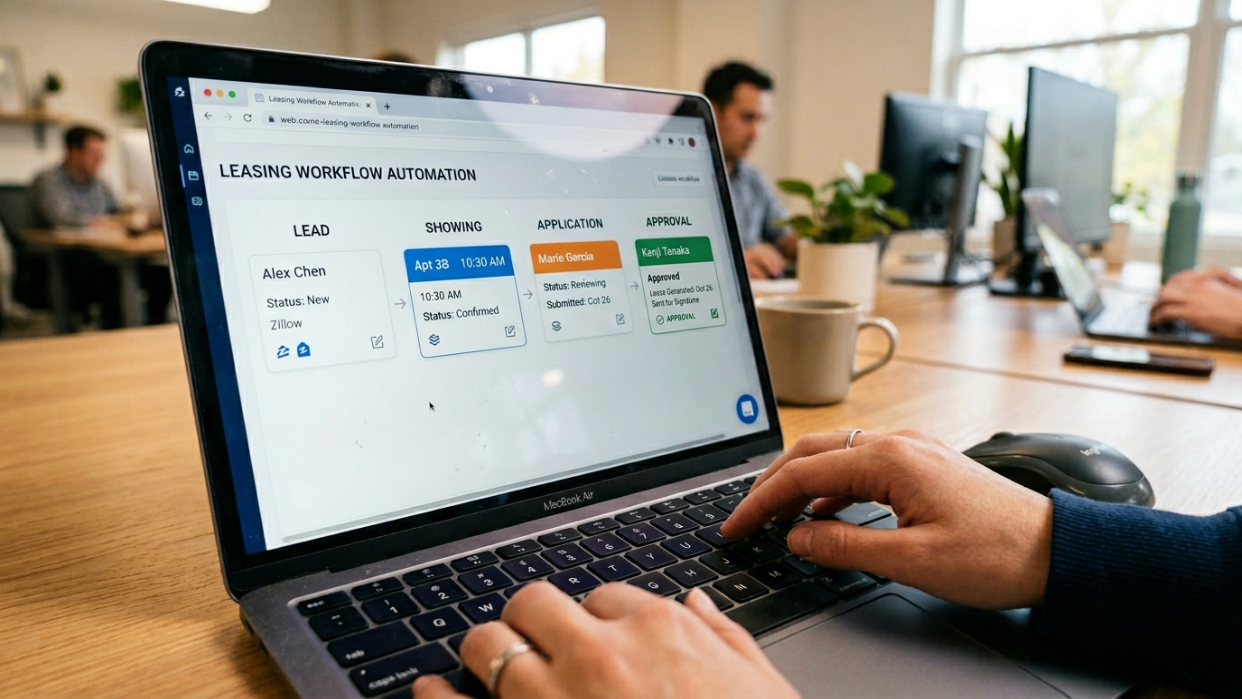
Flows is AppFolio’s workflow automation engine, specifically designed for leasing sequences. The standout metric from AppFolio’s published data: Realm-X Flows achieves a 73% higher lead-to-showing conversion rate compared to properties not using Flows.
That’s a meaningful number if it holds up at the portfolio level. But it’s worth noting this compares Flows users against non-users within AppFolio’s own customer base, not against external competitors or manual processes.
Realm-X Messages
The AI-assisted communication inbox that helps property managers draft responses to tenants and prospects. AppFolio reports that messages written with Realm-X save an average of 26 seconds per message. At first glance, 26 seconds sounds trivial. At a portfolio managing hundreds of units with dozens of daily communications, it compounds to hours per week. For more on how leasing AI ROI scales, the math gets interesting fast.
Realm-X Assistant
AppFolio’s conversational AI interface that lets property managers query data, draft communications, and execute tasks using natural language. It functions as a copilot sitting inside the PMS rather than a standalone agent. Published case studies don’t break out specific metrics for the Assistant alone.
Lisa (AI Leasing Assistant)
Lisa predates the Realm-X branding. AppFolio has been investing in AI and machine learning since 2019, and Lisa was one of the earliest applications: an automated leasing conversation chatbot for prospective tenants.
Lisa is central to the strongest AppFolio AI case study in terms of user outcomes (the Hela Management story, covered below). The average property manager takes 4-6 hours to respond to a rental inquiry. Lisa responds in under 5 minutes. That speed difference drives nearly every downstream metric in AppFolio’s leasing case studies.
Smart Maintenance
AppFolio’s AI-powered system for maintenance request intake, triage, and vendor coordination. On paper, Smart Maintenance handles the full lifecycle: a tenant submits a request, AI categorizes and prioritizes it, and the system routes it to the appropriate vendor.
In practice, user feedback tells a more complicated story. A BBB complaint from March 2026 describes a tenant who found the AI “completely unfinished,” reporting that it was incapable of handling more than a single issue at a time and that it “removed all details and unilaterally ended the chat window” when multiple maintenance needs were submitted. A Capterra reviewer similarly described the maintenance AI chatbot as “very difficult to use and seems impossible to be heard when talking to the robot.”
These aren’t isolated complaints. Across Capterra, G2, and BBB, maintenance AI emerges as the weakest link in AppFolio’s AI suite, especially for multi-issue requests and emergency triage scenarios.
AI-Native Platform
This is AppFolio’s framing for its competitive advantage. Kyle Triplett, SVP of Product, puts it this way: “With our AI-native architecture, where intelligence is built in, not bolted on, we’re empowering customers to amplify human strengths.”
The argument has merit. A platform where AI is woven into every workflow avoids the integration friction that comes with layering third-party tools onto a legacy system. The counterargument is that no single platform can specialize deeply in every workflow. A voice-first AI agent built specifically for maintenance triage may handle edge cases better than a general-purpose PMS AI, even if it requires an integration step.
AppFolio reports that 98% of its customers are already actively using one or more AI-native capabilities. That adoption rate is striking and suggests the native approach removes barriers to entry.
Case Study Metrics: What the Numbers Mean
Every AppFolio AI case study reports metrics that sound impressive in isolation. Context makes them useful.
Hours Saved Per Week (10-11.9 Hours)
Two sources report similar figures. AppFolio’s own surveys peg the number at 10 hours per week. The AWS case study, which examines AppFolio’s use of Amazon Nova Pro models, estimates 11.9 hours per week.
To put this in perspective, 10-12 hours represents roughly 25-30% of a standard 40-hour work week. That’s significant. But the key question is: does this translate to headcount reduction, or does it free up capacity for growth? For a company managing 500 units that plans to add 200 more, the answer is different than for a stable 200-unit portfolio looking to cut costs.
A Redirect Consulting report adds that 75% of AppFolio Realm-X users agree the technology reduces busywork. Agreement that busywork is reduced is a softer metric than measured time savings, but the convergence of multiple data points makes the 10-hour figure credible.
Lead-to-Showing Conversion Rate (73% Improvement)

This is the flagship metric for Realm-X Flows. A 73% lift means that if a property without Flows converts 20 out of 100 leads into showings, a comparable property with Flows converts roughly 35. At typical vacancy costs of $30-50 per day per unit, converting leads faster has a direct financial impact.
The denominator matters here. AppFolio hasn’t publicly disclosed the baseline conversion rate that produces this 73% improvement. Without that baseline, you can’t calculate absolute performance.
Inquiry Response Time (4-6 Hours vs. Under 5 Minutes)
This metric comes from industry benchmarks rather than AppFolio-specific case studies. The average property manager takes 4-6 hours to respond to a rental inquiry, while AI responds in under 5 minutes.
Response speed is one of the most defensible arguments for leasing AI. Research consistently shows that the first responder wins the lead. A 5-minute response at 2 AM on a Saturday is something no human team can match without a 24/7 leasing automation setup.
Guest Cards and Message Volume (Hela Management)
The Hela Management AppFolio AI case study provides the most granular user-outcome data. In one year, Lisa entered over 24,000 guest cards, sent over 118,000 messages to prospects, and booked over 2,500 showings. Lisa also prequalifies leads and cross-sells properties across the portfolio.
These are volume metrics, and they’re impressive. But volume without quality can create problems. 118,000 messages sent doesn’t tell you how many resulted in qualified applications. The 2,500 showings booked is more actionable because it sits closer to the revenue event.
Occupancy Lift (12%)
Hela Management also reported a 12% boost in occupancy over one year. The causal chain is straightforward: faster response times fill vacancies faster, which reduces days-on-market, which lifts occupancy. A 12% occupancy improvement on a 500-unit portfolio (going from, say, 88% to 100%) represents the revenue equivalent of filling 60 previously vacant units. That’s transformative.
Time Saved Per Message (26 Seconds)
This is the most granular metric AppFolio publishes. Twenty-six seconds per message might seem negligible, but a property manager handling 50 messages per day saves about 21 minutes daily, or nearly two hours per week, on message drafting alone. It’s a supporting metric, not a headline one.
AppFolio AI Case Studies vs Real-World Usage
There is a measurable gap between published AppFolio AI case studies and user-reported experiences in production environments.
In leasing workflows, users consistently report strong improvements in response speed and lead handling. However, in maintenance workflows, feedback from platforms like G2, Capterra, and BBB suggests issues with multi-request handling, conversational limitations, and incomplete automation in complex scenarios.
This indicates that AppFolio AI performs best in structured, high-volume workflows like leasing, but less consistently in unstructured, multi-variable workflows like maintenance triage.
Understanding Agentic AI in Property Management
The term “agentic AI” appears across every recent AppFolio AI case study. It’s worth understanding precisely because the industry is in the middle of a shift from AI assistants to AI agents, and the distinction affects what property managers should expect.
The Chatbot-to-Agent Spectrum
AI in property management exists on a spectrum. At one end, simple chatbots follow scripted decision trees (if the tenant says X, respond with Y). In the middle, copilots draft responses for human review. At the far end, agents take autonomous action: creating work orders, dispatching vendors, scheduling tours, and following up without human intervention.
AppFolio’s Performers sit at the agent end of this spectrum for leasing workflows. For maintenance, the reality is more mixed based on user reports.
Bolt-On AI vs. Built-In AI
AppFolio frames this distinction as central to its strategy. Their position: “Software providers that didn’t build their platforms with AI in mind are now layering on isolated tools that are not truly connected. You end up with more complexity, not less.”
This is partially true. A bolt-on approach can create data silos, require duplicate entry, and break when either the PMS or the AI tool updates independently. The built-in approach avoids these problems by default.
But the trade-off is real. Built-in AI moves at the platform’s pace of innovation, not the market’s. If AppFolio’s maintenance AI has gaps (and user reviews suggest it does), operators on the platform must wait for AppFolio to fix them. With a third-party integration approach, you can swap in specialized tools for specific workflows while keeping AppFolio as your system of record.
Third-Party AI Agents
Tools that connect to AppFolio via API to handle workflows like voice-first maintenance intake, after-hours call handling, or multi-channel leasing. AppFolio’s Stack marketplace supports partner integrations, which means running third-party AI alongside native Realm-X features is a supported use case, not a workaround.
This matters for property managers whose needs outpace what native AI covers today. Between 2024 and 2025, AI adoption among property operators jumped from 21% to 34%, and much of that growth comes from specialized tools filling specific gaps rather than platforms doing everything.
What Published AppFolio AI Case Studies Actually Show (and Don’t)
Three major published studies reference AppFolio and AI. They serve completely different audiences.
The AWS/Amazon Nova Case Study
Published in May 2026, this case study examines AppFolio’s adoption of Amazon Nova Pro as a foundation model for Realm-X. It’s a technical document aimed at engineering and infrastructure teams, not property managers. The 11.9-hour weekly time savings figure originates here, but the study’s real focus is model selection, cost optimization, and inference speed.
For property managers, the takeaway is simple: AppFolio is investing in enterprise-grade AI infrastructure. The specific model choice (Nova Pro vs. alternatives) doesn’t affect your daily operations.
The Datadog LLM Observability Case Study
This study covers how AppFolio uses Datadog to monitor the performance and quality of Realm-X Messages. It’s a DevOps case study. The audience is engineering teams evaluating LLM monitoring tools, not property managers evaluating AI features.
The indirect takeaway: AppFolio is investing in quality assurance for its AI outputs, which suggests they’re aware that unreliable AI responses create operational risk. This aligns with the G2 reviewer who reported following incorrect guidance from AppFolio’s AI chatbot on an accounting fix, which “resulted in the permanent loss of about three weeks’ worth of accounts payable work” with no way to recover the data.
The Hela Management Customer Story
This is the only AppFolio AI case study that directly measures property management outcomes. The headline metrics (24,000 guest cards, 118,000 messages, 2,500 showings, 12% occupancy boost) all come from Hela Management’s use of Lisa, the AI leasing assistant.
Hela Management’s results are the strongest evidence that AppFolio’s leasing AI delivers meaningful ROI. The story is specific, quantified, and directly relevant to other property management companies considering the platform.
What’s Missing from Published Case Studies
The most notable gap: maintenance workflow outcomes. AppFolio publishes strong leasing metrics through the Hela Management story but offers no equivalent case study for Smart Maintenance. There’s no published data on after-hours maintenance triage performance, vendor dispatch efficiency, or tenant satisfaction scores tied to AI-handled maintenance requests.
This gap matters because 85% of satisfied renters agree their property manager promptly resolves maintenance issues. Maintenance is where tenant retention lives. Yet it’s the area where AppFolio’s case study evidence is thinnest and where user complaints are most concentrated.
Also absent: multi-language support effectiveness, emergency escalation success rates, and any comparison between AppFolio’s native AI and third-party alternatives running on the same platform.
See how voice-first maintenance AI fills these gaps →
Limitations of AppFolio AI Case Studies
While AppFolio AI case studies demonstrate strong leasing performance metrics, they have several limitations that should be considered when evaluating ROI:
Metrics are largely self-reported rather than independently audited
Leasing outcomes are heavily overrepresented compared to maintenance workflows
No standardized baseline is provided for conversion rate improvements
Case studies focus on best-performing customers rather than average users
Limited data on failure cases, escalation handling, and edge scenarios
These gaps mean the published results should be interpreted as directional performance indicators rather than guaranteed operational outcomes.
AppFolio AI Case Study Breakdown by Source
Case Study Source | Primary Focus | Audience | Key Metrics | Relevance to Property Managers |
|---|---|---|---|---|
AWS (Amazon Nova Pro) | AI infrastructure & model performance | Engineering teams | 11.9 hours/week saved | Low (technical only) |
Datadog LLM Observability | AI monitoring & reliability | DevOps teams | Model performance tracking | Low (no ROI data) |
Hela Management | Leasing AI performance | Property managers | 24,000 guest cards, 2,500 showings, 12% occupancy lift | High (direct ROI evidence) |
How to Evaluate AppFolio AI ROI in Your Portfolio
To understand whether AppFolio AI delivers real ROI, property managers should evaluate performance using a standardized framework:
Step 1: Measure Time Savings
Track hours saved per week across leasing, messaging, and maintenance workflows.
Step 2: Measure Conversion Impact
Compare lead-to-showing conversion rates before and after AI activation.
Step 3: Measure Vacancy Reduction
Assess whether faster response times reduce days-on-market.
Step 4: Calculate Revenue Impact
Metric | Example Impact |
|---|---|
1% occupancy increase | Significant recurring monthly revenue gain |
10–12 hours saved/week | Equivalent to ~0.25 FTE capacity |
Faster lead response | Higher conversion probability during peak demand |
Step 5: Account for AI Limitations
Factor in edge-case failures, escalation needs, and maintenance handling gaps.
Key Questions to Ask When Evaluating Any AI Case Study
Whether you’re reading an AppFolio AI case study or evaluating a competitor, these five questions separate signal from noise.
1. Is the Metric Self-Reported or Independently Measured?
AppFolio’s 10-hour savings figure comes from customer surveys, not time-tracking data. The 73% conversion lift compares Flows users to non-users within AppFolio’s customer base, not a controlled experiment. Self-reported metrics aren’t worthless, but they should be weighted accordingly.
2. Does Time Saved Mean Staff Reduction or Capacity Expansion?
A 10-hour weekly savings per person is meaningful only if you know what happens with those hours. For growing portfolios, freed capacity is more valuable than headcount cuts. For stable portfolios, the ROI calculation is different.
3. Which Plan Tier Produces These Results?
AppFolio offers three pricing tiers: Core ($1.49/unit/month, $298 minimum), Plus ($3.20/unit/month, $960 minimum), and Max ($5.00/unit/month, $7,500 minimum). Not all AI features are available on every tier. Case study results from Max-tier customers may not be replicable on Core. Always ask which tier the case study subject was on.
4. Can the AI Handle Edge Cases?
Multi-issue maintenance requests, emergency triage at 2 AM, tenants who speak primarily Spanish or Mandarin. Published case studies tend to showcase best-case scenarios. Real operations run on edge cases.
One way to pressure-test this: 78% of survey respondents report that they cannot yet rely on the AI features in their legacy property management software. That statistic suggests the gap between demo performance and production performance remains wide across the industry.
5. What Happens When the AI Fails?
Every AI system fails sometimes. The critical question is whether there’s a seamless handoff to a human when it does. The G2 reviewer who lost three weeks of accounts payable data highlights what happens when AI failure meets inadequate recovery mechanisms.
Look for case studies that discuss failure modes and escalation paths, not just success metrics.
Glossary Quick-Reference Table
Term | Definition |
|---|---|
Realm-X | AppFolio’s umbrella brand for all generative AI capabilities |
Realm-X Performers | Autonomous AI agents for leasing, maintenance, and messaging |
Realm-X Flows | Workflow automation engine, primarily for leasing sequences |
Realm-X Messages | AI-assisted communication drafting tool |
Realm-X Assistant | Conversational AI interface for queries and task execution |
Lisa | AppFolio’s AI leasing chatbot, active since 2019 |
Smart Maintenance | AI-powered maintenance intake, triage, and vendor routing |
AI-Native Platform | Architecture where AI is built into core product, not added later |
Agentic AI | AI that takes autonomous actions rather than just assisting |
Bolt-On AI | AI tools layered onto platforms not originally designed for them |
Lead-to-Showing Conversion | Percentage of inquiries that result in scheduled property tours |
Guest Card | Digital record created when a prospect first interacts with a property |
Occupancy Lift | Increase in occupied units attributed to operational improvements |
LLM Observability | Monitoring AI model outputs for quality and reliability (Datadog focus) |
AppFolio Stack | Marketplace for third-party integrations that extend AppFolio’s capabilities |
Amazon Nova Pro | AWS foundation model used to power Realm-X AI features |
The Bottom Line
AppFolio’s AI investment is real. The company has been building toward this since 2019, and the numbers from published case studies, particularly the Hela Management story, show genuine impact on leasing speed and occupancy.
But every AppFolio AI case study tells a partial story. The leasing evidence is strong. The maintenance evidence is thin. User reviews across Capterra, G2, and BBB reveal friction points that published case studies don’t address. And the “native vs. bolt-on” framing, while partially valid, obscures the reality that specialized tools often outperform general-purpose AI in specific workflows.
The 2025 Property Management Benchmark Report found that 75% of respondents ranked operational efficiency as their top challenge for the fourth consecutive year. AI is part of the answer. The question isn’t whether to adopt it, but how to build the right combination of native and specialized tools for your portfolio.
For property managers who need deep specialization in areas like voice-first maintenance intake, emergency triage, and vendor dispatch, the best approach may be running AppFolio as your PMS alongside purpose-built AI agents that fill the gaps native features don’t yet cover.
Book a demo to see how Haven AI agents work with AppFolio →
Frequently Asked Questions
What is the most relevant AppFolio AI case study for property managers?
The Hela Management customer story is the most operationally relevant. It reports specific user outcomes (24,000 guest cards, 2,500 showings, 12% occupancy lift) rather than infrastructure or monitoring metrics. The AWS and Datadog case studies are aimed at technical audiences.
How much time does AppFolio AI actually save?
AppFolio surveys and the AWS case study converge on 10-12 hours per week, roughly 25-30% of a standard work week. This figure covers the full Realm-X suite, not any single feature. Individual results will vary based on portfolio size, plan tier, and which features are activated.
Is AppFolio’s maintenance AI reliable?
Published case study data on maintenance is limited. User reviews on Capterra, G2, and BBB report difficulties with multi-issue maintenance requests and AI chatbot usability. Leasing AI (Lisa) receives significantly stronger reviews than the maintenance-facing tools.
What AppFolio plan do I need to access AI features?
AppFolio offers Core ($1.49/unit/month), Plus ($3.20/unit/month), and Max ($5.00/unit/month) tiers. AI features are distributed across tiers, with more advanced capabilities reserved for Plus and Max plans. Case study results may reflect higher-tier feature sets.
Can I use third-party AI tools alongside AppFolio?
Yes. AppFolio Stack supports partner integrations, allowing third-party AI agents to connect via API. This means you can run AppFolio as your system of record while using specialized AI for workflows like after-hours maintenance or voice-based tenant communication.
How does AppFolio’s AI adoption compare to the industry?
AppFolio reports 98% of its customers use at least one AI feature. Industry-wide, AI adoption among property operators jumped from 21% to 34% between 2024 and 2025. AppFolio’s adoption rate is well above the industry average, likely because features are built into the platform rather than requiring separate purchase and setup.
What does “agentic AI” mean in AppFolio’s context?
Agentic AI refers to AI that takes actions autonomously rather than waiting for human approval. AppFolio’s Realm-X Performers are their version of this concept, handling leasing conversations, maintenance routing, and resident messaging without manual intervention at each step.
Are AppFolio’s case study metrics independently verified?
The core metrics (10 hours saved, 73% conversion lift, 26 seconds per message) come from AppFolio’s own customer surveys and internal data. They are not independently audited or third-party verified. The Hela Management numbers are self-reported by the customer. The AWS case study was co-published with Amazon, adding some external validation to the 11.9-hour figure.