After-Hours Maintenance AI: 2026 Guide for Property Managers
Discover how after-hours maintenance AI handles 24/7 intake, triage, dispatch, and PMS work orders—cutting costs and response times. Read the 2026 guide.

It’s 2:00 AM. A tenant’s pipe just burst, and your office is closed. This is the exact moment when your property management team is put to the test. How you handle these late night emergencies defines tenant satisfaction and protects your properties from costly damage. Traditionally, the solution involved stressful on call rotations or expensive call centers. Today, a smarter approach is transforming property management: after-hours maintenance AI.
At a Glance: What is After-Hours Maintenance AI?
After-hours maintenance AI is an automated system that manages property emergencies 24/7 without human intervention. By integrating with your Property Management System (PMS), it uses Natural Language Processing (NLP) to:
Triage calls based on urgency (e.g., fire vs. leaky faucet).
Troubleshoot minor issues with tenants via SMS/Voice.
Dispatch vendors automatically for high-priority emergencies.
Sync data instantly to platforms like AppFolio, Yardi, or Buildium. The Bottom Line: It reduces manager burnout by up to 80% and cuts emergency repair costs by 3-5x through faster response times.
This technology isn’t just about answering the phone; it’s about creating a fully automated, intelligent system that manages the entire lifecycle of a maintenance request, from the initial call to the final resolution. Let’s break down how it all works.
How AI Handles Calls When Your Office is Closed
The foundation of any solid maintenance operation is ensuring no tenant call goes unanswered, especially after business hours. This is where an after-hours maintenance AI system begins to shine.
Nailing the After-Hours Maintenance Request Intake
First things first, you have to capture the request. After hours maintenance request intake is the process of logging calls, texts, or messages that arrive when your team is off the clock. Emergencies don’t stick to a 9 to 5 schedule, and a missed call about a gas leak or a major flood can have catastrophic consequences.
Failing to respond quickly is expensive. Emergency or breakdown maintenance typically costs three to five times more than preventive maintenance. Chubb’s average cost for water leak claims is more than $55,000. Beyond the financial hit, poor responsiveness damages tenant relationships. Among renters still deciding whether to renew, 31% say being more responsive to maintenance requests would likely convince them to renew their lease., costing you thousands in turnover. An after-hours maintenance AI ensures every single call is answered and logged, providing immediate assurance to your residents.
Providing True 24/7 Maintenance Call Handling
Simply answering the phone isn’t enough. True 24/7 maintenance call handling means having a system ready to manage requests 365 days a year. Tenants expect a fast response, and surveys show that 75% of people consider speed the most important part of a service experience.
An after-hours maintenance AI like Haven provides that instant, round the clock coverage without burning out your staff. While traditional call centers charge per minute, often $1 to $2, AI services can handle unlimited calls at a flat rate. Properties that implement 24/7 call handling see a significant boost in tenant satisfaction scores.
Traditional Call Centers vs. AI Maintenance AI
Feature | Traditional Call Center | After-Hours Maintenance AI |
Cost Structure | $1.50 - $3.00 per minute | Flat monthly fee (Unlimited) |
Response Time | 2-5 minutes (Hold times) | Instant (< 1 second) |
Data Accuracy | Manual entry (High error risk) | Direct PMS Sync (No errors) |
Problem Solving | Message taking only | Automated troubleshooting |
Availability | Subject to staffing shortages | 100% Uptime / No burnout |
The Brains of the Operation: AI Triage and Automation
Once a request is received, the AI’s intelligence kicks in. It doesn’t just take a message; it understands, analyzes, and acts on the information.
AI Triage and Urgency Classification
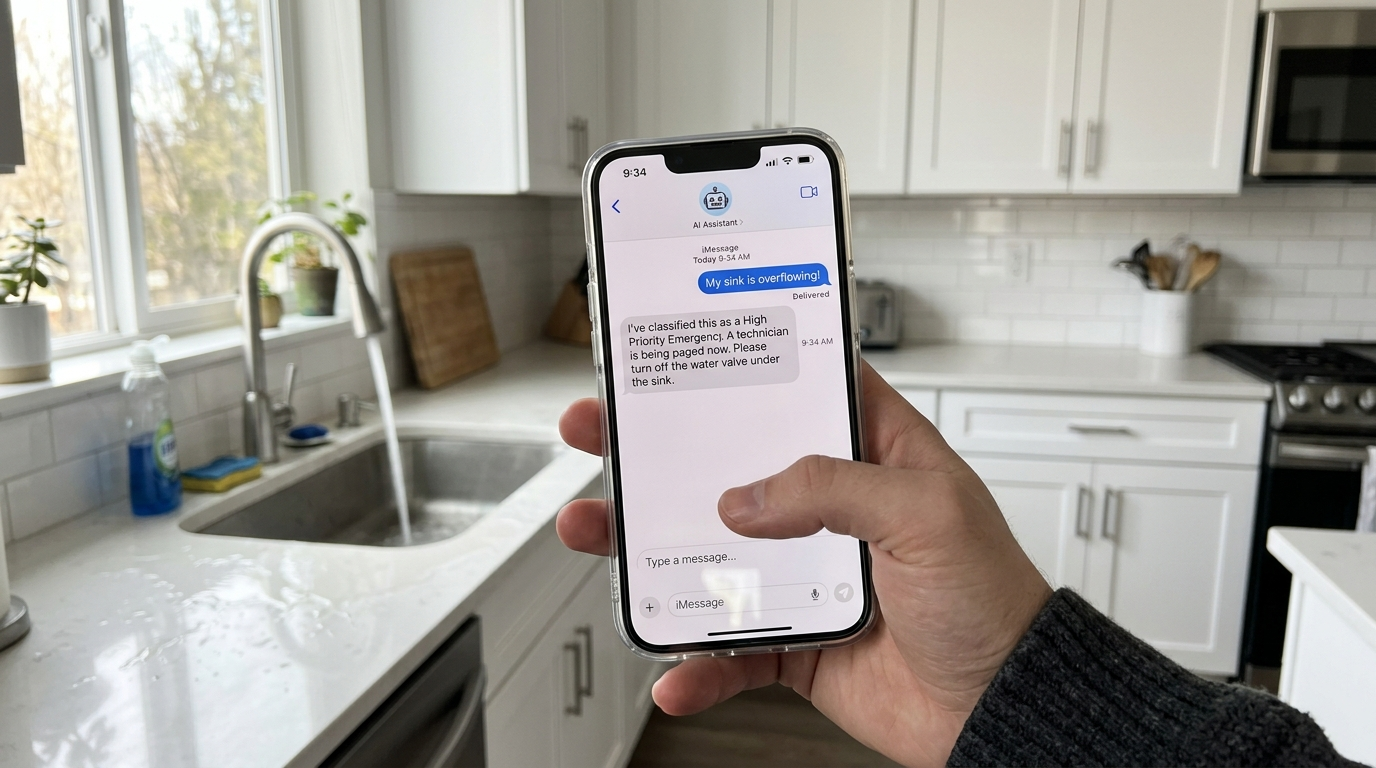
This is where the magic happens. AI triage and urgency classification is the process of using artificial intelligence to determine how critical a maintenance issue is. The AI analyzes the tenant’s words, whether spoken or texted, to categorize the request. “My apartment smells like gas” is immediately flagged as a high priority emergency, while “my closet door is squeaky” is correctly labeled as a routine, non urgent task.
This intelligent filtering is powered by natural language processing. The AI is trained on thousands of maintenance scenarios, allowing it to understand context and even ask clarifying questions like, “How much water do you see?” This ensures that genuine emergencies are prioritized. This process is incredibly efficient, with some property managers seeing a 45% reduction in average emergency response time after implementing an after-hours maintenance AI with smart triage.
Vendor and Technician Dispatch Automation
When an emergency is confirmed, the AI doesn’t wait for a human to wake up. Vendor and technician dispatch automation means the system instantly contacts the right professional for the job. If the AI identifies a critical plumbing leak, it can automatically page your on call plumber with all the necessary details.
This automated process shaves precious minutes, and sometimes hours, off the response time. Advanced systems can even escalate the request to a backup vendor if the primary contact doesn’t respond within a set time. For a breakdown of benefits and ROI from maintenance AI, see our guide.
Empowering Tenants and Keeping Humans in Control
A great after-hours maintenance AI not only streamlines operations but also improves the resident experience and keeps you in ultimate control.
Automated Troubleshooting and Resident Self Service
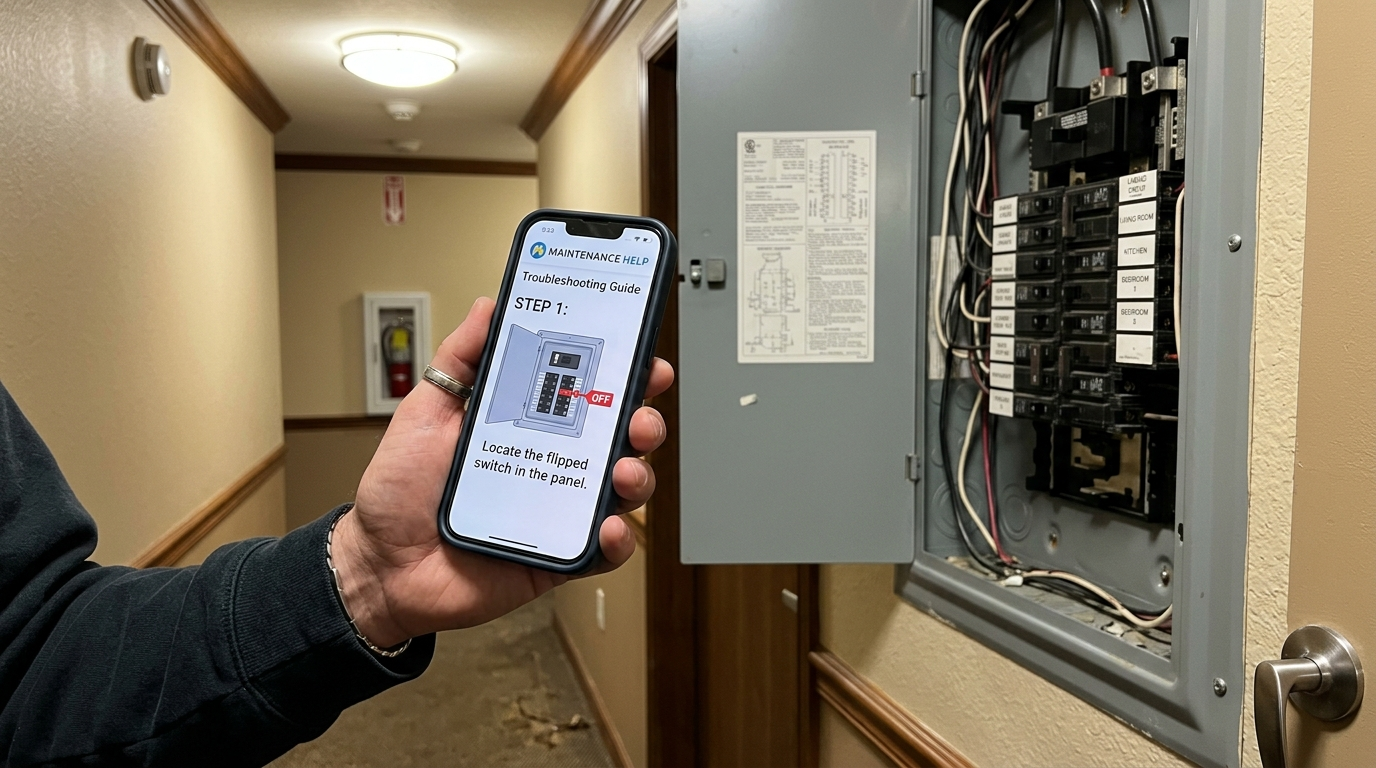
Sometimes, the quickest fix is one the tenant can do themselves. Automated troubleshooting and resident self service empowers tenants to resolve minor issues with AI guided instructions. If you’re evaluating options, compare popular property management AI tools. For instance, if a tenant calls about a partial power outage, the AI can walk them through safely checking and resetting a circuit breaker.
This simple guidance can resolve problems in minutes, saving the cost of an unnecessary technician visit. Self help tools are remarkably effective. Property managers who provide them have seen non urgent after hours calls drop. It’s a win win: tenants feel empowered with an immediate solution, and your maintenance team can focus on more serious issues.
Human in the Loop Escalation
An after-hours maintenance AI is smart, but it also knows its limits. Human in the loop escalation is a critical safety feature that helps ensure Fair Housing compliance and brings a person into the conversation when a situation is too complex, ambiguous, or sensitive for the AI to handle alone. If a tenant is extremely distressed or reports a highly unusual problem, the AI can instantly notify your on call manager.
This hybrid approach combines AI’s efficiency with human judgment. It allows you to rest easy, knowing you’ll only be woken up for true, high stakes emergencies. One property management company found that a well configured AI meant After-hours interruptions reduced by 78%. The AI handled the vast majority of issues, with 10% of weekend calls were escalated to a human.
Pro Tip: When choosing a provider, look for SOC2 Type II compliance. Since the AI handles tenant data and access codes, security is just as important as speed.
Seamless Integration and Flawless Record Keeping
For an after-hours maintenance AI to be truly effective, it must work in harmony with your existing systems and processes.
Property Management System Integration
Integration is key. A powerful AI connects directly to your Property Management System (PMS), such as AppFolio, Yardi, or Buildium. This allows the AI to read and write information automatically, acting as a virtual team member. For example, when a tenant calls, the AI can instantly verify their unit number and lease details from your PMS.
Solutions like Haven’s Maintenance AI are built with deep PMS integration in mind. This seamless connection ensures your system of record is always current, without any manual data entry from your team. For a broader look at how maintenance AI fits into your tech decisions, see our property management AI stack guide.
Top AI-Compatible PMS Platforms in 2026
To maximize ROI, ensure your Maintenance AI plugs directly into these industry leaders:
AppFolio: Best for automated work order flow and vendor invoicing.
Yardi (Voyager/Breeze): Ideal for large-scale enterprise data syncing.
Buildium: Great for streamlined communication between tenants and owners.
Entrata: Preferred for real-time resident portal updates.
Automated Work Order Creation
A direct benefit of PMS integration is automated work order creation. The moment a tenant reports an issue, the AI generates a detailed work order in your system. This ticket includes the tenant’s contact information, a description of the problem, its urgency level, and any actions taken, like dispatching a vendor.
This automation ensures no request ever falls through the cracks. It also saves your team a significant amount of administrative time. A property management team saved 32 hours per week after deploying AI that triages maintenance calls and automatically creates work orders in AppFolio. Your team can start their day with a perfectly organized queue of tasks waiting for them.
Enhancing Communication and Planning
Modern maintenance is about more than just fixing problems. It’s about proactive communication and strategic planning to prevent issues before they start.
Multi Channel Resident Communication
Tenants communicate in different ways. Some prefer a phone call, while others would rather send a text or email. Multi channel resident communication means your after-hours maintenance AI can engage with residents on their preferred platform. Whether a request comes in via call, SMS, or email, it’s all funneled into the same streamlined workflow.
Keeping tenants informed is crucial for satisfaction. Property managers who send status updates via text or email have seen tenant satisfaction scores increase. Explore more AI property management statistics.
Scheduling and ETA Coordination
Once a technician is assigned, the next question a tenant has is, “When will they be here?” An after-hours maintenance AI excels at scheduling and ETA coordination. For non urgent issues, it can automatically schedule the repair for the next available time slot. For emergencies, it can provide real time updates, texting the tenant an ETA once a vendor is en route. This simple communication drastically reduces tenant anxiety and follow up calls.
Predictive Maintenance to Reduce Emergencies
The ultimate goal is to have fewer emergencies in the first place. Predictive maintenance uses data and AI to identify and fix potential issues before they fail. By analyzing maintenance history and data from smart building sensors, an AI can flag warning signs. For example, if it notices multiple minor HVAC complaints from units with the same air handler model, it might suggest a proactive inspection.
This proactive approach yields huge returns. Predictive maintenance can reduce unexpected equipment breakdowns by up to 70% and cut overall maintenance costs by 25% to 30%. Real time leak detection alone has been shown to reduce water leak claims frequency by as much as 96%.
Incident Visibility and Reporting
Finally, an after-hours maintenance AI provides complete transparency. Incident visibility and reporting tools give you a real time dashboard of all maintenance activity. You can see open work orders, vendor status, and resolution times at a glance.
Over time, this data becomes invaluable. You can track key metrics like average response time and first call resolution rate. These reports help you spot recurring problems, manage resources more effectively, and continuously improve your operations. Interested in seeing how this can transform your own operations? You can book a demo with Haven to see it in action.
Frequently Asked Questions
1. What exactly is after-hours maintenance AI?
It is a specialized artificial intelligence system designed for property management. It automatically handles tenant maintenance requests that come in outside of regular business hours, from answering calls and texts to triaging urgency, dispatching vendors, and creating work orders in your PMS.
2. How does the AI know if something is a real emergency?
The AI uses advanced natural language processing trained on thousands of property management scenarios. It analyzes keywords, context, and sentiment in the tenant’s message to accurately classify the issue’s urgency, distinguishing between a true emergency (like a fire or flood) and a routine request.
3. Will an AI replace my maintenance staff?
No, the goal is to augment your staff, not replace them. The AI handles the initial intake, triage, and administrative tasks, freeing up your skilled maintenance team to focus on performing repairs. It acts as a 24/7 coordinator, making your human team more efficient.
4. Can an after-hours maintenance AI work with our existing software?
Yes, a key feature of leading platforms like Haven is deep integration with popular Property Management Systems (PMS) like AppFolio, Yardi, and Buildium. The AI can read and write data directly, so it works seamlessly within your current software ecosystem.
5. What happens if the AI can’t handle a situation?
The system is built with a “human in the loop” safety net. If a call is too complex, the tenant is highly distressed, or the situation meets certain pre-set criteria, the AI automatically escalates the issue to a designated human manager for personal intervention.
6. Is it difficult to set up an after-hours maintenance AI?
Setup is typically straightforward. You provide the AI with your property details, preferred vendor lists, on call schedules, and emergency protocols. The provider, such as Haven, will then configure the system to match your specific operational workflows.
7. Can the AI help reduce our maintenance costs?
Absolutely. An after-hours maintenance AI reduces costs in several ways: by preventing small issues from becoming expensive catastrophes through rapid response, by eliminating unnecessary technician dispatches through smart troubleshooting, and by reducing the high costs associated with traditional call centers.
8. How does the AI communicate with tenants?
It uses a multi channel approach. The AI can communicate with tenants via phone calls (voice), SMS text messages, and email. This ensures residents can report issues and receive updates through the channel they are most comfortable with.