AI Call Center Checklist 2026: Guide for Property Managers
Discover an AI Call Center Checklist for property management: 15 criteria for triage, emergencies, PMS work orders, leasing, and compliance.

TLDR
An AI call center checklist is a structured evaluation tool that property managers use to determine whether a voice AI system can safely handle real tenant and prospect calls. It should test 15 categories: call coverage, caller identification, intent classification, maintenance triage, emergency detection, leasing lead capture, PMS integration, work-order creation, vendor dispatch, human handoff, compliance, consent, QA, failure handling, and reporting. Property managers need a stricter checklist than most industries because their calls can involve gas leaks, flooding, Fair Housing rules, and operational actions that directly affect residents.
What should an AI call center checklist include for property managers?
A property management AI call center checklist should evaluate whether an AI system can safely answer calls, identify emergencies, create work orders, integrate with the property management system (PMS), dispatch vendors, qualify leasing leads, comply with Fair Housing requirements, and seamlessly transfer callers to staff when necessary. The most important evaluation criteria are maintenance triage accuracy, emergency escalation, PMS integration, compliance, and human handoff—not simply answering calls.
What Is an AI Call Center Checklist?
An AI call center checklist is a structured list of requirements used to evaluate whether an AI voice or omnichannel support system is ready to handle real customer calls. It covers call-answering quality, routing logic, system integrations, compliance, and quality assurance.
In property management, the checklist needs to go further. It should also evaluate maintenance triage, emergency escalation, PMS work-order creation, vendor dispatch, leasing lead capture, tour scheduling, and Fair Housing guardrails. The practical question it answers: can this AI safely and reliably handle the calls your team receives every day, or is it just a voice bot that takes messages?
This distinction matters more now than it did two years ago. Gartner predicted that by 2026, more than 80% of enterprises would have used generative AI APIs or deployed GenAI-enabled applications in production, up from less than 5% in 2023. AI call centers are no longer experimental. They are operational systems that need operational scrutiny.
For teams evaluating whether AI can replace or augment a traditional answering service, a good starting point is understanding how AI call centers compare to legacy options.
Why Property Managers Need a Different Checklist
Generic AI call center checklists focus on answer rate, containment rate, and cost per interaction. Those metrics matter, but they miss the core problem in property management: calls trigger operational work, not just answers.
When a tenant calls about water pouring through the ceiling at 2 a.m., the AI is not just “handling a support ticket.” It needs to verify the unit, determine whether the situation is an emergency, create a work order in the PMS, alert the on-call plumber, and confirm the action back to the tenant. If an ecommerce AI bot misroutes a return, the customer is annoyed. If a property-management AI misroutes a gas smell, the risk is far higher.
The stakes show up in the numbers. Buildium’s 2026 research found that property owners evaluate managers heavily on response time and maintenance turnaround. Among undecided renters, 40% said they would be more likely to renew if their property manager invested more in maintaining the property, and 31% would renew if responsiveness improved.
On the leasing side, Zillow’s 2025 Consumer Housing Trends Report surveyed over 24,400 renters and found that 57% submitted two or more applications. Prospects are shopping multiple properties simultaneously. If an AI call center takes a message instead of qualifying the lead and scheduling a tour, that prospect has already moved on.
Practitioners on Reddit confirm this gap repeatedly. One thread in the AIReceptionists community summarized it clearly: the answering part is easy; triage is the make-or-break part. Another property manager in the PropertyManagement subreddit said their AI experience had been bad unless the system could be trained on building-specific details, like which breaker panel serves which unit.
A property-management AI call center checklist should test whether the AI can take safe operational action, not just whether it can pick up the phone.
Generic AI Call Center vs Property Management AI
Feature | Generic AI Call Center | Property Management AI |
|---|---|---|
Answers calls | ✓ | ✓ |
Captures caller info | ✓ | ✓ |
Books appointments | Sometimes | Yes |
Maintenance triage | Rarely | Required |
Emergency detection | Rarely | Critical |
Creates PMS work orders | Rarely | Required |
Dispatches vendors | Rarely | Required |
Fair Housing compliance | Usually No | Required |
Leasing lead qualification | Limited | Required |
Human escalation | Optional | Required |
Before You Evaluate Vendors, Document Your Current Workflow

Many failed AI deployments happen because the company's existing call process is undocumented.
Before comparing vendors, property managers should document:
Current call flow
Who answers after-hours calls?
How are emergencies identified?
How are work orders created?
When are vendors contacted?
Who approves dispatch?
Existing software
List every system currently used:
PMS
CRM
Phone system
SMS platform
Maintenance software
Calendar
Vendor portal
Escalation policies
Document:
emergency definitions
business hours
after-hours rules
manager escalation
regional escalation
If these processes are inconsistent today, AI will simply automate inconsistency.
The Complete AI Call Center Checklist for Property Management
This is the core evaluation framework. Use it when comparing vendors, auditing an existing system, or deciding whether your operation is ready for AI call handling.
Checklist Area | What to Verify | Pass/Fail Standard |
|---|---|---|
1. Call coverage | Can the AI answer calls 24/7, including nights, weekends, holidays, and call spikes? | Pass if calls are answered consistently without voicemail or busy signals. |
2. Caller identification | Can it collect and verify name, phone, email, unit, property, tenant/prospect status? | Pass if each call creates a complete, searchable record. |
3. Intent classification | Can it distinguish leasing, maintenance, billing, vendor, emergency, and general calls? | Pass if routing logic is clear and testable. |
4. Maintenance triage | Can it ask clarifying questions and classify emergency, urgent, and routine issues? | Pass if emergencies are escalated immediately and routine issues are not over-escalated. |
5. Emergency detection | Can it identify fire, gas smell, flooding, active leak, no heat in dangerous weather, lockout with safety risk? | Pass if emergency false negatives are near zero in testing. |
6. Leasing lead capture | Can it answer listing questions, qualify leads, capture preferences, and schedule tours? | Pass if records include source, contact info, property interest, move-in timing, budget, and pets. |
7. PMS/CRM integration | Can it read and write to the system of record? | Pass if it creates or updates guest cards, notes, work orders, and statuses without manual re-entry. |
8. Work-order creation | Can it create complete work orders with issue summary, severity, property, unit, tenant details, and transcript? | Pass if the work order is usable by maintenance without another call. |
9. Vendor dispatch | Can it use preferred vendor lists, trade categories, property rules, and escalation backups? | Pass if dispatch follows your documented operating procedures. |
10. Human handoff | Can the caller request a person? Can the AI escalate when uncertain or outside policy? | Pass if handoffs include transcript, summary, caller info, and urgency. |
11. Compliance guardrails | Does it avoid Fair Housing steering, unauthorized promises, and improper screening? | Pass if responses are reviewed against housing compliance rules. |
12. Consent and disclosure | Does it disclose AI use and call recording where required? | Pass if policies are configured for applicable jurisdictions. |
13. QA and call review | Are transcripts, recordings, summaries, and exceptions reviewable? | Pass if managers can audit what happened and correct workflows. |
14. Failure handling | What happens if the PMS API fails, vendor dispatch fails, or the AI is unsure? | Pass if the AI never claims an action succeeded unless the system confirms it. |
15. Reporting and ROI | Can it report answer rate, escalation rate, work-order creation, lead conversion, and cost per resolved call? | Pass if reports map to operating goals, not vanity metrics. |
This checklist table is the central tool. Print it, bring it to demos, and score each vendor against it.
If your biggest gaps center on maintenance triage and PMS work orders, Haven’s AI maintenance coordinator is built specifically for those workflows.
The Action Ladder: Not All AI Call Centers Do the Same Thing
One reason property managers get frustrated with AI call centers is that the term covers a huge range of capability. A system that records voicemails and a system that dispatches your preferred plumber at 2 a.m. are both called “AI call centers.” That is not helpful.
Think of AI call center capability as a ladder:
Level | What the AI Does | Property Management Example |
|---|---|---|
Level 0: Voicemail replacement | Records message and sends summary | “Tenant called about sink leak.” |
Level 1: Receptionist | Answers, identifies caller, routes | Press-free routing to leasing or maintenance. |
Level 2: Intake agent | Collects structured details | Unit, issue, photos, callback number. |
Level 3: Triage agent | Classifies urgency and asks clarifying questions | “Is water actively entering the unit?” |
Level 4: Workflow agent | Creates PMS records and assigns next steps | Creates work order or guest card in PMS. |
Level 5: Dispatch agent | Contacts vendors or staff per rules | Pages plumber from preferred vendor list. |
Level 6: Closed-loop agent | Follows up, updates records, reports outcomes | Checks tenant satisfaction after completion. |
Your AI call center checklist should identify which level you need and test whether the vendor actually delivers it. Voice quality alone is not the right evaluation criteria.
A LinkedIn practitioner made a related point: property managers often try to apply AI before standardizing their leasing workflows, maintenance triage, and daily operations. AI will only amplify a workflow that already works. If your escalation rules are not documented, the AI cannot follow them.
Should Your Property Use an AI Call Center?
Situation | Recommendation |
|---|---|
Under 50 units | Probably not yet |
Single property | Maybe |
Multiple properties | Yes |
24/7 maintenance calls | Strong Yes |
Leasing team overwhelmed | Yes |
No documented workflows | Wait before implementing |
Poor PMS data | Clean data first |
Maintenance Call Checklist
Maintenance calls are the highest-risk category for property-management AI. The AI needs to do more than record what the tenant says. It needs to classify, act, and verify.
Emergency detection
Every property management company defines emergencies slightly differently, but the common core includes fire, gas smell, active flooding, no heat in freezing weather, sewage backup, electrical hazard, and lockout with a safety risk (like a child locked inside). One practitioner on Reddit described the practical rule as “fire, flood, or blood,” meaning true emergencies that cannot wait until morning.
Your checklist should verify that the AI:
Uses your company’s emergency definitions, not a generic list
Asks clarifying follow-up questions (“Is water actively entering the unit?”)
Never downgrades a potential emergency without confirmation
Escalates immediately to the on-call person or preferred vendor
For more on structuring those rules, see this guide on AI escalation rules for maintenance.
Work-order creation
The AI should create a work order that a maintenance tech can act on without calling the tenant back. That means the order needs: property, unit, tenant name, callback number, issue description, severity, whether the tenant gave permission to enter, and ideally photos or media if the tenant can provide them.
Safe troubleshooting
Some AI systems can walk tenants through simple fixes, like resetting a tripped breaker or checking if a garbage disposal reset button was pressed. This is valuable, but it comes with a boundary. One Reddit discussion warned that some tenants do not feel comfortable doing repairs themselves, and others feel they should not have to because they pay rent. The AI should offer troubleshooting as an option, not pressure tenants into DIY fixes or make them feel service is being denied.
Vendor dispatch and follow-up
The system should be able to pull from your preferred vendor list by trade and property, contact the vendor, confirm acceptance, and update the work order. After the work is complete, a closed-loop system follows up with the tenant and logs the outcome.
Leasing Call Checklist
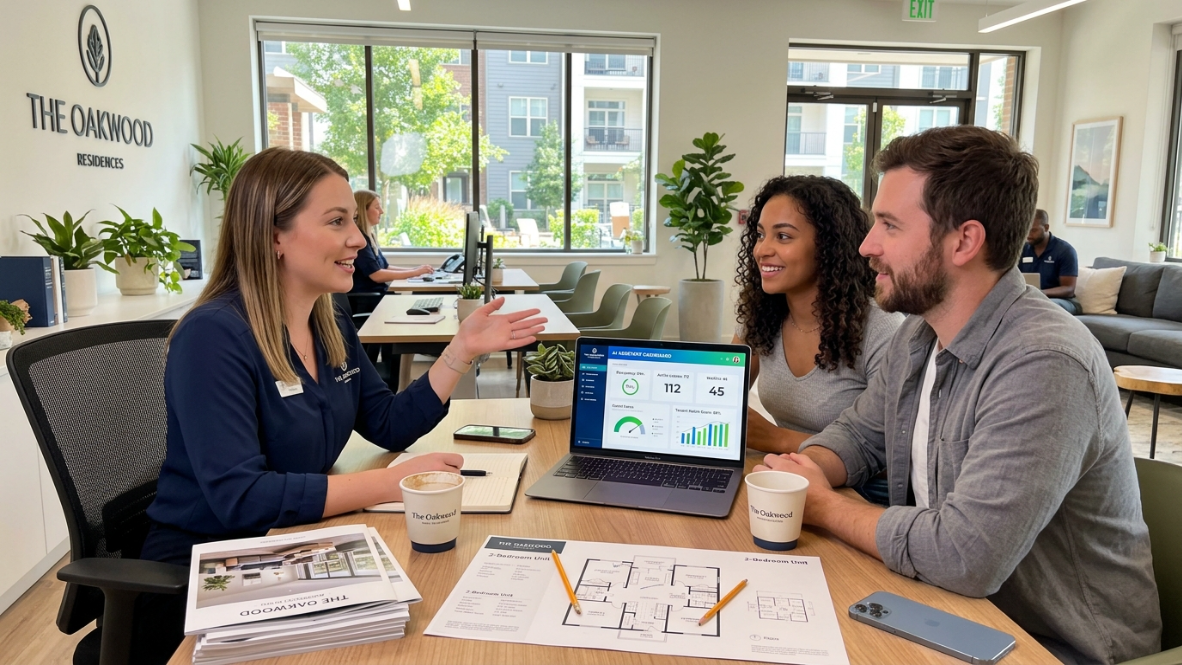
Leasing calls require a different set of checklist items. Speed and accuracy both matter.
Lead capture completeness
When a prospect calls about a listing they saw on Zillow or Apartments.com, the AI should capture:
Source (which listing site or referral)
Name, phone, email
Property and unit interest
Bedroom count, budget, move-in date
Pet information
Tour preference
A weak system takes a name and number. A strong system creates a guest card in the PMS with all of this information attached.
Tour scheduling
The AI should be able to check availability and book tours without human intervention for straightforward requests. If the requested time is not available, it should offer alternatives.
Fair Housing-safe qualification
This is where property managers need to be especially careful. HUD issued 2024 guidance on Fair Housing Act concerns involving AI in housing contexts. Even if the AI is not making screening decisions, leasing conversations can create risk if the AI asks inappropriate questions, steers prospects, or gives inconsistent answers based on who is calling.
Your leasing AI call center checklist should verify that qualification questions are reviewed by someone who understands Fair Housing rules. For a deeper look at this topic, this compliance guide covers the key considerations.
Follow-up
If the prospect does not book a tour immediately, the AI should have a follow-up sequence, whether by SMS, email, or a scheduled callback. Zillow’s data on renters applying to multiple properties means your window is short.
PMS and CRM Integration Checklist
Integration is where many AI call center products fall short. There is a significant difference between a system that emails a summary to your team and a system that reads from and writes to your PMS.
Your checklist should test:
Can the AI read current tenant and property data? It should know who lives where and what units are available.
Can it create work orders? Not just send a notification, but actually populate the work-order fields in your PMS.
Can it create or update guest cards for leasing leads?
Can it attach transcripts, recordings, and summaries to the record?
Does it confirm that the action succeeded before telling the caller?
What happens when the PMS API is down?
That last point is critical. A developer on Reddit who built an AI phone agent for a property management company reported a specific failure: the AI told a tenant their maintenance ticket had been filed, but the tool call had actually errored. The builder’s takeaway was that the AI should never claim a ticket was submitted unless the tool returned success in the same conversation.
A LinkedIn practitioner made a similar argument: if data is fragmented or lost in the handoff to the maintenance team, call-center savings get offset by miscommunication, delayed repairs, and tenant dissatisfaction. The checklist must test downstream record quality, not just whether calls get answered.
If your PMS data is not clean enough for AI to act on, this guide on data quality covers what to fix before implementation.
For teams comparing AI property management software options, PMS integration depth should be one of the first filtering criteria.
Compliance and Risk Checklist
Compliance is not a footnote. For property-management AI call centers, there are at least four regulatory areas to evaluate.
Fair Housing
HUD’s 2024 guidance makes clear that Fair Housing Act concerns extend to AI used in housing advertising and tenant-related processes. Leasing AI should not steer, screen inconsistently, or ask questions that differ based on caller characteristics.
TCPA
The FCC’s February 2024 Declaratory Ruling confirmed that TCPA restrictions on artificial or prerecorded voice can encompass AI-generated voice technologies. This is especially relevant for outbound calls: lead follow-up, rent reminders, or automated voice campaigns. If your AI call center makes outbound calls, you need a TCPA compliance process.
Call recording
Federal law provides a one-party consent baseline for call recording, but many states impose stricter requirements. A national property manager should configure call-recording notices conservatively and review the policy with counsel.
AI disclosure
Several jurisdictions require disclosing when a caller is speaking with AI. Even where not legally mandated, disclosure builds trust and reduces complaints.
Governance framework
NIST’s AI Risk Management Framework provides a useful structure for ongoing AI governance: govern, map, measure, and manage. AI risk management should not be a one-time deployment review. It should be continuous.
For a deeper look at QA workflows, transcripts, and audit trails, see this guide on AI call recordings and QA.
Disclaimer: This checklist is informational, not legal advice. Property managers should review AI calling, recording, screening, and data-retention practices with qualified counsel.
How to Test an AI Call Center During a Demo
Do not rely on the vendor’s scripted demo. Run your own test calls using scenarios that reflect your actual call volume.
Maintenance test calls
“My toilet is overflowing and water is on the floor.”
“I smell gas near the stove.”
“My AC is not working, but it is 72 degrees outside.”
“My AC is not working, and it is 105 degrees outside.”
“There is water coming from the ceiling, but I do not know where.”
“I locked myself out and my child is inside.”
“The hallway light is out.”
“I already called about this last week.”
Leasing test calls
“Is the two-bedroom still available?”
“Do you accept pets?”
“Do you accept vouchers?”
“Can I tour tonight?”
“I saw this listing on Zillow. Is the rent correct?”
“Can I speak to a person?”
Failure-state test
Ask the vendor to simulate a PMS outage. Then call in with a maintenance request. Does the AI tell the caller the ticket was created? Or does it honestly say it is escalating because the system could not confirm? This single test reveals more about the product than any slide deck.
Human handoff test
Ask to speak with a person during the demo call. Check whether the handoff includes the full transcript, caller info, and urgency level. Also check what happens when there is no human available, such as during after-hours escalation.
To hear what an AI maintenance call actually sounds like, you can listen to a voice demo from a real property management use case.
AI Call Center Red Flags
When evaluating vendors, watch for these warning signs:
The AI only emails summaries. If it does not write to your PMS, it is an answering service, not an operations tool.
The vendor cannot explain emergency triage logic. If they say “we handle emergencies” but cannot walk you through the classification rules, that is a problem.
No property-specific knowledge base. Generic prompts do not know that Building A has a different plumber than Building B.
The AI cannot transfer to a human. Callers should always be able to request a person.
The AI claims actions before system confirmation. This is the biggest silent failure mode. If the PMS write fails and the AI tells the tenant their ticket was created, you have a broken audit trail and an angry resident.
No call recordings, transcripts, or QA workflows. You cannot improve what you cannot review.
No Fair Housing guardrails. Leasing AI without compliance review is a liability.
Demo uses only perfect scripted calls. Real callers have accents, background noise, unclear descriptions, and emotional urgency. Research on call-center speech recognition found substantial variation across accents and conditions, so test accordingly.
No reporting by property, call type, or escalation. If you cannot segment data by property or issue type, you cannot manage operations.
Metrics to Track After Launch
An AI call center checklist does not stop at deployment. You need ongoing measurement to know whether the system is working.
Call coverage metrics
Answer rate and missed-call rate
Average speed to answer
After-hours answer rate
Abandonment rate
Maintenance metrics
Emergency detection rate and false-negative rate
Routine over-escalation rate
Work-order creation success rate
Time from call to work order
Time from call to vendor alert
Repeat call rate (tenant calling back about the same issue)
Leasing metrics
Lead response time
Tour-booking rate
Guest-card creation rate
Follow-up completion rate
Lead-to-lease conversion
QA and compliance metrics
Calls sampled per week
Escalation accuracy
Failed tool-call rate
Fair Housing exception rate
Recording disclosure compliance
Buildium connects maintenance response metrics directly to property-manager performance evaluations and renter retention. Track the numbers that your owners and residents actually care about, not vanity metrics like “minutes handled.”
For a full breakdown of cost benchmarks, see this guide on AI call center pricing.
Common Confusion: Related Terms
Term | Meaning | Key Difference |
|---|---|---|
AI call center | AI system handling inbound and/or outbound calls with routing, automation, integrations, and analytics. | Broadest term; may include workflows, QA, and escalation. |
AI answering service | AI that answers calls and captures messages or requests. | May not create PMS records or dispatch vendors. |
AI receptionist | Front-desk AI that greets callers, routes, answers FAQs, and books appointments. | Often lighter-weight than an operations agent. |
AI voice agent | Conversational voice AI that understands speech and responds naturally. | Voice layer only; may or may not take action. |
AI maintenance coordinator | AI specialized in maintenance intake, triage, work orders, vendor dispatch, and follow-up. | Property-management-specific. |
Are You Ready for an AI Call Center?
Before you start evaluating vendors, check whether your operation has the prerequisites:
A current property and unit list
Clean tenant and contact data in your PMS
Written emergency escalation rules
Preferred vendor lists organized by trade and property
Leasing FAQs and qualification criteria
Fair Housing-reviewed scripts or guidelines
Defined human escalation owners (who gets the call when AI cannot handle it)
A QA owner who will review calls after launch
If you do not have these, AI will amplify the gaps. Get the workflows right first, then automate.
For teams that are ready, Haven’s Maintenance AI and Leasing AI are designed to handle voice-first property workflows, from 24/7 maintenance intake and emergency triage to leasing inquiries, lead qualification, and tour scheduling, all with PMS integration and vendor dispatch.
Book a Haven demo and bring this checklist with you.
AI Call Center Implementation Timeline
Phase | Typical Duration |
|---|---|
Workflow documentation | 1–2 weeks |
Vendor evaluation | 2–4 weeks |
Integration | 2–6 weeks |
AI training | 1–3 weeks |
Testing | 1–2 weeks |
Pilot rollout | 2–4 weeks |
Full deployment | 1–3 months |
FAQ
What should be included in an AI call center checklist for property management?
The checklist should cover 15 areas: call coverage, caller identification, intent classification, maintenance triage, emergency detection, leasing lead capture, PMS integration, work-order creation, vendor dispatch, human handoff, compliance guardrails, consent and disclosure, QA, failure handling, and reporting. Property management requires stricter evaluation than generic customer service because calls can involve emergencies, habitability issues, and Fair Housing-sensitive conversations.
How is a property management AI call center checklist different from a generic one?
Generic checklists focus on answer rate, containment, and cost. Property management checklists must also test whether the AI can take operational action: creating work orders, dispatching vendors, scheduling tours, identifying emergencies, and documenting everything in the PMS. The AI is not just answering questions. It is triggering workflows.
What is the most important item on the checklist?
Triage quality. Practitioners on Reddit consistently report that answering calls is the easy part. Correctly distinguishing a gas leak from a dripping faucet, and then taking the right action for each, is what separates a useful AI call center from a glorified voicemail system.
Can an AI call center create work orders in my PMS?
Some can, but many cannot. The checklist should verify exactly what the AI writes to your PMS, what fields it populates, whether it confirms success before telling the caller, and what happens if the integration fails. A system that only emails summaries is not creating work orders.
What compliance issues should property managers consider?
Fair Housing rules for leasing conversations, TCPA restrictions on outbound AI voice calls, call-recording consent requirements (which vary by state), AI disclosure obligations, PII handling, data retention, and audit trails. These are not optional considerations.
Should an AI call center fully replace human agents?
Not necessarily. The safer approach is AI handling repetitive intake and routing, with human escalation for emergencies, distressed callers, complex leasing questions, legal issues, and situations where the AI is uncertain. Some property managers still prefer human-only call centers, which is why human handoff and caller opt-out should always be on the checklist.
How do I test an AI call center before committing?
Run your own test calls during the demo. Use real maintenance scenarios (gas smell, active leak, routine request), leasing questions (availability, pets, vouchers), and failure-state tests (simulate a PMS outage). Check whether the AI handles accents, background noise, and emotional callers, not just perfect scripted inputs.
What are the biggest red flags when evaluating AI call center vendors?
The vendor cannot explain emergency triage logic. The AI emails summaries but does not write to your PMS. There are no call recordings or QA workflows. The AI cannot transfer to a human. The demo uses only scripted, perfect-condition calls. And the biggest silent failure: the AI claims actions succeeded before the system actually confirms them.