AI Call Center Alternative: 2026 Guide for Property Managers
Discover an AI call center alternative for property management that answers 24/7, triages emergencies, books tours, and writes work orders. See how.

TL;DR
An AI call center alternative uses conversational voice AI to answer calls, triage issues, and take real actions (like creating work orders or scheduling tours) without human agents. For property managers, this means replacing $8 to $15 per call answering services with AI that costs a fraction of that while actually integrating with your PMS. The technology crossed a viability threshold in 2024-2025, and most property management companies with 200+ units now have a strong financial case to switch.
An AI call center alternative is software that replaces traditional answering services or outsourced call centers with conversational voice AI. Instead of simply taking messages, modern AI systems can answer leasing questions, triage maintenance emergencies, create work orders in property management software, schedule tours, and dispatch vendors automatically. For most property management companies with more than 200 units, AI provides faster response times, lower operating costs, and 24/7 availability while allowing staff to focus on complex resident issues.
At a Glance
Question | Short Answer |
|---|---|
What is an AI call center alternative? | Voice AI that answers and completes phone tasks automatically. |
Who should use it? | Property managers, multifamily operators, HOA managers, build-to-rent portfolios. |
What replaces? | Call centers, answering services, virtual receptionists. |
Typical cost | $0.05–$0.50 per AI minute or $250–600/month. |
Best use cases | Maintenance calls, leasing, scheduling, vendor dispatch. |
Human still needed? | Yes, for legal disputes, Fair Housing edge cases, and emotional situations. |
What Is an AI Call Center Alternative?
An AI call center alternative is a system that uses conversational AI to handle inbound and outbound phone calls autonomously, without routing callers through human agents or hold queues. These systems listen to callers in natural language, understand their intent, and respond in real time using a voice that sounds human. They can answer questions, collect information, follow decision trees, and, in the best implementations, take actions inside connected business software.
The term covers a broad range of products, but the core idea is simple: AI does the work that a call center agent used to do.
Several related terms overlap with “AI call center alternative” and cause confusion. An “AI voice agent” emphasizes the conversational layer. “AI IVR” refers to replacing the old press-1-for-billing phone trees. “Virtual receptionist” describes the inbound business line use case. “AI answering service” highlights the phone-answering function. “AI call center” is the broadest label, usually applied when AI handles meaningful call volume across multiple use cases.
For property management specifically, the relevant product category is voice-first automation platforms, not enterprise contact center software. This distinction matters because the tools that dominate generic “AI call center” searches (Genesys, Five9, Talkdesk, NICE) are built for 1,000-seat operations with workforce management dashboards. Property managers need something different entirely.
Explore AI property management software to see what a purpose-built alternative looks like.
Why Property Managers Are Searching for This Term
Three problems push property managers toward AI call center alternatives, and all three are getting worse.
Missed calls are a revenue crisis. Over 60% of calls to multifamily properties go unanswered, one of the highest missed-call rates of any industry. A single missed leasing call can represent $15,000 to $30,000 in lost annual rent. When you factor in turnover costs of $1,000 to $5,000 per unit, every unanswered phone is expensive.
Traditional call centers are too costly for the value they deliver. Property management answering services charge $1.25 to $2.75 per call for basic message-taking, with premium plans running $400 to $900 per month. Full-service call centers cost $8 to $15 per call in the PM space, and they still can’t create work orders, dispatch vendors, or schedule tours. They take a message and leave the rest to your team in the morning.
Staff are burning out on phone duty. Property managers spend roughly 40% of their time on tenant communications, with maintenance requests making up the largest share. After-hours on-call rotations accelerate burnout and drive the industry’s already high turnover rates.
The timing matters too. Voice AI quality crossed a critical threshold between 2024 and 2025. Latency dropped from awkward three-second pauses to sub-700 millisecond turn-taking. Voices stopped sounding robotic. Real callers stop noticing they’re talking to AI within the first ten seconds of a well-built call. That shift turned AI call center alternatives from a curiosity into a practical replacement.
The market reflects this momentum. The global call center AI market is projected to grow from $2.98 billion in 2026 to $13.52 billion by 2034, a CAGR of 20.80% according to Fortune Business Insights. Gartner has predicted that generative AI will reduce contact center agent labor costs by $80 billion globally by 2026.
For a deeper look at the after-hours answering service problem specifically, that guide breaks down the math in detail.
AI Call Center Alternative vs AI Answering Service vs Virtual Receptionist
Many buyers use these terms interchangeably, but they describe different levels of automation.
Solution | Answers Calls | Understands Conversation | Creates Work Orders | Schedules Tours | Dispatches Vendors |
|---|---|---|---|---|---|
Traditional answering service | ✓ | No | No | No | No |
Virtual receptionist | ✓ | Limited | No | Sometimes | No |
AI answering service | ✓ | Yes | Sometimes | Sometimes | Limited |
AI call center alternative | ✓ | Yes | ✓ | ✓ | ✓ |
For property management, the biggest difference is whether the platform simply records information or completes work inside your PMS.
How AI Call Center Alternatives Work
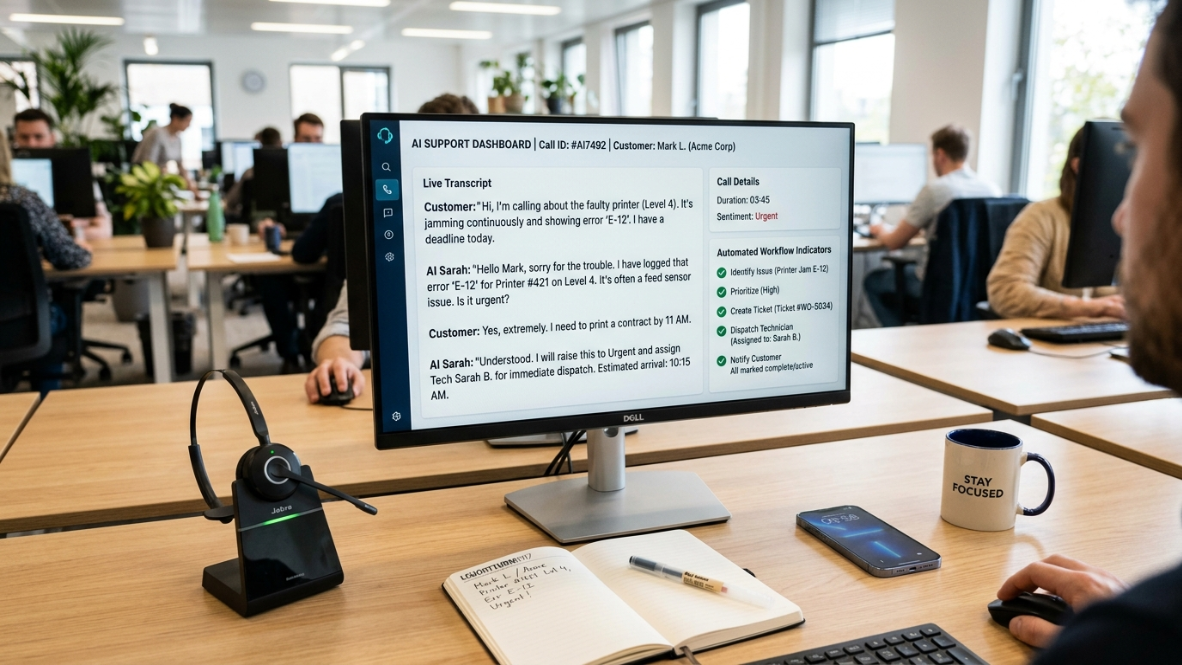
The technical architecture behind an AI voice agent follows a four-step loop that repeats throughout the conversation:
Automatic Speech Recognition (ASR) converts the caller’s voice into text.
A large language model (LLM) interprets the text, determines intent, and generates a response.
Text-to-Speech (TTS) converts the response back into natural-sounding voice.
Telephony integration delivers the audio back to the caller and manages the phone connection.
This loop happens continuously, creating a fluid conversation. The best platforms complete each cycle in under 800 milliseconds, which feels natural to callers. Platforms that bolt AI onto legacy phone systems through API round-trips introduce two to three second delays that feel immediately awkward.
Common Features to Look For
Not every AI voice platform offers the same capabilities. Before evaluating vendors, verify whether the system supports:
Natural voice conversations
Emergency maintenance detection
PMS integration
Vendor dispatch
Tour scheduling
CRM synchronization
Call recording
Call summaries
Multilingual conversations
SMS follow-up
Outbound calling
Call analytics
Human handoff
Fair Housing guardrails
Many inexpensive AI receptionists stop at message taking. The most valuable systems automate the entire workflow after the phone call ends.
The Three Categories of AI Call Center Technology
The AI call center software market breaks into three distinct architectural categories:
Full-stack CCaaS platforms with AI bolted on (NICE, Genesys, Five9, Talkdesk). These are enterprise contact center suites that have added AI features to their existing human-agent infrastructure. They’re designed for organizations with hundreds of agents.
AI assist layers (Cresta, Observe.AI, Dialpad’s agent-assist). These sit on top of an existing call center and help human agents work faster. Practitioners on Reddit describe Dialpad’s agent-assist as the clearest productivity differentiator in the per-seat category, noting that automatic post-call summaries eliminate 60 to 90 seconds of after-call work per interaction.
Voice-first automation platforms that replace human handling for specific call types entirely. For property management, this is the relevant category. These platforms don’t assist human agents. They are the agent.
Message-Taking vs. Action-Taking: The Critical Distinction
This is the single most important thing to understand when evaluating an AI call center alternative for property management.
Message-taking AI answers calls, logs details, and sends a notification to staff. It creates work for your team. You come in Monday morning to a stack of messages that still need to be triaged, entered into your PMS, and acted on.
Action-taking AI answers calls, triages emergencies, creates work orders directly in your PMS, dispatches vendors from your preferred list, and schedules tours. It eliminates work.
Many budget AI receptionists only email or text you a message log. Platforms with function calling and webhooks can book appointments and write work orders directly into a property management system. The difference in operational impact is enormous.
For a full breakdown, the guide on AI maintenance coordinators walks through how action-taking AI handles the complete maintenance workflow.
Questions to Ask Before Choosing a Vendor
Before signing a contract, ask:
Does the AI write directly into our PMS?
Reading data is not enough. The platform should also create work orders and update records.
How quickly does the AI answer?
Response latency should stay under 800 milliseconds.
What happens when the AI cannot solve the issue?
There should be immediate transfer to staff.
Which emergency scenarios are supported?
Flooding, gas leaks, fire, lockouts, heating failures, and electrical hazards should all have predefined escalation rules.
Does it support multilingual callers?
Many portfolios benefit from English and Spanish support.
AI Call Center Alternative vs. Traditional Call Center: Side-by-Side
Factor | Traditional Call Center / Answering Service | AI Call Center Alternative |
|---|---|---|
Cost per interaction | $5 to $25 (human agent); $1.25 to $2.75 (basic PM answering service) | $0.30 to $0.50 per interaction |
Availability | Staffed shifts with hold times; after-hours coverage costs extra | 24/7, zero hold time, unlimited simultaneous calls |
PMS integration | Message relay (email, text, or ticket) | Direct write-back into AppFolio, Buildium, Yardi |
Emergency triage | Follows a script; escalates to on-call staff | Detects emergencies using AI, routes based on severity |
Scalability | Limited by headcount; hiring takes weeks | Handles 1 or 1,000 simultaneous calls identically |
Tour scheduling | Takes a message for your leasing team | Books the tour directly in your calendar |
Vendor dispatch | Relays message to property manager | Contacts preferred vendor from your list automatically |
Consistency | Varies by agent training and turnover | Same quality every call, every time |
The cost difference is stark. A live phone interaction with a human agent costs $17 or more per contact, while AI voice agents handle the same call for $0.30 to $0.50, roughly a 35x cost advantage. A standard four-person in-house team runs approximately $264,212 per year in labor alone, before benefits, office space, or quality assurance.
That said, AI call center alternatives have real limitations. Complex emotional situations (an angry tenant threatening legal action, a sensitive fair housing interaction, a nuanced lease negotiation) still need human judgment. The honest recommendation from industry analysis: deflect the routine calls to AI and keep human agents for the complex ones. In property management, though, the routine-call share is so large (maintenance intake, leasing FAQs, tour scheduling) that near-full replacement is more viable than in most industries.
What AI Call Center Alternatives Handle in Property Management
Property management is unusually well-suited for AI call replacement because the call types are highly structured and repetitive. Here’s what a purpose-built AI voice agent handles:
Maintenance Request Intake and Emergency Triage
This is the highest-volume use case. A tenant calls about a leaking faucet at 11 PM. The AI agent asks targeted questions (where is the leak, how severe, is there water damage), determines urgency, and routes accordingly. For true emergencies like burst pipes, gas leaks, or flooding, the system escalates immediately to on-call staff or dispatches an emergency vendor.
The emergency maintenance triage guide covers how AI distinguishes between “my toilet is running” and “my apartment is flooding” in practice.
Work Order Creation in Your PMS
Action-taking AI doesn’t just record the maintenance request. It creates a structured work order directly in your property management system, whether that’s AppFolio, Buildium, or Yardi. The work order includes the tenant’s unit, the issue description, urgency level, and any photos or details collected during the call.
Vendor Dispatch
Once a work order is created, the AI can contact your preferred vendor from a pre-configured list. No property manager needs to wake up at 2 AM to call a plumber. The system handles it.
Leasing Inquiry Response and Tour Scheduling
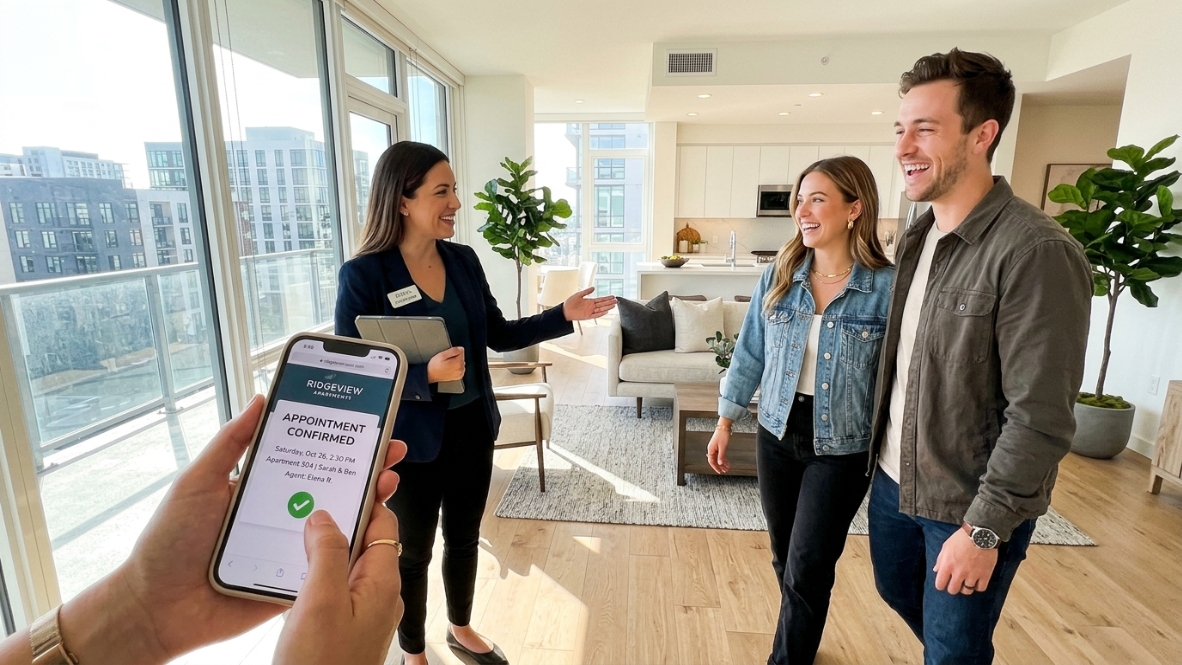
When a prospective tenant calls about availability, the AI answers their questions about pricing, amenities, pet policies, and unit features. It qualifies the lead and books a tour directly on your calendar. Given that a missed leasing call can cost $15,000 to $30,000 annually, this capability pays for itself quickly.
For specifics on how this works, see the overview of AI leasing assistants.
ILS Lead Capture
Leads from Zillow, Apartments.com, and other listing sites often come in as phone calls. AI agents capture these leads, respond immediately (speed-to-lead is critical in leasing), and enter them into your pipeline.
Follow-Ups and Status Updates
Post-work-order follow-ups with tenants (“Was your issue resolved?”), lead nurturing for prospects who toured but haven’t applied, and status update calls all fall within what AI handles well. A 2,000-unit multifamily portfolio using AI reportedly schedules 40+ tours per month that would have otherwise been missed, generating an estimated $120,000 in additional annual revenue.
Pricing Models: What to Expect
AI call center alternative pricing varies significantly based on the platform type. Here are the four main models in the market:
Per-Minute Pricing
AI voice agent pricing typically ranges from $0.05 to $1.00 per minute. Infrastructure-layer platforms start at $0.05 to $0.15 per minute, while managed all-in-one platforms with CRM integrations typically run $0.25 to $0.50 per minute.
Per-Unit Pricing
Some PM-specific platforms charge per unit. AppFolio’s AI add-ons range from $1.49 to $5.00 per unit per month.
Per-Property Pricing
EliseAI runs approximately $200 to $500 per property per month. Practitioners on Reddit report that EliseAI works well for day-to-day basic questions but can struggle with complex ones and sometimes annoys residents or vendors trying to reach the office directly.
Flat Monthly
Super starts at $250 per month for basic call answering. Conduit begins at $500 per month. Most mid-size operators spend $300 to $600 per month total, which is significantly less than a traditional call center at $8 to $15 per call.
Cost Comparison Table
Model | Typical Range | Best For |
|---|---|---|
Per-minute | $0.05 to $1.00/min | Variable call volumes, smaller portfolios |
Per-unit | $1.49 to $5.00/unit/month | Large portfolios with predictable sizing |
Per-property | $200 to $500/property/month | Individual communities with high volume |
Flat monthly | $250 to $600/month | Mid-size operators wanting predictable costs |
Traditional answering service | $129 to $300/month + $1.25 to $2.75/call overages | Basic message-taking only |
The savings potential is substantial. AI voice agents can handle 60 to 90 percent of typical call center workloads at 10 to 30 percent of the cost. A 500-unit multifamily operator reduced after-hours call escalations by 67% using voice AI to triage maintenance requests.
For a detailed ROI analysis, see the guide on replacing your property management call center.
Hidden Costs to Compare
Subscription pricing only tells part of the story. When comparing vendors, also evaluate:
Cost Factor | Traditional Call Center | AI Voice Platform |
|---|---|---|
Setup fees | Sometimes | Sometimes |
Per-call charges | Yes | Usually no |
Overtime staffing | Yes | No |
After-hours surcharge | Yes | No |
Missed calls | High | Low |
Training new agents | Continuous | Minimal |
QA monitoring | Required | Built-in analytics |
Organizations often underestimate the operational savings created by eliminating manual message entry, repetitive phone work, and after-hours staffing.
When to Switch from a Call Center to AI
Not every property management company is ready to make the switch. Here’s a practical decision framework.
Switch when:
Your portfolio exceeds 200 units and call volume justifies the investment (this is typically the threshold where the cost of missed calls exceeds any service fee)
After-hours coverage is your primary cost driver
Maintenance and leasing make up 70% or more of your call volume (high routine-call ratio)
Staff burnout from on-call duties is driving turnover
You need PMS integration, not just message relay
Speed-to-lead on leasing calls matters to your occupancy rates
Keep humans when:
Highly emotional tenant disputes require empathy and de-escalation
Fair housing edge cases need careful, judgment-based responses (though AI compliance guardrails are improving rapidly)
Complex lease negotiations or legal situations arise
You’re managing a very small portfolio where call volume doesn’t justify the setup
The practical approach for most operators is hybrid: AI handles the volume, humans handle the judgment calls. Klarna’s widely cited example shows the potential. Their AI now handles the equivalent work of 700 full-time customer service agents, processes over 2.3 million interactions, and cut resolution time from 11 minutes to under 2 minutes. The net result was $40 million in profit improvement in 2024.
Property management won’t see Klarna-scale numbers, but the ratio of routine-to-complex calls is actually more favorable. Most PM calls are structured (maintenance intake, leasing questions, status checks), making the automation opportunity larger per call than in general customer service.
Book a demo with Haven to see how this works with your specific portfolio.
What Changed in Voice AI (2024 to 2026)
Two years ago, AI call center alternatives were a hard sell. The technology worked, but barely. Callers noticed immediately they were talking to a machine, and the experience was frustrating.
Three things changed:
Latency dropped dramatically. Native AI voice platforms now operate at sub-800ms latency, which means the AI responds as quickly as a human would in natural conversation. Plugin-based systems that add third-party LLMs to legacy phone infrastructure still introduce two to three second delays that feel unnatural.
Voice quality improved. Modern text-to-speech systems produce voices that are nearly indistinguishable from real humans. Tone, pacing, and inflection all improved significantly.
Integration depth expanded. Early AI answering services could only take messages. Today’s platforms use function calling and webhooks to write directly into PMS systems, trigger vendor outreach, and update CRM records in real time. This is what makes action-taking AI possible.
For property managers who evaluated AI phone systems in 2022 or 2023 and walked away unimpressed, the technology in 2025 is fundamentally different.
Implementation Checklist
Before replacing your call center, verify the following:
Phone numbers are ported correctly
PMS integration is connected
Vendor directory is imported
Emergency escalation rules are configured
Leasing scripts are reviewed
Fair Housing responses are approved
Tour calendars are synchronized
Call recordings are enabled
Staff handoff procedures are tested
After-hours workflows are validated
This checklist helps reduce implementation risk and provides a useful reference during deployment.
Frequently Asked Questions
Is an AI call center alternative just a chatbot for phone calls?
No. Chatbots are text-based and typically follow rigid decision trees. AI voice agents engage in free-form spoken conversation, understand context, and handle the unpredictable ways real people describe problems. A tenant saying “there’s water everywhere and I don’t know what to do” gets understood and triaged, not met with “I didn’t understand that, please try again.”
Will tenants know they’re talking to AI?
With well-built systems running sub-700ms latency, most callers don’t notice within the first ten seconds. The voice sounds natural, the responses are contextual, and the conversation flows without awkward pauses. Some operators choose to disclose that the caller is speaking with an AI assistant, which is a good practice for transparency.
Does AI replace my entire team?
No. It handles the volume so your team can handle the judgment calls. Maintenance intake, leasing FAQs, tour scheduling, and status updates get automated. Sensitive disputes, complex negotiations, and situations requiring human empathy stay with your staff. The result is fewer burned-out property managers, not fewer jobs that matter.
What about Fair Housing compliance?
This is a legitimate concern. AI voice agents can actually improve Fair Housing compliance by delivering consistent, scripted responses to every caller regardless of who they are. There’s no risk of an undertrained call center agent giving different information to different callers. That said, the AI needs to be configured with proper guardrails. The guide on Fair Housing compliance for AI covers this in detail.
How long does implementation take?
It depends on the platform and the complexity of your workflows. Most PM-specific AI voice platforms can be operational within one to four weeks, including PMS integration setup and call flow configuration. Enterprise CCaaS platforms take months. For a realistic timeline, see the AI implementation timeline guide.
What PMS systems do AI call center alternatives integrate with?
The major PM-focused AI platforms integrate with AppFolio, Buildium, Yardi, and other widely used property management systems. The depth of integration varies. Some platforms only read data from your PMS, while others can write work orders, update tenant records, and create notes directly. Write access is what makes the difference between message-taking and action-taking.
At what portfolio size does switching make financial sense?
The threshold typically falls around 200 units. Below that, the cost of missed calls may not exceed the service fee for an AI platform. Above that, the math tilts heavily in favor of AI, especially if after-hours call volume is significant. A mid-size operator spending $300 to $600 per month on AI replaces what would cost several thousand dollars monthly through traditional call centers.
Can AI handle emergency maintenance calls safely?
Yes, this is one of the strongest use cases. AI voice agents are trained to detect emergency keywords and scenarios (flooding, gas smell, no heat in winter, fire), assign the correct urgency level, and escalate immediately to on-call staff or dispatch an emergency vendor. The consistency is actually an advantage over human agents who might misjudge severity at 3 AM.