AI Leasing Assistant 2026: What It Is, Key Features, Vendors
Discover how an AI leasing assistant handles calls, texts, and tours, integrates with your PMS, stays Fair Housing compliant, and boosts 2026 ROI.

TL;DR
An AI leasing assistant is software that answers renter inquiries across phone, text, email, and chat, then qualifies leads, schedules tours, and syncs everything to your property management system. It works around the clock, which matters because nearly 49% of leasing office calls go unanswered and 71% of renters expect a reply within a day. The best tools go beyond website chatbots by handling voice calls, connecting to listing sites like Zillow and Apartments.com, and writing guest cards directly into your CRM. This guide covers how they work, what features to prioritize, Fair Housing compliance, key metrics, and the vendors worth knowing about.
Quick Answer: What is an AI Leasing Assistant?
An AI leasing assistant is an autonomous software agent designed for multifamily property management that automates lead qualification, tour scheduling, and CRM data entry. Unlike basic chatbots, 2026-era assistants use Voice-AI and Natural Language Processing (NLP) to handle phone calls, SMS, and emails in real-time, integrating directly with PMS platforms like Yardi, RealPage, and AppFolio to provide instant pricing and availability.
What Is an AI Leasing Assistant?
An AI leasing assistant is software that uses conversational AI to respond to renter inquiries, answer leasing questions, qualify leads, and schedule tours across channels like phone, SMS, email, and chat. It integrates with a property’s PMS/CRM and pulls leads from listing sites so prospects get answers instantly and staff can focus on higher-value work.
That definition sounds simple. The reality behind it is not.
Property management teams have been drowning in inbound communication for years. According to Zillow’s research on renter expectations, 71% of renters expect a reply within one day, and roughly a third expect a response within hours. Meanwhile, LeaseHawk reports that nearly 49% of phone calls to leasing offices go unanswered, and 87% of those callers won’t leave a voicemail. They just move on to the next listing.
An AI leasing assistant exists to close that gap. Not by replacing your team, but by making sure every prospect gets an immediate, accurate response regardless of when they reach out or which channel they use.
How It Differs from a Chatbot or Call Center
This distinction matters more than most vendor pages let on.
A chatbot typically lives on your website. It answers basic FAQs using scripted decision trees. It can’t pick up the phone, send a follow-up text, or write a guest card into your PMS.
A call center uses human agents who can handle complex conversations but cost significantly more per interaction, often struggle with property-specific details, and may not be available on every channel simultaneously.
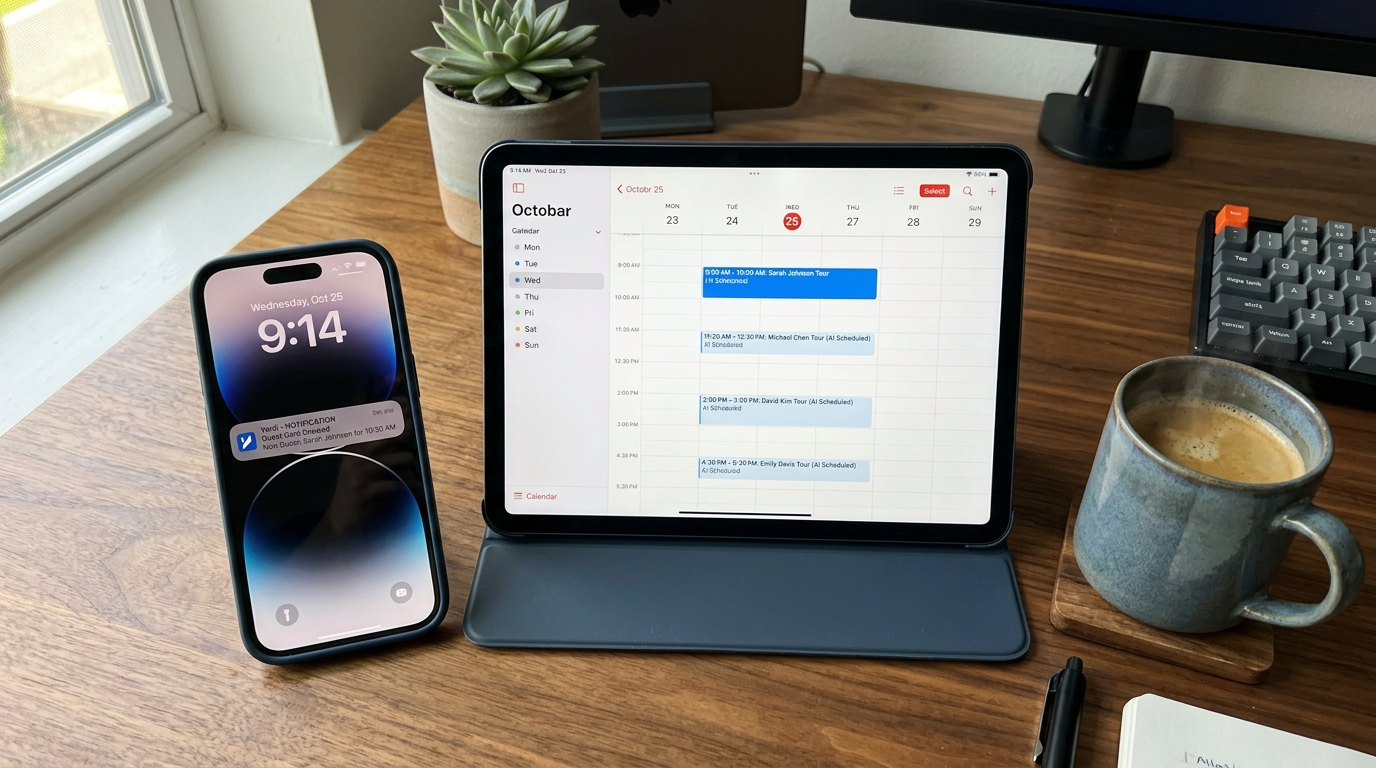
An AI leasing assistant sits between these two. It handles phone calls, text messages, emails, and web chat. It pulls real-time pricing and availability from your PMS, books tours on actual calendars, creates guest cards, and logs every interaction for compliance review. The best ones connect natively to listing sites, so a lead that comes in through Zillow at 11 p.m. gets an immediate, informed response without a human touching it.
Understanding how AI workers function in property management helps clarify why these tools are more than glorified chatbots. They take actions inside your systems, not just answer questions.
Comparison: AI Leasing Assistant vs. Traditional Tools
Feature | Website Chatbot | Call Center (Human) | AI Leasing Assistant (2026) |
Primary Channel | Web Browser only | Phone only | Voice, SMS, Email, & Web |
Response Time | Instant (Scripted) | 2–5 Minutes | Instant (Generative) |
PMS Integration | Rare / Read-only | Manual Entry | Deep / Bi-directional |
Availability | 24/7 | Variable (Costly) | 24/7 |
Handling Complexity | Low (FAQ only) | High | High (Context-Aware) |
How an AI Leasing Assistant Works in Practice
The Channels That Matter
Not all channels are equal in leasing. Phone and SMS convert at higher rates than web chat, yet most roundup articles treat them as interchangeable. They’re not.
Voice is the highest-stakes channel. When a prospect calls, they’re usually further along in their search. If that call goes to voicemail, you’ve likely lost them. Tools like LeaseHawk ACE focus heavily on phone because of this, citing their missed-call and voicemail data as the core business case.
SMS and email handle the bulk of ILS-generated leads. When someone submits a contact form on Zillow or Apartments.com, the AI assistant responds via text or email within seconds, answers questions about the unit, and books a tour. Zillow’s AI Assist activates specifically after a lead is submitted on a listing, not as a pop-up chatbot. That distinction reduces friction because the renter has already expressed intent.
Web chat is the most familiar channel but often the least impactful for leasing. It catches website visitors who are browsing, which is useful but lower-intent compared to someone who called or submitted an ILS inquiry.
If you’re evaluating solutions, prioritize voice and SMS capability. Chat-only tools leave the most valuable leads on the table.
ILS-Native vs. Standalone
This is another area where current content tends to blur important differences.
An ILS-native assistant is embedded directly in a listing marketplace. Zillow AI Assist, for example, is powered by EliseAI and activates inside the Zillow experience itself. The renter submits a lead, and the AI immediately engages them with property-specific answers, tour scheduling, and follow-up. Because it intercepts the lead at the point of highest intent, it reduces the drop-off that happens when a renter submits a form and then waits hours for a reply.
A standalone assistant connects to ILS lead sources through integrations. It receives the lead via email or API, then reaches out to the renter. This works well but adds a small delay and requires the integration to be properly configured.
Both approaches can be effective. ILS-native tools capture more initial momentum. Standalone tools give you more control over branding and conversation flow.
PMS and CRM Integration
An AI leasing assistant that can’t write back to your property management system creates more work, not less. Your team ends up manually re-entering guest cards, tour notes, and follow-up tasks.
Look for tools that sync with your PMS for:
Real-time unit pricing and availability
Calendar access for direct tour booking
Guest card creation and updates
Lead source attribution
Notes and conversation logs
Platforms like AppFolio build the assistant directly into their PMS, which simplifies the integration question. Third-party tools typically connect via API to systems like AppFolio, Yardi, or RealPage. If you’re running AppFolio, it’s worth exploring how dedicated integrations handle this to avoid manual workarounds.
The Typical Workflow
Here’s what happens end-to-end when an AI leasing assistant is working properly:
A lead arrives from Zillow, Apartments.com, your website, or a phone call.
The assistant responds within seconds, with unit-specific details.
It answers questions (pet policy, parking, pricing, move-in specials).
It qualifies the renter based on criteria you set (income, move-in date, household size).
It offers available tour times and books directly on the calendar.
It sends tour confirmations and reminders to reduce no-shows.
It creates or updates the guest card in your PMS/CRM.
If the conversation hits a threshold (complex negotiation, complaint, or escalation trigger), it hands off to a human with full context.
For prospects who go quiet, it follows up automatically at intervals you define.
Every step gets logged, which matters for both performance tracking and Fair Housing compliance.
Why It Matters: The Business Case for AI Leasing Assistants
Speed-to-Lead Is the Whole Game
The data here is unambiguous. Zillow’s consumer research shows that renters who get fast replies are more likely to schedule tours and ultimately sign leases. When your average response time is measured in hours and your competitor’s is measured in seconds, the math works against you.
Zillow AI Assist’s internal pilot data shows a 25% lift in lead-to-tour booked for enabled buildings, with 99% of messages receiving a response and 94% of conversations handled end-to-end. These are vendor-reported metrics from late-2025 cohorts, so treat them as directional rather than universal benchmarks. But the direction is clear.
After-Hours Coverage Isn’t Optional Anymore
A significant share of leasing inquiries come in outside business hours. Evenings, weekends, holidays. That’s when renters are browsing listings, and it’s exactly when most leasing offices are closed.
With nearly half of all calls missed and the overwhelming majority of callers refusing to leave voicemail, 24/7 coverage stops being a “nice-to-have” and becomes a revenue issue. Every missed call is a prospect who likely contacted the next property on their list.
For teams thinking about how property management automation fits into broader operations, leasing is usually the highest-ROI starting point because the connection between response speed and revenue is so direct.
Reduced Busywork, Better Handoffs
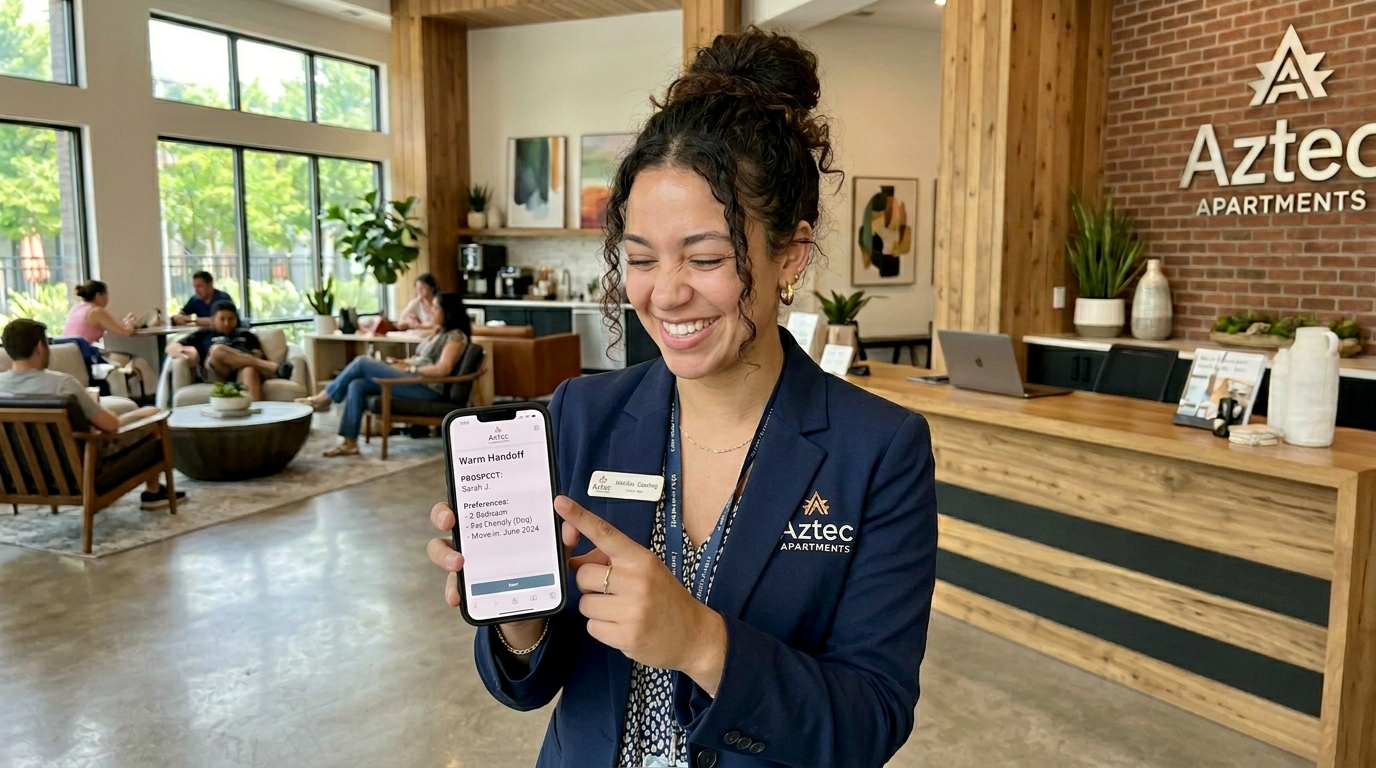
AppFolio positions its Lisa assistant around this idea: let AI handle data entry, FAQ responses, and scheduling so leasing agents focus on qualified tours and resident relationships. That’s the right framing. The goal isn’t to eliminate human involvement. It’s to make sure humans spend their time on the interactions that actually require judgment, empathy, or negotiation.
The handoff quality matters enormously here. When a prospect needs to speak with a person, the AI should pass along the full conversation history, the renter’s stated preferences, and any qualification data it’s collected. A warm handoff converts. A cold transfer to someone who asks the prospect to repeat everything does not.
Top AI Leasing Trends for 2026
As we move through 2026, the technology has shifted from "reactive bots" to "proactive agents." Key trends include:
Agentic Workflows: AI no longer just answers; it completes tasks like generating lease documents or initiating background checks without human prompts.
Multi-Modal Identity Verification: Modern assistants can now guide prospects through biometric identity verification during the scheduling phase to reduce fraud.
Predictive Lead Scoring: Using historical data to prioritize leads most likely to sign a lease within 48 hours.
Features Checklist: What to Require
Must-Haves
24/7 voice answering with low missed-call rates
SMS and email response for ILS-generated leads
Native ILS lead capture from Zillow and Apartments.com
Direct tour booking on shared calendars (not just “tour requests”)
Tour reminders and no-show reduction flows
PMS/CRM writeback for guest cards, notes, and actions
Conversation logging for every interaction
Human escalation rules with configurable triggers
Qualification logic based on your criteria
Reporting on response times, conversion rates, and channel performance
Nice-to-Haves
Multilingual voice and text capability
Conversation memory across sessions (the AI remembers returning prospects)
Self-guided and virtual tour coordination
Owner/operator-level reporting dashboards
Maintenance request routing for off-topic inquiries
For a broader view of which AI tools are worth evaluating across property management functions, the features list expands significantly. But for leasing specifically, the must-haves above are non-negotiable.
Fair Housing and Compliance: What You Need to Know
This is the section most vendor pages skip or treat superficially. It shouldn’t be optional.
HUD’s 2024 Guidance on AI
The Department of Housing and Urban Development issued guidance in 2024 that applies Fair Housing Act standards to AI used in tenant screening and digital advertising. The key principle: using an algorithm doesn’t shield you from liability for discriminatory outcomes.
This applies to AI leasing assistants in several ways:
Qualification criteria programmed into the AI must not serve as proxies for protected characteristics. If your AI screens based on income thresholds, source of income, or household composition, those criteria need to comply with federal and local fair housing law.
Conversation patterns should be consistent across all prospects. An AI that provides different information to different renters based on factors correlated with protected classes creates legal exposure.
Documentation is your defense. Every conversation, every qualification decision, every escalation should be logged and auditable.
Practical Compliance Steps
Log everything. Every AI conversation should be stored and accessible for review. This protects you if a fair housing complaint is filed.
Set clear escalation triggers. Reasonable accommodation requests, disability-related questions, and complaints should route to a trained human immediately.
Audit regularly. Review a sample of AI conversations monthly. Look for inconsistent responses, qualification errors, or language that could be interpreted as steering.
Maintain human accessibility. Renters should always have a clear path to reach a person. This isn’t just good practice; it’s increasingly expected by regulators.
Document your criteria. Write down the qualification rules your AI uses and why. Keep records of any changes.
For a deeper look at compliance considerations when deploying AI in property management, the intersection of automation and fair housing law deserves careful attention.
KPIs and Benchmarks to Track
Once you deploy an AI leasing assistant, you need to know if it’s working. These are the metrics that matter, paired with reasonable targets based on available data.
Metric | What It Measures | Target Range |
|---|---|---|
Time to first response | How quickly the AI replies after a lead arrives | Under 2 minutes |
After-hours answer rate | % of leads outside business hours that get a response | 95%+ |
Missed-call rate | % of inbound calls that go unanswered | Under 10% (vs. ~49% industry average) |
Lead-to-tour set rate | % of leads that result in a scheduled tour | 20-30% |
Tour show rate | % of scheduled tours where the prospect shows up | 60-70% |
End-to-end automation rate | % of conversations handled without human intervention | 80-95% |
Human escalation rate | % of conversations requiring handoff | 5-15% |
Tour-to-application rate | % of toured prospects who apply | Track as baseline, then improve |
The 49% missed-call rate from LeaseHawk and Zillow’s response expectation data give you anchors for the “before” state. Zillow AI Assist’s pilot metrics (99% response rate, 94% end-to-end handling) provide a ceiling to aim for, keeping in mind those are vendor-reported figures from controlled environments.
For more statistics on AI performance in property management, it helps to benchmark against a wider set of operational data before setting your own targets.
AI Leasing Assistant Tools in the Market
Here’s a factual snapshot of the major vendors, based on their published capabilities.
AppFolio Lisa is built into the AppFolio PMS. It handles SMS, email, and scheduling with a focus on never missing a lead. Because it’s PMS-native, integration is seamless for AppFolio users. The tradeoff is that it’s tied to the AppFolio ecosystem.
Zillow AI Assist is embedded directly in Zillow multifamily listings, powered by EliseAI. It engages renters immediately after they submit a lead, handles multilingual conversations, and books tours with reminders. It’s free for eligible multifamily advertising partners, which makes the cost barrier low but limits it to the Zillow channel.
EliseAI operates as a standalone platform offering leasing and resident communication automation, VoiceAI, and CRM capabilities. It powers Zillow AI Assist and also serves as a direct-to-operator product.
LeaseHawk ACE differentiates on voice. Its product page leads with the missed-call and voicemail statistics that justify phone-first AI, and it covers calls, text, and chat with PMS/CRM integrations.
BetterBot positions itself around omnichannel orchestration, describing a “one AI brain” across SMS, voice, email, and chat. It lists broad integrations across PMS/CRM systems and ILS partners.
Each tool has strengths in different areas. The right choice depends on your PMS, your primary lead sources, and whether voice coverage is a priority (it should be, based on the data).
What Operators and Renters Actually Say
Vendor marketing tells one story. Practitioners on Reddit tell another, and both are worth hearing.
The Positive Side
Leasing agents on Reddit report that EliseAI works well for answering common questions (pet policies, parking, office hours) and booking tours, especially after hours. One practitioner described it as effective for triage, handling the routine stuff so the team can focus on in-person interactions. The voice feature gets specific praise for covering basics when the office is closed.
The Pain Points
Multiple threads on Reddit critique AppFolio’s Lisa, with some users describing it as feeling like an “older-gen bot” that struggles with nuance. The consistent theme across these discussions isn’t that the AI itself is bad, but that onboarding and internal workflow changes matter as much as the technology. Teams that deploy an AI leasing assistant without updating their processes, escalation rules, and quality standards tend to be disappointed.
The Renter Perspective
This one deserves attention. Renters on Reddit have expressed frustration about being forced to interact with AI without a clear path to a human. The complaint isn’t about AI existing. It’s about AI being the only option. Properties that use AI leasing assistants without preserving accessible human channels risk alienating the very prospects they’re trying to convert.
The takeaway: deploy AI for speed and coverage, but always keep a visible, easy-to-reach human escalation path. And invest in setup and QA. The tool is only as good as the configuration and oversight behind it.
Where Haven Fits
Haven’s Leasing AI is built voice-first, covering phone, SMS, and email inquiries around the clock. It qualifies renters, schedules tours, captures leads from Zillow and Apartments.com, follows up automatically, and writes guest cards and notes directly into your PMS/CRM. Multi-language voice agents and conversation memory mean returning prospects don’t have to start over each time they call.
What sets Haven apart from chat-only tools is its operational depth. The same platform offers a Maintenance AI agent that handles emergency triage, work-order creation, vendor dispatch, and follow-ups. For property managers who want one AI layer across leasing and maintenance rather than stitching together multiple point solutions, that unified approach matters.
Haven integrates with major PMS platforms including AppFolio and Yardi, and is backed by Y Combinator.
If you’re evaluating AI leasing assistants and want to hear what it actually sounds like, book a demo and try the public voice demo for yourself.
Frequently Asked Questions
Is an AI leasing assistant the same as a chatbot?
No. A chatbot typically lives on your website and handles basic Q&A through scripted flows. An AI leasing assistant operates across phone, SMS, email, and chat. It books tours on real calendars, writes guest cards into your PMS/CRM, and can engage leads from ILS platforms like Zillow. The scope of actions and channels is fundamentally different.
Will an AI leasing assistant replace my leasing agents?
No. Even vendors like Zillow explicitly position AI Assist as a complement to leasing teams, not a replacement. The AI handles routine inquiries, data entry, and after-hours coverage. Your agents focus on tours, complex questions, relationship building, and closing leases. Think of it as removing the busywork, not removing the team.
Which KPIs improve first after deploying one?
Time-to-first-response shows the most immediate change, often dropping from hours to seconds. After-hours coverage and missed-call recovery improve next. Lead-to-tour conversion typically follows within the first month or two as the system handles more conversations end-to-end. Tour-to-lease impact takes longer to measure because it depends on factors beyond the AI’s control.
How do I stay compliant with Fair Housing when using AI?
Follow HUD’s 2024 guidance: log all conversations, ensure qualification criteria don’t proxy for protected characteristics, audit AI outputs regularly, maintain human escalation paths, and document your decision-making framework. Using an algorithm does not change the legal standard. Discriminatory outcomes create liability regardless of whether a human or AI caused them.
Does the AI work with my existing PMS?
Most AI leasing assistants integrate with major property management systems like AppFolio, Yardi, and RealPage. The depth of integration varies. Some tools only push lead data; others read real-time availability, book tours on synced calendars, and create guest cards. Ask vendors specifically about writeback capability, not just data import.
What happens when the AI can’t answer a question?
A well-configured AI leasing assistant should have clear escalation rules. When a conversation hits a defined threshold (reasonable accommodation request, complaint, complex negotiation), it transfers to a human with the full conversation history attached. If the vendor can’t explain their escalation logic in detail, that’s a red flag.
How long does setup take?
It varies by vendor and portfolio size. Expect anywhere from a few days to a few weeks. The technology setup is usually the easy part. The harder work is configuring qualification criteria, building your FAQ knowledge base, defining escalation rules, and training your team on the new workflow. Practitioners consistently report that change management matters more than the tool itself.
Is there a cost for Zillow AI Assist?
Zillow AI Assist is currently free for eligible multifamily advertising partners. However, it only covers the Zillow channel. If you need AI coverage across phone, other ILS platforms, your website, and email, you’ll need a broader solution alongside or instead of it.