Replace Property Management Call Center: 2026 ROI Guide
Replace property management call center with AI voice agents that answer 24/7, triage emergencies, book tours, and cut costs. Read the 2026 guide.

TL;DR
Replacing a property management call center means switching from traditional human-staffed answering services to AI voice agents that handle tenant calls, create work orders, triage emergencies, and book tours automatically. The shift saves most 100-unit portfolios between $28,000 and $56,000 per year. About 75 to 85% of inbound property management calls are routine enough for AI to handle without human involvement, and adoption among property management companies jumped from 21% to 34% in just one year.
Book a demo with Haven to hear how AI handles real property management calls.
Replacing a property management call center means using AI voice agents instead of traditional answering services to answer tenant calls, create work orders, dispatch vendors, qualify leasing leads, and escalate emergencies automatically. For most portfolios, AI reduces operating costs by 40–70%, answers every call instantly, and automates 70–85% of routine conversations while allowing staff to focus on higher-value work.
Quick Takeaways
Question | Short Answer |
|---|---|
Can AI replace a property management call center? | Yes, for 70–85% of routine tenant conversations. |
Typical savings | $28,000–$56,000 annually for a 100-unit portfolio. |
Best deployment | Hybrid AI with human escalation. |
Break-even size | Around 15–30 units versus part-time staff. |
Biggest benefit | Instant response and automated work orders. |
Biggest risk | Poor emergency escalation if not configured properly. |
What Does “Replace Property Management Call Center” Mean?
To replace a property management call center is to move some or all of your inbound tenant communication, from maintenance requests and leasing inquiries to emergency calls, away from a traditional human-staffed answering service and toward an AI-powered alternative.
This doesn’t always mean flipping a switch and eliminating humans entirely. The replacement spectrum runs across three distinct models, from conservative to aggressive. Some property managers start by covering only after-hours calls with AI, while others hand over 100% of tier-1 communication to voice agents that create work orders, dispatch vendors, and schedule tours without human involvement.
The core distinction that matters: traditional call centers are message-takers. They write down what the tenant said and send it to you. Modern AI replacements are action-takers. They write work orders directly into your property management system, contact your preferred vendors, and book tours automatically. That gap, between capturing a message and executing on it, is what drives most property managers to make the switch.
Want to hear the difference? Listen to a real AI maintenance call to understand what action-taking sounds like in practice.
Why Property Managers Are Replacing Traditional Call Centers
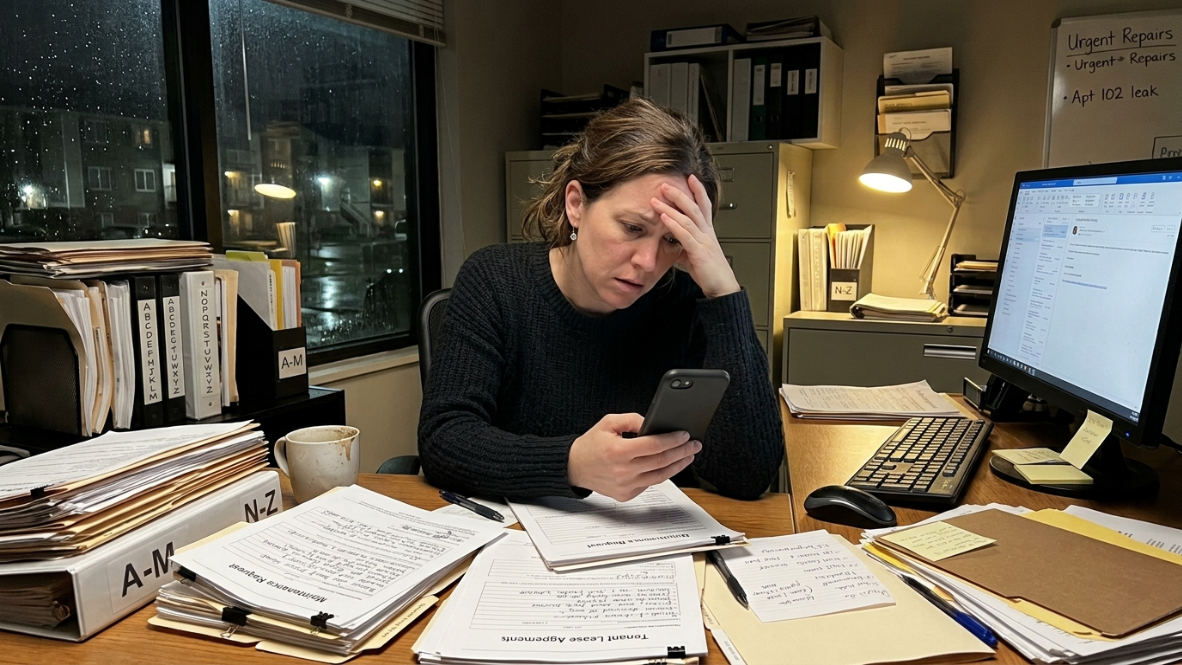
The push to replace property management call centers is not driven by fascination with AI. It’s driven by pain.
The Missed Call Problem Is Staggering
Property management companies have some of the highest missed call rates of any industry, with over 60% of calls going unanswered in many multifamily operations. A single missed leasing call can represent $15,000 to $30,000 in lost annual rent, depending on the property type and market.
And voicemail doesn’t save you. Approximately 80% of callers who reach voicemail hang up without leaving a message. They call the next property on their list instead. Voicemail captures less than 20% of the people you miss, which makes it a terrible safety net.
Response Speed Makes or Breaks Leasing
A Harvard Business Review study found that responding to a lead within five minutes makes you 100 times more likely to connect compared to waiting 30 minutes. Traditional call centers, with their queue times and callback workflows, rarely hit that window during peak leasing season.
Traditional Call Centers Break at Scale
Most property management teams route overflow calls to traditional call centers that use identical scripts for every tenant and every property. This works at 200 units. At 500 or 1,000 units, transfers fragment the tenant experience, response times stretch from minutes to hours, and context gets lost between handoffs.
Adding portfolios means adding agents, training, and quality assurance overhead, at $20 to $40 per qualified lead handled. The economics get worse as you grow, not better.
Manager Burnout Is Real
After-hours calls typically fall on property managers through rotating on-call schedules. There’s no off switch. A manager is tethered to their phone every night they’re on rotation, ready to handle anything from a flooded bathroom to a lockout. This is a recipe for burnout and high turnover. For a deeper look at solving this specific problem, see this guide on after-hours maintenance AI.
The “Second Inbox” Frustration
Practitioners in answering-service review threads consistently describe the same pain point: traditional call centers create a second inbox. Messages arrive by email or text, and someone on your team has to manually reconcile them, re-enter data into the PMS, and follow up. It doubles the administrative work instead of eliminating it.
The expectation has shifted. Property managers no longer want passive message capture. They want active operational execution: work orders created, vendors dispatched, tours booked.
Three Models for Replacing a PM Call Center
The question isn’t “should I replace my call center?” but “how far should I go?” Here are the three models, matched to portfolio size and operational readiness.
Model 1: After-Hours AI Overlay
How it works: AI handles calls only during nights, weekends, and holidays. Your existing team (or call center) handles daytime calls.
Best for: Property managers with 50 to 200 units who want to test AI with minimal risk. This is the easiest pilot because it doesn’t disrupt existing daytime workflows.
What changes: On-call rotations shrink or disappear. Emergency triage happens automatically. Morning teams arrive to find structured work orders already created, not a pile of voicemails.
Model 2: Hybrid, AI First-Contact With Human Escalation
How it works: AI answers every call, handles routine requests (which make up 70 to 85% of all inbound calls), and escalates complex or emotional situations to a human with full context. The tenant never has to repeat themselves.
Best for: Portfolios of 200 to 1,000 units where call volume makes it impractical to staff enough humans for instant response. This model gives you the speed of AI with the judgment of your team for edge cases.
What changes: Human staff shift from reactive call-answering to proactive property management. They handle only the 15 to 25% of calls that actually require human judgment. To understand how an AI maintenance coordinator fits into this model, that guide breaks down the workflow in detail.
Model 3: Full AI Replacement of Tier-1 Calls
How it works: AI handles 100% of tier-1 communication across maintenance, leasing, and general inquiries. Humans are involved only for escalated judgment calls, complex disputes, or situations requiring empathy that goes beyond what AI can deliver.
Best for: Large portfolios (1,000+ units) and operators who have already proven AI in a hybrid setup. Also works well for scattered-site portfolios where consistent service across many locations is hard to achieve with humans alone.
What changes: The call center contract goes away entirely. Operating costs drop significantly. But this model requires thorough testing of emergency triage, Fair Housing compliance, and escalation paths before going live.
Traditional Call Center vs AI Voice Agent at a Glance
Feature | Traditional Call Center | AI Voice Agent |
|---|---|---|
Answer speed | 20–90 seconds | Under 1 second |
Availability | Limited by staffing | 24/7 |
Wait queues | Yes | No |
Work order creation | Manual | Automatic |
PMS integration | Often limited | Native integrations |
Vendor dispatch | Manual | Automated |
Leasing tour booking | Usually transferred | Automatic |
Scalability | Hire more agents | Instant |
Language support | Depends on staffing | Multiple languages |
Cost per routine interaction | High | Low |
Cost Comparison: Traditional Call Center vs. AI

The economics of replacing a property management call center are straightforward, but the details matter because pricing models vary.
Traditional Call Center Pricing
Traditional call centers charge in several ways:
Per-minute: $0.75 to $1.50 per minute of talk time, with some specialized property management services charging up to $2.00 per minute
Per-unit: $1 to $3 per unit per month for property management-specific services
Per-call plans: Services like Smith.ai start at $292.50 per month for 30 calls, with overages of $9.75 to $11 per call. A busy leasing season can push costs past $1,400 monthly on a mid-tier plan.
Hidden costs: Agent turnover in call centers runs 30 to 45% annually. Each departing agent represents $10,000 to $20,000 in lost training investment, creating a cycle of continuous hiring that gets passed along as higher rates.
AI Voice Agent Pricing
AI alternatives use different pricing structures:
Flat monthly: $400 to $2,500 per month depending on portfolio size, call volume, and feature set
Per-minute: Per-minute platforms typically cost $0.07 to $0.15 per minute of call time
Cost per call: Some AI providers report effective costs of roughly $0.40 per call versus $7 to $12 per call for human-staffed centers
For a deeper breakdown of ROI across different portfolio sizes, see this analysis of AI property management benefits and ROI.
Break-Even Analysis
The break-even point depends on what you’re replacing:
AI vs. part-time human assistant: 15 to 30 units
AI vs. full-time hire: 50 to 80 units
Annual savings for a 100-unit portfolio: $28,000 to $56,000 compared to a full-time human property management assistant (whose all-in cost runs $40,000 to $60,000 per year)
These numbers explain why AI adoption among property management companies jumped from 21% in 2024 to 34% in 2025, according to the DoorLoop/NARPM 2025 report. Another 29% planned to adopt, leaving only 37% with no plans (down from 51% the year before).
ROI Calculator by Portfolio Size
This is excellent for snippets.
Portfolio Size | Estimated Annual Savings | Recommended AI Deployment |
|---|---|---|
25 Units | $6k–12k | After-hours AI |
50 Units | $15k–25k | Hybrid |
100 Units | $28k–56k | Hybrid |
250 Units | $70k–120k | AI-first |
500 Units | $140k–250k | AI-first |
1000+ Units | $250k+ | Full Tier-1 Automation |
What to Look for in an AI Call Center Replacement
Not all AI answering services are equal. The five capabilities below separate tools that actually replace a call center from tools that just add another layer of complexity.
1. Emergency Triage Accuracy
This is the highest-stakes feature. The AI must accurately separate a gas leak or flood from a dripping faucet, page the on-call technician for the former, and queue the latter as a morning work order. Getting this wrong has safety and liability consequences.
Before going live, test emergency triage extensively. For guidance on what to test and how, read this emergency maintenance triage guide.
2. PMS Integration Depth
Integration depth varies sharply across vendors. AI platforms with function calling and webhooks can book appointments and write work orders directly into your PMS. Budget answering services only email or text you a message log, which creates the exact “second inbox” problem you’re trying to escape.
The question to ask any vendor: “Does your AI take actions inside my PMS, or does it just send me messages?” If the answer is the latter, you haven’t replaced your call center. You’ve just automated the message-taking.
See how AI creates work orders in AppFolio for an example of what real PMS integration looks like.
3. Leasing Lead Capture With Tour Booking
Over 60% of calls to multifamily properties go unanswered. AI that answers leasing inquiries instantly, qualifies the lead, and books a tour without human involvement closes the gap between “interested renter” and “scheduled visit.” That gap is where most leasing revenue leaks out.
4. Vendor Dispatch
The AI should not just log maintenance requests. It should initiate the repair process by contacting your preferred vendors directly. This turns a call from a tenant into a dispatched work order in minutes, not hours.
5. Multi-Language Voice Support
In markets where many residents prefer Spanish or another language, a single AI agent can switch languages mid-call rather than routing to a separate team. This eliminates a common source of dropped calls and tenant frustration.
Additional Considerations
Beyond these five, look for conversation memory (so tenants don’t have to re-explain their issue on follow-up calls), Fair Housing compliance safeguards (especially for leasing conversations), and clear escalation paths for situations that genuinely need a human.
For property managers concerned about Fair Housing compliance with AI, that guide covers the specific risks and testing protocols.
AI Call Center Replacement Checklist
Before choosing a vendor, verify that it offers:
Native PMS integration
Emergency maintenance triage
Vendor dispatch automation
Leasing tour scheduling
CRM synchronization
Fair Housing safeguards
Call recording
Conversation summaries
Human escalation
Multi-language support
Analytics dashboard
Custom workflows
Call transcripts
Role-based permissions
API access
SOC 2 or equivalent security
Industry Benchmarks: How AI Stacks Up
Traditional call center performance is measured against well-established benchmarks:
Metric | Industry Standard | Typical AI Performance |
|---|---|---|
Average Speed to Answer | Under 20 seconds | Under 1 second |
Abandon Rate | Under 3% | Near 0% (no queue) |
First Call Resolution | 85%+ | 85%+ for routine calls |
Percentage of Calls That Are Routine | N/A | 70-85% (automatable) |
The speed advantage is dramatic. Human call centers aim for 20-second answer times and often miss it during peak hours. AI answers instantly, every time, with no hold music and no queue.
The industry data on AI outcomes supports the switch. According to the EliseAI 2025 State of AI in Multifamily survey, 77% of operators using AI reported moderate to significant reductions in operating expenses, while 85% saw measurable improvements in lead-to-lease conversion rates. Perhaps most telling: 78% of respondents admitted they had already lost new business opportunities to AI-enabled competitors.
For more on where the industry is heading, see this overview of AI property management trends.
Which Property Management Companies Benefit Most?
Best Fit
Multifamily operators
Student housing
Build-to-rent communities
HOA management companies
Single-family rental portfolios
Affordable housing
Mixed-use developments
Commercial property managers
Less Ideal
Luxury concierge properties with highly personalized service
Boutique firms receiving fewer than five calls per day
Portfolios without digital maintenance workflows
A Demographic Shift Is Accelerating the Change
There’s a generational factor that makes replacing property management call centers not just economically smart but increasingly necessary. According to the PwC/ULI Emerging Trends 2026 report, multifamily operators are finding that young adult residents actually prefer renting properties that use chatbots and AI for basic communications over those with a traditional onsite manager. As one industry observer summarized: “Young renters would rather deal with a good app than a person.”
This doesn’t mean human touch is irrelevant. It means the baseline expectation for routine interactions (submitting a maintenance request, asking about lease terms, scheduling a tour) is digital-first and instant. The call center model, built around phone queues and business-hours availability, is misaligned with how a growing share of renters want to communicate.
Common Mistakes When Switching
Replacing a property management call center goes wrong when teams skip the fundamentals. Here are the most common errors.
Choosing message-takers instead of action-takers. If the AI just sends you a text summary of the call, you haven’t replaced anything. You’ve added a middleman. Demand PMS integration that creates work orders, updates statuses, and dispatches vendors.
Ignoring PMS integration entirely. Without integration, every AI-handled call generates manual data entry. This defeats the purpose and often costs more time than the old system.
Skipping emergency triage testing before go-live. Emergency triage is the one thing you cannot afford to get wrong. Test it with realistic scenarios (gas leaks, flooding, lockouts, noise complaints) before routing real calls.
Not configuring escalation paths. Some calls need a human. Angry tenants, complex legal situations, sensitive fair housing scenarios. If you don’t define clear escalation triggers, the AI will try to handle things it shouldn’t.
Underestimating property-specific context. Every property has quirks: which vendors to call for what, which gates have codes, which units have known plumbing issues. The AI needs this context configured before launch. Generic setup leads to generic (and often wrong) answers.
Going from zero to full replacement overnight. Start with after-hours coverage or a single property. Build confidence with data before expanding.
Overcoming Skepticism and Barriers
The biggest barrier to replacing a property management call center isn’t technology. It’s trust. According to industry surveys, skepticism about reliability and accuracy is the number one barrier at 40%, up from 34% in 2024. Other concerns include preference for the status quo (38%), lack of familiarity with AI (35%), privacy and data security (33%), and ethical or bias concerns (28%).
These concerns are legitimate. Removing the human touch entirely can jeopardize the kind of customer experience that differentiates smaller businesses from larger competitors. The hybrid model exists specifically for this reason: AI handles the 75 to 85% of calls that are repetitive and rule-based, while humans step in for the moments that require empathy, judgment, or nuance.
Fair Housing compliance deserves specific attention. AI systems used in leasing conversations must be tested to avoid discriminatory treatment, whether through biased language, inconsistent information delivery, or selective availability. This is not optional. It’s a legal requirement.
Explore Haven’s AI agents to see how these concerns are addressed in a property management-specific platform.
Signs You're Ready to Replace Your Call Center
Staff regularly miss leasing calls
Managers rotate after-hours phones
Maintenance requests require manual entry
Vendors are dispatched manually
Call volume spikes during leasing season
Existing answering service only sends messages
Staff spend hours returning voicemails
Leasing response time exceeds five minutes
Occupancy depends heavily on phone leads
Portfolio growth requires hiring more coordinators
Migration Timeline
Week | Activity |
|---|---|
Week 1 | Configure property information |
Week 2 | Connect PMS |
Week 3 | Test emergency scenarios |
Week 4 | Pilot after-hours calls |
Month 2 | Expand to leasing |
Month 3 | Full deployment |
FAQ
Can AI fully replace a property management call center?
For routine tier-1 communication, yes. AI handles 70 to 85% of inbound property management calls without human involvement, including maintenance requests, leasing inquiries, and general questions. Complex or emotionally charged situations still benefit from human escalation. Most property managers find a hybrid model, where AI handles first contact and escalates when needed, delivers the best results.
How much does it cost to replace a PM call center with AI?
AI voice agents for property management typically cost $400 to $2,500 per month depending on portfolio size and features. Per-minute AI platforms run $0.07 to $0.15 per minute. Compare that to traditional call centers at $0.75 to $1.50 per minute or $1 to $3 per unit per month. A 100-unit portfolio switching from a human assistant to AI saves an estimated $28,000 to $56,000 annually.
What size portfolio needs an AI answering service?
The break-even point is approximately 15 to 30 units when comparing AI to a part-time human assistant, and 50 to 80 units when comparing to a full-time hire. Even smaller portfolios benefit if they’re experiencing high missed-call rates or property manager burnout from on-call rotations.
Is AI safe for Fair Housing compliance?
AI can be compliant, but it requires deliberate testing and configuration. AI leasing agents must provide consistent information to every caller regardless of protected characteristics, and they must be regularly audited for discriminatory patterns. The advantage of AI is that it follows the same script every time, eliminating the human variability that often causes Fair Housing violations. The risk is that biased training data or poorly designed prompts can introduce systematic discrimination. Thorough testing before deployment is essential.
What’s the difference between an AI answering service and an AI call center replacement?
An AI answering service picks up the phone and takes a message. An AI call center replacement takes action: it creates work orders in your PMS, dispatches vendors, books tours, qualifies leads, and follows up with tenants. The distinction between message-taking and action-taking is the single most important factor when evaluating vendors.
How long does it take to switch from a traditional call center to AI?
Most implementations take two to four weeks, including property-specific configuration, PMS integration setup, emergency triage testing, and a pilot period on a subset of properties or during after-hours only. Full portfolio rollout typically follows within 30 to 60 days.
Will tenants know they’re talking to AI?
Modern voice AI is conversational enough that many tenants don’t notice or don’t care, particularly for routine requests. The PwC/ULI Emerging Trends 2026 report found that younger renters actually prefer digital-first communication for basic interactions. Transparency is good practice, though. Disclosing that calls are handled by an AI assistant builds trust and may be required in some jurisdictions.
What happens during an emergency if AI is handling calls?
Properly configured AI performs emergency triage on every call. It identifies true emergencies (gas leaks, flooding, fire, break-ins) based on the caller’s description, immediately pages the on-call technician or emergency contact, and provides the caller with safety instructions. Routine requests are queued as morning work orders. This triage accuracy is the single most important capability to test before going live.
Ready to see how AI handles your property’s calls? Book a demo with Haven to hear the difference between message-taking and action-taking.