AI Work Order Creation in AppFolio: 2026 Playbook
Explore AI work order creation in AppFolio for 2026: native vs third-party, workflow, triage, and vendor dispatch. Get tips and book a demo.

TL;DR
AI work order creation in AppFolio means an AI agent automatically generates a maintenance work order from a tenant’s phone call, text, or portal request, without manual data entry by staff. AppFolio offers native tools like the Realm-X Maintenance Performer, but third-party AI agents fill critical gaps around voice calls, SMS intake, and multi-language support. This guide defines every key term, walks through the actual workflow, and honestly addresses the limitations practitioners report.
A typical 300-unit portfolio generates 30 to 50 maintenance requests per week. Without automation, that volume requires a full-time maintenance coordinator just for triage and dispatch alone. That math is why AI work order creation inside AppFolio has gone from novelty to operational necessity.
But the term gets thrown around loosely. Vendors use it to mean different things. AppFolio’s own tools have evolved rapidly, with Smart Maintenance giving way to Realm-X Maintenance Performer. And third-party AI agents now write work orders directly into AppFolio through its API. If you’re a property manager trying to figure out what actually works, the confusion is understandable.
This guide cuts through it. Every key term defined, the real workflow explained step by step, and honest practitioner feedback included, not just marketing claims.
Book a demo to see how Haven’s AI agents create work orders inside AppFolio.
Direct Answer: What is AI Work Order Creation in AppFolio?
AI work order creation in AppFolio is the automated process where an AI system converts tenant maintenance requests (from phone, SMS, email, or portal) into structured work orders inside AppFolio without manual staff input. The AI classifies the issue, determines urgency, collects missing details (like unit number, photos, and access permission), and routes or assigns the job to the appropriate vendor.
It reduces coordination workload, speeds up emergency response, and improves dispatch accuracy—but performance depends on whether requests come through AppFolio’s portal (native AI) or external channels (third-party AI agents via API).
What Is AI Work Order Creation?
AI work order creation is the automated generation of a maintenance work order inside a property management system by an AI agent. The trigger is a tenant request, whether it comes via phone, text, chat, or portal. The result is a fully structured work order in your PMS, created without manual data entry by your staff.
This is not the same as a tenant filling out a digital form on a portal. The AI layer adds three things that a basic form cannot:
Triage. The AI assesses urgency, distinguishing a gas leak from a squeaky hinge.
Classification. It categorizes the issue (plumbing, electrical, HVAC, appliance) so the right vendor gets assigned.
Structured data capture. It asks follow-up questions to collect unit number, location within the unit, photos, and permission-to-enter, then writes all of that into the correct fields.
The Four Stages
Every AI work order creation system, whether native to AppFolio or third-party, follows roughly the same flow:
Intake → The tenant contacts you through any channel. The AI engages in a conversation to understand the problem.
Triage → The AI determines urgency. Emergency issues like flooding or gas leaks get flagged for immediate escalation. Routine requests get queued normally.
Work order generation → The AI creates the work order inside AppFolio with structured fields: property ID, unit ID, job description, priority level, and any attached photos.
Vendor dispatch → Optionally, the AI assigns the work order to the correct vendor from your preferred vendor list, without staff intervention.
For AppFolio users specifically, this matters because 98% of AppFolio customers are already actively using one or more AI-native capabilities within the platform. The question is no longer whether to use AI for work orders, but which approach fits your operation.
For a broader look at how maintenance AI triage creates ROI, that guide breaks down the numbers.
End-to-End AppFolio AI Work Order Workflow (Visual Breakdown)
This is how AI work order creation actually flows in AppFolio environments:
Step-by-Step Workflow
Tenant submits request (phone, SMS, portal, email)
AI intake system captures issue details
Follow-up questions collect missing data
AI classifies maintenance type
AI determines urgency level
Work order is structured and validated
Work order is created in AppFolio via native system or API
Vendor assignment occurs automatically or manually
Status updates are synced back to tenant and manager
Why AI Work Order Creation Matters in Property Management
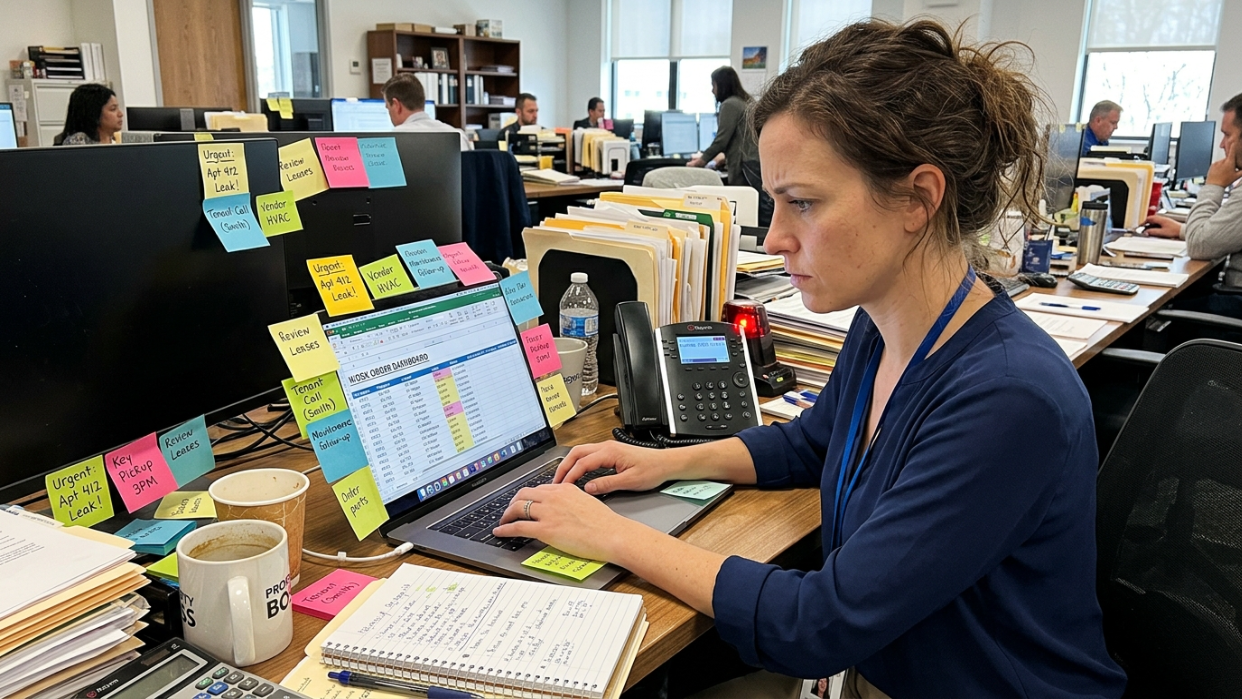
AI work order creation is becoming a core operational layer in modern property management because maintenance coordination is one of the largest hidden cost centers in rental operations.
Most property managers underestimate the volume impact:
Typical Maintenance Load by Portfolio Size
Portfolio Size | Avg Weekly Work Orders | Monthly Work Orders | Staffing Pressure |
|---|---|---|---|
100 units | 10–20 | 40–80 | Part-time admin |
300 units | 30–50 | 120–200 | Full-time coordinator |
1,000 units | 100–200 | 400–800 | Dedicated maintenance team |
AI reduces this load by automating:
intake conversations
triage decisions
work order creation
vendor assignment
Key Terms Glossary
AppFolio Smart Maintenance
AppFolio Smart Maintenance is an automated maintenance request system that provides a 24/7 call service, logs tenant requests, and assigns vendors based on pre-set lists. It was AppFolio’s first significant step toward AI work order creation.
How it works: Tenants call the hotline or submit a request online. The system assesses urgency, auto-assigns the work order to a vendor, and notifies the property manager.
What practitioners actually report: The reviews are mixed. On BiggerPockets, a property manager shared that they noticed the Smart Maintenance option while switching to AppFolio, calling it “a cool idea if it works well.” That uncertainty captures the common sentiment.
The real problems surface in day-to-day use. Property managers report that vendors receive little context about the work orders assigned to them, leading to rejected jobs or incomplete repairs. The system sometimes misdiagnoses issues entirely. One practitioner noted on a bookkeeping blog that if you require detailed troubleshooting, strong vendor communication, and cost efficiency, Smart Maintenance “may fall short.”
Bottom line: Smart Maintenance works as a basic intake and dispatch layer. It struggles with nuance, troubleshooting depth, and multi-issue requests.
Realm-X Maintenance Performer
AppFolio’s latest-generation agentic AI for maintenance workflows, designed to replace the limitations of Smart Maintenance.
The Maintenance Performer “self-sufficiently diagnoses and prioritizes resident maintenance requests with the ability to detect issues via image, create work orders, and log summaries,” according to AppFolio. Built into the Online Resident Portal and Contact Center, it acts as an AI coordinator that responds to residents and handles dispatch.
Key upgrade over Smart Maintenance: The Maintenance Performer adds computer vision, analyzing photos that tenants upload to identify the type and severity of an issue. It also integrates with Realm-X Flows for multi-step workflow automation.
The limitation nobody talks about: The Maintenance Performer handles requests through the AppFolio portal and contact center. But many residents, especially older renters, Spanish-speaking tenants, and single-family rental occupants, prefer to call or text directly. If your tenants don’t use the portal, the native AI never sees their requests.
Realm-X Flows
Realm-X Flows is AppFolio’s workflow automation engine. It standardizes property management processes and increases the speed and consistency of execution.
For work orders specifically, Flows lets you insert AI Performers into specific steps of a workflow. A step that once required your team to manage (like helping a resident troubleshoot a maintenance issue before creating a work order) can be assigned to a Performer to handle autonomously.
Think of Flows as the connective tissue. The Maintenance Performer handles the AI conversation. Flows defines the sequence of what happens next.
AppFolio Stack API (Work Order Endpoints)
The AppFolio Stack API is the official framework that allows third-party tools to programmatically create, read, and update work orders inside AppFolio.
Key data fields exposed by the API:
Id — unique identifier of the work order
PropertyId — which property the request belongs to
UnitId — the specific unit
Statuses — e.g., “completed,” “in progress”
JobDescription — the AI-generated summary of the issue
AssignedUsers — who’s handling it
Priority — e.g., “urgent,” “normal”
This is what makes AI work order creation in AppFolio possible for external tools. Without the API, third-party agents would need screen-scraping or manual entry, both unreliable. The ecosystem is growing quickly, with AppFolio Stack permitting operations like uploading attachments, creating work orders, and updating maintenance records.
For more on how AppFolio’s AI ecosystem fits together, the AppFolio AI integration glossary covers the full picture.
Emergency Triage and Urgency Detection

A sub-function of AI work order creation where the AI determines whether a request is an emergency or routine.
Emergency issues like water leaks or gas smells get flagged and escalated immediately. Routine requests like a dripping faucet are categorized, prioritized, and queued for the next available technician. The difference matters enormously. A missed gas leak notification creates liability. An over-escalated dripping faucet wastes vendor time and money.
Good emergency maintenance triage systems use keyword detection, follow-up questions, and escalation rules to get this right. Poor ones just pattern-match on a few words and guess.
Vendor Dispatch Automation
The AI’s ability to automatically assign a work order to the correct vendor from a preferred vendor list, without staff intervention.
AppFolio’s Maintenance Performer can dispatch work to your in-house team or to external vendors through the Lula Vendor Network, an AppFolio Stack partner. You choose which work order types to outsource, and dispatch happens automatically.
The catch: dispatch is only as good as the classification that precedes it. If the AI misidentifies a plumbing issue as an appliance problem, the wrong vendor shows up. This is where vendor relationship management becomes critical.
Third-Party AI Agents for AppFolio Work Orders
Multiple vendors now integrate with AppFolio via API to create work orders from AI-driven conversations. These tools typically handle the channels that AppFolio’s native AI does not cover well: inbound phone calls, SMS messages, and email.
Examples include Frontdesk (My AI Front Desk), which triages calls, texts, and chats, then creates an AppFolio work order with live escalation for emergencies. RentCheck offers work order integration for inspection-driven maintenance. Wrk, Scaalr, and Domos AI also connect to AppFolio for maintenance automation.
Haven’s Maintenance AI takes a voice-first approach, handling phone, SMS, and email intake, then writing structured work orders directly into AppFolio through its PMS integration.
Work Order Data Fields
What actually gets written into AppFolio matters more than most property managers realize. The standard fields include property ID, unit ID, job description, priority level, assigned users, and status. But the quality difference between AI tools shows up in what fills those fields.
A well-built AI captures specific location within the unit, detailed issue description, photos, permission-to-enter status, and tenant contact preferences. A poorly built one writes “kitchen issue” in the job description and calls it done. Vendors reject work orders that lack context. Data quality is the real bottleneck.
How AI Work Order Creation Actually Works in AppFolio
There are two distinct paths for AI work order creation in AppFolio. Understanding both is essential for choosing the right setup.
Path 1: Native (Realm-X Maintenance Performer)
A tenant logs into the AppFolio resident portal or calls the AppFolio contact center.
The Maintenance Performer engages in conversation, asking about the issue and requesting photos.
Computer vision analyzes uploaded images to identify the problem type and severity.
The AI creates a work order with a logged summary, classification, and priority level.
If configured, the system dispatches the work order to a vendor from your preferred list.
The property manager receives a notification and can review or override.
This path works well for tenants who use the portal. It falls short for tenants who call your office line directly, text your team’s phone number, or email maintenance requests.
Path 2: Third-Party AI Agent via AppFolio API
A tenant calls, texts, or emails. The AI agent (running outside AppFolio) picks up.
The agent conducts a structured conversation: what’s the issue, where exactly, how urgent, can we enter the unit?
For emergencies, the agent escalates immediately to on-call staff.
For routine requests, the agent writes a work order into AppFolio through the Stack API, populating PropertyId, UnitId, JobDescription, Priority, and any attachments.
Vendor dispatch can be triggered automatically or left for staff review.
The AI follows up with the tenant after work completion.
This path handles the channels that AppFolio’s native AI misses. It’s especially valuable for after-hours maintenance when your office is closed but tenants still call.
Native vs. Third-Party AI: When You Need Each
AppFolio’s Realm-X Maintenance Performer is a strong tool that keeps improving. But it has a specific coverage area, and pretending otherwise leads to gaps in your maintenance workflow.
What AppFolio’s native tools handle well
Portal-based maintenance requests from tenants who are comfortable with digital self-service
Image-based diagnostics when tenants upload photos through the portal
Workflow automation through Realm-X Flows for multi-step processes
Vendor dispatch through integrated partners like the Lula Vendor Network
AppFolio reports that 75% of Realm-X users agree the technology reduces busywork, saving users 10-plus hours per week. For portal-active tenant populations, those savings are real.
Where third-party AI agents fill the gap
Phone calls. Many tenants, especially in single-family rentals and senior housing, prefer calling. The Maintenance Performer doesn’t answer your office phone line.
SMS and email. Tenants who text “my toilet is overflowing” to your company number need an AI that reads and responds on that channel.
Multi-language support. Spanish-speaking tenants and other non-English speakers need AI that can conduct intake in their language.
After-hours coverage. When your office is closed at 11 PM and a tenant calls about a burst pipe, the AI agent that answers that call is the one that matters.
A 2023 survey found that 36% of property management employees’ time is spent on “busy work.” The goal isn’t choosing native or third-party. It’s covering every channel where tenants actually reach out.
Decision framework
Factor | Native AppFolio AI | Third-Party AI Agent |
|---|---|---|
Portal requests | Strong | Not needed |
Phone calls | Limited to contact center | Full coverage |
SMS/email intake | Limited | Full coverage |
Multi-language | Limited | Varies by vendor |
Image diagnostics | Yes (computer vision) | Depends on vendor |
API work order creation | Native | Via AppFolio Stack API |
Vendor dispatch | Yes (Lula network) | Yes (preferred vendor lists) |
After-hours coverage | Portal only (24/7) | Phone, SMS, email (24/7) |
For many property managers, the right answer is both. Use the Maintenance Performer for portal traffic, and a third-party AI agent for everything else. Check Haven’s integration options to see how this works in practice.
AppFolio AI Work Order Automation: Which Setup Should You Use?
Most property managers don’t need to choose between native and third-party AI—they need both.
Recommended Setup by Portfolio Type
Portfolio Type | Best Setup |
|---|---|
Portal-heavy (younger renters) | AppFolio Realm-X Maintenance Performer |
Mixed communication channels | Hybrid (Native + API AI agent) |
Call-heavy operations | Third-party AI agent + AppFolio API |
Multilingual tenant base | Third-party AI with language support |
Practical Rule
If >60% of requests come through the portal → native AI is enough
If requests come via phone/SMS/email → third-party AI is essential
Common Pitfalls and What to Watch For
AI work order creation in AppFolio is not plug-and-play. Practitioners report specific, recurring problems that deserve attention before you commit to any tool.
The multi-issue problem
A BBB complaint from March 2026 captured this clearly: a tenant needed three types of maintenance addressed, but the AI “focused only on one, removed all the details included, and unilaterally ended the chat window and submitted an incomplete report.” The AI was incapable of handling more than a single issue at a time.
This is a real limitation. If your tenants tend to batch maintenance requests (common in older buildings), make sure your AI tool can handle multiple issues in a single conversation and create separate work orders for each.
Misdiagnosed issues and wrong vendor assignments
Because AI classification isn’t perfect, vendors sometimes show up for the wrong job. A plumbing issue gets classified as an appliance problem. A water heater complaint turns out to be a building plumbing issue. The vendor wastes a trip, the tenant gets frustrated, and you get a call anyway.
The fix is troubleshooting depth. The best AI systems ask follow-up questions, suggest self-fixes when appropriate, and only create a work order when genuinely needed. Systems that skip this step generate unnecessary work orders.
Vendor communication gaps
Even when the classification is correct, vendors often receive work orders with minimal context. No photos, no location specifics, no notes about access. This leads to rejected jobs, return visits, and higher costs.
Before going live with any AI work order system, review the actual work orders it generates. Are the job descriptions specific enough for a vendor to show up prepared? Do they include permission-to-enter flags?
Over-automation without quality control
With the Maintenance Performer and Smart Maintenance active, practitioners report that the coordinator role shifts to oversight and quality control. The AI handles intake, routing, and billing. The human handles vendor relationships and capital projects.
This is healthy. But some teams turn on automation and stop checking. Without regular QA on AI-created work orders, errors compound. A maintenance AI implementation guide can help structure the rollout so quality doesn’t slip.
Data quality as the real bottleneck
Garbage in, garbage out. If the AI doesn’t capture structured data during intake, the work orders it creates will be vague and unhelpful. The quality of AI-generated work orders in AppFolio depends entirely on how well the AI conducts the intake conversation.
Look for systems that capture: issue type, specific location within the unit, severity/urgency, photos, permission to enter, and tenant preferred contact times. If those fields are empty, you have a data quality problem, not an AI problem.
For a comprehensive list of common maintenance AI mistakes and how to fix them, that guide goes deeper.
FAQ
Can AI create work orders in AppFolio without any human review?
Yes, technically. Both the Realm-X Maintenance Performer and third-party AI agents can create work orders autonomously. But most property managers keep human review in the loop, at least initially. The AI handles intake and creation; a coordinator reviews for accuracy before vendor dispatch. As confidence grows, many teams move to full automation for routine requests while keeping human review for high-priority or ambiguous ones.
Does the Realm-X Maintenance Performer handle inbound phone calls?
It handles calls through the AppFolio Contact Center, but it does not answer your office phone line directly. Tenants who call your main number, text your team, or email maintenance requests won’t reach the Maintenance Performer unless those channels are routed into AppFolio’s system. This is the primary reason property managers add third-party AI agents to cover phone and SMS channels.
What API fields does AppFolio expose for work orders?
The AppFolio Stack API exposes: Id, PropertyId, UnitId, Statuses, JobDescription, AssignedUsers, and Priority. Third-party tools can also upload attachments. These fields determine what information appears on the work order your vendor receives, so the completeness of AI-captured data directly impacts vendor success rates.
How do third-party AI agents connect to AppFolio?
Through the AppFolio Stack API. The third-party agent conducts the tenant conversation on its own platform (phone, SMS, or email), captures structured data, then writes the work order into AppFolio programmatically. No screen-scraping, no manual entry. The work order appears in AppFolio just as if a staff member had created it.
Is AppFolio Smart Maintenance the same as the Realm-X Maintenance Performer?
No. Smart Maintenance is the older system focused on call intake and basic vendor assignment. The Realm-X Maintenance Performer is AppFolio’s next-generation agentic AI with image-based diagnostics, better triage logic, and integration with Realm-X Flows. Think of Smart Maintenance as version 1.0 and the Maintenance Performer as version 2.0.
What size portfolio benefits most from AI work order creation in AppFolio?
The ROI scales with volume. A 300-unit portfolio generating 30 to 50 maintenance requests weekly sees the clearest benefit, as that volume would otherwise require a full-time coordinator just for triage. But even smaller portfolios benefit from after-hours coverage and emergency triage, where the cost of a missed call can far exceed the cost of the AI tool.
How accurate is AI urgency detection for maintenance requests?
Accuracy varies by system. Keyword-based urgency detection (looking for words like “flood,” “gas,” “fire”) catches obvious emergencies but misses subtle ones. More advanced systems use conversational follow-up questions to confirm severity before escalating. No system is perfect, which is why most include a live escalation path to on-call staff for anything flagged as an emergency.
Can AI handle maintenance requests in languages other than English?
AppFolio’s native tools have limited multi-language support. Third-party AI agents vary. Some, including Haven, offer multi-language voice agents that can conduct intake conversations in Spanish and other languages, then write the work order into AppFolio in English. For portfolios with diverse tenant populations, this is a significant factor in tool selection.
AI work order creation in AppFolio is real, it’s improving fast, and it genuinely reduces the operational burden on property management teams. But it’s not magic. The tools have specific strengths, specific gaps, and specific failure modes that matter for your daily operations. Know the terms, understand the workflow, and choose the combination of native and third-party tools that covers how your tenants actually communicate.
See Haven’s AI agents in action with a live demo.