Maintenance AI and Vendor Relations: 2026 Operator Playbook
Learn how Maintenance AI and Vendor Relations streamlines 24/7 intake, compliance-first dispatch, and KPI tracking to boost first-trip fixes. See how.

TL;DR
Maintenance AI and vendor relations describes how AI agents handle tenant maintenance requests around the clock, triage urgency, create work orders in your PMS, and dispatch credentialed vendors from a preferred list, all while tracking performance that strengthens vendor partnerships over time. The biggest ROI comes not from deflecting tickets but from accurate intake, fast assignment, and first-trip completion. This guide explains the full loop, the KPIs that matter, and what to do next.
At a Glance: The ROI of AI-Driven Maintenance
What is the primary benefit of Maintenance AI? The most significant ROI of Maintenance AI in 2026 is the optimization of First-Trip Completion (FTC) rates. By utilizing 24/7 intelligent intake and automated compliance gates, operators reduce "empty" vendor trips, lower after-hours surcharges by an average of 30-40%, and decrease resident churn caused by maintenance delays.
Key Outcomes:
24/7 Triage: Immediate emergency detection without human call-center overhead.
Automated Compliance: 100% enforcement of COI and trade licenses at the point of dispatch.
Performance Data: Transitioning from "gut-feel" vendor selection to data-driven tiering.
What “Maintenance AI and Vendor Relations” Actually Means
Here is the working definition a site-level property manager would recognize:
Maintenance AI and vendor relations refers to AI-powered intake and triage that turns tenant requests into PMS work orders 24/7, then dispatches credentialed, preferred vendors with compliance checks, SLAs, and post-repair follow-ups that strengthen vendor partnerships over time. It reduces after-hours chaos, speeds assignments, and makes vendor performance measurable.
That definition has several moving parts. In practice, the concept covers five things happening together:
Always-on intake through voice, SMS, and email, with emergency detection and guided troubleshooting
PMS actions like creating work orders, adding notes, and assigning tickets automatically
Compliance gates that block dispatch when a vendor’s COI or license has lapsed
Intelligent dispatch from a preferred vendor list based on trade, proximity, availability, price, and past performance
Post-completion follow-ups and vendor scorecards that feed back into future dispatch decisions
PMS-native examples include AppFolio’s Smart Maintenance paired with the Lula Vendor Network for automated vendor outsourcing and dispatch, and credentialing platforms like RealPage Vendor Credentialing and Yardi VendorCafe for compliance control at scale.
Why Maintenance AI and Vendor Relations Matters Right Now
Three forces are converging to make this more than a nice-to-have.
Resident expectations have shifted permanently
According to Zendesk’s CX Trends 2026 data, 74% of consumers now expect 24/7 service availability, and 88% expect faster response times than they did a year ago. Tenants are consumers. They text their landlord at 11pm and expect something to happen before morning. Traditional office-hours workflows can’t keep up, and the gap between expectation and response is where dissatisfaction (and turnover) lives.
Maintenance costs keep climbing
Repairs and maintenance expenses rose 13.8% in 2024 across a LIHTC property sample tracked by Novogradac, outpacing many other operating expense lines. When every service call costs more, getting the right vendor to the right unit on the first trip matters enormously for NOI.
Skilled trades are in short supply
The Angi 2024 Skilled Trades report documents persistent shortages and demographic pressure across plumbing, HVAC, and electrical trades. Fewer available contractors means the ones you have are more valuable. Strong vendor relationships, backed by fast assignments and fair treatment, are what keep your best contractors answering the phone.
How It Works: The AI-to-Vendor Relations Loop
The core of maintenance AI and vendor relations is a feedback loop. Each step feeds the next, and the quality of the loop improves over time. Here is how each stage works.
Step 1: Intake and Triage
AI captures tenant requests 24/7 via phone, SMS, and email. The system identifies emergencies (no heat below 40°F, active water leaks, gas smells, electrical hazards), collects details like photos and access instructions, and creates a structured work order in the PMS.
This step matters more than most operators realize. Property Meld’s 2026 Maintenance Forecast data shows that intake accuracy, meaning the completeness and correctness of the initial request, directly drives downstream outcomes like first-trip completion rates, invoice costs, and tenant satisfaction. A vague “something’s leaking” work order leads to wasted trips. A structured one with unit number, photos, and access notes leads to a fix.
For a deeper look at how emergency detection works in practice, see this guide to emergency maintenance triage.
Step 2: Compliance Gate
Before any vendor receives a job, the system checks credential status. Is their general liability insurance current? Is their trade license valid in this jurisdiction? Is their W-9 on file?
This is the step most teams skip or do manually, and it creates real liability exposure. NetVendor’s compliance guide makes a strong case for treating compliance as a hard stop rather than an afterthought. If a vendor’s COI lapsed last Tuesday and they cause damage on a job dispatched today, the property manager owns that risk.
The right approach: put the compliance check in front of assignment, not after. Configure your PMS or AI agent to block dispatch to any vendor with an expired credential. No exceptions.
Step 3: Dispatch from the Preferred Vendor List
With compliance confirmed, the system selects a vendor based on trade specialty, geographic proximity, availability, price, and historical performance score. The vendor gets the job details, access instructions, and SLA expectations pushed to them automatically.
This is where maintenance AI and vendor relations starts to pay off in ways traditional dispatch can’t match. A human coordinator working the phone at 2am is making gut calls. An AI agent is pulling from structured data, vendor scorecards, and real-time availability.
PMS ecosystems increasingly support this. For example, AppFolio users can integrate automated dispatch workflows directly with their work order and vendor management systems. The full end-to-end workflow, from request intake to vendor assignment, is covered in detail in this maintenance AI workflows guide.
Step 4: Execute and Track
Once the vendor is dispatched, the system tracks key execution metrics:
On-time arrival (did they show up within the SLA window?)
First-trip completion (was the issue resolved without a return visit?)
Parts needs (did they need to order something and come back?)
Message count (how many back-and-forth messages were needed?)
That last one is underrated. Property Meld’s data suggests that higher message volume on a work order correlates with lower satisfaction and higher churn risk. The “ten-message rule” is a useful quality bar: if a routine repair requires more than ten messages between all parties, something broke down in the intake or assignment.
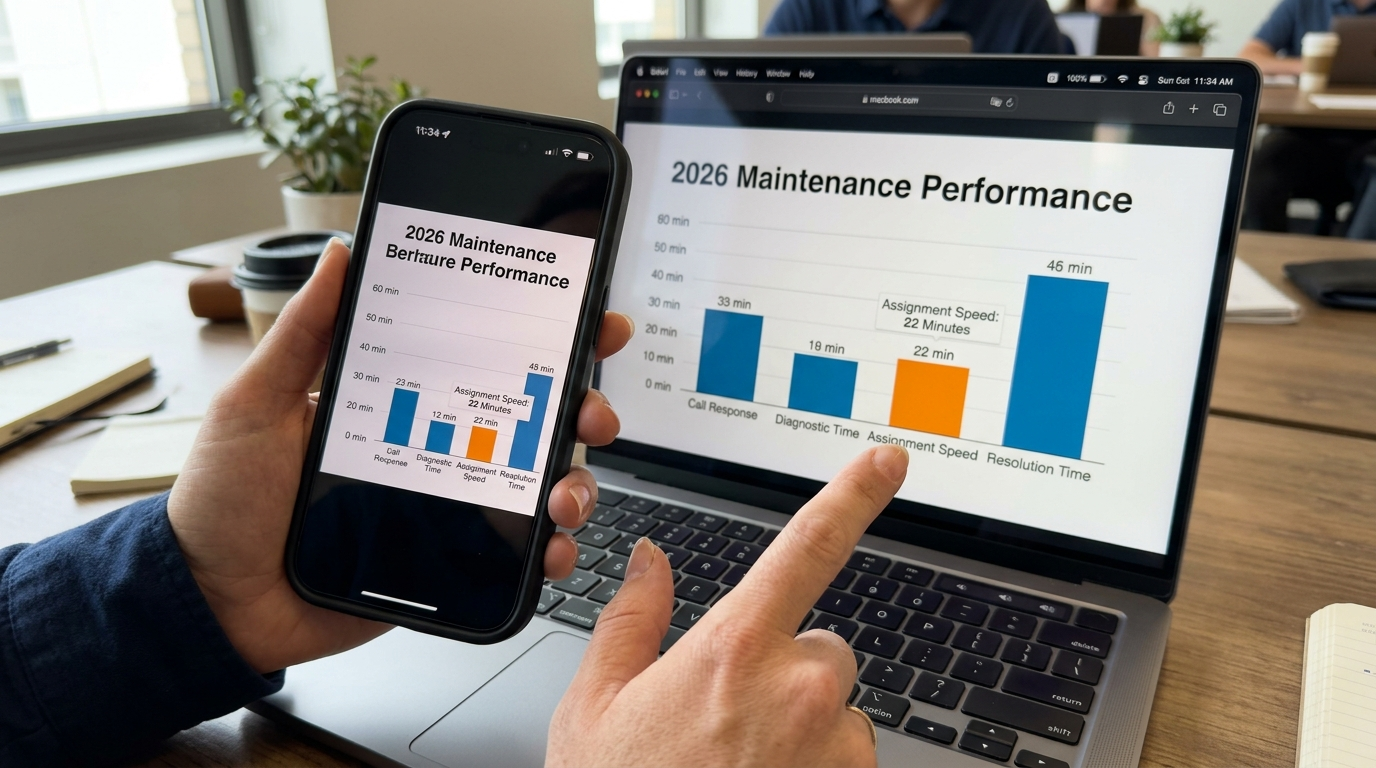
Recommended Data Table: 2026 Performance Benchmarks
Metric | Industry Standard (Manual) | AI-Optimized Target | Business Impact |
Assignment Speed | 4–12 Hours | < 30 Minutes | Reduces tenant anxiety & churn |
First-Trip Completion | 65% | 85%+ | Lowers total invoice cost |
On-Time Arrival | 78% | 95% | Increases vendor accountability |
Admin Hours per Ticket | 45 Minutes | 5 Minutes | Reclaims staff time for leasing |
Compliance Accuracy | 80% (Manual checks) | 100% (Auto-gate) | Eliminates liability risk |
Step 5: Score and Learn
After the work is done, the system collects a resident satisfaction rating, compares the invoice to the original estimate, and updates the vendor’s scorecard. These scores feed back into Step 3, so the next dispatch decision is better than the last one.
This is the loop. It gets smarter over time, but only if you’re actually tracking and using the data. For more on how post-work follow-ups close this loop with tenants, that guide walks through the mechanics.
What AI Changes (and What It Won’t Fix)
What AI makes easier
Faster handoffs. AI intake normalizes descriptions and creates complete work orders so emergencies don’t sit in an inbox until Monday morning.
Compliance enforcement at the point of assignment. No more discovering after the fact that a vendor’s insurance lapsed.
Data-driven vendor selection. Instead of defaulting to whoever the coordinator knows, dispatch decisions draw on actual performance history.
Lower after-hours costs. Traditional answering services for property management commonly bill $175 to $470 per month as a base, plus per-minute fees in the $1.00 to $1.90 range, with surcharges on holidays and weekends. AI intake offers flat-rate 24/7 coverage with structured data output that feeds directly into dispatch. That cost structure difference alone is a common reason teams explore AI as an alternative to call centers.
What AI won’t fix
Don’t bank on huge “self-solve” gains. The idea that AI chatbots will resolve most maintenance requests without sending a vendor is appealing, but it’s not supported by current data. Property Meld’s 2026 benchmarks show modest incremental impact from self-solve. The bigger wins come from better intake accuracy, faster assignment, and higher first-trip completion rates.
In other words, the ROI of maintenance AI and vendor relations is not about avoiding dispatch. It’s about making every dispatch count.
AI vs. Traditional Answering Services: Cost & Efficiency
While traditional answering services provide a human voice, they often lack the technical integration to solve problems.
Answering Services: Often result in "transcription only," requiring a property manager to re-read and manually dispatch in the morning.
Maintenance AI: Executes the "Intake-to-Dispatch" loop in real-time. By the time a manager logs in at 8am, the vendor is already on-site or scheduled, saving an average of 3-5 hours of administrative lag per emergency.
Best Practices for Vendor Relations in an AI Workflow
Build a tiered vendor pool
Not every vendor should get the same volume or the same jobs. A tiered structure works:
Tier 1 (Strategic Partners): High-volume, high-trust vendors with proven track records. They get first crack at jobs in their trade and geography. Monthly scorecard reviews.
Tier 2 (Preferred): Reliable vendors with solid compliance who fill gaps when Tier 1 is unavailable. Quarterly reviews.
Tier 3 (Approved): Credentialed and available, but haven’t earned volume yet. Used for overflow or specialized trades.
OxMaint’s vendor management guide outlines this tiering approach with specific SLA thresholds and gap analysis frameworks. The principle is simple: reward reliability with volume, and make the criteria transparent so vendors know how to move up.
Embed SLAs with real consequences
SLAs without consequences are suggestions. Effective vendor programs tie performance to work volume. If a Tier 1 HVAC vendor consistently misses the 2-hour emergency response window, they lose Tier 1 status. If a Tier 2 plumber hits 95% on-time arrival for six months, they earn an upgrade. The AI system should automate this scoring so it isn’t dependent on a coordinator’s memory.
Pay on time
This sounds obvious, but it’s a common friction point. AppFolio’s research on strengthening vendor relationships highlights that vendors increasingly prefer eCheck payments and consistent payment timelines. Paying net-15 instead of net-45 is one of the cheapest ways to stay at the top of a good contractor’s priority list.
Track KPIs monthly
The numbers that matter for vendor relations powered by AI:
Assignment speed (request to vendor assigned): This is the lead indicator. Practitioners report that churned residents often had slower assignment times.
Emergency arrival SLA adherence
On-time arrival rate: Target 90% or higher
First-trip completion rate
Callback/rework rate: Target 5% or less
Invoice variance to estimate: Target 2% or less
COI/license compliance rate: 100%, non-negotiable
Post-service tenant satisfaction rating
Message count per work order (lower is better)
These thresholds are drawn from practitioner frameworks and reflect what high-performing vendor programs actually measure. For a deeper look at how these KPIs connect to financial returns, see this maintenance AI ROI guide.
What Practitioners Actually Say
The theory is clean. The reality is messier. Here is what property managers report in community discussions.
“Fire, flood, or blood”
Practitioners on Reddit consistently cite this rule of thumb for after-hours emergency criteria. Most calls that come in at 2am are not true emergencies. A running toilet is annoying; a burst pipe flooding a unit is an emergency. AI intake can screen and document non-emergencies for morning dispatch while routing genuine emergencies to on-call vendors immediately. The cost savings from avoiding unnecessary after-hours dispatch add up fast. If you’re rethinking your own after-hours maintenance approach, the key is defining your emergency criteria in the AI intake script with specific thresholds (no heat below 40°F, active leak affecting multiple units, gas or electrical hazard).
COI tracking is still a mess for many teams
One thread on r/PropertyManagement about COI tracking reveals that many teams still manage vendor insurance expirations in spreadsheets. They know it’s a liability risk. They just haven’t found a system that makes it painless. This is where compliance-first dispatch, built into the AI workflow, solves a real problem rather than just adding automation for its own sake.
Preferred status is earned, not bought
Practitioners on Reddit describe what actually gets a vendor onto a preferred list: consistent communication, detailed invoices (not just “labor + parts”), showing up for true emergencies (not just the easy daytime calls), and navigating credentialing systems like RealPage Vendor Credentialing or Compliance Depot without constant reminders. For larger management companies, getting through corporate credentialing is table stakes just to receive work.
Portal friction is real
Some managers complain about slow or hard-to-navigate vendor portals in popular PMS platforms. Clean data, simple vendor-facing experiences, and minimal clicks to accept a job all matter. If your vendor portal is clunky, your best contractors will deprioritize your jobs in favor of clients who make their lives easier.
Common Confusions, Clarified
AI triage vs. AI self-solve
Triage means classifying, prioritizing, and preparing the job with complete information. Self-solve means fully resolving the issue without sending anyone. Current data: self-solve rates are not exploding. The focus should be on triage quality and first-trip completion, which have a much larger impact on costs and satisfaction.
Vendor compliance vs. vendor management
Compliance verifies eligibility (insurance, licenses, W-9) before work starts. Management covers the full lifecycle: onboarding, SLAs, dispatch, performance tracking, and renewal decisions. Both matter. The critical connection is that non-compliant vendors should never receive jobs, period.
Dispatch automation vs. procurement
Dispatch assigns individual work orders to approved vendors from your existing pool. Procurement runs competitive bids, negotiates contracts, and sets rates. Some AI platforms address procurement, but day-to-day maintenance runs on dispatch within an already-approved vendor pool. Don’t confuse the two when evaluating tools.
A Quick Example: The 2am No-Heat Call
Here is the AI-to-vendor relations loop in action:
A tenant calls at 2am. It’s January, outside temperature is 18°F, and their heat is out. The AI agent picks up, confirms the unit and issue, determines this is a true emergency (no heat below 40°F), and creates a PMS work order with the tenant’s access instructions and contact details.
The system checks the preferred HVAC vendor list. Vendor A has an expired general liability certificate. Blocked. Vendor B is Tier 1, compliant, within 15 miles, and has a 93% on-time arrival rate. Dispatched with a 2-hour SLA. The tenant gets an SMS with the vendor’s ETA.
The vendor arrives, fixes the furnace, and closes the job. The system sends the tenant a satisfaction survey, compares the invoice to the vendor’s rate card, and updates Vendor B’s scorecard. The property manager sees a completed work order when they open their laptop at 8am.
No phone tree. No answering service. No spreadsheet lookup for insurance dates.
Do This Next: Operational Checklist
If you want to put maintenance AI and vendor relations into practice, start here:
Audit your preferred vendor list by trade, service area, insurance status, and SLA commitments. Flag every missing or expired COI and license today.
Define emergency criteria in writing. “Fire, flood, or blood” is a starting point. Add specific thresholds (temperature cutoffs, active water intrusion, gas/electrical hazards) and build them into your intake scripts.
Configure compliance-first dispatch. Set a hard stop in your PMS or AI agent so that no work order can be assigned to a vendor with lapsed credentials.
Set KPI targets with your top vendors. Share them. Review Tier 1 monthly, Tier 2 quarterly. Make the criteria for tier movement transparent.
Add post-work surveys and invoice variance checks. Without these, your vendor scorecards are incomplete and your dispatch decisions don’t improve.
Evaluate your after-hours coverage. Compare what you’re paying for answering services against what AI intake offers in structured data, 24/7 coverage, and dispatch integration.
If your team is ready to see how AI-powered maintenance intake, triage, and vendor dispatch works inside a real PMS, book a demo with Haven to walk through the workflow with your own properties.
Frequently Asked Questions
What is maintenance AI and vendor relations in property management?
It is the use of AI agents to handle tenant maintenance requests 24/7 (via voice, SMS, and email), triage urgency, create work orders in your property management system, and dispatch credentialed vendors from a preferred list. The “vendor relations” piece means tracking performance, enforcing SLAs, and using scorecards to strengthen partnerships over time rather than treating vendors as interchangeable.
Does AI replace the need for a vendor program?
No. AI automates the intake, triage, and dispatch steps, but it depends on having a well-structured vendor program underneath it. You still need tiered vendor lists, negotiated rates, compliance tracking, and regular performance reviews. AI makes those programs more effective by enforcing rules consistently and generating the data to evaluate vendors objectively.
How much can AI intake save compared to a traditional answering service?
Traditional property management answering services typically cost $175 to $470 per month as a base fee, plus per-minute charges in the $1.00 to $1.90 range with additional surcharges for holidays and after-hours. AI intake offers flat-rate 24/7 coverage and produces structured work order data that feeds directly into dispatch. The savings depend on call volume, but the bigger financial impact comes from faster assignment and higher first-trip completion rates, which reduce total repair costs.
What KPIs should I track for vendor performance in an AI-driven workflow?
The most important metrics are assignment speed (request to vendor assigned), on-time arrival rate (target 90%+), first-trip completion rate, callback/rework rate (target 5% or less), invoice variance to estimate (target 2% or less), COI/license compliance rate (target 100%), and post-service tenant satisfaction. Message count per work order is also worth watching as a proxy for communication efficiency.
Will AI self-solve most maintenance requests without sending a vendor?
Current data says no. Property Meld’s 2026 maintenance benchmarks show modest gains from self-solve. The much larger impact on costs and satisfaction comes from better intake accuracy, faster assignment, and first-trip completion. Think of AI as making every vendor visit more effective rather than eliminating vendor visits.
What does “compliance-first dispatch” mean?
It means the system checks a vendor’s insurance, trade license, and W-9 status before assigning them a work order, not after. If any credential is expired, the vendor is automatically blocked from receiving jobs until they update their documentation. This removes a significant liability risk that many teams currently manage through manual spreadsheet tracking.
How do I decide which vendors belong in Tier 1 vs. Tier 2?
Tier 1 vendors consistently hit SLA targets (90%+ on-time arrival, low rework rates), maintain current credentials without reminders, communicate proactively, provide detailed invoices, and show up for true emergencies including after-hours calls. Tier 2 vendors are reliable but haven’t demonstrated the volume or consistency to earn top-priority routing. Make the criteria transparent so vendors understand how to advance.
Can maintenance AI integrate with my existing PMS?
Yes, most maintenance AI platforms are designed to integrate with major property management systems. For example, Haven’s Maintenance AI integrates with PMS platforms like AppFolio and Yardi to create work orders, update ticket statuses, add notes, and manage vendor assignments directly within your existing system, so there’s no need for a platform migration.