Maintenance AI vs Call Center: Why AI Wins in 2026
Compare Maintenance AI vs Call Center in 2026: cost, 24/7 coverage, triage, PMS integration, and scalability. See why AI boosts NOI and resident satisfaction.

When a tenant’s pipe bursts at 2 AM, how you respond defines their entire experience. For years, the only option for after hours support was a traditional call center. But today, there’s a new contender: maintenance AI. The debate of maintenance AI vs call center is heating up among property managers, and for good reason. It’s a choice that impacts everything from operational efficiency to resident satisfaction and your bottom line.
So, which is truly better? While a traditional call center was once the only option, a specialized maintenance AI now offers a more efficient, consistent, and scalable solution. We’ll dive into every angle of the maintenance AI vs call center comparison to demonstrate how AI is reshaping the demands of modern property management.
At a Glance: Maintenance AI vs. Call Center
The Verdict: In 2026, Maintenance AI outperforms traditional call centers by providing instant, 24/7 response with 0% wait times and 100% data accuracy. While call centers offer a human voice, they struggle with scalability, high turnover (30-45%), and manual data entry errors. AI-driven solutions like Haven integrate directly with PMS platforms (Yardi, AppFolio), reducing administrative tasks by an average of 10 hours per week and lowering invoice costs by 18.8% through precise emergency triage.
Round 1: Availability and After Hours Coverage
Always On: The 24/7 Promise
24/7 availability means a tenant can report an issue anytime, day or night. This is non negotiable in today’s rental market. The challenge? Many tenant maintenance calls happen when your office is closed, during evenings, weekends, or holidays. A traditional property management office without an after hours service can miss these calls, which can lead to unresolved emergencies and very unhappy residents.
This is the first major point in the maintenance AI vs call center discussion. Both promise 24/7 coverage, but how they deliver differs. Call centers rely on human agents working in shifts. AI, like Haven’s Maintenance AI, is software. It doesn’t sleep, take breaks, or call in sick. It’s always there, ready to answer on the first ring.
Handling the After Hours Rush
After hours coverage is your safety net for everything that happens outside the typical 9 to 5. Many real maintenance emergencies occur after business hours. If no one is there to answer, a small leak can become a costly disaster.
A call center provides a human voice, which can be reassuring. However, they can get overwhelmed. An AI service can handle an unlimited number of concurrent calls with no wait time. Imagine a power outage affects an entire building. A call center might have five tenants on hold while an AI can greet and process requests from everyone simultaneously. This scalability is a key advantage when considering a maintenance AI vs call center.
Round 2: The Core Job of Handling Maintenance
Emergency Triage and Escalation
When a call comes in, the first step is triage: figuring out if it’s a true emergency. A clogged toilet is an inconvenience; a gas leak is a crisis. An effective system must distinguish between the two and escalate critical issues immediately.
Call Centers: Human agents follow a script to triage calls. They can be effective, but quality can vary depending on the agent’s training and experience.
Maintenance AI: An AI is trained to recognize keywords like “flood,” “burst,” or “no heat.” It can analyze the tenant’s natural language to assess urgency and instantly trigger an escalation protocol, like alerting your on call technician via text or call. This automated process tackles problems before they get worse; as a result, Invoices are 18.8% lower on average when repairs are initiated through MAX (an AI-fueled intake/triage tool) versus traditional forms.
Request Intake, Logging, and Work Orders

Once an issue is reported, it needs to be logged accurately and turned into a formal work order in your Property Management System (PMS).
This is where the maintenance AI vs call center gap widens. A call center agent manually types notes into their system, which then have to be transferred to your PMS, creating opportunities for human error.
An integrated AI like Haven automates this entirely. It converses with the tenant, captures all the necessary details, and creates a work order directly in your PMS (like AppFolio, Yardi, or Buildium) in real time. This automated process can save property managers an average of 10 hours per week on administrative tasks, freeing them up for more important tasks.
Appointment Scheduling and Vendor Dispatch
After creating a work order, the next step is scheduling the repair and dispatching the right person. This often involves a frustrating game of phone tag between the tenant, the manager, and the vendor.
A call center agent can make these calls, but it’s a manual, time consuming process. Some services even charge extra per minute for emergency dispatch calls. An AI can automate this. It can check your preferred vendor list, contact the appropriate technician, and even coordinate a time with the tenant via text message. This speed is critical; a work order that takes more than 5.5 days to complete has less than a 1% chance of receiving a positive resident review.
Round 3: Technology and Efficiency
Intelligent Call Routing
Intelligent call routing ensures callers get to the right place fast. Is it a leasing inquiry or an emergency maintenance request? An AI can understand the caller’s intent from their natural speech and route them accordingly, or handle the request itself. A call center uses a more basic phone tree (press 1 for maintenance) or a receptionist who manually transfers calls. Given that Nearly 49% of phone calls are missed by leasing offices, an AI that catches and routes every call is a massive advantage.
Speed of Response and First Contact Resolution
Modern renters expect speed. An AI responds instantly, 24/7. A call center might put tenants on hold during busy times.
First contact resolution (FCR), solving the issue on the first try, is just as important. For every 1% improvement in FCR, customer satisfaction also increases by about 1%. An AI armed with your knowledge base and PMS integration can often resolve an issue (like creating a work order and confirming dispatch) in a single interaction.
Data Capture and Trend Insights
Every tenant interaction is a data point. A key difference in the maintenance AI vs call center debate is how this data is used. Call centers log calls, but the data can be messy and hard to analyze.
An AI, on the other hand, captures and structures everything: call transcripts, issue types, resolution times, and more. This creates a clean dataset you can use for maintenance trend reporting. You can identify which appliances fail most often or spot a building with recurring plumbing issues, allowing you to shift from reactive fixes to proactive, preventative maintenance. This is crucial because maintenance is often the most controllable yet least optimized expense for property managers.
The Hidden Cost of 'Manual Relay'
The primary weakness of a call center isn't the person; it's the gap between the call and your software.
Call Center: Agent takes a note \rightarrow sends email \rightarrow Property Manager reads email $\rightarrow PM manually creates work order \rightarrow PM calls vendor.
Maintenance AI: AI takes call \rightarrow AI creates work order in AppFolio \rightarrow AI auto-notifies vendor based on your priority list.
Key Data: This automation chain reduces the "Time to Repair" by an average of 48 hours, keeping resident satisfaction scores high.
Round 4: Cost and Scalability
The Cost Model: Per Minute vs. Per Unit
This is a huge factor in the maintenance AI vs call center decision.
Call Centers (Per Minute): Most traditional answering services charge by the minute, often around $1.40 per minute. This cost is unpredictable. A month with lots of maintenance emergencies can lead to a surprisingly high bill.
Maintenance AI (Per Unit): Many AI services use a flat, predictable per unit (or per door) pricing model. You pay a set amount each month, regardless of call volume. This makes budgeting simple and protects you from seasonal cost spikes.
For property managers tired of unpredictable bills, the per unit model offered by many AI solutions is a clear winner.
Scalability for Growth
As your portfolio grows, so does your call volume. How does each solution scale? With a call center, your per minute costs will simply increase. You might even have to upgrade to a more expensive plan.
An AI solution is built to scale. It can handle calls for 50 units or 5,000 units with the same efficiency. Because AI can manage unlimited concurrent calls, you never have to worry about outgrowing your system or tenants hitting a busy signal during a crisis.
Round 5: The Human Touch and Resident Experience
Personalized and Multilingual Support
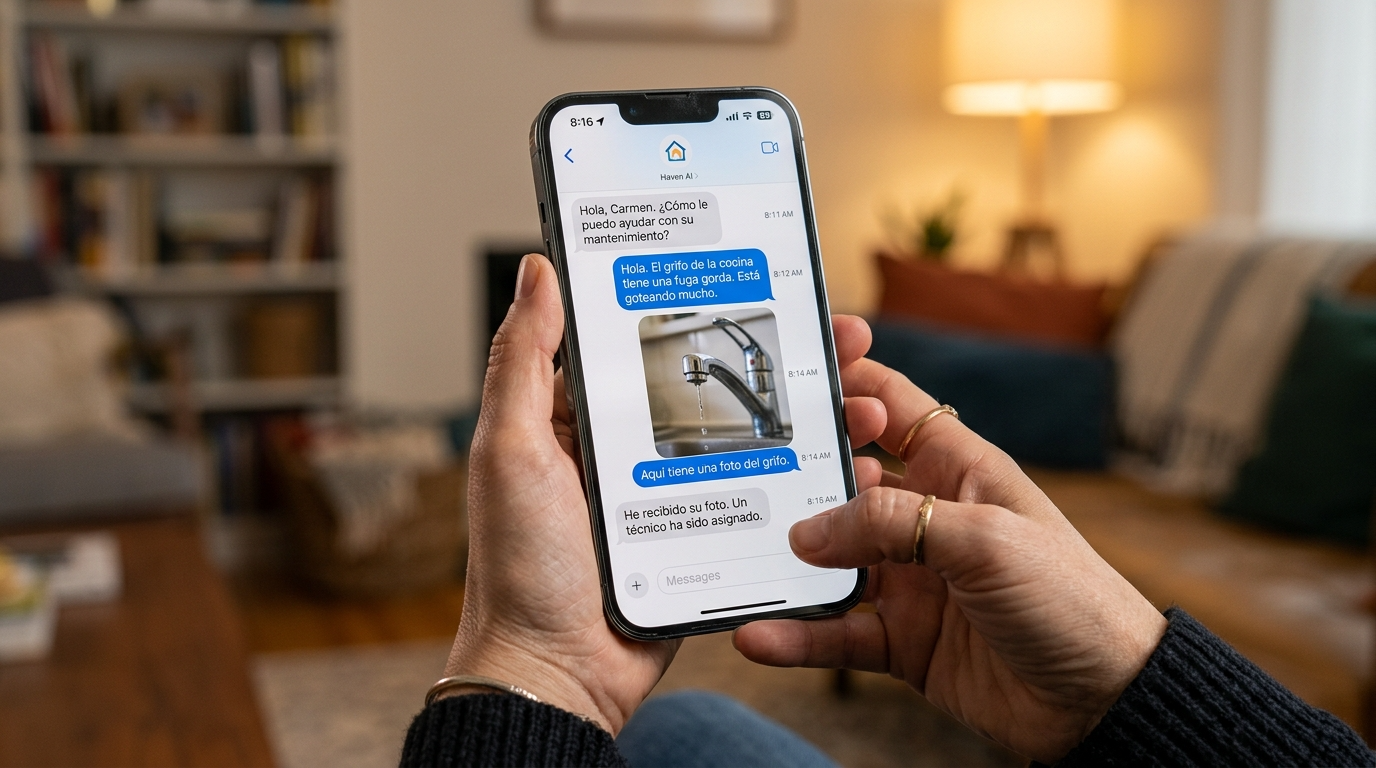
Can an AI be personal? Surprisingly, yes. By integrating with your PMS, an AI can greet tenants by name and reference their history. “Hi Sarah, are you calling about the work order for your dishwasher?” This level of personalization makes residents feel heard.
AI also excels at multilingual support. With over 20% of U.S. residents speaking a language other than English at home, this is essential. An AI like Haven can seamlessly switch to Spanish, ensuring clear communication during a stressful maintenance event. While some call centers offer bilingual agents, it’s not always standard.
Quality and Consistency of Answers
Human call center agents can be fantastic, but quality varies. High turnover rates (around 30-45% annually) mean you’re often getting someone who isn’t deeply familiar with your properties.
An AI delivers perfect consistency. It pulls answers from your approved knowledge base every single time, eliminating the risk of someone giving a tenant incorrect policy information. This consistency builds trust and reduces disputes.
The Human in the Loop Advantage
No one wants to be trapped in a frustrating automated loop. That’s why a good AI system always includes a “human in the loop” option. For complex or highly sensitive issues, the AI should be able to seamlessly escalate the call to a live person. An overwhelming 89% of consumers believe companies should always offer an option to speak to a human. The best systems, like those from Haven, combine the efficiency of AI with the critical judgment and empathy of your team when it’s needed most.
The Final Verdict: Maintenance AI vs Call Center
When you tally the score, the benefits of a specialized AI solution become clear.
Comparison Matrix: 2026 Maintenance Standards
Feature | Maintenance AI (e.g., Haven) | Traditional Call Center |
Response Time | Instant (First Ring) | Variable (30s - 5min+) |
Simultaneous Calls | Unlimited / Infinite | Limited by Seat Count |
PMS Integration | Real-time, 2-way sync | Manual entry / Email relay |
Language Support | Instant Switching (47+ languages) | Limited to available staff |
Cost Predictability | Fixed Per-Unit/Month | Variable Per-Minute |
Data Accuracy | 99% (Digital Logging) | High risk of human error |
While a call center provides a human touch, a modern maintenance AI offers superior efficiency, scalability, and consistency. It automates tedious administrative work, provides valuable data insights, and ensures every tenant call is answered instantly and handled according to your exact protocols. This focus on specialized, integrated service is what truly separates a maintenance AI vs call center.
The goal is to boost resident satisfaction, which is heavily tied to maintenance quality. In fact, 36% said maintenance issues would prevent renewal. By providing faster, more reliable, and more consistent service, a maintenance AI directly impacts your retention and reputation.
Ready to see how an AI can transform your maintenance operations? Book a demo with Haven to see it in action.
Final Takeaway for 2026: The choice between maintenance AI vs call center is no longer about "human vs machine"—it’s about data vs noise. In a market where 36% of residents cite maintenance as their reason for not renewing, the speed and precision of AI provide a competitive edge that human-only call centers can no longer match.
Frequently Asked Questions
1. Is a maintenance AI more expensive than a call center?
Not necessarily. While call centers often charge per minute, leading to unpredictable bills, many AI services offer a flat per unit monthly fee. For many property managers, this predictable cost model proves to be more affordable, especially when you factor in the time saved on manual data entry and coordination.
2. Can an AI show empathy to an upset tenant?
While AI cannot feel empathy, it can be programmed to use empathetic language, remain calm, and act with urgency. It can de-escalate by immediately taking action (like creating a work order and dispatching a vendor), which often calms frustrated tenants faster than words alone. For truly sensitive situations, it can escalate to a human manager.
3. How hard is it to set up a maintenance AI?
Companies like Haven specialize in property management and offer guided onboarding. They help integrate the AI with your existing PMS and build out your knowledge base with your specific property rules and vendor lists. The process is designed to be smooth, without requiring you to migrate your core systems.
4. What happens if the AI doesn’t understand a request?
A well designed AI will have a fallback. If it cannot understand a tenant’s request or detects a high level of frustration, it will offer to transfer the call to a live person on your team, ensuring no issue is left unresolved. This “human in the loop” approach combines automation with human oversight.
5. In the choice of maintenance AI vs call center, which is better for emergencies?
This is a critical question. An AI can often be faster and more reliable in an emergency. It answers instantly, triages based on keywords and pre set rules without emotional error, and can dispatch vendors automatically in seconds. A human agent might have to look up a protocol or get approval, adding precious minutes to the response time.
6. Will my tenants be weirded out by talking to a robot?
Acceptance of AI is growing rapidly. Most tenants prioritize getting their problem solved quickly and efficiently. As long as the AI is effective and provides a clear path to a human if needed, tenants typically appreciate the instant response and 24/7 availability. You can even give your AI a name to make it feel more like part of your team.