Maintenance AI Implementation Guide 2026: Key Terms & ROI
Maintenance AI Implementation Guide for property managers: clear definitions for intake, triage, dispatch, PMS integration, KPIs, and ROI—plus a 2026 roadmap.

TL;DR
This maintenance AI implementation guide defines the key terms property managers encounter when evaluating and deploying AI for maintenance operations. It covers everything from intelligent intake and emergency triage to vendor dispatch automation and PMS integration. Terms are organized by workflow stage (not alphabetically) so each concept builds on the last, giving you a practical reference for making informed implementation decisions.
The 2026 Maintenance AI Implementation Summary
What is Maintenance AI implementation? Maintenance AI implementation is the integration of artificial intelligence into the property management workflow to automate intelligent intake, emergency triage, vendor dispatch, and resident follow-up. By connecting directly to a Property Management System (PMS) via API, AI agents reduce administrative overhead by 35%, lower repair costs by approximately 18%, and ensure 24/7 responsiveness without increasing headcount.
Why This Guide Exists
Vendor demos move fast. Terms like “intelligent intake,” “AI triage,” and “conversation memory” get tossed around as if everyone already agrees on what they mean. They don’t.
The vocabulary of maintenance AI is evolving faster than the industry’s understanding of it. According to AppFolio’s 2026 Benchmark Report, 44% of property managers now use AI in their roles, a 29% year-over-year acceleration. Yet most of those managers would struggle to explain the difference between an AI agent and a chatbot, or what “PMS integration” actually means at the API level.
This maintenance AI implementation guide is built for property managers who are past the “what is AI?” stage and ready to understand how it works. Each term below is organized by where it falls in the maintenance workflow: intake, triage, dispatch, resolution, follow-up, and evaluation. Definitions are grounded in real data and practitioner experience rather than marketing copy.
Bookmark this page. You’ll want it during your next vendor evaluation.
Foundational Terms: What Maintenance AI Actually Is
Before getting into workflow-specific vocabulary, these foundational concepts set the baseline for every other term in this guide.
Maintenance AI (AI Maintenance Coordination)
Maintenance AI applies artificial intelligence to the coordination layer between a resident submitting a request and a vendor closing it out. That includes scheduling, triage, communication, prioritization, dispatch, and follow-up.
Done well, a resident submits a request at 11 PM and the system immediately assesses severity, collects information, and routes it, all without a human involved until one is actually needed. Done poorly, as Property Meld bluntly puts it, it means “a chatbot asks a resident ‘please describe your issue’ and dumps a transcript into a queue.”
The distinction matters. Property management is fundamentally a coordination problem. AI changes the architecture of how that coordination happens, not just the speed. For a deeper look at how AI maintenance coordinators function in practice, see this AI maintenance coordinator guide.
AI Agent vs. Chatbot
This is the single most confused distinction in the space right now. Vendor marketing blurs the line constantly.
A chatbot responds with canned responses, menu options, and scripted decision trees. It can collect basic information, but it doesn’t understand context, make judgment calls, or take actions inside your systems. Property Meld’s framework is clear: a chatbot “presenting a slightly friendlier form is not doing triage.”
An AI agent uses natural language understanding to interpret what a resident is saying, determine the appropriate response, and execute real actions: creating work orders in your PMS, dispatching vendors, scheduling follow-ups, and escalating when thresholds are breached. It operates across phone, SMS, and email while maintaining context across interactions.
The practical test: can this system create a work order in AppFolio without a human copying and pasting information? If yes, it’s closer to an AI agent. If it just generates a transcript for someone to process later, it’s a chatbot wearing a better costume.
Comparison: AI Agents vs. Traditional Maintenance Chatbots
Feature | Legacy Chatbot | 2026 AI Maintenance Agent |
Logic Type | Scripted/Decision Tree | Natural Language Understanding (NLU) |
PMS Action | Sends transcript via email | Creates/Updates Work Orders via API |
Emergency Triage | Keyword-based (unreliable) | Contextual Triage (Urgency Scoring) |
Communication | Single channel (usually Web) | Multi-channel (Voice, SMS, Email) |
Vendor Handling | Manual notification | Automated Dispatch & SLA Tracking |
PMS Integration (Property Management Software Integration)
The API-level connection between AI tools and your core property management software (AppFolio, Yardi, Buildium, Rent Manager, and others) that allows automated work order creation, status updates, and data synchronization.
This term gets thrown around loosely. “Integrates with AppFolio” could mean anything from “we send you an email you can paste into AppFolio” to “we create and update work orders directly inside AppFolio through their API.” The depth of integration determines whether AI actually saves time or just moves the bottleneck. You can check specific PMS integration details to understand what a real integration looks like.
Multi-Channel Communication
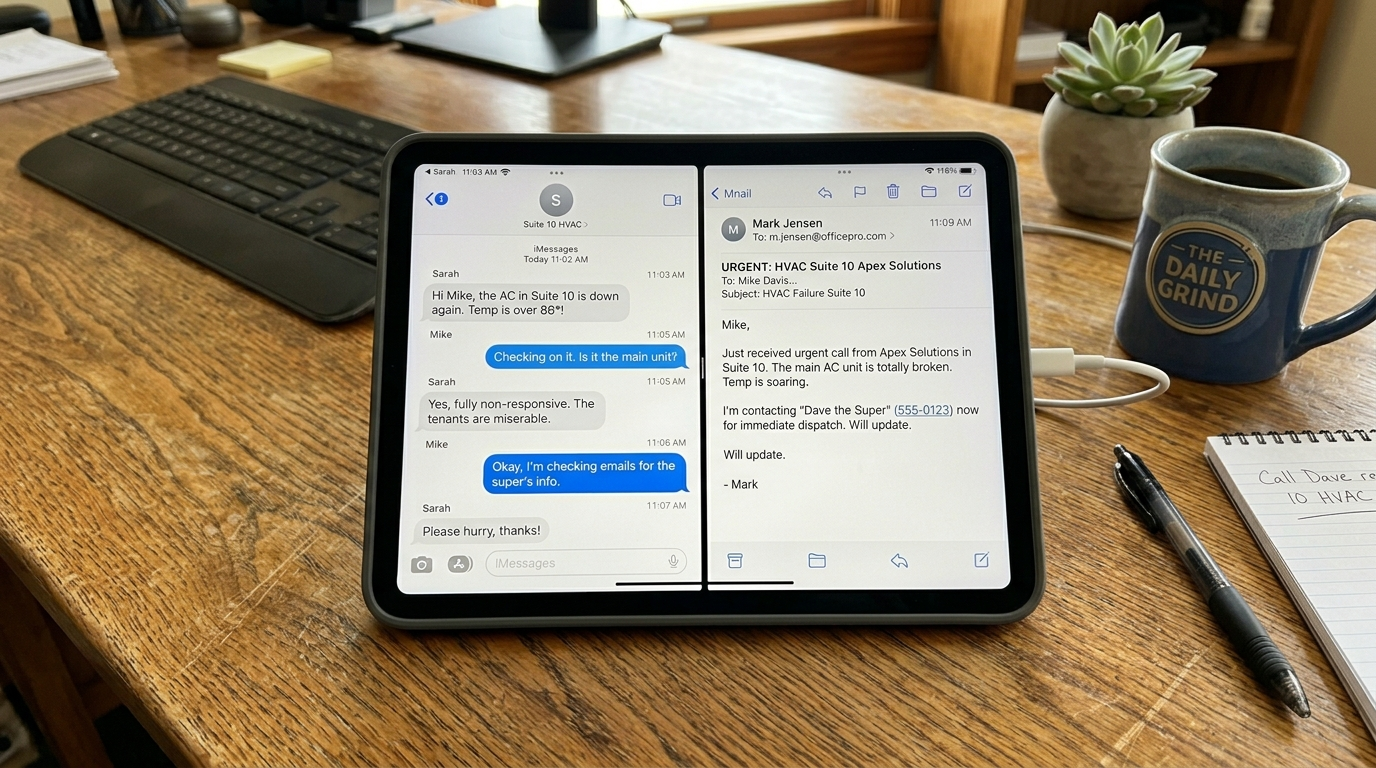
AI that operates across phone, SMS, and email simultaneously while maintaining context across all three channels. A resident might call to report a leak, then text a photo an hour later, then get an email confirmation when the vendor is scheduled. Multi-channel means the system treats all of that as one continuous interaction.
This matters because residents don’t stick to one channel. If your AI only handles text, you’re missing the dominant communication method for maintenance requests: phone calls.
Conversation Memory and Continuity
The AI’s ability to retain context across multiple interactions with the same tenant about the same issue. Without conversation memory, every touchpoint starts from scratch: “Can you describe the issue again?” Residents hate this. Staff hate this.
With conversation memory, the AI knows that unit 4B called about a leaking dishwasher on Tuesday, that a photo was submitted via SMS on Wednesday, and that the plumber is scheduled for Thursday. When the resident calls back to check status, the AI picks up where the conversation left off.
This concept is one of the clearest differentiators between a basic chatbot and a genuine AI agent, and it’s rarely explained in competitor content.
Intake and Triage Terms
These terms cover the first stage of the maintenance workflow: what happens when a request comes in.
Intelligent Intake
The AI-driven process of collecting complete, structured information from a tenant at the moment they submit a request.
Most work orders arrive incomplete. A coordinator receiving “my heat isn’t working” has to call back and ask: which unit? When did it stop? Gas or electric? Is the thermostat set correctly? At scale, these callbacks consume enormous staff time.
Intelligent intake means the AI asks the right follow-up questions during the initial interaction, gathering enough detail for a vendor to diagnose and prepare before arriving on site. This directly improves first-time fix rates and reduces the back-and-forth that frustrates everyone involved.
AI Triage and Emergency Triage
The decision layer that determines urgency. AI triage classifies incoming requests by severity using natural language processing, cross-referencing what a resident describes against defined safety criteria.
Here’s why this matters: Property Meld’s data shows that 40% of issues residents report as emergencies aren’t actually emergencies. A dripping faucet and water coming through the ceiling both get tagged “urgent” when humans are stressed, tired, or just worried. AI triage applies consistent criteria regardless of time of day or emotional tone.
Emergency triage specifically focuses on safety-critical situations: gas leaks, flooding, fire damage, no heat in winter. These need immediate escalation. Everything else gets prioritized based on urgency scoring rather than whoever called most recently.
For a complete breakdown of how emergency triage works in AI systems, see this emergency maintenance triage guide.
Urgency Scoring
A numerical or categorical ranking that AI assigns to each incoming request based on factors like issue type, safety implications, weather conditions, and property risk. A burst pipe in January scores differently than a squeaky door hinge.
Platforms like Lula use NLP to classify issues and cross-reference them against safety criteria, distinguishing between a running toilet (annoying but low urgency) and a ceiling leak (high urgency, potential structural damage). The score determines routing speed, vendor priority, and whether the system escalates to a human.
Resident Self-Resolution and Self-Troubleshooting
AI-guided troubleshooting that helps tenants resolve simple issues themselves. Think: garbage disposal reset button, tripped breaker, thermostat programming.
This isn’t call deflection. It’s legitimate diagnostic assistance at intake. If a resident’s disposal stopped working and the fix is pressing the red reset button on the bottom of the unit, walking them through that saves everyone time and a $150 service call. Entrata’s Maintenance AI describes this as SMS-based guidance that resolves common issues before a work order is ever created.
The key: self-resolution should be offered when appropriate, not forced as a gatekeeping mechanism.
Dispatch and Resolution Terms
Once a request is triaged, these terms cover how it gets routed and resolved.
Work Order Automation
The automatic creation, categorization, and routing of maintenance work orders within a PMS. Instead of a coordinator manually typing up a ticket from phone notes, the AI creates the work order directly in your system with the resident’s description, photos, unit information, and urgency classification already attached.
This eliminates double data entry and ensures nothing falls through the cracks between “I took the call” and “I entered it into the system.” For property managers running hundreds or thousands of units, the time savings compound fast, with industry data showing admin overhead cut by 35% through automation.
Vendor Dispatch Automation
AI-powered routing of work orders to the right vendor based on trade specialty, proximity, availability, and workload. OxMaint reports that AI can auto-dispatch to the best-matched technician in under 60 seconds, compared to the manual process of calling down a list until someone answers.
This is where maintenance AI implementation moves from “nice to have” to “game changer” for scattered-site portfolios. When you manage properties across a metro area with dozens of vendor relationships, manual dispatch is a coordination nightmare. Automated dispatch matches the issue type to the vendor’s specialty, checks availability, and sends the work order, all before a human would have finished reading the request.
SLA Enforcement (Service Level Agreement)
In maintenance context, SLAs define the maximum acceptable response and resolution times for different issue types. OxMaint describes AI-enforced SLAs as emergency response under 4 hours, standard repairs under 18 hours, with auto-escalation firing before any SLA breach occurs.
The “before” part is critical. Manual SLA tracking means someone notices a breach after it happened. AI-enforced SLAs trigger escalation proactively: if a vendor hasn’t confirmed acceptance within the defined window, the system automatically reassigns or alerts a manager.
First-Time Fix Rate
The percentage of maintenance issues resolved on the first vendor visit. This metric matters because every callback means more cost, more resident frustration, and more coordination overhead.
AI improves first-time fix rates through better intake. When a vendor arrives knowing exactly what’s wrong, what unit layout they’re dealing with, and what parts they might need, callbacks drop. Property Meld reports that companies using their AI see 24-hour repair completions nearly double, from 12.5% to 23.75%, and cost per repair drops from $394 to $320.
Follow-Up and Communication Terms
The resolution of a maintenance request doesn’t end when the vendor leaves. These terms cover what happens next.
After-Hours AI and 24/7 Maintenance Intake
AI systems that handle maintenance requests outside business hours, replacing or augmenting traditional answering services. This is one of the fastest-growing use cases for maintenance AI implementation in property management.
The math is straightforward. Large portfolio operators report 35% declines in after-hours maintenance calls when AI handles intake, because many “emergencies” are resolved through triage and self-troubleshooting guidance. The calls that do need human intervention get flagged and escalated with full context attached.
Unlike answering services, AI applies consistent triage criteria at 2 AM the same way it does at 2 PM. It doesn’t improvise when the script runs out, and it doesn’t cost more during demand spikes. For a detailed comparison, read this maintenance AI vs. call center analysis.
Voice AI and Voice Agents
AI that conducts actual voice conversations over the phone, as opposed to text-only chatbots. This is a meaningful distinction because phone calls remain the dominant channel for maintenance requests, especially for emergencies and for residents who aren’t comfortable with apps or portals.
A voice AI agent picks up the phone, talks with the resident naturally, asks clarifying questions, determines urgency, and can create a work order or dispatch a vendor in real time. It’s not an IVR menu system (“press 1 for maintenance, press 2 for leasing”). It’s a conversational agent that understands what someone is saying and responds accordingly.
Practitioners in property management communities report that AI’s ability to break language barriers is one of its most underrated features. An English-speaking management team communicating with Spanish-speaking residents through a multilingual voice agent eliminates a friction point that traditionally required bilingual staff or translator services.
Automated Follow-Up
AI-initiated outreach after a work order is completed to confirm satisfaction, check that the issue is actually resolved, and capture feedback. This is the step most property managers skip because they don’t have time, and it’s the step that most directly impacts resident retention.
Transparent communication during the repair process reduces complaint escalations by more than 40%. Automated follow-up extends that transparency beyond resolution. A simple “Was your dishwasher repair completed to your satisfaction?” text, sent automatically 24 hours after the vendor visit, catches unresolved issues before they become lease non-renewals.
For more on how follow-up workflows affect retention, see this AI maintenance follow-up guide.
Real-Time Status Tracking
Automated updates that keep residents informed about where their request stands: received, triaged, vendor assigned, vendor en route, completed. Instead of residents calling the office to ask “what’s happening with my work order?”, they get proactive updates via their preferred channel.
This reduces inbound call volume and improves satisfaction simultaneously. It also creates a documented communication trail for compliance purposes.
Integration and Data Terms
This section of the maintenance AI implementation guide covers the technical infrastructure that makes everything above possible.
PMS API Integration
The specific technical connection between an AI platform and your property management software. API (Application Programming Interface) is the mechanism that allows two systems to exchange data automatically.
In practical terms, PMS API integration means the AI can pull property data, unit information, and tenant records from your PMS, and push work orders, status updates, and notes back in. The alternative, manual data transfer, defeats the purpose of automation.
Not all integrations are equal. Some AI tools offer native, deep integrations with specific PMS platforms. Others use middleware or require manual configuration. During vendor evaluation, ask: what specific actions can this AI take inside my PMS? Can it create work orders? Update them? Add notes? Or does it just read data?
For a broader look at how AI tools connect across the property management tech stack, see this property management AI stack guide.
Data Foundation and Data Quality
The state of your existing data before AI touches it. This is unglamorous but essential.
RTS Labs warns that property data is often “scattered across multiple systems”, with a lease addendum on someone’s laptop, CRM data that doesn’t sync with accounting, and vendor contact lists in a spreadsheet that hasn’t been updated in six months. AI built on bad data produces bad results.
Building a data foundation means cleaning tenant records, standardizing maintenance logs, and ensuring your PMS is the single source of truth. It’s the least exciting step in any maintenance AI implementation guide, and it’s the one that determines whether everything else works.
Legacy System Integration
The challenge of connecting modern AI tools to older property management software. Many property managers still rely on on-premise systems or PMS platforms with limited API capabilities. RTS Labs identifies this as one of the top barriers to AI adoption, noting that outdated software makes integration with modern AI tools significantly harder.
The practical question: does your current PMS have an open API? If yes, integration is usually feasible. If not, you may need middleware solutions or, in some cases, a PMS migration.
ROI and Evaluation Terms
These terms help property managers measure whether a maintenance AI implementation is worth the investment.
Total Cost of Ownership
The full cost of an AI tool over time, including subscription fees, implementation costs, staff training time, and ongoing optimization. This is different from the sticker price. A tool that costs less per month but requires 40 hours of manual configuration and ongoing babysitting isn’t cheaper.
When evaluating vendors, ask about implementation timelines, dedicated support during onboarding, and what happens when something breaks. The cheapest tool on paper is often the most expensive in practice.
Per-Unit Pricing (Per-Door Pricing)
A common billing model in property management AI where costs scale based on the number of units in your portfolio. EliseAI reports that AI-driven maintenance coordination generates more than $12 in savings per door through optimized scheduling, vendor management, and tenant communication. Per-unit pricing means you can calculate ROI at the portfolio level and compare it directly against current costs.
KPIs for Maintenance AI
The key performance indicators that tell you whether your implementation is working. The ones that matter most:
Average response time: How fast does a request get acknowledged? Manual systems average 4.6 days; AI-assisted systems can get that under 18 hours.
Cost per repair: Track before and after implementation. The benchmark drop is from $394 to $320 per repair.
24-hour completion rate: What percentage of requests are resolved within a day?
Resident satisfaction score: Measured through automated follow-up surveys.
After-hours call volume: Should decline as AI handles intake.
Work order accuracy: Are orders arriving to vendors with complete information?
For a detailed analysis of financial metrics, see this maintenance AI ROI guide covering costs, savings, and retention impact.
Maintenance Cost Reduction Benchmarks
The data points that set realistic expectations. Gitnux reports maintenance expenses dropping 28% via AI. EliseAI implementations have demonstrated 15 to 25% operational cost reductions across enterprise portfolios, often justifying initial investments within 12 to 18 months. McKinsey’s 2024 research found that AI-driven operations in asset-heavy industries reduce coordination costs by 20 to 40% when deployed systemically rather than as isolated point solutions.
The “systemically” part is important. Adding AI to one slice of your workflow produces modest gains. Connecting AI across intake, triage, dispatch, and follow-up produces compounding returns.
How to Calculate Maintenance AI ROI
Baseline Labor Costs: Calculate hours spent by coordinators on manual intake and vendor "phone tag."
After-Hours Savings: Total the cost of third-party answering services replaced by Voice AI.
First-Time Fix Rate: Audit the percentage of "no-part" return trips; target a 15% improvement with Intelligent Intake.
Resident Retention Value: Factor in the cost of a vacancy ($2,500+) vs. a satisfied resident staying due to fast repairs.
Operational Reduction: Target the industry benchmark of 20% to 40% reduction in coordination costs.
Compliance and Governance Terms
Any maintenance AI implementation guide that skips compliance is incomplete. These terms cover the guardrails.
Fair Housing Compliance in AI
AI-driven communication must be equitable and accessible for all residents, including those with disabilities, limited English proficiency, or lack of technology access. Over-reliance on automated digital tools can inadvertently exclude tenants who don’t have smartphones or who struggle with text-based communication.
The practical implication: your AI needs to work across channels (including phone) and in multiple languages. A text-only chatbot that only communicates in English creates a Fair Housing risk in buildings with diverse resident populations. For a thorough treatment of this topic, read this AI property management compliance and Fair Housing guide.
Data Privacy (CCPA/GDPR)
Managing tenant data securely within AI systems. Maintenance requests contain personal information: names, unit numbers, descriptions of living conditions, sometimes photos of the interior of someone’s home. AI tools must comply with relevant privacy regulations, including CCPA for California residents and GDPR for properties with EU-connected data.
Ask vendors: where is data stored? Who has access? How long is it retained? Is it used to train models beyond your portfolio?
Human-in-the-Loop

The principle that AI should escalate to a human when situations exceed its confidence threshold or involve safety-critical decisions. No maintenance AI should be a black box that makes every decision autonomously.
The best implementations define clear escalation rules: emergencies always notify a human, vendor disputes get flagged, and resident complaints above a certain severity threshold route to a manager. AI handles the routine so humans can focus on the exceptions that genuinely need judgment.
AppFolio’s State of AI research found that property management professionals consistently emphasize AI empowering rather than replacing staff. One interviewee noted the importance of maintaining headcount because the industry is fundamentally customer-service-driven. The right framing is AI as a force multiplier, not a replacement.
Implementation Roadmap: Putting It All Together
Understanding the terminology is step one. Here’s how these concepts translate into an actual implementation plan, adapted from RTS Labs’ six-step framework and practitioner experience.
Step 1: Identify Your Highest-Impact Workflow
Evaluate where AI will make the biggest difference. Maintenance triage is consistently the highest-leverage starting point because it affects response time, resident satisfaction, and cost simultaneously. Start there rather than trying to automate everything at once.
Step 2: Build Your Data Foundation
Clean your tenant records, standardize your maintenance categories, update your vendor list, and make sure your PMS data is current. This is the step everyone wants to skip and nobody should.
Step 3: Define Success Metrics Before You Start
Pick 3 to 5 KPIs from the list above and measure your baseline before implementation. You can’t prove ROI if you don’t know where you started.
Step 4: Run a Pilot Program
Test on one property or one subset of your portfolio. Track results against your baseline metrics for 60 to 90 days. Firms that have broadly adopted AI expect average portfolio growth of 31% in 2026, nearly triple the 12% anticipated by those that haven’t implemented, but that broad adoption started with a pilot somewhere.
Step 5: Equip and Educate Your Team
Front-desk staff may resist AI if they believe it replaces their role instead of assisting them. Hands-on training, clear explanations of what the AI does and doesn’t do, and feedback loops during the pilot period build buy-in. Change management is as important as the technology itself.
Step 6: Scale Deliberately
Once the pilot proves out, expand to additional properties. Adjust configurations based on what you learned. Continue tracking KPIs and optimizing.
The market is moving quickly. In 2024, 17% of property managers planned to adopt AI tools. By 2025, that figure was 28%. By 2026, 44% were already using it. The question isn’t whether to implement, but how quickly and how thoughtfully.
If you’re evaluating maintenance AI solutions and want to see how these concepts work in a live system, book a demo with Haven to see AI agents handling maintenance triage, vendor dispatch, and PMS integration in real time.
Frequently Asked Questions
What is the difference between maintenance AI and a chatbot?
Maintenance AI refers to a system that handles the full coordination workflow: intake, triage, dispatch, follow-up, and PMS integration. A chatbot is a scripted interface that collects basic information. The key difference is whether the system can take real actions (creating work orders, dispatching vendors) or just generates transcripts for a human to process. True AI agents understand context, make urgency decisions, and execute tasks inside your PMS.
How long does it take to implement maintenance AI?
Most implementations follow a phased approach. A pilot on a single property or portfolio subset typically runs 60 to 90 days. Full rollout depends on portfolio size, PMS integration complexity, and data quality. Vendors with native PMS integrations tend to have shorter implementation timelines than those requiring custom API work.
What PMS systems does maintenance AI typically integrate with?
The major platforms are AppFolio, Yardi, Buildium, Rent Manager, and Entrata. Integration depth varies by vendor. Some AI tools offer native integrations that can create, update, and manage work orders directly. Others require middleware or manual steps. Always ask specifically what actions the AI can perform inside your PMS rather than accepting vague claims about “integration.”
How much does maintenance AI cost?
Pricing varies widely. Many vendors use per-unit (per-door) pricing models. EliseAI reports savings exceeding $12 per door through optimized scheduling and vendor management. Industry benchmarks show 15 to 25% operational cost reductions, with payback periods of 12 to 18 months for enterprise portfolios. The total cost of ownership includes subscription fees, implementation time, and staff training.
Will maintenance AI replace my maintenance coordinators?
No. The consistent message from practitioners and industry research is that AI empowers staff rather than replacing them. AI handles routine intake, triage, and communication, freeing coordinators to focus on complex issues, vendor relationships, and resident satisfaction. Most successful implementations maintain the same headcount while significantly increasing the volume of work the team can handle.
What should I measure to know if maintenance AI is working?
Track average response time, cost per repair, 24-hour completion rate, resident satisfaction scores, after-hours call volume, and work order accuracy. Measure these before implementation to establish a baseline, then compare at 30, 60, and 90 days post-launch.
Is maintenance AI compliant with Fair Housing regulations?
It can be, but compliance depends on implementation. AI must be accessible across communication channels (not just text) and available in multiple languages to avoid excluding residents. Voice-first AI with multilingual support addresses the most common Fair Housing concerns. Human-in-the-loop escalation for sensitive situations is also essential. Review your vendor’s compliance posture and document your own policies.
What’s the best place to start with a maintenance AI implementation?
After-hours maintenance intake and emergency triage. These two use cases deliver the fastest, most measurable ROI because they address the biggest pain points: missed calls, delayed responses, and inconsistent emergency classification. Once those are working, expand into vendor dispatch automation and automated follow-up.