AI Data Quality PMS: 2026 How-To Guide for Property Managers
Learn why AI Data Quality PMS drives leasing, maintenance, and ops. Audit CDEs, dedupe records, and pick tools that improve data. Get the guide.

TL;DR
AI data quality in PMS refers to how accurate, complete, and consistent the data inside your Property Management System needs to be for AI tools to function properly. Poor PMS data causes AI to misroute work orders, dispatch wrong vendors, and lose leads. Gartner predicts 60% of AI projects will be abandoned due to data quality failures. Property managers should audit and clean their PMS data before deploying any AI tool, and choose AI solutions that improve data quality over time through structured intake.
AI Data Quality in PMS: Quick Answer
AI data quality in a Property Management System (PMS) means ensuring tenant records, work orders, vendors, leases, and property information are accurate, complete, standardized, and up to date before AI uses them.
Poor PMS data causes AI to:
- Misclassify maintenance requests
- Contact the wrong tenant
- Dispatch incorrect vendors
- Show unavailable units
- Produce inaccurate reports
For most property managers, improving AI performance starts with cleaning five critical data areas:
Priority | Data Type | Why It Matters |
|---|---|---|
1 | Tenant contact information | Prevents failed communications |
2 | Work order descriptions | Enables accurate AI triage |
3 | Unit identifiers | Prevents mismatched records |
4 | Vendor database | Improves dispatch accuracy |
5 | Vacancy and lease status | Supports leasing automation |
A simple data audit before AI deployment typically delivers more value than purchasing additional AI features.
Why AI Data Quality in Your PMS Matters Right Now
Between 2024 and 2025, the percentage of property management operators using AI tools jumped from 21% to 34%. That adoption curve is steep. But here’s the problem most vendors won’t lead with: the performance of every AI tool you deploy is capped by the quality of data sitting in your Property Management System.
This isn’t a theoretical concern. Gartner predicts that through 2026, organizations will abandon 60% of AI projects unsupported by AI-ready data. In real estate specifically, while 92% of commercial real estate occupiers have started or plan to start AI pilots, only 5% of firms have achieved all their AI program goals. The gap between enthusiasm and results is almost entirely a data quality problem.
If you’re evaluating AI for maintenance, leasing, or operations, understanding AI property management benefits starts with understanding what your PMS data looks like right now.
See how Haven’s AI agents work with your PMS data →
What Makes PMS Data AI-Ready?
Not all clean data is AI-ready.
AI-ready PMS data has four characteristics:
Requirement | Description | Example |
|---|---|---|
Complete | Required fields are filled | Phone number, unit number, maintenance category |
Consistent | Same format everywhere | "Unit 205" instead of Unit-205, #205, Apt 205 |
Current | Updated regularly | Vendor list reflects active contractors |
Connected | Records relate correctly | Tenant → Lease → Unit → Property → Work Order |
If any of these relationships are broken, AI begins making assumptions rather than decisions based on facts.
Key Terms Defined
Data Quality
Data quality refers to the accuracy, consistency, and reliability of data used in decision-making. The five standard dimensions are accuracy, completeness, consistency, timeliness, and validity.
Why it matters for property managers: If a tenant’s phone number has a typo, AI can’t reach them about a maintenance update. If a work order says “something is broken” instead of “kitchen faucet leaking,” AI can’t triage it correctly. Every data field is a potential point of failure.
Data Quality Management (DQM)
Data quality management is the systematic practice of measuring, monitoring, and improving data quality across its entire lifecycle. It encompasses the processes, policies, roles, and technologies that ensure data is fit for its intended use.
Why it matters for property managers: DQM isn’t a one-time cleanup. It’s an ongoing discipline. Without it, your PMS slowly accumulates duplicate records, outdated contacts, and inconsistent formatting that compounds over months and years.
AI-Ready Data
Gartner defines AI-ready data as data aligned to specific use cases, actively governed at the asset level, supported by automated pipelines with quality gates, managed through live metadata, and continuously quality-assured.
Why it matters for property managers: Your PMS data doesn’t need to be perfect, but it does need to meet a minimum bar. AI-ready data for a maintenance triage tool means complete work order descriptions, accurate unit identifiers, and current vendor assignments. AI-ready data for a leasing tool means up-to-date availability, correct pricing, and complete lead records.
Property Management System (PMS)
A Property Management System is software designed to help property owners and managers streamline day-to-day operations. PMS platforms manage tenant information, lease agreements, maintenance requests, financials, and communications. Common examples include AppFolio, Yardi, Buildium, and RealPage.
Why it matters: Your PMS is the single source of truth for AI tools. If you’re exploring how AI connects to platforms like Buildium, this AI Buildium integration guide covers the specifics.
Integration Debt
Integration debt is the accumulated cost of data duplicated, notes missed, and staff time spent managing disconnected software instead of managing properties. An NMHC report found that multifamily operators commonly use 10 to 20 different solution providers throughout the customer journey. Each system introduces another data entry point and another opportunity for inconsistency.
Why it matters for property managers: Every tool in your stack that doesn’t sync bidirectionally with your PMS creates integration debt. That debt shows up as duplicate tenant records, conflicting vacancy data, and vendor lists that don’t match reality.
GIGO (Garbage In, Garbage Out)
The oldest principle in computing. If you feed an AI system bad data, you get bad outputs. In property management, garbage in looks like vague maintenance descriptions, stale availability listings, or inconsistent unit numbering. Garbage out looks like misdirected vendor dispatches, missed emergency escalations, and lost leads.
Data Validation
Data validation is the process of checking whether data entries meet predefined rules before they’re accepted into a system. Examples include verifying that phone numbers have the right number of digits, dates follow expected formats, and required fields aren’t left blank.
Why it matters for property managers: Validation at the point of entry is dramatically cheaper than cleanup after the fact. The “1-10-100 rule” puts numbers to this: it costs $1 to verify a record at entry, $10 to clean it later, and $100 if it’s left uncorrected. In property management terms, a wrong tenant phone number costs a dollar to verify at intake, ten dollars worth of staff time to track down later, and potentially hundreds if it causes a missed emergency response.
Data Reconciliation
Data reconciliation is the process of comparing records across two or more systems to identify and resolve conflicts. In property management, this typically means matching PMS records against reality: Is unit 4B actually vacant? Does the vendor list reflect current contracts?
Bidirectional Sync / Two-Way Integration
A two-way integration means data flows in both directions between systems. When an AI tool creates a work order, it writes to the PMS. When a property manager updates a record in the PMS, the AI tool reflects that change. This is critical for maintaining PMS data integrity when AI is in the loop.
Critical Data Elements (CDEs) in Property Management
CDEs are the specific data fields that, if inaccurate or missing, cause the biggest operational problems. For property management AI, these include:
Tenant contact information (phone, email)
Unit identifiers (standardized format)
Work order descriptions and categories
Vendor contact info and trade assignments
Lease status and vacancy data
Property addresses and unit counts
Common PMS Data Quality Problems That Break AI
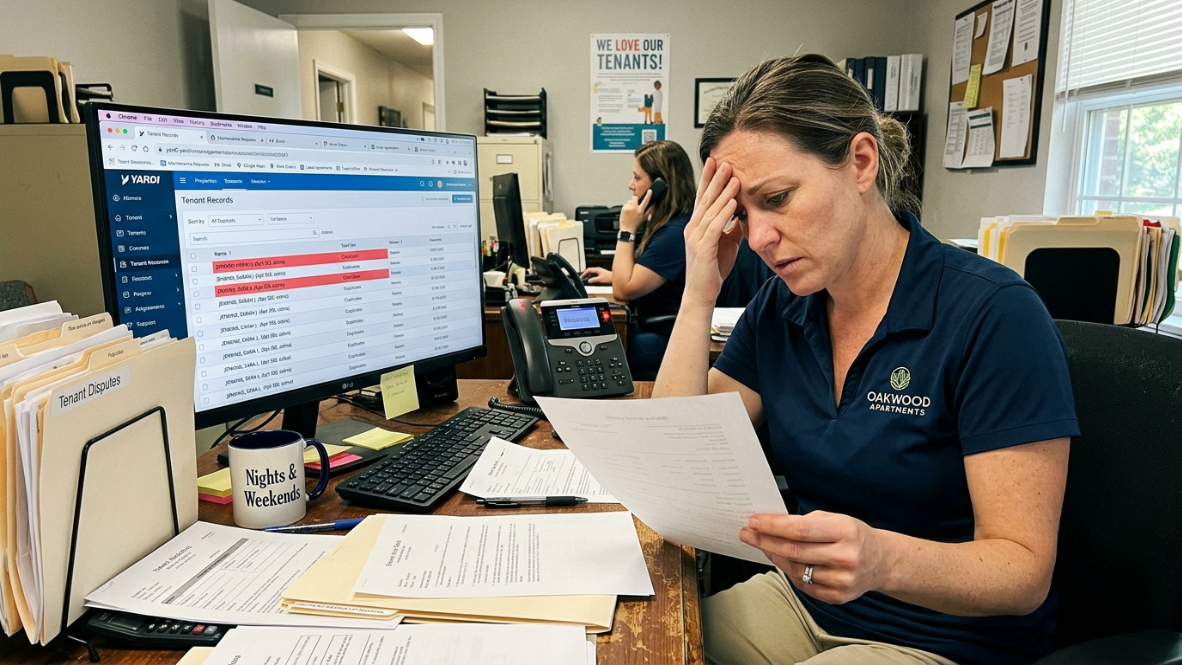
The gap between “we have a PMS” and “our PMS data is AI-ready” is wider than most property managers expect. Here are the specific problems that cause AI tools to produce bad results.
Duplicate Tenant Records from ILS Imports
When leads come in from Zillow, Apartments.com, and your website simultaneously, the same prospect often ends up as two or three separate records. AI leasing tools then send duplicate communications or, worse, treat the same person as different leads with conflicting qualification statuses.
Incomplete Work Order Descriptions
A tenant calls and says “something is broken in the bathroom.” If that’s what gets entered into the PMS, an AI triage system has almost nothing to work with. It can’t determine severity, can’t assign the right vendor trade, and can’t detect whether this is an emergency. For a deeper look at how these failures cascade, this guide on common maintenance AI mistakes covers the most frequent ones.
Stale Vacancy and Availability Data
When the PMS shows a unit as available but it’s already been leased (or vice versa), AI leasing tools will quote wrong availability to prospects. This creates a terrible first impression and wastes everyone’s time.
Inconsistent Unit Identifiers
“Apt 1A” in one record, “Unit 1-A” in another, “#1A” in a third. Humans can puzzle through these variations. AI systems often cannot, especially when matching records across maintenance logs, lease files, and vendor dispatch histories.
Missing or Incorrect Contact Information
If tenant emails and phone numbers are missing or wrong, AI follow-up tools hit dead ends. Automated maintenance updates never reach the tenant. Leasing nurture sequences go to the wrong inbox.
Fragmented Data Across Multiple Tools
Data fragmentation across different software platforms is a persistent problem in property management. Property managers often use separate solutions for accounting, lease management, maintenance tracking, and tenant communication. When these systems don’t share data, no single system has the full picture, and AI tools built on top of any one system inherit blind spots.
Signs Your PMS Data Needs Cleanup
If your AI system regularly experiences any of the following, data quality is likely the root cause:
Duplicate follow-up emails
Incorrect maintenance routing
AI asking repetitive questions
Vendors receiving wrong work orders
Incorrect occupancy reports
Duplicate tenant records
Wrong lease renewal reminders
Missing maintenance history
AI recommending unavailable units
These operational issues often appear before managers realize the underlying problem is poor PMS data quality.
How AI Agents Depend on PMS Data Quality
Understanding the specific dependencies helps you prioritize which data to clean first.
Maintenance Triage
AI maintenance triage depends on complete, categorized work order descriptions. The system needs to know what’s broken, where it is, and how urgent it is. If your PMS maintenance categories are inconsistent (some properties use “plumbing” while others use “water issues”), the AI learns conflicting patterns. Accurate emergency maintenance triage is impossible without clean data feeding the detection logic.
Vendor Dispatch
Automated vendor dispatch requires accurate vendor contact info, correct trade assignments, and up-to-date preferred vendor lists per property. If your PMS shows a plumber who stopped working with you six months ago, the AI will keep dispatching to them.
Leasing Automation
AI leasing agents need current unit availability, correct pricing, accurate property amenity data, and complete lead records to qualify prospects and schedule tours. One AppFolio user on G2 shared a cautionary tale: they followed incorrect guidance from an AI chatbot on an accounting fix, which resulted in permanent loss of about three weeks’ worth of accounts payable work. No version control, no rollback capability. This illustrates what happens when AI operates on bad data without safeguards.
Emergency Detection
AI emergency detection depends on correct property context. The system needs to know which property and unit a caller is referencing, what systems are present (gas vs. electric), and what the escalation protocol is. Wrong unit data means the wrong emergency response.
Explore how Haven’s AI agents integrate with your PMS →
Clean Data vs Poor Data
AI Function | Clean PMS Data | Poor PMS Data |
|---|---|---|
Maintenance AI | Correct vendor dispatched | Wrong trade dispatched |
Leasing AI | Accurate availability | Shows unavailable units |
Voice AI | Complete work orders | Missing maintenance details |
Reporting | Reliable KPIs | Incorrect occupancy |
Forecasting | Better predictions | Unreliable trends |
Resident Communication | Correct tenant contacted | Messages fail |
How AI Can Improve PMS Data Quality

Here’s the insight most articles miss: the relationship between AI and data quality is bidirectional. AI needs clean data to work well, and AI can actively clean data over time.
Structured Intake Replaces Unstructured Input
When a tenant calls a traditional answering service or leaves a voicemail, the resulting work order is only as good as whoever transcribed it. AI voice agents that conduct structured conversations, asking follow-up questions about location, severity, and symptoms, produce consistently complete work orders from unstructured phone calls. This means the data entering your PMS is higher quality from the start.
This distinction matters. Many tools automate workflows. Fewer actually improve data quality. AI-driven validation is what separates intelligence from automation.
Real-Time Validation Catches Errors Before They Persist
AI algorithms can continuously monitor data quality metrics in real estate systems, flagging incomplete records, detecting format inconsistencies, and alerting teams to anomalies. Machine learning algorithms can detect errors like missing values or schema changes and alert teams immediately, rather than letting bad data sit for months.
AI-Driven Deduplication
AI can match and merge duplicate records far faster than manual review. Lead records from multiple ILS sources, tenant records created during different lease terms, vendor entries with slight name variations: these are all patterns AI excels at identifying. Understanding how PMS API and AI access works is essential for enabling this kind of bidirectional data improvement.
AppFolio’s own engineering team has noted that “LLMs are an impartial check on our data and API models, if a model can’t reason its way through, a non-expert human will also have a hard time.” Even PMS vendors view AI as a data quality stress test.
Pre-Implementation Data Quality Checklist
The phases that get skipped most often, data audits and record reconciliation, are the ones that most directly shape long-term AI performance. Here’s a practical checklist for property managers preparing to deploy any AI tool.
1. Deduplicate tenant and lead records. Merge duplicate entries from multiple ILS sources. If one prospect exists as three separate leads, your AI will send three separate follow-ups.
2. Standardize unit identifiers. Pick one format and apply it everywhere. “Unit 1A” or “Apt 1A” or “#1A,” not all three.
3. Complete contact fields. Fill in missing phone numbers and email addresses for all active tenants. Prioritize the properties where you’re deploying AI first.
4. Clean maintenance categories. Standardize issue types across all properties (plumbing, HVAC, electrical, appliance, general). AI triage models need consistent categories to learn from.
5. Update vendor lists. Verify that every preferred vendor has current contact info, correct trade assignments, and accurate service area coverage. Remove inactive vendors.
6. Reconcile vacancy data. Walk your PMS availability against actual unit status. Every mismatch is a future AI error.
7. Archive stale records. Remove or flag inactive leases, closed work orders past your retention period, and former tenant records cluttering your active database.
If you’re planning to scale AI across multiple properties, this AI scaling guide for property management covers how to sequence the rollout based on data readiness.
Book a demo to see how Haven handles PMS data quality →
The Cost of Ignoring PMS Data Quality
The numbers are stark. Gartner research reveals poor data quality costs organizations an average of $12.9 million per year across all industries. MIT Sloan Management Review research adds that companies lose 15-25% of revenue annually due to poor data quality.
In property management specifically, 41% of commercial developers report dissatisfaction with data quality, according to Warwick Business School research. And at least 50% of generative AI projects were abandoned after proof of concept due to poor data quality, inadequate risk controls, escalating costs, or unclear business value.
The 1-10-100 rule makes this tangible for property managers. A wrong tenant phone number costs $1 to verify when the tenant signs the lease. It costs $10 in staff time to track down the correct number later. And if that wrong number means a burst pipe notification never reaches the tenant, the resulting damage and liability can easily cost hundreds or thousands of dollars.
Gartner projects that by 2027, 70% of organizations will adopt modern data quality solutions to better support their AI adoption. Property managers who clean their data now will be ahead of a curve that most of the industry hasn’t started climbing.
Should You Clean Your PMS Before Buying AI?
Situation | Recommendation |
|---|---|
New PMS | Clean first |
Duplicate tenant records | Clean first |
AI only for maintenance | Clean maintenance data first |
AI only for leasing | Clean leasing data first |
Small portfolio | Audit manually |
Large portfolio | Use automated validation |
FAQ
Does my PMS need to be perfect before I add AI?
No. Perfection isn’t the standard. The goal is “AI-ready,” which means your critical data elements (tenant contacts, unit IDs, vendor lists, maintenance categories) are accurate, complete, and consistently formatted. Start with the data that feeds whatever AI use case you’re deploying first, whether that’s maintenance triage or leasing automation.
What’s the minimum data quality standard for AI to work?
At minimum, the fields your AI tool reads and writes need to be accurate and consistently formatted. For maintenance AI, that means complete work order descriptions, standardized categories, and current vendor lists. For leasing AI, that means up-to-date availability, correct pricing, and deduplicated lead records. If more than 10-15% of records in these critical fields are incomplete or inconsistent, expect noticeable errors.
How do I know if my PMS data quality is good enough?
Run a simple audit. Pull a random sample of 50 tenant records, 50 work orders, and your full vendor list. Check for completeness (are required fields filled?), consistency (is the same format used throughout?), and accuracy (does the data match reality?). If you find problems in more than 10% of the sample, a broader cleanup is warranted before AI deployment.
Can AI fix my data problems, or do I need to clean first?
Both. You should do a baseline cleanup before going live, especially for critical data elements. But AI tools with structured intake (like voice agents that ask targeted follow-up questions) will improve data quality going forward by ensuring new records enter the PMS in complete, consistent formats. The key is getting to a baseline where the AI can function, then letting it maintain and improve quality over time.
What is integration debt, and why should I care?
Integration debt is the accumulated cost of running disconnected systems that duplicate data, miss syncs, and force staff to manually bridge gaps between tools. With 10-20 different solution providers common in multifamily operations, every non-integrated tool adds noise to your data. Reducing integration debt, either by consolidating tools or using AI that integrates directly with your PMS, is one of the highest-impact steps you can take.
Does bolt-on AI create more data quality problems than native AI?
Not necessarily. Bolt-on AI tools that integrate deeply via API and maintain bidirectional sync can be just as clean as native features. The risk comes from tools that operate in a silo, requiring staff to manually transfer data between systems. That manual step is where errors, duplicates, and stale data creep in.
How often should I audit PMS data quality after deploying AI?
Quarterly is a reasonable cadence for most portfolios. Monthly is better during the first 90 days after AI deployment, when you’re most likely to catch patterns of bad data that weren’t visible before. After that, many AI tools can flag data quality issues in real time, reducing the need for manual audits.