AI Payment Plan Outreach: 2026 Guide to Rent Collection
Learn how AI Payment Plan Outreach negotiates repayment, automates follow-ups, and cuts delinquencies—plus compliance tips to start.

TL;DR
AI payment plan outreach uses artificial intelligence to proactively contact tenants who owe rent, negotiate structured repayment plans within property manager-defined rules, and follow up across SMS, email, and voice until the balance is resolved or escalated to a human. It goes far beyond automated reminders by holding real conversations, remembering context, and adapting tone based on each resident’s history. With multifamily delinquency rates at their highest since the financial crisis, this technology is becoming a core tool for protecting NOI and avoiding costly evictions.
Quick Answer
AI payment plan outreach is an AI-powered rent collection system that proactively contacts tenants through SMS, email, and voice, negotiates payment plans within predefined rules, and automatically follows up until payment is received or the account is escalated to staff. Unlike traditional automated reminders, conversational AI understands tenant responses, remembers previous conversations, adjusts communication based on payment history, and helps reduce delinquency, bad debt, staff workload, and costly evictions while maintaining consistent compliance with company policies.
Key Takeaways
AI initiates rent collection instead of waiting for tenants to respond.
Modern AI can negotiate payment plans using rules defined by property managers.
Multi-channel outreach increases tenant response rates.
Consistent AI communication reduces compliance risks associated with manual collections.
AI handles routine conversations while staff focus on exceptions.
Early intervention helps prevent expensive eviction proceedings.
Most platforms integrate directly with property management software.
What Is AI Payment Plan Outreach?
AI payment plan outreach is the use of artificial intelligence, typically through voice calls, SMS, and email, to proactively contact tenants with overdue balances, offer structured repayment options, negotiate terms within guardrails set by the property manager, and follow up until the balance is paid or the case is handed to human staff.
The key word is “proactive.” The AI initiates contact, not the tenant. It reads balance data directly from the property management system, identifies who is behind, and launches a multi-channel outreach sequence without anyone on your team picking up a phone or drafting an email. When a tenant engages, the AI doesn’t just send a payment link. It holds a conversation, proposes payment plan options, parses the tenant’s reply, and schedules follow-ups accordingly.
This is conversational, generative AI doing the uncomfortable work of chasing rent, not a reminder scheduler.
Explore Haven’s AI agents to see how AI handles property management communications around the clock.
Why AI Payment Plan Outreach Matters Right Now
The Delinquency Crisis Is Real
The timing for AI-driven collections outreach is not hypothetical. Multifamily delinquency pressure is at levels not seen in over a decade.
As of Q3 2025, multifamily delinquencies reached 1.37%, the highest level since 2010, according to CRED iQ data. By March 2026, the multifamily delinquency rate had increased 30 basis points month over month to 7.15%, pushing above its previous high of 7.12% in October 2025. For context, one year earlier it sat at 5.44%, and two years before that, just 1.84%.
These numbers translate directly to revenue pressure for property managers and owners. Every delinquent unit represents not just lost rent but potential legal costs, unit turnover, and NOI erosion.
Eviction Is the Expensive Alternative
When outreach fails or doesn’t happen at all, the default path is eviction. The average eviction costs between $3,500 and $10,000 when you add up legal fees, lost rent during proceedings, property damage, and turnover expenses. AI payment plan outreach exists specifically to prevent that outcome by catching delinquency early and giving tenants a realistic path to pay.
Payment plan outreach also reduces inbound call volume from anxious or confused tenants. When residents receive clear, timely communication about their options, they stop calling the office in a panic.
The Adoption Curve Is Accelerating
AI use among property managers rose from 21% in 2024 to 34% in 2025, according to AppFolio’s Benchmark Reports. Firms with broad AI adoption project roughly 31% portfolio growth in 2026 versus about 12% for non-adopters. Payment plan outreach is one of the highest-impact applications of AI in property management because it directly protects cash flow.
For operators looking to scale without adding headcount, collections automation is often the most immediate revenue-positive use case.
Benefits at a Glance
Benefit | Impact |
|---|---|
Faster collections | Shortens payment cycle |
Lower delinquency | Encourages earlier payments |
Reduced bad debt | More successful repayment plans |
Fewer evictions | Earlier intervention |
Better tenant experience | Flexible payment conversations |
Less staff workload | AI handles repetitive outreach |
Improved compliance | Consistent communication |
Higher NOI | Better cash flow |
How AI Payment Plan Outreach Works: Step by Step
The workflow follows a structured cadence that escalates in urgency and shifts communication channels as time passes. Here’s what a typical AI-driven collection sequence looks like, based on practitioner descriptions.
The Outreach Cadence
Stage | Timing | Channel | Action |
|---|---|---|---|
Pre-due reminders | Day -5 to Day -3 | SMS, email | Friendly reminder with payment link |
Due date notification | Day 0 | SMS, email | Confirmation or last-minute reminder |
Grace period follow-up | Day +1 to Day +5 | SMS, email | More urgent messaging, late fee warnings |
Proactive outreach begins | Day +7 onward | Voice, SMS, email | Phone calls, payment plan offers, negotiation |
Human escalation | Day +14 to Day +30 | Staff handoff | Legal notice workflows, formal collections |
A practitioner working with real portfolios describes the escalation path: by Day +3, the AI offers a 3-payment plan or hands the conversation to a human if the tenant pushes back.
The cadence is not rigid. AI adjusts based on resident behavior, payment history, and responses. If a tenant replies “I get paid on the 15th,” the system stores that context and shifts follow-up timing accordingly.
Multi-Channel Execution
AI payment plan outreach works across text, email, and voice calls to connect with residents through their preferred communication method. Automated follow-ups fire at intervals the property manager defines until payment is made or the account is escalated.
This multi-channel approach matters because different tenants respond to different mediums. Some ignore emails but respond to texts within minutes. Others need a phone call. The AI figures out what works and adapts. Learn more about how 24/7 tenant communication tools support this kind of always-on outreach.
Typical AI Payment Plan Workflow
Stage | AI Action | Tenant Action |
|---|---|---|
Detect delinquency | Reads PMS balance | None |
First outreach | Sends reminder | Pays or replies |
Conversation | Understands situation | Explains hardship |
Plan creation | Offers payment options | Selects plan |
Follow-up | Sends reminders | Makes installments |
Completion | Confirms balance | Account current |
Escalation | Transfers to staff | Manual handling |
AI Outreach vs. Automated Reminders: The Critical Distinction
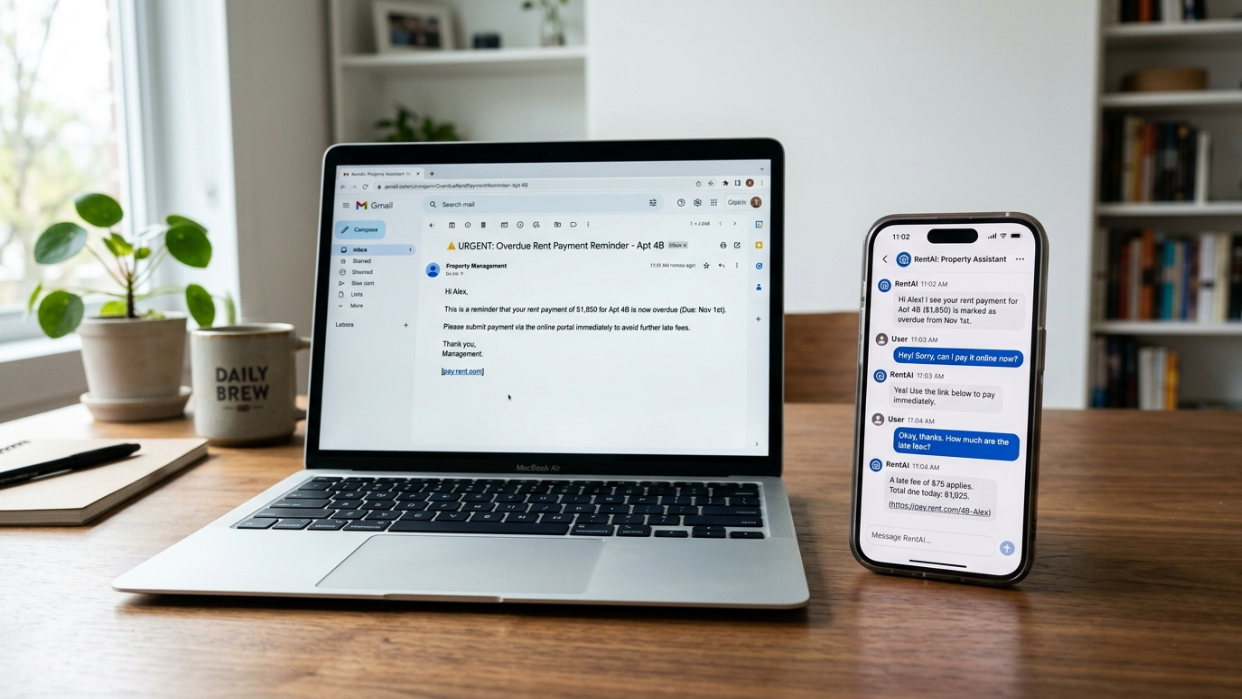
This is the most common point of confusion. Many property managers hear “AI payment plan outreach” and think it means scheduling reminder emails. It doesn’t.
Automated reminders are static, pre-written messages sent on a schedule. They say the same thing to every tenant regardless of circumstances. “Your rent is overdue. Please pay by clicking here.” If the tenant replies with a question or explains a hardship, the reminder system has no idea what to do with that response.
AI outreach is conversational. It reads and understands tenant replies. It negotiates. It adapts.
For example, one AI collections platform parses incoming replies so that if a tenant replies “Sorry, I’ll pay first thing Friday when I get my paycheck,” the system recognizes that as a promise to pay and schedules a follow-up for Friday. That’s fundamentally different from a cron job that blasts the same message every three days.
The difference is similar to what property managers experience with AI follow-up patterns in maintenance workflows, where context-aware conversation beats one-size-fits-all messaging every time.
What Makes AI Payment Plan Outreach Different?
Traditional Collections | AI Payment Plan Outreach |
|---|---|
Manual phone calls | AI voice conversations |
Generic emails | Personalized conversations |
Office hours only | 24/7 availability |
One reminder schedule | Dynamic follow-up timing |
Staff negotiate | AI negotiates within rules |
Manual documentation | Automatic conversation logging |
Human memory | Persistent context memory |
Limited scalability | Thousands of simultaneous conversations |
Key Capabilities That Define AI Payment Plan Outreach
Context Memory
AI for property management remembers context across conversations. If a tenant mentioned in March that they get paid on the 5th, the system stores that and shifts the cadence for future months. This personalization is where automated tenant communication stops feeling robotic and starts feeling like a competent assistant handling each case individually.
Adaptive Tone
The best AI collections tools adjust message tone and timing per resident. Early in the delinquency window, messages are friendly and solution-oriented. As time passes without resolution, urgency increases. Some systems, like EliseAI’s DelinquencyAI, negotiate payment plans within rules the property manager sets and flag accounts trending toward eviction risk.
Payment Plan Negotiation Within Guardrails
This is the core capability. The AI doesn’t just offer a single take-it-or-leave-it option. It can present multiple payment plan structures (two payments, three payments, custom timelines) within boundaries the operator defines. Maximum duration, minimum payment amounts, whether a down payment is required, all configurable. The AI negotiates within those guardrails without involving staff.
Reply Parsing and Conversational Intelligence
Natural language understanding allows the AI to interpret unstructured tenant responses. “I can do half now and half on the 20th” gets parsed as a specific proposed arrangement, not treated as an error message. This is what separates true AI payment plan outreach from chatbot-style decision trees.
PMS Integration
Modern AI collections technology integrates with the property management system to detect who hasn’t paid by the due date, then initiates a predefined collection workflow. This eliminates the manual step of pulling delinquency reports and deciding who to call. The AI reads the ledger, identifies balances, and acts.
See how Haven integrates with PMS platforms to automate property management workflows.
Human Escalation
AI routes cases to legal or formal notice workflows only when automated resolution has been exhausted. The best platforms enforce consistent, policy-driven communication throughout, which actually reduces compliance risk compared to ad hoc, staff-driven outreach. Staff only get involved when their judgment is genuinely needed.
Best Practices for AI Rent Collection
Property managers achieve the best results when AI supports a well-defined collections policy rather than replacing it.
Best practices include:
Contact residents before balances become severely delinquent.
Offer payment plans consistently to all eligible residents.
Keep payment options simple.
Maintain multiple payment methods.
Escalate complex situations quickly.
Review AI conversations regularly.
Update payment plan policies quarterly.
Monitor collection KPIs monthly.
Compliance Considerations for AI Payment Outreach
Payment outreach intersects with fair housing law, the Fair Debt Collection Practices Act (FDCPA), the Telephone Consumer Protection Act (TCPA), and state-specific collection rules. This section is not optional for anyone deploying these tools.
The Consistency Advantage
AI collections enforce policy uniformly across every resident, every unit, every time. That consistency is not just operationally valuable. It is a meaningful fair housing compliance safeguard. When humans handle collections, selective treatment (consciously or not) creeps in. One resident gets three calls, another gets one. One gets offered a payment plan, another doesn’t. AI eliminates that variability.
For a deeper look at how AI intersects with housing law, read our compliance and fair housing guide. For specific guidance on collections compliance, including FDCPA and TCPA, see our collections AI compliance guide.
Equitable Payment Plan Offerings
Payment plans must be offered equitably to all eligible residents. Selectively offering payment plans creates fair housing exposure. The plans themselves must be documented in writing, require ongoing current assessments alongside installments, and follow a consistent policy. AI enforces this by default because it follows the same rules for everyone.
Accessibility Matters
Digital payment systems present challenges. Many residents, particularly those from lower-income households, may not have access to online banking. When digital payments become the sole method, these individuals face unnecessary barriers. Property managers should ensure that multiple payment options remain available alongside AI-driven outreach. The AI should communicate all available payment methods, not just the most convenient digital one.
Avoiding Harassment Claims
AI-driven payment reminders and automated late notices must be carefully managed to avoid unintended pressure or harassment. This means configuring appropriate contact windows (no 3 AM texts), respecting frequency limits, and ensuring opt-out mechanisms work. Well-configured AI actually performs better here than human collectors, who may call too often or at inappropriate times without realizing it.
Common Mistakes to Avoid
Many implementations underperform because of poor configuration rather than poor technology.
Avoid these mistakes:
Waiting until accounts are 30+ days overdue.
Offering inconsistent payment plans.
Using only email.
Ignoring SMS.
Not integrating with PMS software.
Failing to monitor AI conversations.
Sending too many reminders.
Using AI without documented collection policies.
Not training staff on escalation procedures.
Forgetting state-specific regulations.
Real-World Results: What the Numbers Show

The performance data from early adopters of AI payment plan outreach is striking.
Metric | Organization | Result |
|---|---|---|
Delinquency reduction | EliseAI customers (average) | 40% reduction in delinquency |
Collection rate improvement | Brookfield (EliseAI pilot) | 2% collections boost, payments sped up by 14 days |
On-time payment increase | Asset Living (EliseAI) | 600 basis point increase in on-time rent payments |
AI-handled conversations | PeakMade (EliseAI) | 85%+ of delinquency conversations handled by AI, saving 954 hours in one quarter |
Bad debt reduction | Flatz Living (EliseAI) | 230 bps reduction in bad debt, ~$260,000 annualized savings for ~1,000 units |
Total AI collections | Summit PM (EliseAI) | $3M collected over 6 months |
Staff time saved | Entrata Payments AI | 175+ hours per month per portfolio |
On-time payment rate | UnleashX deployments | 96.2% on-time payment rate in production |
Practitioners on forums report that results vary by asset class. Automating the reminder cadence drops 30-day delinquency by roughly 15 to 30%. One practitioner noted that a Class-A urban portfolio saw a 31% improvement in Q3 2025, while a Class-C scattered-site operator saw 12%. The technology works across the spectrum, but expectations should be calibrated to the resident demographic and property type.
For broader context on AI ROI in property management, see our benefits, use cases, and ROI guide.
Who Should Use AI Payment Plan Outreach?
Ideal users include:
Apartment communities
Multifamily operators
Student housing
Build-to-rent communities
Affordable housing providers
Property management companies
Single-family rental portfolios
REIT asset managers
The AI Collections Tool Landscape
The market for AI payment plan outreach tools is consolidating quickly.
EliseAI is the current market leader, with its DelinquencyAI product implemented across over 1 million apartment units. Major firms including Brookfield, Cardinal Group, and Equity Residential use it. The company reached a $1 billion valuation as a proptech startup.
Entrata acquired Colleen AI in June 2024 and folded its collections engine into ELI+, providing AI-driven resident outreach on delinquent balances and payment plan negotiation inside Entrata’s stack. Notably, Colleen AI’s own domain now returns a server error, yet it still appears in competitor roundup articles, a sign that much of the content covering this space is already stale.
Zuma (formerly Kelsey) operates as an active standalone, proactively managing rent reminders, delinquency outreach, and past resident balances.
Buzz was acquired by Pay Ready in March 2025. It specialized in delinquency management with a smart assistant before the acquisition.
If you’re evaluating these tools, our collections AI tools overview breaks down the current options. You can also compare Haven and EliseAI to understand how different platforms approach AI-driven property management.
Common Misconceptions
“AI Can Force Tenants to Pay”
It can’t. One of the biggest misconceptions is that AI changes a resident’s willingness or ability to pay. AI won’t change someone’s financial situation, but it will remove the friction that delays payments. The tenant who intends to pay but keeps forgetting, or who wants to set up a plan but can’t reach the office during business hours, that’s where AI payment plan outreach excels. It closes the gap between intent and action.
“Payment Plan Equals Rent Forgiveness”
A payment plan is a document that establishes a schedule to pay back overdue rent, how much each payment should be, whom the tenant should pay, and how much total back rent is owed. It is not rent forgiveness or deferral. The full balance is still owed. The AI simply structures when and how it gets paid.
“This Is Just Fancy Reminders”
As covered above, the distinction between static reminders and conversational AI outreach is the difference between a calendar notification and a skilled collections coordinator. For more on how AI reduces late payments through intelligent communication sequences, that guide covers the tactical details.
How Property Managers Get Started
Step 1: Define Your Policies First
Before selecting any AI tool, document your payment plan policies. What’s the maximum plan duration? What’s the minimum payment? Is a down payment required? Are plans available to all residents or only those meeting specific criteria? (The answer should be “all eligible residents” for fair housing reasons.) The AI will enforce whatever rules you set, so the rules need to exist before the AI does anything.
Step 2: Ensure PMS Integration
AI payment plan outreach depends on clean, real-time data from your property management system. The AI needs to know who owes what, when it was due, and what the current balance is. If your PMS data is messy or your system doesn’t support the necessary API connections, the AI can’t function properly.
Step 3: Start With One Property or Cohort
Rolling out across an entire portfolio at once creates risk. Start with a single property or a defined group of delinquent accounts. Monitor the AI’s conversations, check that payment plans align with your policies, and verify that escalation to human staff happens when it should.
Step 4: Build the Infrastructure Now
Even if you’re not ready to deploy collections AI today, getting the foundational AI infrastructure in place (tenant communication tools, PMS integrations, after-hours answering capabilities) means you can activate collections automation faster when the time comes. The property managers seeing the best results from AI payment plan outreach are those who already had AI handling maintenance and leasing before they added collections.
Related Terms
Collections AI: The broader category of AI tools designed for rent collection workflows, including but not limited to payment plan outreach.
Delinquency management: The full process of tracking, communicating about, and resolving overdue rent balances.
Rent collection automation: Any technology that automates part of the rent collection process, from reminders to payment processing.
Payment plan agreement: The formal written document that records the terms of a structured repayment arrangement between tenant and property manager.
Frequently Asked Questions
How is AI payment plan outreach different from sending automated rent reminders?
Automated reminders are pre-written, static messages sent on a schedule. AI outreach is conversational. It reads tenant replies, understands intent (like a promise to pay on a specific date), negotiates payment plan terms within rules you define, and adjusts its timing and tone based on each resident’s history and responses. Reminders inform. AI outreach resolves.
Does AI payment plan outreach comply with fair housing laws?
When properly configured, it actually strengthens compliance. AI applies the same outreach cadence, tone, and payment plan options to every resident uniformly. This consistency eliminates the selective treatment that creates fair housing exposure in human-driven collections. That said, property managers still need to ensure plans are offered equitably and that multiple payment methods remain available.
What kind of results can property managers expect?
Results vary by asset class and resident demographic. Industry benchmarks show delinquency reductions of 15 to 40%, with collections velocity improvements of up to 14 days. Class-A properties tend to see larger percentage improvements than Class-C, but both benefit. One operator reported $260,000 in annualized savings from a 230 basis point reduction in bad debt across roughly 1,000 units.
Can AI actually negotiate payment plans, or does it just offer a fixed option?
True AI collections tools negotiate within guardrails. The property manager defines maximum plan duration, minimum payment amounts, and other parameters. Within those boundaries, the AI can present multiple options, respond to counteroffers, and finalize arrangements without human involvement. It only escalates to staff when the conversation falls outside its defined authority.
What happens when the AI can’t resolve a delinquent account?
The AI routes unresolved cases to human staff or legal/formal notice workflows after automated resolution has been exhausted. The specific escalation triggers are configurable: a certain number of days past due, a tenant explicitly refusing to pay, or a conversation the AI cannot parse. The goal is to handle the majority of cases automatically so staff can focus on the genuinely difficult ones.
Do tenants know they’re talking to AI?
Disclosure requirements vary by jurisdiction, but best practice (and increasingly, legal requirement) is to identify AI communication as such. Most tenants don’t mind as long as the AI is helpful, responsive, and offers real solutions. In practice, the lack of judgment in AI conversations sometimes makes tenants more willing to engage honestly about their financial situation than they would be with a human caller.