AI Tenant Retention in Property Management: 2026 Guide
Learn how AI Tenant Retention in Property Management lifts renewals with 9 proven strategies, 2026 data, and ROI math. Get the playbook now.

What Is AI Tenant Retention?
AI tenant retention is the use of artificial intelligence to identify residents at risk of moving out and improve the operational factors that influence lease renewals, including maintenance response, communication, renewal outreach, resident satisfaction, and rent decisions. The goal is not simply to automate property management, but to intervene earlier and make staying easier for residents.
TL;DR
Tenant turnover costs roughly $3,872 per unit. With average retention at just 57%, a 500-unit portfolio bleeds nearly $920,000 annually in turn costs alone. AI attacks this problem at its root by speeding up maintenance response (the #1 reason tenants leave), automating renewal outreach before tenants start browsing apartments, and keeping communication consistent across every channel, every hour of the day. The nine strategies below are ranked by retention impact, with real numbers and tool recommendations for each.
Quick Answer: How Can AI Improve Tenant Retention?
AI can improve tenant retention by responding to maintenance requests faster, maintaining consistent 24/7 communication, identifying residents who may be at risk of non-renewal, starting renewal conversations earlier, and helping property managers make more informed rent and service decisions. The highest-priority starting point is usually maintenance and communication because these affect the resident experience throughout the lease, not just at renewal time.
For multifamily operators, the best AI retention strategy is not one automation. It is a connected workflow that captures resident issues, resolves them quickly, follows up, identifies renewal risk, and engages residents before they decide to move.
The Math That Should Keep Every Property Manager Up at Night
Every vacant unit tells a financial story most operators underestimate. According to Zego’s reporting, apartment turnover costs average $3,872 per unit. The National Apartment Association found that over half of property management firms spend between $1,500 and $3,500 per turn, with nearly one in five exceeding $3,500.
Scale that across a portfolio. A 100-unit community with average retention turns roughly 43 units a year, costing $166,496. A 500-unit complex hits $919,600 annually. And that’s before counting the hit to property value: if high turnover shaves $50,000 per year off NOI at a 5.5% cap rate, you’ve lost $909,000 in asset value.
Here’s the number that matters most: 23% of tenants haven’t decided whether to renew. They aren’t committed to staying, and they aren’t committed to leaving. They’re persuadable. Every strategy in this article targets that group, because saving even a fraction of them changes your bottom line dramatically.
The current national average retention rate sits at roughly 57%. A rate above 60% is considered good; 70% or higher is the goal. AI gives property managers the tools to close that gap without hiring more staff.
Explore Haven’s AI property management platform to see how these strategies work in practice.
What Actually Causes Tenant Turnover?
AI cannot improve tenant retention simply by adding automation. It has to address the reasons residents decide not to renew.
The most useful way to approach retention is to separate controllable operational problems from unavoidable move-outs.
Common controllable retention problems
Slow or unresolved maintenance
Poor communication
Lack of follow-up after service requests
Unexpected or poorly explained rent increases
Inconvenient renewal processes
Inconsistent service between employees and communication channels
Failure to identify dissatisfied residents early
Common reasons that may be difficult for a property manager to prevent
Job relocation
Buying a home
Changes in household size
Financial circumstances
Relationship or family changes
Moving to another market
Lease or housing requirements changing
The goal of AI tenant retention is therefore not to prevent every move-out. It is to identify the portion of turnover that can potentially be influenced by better service, faster response, better communication, and more timely renewal engagement.
This distinction matters because a lower turnover rate does not automatically mean better management. Some residents will leave regardless of the quality of the resident experience.
At-a-Glance: 9 AI Retention Strategies Compared
AI Strategy | How It Helps Retention | Estimated Impact | Best For | ROI Timeline |
|---|---|---|---|---|
1. Unified AI Agent Platform (Haven) | Covers maintenance intake, vendor dispatch, leasing, and follow-ups in one coordinated system | Combines benefits of multiple point solutions; response times under 18 hours, satisfaction up 30% | Operators with 350+ units wanting a single platform | 1-3 months |
2. 24/7 Maintenance Intake | Eliminates after-hours black holes | Response time drops from 4.6 days to under 18 hours | All portfolio sizes | 1-3 months |
3. Maintenance Triage & Vendor Dispatch | Cuts request-to-resolution time | Emergency calls drop up to 40% | Scattered-site & multi-vendor portfolios | 2-4 months |
4. Automated Lease Renewal Outreach | Reaches undecided tenants earlier | 8-15 percentage point retention gain | Mid-to-large multifamily | 6-12 months |
5. Multichannel AI Communication | Consistent responses on every channel | 20-35% higher renewal rates | High-volume portfolios | 1-3 months |
6. Predictive Churn Scoring | Identifies at-risk tenants before move-out intent | 80-90% prediction accuracy | Data-rich operators (500+ units) | 3-6 months |
7. AI Rent Optimization | Balances revenue with renewal probability | Reduces rent-increase-driven churn | Markets with high comp volatility | 3-6 months |
8. Post-Maintenance Follow-Up | Closes the loop, catches unresolved issues | 34% satisfaction improvement in Q1 | All portfolio sizes | Immediate |
9. AI Leasing Speed | Minimizes vacancy between tenants | Compresses vacant days below 34-day average | Portfolios with 15%+ annual turnover | 1-3 months |
1. Unified AI Agent Platform for Maintenance and Leasing (Haven)
Best for: Operators managing 350+ units who want a single AI platform that handles the full retention loop, from maintenance intake to vendor dispatch to leasing, rather than stitching together point solutions.
Most retention strategies in this article target one piece of the tenant experience. The highest-impact approach is deploying a unified AI agent platform that covers multiple retention workflows in a coordinated system. When the same platform handles maintenance calls, dispatches vendors, follows up after repairs, and captures leasing leads, the data flows between those functions and nothing falls through the cracks.
Haven is built specifically for this. It is a Y Combinator-backed AI platform purpose-built for property management, with two core products: Maintenance AI and Leasing AI. Rather than offering generic chatbot functionality, Haven’s AI agents take real operational actions inside PMS and CRM systems, creating work orders, assigning tickets, dispatching vendors from preferred lists, and following up with tenants after completion.
How it works:
Voice-first AI agents answer tenant calls, texts, and emails 24/7 across maintenance and leasing
Maintenance requests are triaged with emergency detection, logged as work orders directly in PMS systems like AppFolio and Buildium, and dispatched to preferred vendors automatically
Leasing inquiries from Zillow, Apartments.com, and direct calls are answered within seconds, with lead qualification and tour scheduling handled automatically
Conversation memory carries context across channels and interactions, so tenants never have to repeat themselves
Post-work-order follow-ups close the loop and catch unresolved issues
Multi-language support ensures consistent service for all tenants
The numbers: Properties using Haven report response time drops from 4.6 days to under 18 hours and satisfaction improvements of up to 30%. Real Capital Group expanded from Maintenance AI to Leasing AI after seeing ROI improvements. Luke Properties (360+ units) deployed Haven AI agents named “Serena” and “Max” to handle maintenance and leasing coordination across their scattered-site portfolio.
Why a unified platform matters for retention: The retention strategies listed below (maintenance intake, vendor dispatch, follow-ups, leasing speed) are interconnected. A tenant who calls about a leak at midnight needs that request triaged, a vendor dispatched, and a follow-up sent after the repair. If those steps live in different systems, gaps appear. Haven handles the complete coordination loop in one platform, which is why operators use it to replace call centers entirely rather than supplement them.
Buildium’s marketplace specifically lists Haven as an AI partner that can automate communications and operational workflows, giving operators in that ecosystem a clear integration path.
Limitations to consider:
Sales-led onboarding with no self-serve option; implementation requires configuration and QA per property
No transparent public pricing
Depends on PMS data quality for accurate work order creation
Best suited for operators with 350+ units where the volume justifies the investment
Book a demo with Haven to see the full maintenance and leasing workflow in action.
2. 24/7 AI Maintenance Request Intake
Best for: Any property manager losing tenants to slow or missed maintenance responses, especially after hours.
Maintenance responsiveness is the single biggest driver of whether a tenant renews or walks. Not amenities. Not location. Not even rent. 72% of tenants cite unresolved maintenance as the primary reason for not renewing, and properties with response times exceeding five days see 2.7x higher non-renewal rates.
The problem is obvious: maintenance requests don’t respect business hours. A burst pipe at 11 PM on a Saturday needs immediate acknowledgment. Traditional answering services capture the message but can’t act on it. AI changes that equation completely.
How it works:
AI agents answer maintenance calls, texts, and emails around the clock
Requests are categorized, logged, and converted into work orders inside the PMS automatically
Emergency situations (flooding, gas leaks, fires) are detected and escalated instantly
Tenants receive immediate confirmation that their issue is being handled
The numbers: Properties using AI maintenance technology report response time drops from 4.6 days to under 18 hours, with resident satisfaction rising as much as 30%. That satisfaction boost isn’t just a feel-good metric. A 2024 MIT Center for Real Estate study found that a one-point increase in tenant satisfaction corresponds with an 8.6% higher likelihood of lease renewal.
Haven’s Maintenance AI provides voice-first 24/7 intake, creates work orders directly in PMS systems like AppFolio, detects emergencies, and dispatches vendors automatically. The AI handles the full coordination workflow rather than just taking messages.
For a deeper look at how after-hours AI intake works, see this guide on 24/7 maintenance request intake.
Limitations to consider:
Requires clean PMS data for accurate work order creation
Some tenants, particularly older demographics, prefer speaking with a human for complex issues
Initial configuration and QA are needed to train the AI on property-specific details
One practitioner insight worth noting: at a Dallas apartment complex covered by the New York Times, AI bots named Matt, Lisa, and Hunter handle maintenance coordination, leasing inquiries, and rent reminders respectively. Tenants frequently mistake them for real employees. The building’s property manager reported that staff are much happier now because vacation coverage used to be “very stressful.” This points to a secondary benefit: AI improves staff retention, which cascades to tenant retention through service consistency.
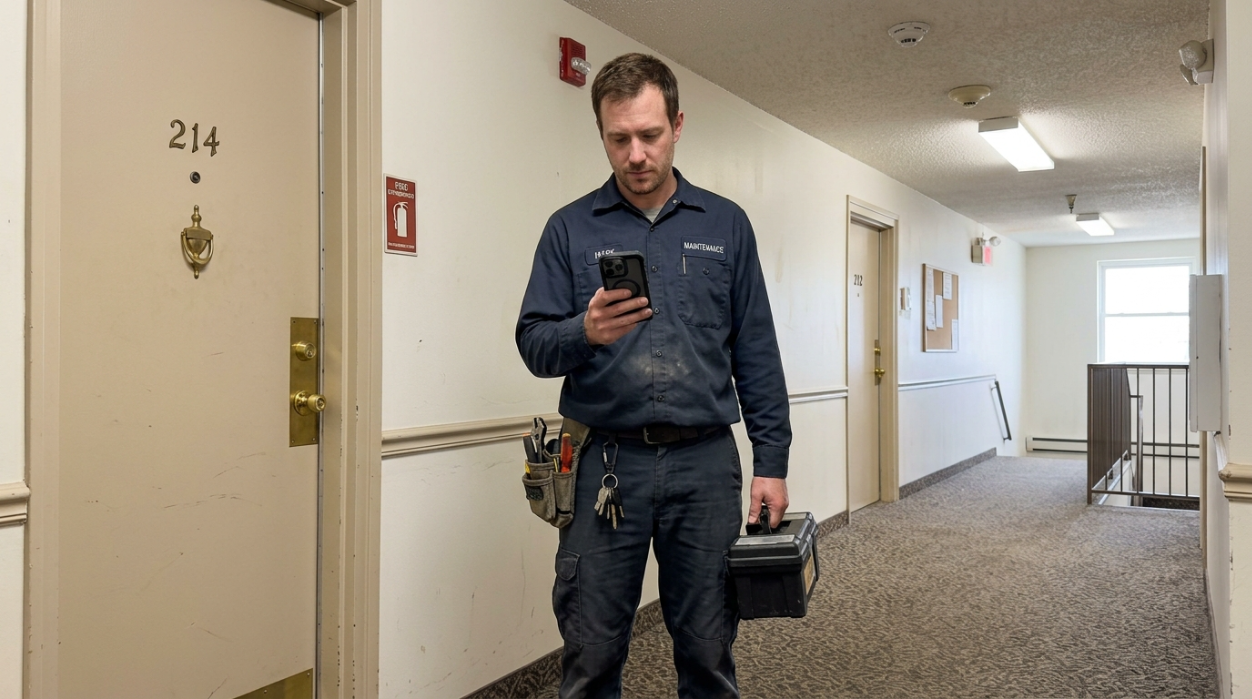
3. AI-Powered Maintenance Triage and Vendor Dispatch
Best for: Scattered-site portfolios and operators managing multiple vendor relationships where manual coordination creates bottlenecks.
Getting the request is only step one. The real retention impact comes from how quickly that request turns into a resolved issue. As one property management consulting firm noted, the manual coordination process involves too many handoffs: receiving the request, logging it, contacting the vendor, confirming the appointment, following up on completion, and closing the loop. Each handoff adds delay, and delay is what tenants actually feel.
How it works:
AI classifies each request by urgency (emergency, urgent, routine)
Appropriate vendors are selected from preferred vendor lists based on issue type, location, and availability
Work orders are dispatched automatically with all relevant details
The system tracks vendor response and follows up if SLAs are missed
The numbers: Emergency maintenance calls drop by up to 40% when AI platforms handle triage, largely because proper categorization prevents minor issues from escalating into emergencies. Firms that consistently resolve requests quickly see renewal rates 20 to 35% higher than those that let requests sit.
Haven’s AI Maintenance Coordinator manages this full loop, from intake through vendor dispatch to post-completion follow-up. It dispatches from preferred vendor lists and tracks the entire resolution cycle.
For operators looking to streamline vendor relationships further, this guide on AI vendor dispatch automation covers the nuts and bolts.
Limitations:
Vendor adoption matters; if your plumber doesn’t check texts, automation stalls at dispatch
Complex multi-trade issues (e.g., a leak that needs both plumbing and drywall) may require human judgment on sequencing
Quality depends on keeping vendor lists current in the system
4. Automated Lease Renewal Outreach
Best for: Mid-to-large multifamily operators who want to reach the “persuadable 23%” before they start apartment shopping.
Most property managers start renewal conversations 60 days before lease expiration. That’s too late. By then, undecided tenants have already browsed Zillow, toured a competitor’s unit, or mentally committed to leaving. AI-optimized outreach at 90 to 120 days converts significantly better because it catches tenants before alternatives take root.
How it works:
AI identifies leases approaching renewal windows and segments tenants by risk level
Personalized renewal offers are generated based on tenure, payment history, and local market conditions
Multi-touch outreach across email, SMS, and phone ensures the message reaches tenants on their preferred channel
Follow-up sequences adapt based on tenant engagement (opened email but didn’t respond, answered call but asked for time, etc.)
The numbers: Properties implementing AI lease renewal optimization typically achieve 8 to 15 percentage point improvements in retention rates within the first 12 months. McKinsey research found that organizations using AI-powered leasing workflows improve renewal rates by 3% to 7%. On a 200-unit property, a 10-point retention improvement translates to $120,000 to $200,000 in annual avoided turnover costs.
Tommaso Maria Ricci, a real estate technology analyst, puts it well: most firms only contact tenants when something is wrong. Targeted, well-timed communication is the most underexploited revenue lever in property management.
Key players in this space:
Colleen AI focuses on lease renewal and collections automation for large NMHC-level operators
Renew AI offers predictive retention and renewal automation for mid-to-large multifamily
EliseAI’s ResidentAI handles the full resident lifecycle including renewals, used in almost 2.5 million apartments
RealPage LUMINA provides agentic AI across leasing, operations, and resident engagement
For a detailed comparison of tools in this category, see this roundup of AI tools for lease renewals.
Limitations:
Renewal optimization is only as good as the data feeding it; incomplete payment or maintenance histories weaken predictions
Over-automation can feel impersonal; the best systems allow property managers to personalize AI-generated offers before they go out
Rent increase calculations still need human review for regulatory compliance in rent-controlled markets
5. Multichannel AI Communication (Phone, SMS, Email)
Best for: High-volume portfolios where communication gaps across channels create inconsistent tenant experiences.
Tenants don’t pick one channel and stick with it. They call after hours, text during the workday, and email on weekends. When responses are fragmented, when a tenant texts about a broken dishwasher and then calls to follow up but the phone agent has no context, that inconsistency breeds dissatisfaction.
How it works:
AI agents handle phone, SMS, and email through a unified system
Conversation memory carries context across channels (the AI “remembers” the text when the tenant calls)
Multi-language support ensures non-English-speaking tenants receive the same quality of service
Response time drops to seconds regardless of channel or time of day
The numbers: Firms that respond to tenant inquiries within 15 minutes see 20 to 35% higher renewal rates than those with response times over a day. Properties integrating technology broadly report 10 to 15% lower operational costs and higher tenant retention.
Haven’s voice-first design with SMS and email creates this unified communication layer, with conversation continuity and multi-language support built in. For more on how 24/7 tenant communication AI tools compare, that guide breaks down the options.
The trust gap is real, though. Some tenants push back against AI communication. As one renter put it in a report covered by the New York Times: “I’d rather deal with a person. If it’s all automated, it feels like they don’t care enough.” The best approach treats AI as augmentation, not replacement. AI handles the first response, the after-hours call, the routine question. Humans step in for complex or emotionally charged conversations.
A Fair Housing note: Consistent AI communication actually strengthens compliance. When every tenant receives the same quality of response regardless of who they are or when they call, you reduce the risk of disparate treatment claims. For details, see this AI Fair Housing compliance guide.
6. Predictive Tenant Churn Scoring
Best for: Data-rich operators with 500+ units who want to intervene proactively rather than react to move-out notices.
You can’t save a tenant you don’t know is at risk. By the time someone submits a non-renewal notice, the decision was made weeks or months earlier. Predictive churn scoring surfaces warning signals before move-out intent fully forms.
How it works:
AI analyzes payment history patterns (late payments increasing over time)
Maintenance request frequency and sentiment are tracked (multiple unresolved issues = red flag)
Engagement data such as portal logins, email opens, and communication responsiveness gets factored in
Market conditions like local rent trends and competing vacancies add external context
Each tenant receives a renewal probability score, typically with 80-90% accuracy
The numbers: The MIT Center for Real Estate study connecting satisfaction to renewals is the foundation here: each one-point increase in satisfaction drives an 8.6% higher renewal likelihood. Churn models let property managers focus retention efforts (rent concessions, personal outreach, maintenance prioritization) on the tenants most likely to respond.
Key players:
RealPage offers analytics and predictive features within its broader suite
Renew AI specializes in predictive retention scoring
EliseAI includes predictive elements in its resident engagement tools
AppFolio’s Realm-X provides some AI-assisted insights for AppFolio users
Limitations:
Accuracy depends heavily on data quality, and many PMS systems have gaps in historical data
Small portfolios (under 100 units) may not generate enough data for meaningful predictions
Churn scores are probabilistic, not deterministic; acting on them still requires human judgment about what intervention fits each tenant
Privacy considerations arise when aggregating behavioral data
7. AI-Driven Rent Optimization
Best for: Markets with high comp volatility where one-size-fits-all rent increases drive avoidable turnover.
Rent increases are the second most common reason tenants leave, right behind maintenance. The challenge is that setting increases too low leaves revenue on the table while setting them too high pushes out good tenants. AI makes this a data problem instead of a guessing game.
How it works:
AI analyzes 50+ variables: local comps, demand signals, tenant tenure, payment history, renewal probability, seasonal trends
Each tenant receives a personalized rent recommendation that balances revenue maximization with acceptable renewal probability
Scenario modeling shows the projected impact of different increase levels on retention vs. revenue
Recommendations update dynamically as market conditions shift
Why personalization matters: A tenant who has renewed three times, always pays early, and submitted zero maintenance requests in two years can absorb a different increase than a first-term tenant who filed five work orders last quarter. One-size-fits-all increases treat both identically, which is both a financial and retention mistake.
Key players:
RealPage is the dominant player in rent optimization (though it faces antitrust scrutiny around algorithmic pricing)
Yardi offers revenue management tools integrated with its PMS
Rentana focuses specifically on AI-powered pricing
Limitations:
Algorithmic pricing has drawn regulatory attention; the DOJ has investigated whether coordinated use of pricing algorithms constitutes anti-competitive behavior
AI recommendations still need human review, especially in rent-controlled or rent-stabilized markets
Overreliance on revenue optimization without weighing retention costs can backfire; the model needs to account for turnover costs, not just market rent
8. Post-Maintenance Follow-Up Automation
Best for: Every property manager, period. This is the most underused retention lever in the industry.
Completing a repair is only 80% of the retention benefit. The remaining 20% comes from closing the loop: confirming the tenant is satisfied, catching issues that weren’t fully resolved, and demonstrating that management cares about the outcome, not just checking a box.
Most property managers fail here. Not because they don’t care, but because manual follow-ups are the first thing to drop when the day gets busy. AI makes follow-ups automatic and consistent.
How it works:
After a work order is marked complete, AI automatically contacts the tenant (via their preferred channel) to confirm satisfaction
If the tenant reports an unresolved issue, the work order is reopened and escalated
Satisfaction data is collected and stored, creating a record that can inform renewal conversations
Trends in post-maintenance dissatisfaction surface systemic vendor or building issues
The numbers: Satisfaction scores improve 34% in the first quarter after implementing automated status updates and follow-ups. Data-backed renewal conversations (those that reference resolved maintenance and satisfaction scores) convert 22% better than generic renewal outreach.
Haven handles post-work-order follow-ups as part of its maintenance coordination workflow, directly addressing this gap without requiring property managers to add another task to their plate.
For a detailed walkthrough of how this works, see the guide on AI maintenance follow-ups.
Limitations:
Follow-up fatigue is possible if tenants receive surveys after every minor request (smart systems limit follow-ups to significant work orders)
Reopened work orders need a clear escalation path, or the follow-up creates frustration rather than resolution
The data collected is only useful if someone actually reviews it and acts on trends
9. AI Leasing Speed (Reducing Vacancy Between Tenants)

Best for: Portfolios with annual turnover above 15% where minimizing vacant days has the highest revenue impact.
Even with the best retention strategies, some tenants will leave. When they do, every vacant day costs money. Average vacant days hit 34.4 at the end of 2024, up from 30 in 2020. AI compresses this window by responding to prospects instantly, qualifying them automatically, and scheduling tours without human involvement.
How it works:
AI agents capture leads from listing sites like Zillow and Apartments.com in real time
Prospects are qualified based on income, move-in date, pet policy, and other criteria
Tour scheduling happens within seconds of inquiry, not hours
Lead nurturing sequences keep prospects engaged through the application process
Why this is a retention play: Speed signals desirability. When current tenants see units filling quickly, it reinforces that their building is in demand, which makes them less likely to test the market. Conversely, visible vacancies and “For Rent” signs create a negative spiral.
Haven’s Leasing AI captures leads from listing sites, qualifies tenants, and schedules tours within seconds. It handles phone, SMS, and email inquiries with the same conversation continuity as the maintenance side.
Limitations:
AI qualification works best with clear, standardized criteria; nuanced situations (co-signers, non-traditional income) may need human review
Prospects in competitive markets expect a human touchpoint before signing; AI should accelerate the funnel, not replace the final conversion conversation
Integration with listing sites depends on API availability, which varies by platform
The Staff Burnout Connection Nobody Talks About
There’s a retention cascade that most articles on this topic ignore. When property managers are burned out, overwhelmed by after-hours calls and maintenance coordination overhead, they leave. Staff turnover means new faces, inconsistent processes, and a worse tenant experience. That drives tenant turnover, which creates more work, which accelerates staff burnout.
AI breaks this cycle. The Dallas property manager whose AI bots handle routine coordination said his staff is “much happier now.” Happy staff stay longer. Consistent staff deliver better service. Better service retains tenants. This indirect path from AI to tenant retention is just as important as the direct one.
For operators dealing with this challenge, this guide on property manager burnout and AI goes deep on solutions.
Which KPIs Should Property Managers Track for AI Tenant Retention?
AI tenant retention programs should be measured using operational, resident-experience, and financial metrics. A single renewal-rate number is not enough because renewal outcomes can be affected by rent changes, market conditions, household changes, and other factors outside the property's control.
KPI | What It Measures | Why Track It |
|---|---|---|
Resident retention rate | Percentage of residents who renew | Primary retention outcome |
Non-renewal rate | Percentage of residents who leave | Shows where retention is being lost |
Maintenance first-response time | Time until a resident receives acknowledgment | Measures service responsiveness |
Maintenance resolution time | Time from request to completion | Measures operational execution |
Work-order reopen rate | Percentage of completed requests reopened | Shows whether repairs are actually resolving problems |
Resident satisfaction | Resident perception of service | Leading indicator of retention |
Renewal outreach response rate | Residents responding to renewal communications | Measures engagement |
Renewal conversion rate | Residents accepting renewal offers | Measures renewal effectiveness |
At-risk resident intervention rate | At-risk residents receiving an intervention | Measures whether predictive tools lead to action |
Turnover cost per unit | Cost associated with each move-out | Connects retention to financial impact |
Vacancy days | Time a unit remains unoccupied | Measures the financial impact of unavoidable turnover |
The most useful approach is to establish a baseline before implementing AI and compare the same metrics after implementation. Measure results by property, unit type, resident segment, and time period where appropriate.
Your ROI Calculator: A Simple Framework
Here’s the math to build your business case:
Step 1: Calculate your annual turnover cost
(Total units) x (turnover rate) x ($3,872 average cost per turn) = Annual turnover cost
Example for a 200-unit property at 43% turnover:
200 x 0.43 x $3,872 = $332,992/year
Step 2: Estimate AI retention improvement
Conservative estimate: 8 percentage points (based on reported 8-15 point improvements in the first year)
Step 3: Calculate savings
200 units x 0.08 improvement x $3,872 = $61,952/year in avoided turnover costs
Step 4: Factor in the NOI and valuation impact
At a 5.5% cap rate, $61,952 in preserved NOI adds $1,126,400 in property value.
That’s before counting reduced vacancy loss, lower marketing spend for re-leasing, and staff productivity gains.
Choosing the Right AI Retention Tool
The market has several credible options, and the right choice depends on your portfolio size, PMS, and which retention problem is most acute.
Tool | Primary Strength | Best Portfolio Size | PMS Integration | Limitation |
|---|---|---|---|---|
Haven | Maintenance AI + Leasing AI with full coordination workflow | 350+ units, scattered-site | AppFolio, Buildium, others | Sales-led onboarding; no self-serve |
EliseAI | Full resident lifecycle (leasing, resident, collections) | Large multifamily (1,000+) | Multiple PMS platforms | Enterprise-oriented; may be heavy for smaller operators |
RealPage LUMINA | Agentic AI across leasing, operations, resident | Enterprise multifamily (1,000+) | RealPage suite | Antitrust scrutiny on pricing algorithms |
Colleen AI | Lease renewal + collections automation | NMHC-level operators | Not broadly disclosed | No maintenance component |
Renew AI | Predictive retention + renewal automation | Mid-to-large multifamily | Not broadly disclosed | Renewal-only; no maintenance |
AppFolio Realm-X | Built-in AI assistant within PMS | 50+ units | Native AppFolio | Limited maintenance dispatch capabilities |
Buildium | Workflow automation + marketplace AI partners | 1-5,000 units | Native + partners like Haven | No native conversational AI |
Buildium’s marketplace specifically lists Haven as an AI partner that can automate communications and operational workflows, which gives operators in that ecosystem a clear integration path.
For operators weighing the maintenance AI decision specifically, the critical question is whether the tool handles the complete coordination loop (intake, triage, dispatch, follow-up) or just the first step.
See how Haven’s AI agents work across maintenance and leasing.
FAQ
How much does tenant turnover actually cost per unit?
The national average is approximately $3,872 per unit according to Zego, with the National Apartment Association reporting that over half of firms spend $1,500 to $3,500 and nearly 20% spend more than $3,500. These figures include make-ready costs, lost rent during vacancy, marketing, and administrative time but often undercount the opportunity cost of staff hours diverted from retention activities.
What is a good tenant retention rate?
The national average sits around 56-57%. A rate above 60% is generally considered good, while 70% or higher is the target most successful operators aim for. Each percentage point of improvement translates directly to avoided turnover costs and preserved NOI.
Which AI application has the biggest impact on tenant retention?
Maintenance AI consistently shows the strongest results because maintenance responsiveness is the top driver of lease renewals. Properties using AI maintenance tools report response time drops from 4.6 days to under 18 hours, satisfaction improvements of 15-25%, and renewal rate increases of around 10%. Start here if you’re choosing one AI investment.
Do tenants actually want to interact with AI?
It depends. Many tenants can’t tell the difference between a well-designed AI agent and a human employee, as demonstrated by the Dallas apartment complex where AI bots are routinely mistaken for real staff. However, some tenants, particularly in emotionally charged situations, prefer human contact. The best implementations use AI for speed and consistency on routine interactions while routing complex or sensitive conversations to human staff.
How long does it take to see ROI from AI tenant retention tools?
Most operators see measurable impact within 1-3 months for maintenance-related AI (faster response times, higher satisfaction scores) and 6-12 months for renewal-focused tools (retention rate improvements). Maintenance AI tends to show the fastest payback because the before-and-after on response time is immediately measurable.
Does AI communication create Fair Housing risks?
Properly implemented AI communication actually reduces Fair Housing risk. Because AI agents deliver consistent responses regardless of the caller’s identity, accent, or time of contact, they eliminate the variability in human responses that can lead to disparate treatment claims. The key is ensuring the AI is configured with compliant language and escalation protocols from the start.
Can small property managers (under 100 units) benefit from AI retention tools?
Yes, though the tool selection matters. Embedded PMS AI features (like AppFolio’s Realm-X) offer a lower barrier to entry. Dedicated AI platforms like Haven are designed for operators with 350+ units where the volume of maintenance requests and leasing inquiries justifies the investment. For very small portfolios, start with AI maintenance intake as a call center replacement, which typically pays for itself fastest.
How does AI retention compare to traditional retention strategies like amenity upgrades?
Amenity upgrades (new fitness equipment, package lockers, coworking spaces) are capital-intensive and benefit all tenants equally regardless of whether they were considering leaving. AI retention strategies are targeted and operational. They cost less, scale better, and address the specific friction points (slow maintenance, poor communication, mistimed renewal offers) that actually drive move-outs. The most effective approach combines both, but if budget forces a choice, fix the operations first.