How Tenant Satisfaction Maintenance AI Drives Renewals 2026
Learn how Tenant Satisfaction Maintenance AI speeds repairs, raises TSS 15-25%, and lifts renewals while cutting turnover costs. See metrics, benchmarks, ROI.
TL;DR
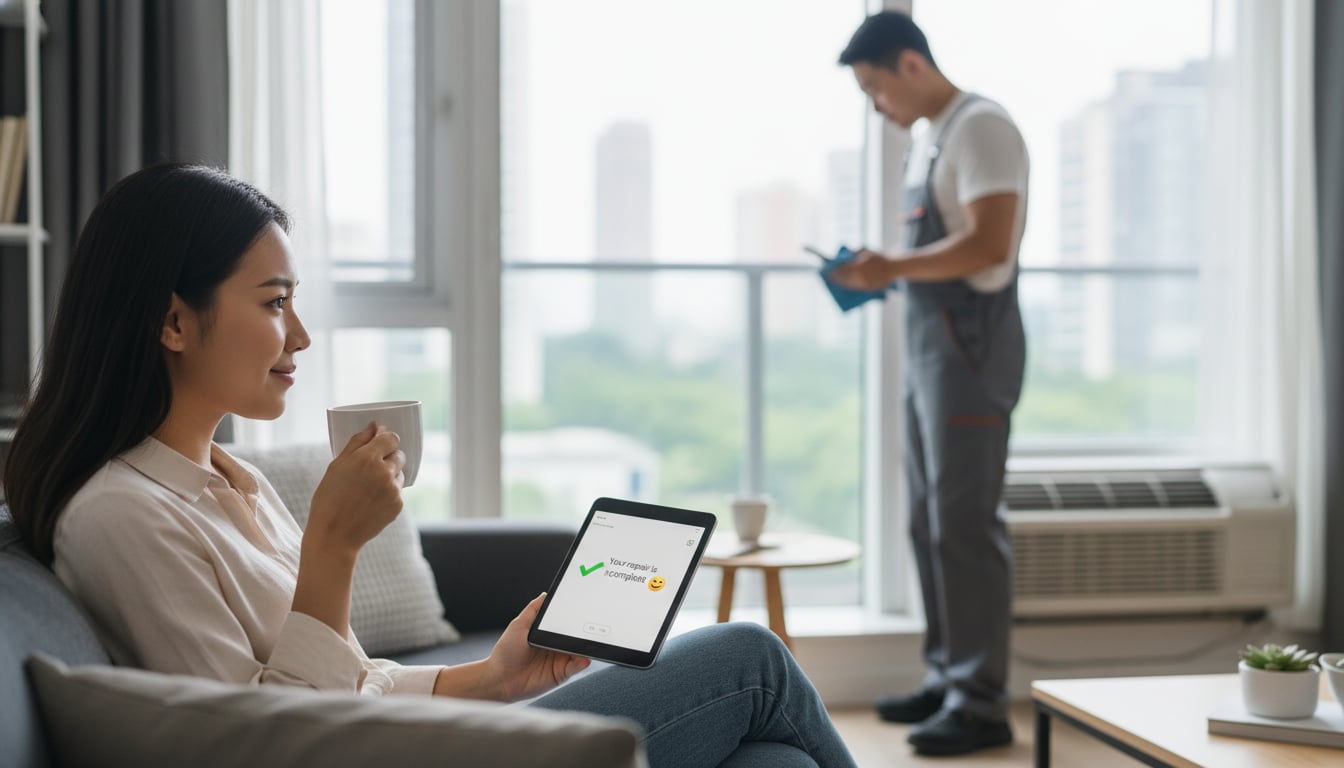
Tenant satisfaction maintenance AI refers to the use of artificial intelligence within maintenance operations to directly improve how tenants experience repairs and upkeep. Maintenance is the single biggest driver of tenant satisfaction, and AI addresses it by automating request intake, triaging urgency, dispatching vendors, and following up after completion, all 24/7. Properties using this technology report response time drops from 4.6 days to under 18 hours and satisfaction score improvements of 15 to 25 percent. The financial case is straightforward: higher satisfaction means more renewals and fewer turnovers, which cost $1,750 to $3,872 per unit.
How does maintenance AI impact tenant renewals?
Tenant satisfaction maintenance AI drives renewals by reducing maintenance response times from an industry average of 4.6 days to under 18 hours. By providing 24/7 automated intake, instant triage, and proactive communication, AI increases tenant satisfaction scores by 15% to 25%. Since higher satisfaction leads to an 8.6% increase in lease renewal probability, AI directly reduces turnover costs, which typically range from $1,750 to $3,872 per unit.
What Is Tenant Satisfaction in Property Management?
Tenant satisfaction is a metric that measures how well a property meets its occupants’ needs and expectations. In the context of maintenance, it narrows to something very specific: how tenants perceive the speed, quality, and communication around repair requests.
This is not a soft metric. A 2024 study from the MIT Center for Real Estate examined 104,586 survey responses across 2,906 office buildings and found that a one-point increase in overall tenant satisfaction (on a one-to-five scale) corresponded with an 8.6% higher likelihood of lease renewal and an 11.5% higher likelihood that the tenant would recommend the building. Satisfaction predicts retention with measurable precision.
Industry benchmarks put an acceptable tenant satisfaction score between 70% and 90%. Scores above 80% indicate strong retention health. Scores below 70% signal active risk, meaning tenants are already comparing alternatives.
Why does maintenance dominate these scores? Because it’s the most frequent and tangible interaction between tenant and property management. Leasing happens once. Rent payments are automated. But a broken HVAC system in August or a leaking pipe at 2 a.m. creates emotional, high-stakes moments that define a tenant’s entire perception of the property.
Understanding the financial impact of maintenance AI on retention and costs makes the connection between satisfaction scores and bottom-line outcomes concrete.
What Is Maintenance AI?
Maintenance AI is artificial intelligence applied to the maintenance workflow in property management. One property management consulting firm defines AI in this context as “the use of technology that mimics human decision-making to streamline, automate, or personalize tenant interactions.” That framing is useful, but maintenance AI is more specific than general property management AI. It focuses on the entire lifecycle of a maintenance request.
Here are the six core functions:
Automated intake. AI accepts maintenance requests around the clock via phone, text, or chat. No voicemail boxes, no missed calls, no “we’ll get back to you during business hours.” For a deeper look at how this works in practice, see this guide on 24/7 maintenance request intake.
Triage and prioritization. AI categorizes each request by urgency: emergency, urgent, or routine. It uses keyword detection and severity scoring to identify situations like gas leaks, flooding, or fire, and escalates those immediately to human staff.
Work order creation. AI generates work orders directly inside the property management system (PMS), eliminating the manual step of re-entering information from a phone call or email.
Vendor dispatch. AI assigns technicians or vendors from a preferred vendor list based on issue type, availability, and location.
Follow-up and feedback. After work is completed, AI contacts the tenant to confirm resolution and collect satisfaction feedback.
Predictive maintenance. AI analyzes sensor data and historical patterns to flag equipment likely to fail before it actually does, preventing tenant disruption entirely.
This is fundamentally different from traditional PMS tools or call centers. A call center takes a message. Maintenance AI takes action. To understand the full coordination workflow, the AI maintenance coordinator guide breaks down each step.
Tenant Satisfaction Maintenance AI: The Combined Concept
Tenant satisfaction maintenance AI is the application of artificial intelligence within maintenance operations specifically to improve tenant satisfaction outcomes. It connects three elements: the metric (satisfaction), the operational domain (maintenance), and the technology (AI).
The concept represents a shift from reactive, manual maintenance workflows to automated, proactive ones, with tenant experience as the measured output. It’s not just about having AI in your tech stack. It’s about deploying AI in the operational area that has the greatest impact on whether tenants stay or leave.
The cause-and-effect chain looks like this:
AI speeds up response → Tenants feel heard → Satisfaction scores rise → Lease renewals increase → Turnover costs drop
Each link in that chain is supported by data, which the following sections cover.
How the AI Maintenance-to-Renewal Loop Works
Instant Acknowledgement: Tenant submits a request via SMS or Chat; AI responds in seconds, lowering anxiety.
Smart Triage: AI identifies if the issue is an emergency (e.g., flooding) and dispatches immediately.
Transparent Tracking: Automated updates keep the tenant informed, eliminating "dark periods" where tenants feel ignored.
Feedback Capture: AI requests a rating immediately upon completion, catching friction points before they fester.
Data-Driven Retention: Property managers use satisfaction data to identify at-risk tenants months before lease expiration.
How AI Improves Tenant Satisfaction Through Maintenance
Speed
This is the most measurable improvement. Average maintenance response time typically drops from 4.6 days to under 18 hours within 30 days of AI implementation. AI chatbots that categorize issue urgency, dispatch work orders, and schedule vendor appointments reduce the average time from request to resolution by 40 percent.
Speed matters because tenants benchmark their experience against what feels reasonable, not against industry averages they’ve never seen. When a repair takes five days, the tenant doesn’t think “that’s close to the 4.6-day average.” They think “nobody cares.”
Availability
24/7 availability through AI eliminates after-hours staffing costs while improving tenant satisfaction scores by 15 to 25 percent through instant response capability. Most maintenance emergencies happen outside business hours. A burst pipe at midnight that reaches voicemail becomes a story the tenant tells everyone. The same pipe addressed in real time by an after-hours maintenance AI system becomes a data point in a work order.
Communication
Here is the finding that surprises most property managers: speed is the baseline, but communication is the differentiator. Data from Kingsley Index surveys consistently shows that tenants who feel a complaint was heard and addressed are more likely to renew than tenants whose concerns were handled but never acknowledged. The acknowledgment itself carries weight.
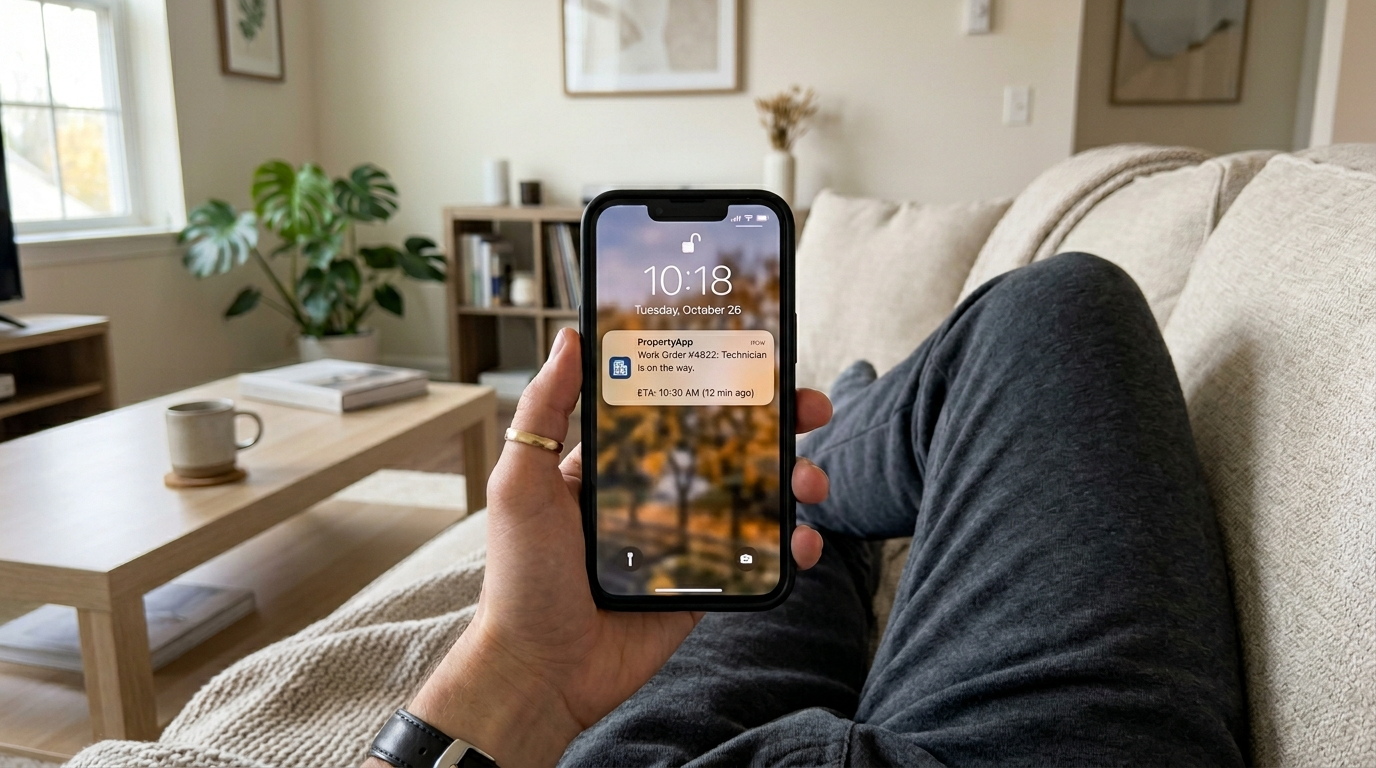
AI enables automated status updates at every stage: “We received your request,” “A technician has been assigned,” “Your repair is scheduled for Thursday,” “Your work order has been completed.” These updates are not extras. They are what tenants experience as “being cared about.”
Accuracy
AI triage routes issues correctly the first time, matching the right vendor to the right problem. This increases the first-time fix rate, which directly affects satisfaction. When a tenant has to submit the same request twice, or a wrong vendor shows up, trust erodes quickly.
Follow-Up
Post-completion feedback loops are where tenant satisfaction maintenance AI closes the circle. After a work order is marked complete, AI contacts the tenant to confirm the issue was actually resolved and to collect a satisfaction rating. This does two things: it catches incomplete repairs before they become complaints, and it generates continuous satisfaction data. For more on how this works, see the AI follow-up after maintenance guide.
Prevention
Predictive maintenance is the most advanced application. AI analyzes equipment age, usage patterns, and sensor data to identify systems likely to fail. Replacing an aging water heater before it floods a unit is better for the tenant, better for the property, and dramatically cheaper than emergency repair plus damage remediation.
Key Metrics to Track
Implementing tenant satisfaction maintenance AI without tracking outcomes is guesswork. These are the metrics that matter:
Tenant Satisfaction Score (TSS). The core metric. Survey tenants after maintenance completions, not just once a year. Target 80% or higher.
First-time fix rate. The percentage of issues resolved on the first vendor visit. Target 80% or above. Low first-time fix rates mean repeat disruptions for tenants and repeat costs for operators.
Average response time. Measure both acknowledgment time (how fast the tenant hears back) and resolution time (how fast the problem is actually fixed). These are separate metrics with separate benchmarks.
Lease renewal rate. The downstream metric that proves satisfaction is translating into retention. The MIT study shows this correlation is strong and measurable.
Net Promoter Score (NPS). Would your tenants recommend the property? This captures overall sentiment beyond individual maintenance interactions.
Maintenance request volume and resolution rate. AI should increase the resolution rate (percentage of requests fully resolved) while potentially decreasing volume over time as predictive maintenance prevents issues.
Practitioners on TurboTenant have noted an underappreciated benefit: AI chatbots help tenants diagnose and sometimes fix minor maintenance issues before ever contacting the landlord. This reduces unnecessary service calls while still making tenants feel supported. That self-resolution capability is a satisfaction lever that doesn’t show up in traditional response-time metrics.
Maintenance Response Time Benchmarks
Response time expectations should be tiered by urgency. These are the widely recognized standards:
Urgency Level | Acknowledgment | Resolution |
|---|---|---|
Emergency (gas leak, flood, fire) | Within 1 hour | On-site within 4 hours |
Urgent (HVAC failure, major plumbing) | Within 4 hours | Resolved within 24 hours |
Routine (appliance repair, minor fix) | Within 24 hours | Resolved within 48 hours |
The 24-hour acknowledgment and 48-hour resolution standard for routine issues is the threshold between tenants who feel cared for and tenants who begin looking for alternatives. Miss it consistently, and renewals drop.
Property managers on forums and practitioner channels consistently raise one concern about AI handling these tiers: “What if AI misclassifies an emergency?” The answer from deployed systems is reassuring. AI triage uses keyword detection and severity scoring, with automatic escalation to human staff for anything flagged as potentially dangerous. The escalation path is what makes the system safe, not the assumption that AI will be perfect. For a detailed breakdown of how emergency maintenance triage AI handles these situations, that guide covers the detection and routing logic.
The Financial Case for Tenant Satisfaction Maintenance AI
The numbers are not ambiguous.
Tenant turnover costs between $1,750 and $3,872 per vacancy when you account for cleaning, repairs, marketing, lost rent during vacancy, and leasing costs. The average cost of property maintenance increased by 12% in 2024, and maintenance accounted for 33.5% of property management revenue share.
Properties that streamline maintenance communication report turnover drops of up to 25% within six months of implementation. AI property management chatbots resolve 65 to 75 percent of tenant inquiries without human intervention, reducing the cost per interaction dramatically compared to call centers.
Griffin Partners, using Kingsley survey-driven satisfaction strategies, saw a 14% jump in tenant retention over two years, equating to $14 million in retained lease value.
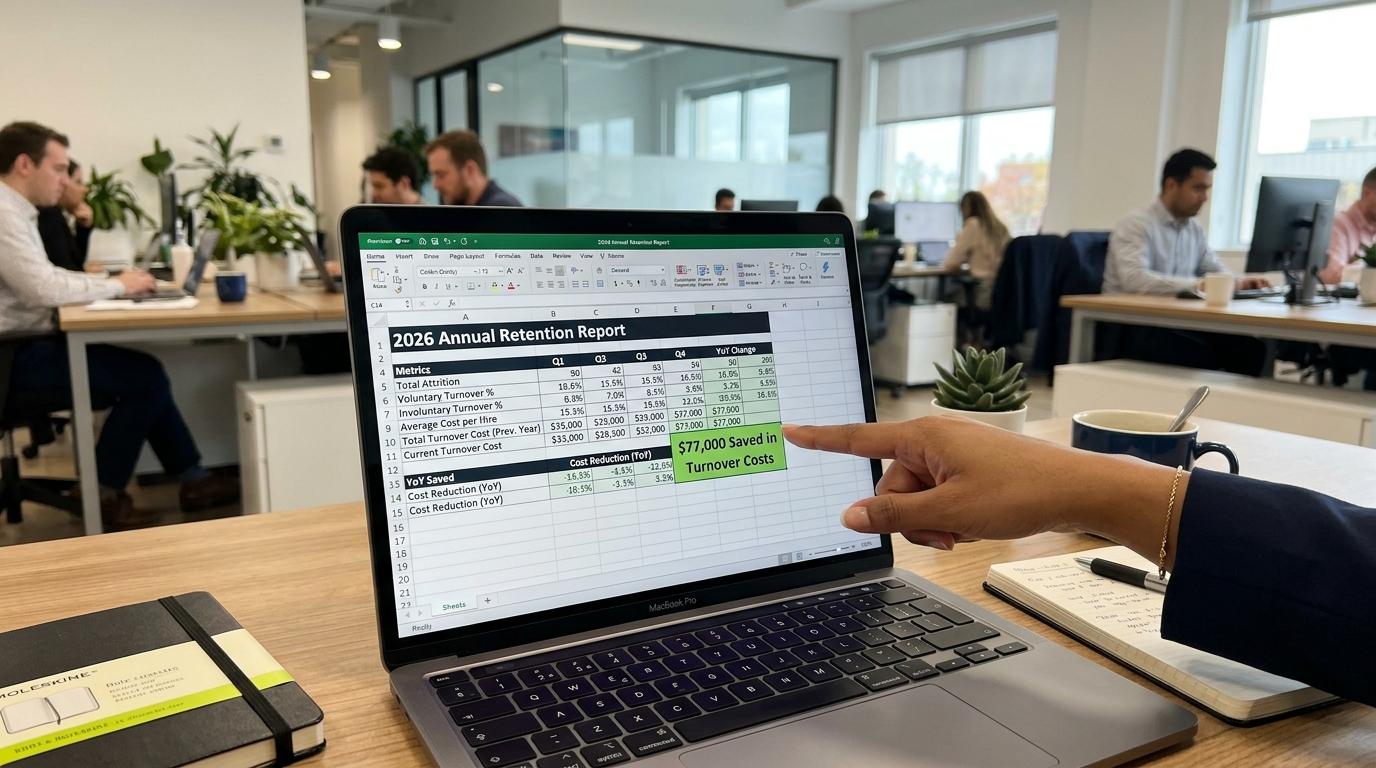
For a portfolio of 500 units with a 40% annual turnover rate, preventing even 10% of those turnovers saves $35,000 to $77,000 per year at the low end. AI tools that cost a fraction of a single call center agent’s salary produce outsized returns because they operate continuously, consistently, and at scale.
According to Marketo data cited by TenantCloud, 76% of those who automate their business see ROI within the first year.
The Cost of Manual vs. AI-Driven Maintenance
Using a data table helps Google pull information for "Comparison" style search queries.
Feature | Manual/Traditional Process | AI-Driven Maintenance |
Response Time | 4.6 Days (Average) | < 18 Hours |
Availability | Business Hours (9-5) | 24/7/365 |
Tenant Satisfaction | Baseline (60-70%) | Optimized (80-90%+) |
Turnover Rate | Standard Industry Rates | Up to 25% Reduction |
Cost Per Intake | High (Staff/Call Center) | Low (Automated) |
Resolution Logic | Human Triage (Varies) | Instant Triage & Dispatch |
AI Adoption Trends in Property Management
Tenant satisfaction maintenance AI is not a future concept. Adoption is accelerating right now.
The 2025 AppFolio Benchmark Report shows AI usage among property managers jumped from 21% to 34% in a single year. Separately, 28% of respondents plan to adopt AI tools in 2025, up from 17% in 2024.
These numbers signal the industry is past the early-adopter phase and into the early majority. Property managers who delay adoption aren’t holding steady; they’re falling behind a shifting baseline of tenant expectations.
The AI Property Manager Newsletter, a practitioner publication, makes a sharp observation: AI isn’t merely improving property management, it’s rewriting its economics. Manual maintenance triage caused delays and tenant dissatisfaction not because managers weren’t trying hard enough, but because the old system of emails, spreadsheets, and phone calls couldn’t coordinate at scale. The architecture itself was broken. AI replaces sequential human processing with parallel signal processing.
Haven’s Maintenance AI is built on this principle, handling intake, triage, work order creation, vendor dispatch, and follow-up as an integrated workflow rather than a chain of manual handoffs.
Common Misconceptions
“AI replaces the human touch”
This is the most common objection from property managers considering tenant satisfaction maintenance AI. Property management consultants like Deb Newell frame the real concern well: operators worry tenants will feel depersonalized. The practical answer emerging from the industry is a division of labor. AI handles the speed layer (instant acknowledgment, triage, routing), while humans handle the relationship layer (complex complaints, escalations, emotionally charged situations).
AI doesn’t eliminate the human touch. It frees up human attention for the moments where it actually matters. For a fact-based breakdown of this concern, the article on AI property management myths addresses several related objections.
“AI can’t handle emergencies”
Emergency detection and escalation is a core function of maintenance AI, not an afterthought. Systems use keyword detection, severity scoring, and automatic routing to human staff for anything involving gas leaks, flooding, fire, or carbon monoxide. The question isn’t whether AI can handle emergencies. The question is whether your current voicemail system can.
“We’d need to rip and replace our PMS”
Modern maintenance AI integrates with existing property management systems. Work orders are created, updated, and closed inside the PMS the team already uses. No migration required.
“Annual satisfaction surveys are enough”
Pulse surveys, short check-ins tied to specific events like maintenance completions, capture sentiment when it’s most current and honest. Building Engines recommends pairing annual surveys with pulse surveys for a continuous read rather than a once-a-year snapshot. AI enables this by triggering feedback requests automatically after every completed work order.
Related Terms
Predictive maintenance. The use of IoT sensor data and AI pattern recognition to anticipate equipment failures before they occur. Prevents tenant disruption rather than reacting to it.
Work order automation. AI-generated work orders sent directly to the property management system, eliminating manual data entry and reducing errors.
Maintenance triage. AI classification of maintenance request urgency into emergency, urgent, and routine tiers, with appropriate routing for each.
Tenant retention rate. The percentage of tenants who renew their leases. Directly correlated with satisfaction scores and maintenance responsiveness.
First-time fix rate. The percentage of maintenance issues resolved on the first vendor visit. Higher rates mean fewer repeat disruptions and higher satisfaction.
For a comprehensive view of how these concepts fit together in a modern property management operation, the maintenance AI triage and ROI guide connects the dots between triage, automation, and financial returns.
Getting Started with Tenant Satisfaction Maintenance AI
The gap between properties using AI for maintenance and those relying on manual workflows is widening. Tenants increasingly expect instant acknowledgment, transparent communication, and fast resolution. Those expectations won’t go backward.
For property managers ready to evaluate how AI can improve their maintenance operations and tenant satisfaction scores, booking a demo with Haven is a practical first step. Haven’s AI agents handle intake, triage, work order creation, vendor dispatch, and follow-up across phone, SMS, and email, integrating directly with your existing PMS.
Frequently Asked Questions
What is tenant satisfaction maintenance AI?
Tenant satisfaction maintenance AI is the use of artificial intelligence within maintenance operations to improve how tenants experience repairs and upkeep. It connects three elements: the satisfaction metric, the maintenance workflow, and AI technology. The goal is faster responses, better communication, and higher renewal rates.
How does AI improve tenant satisfaction in maintenance?
AI improves satisfaction through speed (reducing response times by up to 40%), availability (24/7 request intake), communication (automated status updates at every stage), accuracy (correct triage and vendor matching), and follow-up (post-completion feedback collection). Together, these address the factors tenants care about most.
What tenant satisfaction score should property managers target?
Industry benchmarks place acceptable scores between 70% and 90%. Scores above 80% indicate strong retention health. Scores below 70% suggest tenants are actively considering alternatives. Pulse surveys tied to maintenance events give more actionable data than annual surveys alone.
How fast should maintenance requests be resolved?
Emergency issues should be acknowledged within 1 hour with someone on-site within 4 hours. Urgent issues like HVAC failures should be resolved within 24 hours. Routine requests should be acknowledged within 24 hours and resolved within 48 hours. These benchmarks represent the threshold between satisfied and at-risk tenants.
Does maintenance AI work with existing property management software?
Yes. Modern maintenance AI integrates with existing PMS platforms. Work orders are created, updated, and closed inside the system property managers already use. There’s no need for system migration or replacement.
What happens if AI misclassifies an emergency?
AI triage systems use keyword detection and severity scoring with automatic escalation to human staff for anything potentially dangerous. The safety of the system depends on the escalation path, not on AI being infallible. Gas leaks, flooding, fire, and carbon monoxide triggers route to humans immediately.
What is the ROI of tenant satisfaction maintenance AI?
With turnover costing $1,750 to $3,872 per unit and AI improving satisfaction by 15 to 25 percent, even small portfolios see meaningful returns. Properties report turnover drops of up to 25% within six months. According to industry data, 76% of businesses that automate see ROI within the first year.
How widely adopted is AI in property management?
AI usage among property managers jumped from 21% to 34% between 2024 and 2025, according to the AppFolio Benchmark Report. Another 28% plan to adopt AI tools in 2025. The industry is past the early-adopter phase and moving into mainstream adoption.