AI Vendor Dispatch Property Management: 2026 Playbook
AI Vendor Dispatch Property Management triages requests, assigns vetted vendors, cuts costs 28%, and speeds repairs under 24 hours. See the workflow.

TL;DR
AI vendor dispatch in property management automates the process of assigning maintenance work orders to the right vendor based on trade specialty, location, availability, performance history, and compliance status. It replaces the manual phone-tag and spreadsheet-scanning that eats up 20+ hours per week for most coordinators. Companies using AI dispatch report 28% lower maintenance costs, response times dropping from 72+ hours to under 24 hours, and first-time fix rates climbing from roughly 60% to 85%.
The average property manager spends 4.2 hours every day on work a properly configured system could handle automatically: chasing work order updates, manually dispatching vendors, copying invoice data between systems. For a company managing 300 doors and fielding 3 to 5 maintenance requests daily, that manual coordination doesn’t just burn time. It caps growth, frustrates tenants, and bleeds money.
AI vendor dispatch is the technology layer that eliminates most of that grind. This guide breaks down exactly what it is, how it works step by step, where it outperforms simpler automation, and what to watch out for when implementing it.
Explore Haven’s Maintenance AI to see how AI vendor dispatch works in practice.
AI vendor dispatch software automatically assigns maintenance work orders to the best available contractor using AI instead of manual coordination. The system evaluates issue type, urgency, vendor specialty, location, availability, insurance status, historical performance, and tenant communication before dispatching work. For most property managers, AI dispatch reduces maintenance coordination time by 70–90%, shortens response times, lowers maintenance costs, and allows larger portfolios to be managed without increasing headcount.
At a Glance
Question | Answer |
|---|---|
Best for | Property managers handling 100+ units |
Primary benefit | Automated maintenance dispatch |
Biggest time savings | Vendor assignment and follow-up |
Average response improvement | 72+ hours → under 24 hours |
Typical maintenance savings | Around 28% |
Human approval needed? | Yes, for high-cost or unusual repairs |
Required integration | Property Management Software (PMS) |
What Is AI Vendor Dispatch?
AI vendor dispatch is the automated assignment of maintenance work orders to preferred vendors using artificial intelligence. Instead of a maintenance coordinator scanning a spreadsheet, calling down a contact list, and manually matching a plumber to a leak, the AI system handles that decision in seconds. It evaluates issue type, vendor specialty, property location, vendor availability, performance history, and compliance status, then sends the assignment automatically.
A working definition from industry practitioners: automated dispatch is a workflow where AI triages a maintenance request, checks vendor availability, and assigns the work order without a person coordinating each step.
The key word is “assignment,” not “suggestion.” AI vendor dispatch doesn’t just recommend a vendor and wait for a coordinator to click approve. It executes the dispatch, notifies the vendor with full job context, and updates the tenant, all while syncing back to the property management system.
This distinction matters because many tools marketed as “AI dispatch” are actually chatbots that handle intake but stop short of assigning work. The real value sits in what practitioners call the “execution layer,” the system that progresses the workflow from intake through dispatch, follow-up, and completion tracking with minimal human involvement.
How It Differs from Manual and Rule-Based Dispatch
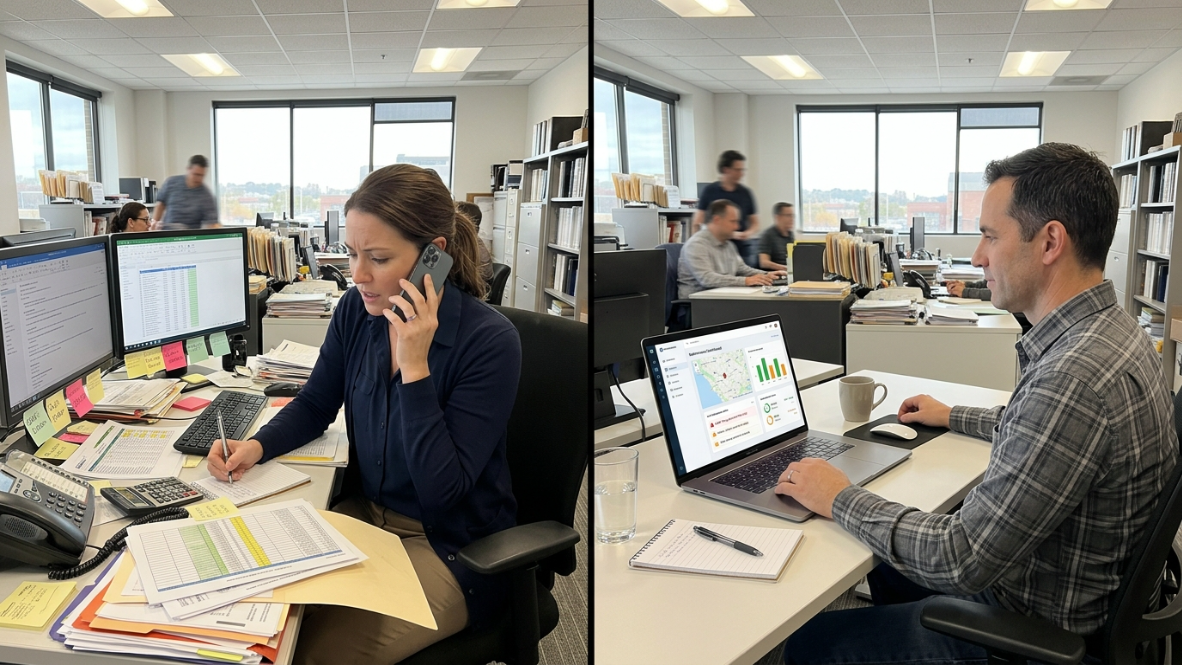
Not all dispatch automation is the same. There are three tiers worth understanding:
Manual Dispatch | Rule-Based Automation | AI Vendor Dispatch | |
|---|---|---|---|
How vendors are selected | Coordinator picks from memory or a spreadsheet | Static if/then rules (e.g., “all plumbing goes to Vendor A”) | Weighted scoring across multiple factors, updated dynamically |
Speed | 30-60 minutes per request | Near-instant for matching rules, fails on edge cases | Near-instant, handles edge cases through learning |
Adaptability | Depends on coordinator knowledge | Breaks when vendors change or rules become outdated | Learns from outcomes, adjusts vendor rankings over time |
Compliance checks | Manual (often skipped) | Can be programmed but rarely updated | Can verify COI and license status at the moment of dispatch |
Scalability | Caps out at 150-200 doors per person | Better, but brittle at scale | Supports 400-600+ doors per person |
Rule-based dispatch is a meaningful upgrade over manual coordination, but it’s static. If Vendor A stops taking weekend jobs or Vendor B’s insurance lapses, the rules don’t know. AI dispatch adjusts because it incorporates real-time data and learns from historical patterns.
Where It Fits in the Maintenance Lifecycle
AI vendor dispatch occupies the middle of the maintenance request workflow: after a tenant submits a request and the system triages it, but before a vendor closes the job and follow-up happens. Think of it as the bridge between “we know what’s broken” and “someone qualified is on the way.”
The full chain looks like this: intake, triage, dispatch, vendor execution, completion tracking, tenant follow-up. Dispatch is the step where most manual bottlenecks live, and it’s where AI creates the biggest time savings.
How AI Vendor Dispatch Works (Step by Step)
Here’s what actually happens when a tenant reports a broken furnace at 11 PM on a Tuesday in January.
Step 1: Intake and Triage
The tenant calls, texts, or submits a request through a portal. AI processes the message using natural language processing to classify the issue: HVAC, no heat, potential emergency. It assesses urgency. A “no heat” call in January with sub-freezing temperatures gets flagged as an emergency. A dripping faucet does not.
This triage step is critical because it determines how fast dispatch needs to happen. Property Meld’s analysis of over 9.3 million work orders estimates a 40% false emergency rate as a baseline, meaning four out of ten after-hours “emergency” dispatches are for issues that don’t actually qualify. Good AI triage filters those out before dispatch, saving thousands in unnecessary after-hours vendor fees.
Step 2: AI Queries the Preferred Vendor List
The system pulls the property’s preferred vendor list from the PMS. This isn’t a generic directory. It’s the curated list of contractors the property manager has vetted, negotiated rates with, and approved for specific work.
Step 3: Matching Criteria Applied
This is where AI dispatch separates itself from simpler automation. The system applies multiple weighted factors simultaneously:
Trade matching. Only licensed HVAC technicians are considered for a “no heat” issue. Plumbers don’t get dispatched to electrical problems, regardless of availability.
Geographic matching. The AI identifies vendors within a defined radius (often 15 minutes driving time) of the property. For scattered-site portfolios, this is especially valuable since a vendor who’s great for your downtown properties may be 45 minutes from your suburban units.
Availability checks. The system checks vendor calendars or pings availability in real time. No more dispatching to someone who’s already booked solid.
Performance scoring. Historical data matters. A vendor with a 92% first-time fix rate and consistent 4.8 satisfaction scores ranks above one with a 65% fix rate, even if the second vendor is slightly closer.
Compliance verification. This is the most underrated factor. The AI can verify that a vendor’s certificate of insurance (COI) and trade license are current before sending the work order. According to NARPM, 23% of property management companies have faced liability issues due to working with vendors whose insurance had lapsed.
Step 4: Vendor Receives Dispatch with Full Context
The selected vendor gets a notification (text, email, app push, or all three) that includes the specific issue description, property address, access instructions, tenant contact information, and any relevant history (“Unit 204, same tenant reported a pilot light issue three months ago”). This preparation is why first-time fix rates jump. Vendors arrive knowing the exact problem and what parts to bring.
Step 5: Tenant Gets Real-Time Updates
The tenant receives confirmation that a vendor has been assigned, along with an estimated arrival window. No more calling the office to ask “did anyone see my request?” This automated communication loop is where tenant satisfaction scores see the biggest lift, especially for after-hours requests when no staff is available to provide updates.
Step 6: Completion Tracking and Follow-Up
After the vendor completes the work, the system logs completion in the PMS, triggers a tenant satisfaction follow-up, and feeds the outcome data back into the vendor performance model. If the vendor needed a callback, that affects their future ranking. If they resolved it in one visit, their score goes up. The system gets smarter with every completed work order.
AI Vendor Dispatch Workflow Diagram
Use a numbered workflow.
Tenant submits maintenance request
↓
AI classifies issue
↓
Urgency determined
↓
Preferred vendors identified
↓
Compliance verified
↓
Availability checked
↓
Best vendor selected
↓
Vendor dispatched automatically
↓
Tenant notified
↓
Repair completed
↓
Performance recorded
↓
Vendor ranking updated
Why AI Vendor Dispatch Matters for Property Managers
The numbers tell a clear story.
Time Savings
Property managers spend an estimated 20 hours per week on vendor coordination with manual tracking. Individual maintenance requests consume 30 to 60 minutes each when handled manually. That’s 4 to 8 hours of pure admin per day, which is the reason most PMs cap out around 150 to 200 doors per person.
AI dispatch compresses most of that coordination into seconds. The coordinator’s role shifts from “traffic controller making calls” to “exception handler reviewing flagged cases.”
Cost Reduction
Industry data shows 28% maintenance cost reductions when AI handles coordination, with average repair costs dropping from $394 to $320 per work order. Part of this comes from better vendor matching (right vendor, right price), and part comes from eliminating redundant truck rolls. Simply Connected Systems reports that 25% of service calls require at least one redundant callback when dispatch is manual.
The hidden cost is even bigger. According to OxMaint, property managers overpay 18 to 24% annually because vendor contracts go untracked. For a 200-unit property spending $400,000 on maintenance, that’s $72,000 to $96,000 lost every year to inefficient vendor management alone.
Speed
Automated maintenance systems reduce average repair response time from 72+ hours to under 24 hours. Property Meld’s analysis of millions of work orders puts world-class speed of repair at 2.7 days from request to resolution.
Tenant Retention
Speed isn’t just an operational metric. It’s a retention lever. Companies that achieve sub-1-hour dispatch times retain 12% more tenants annually than those with 4+ hour dispatch times, according to RentCafe’s 2025 data. Given the cost of a turnover ($1,000 to $5,000+ per unit depending on market), faster dispatch pays for itself quickly.
Portfolio Scaling
This is the growth argument. Companies using AI maintenance tools report scaling to 400 to 600+ doors per property manager, compared to the 150 to 200 door ceiling that manual operations impose. For growing firms, AI vendor dispatch isn’t just an efficiency tool. It’s the infrastructure that makes scaling possible without proportional headcount increases.
Learn how AI fits into a broader property management stack for scaling operations.
ROI Calculator Example
Portfolio Size | Manual Dispatch Hours/Week | Hours Saved with AI | Estimated Annual Labor Savings |
|---|---|---|---|
100 units | 8 | 6 | $12,000+ |
250 units | 20 | 16 | $32,000+ |
500 units | 40 | 33 | $66,000+ |
1,000 units | 75 | 62 | $125,000+ |
What to Look For in an AI Vendor Dispatch System

Not every system that claims “AI dispatch” delivers the same thing. Here’s what separates effective tools from marketing fluff.
Bidirectional PMS Integration
The system needs to read from and write to your property management software. Read-only integrations can pull property and vendor data, but they can’t create work orders, update statuses, or log notes back into the PMS. That means coordinators still have to manually enter information, which defeats the purpose. If you’re evaluating tools, ask specifically: “Does your integration create and update work orders in my PMS, or does it just read data?”
Data quality is the foundation here. If your PMS has outdated vendor contacts or incomplete property records, the AI will faithfully work with bad data. This “garbage in, garbage out” problem is the most common failure mode practitioners report. One property management guide puts it bluntly: if your vendor list has retired contractors or outdated contact information, the AI will dispatch to a dead end. Review and clean your vendor list quarterly at minimum. For more on this, read about PMS data quality and its impact on AI performance.
Vendor Compliance Checks at Dispatch
This is a feature most buyers don’t think to ask about until they get burned. Consider this scenario from a real-world case study: at 8:15 AM, a maintenance team dispatches a roofing vendor to an active leak at a 300-unit multifamily community. By noon, ownership discovers the vendor’s insurance expired two weeks ago. Work stops. Legal reviews begin.
The best AI dispatch systems verify that vendor insurance certificates and trade licenses are current before assigning work. Given that NARPM found nearly a quarter of property management companies have faced liability from lapsed vendor insurance, this isn’t a nice-to-have. It’s a risk management essential.
Performance Scoring That Learns
Static vendor rankings are just rule-based dispatch with extra steps. True AI dispatch updates vendor scores based on actual outcomes: first-time fix rates, tenant satisfaction ratings, response time consistency, and callback frequency. Over time, the system should get better at predicting which vendor will deliver the best outcome for a specific type of job at a specific property.
Escalation Logic
Not every work order should be auto-dispatched. High-cost repairs (typically above $500 to $1,000 depending on the owner’s threshold), unusual issues the AI can’t confidently classify, and situations involving potential Fair Housing implications all need human review. The system should have clear escalation rules that route ambiguous or high-stakes requests to a person rather than forcing automation on cases where it doesn’t belong.
Tenant Communication Loop
Dispatch without communication is half a solution. The system should automatically notify tenants when a vendor is assigned, provide estimated arrival times, and follow up after completion. This closes the information gap that generates the majority of “where’s my repair?” calls.
Transparent Matching Logic
If you can’t see why the AI selected Vendor B over Vendor A, you can’t audit the system or explain decisions to property owners. Look for systems that provide clear reasoning for vendor assignments, not a black-box algorithm.
Questions to Ask Before Buying AI Vendor Dispatch Software
Does the AI actually dispatch vendors or only recommend them?
Does it integrate bidirectionally with your PMS?
Can it verify vendor insurance automatically?
Does it learn from completed work orders?
Can it prioritize preferred vendors?
Can it dispatch after business hours?
Does it support owner approval thresholds?
Can tenants receive automatic updates?
Does it support multiple portfolios?
Can dispatch rules be customized?
Common Pitfalls
AI vendor dispatch is powerful, but it fails in predictable ways when implementation is sloppy.
Dirty vendor lists. This is the number one failure mode. AI systems are only as good as the data they work with. If your preferred vendor list contains inactive contractors, wrong phone numbers, or vendors who no longer serve certain zip codes, the AI will dispatch to dead ends with perfect confidence. Quarterly vendor list audits are non-negotiable.
Over-automation without human oversight. Automating routine work orders is smart. Automating a $15,000 HVAC replacement without owner approval is reckless. Every AI dispatch system needs clearly defined thresholds where human approval is required. Property managers consistently report that the fear of losing control over vendor coordination is one of their biggest concerns with AI adoption.
Ignoring vendor compliance. Dispatching to uninsured vendors exposes the property management company and the property owner to liability. MrTask estimates the all-in cost of one bad vendor incident in 2026 averages around $7,000 when you factor in callbacks, tenant compensation, time, downstream damage, and potential turnover.
Not tracking auto-dispatch accuracy. If you don’t measure how often the AI makes the right vendor assignment, you can’t improve the system. Target 90%+ accuracy on auto-dispatched work orders, and review the misses monthly to refine matching logic.
Neglecting the vendor relationship. According to NARPM’s 2025 survey, the average property management company loses 4.3 vendor relationships per year due to payment delays, communication breakdowns, and scheduling conflicts. AI dispatch can help here (faster payments, clearer communication, better-clustered work orders), but only if the system is configured to respect vendor preferences and capacity limits.
Implementation Checklist
Before launch
□ Clean vendor database
□ Verify vendor insurance
□ Remove inactive vendors
□ Standardize trade categories
□ Connect PMS
□ Configure emergency rules
□ Configure owner approval thresholds
□ Test dispatch workflows
□ Train maintenance staff
□ Review first 100 dispatches manually
Key Benchmarks for AI Vendor Dispatch
If you’re running (or evaluating) an AI vendor dispatch system, these are the numbers that matter:
Metric | Target | Context |
|---|---|---|
Auto-dispatch rate | 73%+ of routine work orders | The remaining ~27% are complex or ambiguous cases that should route to a human |
Triage accuracy | 90%+ | Percentage of requests correctly classified by issue type and urgency |
False emergency filter rate | ~40% of after-hours “emergencies” correctly reclassified | Saves significant after-hours vendor costs |
First-time fix rate | 85%+ | Up from ~60% with manual dispatch, driven by better vendor-issue matching and job context |
Self-resolution rate | 15-25% | Percentage of routine requests resolved through tenant troubleshooting guidance without dispatching a vendor at all |
Response time (dispatch to vendor assignment) | Under 1 hour for emergencies, under 4 hours for routine | Sub-1-hour dispatch correlates with 12% higher tenant retention |
Average repair cost | $320 or less per work order | Down from $394 industry average with manual coordination |
These benchmarks are drawn from datasets including Property Meld’s analysis of 9.3 million+ work orders and OxMaint’s operational data. For a deeper dive into maintenance KPIs, see the full benchmarks guide.
The Vendor-Side Perspective
Most discussions about AI dispatch focus on the property manager’s experience. But the vendor’s experience matters too, because happy vendors deliver better work and stick around longer.
AI dispatch improves the vendor experience in several concrete ways. Vendors receive work orders with complete issue descriptions, property access details, and relevant repair history, so they arrive prepared instead of walking in blind. Work orders can be geographically clustered, reducing windshield time between jobs. Communication is consistent and professional instead of depending on which coordinator happens to be available. Payment processing can be triggered automatically upon completion confirmation.
The net effect: vendors who work with AI-dispatching companies tend to prioritize those clients because the jobs are better organized, the communication is clearer, and payment is faster. In a tight labor market for skilled trades, that vendor preference becomes a competitive advantage.
AI Adoption Is Accelerating
For property managers still on the fence, the market is moving fast. The Buildium 2026 State of the Industry Report found that AI tool adoption surged from 20% to 58% among property management professionals in just one year. AppFolio’s benchmark reports show that firms with broad AI adoption project roughly 31% portfolio growth compared to about 12% for non-adopters.
AI vendor dispatch is one of the highest-impact starting points because it targets the most time-consuming daily task (vendor coordination) and delivers measurable results within weeks, not months.
Book a demo with Haven to see AI vendor dispatch and maintenance coordination in action.
AI Vendor Dispatch vs Traditional Vendor Coordination
Feature | Manual | Rule-Based | AI Dispatch |
|---|---|---|---|
Auto assignment | No | Partial | Yes |
Learns from history | No | No | Yes |
Checks insurance | Manual | Sometimes | Yes |
Real-time availability | No | Limited | Yes |
Vendor scoring | Manual | Static | Dynamic |
Handles emergencies | Manual | Limited | Yes |
Tenant updates | Manual | Partial | Automatic |
Portfolio scalability | Low | Medium | High |
AI Vendor Dispatch Software Features Checklist
Feature | Recommended |
|---|---|
Vendor scoring | ✓ |
AI triage | ✓ |
Auto dispatch | ✓ |
Compliance monitoring | ✓ |
Mobile vendor app | ✓ |
SMS updates | ✓ |
Owner approval workflows | ✓ |
Analytics dashboard | ✓ |
Geo-dispatch | ✓ |
Vendor performance reports | ✓ |
Common Maintenance Requests Best Suited for AI Dispatch
Maintenance Issue | AI Dispatch Recommended? | Reason |
|---|---|---|
Plumbing leak | Yes | Clear trade matching |
HVAC repair | Yes | Emergency prioritization |
Electrical outage | Yes | Licensed electrician required |
Appliance repair | Yes | Vendor specialization |
Pest control | Yes | Scheduled vendor routing |
Landscaping | Yes | Recurring scheduling |
Roof replacement | Human approval | High cost |
Structural damage | Human approval | Inspection required |
Frequently Asked Questions
Does AI vendor dispatch replace maintenance coordinators?
No. It replaces the repetitive, time-consuming parts of their job: scanning vendor lists, making calls, sending follow-up texts, updating the PMS. Coordinators shift to handling exceptions, managing vendor relationships, and overseeing complex or high-cost repairs. The auto-dispatch target of 73%+ means roughly one in four work orders still benefits from human judgment.
What happens when the AI can’t match a vendor?
Good systems have fallback logic built in. If no vendor matches the criteria (wrong trade, no availability, compliance issues), the work order gets escalated to a human coordinator with a clear explanation of why auto-dispatch failed. The coordinator then handles it manually, and that outcome feeds back into the system to improve future matching.
How does AI vendor dispatch handle after-hours emergencies?
The AI triages the request to determine if it’s a true emergency. If it is (active flooding, no heat in freezing temperatures, gas leak), dispatch happens immediately to the available emergency vendor. If the request is urgent but not an emergency, the system schedules it for the next business day and notifies the tenant. This filtering is valuable because an estimated 40% of after-hours “emergency” calls don’t actually qualify. Learn more about emergency maintenance triage.
Does AI vendor dispatch work with my PMS?
Most AI dispatch systems integrate with major property management platforms like AppFolio, Buildium, and others. The critical question is whether the integration is bidirectional (can it read and write data?) or read-only. A read-only integration still requires manual data entry, which significantly reduces the time savings.
What’s the difference between AI vendor dispatch and a maintenance chatbot?
A chatbot typically handles the intake side: answering tenant messages, collecting issue details, maybe creating a ticket. AI vendor dispatch goes further. It’s the execution layer that takes the classified request, matches it to the right vendor, sends the assignment, updates the tenant, tracks completion, and feeds outcomes back into performance scoring. Chatbots start the conversation. AI dispatch finishes the job.
How long does it take to see results from AI vendor dispatch?
Most property managers report measurable improvements within the first month: faster response times, fewer missed dispatches, reduced coordinator hours spent on routine assignments. The system continues improving over the first 90 days as it accumulates performance data and refines vendor scoring.
What’s the biggest risk of implementing AI vendor dispatch?
Bad data. If your vendor list is outdated, your property records are incomplete, or your PMS data is messy, the AI will automate errors at scale instead of automating efficiency. Clean your data before you flip the switch. The second biggest risk is over-automating decisions that need human judgment, like high-dollar repairs or situations with legal implications.
Can AI vendor dispatch help with scattered-site portfolios?
This is actually where it provides the most value. Scattered-site portfolios have vendors spread across different geographies, and manually tracking which vendor serves which area is a coordination nightmare. AI dispatch uses geo-zone matching to assign the closest qualified vendor to each property, which is nearly impossible to do consistently at scale with manual coordination.