Automate Tenant Outreach: 7 Proven Workflows for 2026
Automate tenant outreach in 2026 with 7 tactics for maintenance, renewals, and leasing. Get tools, workflows, and where to start to boost retention.

TL;DR
Automating tenant outreach means replacing manual phone calls, emails, and follow-ups with event-triggered communication that runs without someone remembering to hit send. The highest-ROI starting point is maintenance follow-ups (because slow maintenance response is the top reason tenants leave), followed by lease renewal sequences and leasing lead nurture. This guide covers seven specific ways to automate tenant outreach, maps each to the best tools for the job, and includes a decision framework for where to start.
Quick Answer: What is the best way to automate tenant outreach?
The best tenant outreach automation starts with event-triggered workflows rather than mass messaging. Prioritize maintenance follow-ups, lease renewal reminders, leasing lead nurture, rent reminders, move-in communication, inspections, and move-out outreach. Each workflow should have a defined trigger, message, channel, escalation rule, and measurable outcome. For most property managers, maintenance and renewal workflows are the best starting points because poor maintenance response and communication can directly affect resident retention.
Why You Need to Automate Tenant Outreach Now
The average apartment turnover costs $3,872 per unit. With 43% of units turning over every year, that’s a staggering operational drain. At the January 2025 average effective rent of $1,818, every vacant day costs roughly $60 in lost rent.
Most property managers treat tenant outreach as “sending emails.” That misses the point. Real outreach automation means the right message, on the right channel, triggered by the right event, without a human remembering to do it. An automated maintenance follow-up that checks work order status and asks the tenant to confirm resolution is outreach. A bulk email about pool hours is not.
The National Apartment Association’s 2024 member survey identified the top three reasons tenants leave: maintenance response time, communication quality, and feeling unvalued. Every one of those problems is an outreach problem, and every one of them can be automated.
The good news? According to Forrester’s 2024 Total Economic Impact studies, business process automation averages roughly 200% ROI in year one. And NAA’s 2025 benchmarks show property managers using workflow automation handle 2.4x more units per staff member compared to manual operations.
Explore Haven’s AI property management platform to see how voice-first automation handles maintenance, leasing, and vendor outreach in one system.
At-a-Glance Comparison Table
Tool/Method | Best For | Channels | Starting Price | AI-Native? | PMS Integration |
|---|---|---|---|---|---|
Haven AI | 350+ units, maintenance + leasing outreach | Voice, SMS, Email | Demo required | Yes (voice-first) | AppFolio, Buildium |
EliseAI | Large multifamily (500+) | Email, SMS, Chat, Voice | Custom | Yes | Yardi, RealPage, Entrata |
AppFolio Realm-X | 200-5,000 units (existing AppFolio users) | Portal, Email | ~$1.40/unit/mo | Yes | Native |
Buildium | SFR & small multifamily (<150 units) | Portal, Email | $62/mo | Limited | Native |
LeadSimple | Growth-focused PM companies | Phone, Email, SMS | $59/user/mo | Emerging | AppFolio, Buildium, Rentvine |
Knock CRM | Multifamily lease-up operations | Email, SMS, App | Custom | Partial | AppFolio, Yardi |
DIY Stack (n8n + Twilio) | Tech-savvy small operators | SMS, Email | <$50/mo | No | API-dependent |
Now let’s break down each approach to automating tenant outreach by the specific problem it solves.
1. Haven AI: Voice-First Maintenance Follow-Ups and After-Hours Intake
Best for: Property managers with 350+ units who need outreach that results in action, not just message-taking. Especially strong for scattered-site and single-family operators where every missed call risks losing a tenant.
Maintenance response time is the single biggest driver of tenant satisfaction. Buildium’s 2024 Property Manager Report found that properties acknowledging requests within 4 hours retain tenants 23% longer than those taking more than 24 hours. The problem? Nearly half of all calls to leasing offices go unanswered, and most callers who can’t reach someone never call back.
Haven AI addresses this with voice-first AI agents that handle 24/7 maintenance request intake, emergency triage, work order creation inside your PMS, vendor dispatch from preferred vendor lists, and post-work-order follow-up outreach. The AI also covers leasing inquiries across phone, SMS, and email.
Key features:
AI agents take real actions inside your PMS/CRM (creating work orders, assigning tickets, adding notes)
Voice-first with SMS and email fallback for full channel coverage
Conversation memory and continuity across interactions
Multi-language voice support
Buildium and AppFolio integrations
Emergency maintenance triage with automatic escalation
Pricing: Sales-led with demo required. No public pricing.
Real-world signal: Luke Properties (~350+ units) uses Haven AI agents named “Serena” and “Max” to handle tenant outreach. Real Capital Group expanded from Maintenance AI to Leasing AI after seeing ROI from the initial deployment.
Tradeoffs:
No self-serve onboarding; requires configuration and QA during deployment
Sales-led process means no instant signup
Performance depends on PMS data quality
Recognition: Y Combinator backed and featured in Commercial Observer’s Top 50 AI Startups in Real Estate.
See how Haven’s Maintenance AI works
2. Automated Lease Renewal Outreach Sequences
Best for: Any property manager losing tenants to silence, meaning tenants who leave because nobody asked them to stay.
This isn’t a single tool recommendation. It’s a workflow pattern that multiple tools can execute, and it’s one of the highest-value ways to automate tenant outreach.
Tenant retention marketing is 5-8x cheaper than vacancy marketing. Yet most property managers start the renewal conversation 30 days before lease expiration, which is far too late. Best-in-class teams use a 120/90/60/45-day cadence:
120 days out: Informal, relationship-building check-in. “How’s everything going in unit 4B?”
90 days out: Formal renewal offer with market data supporting the new rate
60 days out: Follow-up with specific terms and deadline
45 days out: Decision request with clear consequences of non-response
Each communication should include the tenant’s name, unit number, current rent, proposed rent, and market comparables supporting any increase. Generic templates don’t cut it.
Advanced tactic: Churn scoring. Segment tenants by likelihood to vacate using lease history, payment patterns, maintenance request frequency, and response to previous increases. High-risk tenants get a different message sequence with earlier personal outreach from a property manager.
The data backs this up: 80% of B2B deals require 5+ follow-ups, yet most reps stop after the fourth. The same applies to renewal outreach. Automation ensures every follow-up actually happens.
Tools that execute this well:
AppFolio Realm-X: Task automations trigger based on predefined rules, such as sending pre-renewal notices or escalating non-responses
LeadSimple: Workflow process tool lets you build custom renewal sequences triggered automatically based on lease dates
Buildium: Supports configurable lead times and automated follow-up emails, with reporting showing which tenants opened renewal notices
For a deeper comparison of renewal-specific tools, see this guide on AI for lease renewals.
3. Haven Leasing AI: Lead Nurture and Tour Scheduling
Best for: Property managers losing leads because nobody answers the phone fast enough.
Nearly half of all calls to leasing offices go unanswered. Most prospects who can’t reach someone never call back. That’s revenue walking away.
Haven’s Leasing AI handles phone, SMS, and email inquiries automatically. It qualifies leads, schedules tours, and captures leads from listing sites like Zillow and Apartments.com, all without waiting for a leasing agent to be available.
Key features:
Responds to prospect inquiries within seconds across phone, SMS, and email
Lead qualification and tour scheduling
Zillow and Apartments.com lead capture
PMS/CRM integration for seamless data flow
Follow-up nurturing for leads that don’t convert immediately
Pricing: Demo required. No public pricing.
Tradeoffs:
Requires setup and configuration per property
Best suited for operators with 350+ units
No self-serve onboarding
For strategies on speeding up AI lead follow-up for leasing, that guide covers cadence timing and conversion benchmarks.
4. EliseAI: Conversational AI for Large Multifamily Portfolios
Best for: Large multifamily portfolios (500+ units) with dedicated leasing teams that need to automate tenant outreach at scale across the entire resident lifecycle.
EliseAI sits on top of your PMS and takes over conversations: prospect inquiries, tour requests, renewal nudges, maintenance intake, and late-rent follow-ups. The company claims its assistant now powers leasing conversations for roughly 1 in 8 apartment units in the United States.
Key features:
24/7 automated communication through email, SMS, calls, and web chat
Tour scheduling and renewal outreach
Delinquency follow-up automation
Integration with Yardi, RealPage, and Entrata
Pricing: No public pricing. Sales-led. The company has raised $75 million in a Series D round valued at $1 billion.
Tradeoffs:
Limited customization reported by some users
Replies can feel rigid for complex questions
According to one reviewer, the chatbots sometimes fail to loop in managers when they should and book tours without collecting key information like move-in dates
Not property management software. It does not do accounting, run owner statements, or replace AppFolio or Buildium
Primarily built for large multifamily; less suited for smaller or scattered-site operations
User sentiment: Some practitioners on review sites note that while EliseAI handles volume well, the lack of flexibility becomes noticeable when tenants have nuanced questions.
5. AppFolio Realm-X: Native PMS Automation for Tenant Communication
Best for: Teams already on AppFolio managing 200-5,000 units who want to automate tenant outreach without adding third-party tools.
AppFolio’s Realm-X Leasing Performer is an AI leasing agent that automates the most critical stages of the vacancy funnel. It instantly responds to inquiries 24/7, schedules tours, and answers questions. According to AppFolio’s published platform data, the AI leasing assistant handles 80%+ of initial prospect inquiries automatically.
Key features:
Task automations trigger based on predefined rules (escalating maintenance after 48 hours, sending pre-renewal notices)
AI leasing assistant for prospect inquiry response
Building announcements and tenant portal messaging
Native integration, no third-party connectors needed
Pricing: Per-unit pricing. Core plan at approximately $1.40/unit/month. At 200 units, that’s roughly $280/month.
User sentiment: The G2 Grid Report for Property Management, Summer 2026, places AppFolio in the Leader quadrant with a 4.6/5 rating across 963 reviews.
Tradeoffs:
Tenant outreach automation is bundled into the larger PMS; you can’t buy just the outreach layer
Renewal reminders lack native SMS capability
Requires Zapier or API integration for SMS outreach sequences
Less flexibility for operators who need outreach beyond what AppFolio’s native workflows support
6. Buildium and LeadSimple: Mid-Market PMS with CRM-Driven Outreach
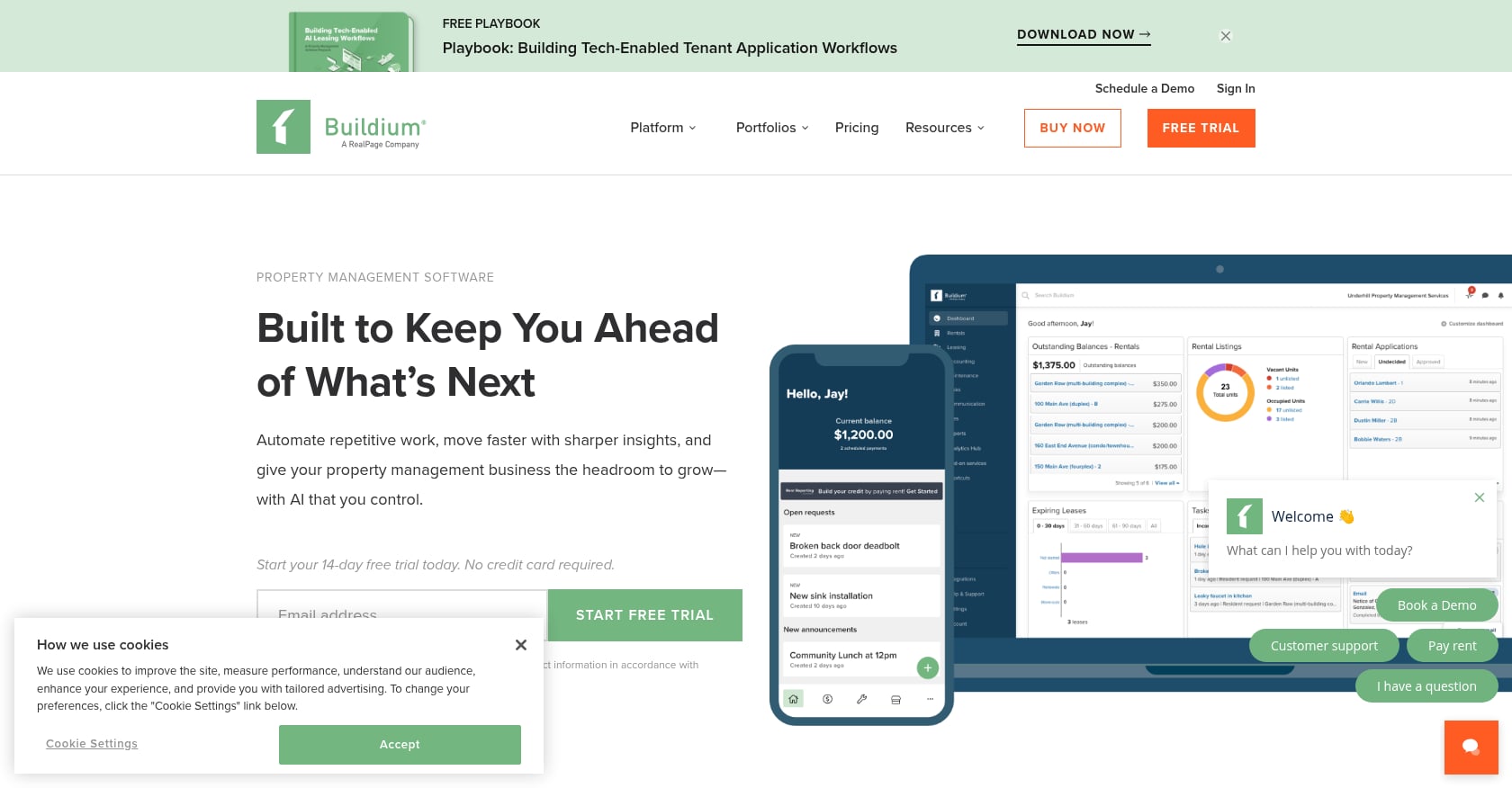
Best for: Single-family and small multifamily operators under 150 units (Buildium) and growth-focused PM companies that need outreach workflows on top of an existing PMS (LeadSimple).
These two tools work well independently but are often paired together.
Buildium
Buildium covers tenant portal messaging, email notifications, automated renewal reminders, listing syndication, and maintenance request tracking. Its Lumina AI adds newer automation features.
Key features:
Configurable lead times for automated follow-up emails
Reporting showing which tenants opened renewal notices, submitted confirmations, or haven’t responded
Multiple communication forms including email and texting through the portal
Pricing: Essential plan starts at $62/month. Growth and Premium tiers add more automation.
User sentiment: G2 rating of 4.5/5 across 220+ reviews. Users highlight that Buildium’s communication features enhance interaction between staff and residents.
LeadSimple
LeadSimple is a CRM, process management, and communications platform built specifically for property management. That specificity matters because generic CRMs don’t understand lease dates, delinquency triggers, or move-in/move-out sequences.
Key features:
Workflow process tool for building custom outreach sequences
Automatic triggers based on delinquencies, move-ins, lease renewals, and move-outs
Recently added AI voice agent and Maintenance AI features
Phone + inbox, CRM, and operations modules
Pricing: Phone + Inbox at $59/user/month, CRM at $99/month, Operations at $1.35/door/month. 14-day free trial available.
User sentiment: G2 rating of 4.9/5 (26 reviews). Highly rated but small review sample. Capterra ease-of-use score: 4.73.
Combined tradeoffs:
Buildium lacks native SMS notifications; requires third-party integration via Zapier or direct API
LeadSimple is not a PMS. No trust accounting, rent collection, owner statements, or 1099s
Running both adds cost and complexity
LeadSimple’s additional user and pipeline fees add up for larger teams
For operators using Buildium, Haven’s Buildium integration adds voice-first AI for maintenance and leasing outreach on top of the existing PMS.
7. DIY Automation Stack: n8n/Make + Twilio + Your PMS
Best for: Tech-comfortable operators who want full control over outreach logic, timing, and messaging, and can’t justify per-unit SaaS fees.
You don’t always need a purpose-built platform to automate tenant outreach. A DIY stack connects your PMS data layer (DoorLoop, Buildium, or AppFolio) with Twilio for SMS and n8n or Make for the automation logic.
Highest-ROI workflows to build first:
Rent reminders and late-payment sequences
Maintenance request intake and vendor routing
Lease renewal outreach starting 90 days out
Inspection scheduling notifications
Emergency handling example: A keyword filter (flood, fire, no heat, gas smell, leak) bypasses the standard queue, fires SMS and phone alerts to the on-call manager, and dispatches a priority vendor. This alone can prevent catastrophic property damage.
Pricing: Twilio SMS costs roughly $0.0079/message. n8n self-hosted is free. Make starts at $9/month. Total cost can stay under $50/month for smaller portfolios.
Tradeoffs:
Requires technical setup and ongoing maintenance
No AI conversation ability; strictly rule-based triggers and templates
No voice capability
Breaks if your PMS API changes
No conversation memory or context between interactions
Practitioners on forums report that DIY stacks work well for straightforward, repeatable outreach but fall apart when tenant responses require judgment calls. If a tenant replies “I’m not sure about renewing, my dishwasher has been broken for three weeks,” a rule-based system can’t connect that to an open work order. An AI agent can.
For more on the spectrum between manual workflows and automation, that guide breaks down where each approach makes sense.
What to Automate First: A Decision Framework
Not every team should start in the same place. Here’s how to prioritize:
If tenants are leaving because of slow maintenance response, start with maintenance AI. Automating after-hours intake and follow-ups directly addresses the number one reason tenants leave. Properties that acknowledge requests within 4 hours retain tenants 23% longer.
If you’re losing renewals to manual processes, start with renewal outreach automation. The 120/90/60/45-day cadence prevents the “silent vacancy,” where tenants leave because nobody asked them to stay. Renewal automation is usually the highest-value target because the revenue risk is immediate.
If leads are going cold before your team responds, start with leasing response automation. Automated reminders have been associated with a 58% increase in grace-period payments. When combined with autopay enrollment, on-time payment rates approach 99%.
If your team is drowning in coordination work, you’re not alone. Most agencies find 40 to 70 hours a month of coordination work that can be automated across renewals, maintenance triage, tenant communication, and inspection scheduling.
One critical insight that practitioners emphasize: data quality matters more than the AI itself. If your PMS has incomplete tenant records, wrong phone numbers, or outdated lease dates, no automation tool will fix that. Clean your data first, then automate.
Channel coverage also determines success. NAA’s 2025 Resident Communication Survey found that no single channel reaches more than 81% of tenants within 24 hours. But platforms covering four channels (voice, SMS, email, portal) hit 98% delivery rates, a 34-percentage-point improvement over two-channel systems.
AI adoption among property managers surged from 21% in 2024 to 34% in 2025. The teams adopting now are the ones that will handle more units per staff member without burning out their people. For more on reducing property manager burnout with AI, that guide covers the operational side.
Fair Housing Compliance Note
Any system that automates tenant outreach must apply the same messaging, timing, and terms to all tenants in the same situation. Automated systems actually help with compliance because they remove the inconsistency of manual outreach, where one tenant gets a friendly renewal call and another gets forgotten. But you still need to review your templates, escalation rules, and segmentation logic to ensure nothing inadvertently discriminates based on protected classes. For a detailed breakdown, see this guide on AI compliance and Fair Housing.
Start Automating Tenant Outreach Today
The math is simple. Every day a unit sits vacant costs $60. Every missed maintenance call erodes trust. Every renewal that slips through the cracks costs $3,872 to replace. Automating tenant outreach isn’t about sending more messages. It’s about making sure the right communication happens at the right time, on the right channel, tied to real operational actions.
The tools exist. The ROI is proven. The only question is where to start.
Book a Haven demo to see voice-first AI that handles maintenance intake, vendor dispatch, leasing inquiries, and tenant follow-ups inside your existing PMS.
FAQ
What does it mean to automate tenant outreach?
Automating tenant outreach means using software or AI to trigger, send, and follow up on tenant communications without manual intervention. This includes maintenance follow-ups, lease renewal sequences, rent reminders, leasing lead nurture, and vendor status updates. The best systems are event-triggered (a lease expiring, a work order completing) rather than just scheduled blasts.
Which tenant outreach tasks should I automate first?
Start with the outreach that has the highest cost of failure. For most property managers, that’s maintenance follow-ups and after-hours intake, since slow maintenance response is the top reason tenants leave. Lease renewal sequences are the second priority because they directly prevent vacancy costs.
Can I automate tenant outreach without switching my PMS?
Yes. Tools like Haven AI, EliseAI, LeadSimple, and Knock CRM integrate with existing PMS platforms like AppFolio, Buildium, Yardi, and others. You don’t need to migrate your entire system. You add an automation layer on top.
How much does it cost to automate tenant outreach?
Costs range from under $50/month for a DIY stack (n8n + Twilio) to per-unit pricing for platforms like AppFolio (~$1.40/unit/month). AI-native platforms like Haven AI and EliseAI use custom pricing based on portfolio size. Buildium starts at $62/month, and LeadSimple starts at $59/user/month.
Does automating tenant outreach hurt the personal touch?
Done right, it improves it. Automated systems personalize messages with tenant names, unit numbers, lease terms, and maintenance history. They also ensure every tenant gets timely communication instead of some tenants getting forgotten. The impersonal experience is the one where nobody follows up, not the one where an AI checks in after a repair.
Is automated tenant outreach Fair Housing compliant?
Automation can actually improve compliance by applying the same outreach cadence and messaging to all tenants in equivalent situations. The risk comes from poorly designed segmentation or message logic. Review all templates and rules to ensure they don’t inadvertently treat tenants differently based on protected classes.
What’s the difference between AI agents and rule-based automation for tenant outreach?
Rule-based automation follows “if X, then Y” logic: if a lease expires in 90 days, send an email template. AI agents can understand tenant responses, handle multi-turn conversations, create work orders, dispatch vendors, and adapt their communication based on context. Rule-based systems work for simple, predictable outreach. AI agents handle the messy, conversational stuff that actually drives retention.
How many communication channels do I need to reach tenants effectively?
NAA’s 2025 research found that two-channel systems (like email plus portal) reach only 64% of tenants within 24 hours. Four-channel systems (voice, SMS, email, portal) reach 98%. If your outreach automation only covers email, you’re missing roughly a third of your tenants.