PMS Automation vs Manual Workflows: 2026 ROI Guide
Compare PMS Automation vs Manual Workflows in 2026. See time savings, ROI benchmarks, and what to automate first to scale faster.

TL;DR
PMS automation uses software to handle repetitive property management tasks like rent collection, maintenance dispatch, and lease renewals without manual intervention. Manual workflows rely on phone calls, spreadsheets, and email chains to accomplish the same tasks, consuming roughly 40% of a property manager’s workday. The gap between the two approaches widens as portfolios grow, with automated operations showing 22% higher profit margins. Understanding the spectrum from manual to rule-based automation to AI agents helps property managers decide what to automate first and what to keep human.
Property management automation replaces repetitive administrative work with software workflows and AI, while manual workflows rely on staff to complete every task individually.
For most property managers, automation becomes financially beneficial once repetitive tasks consume more than 8–10 hours per week. The highest ROI usually comes from automating:
Maintenance request intake
Rent reminders and collections
Vendor dispatch
Lease renewal notifications
Owner reporting
Manual workflows remain valuable for relationship management, negotiations, legal matters, and situations requiring human judgment.
The most successful property management companies combine automation for repetitive work with people for strategic decisions.
What Is PMS Automation?
A property management system (PMS) is software that supports the daily operations of residential and commercial rental properties. It centralizes tenant information, maintenance requests, lease agreements, financials, and communications into a single platform. Common examples include AppFolio, Buildium, Yardi, and RealPage.
PMS automation refers to the use of software-driven workflows within these systems to handle repetitive operational tasks without manual intervention. A simple example: setting lease renewal emails to automatically send to tenants 90 days before their current term ends. A more complex one: automatically generating late fees on the fifth day after a missed rent payment and triggering a notice sequence.
The concept has evolved significantly. In the 1980s, property management was paper ledgers and filing cabinets. Through the 2000s, desktop software replaced some of the paper. By the early 2020s, cloud-based PMS platforms made automation accessible to smaller operators. Now, in 2025 and beyond, AI property management software adds a layer of intelligence on top of those platforms, moving beyond simple if/then triggers toward systems that can reason and adapt.
The key thing to understand: PMS automation is not one thing. It exists on a spectrum, and where you sit on that spectrum determines how much time you recover and how effectively you can scale.
PMS Automation at a Glance
Feature | Manual Workflow | PMS Automation | AI Agent |
|---|---|---|---|
Data Entry | Manual | Automatic | Automatic |
Maintenance Intake | Phone/Email | Online Forms | Phone, SMS, Email, Voice AI |
Vendor Assignment | Staff Decision | Rules | Context-aware Decisions |
Availability | Office Hours | 24/7 | 24/7 |
Learns Over Time | No | No | Yes |
Requires Human Action | Always | Sometimes | Rarely |
Scales Easily | Poorly | Good | Excellent |
What Are Manual Workflows in Property Management?
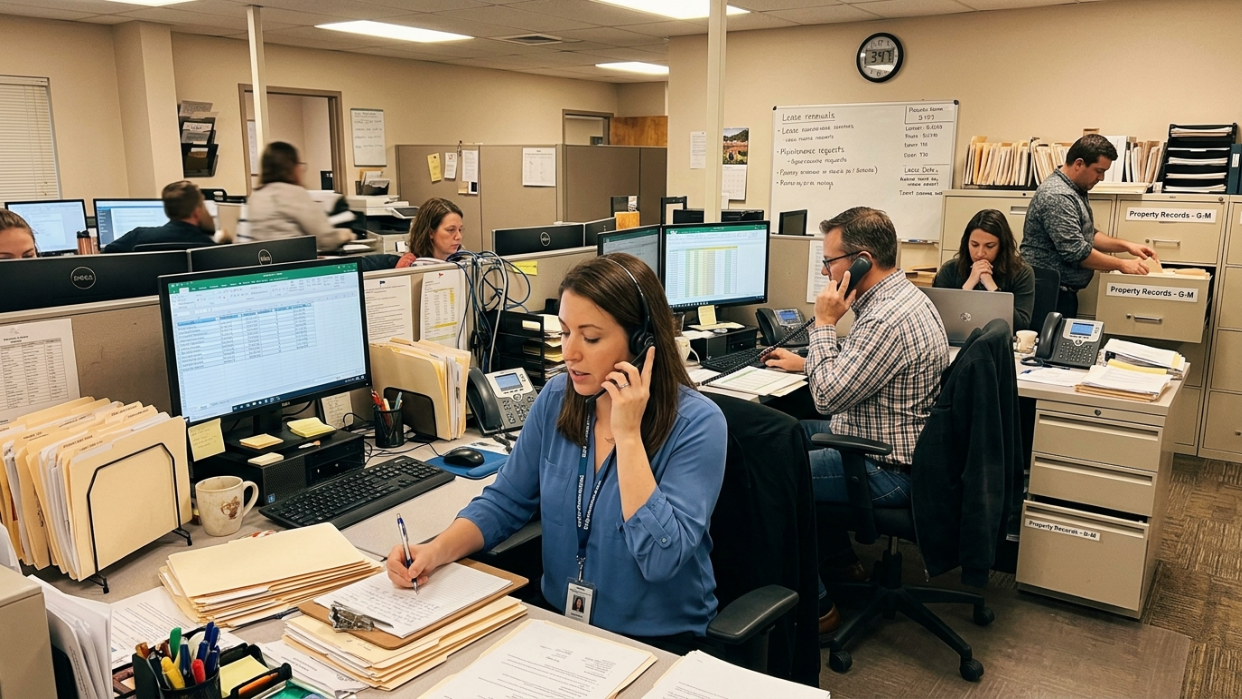
Manual workflows are the processes property managers execute by hand, without software triggers or automated logic. They include phone-based maintenance intake, spreadsheet tracking for work orders, paper lease files, email-chain vendor coordination, and manual data entry across systems.
These processes are familiar because most property managers started with them. They are also expensive.
Research shows that 40% of a property manager’s workday disappears into administrative tasks, and nearly 60% of property managers say manual processes slow operations and increase errors. The costs compound in ways that aren’t always obvious. Manual invoice reconciliation, for instance, follows a three-step pattern: receive a vendor invoice, manually match it to a work order, then re-enter the data into the PMS for accounting. At scale (a 20-property portfolio generating 400+ monthly work orders), that process alone consumes days of administrative time each month and introduces data entry errors at every step.
The biggest hidden cost of manual workflows is institutional knowledge loss. With 33% staff turnover in property management, valuable process knowledge walks out the door regularly. Remaining team members spend even more time reconstructing document trails and relearning procedures that were never documented in a system.
Manual doesn’t mean wrong, though. Some tasks genuinely benefit from human judgment. The problem is when manual processes handle high-volume, low-judgment work that software could do faster and more consistently.
Explore how AI workers fit into property management →
PMS Automation vs Manual Workflows: Side-by-Side Comparison
The difference between PMS automation and manual workflows becomes clearest when you compare them across specific operational tasks. Here’s how the two approaches stack up for the workflows that consume most of a property manager’s time.
Maintenance Request Intake
Manual: A tenant calls the office or sends an email. Someone listens to the voicemail (often the next morning), writes down the details, and enters them into a spreadsheet or PMS. After-hours requests wait until business hours. Emergency calls go to a personal cell phone.
Automated: The PMS accepts requests through an online portal 24/7. Rule-based automation routes requests by category. An AI maintenance coordinator can go further, handling intake via phone or text at any hour, triaging emergencies in real time, and creating work orders directly in the PMS without human involvement.
Impact: Property managers save an average of 6 hours weekly on maintenance coordination with automated platforms. After-hours response times drop from “next business day” to minutes.
Work Order Creation & Vendor Dispatch
Manual: A property manager reads the maintenance request, creates a work order in the PMS by hand, then calls or texts the appropriate vendor. Follow-up requires checking in manually. Maintenance managers spend 8 to 12 hours per week on spreadsheet data entry and report building, totaling over 400 hours annually.
Automated: The PMS generates work orders from submitted requests and assigns them based on predefined rules (all plumbing goes to Vendor A). AI-powered systems take this further by analyzing request details and past repair patterns to create work orders in AppFolio or other platforms, selecting the most appropriate vendor based on urgency, complexity, and availability.
Impact: Work order creation time drops from 15 to 20 minutes per request to near-zero. Vendor dispatch happens in seconds rather than hours.
Leasing Inquiry Response
Manual: A prospect calls or submits a form on Zillow or Apartments.com. The leasing agent responds during office hours, often hours or days later. By then, the prospect has already applied elsewhere.
Automated: Rule-based systems send an auto-reply email. An AI leasing assistant answers phone calls, qualifies leads, provides unit details, and schedules tours within seconds of the inquiry, regardless of the time of day.
Impact: Properties using automated systems process applications in under 24 hours compared to 7 to 10 days with traditional paper processes. In competitive rental markets, the property that responds first secures the qualified tenant.
Rent Collection & Late Fees
Manual: Staff tracks payment due dates, sends reminder emails individually, manually applies late fees in the PMS, and initiates collections calls for delinquent accounts.
Automated: The PMS sends payment reminders on a schedule, applies late fees automatically after the grace period, and escalates delinquent accounts through a predefined notice sequence.
Impact: Automated systems help increase on-time rent payments by 25%.
Owner Reporting
Manual: A property manager pulls data from multiple sources, formats it into a report (often in Excel), and emails it to each owner individually. Formatting varies by person and month.
Automated: The PMS generates standardized monthly reports and distributes them on a schedule. Advanced setups include real-time owner portals with live financial data.
Impact: According to NARPM’s 2025 State of Property Management Report, managers who deliver consistent, formatted reports via automated systems see 41% higher owner satisfaction scores and 2.3x longer management contract duration compared to those relying on manual reporting.
Manual vs Automation by Portfolio Size
One of the biggest misconceptions is that every property manager needs enterprise automation. The reality depends on portfolio size.
Portfolio Size | Manual Workflows | Basic Automation | AI Agents |
|---|---|---|---|
Under 50 Units | Mostly acceptable | Recommended | Optional |
50–200 Units | Becoming inefficient | Strongly Recommended | Helpful |
200–500 Units | Difficult to scale | Essential | High ROI |
500+ Units | Unsustainable | Essential | Usually Necessary |
Three Levels of PMS Automation
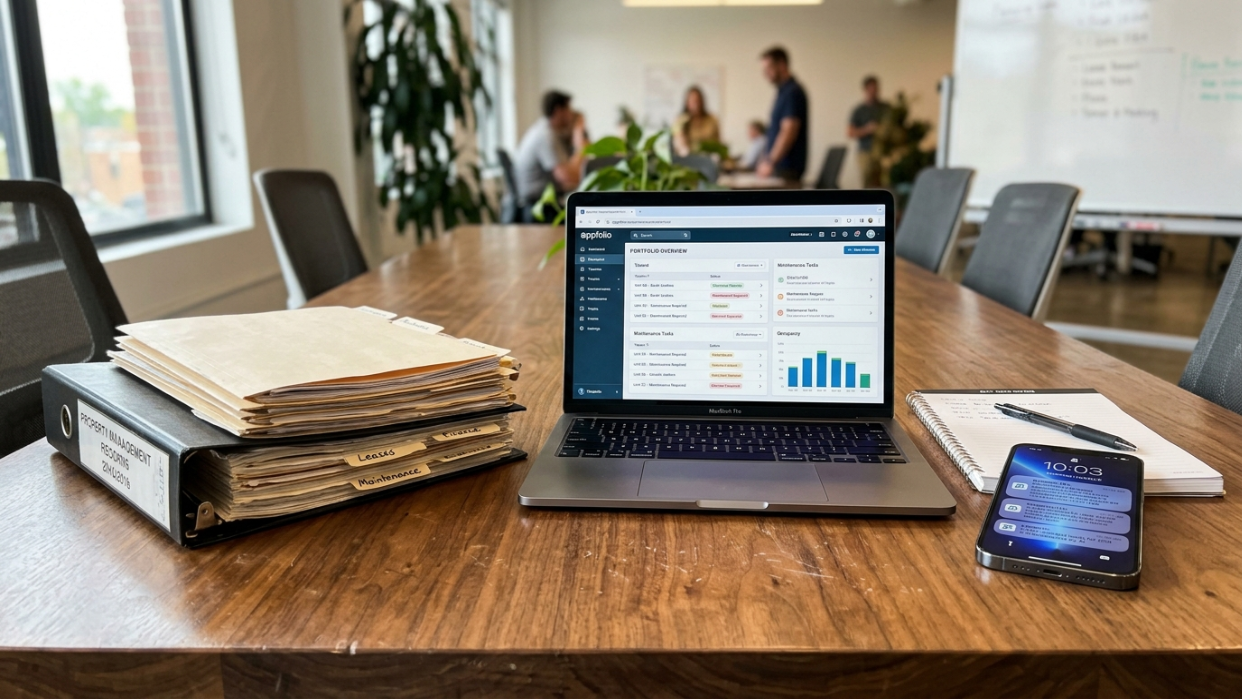
Most articles about property management automation treat it as a binary: you’re either manual or automated. That framing misses the reality that automation exists on a spectrum with meaningfully different capabilities at each level.
Level 1: Manual
Spreadsheets, phone calls, sticky notes, and email chains. Work orders tracked in Excel. Vendor coordination via text message. Lease files in paper folders or scattered across shared drives.
The biggest limitation of spreadsheet-based systems is the total absence of automated work order generation, especially for preventive maintenance. There is no ability to automatically generate forms based on a schedule, so creation, assignment, and distribution remain entirely manual.
This is where most small operators start, and where many stay until pain forces a change.
Level 2: Rule-Based PMS Automation
If/then triggers built into platforms like AppFolio, Buildium, or Yardi. Examples include auto-late-fee application, automated lease renewal reminders, scheduled owner reports, and maintenance request routing by category.
This level handles predictable, repeatable scenarios well. The limitation is what practitioners call the “ceiling problem.” Rule-based automation only works when the situation matches the rule. In property management, situations rarely follow a predetermined script. A tenant reporting a “leak” might mean a dripping faucet or a burst pipe. A rule can’t tell the difference, but a human (or an AI) can.
For a deeper look at how AppFolio maintenance automation works at this level, including its strengths and gaps, see our dedicated guide.
Level 3: AI Agents
Context-aware systems that take real actions inside the PMS, learn from past interactions, and make decisions based on the specifics of each situation. An automation rule routes all plumbing requests to a specific vendor. An AI agent analyzes the request details, checks vendor availability, considers past repair patterns, and selects the best option for that particular job.
The distinction between rule-based automation and AI matters more than most people realize. Rule-based automation has existed in software for decades. Genuine AI reasons, adapts, and learns. Conflating the two leads to unrealistic expectations of simple automation and underestimation of what AI can actually do.
This third level is where external AI layers come in. Rather than replacing your existing PMS, these systems integrate with it, acting inside the platform you already use. Haven’s AI agents, for instance, connect to property data and work within a property manager’s existing PMS to automate tasks like work order creation, vendor dispatch, and tenant communication, without requiring a platform migration.
See how Haven’s AI agents work inside your PMS →
Key Metrics: Automation ROI vs Manual Cost
The financial case for PMS automation vs manual workflows is well-documented at this point. Here are the numbers that matter most.
Time recovery: Modern automation solutions cut administrative tasks by 40%. In practice, this means saving 20 hours monthly in year one, scaling to 40+ hours monthly by year three as workflows are optimized and portfolios grow.
Profit margins: According to McKinsey’s 2025 Operations Report, firms that automate at least 40% of their back-office tasks see 22% higher profit margins.
Management costs: Property managers using automation tools spend 15% less on management costs and see positive ROI within four months.
Property value: Neglecting preventive maintenance (a common consequence of overwhelmed manual operations) can reduce property value by up to 10%, according to the National Association of Realtors.
Enterprise-scale savings: EliseAI implementations have demonstrated 15 to 25% operational cost reductions across enterprise portfolios, typically justifying initial investments within 12 to 18 months.
For a broader look at these benchmarks, see our collection of AI property management statistics.
The throughline across all of these numbers is the same: manual workflows create a cost structure that gets worse as you grow, while automated workflows create one that gets better.
Example ROI Calculation
Consider a property management company with 300 units.
Metric | Manual | Automated |
|---|---|---|
Admin Hours per Month | 120 | 70 |
Hours Saved | — | 50 |
Average Hourly Cost | $35 | $35 |
Monthly Labor Savings | — | $1,750 |
Annual Labor Savings | — | $21,000 |
This example excludes additional gains from:
Faster leasing
Reduced vacancy
Improved tenant retention
Fewer accounting errors
Better owner retention
Simple ROI examples improve featured snippet eligibility because they answer "Is it worth it?" with concrete numbers.
What to Automate First (And What to Leave Manual)
Not every process should be automated on day one. The right sequence matters more than the ambition to automate everything at once.
The Prioritization Rule
Automate tasks that are high volume and low judgment first. These give you the fastest return with the least risk.
Start here:
Maintenance request intake (high volume, standardizable, biggest after-hours pain point)
Rent payment reminders and late fee application (completely predictable, zero judgment required)
Lease renewal notices (time-sensitive, easily templated)
Then move to:
Work order creation and vendor dispatch
Leasing inquiry response and lead qualification
Owner report generation and distribution
Leave manual (for now):
Owner relationship calls and strategic conversations
Complex legal disputes or eviction proceedings
In-person property inspections
Negotiations with high-value commercial tenants
Fix the Process Before You Automate It
One insight from property management consultants deserves emphasis. Practitioners at PropertyManagementConsulting.com consistently find that firms rush to implement software without first establishing operational structure. Automating a broken process just creates faster chaos. Firms that pair process optimization with technology adoption consistently outperform peers in scalability and return on investment.
Before turning on any automation, map your current workflow on paper. Identify where handoffs break, where information gets lost, and where redundant steps exist. Then automate the cleaned-up version.
Common Confusion Points
When comparing PMS automation vs manual workflows, several misconceptions come up repeatedly.
PMS automation is not the same as AI. Most automation built into property management systems today is rule-based. It follows predetermined logic. AI goes further by reading context, making decisions, and adapting. The difference matters when you evaluate what a tool can actually handle. For a detailed breakdown, see our guide on AI leasing agents vs humans.
Automation doesn’t remove the human touch. It removes busywork. The goal is not to eliminate human involvement but to redirect it. Instead of spending two hours entering work orders, a property manager spends that time building owner relationships or improving tenant retention strategies.
“Going automated” doesn’t mean switching PMS platforms. This is one of the biggest barriers to adoption. Many property managers assume automation requires migrating to a new system. In most cases, automation layers (especially AI agents) are designed to work on top of your existing PMS, not replace it.
You don’t have to automate everything. The comparison between PMS automation and manual workflows is not an all-or-nothing decision. The most effective operators automate the high-volume repetitive work and keep humans on the tasks that require judgment, empathy, or strategic thinking.
Signs Your Property Management Company Has Outgrown Manual Workflows
If several of these sound familiar, automation will likely produce measurable ROI.
Staff spend hours answering repetitive phone calls.
Maintenance requests arrive through multiple channels.
Rent reminders are sent manually.
Owner reports require spreadsheets every month.
Leasing inquiries receive delayed responses.
Vendors regularly need follow-up calls.
Work orders are tracked outside the PMS.
Employees duplicate data across multiple systems.
Many operators recognize these symptoms before realizing they indicate workflow bottlenecks rather than staffing shortages.
Frequently Asked Questions
What does PMS stand for in property management?
PMS stands for Property Management System. It refers to software that centralizes operations like tenant management, lease tracking, maintenance requests, rent collection, and financial reporting into a single platform. Common PMS platforms include AppFolio, Buildium, Yardi, and RealPage.
Is PMS automation worth it for small portfolios?
Yes, though the calculus is different. A property manager with 50 units won’t see the same raw hour savings as one with 500. But the proportional impact can be even larger because small teams have less slack. Automating maintenance intake and rent reminders alone can recover 20 hours per month, which for a two-person operation represents a significant capacity increase.
How fast does PMS automation pay for itself?
Industry data suggests that property managers who adopt modern automation tools see positive ROI within four months. The timeline depends on portfolio size, the number of workflows automated, and the cost of the solution. Enterprise implementations with AI typically justify their investment within 12 to 18 months.
Can AI agents work inside my existing PMS?
Yes. AI agents in property management are increasingly designed as integration layers rather than standalone platforms. They connect to your existing PMS (like AppFolio or Buildium) and take actions within it, creating work orders, updating tenant records, dispatching vendors, without requiring you to switch systems. Haven’s AI agents, for example, are built specifically around this integration-first approach.
Book a demo to see how it works →
What’s the difference between PMS automation and AI agents?
PMS automation typically refers to rule-based triggers built into your property management software: “if rent is 5 days late, apply fee.” AI agents go beyond rules by understanding context, making decisions, and learning from past interactions. An automation rule routes all plumbing requests to one vendor. An AI agent evaluates urgency, vendor availability, and repair history to choose the best vendor for each specific job.
What workflows should I automate first?
Start with tasks that are high volume and require little judgment: maintenance request intake, rent reminders, and lease renewal notices. These deliver the fastest time savings with the least implementation risk. Move to more complex workflows like vendor dispatch and leasing response after the fundamentals are running smoothly.
Will automation make my team’s jobs obsolete?
No. The property management industry has a 33% annual turnover rate, partly driven by the burden of repetitive administrative tasks. Automation reduces that burden, which tends to improve job satisfaction and retention rather than eliminate positions. The most common outcome is that existing staff handle more units, not that teams get smaller.
Does automating workflows help with tenant satisfaction?
Directly. Faster maintenance response, consistent communication, and 24/7 availability all improve the tenant experience. When a maintenance request gets acknowledged in minutes rather than the next business day, tenants notice. The downstream effect shows up in renewal rates and reduced vacancy costs.