AI Leasing Agent vs Human: Pros, Cons & 2026 Playbook
AI leasing agent vs human explained: definitions, key differences, handoffs, and 2026 best practices. Learn when to use each and how to scale.

TLDR
An AI leasing agent is software that handles routine leasing tasks like answering inquiries, qualifying leads, scheduling tours, and following up across phone, SMS, email, and listing sites. A human leasing agent is a person who builds trust, conducts tours, handles objections, and closes leases. The practical question is not which one is better. It is which leasing tasks each one should own, and how the handoff between them should work.
At a Glance: AI vs. Human Leasing Agents
In 2026, the primary difference between AI and human leasing agents is functional ownership. AI leasing agents own the Speed Zone, handling 24/7 lead capture, instant FAQs, and automated tour scheduling. Human leasing agents own the Trust Zone, focusing on in-person storytelling, nuanced objection handling, and Fair Housing compliance. For maximum ROI, properties use a hybrid model where AI captures 100% of initial inquiries and humans close the high-intent prospects.
What Does “AI Leasing Agent vs Human” Actually Mean?
The comparison between an AI leasing agent and a human leasing agent is not about choosing one or the other. It is about understanding what each does well, where each falls short, and how they fit together in a modern leasing operation.
An AI leasing agent is software that communicates with prospective renters and performs routine leasing workflows: answering availability questions, qualifying leads, scheduling tours, sending follow-ups, capturing leads from listing sites, and updating CRM or property management systems. Modern AI leasing agents can operate across phone, SMS, email, chat, and listing platforms like Zillow and Apartments.com. They are different from basic chatbots because they can use property-specific data, follow multi-step workflows, and integrate with PMS/CRM systems. For a deeper look at the category, see this guide to AI leasing assistants, key features, and vendors.
A human leasing agent is a person responsible for leasing apartments or rental homes. They communicate with prospects, conduct or coordinate tours, explain policies and lease terms, handle objections, build trust, manage special cases, and help renters move from interest to a signed lease. The human leasing agent’s strongest contributions happen at the moments where persuasion, emotional confidence, and judgment matter most.
The one-sentence version: AI leasing agents are best for speed, availability, consistency, and repetitive workflows. Human leasing agents are best for trust, judgment, persuasion, exceptions, and relationship-driven leasing.
AI Leasing Agent vs Human Leasing Agent: Quick Comparison
Category | AI Leasing Agent | Human Leasing Agent | Best Approach |
|---|---|---|---|
Availability | 24/7, including nights, weekends, holidays | Limited to office hours and staffing | AI |
Response speed | Seconds | Minutes to hours (or days) | AI |
Accuracy on routine questions | High, if connected to reliable PMS data | Varies by training and workload | AI with data controls |
Personalization | Follows scripts and data fields | Reads tone, adjusts in real time | Human |
Follow-up consistency | Automated and reliable | Depends on workload and memory | AI with frequency limits |
Tour scheduling | Fast, if synced to real availability | Flexible but slower | AI with calendar guardrails |
In-person tours | Cannot conduct | Storytelling, rapport, confidence | Human |
Objection handling | Limited to programmed responses | Nuanced, persuasive, adaptive | Human |
Compliance-sensitive decisions | Should escalate, not decide | Can apply judgment under policy | Human with approved policy |
Cost scalability | Handles volume without adding headcount | Every new person costs salary, benefits, training | AI for volume, human for value |
Data entry / CRM updates | Automatic | Manual, often inconsistent | AI |
Resident confidence | Useful but impersonal | Builds trust and emotional comfort | Human |
Where AI Leasing Agents Outperform Humans
First Response Speed
The most straightforward advantage of an AI leasing agent over a human is speed. Zillow found that 71% of renters who inquire about a listing expect a response within 24 hours, but only about 51% say they actually receive the timely response they expect. That gap is where leads go cold or move to a competitor.
Apartments.com’s May 2025 renter survey adds useful nuance: 83% of renters expect a response by the end of the next day or sooner, with 31% expecting same-day response. Only 5% expect a response within one hour. Speed matters, but what renters really want is reliability, not just instant replies.
AI closes the gap by responding immediately to every inquiry, including after-hours and weekends. Knock reported that 38% of client tours were scheduled after hours, when onsite staff would not have been available. That is a significant share of leasing activity happening while the office is dark.
Lead Capture From Listing Sites
Today’s renters search everywhere. Zillow’s 2025 renter research found that 81% of recent renters searched on a mobile website, 73% used a mobile app, and the typical renter used five sites or apps during their search. Meanwhile, Apartments.com reported that only 12% of renters have a specific property in mind before starting their search, and three-quarters use an internet listing service to explore options.
Property managers are competing for attention across Zillow, Apartments.com, and multiple other platforms simultaneously. AI leasing agents can capture and respond to leads from these sources within seconds, regardless of which channel the renter used or what time they reached out.
Financial Impact: AI vs. Human Staffing Costs
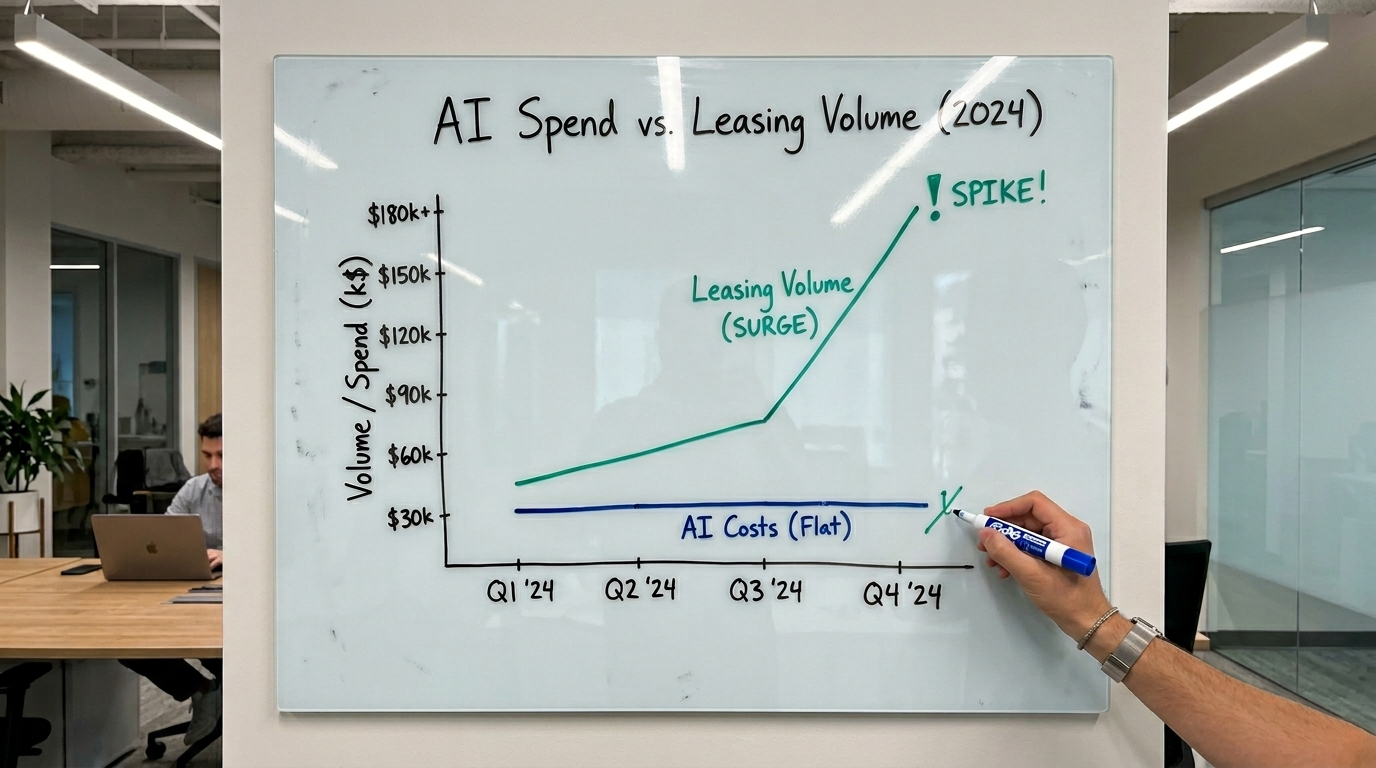
Expense Category | AI Leasing Agent | Human Leasing Agent |
Base Cost | $200–$600 / month per property | $45,000–$65,000 / year + benefits |
Availability | 168 hours / week | 40 hours / week |
Cost per Lead | Decreases as volume scales | Increases with overtime/headcount |
Turnover Cost | $0 (Software) | $5,000+ (Recruiting & Training) |
Routine FAQs
Most initial prospect questions are predictable:
“Is this unit available?”
“How much is rent?”
“Do you allow pets?”
“Is parking included?”
“Can I schedule a tour?”
“What is the application process?”
AI handles these quickly and consistently, as long as it has access to accurate property data. A human answering the same six questions fifty times a day is not adding judgment or persuasion. They are doing data retrieval, and AI does that faster.
Tour Scheduling and Reminders
AI can reduce the back-and-forth of scheduling by offering available times, confirming appointments, and sending reminders automatically. This is one of the highest-value automation wins in leasing. But it only works well when the AI is synced to real office hours and calendar availability (more on this failure mode below).
Follow-Up Consistency
Human teams forget. They get busy. Leads sit in inboxes. AI follows up consistently and on schedule. That said, follow-up without frequency caps and human-takeover rules quickly turns from helpful to annoying, a pattern that practitioners report with frustrating regularity.
CRM and PMS Updates
AI can capture notes, lead source, preferred unit type, tour time, and follow-up status directly in the property management system. This saves admin time and reduces the inconsistency that comes from manual data entry after every call and email.
Haven’s Leasing AI, for example, handles phone, SMS, and email inquiries while integrating with PMS/CRM systems to take actions like creating notes and updating lead records. You can listen to a Haven voice agent demo to hear how this works in practice.
Where Human Leasing Agents Still Win
2026 Compliance: Navigating HUD and FTC Guidelines
As of 2026, the regulatory scrutiny on AI in housing has intensified. Property managers must ensure their AI leasing agents adhere to the following:
Fair Housing Act (FHA): AI must not use "proxy variables" (e.g., zip codes or specific interests) to filter leads in a way that creates disparate impact.
Transparency: Per recent FTC guidance, prospects must be able to easily identify when they are speaking to an AI versus a human.
The Human Override: A manual review process must exist for any AI-assisted lead disqualification to prevent "black box" discrimination.
Tours and Property Storytelling
A human can read the prospect. They notice what catches someone’s eye, tailor the tour route, and sell the lived experience of a community, not just its square footage. Zillow found that 55% of recent renters said taking a private tour was essential, and 47% said meeting or speaking with the landlord or property manager was essential. Apartments.com reported that 97% of renters showed interest in in-person tours with a leasing agent.
Tours remain one of the most consequential moments in leasing. AI cannot walk a prospect through a unit and say, “This corner gets morning light, and it is the quietest unit in the building.” A human can.
Objection Handling
When a prospect says, “The rent is higher than I expected,” or “I am comparing this to another property down the street,” the response requires nuance, reading the situation, and sometimes creative problem-solving. AI can offer scripted responses. Humans can actually persuade.
Trust and Emotional Confidence
Renting a home is a high-stakes personal decision. One property manager on Reddit explained that they intentionally keep a person at the front desk and avoid phone menus because renters feel more secure talking to a real person. Another practitioner in the same thread argued that it is “more important than ever to be human” while using AI to improve efficiency.
Human contact is not obsolete. It is a premium moment. AI should protect human time for the interactions that actually affect trust and conversion.
Exceptions and Special Circumstances
A prospect with a housing voucher, a complicated application history, or a reasonable accommodation request needs a trained human, not a bot following a decision tree. These situations require policy knowledge, sensitivity, and judgment that AI is not built to provide.
Compliance-Sensitive Decisions
HUD issued 2024 guidance making clear that Fair Housing Act obligations apply even when AI or algorithms are used in housing decisions. The guidance specifically warns that AI and machine learning can make processes less transparent by obscuring reasons for denial. The FTC and CFPB have also requested public comment on how algorithms and AI are used in tenant screening and whether they may drive discriminatory outcomes.
AI can ask prequalification questions and collect information. But screening criteria, denials, accommodations, and protected-class-sensitive situations need human-reviewed policies and Fair Housing oversight. This is not optional.
Closing the Lease
AI can move a lead forward through the funnel. Humans often close the deal by creating confidence, urgency, and emotional fit. The final step from “interested” to “signed” usually requires a person.
The Best Model Is Not AI vs Human. It Is AI Plus Human.
The strongest leasing teams do not ask AI to replace the leasing office. They use AI to make sure no lead waits, no inquiry gets lost, no tour request sits overnight, and no follow-up depends on someone remembering. Then they use humans where humans matter most.
Think of it as two complementary zones.
AI owns SPEED:
Seconds-fast response
Persistent follow-up
Every-channel coverage
Evening and weekend availability
Data capture and CRM/PMS updates
Humans own TRUST:
Tours and property storytelling
Rapport and emotional confidence
Unusual situations and exceptions
Sensitive compliance judgment
Tactical closing and objection handling
The handoff between these two zones is where most operations succeed or fail.
The Handoff Ladder
A well-designed AI-to-human leasing workflow follows a predictable sequence:
Capture. AI answers immediately when a lead comes from Zillow, Apartments.com, the property website, phone, SMS, or email.
Clarify. AI confirms move-in date, budget, unit type, pets, preferred tour time, and contact details.
Answer. AI answers routine questions from approved data: availability, pricing, fees, pet policy, amenities, parking, application steps.
Schedule. AI offers only valid tour slots synced to real staff availability or self-guided tour systems.
Route. AI flags high-intent, complex, unhappy, or compliance-sensitive leads for a human.
Human close. The human agent handles the tour, builds rapport, addresses objections, manages exceptions, and guides the prospect to application or lease.
AI follow-up. AI sends approved reminders and follow-ups, but stops or changes behavior once a human owns the conversation.
This model is consistent with what current ranking resources recommend. It also matches what practitioners describe on Reddit and LinkedIn as the model that actually works in practice.
For a broader view of how leasing AI fits alongside other property management tools, the property management AI stack guide covers the full picture.
Common AI Leasing Mistakes (and Why They Matter)
Most articles about AI leasing agents vs humans list benefits and stop there. But the real-world failures are just as important, especially for property managers evaluating whether to adopt AI.
Bad Tour Scheduling
The worst AI leasing experience is not a bot that says “I don’t know.” It is a bot that confidently books a tour your team cannot honor.
A renter on Reddit described an AI chatbot confirming a tour for a time when the leasing office was closed. Another commenter in the same thread said they had shown up to at least three scheduled tours where the office was locked. This failure destroys trust instantly and is entirely preventable with proper calendar integration.
Wrong or Stale Information
If PMS or listing data is wrong, AI will quote incorrect pricing, availability, fees, or policies. Zillow found that 94% of renters agree rental listings should clearly list all fees, and Apartments.com reported that 80% of renters will immediately stop considering a property if it is too expensive. When AI gives wrong pricing because of stale data, the damage is real.
AI leasing agents need reliable, up-to-date connections to property management systems. This is why PMS and CRM integrations matter so much in evaluating any AI leasing tool.
Over-Follow-Up
A property management professional on Reddit using an AI tool through their CRM described the AI contacting prospects three to four times before staff arrived in the morning and continuing to check in after a human agent had already taken ownership of the lead. The commenter called it “borderline harassment.”
AI follow-up needs frequency caps, stop rules, and clear detection of when a human has taken over the conversation.
Generic Answers That Do Not Sell
AI can answer “we offer one, two, and three bedrooms.” A human can say, “I have a top-floor one-bedroom facing the courtyard that fits what you described.” This distinction came up repeatedly in practitioner discussions. One leasing professional on Reddit criticized the AI for not understanding simple questions about garages and instead giving irrelevant bedroom-count answers.
The difference between answering a question and selling a home is meaningful.
No Human Escape Hatch
If renters cannot reach a human, AI hurts trust instead of building it. Practitioners on Reddit report frustration from both sides: renters who feel property managers use AI to avoid communication rather than improve it, and onsite teams who see prospects slip away because the bot could not handle a real conversation.
Every AI leasing system needs a clear, easy path for prospects to reach a person.
Compliance Blind Spots
AI that prequalifies or screens without clear policy controls can create Fair Housing risk. A practitioner in a Reddit thread on AI call centers for property management raised concern that AI coded to weed out unqualified applicants could violate equal opportunity housing rights if not governed correctly.
HUD’s guidance is unambiguous: housing providers remain responsible for fair housing compliance regardless of the technology used. For more on separating AI reality from hype, see this breakdown of property management AI myths and facts.
How to Decide Which Tasks AI Should Handle
A simple decision rule works well here.
Use AI when the task is: repetitive, low-risk, data-driven, easy to audit, time-sensitive, high-volume, or governed by clear policy.
Examples: first response, availability answers, tour scheduling, tour reminders, lead capture, follow-up sequences, CRM notes.
Use humans when the task is: emotional, persuasive, compliance-sensitive, exception-heavy, high-value, ambiguous, or relationship-driven.
Examples: in-person tours, objection handling, lease negotiation, special circumstances, reasonable accommodation questions, application denial conversations, reputation recovery after a bad bot experience.
Leasing Task | Best Owner | Why |
|---|---|---|
First response to listing lead | AI | Speed, 24/7 coverage, no missed inquiry |
Basic availability questions | AI (if PMS data is accurate) | Routine and data-driven |
Fee and pricing questions | AI with data controls | High renter importance, must be accurate |
Pet policy, parking, amenity FAQs | AI | Repetitive and low judgment |
Lead qualification | AI collects, human governs criteria | AI gathers info; humans own policy |
Tour scheduling | AI with calendar guardrails | Useful, but fails if hours are wrong |
Tour reminders | AI | Reduces no-shows |
In-person property tour | Human | Storytelling, confidence, rapport |
Objection handling | Human | Requires nuance and persuasion |
Negotiating lease terms or specials | Human | Judgment and policy control |
Reasonable accommodations | Human | Compliance-sensitive |
Application denial or adverse action | Human-reviewed process | Legal and Fair Housing risk |
Post-tour follow-up | Hybrid | AI can remind, human should personalize for high-intent leads |
Dormant lead nurture | AI with stop rules | Valuable unless it becomes spammy |
Trust repair after bad bot experience | Human | Trust repair requires human accountability |
For property managers thinking about automation more broadly, the same principle applies across operations: automate what is repetitive, keep humans where judgment matters.
What Property Managers Should Look for in an AI Leasing Agent

Not all AI leasing tools are equal. When comparing an AI leasing agent vs a human, the quality of the AI matters just as much as the decision to adopt it.
Evaluation Checklist
Voice, SMS, and email support. Renters do not stay in one channel. The AI should meet them wherever they reach out.
Listing-site lead capture. Integration with Zillow, Apartments.com, and other listing platforms is critical for capturing leads at scale.
PMS/CRM integration. AI needs real-time or reliable access to pricing, availability, unit details, and lead status. Without this, answers will be wrong.
Calendar-aware tour scheduling. The system must sync to actual office hours and staff availability. No more locked-office tours.
Human handoff rules. AI should escalate when confidence is low, when the lead is high intent, or when the topic is sensitive.
Conversation memory. Prospects should not have to repeat themselves when they switch channels or when a human takes over.
Follow-up controls. Frequency caps, stop rules, and human-takeover detection are non-negotiable.
Reporting. Track response time, lead source, tour booking, show rate, application rate, lease conversion, and AI-to-human handoff rate.
Fair Housing and compliance workflows. AI should follow approved scripts and escalate sensitive situations.
Ongoing QA. An AI leasing agent is not set-and-forget. As one practitioner noted on LinkedIn, AI providers should have evaluation systems that monitor conversations, outcomes, errors, and AI actions over time.
Haven’s Leasing AI is built around these principles: voice-first communication across phone, SMS, and email, with lead qualification, tour scheduling, Zillow and Apartments.com lead capture, follow-up and nurturing, leasing reporting, and PMS/CRM integrations.
KPIs for Comparing AI, Human, and Hybrid Leasing
Measuring the AI leasing agent vs human comparison requires looking beyond anecdotes. Here are the metrics that matter.
Top-of-funnel speed:
Average and median first response time
After-hours response rate
Missed-call and missed-lead rate
Listing-site lead capture rate
Lead quality:
Qualification completion rate
Unit-specific lead rate
Tour request rate
AI-to-human escalation rate
Tour performance:
Tour scheduled rate
Show rate and no-show rate
Time from inquiry to tour
Tour-to-application rate
Conversion:
Lead-to-application rate
Application-to-lease rate
Lead-to-lease rate
Time to lease
Cost per lease
Experience and risk:
Prospect satisfaction or complaint rate
Wrong-answer rate
Human takeover rate
Compliance escalation rate
Follow-up opt-out or stop rate
The right baseline is not an industry average. It is the property’s own pre-AI performance. Compare before vs after: response time, tour scheduling, lead-to-lease, and leasing staff workload. That is how you know whether the AI is actually working.
For more on measuring AI benefits and ROI in property management, including how to build a business case, there is a dedicated guide.
Practical Examples: AI vs Human in Action
Good AI Use
A renter submits a Zillow lead at 9:45 p.m. asking about a two-bedroom unit that allows dogs. The AI replies immediately, confirms the dog policy, asks move-in date and budget, offers available tour times, books a valid tour, sends a confirmation, and logs the lead in the CRM. The human leasing agent reviews the lead the next morning and prepares for the tour.
Bad AI Use
A renter asks whether garages are available. The AI answers with bedroom counts instead, sends three follow-up texts overnight, and schedules a tour for a time the leasing office is closed. The renter shows up, finds the office locked, and loses trust in the property.
Human-Required Handoff
A prospect mentions they have a housing voucher and need a reasonable accommodation. The AI acknowledges the request, provides approved general next steps, and routes the conversation to a trained human who can handle the situation with the judgment and sensitivity it requires.
Hybrid Closing
AI schedules the tour and sends a reminder. The human leasing agent conducts the tour, learns the prospect wants quiet and morning light, highlights the top-floor unit facing away from the street, handles the budget objection, and sends a personalized follow-up. AI then sends the application reminder and logs next steps in the CRM.
Common Confusion Points
A few terms in this space cause unnecessary confusion.
AI leasing agent vs AI leasing assistant. Usually the same category. “Agent” implies more workflow ownership and system-level action. “Assistant” implies support for human staff. The distinction is mostly branding.
AI leasing agent vs chatbot. A chatbot usually answers questions in one channel with limited logic. An AI leasing agent handles multi-step workflows: answer, qualify, schedule, follow up, update CRM/PMS, and escalate. For more on how AI workers function inside property management, there is a full explainer.
AI leasing agent vs virtual leasing agent. A virtual leasing agent can mean AI software or a remote human leasing agent. Always clarify which one is being discussed.
AI leasing agent vs centralized leasing. Centralized leasing is an operating model where leasing work is handled across multiple properties or by a central team. AI can support centralized leasing, but they are not the same thing.
Will AI Leasing Agents Replace Human Leasing Agents?
AI changes the leasing role before it eliminates the leasing role. It removes repetitive admin first, then forces human agents to become better closers, tour specialists, relationship builders, and exception handlers.
A Reddit thread titled “RIP to the Leasing Consultant” captures the anxiety. One commenter said AI is already replacing tasks like applications, tour confirmations, post-tour follow-up, and delinquency outreach. Another said AI helps with many tasks and teams will be smaller, but “we will always have work.”
The honest answer: AI will reduce the number of leasing tasks that require a human. It will not eliminate the need for humans in leasing. Properties that try to run leasing entirely through AI will lose the trust moments, the objection handling, and the closing conversations that actually win leases.
The winning position is clear. AI leasing agents are not competing with human leasing agents for the same job. They are strongest at the parts of leasing that are repetitive, time-sensitive, and data-driven. Human leasing agents are strongest at the parts of leasing that require trust, judgment, persuasion, and care. Property managers should not choose between AI and humans. They should design a leasing workflow where AI captures every opportunity and humans step in for the moments that win the lease.
If you are evaluating how an AI leasing agent could fit your current operation, book a demo to see how it works with your PMS and leasing workflow.
FAQ
Is an AI leasing agent the same as a chatbot?
No. A chatbot usually answers questions in one channel with simple logic. An AI leasing agent handles broader leasing workflows: lead capture, qualification, tour scheduling, follow-up, CRM/PMS updates, and human handoff across multiple communication channels.
Will AI leasing agents replace human leasing agents?
AI will replace some repetitive leasing tasks, but not every human leasing function. AI is strongest for speed, coverage, and routine workflows. Humans remain important for tours, objections, trust-building, exceptions, compliance-sensitive issues, and closing.
When should a human take over from AI?
A human should take over when the prospect is high intent, confused, frustrated, asking about special circumstances, requesting an accommodation, negotiating terms, raising a compliance-sensitive question, or receiving an answer the AI cannot verify.
What is the biggest risk of using an AI leasing agent?
The biggest risk is not that AI exists. It is deploying AI without accurate property data, calendar controls, escalation rules, follow-up limits, and human oversight. Bad AI is worse than no AI.
Is AI leasing safe for Fair Housing compliance?
AI can be used in leasing communication, but it must operate under approved policies, avoid discriminatory language or decision-making, and escalate sensitive issues to trained humans. HUD has made clear that Fair Housing Act obligations apply when AI and algorithms are used in housing-related functions.
How should property managers measure AI leasing performance?
Track response time, missed leads, after-hours capture, tour scheduled rate, show rate, application rate, lead-to-lease rate, wrong-answer rate, escalation rate, prospect satisfaction, and human takeover outcomes. Compare against your own pre-AI baseline, not industry averages.
What leasing tasks should AI handle vs humans?
AI should handle first response, basic FAQs, lead qualification questions, tour scheduling, reminders, follow-up, CRM notes, and after-hours lead capture. Humans should handle in-person tours, objection handling, lease negotiation, complex application questions, accommodation requests, and final judgment on sensitive leasing decisions.
How do I know if my AI leasing agent is working well?
Monitor conversations regularly. Look for wrong answers, impossible tour bookings, excessive follow-ups, low show rates, high complaint rates, and situations where the AI failed to escalate to a human. An AI leasing agent is not set-and-forget. It needs ongoing QA and tuning.