7 Best Voice AI Leasing Tools for Property Managers (2026)
Compare 7 Voice AI Leasing tools for 2026—see features, pricing notes, PMS integrations, and best-fit picks for property managers. Choose smarter.

TL;DR
Voice AI leasing software answers prospective renters by phone, qualifies leads, answers property questions, follows up by SMS or email, and can schedule tours without requiring a leasing agent to answer every interaction manually. The main differences between platforms are voice capability, PMS integration, portfolio size, deployment model, pricing, and human escalation.
For property managers, the right platform depends primarily on three factors: portfolio size, existing property management software, and how much of the leasing process you want AI to handle. AppFolio users may prefer a native AI option, while operators looking for a dedicated voice-first system may prefer a specialist platform such as Haven. Enterprise operators may prioritize broader conversational AI and centralized leasing workflows, while smaller operators may prioritize simple scheduling and chat automation.
Before signing a contract, compare the vendor's actual voice capabilities, PMS integration depth, AI disclosure, Fair Housing safeguards, human handoff process, reporting, implementation requirements, and total cost per property or unit.
Which Voice AI Leasing Tool Is Right for Property Managers?
The right voice AI leasing platform depends on your portfolio size, property management system, and leasing workflow. AppFolio users may prioritize AppFolio's native AI capabilities, while operators looking specifically for a voice-first leasing system may evaluate specialist platforms such as Haven. Enterprise operators may prefer platforms that combine AI with CRM, lead management, and centralized leasing workflows. Smaller operators may prioritize lower-cost tools focused on chat, SMS, or tour scheduling.
When comparing vendors, look beyond whether a platform says it offers “voice AI.” Verify whether it can answer inbound calls, qualify prospects, access live availability and pricing, schedule tours, update the PMS, transfer calls to humans, disclose that the caller is speaking with AI, and maintain an auditable record of the interaction.
Why Voice AI for Leasing Matters Right Now
Here’s the math that should worry every property manager: over 60% of calls to multifamily properties go unanswered, and a single missed call can cost between $15,000 and $30,000 in annual revenue. Two-thirds of prospective renters reach out after business hours, and according to ShowMojo’s research, leads go cold within five minutes of first contact. They call this “the First Five,” and the data behind it is stark: 65% of renters lease with the first property to respond.
The national multifamily vacancy rate sits at 7.1% as of August 2026, with economic headwinds pressuring household formation. Units take an average of 32 days to lease after listing. In that environment, every unanswered phone call is money left on the table.
This is why voice AI leasing tools have moved from experimental to essential. Not chatbots, not email autoresponders, but AI that picks up the phone, holds a real conversation, qualifies the prospect, and books a tour before your leasing agent clocks in the next morning.
Explore Haven’s Leasing AI platform to hear how a voice-first agent handles real leasing calls.
What Voice AI Leasing Actually Means
There’s an important distinction most articles in this space gloss over. A chatbot that pops up on your website is not voice AI. An autoresponder that sends templated emails is not voice AI. True voice AI leasing means a system that answers a ringing phone, processes natural language in real time through speech recognition and synthesis, and carries on a conversation that sounds human.
This matters because the phone remains the highest-value leasing channel. Prospects who call are further along in their decision-making than those who browse a website. They want answers now, not a “we’ll get back to you” message.
Voice-first platforms are built from the ground up around phone conversations, with SMS and email as secondary channels. Voice-added platforms started with chat or email and bolted on phone capability later. The difference shows up in conversation quality, latency, and how naturally the AI handles interruptions, accent variation, and complex questions.
For a deeper breakdown of how these systems differ from basic chatbots, see this guide on leasing AI vs. chatbots.
Capability | Voice AI Leasing | Chatbot | Traditional Leasing Agent |
|---|---|---|---|
Answers phone calls | Yes | No | Yes |
Website chat | Often | Yes | Sometimes |
SMS follow-up | Often | Sometimes | Yes |
24/7 availability | Yes | Yes | Usually no |
Tour scheduling | Often | Often | Yes |
Handles natural spoken conversation | Yes | No | Yes |
Handles complex conversations | Depends on platform | Limited | Usually strongest |
Human escalation | Usually available | Sometimes | Not applicable |
PMS actions | Depends on integration | Depends on integration | Usually |
Cost structure | Software/usage fee | Software fee | Labor cost |
A chatbot communicates primarily through text. Voice AI communicates through spoken conversations. A leasing AI platform may include both, but property managers should verify whether “voice AI” means genuine two-way phone conversations or simply automated outbound calls and voicemail handling.
At-a-Glance Comparison Table
Platform | Voice Calls | SMS | PMS Integration | Tour Scheduling | Human Handoff | AI Disclosure | Pricing | Best Fit |
|---|---|---|---|---|---|---|---|---|
Haven | Yes | Yes | Verify integration depth | Yes | Verify | Verify | Quote | Operators prioritizing voice AI |
EliseAI | Yes | Yes | Multiple PMS | Yes | Yes | Verify | Quote | Enterprise multifamily |
Funnel / Fenix AI | Yes | Yes | Funnel ecosystem | Yes | Yes | Verify | Quote | Large centralized leasing teams |
AppFolio Realm-X | Yes | Yes | Native AppFolio | Yes | Verify | Verify | Plus tier | Existing AppFolio users |
BetterBot | Verify | Yes | Multiple PMS | Yes | Verify | Verify | Quote/estimate | Smaller operators |
ShowMojo / Mo | Yes | Yes | Scheduling-focused | Yes | Verify | Verify | Subscription/quote | Showing and scheduling workflows |
Anyone Home | Yes | Yes | Multiple PMS | Yes | Yes | Verify | Quote | AI + human leasing workflows |
Note: All pricing figures are from third-party reports and should be verified directly with vendors. As independent reviewers at AIToolsBakery have pointed out, almost every vendor in this category is quote-only, making transparent pricing nearly impossible to find.
How We Compared Voice AI Leasing Tools
We compared these platforms based on the capabilities that matter most to property managers evaluating AI leasing software in 2026:
Voice capability: Whether the platform can answer and manage real-time inbound phone conversations rather than relying primarily on web chat or SMS.
Leasing automation: Whether the AI can answer property questions, qualify prospects, follow up with leads, and schedule tours.
PMS integration: Whether the platform can connect to the property management system and whether that connection is read-only or allows the AI to take actions.
Channel coverage: Whether the platform supports phone, SMS, email, web chat, or other leasing channels.
Human escalation: Whether complex conversations can be transferred to a human while preserving conversation context.
Compliance controls: Whether the platform provides AI disclosure, conversation records, escalation controls, and tools that can support Fair Housing compliance.
Pricing and implementation: Whether pricing is publicly available, quote-based, usage-based, or bundled with another software platform, as well as how much implementation work is required.
Portfolio fit: Whether the product is primarily designed for small operators, mid-market property managers, or large multifamily organizations.
Vendor capabilities, pricing, integrations, and product availability can change, so property managers should confirm current terms directly with each provider before purchasing.
7 Best Voice AI Leasing Tools in 2026
1. Haven
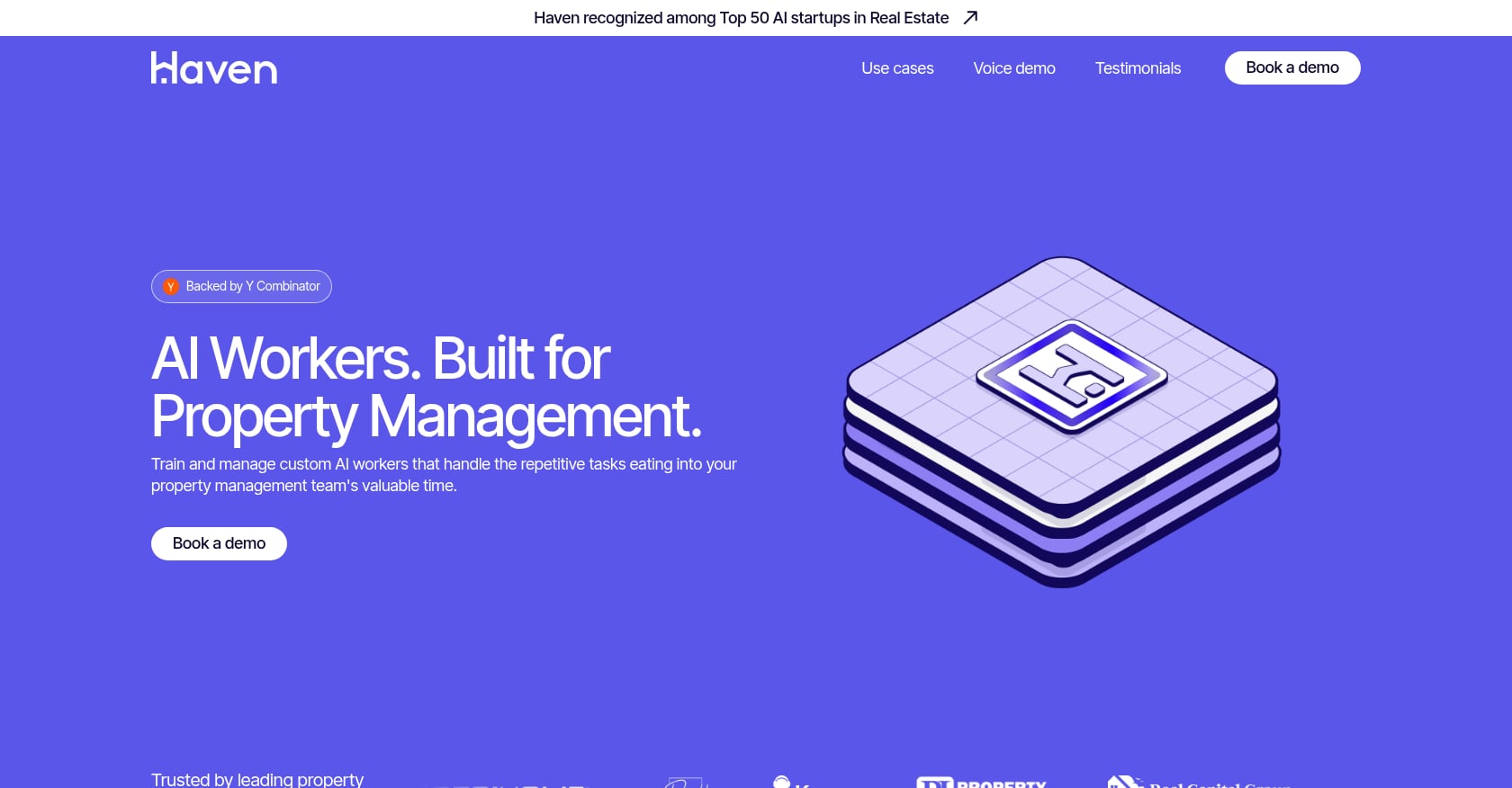
Best for: Property managers with 350+ units who need a voice-first leasing and maintenance AI with deep PMS integration.
Haven is the only platform on this list built voice-first from day one. Where competitors started with chat widgets and added phone capability over time, Haven’s entire architecture centers on real-time phone conversations across leasing and maintenance workflows.
Key features:
Answers phone calls, SMS, and emails for leasing inquiries 24/7
Lead qualification and tour scheduling through natural voice conversations
Captures leads from Zillow and Apartments.com listings automatically
Bi-directional PMS integration that takes real actions (creating work orders, logging notes, assigning tickets)
Multi-language voice agent support
Conversation memory and continuity across interactions
Dual product: Leasing AI and Maintenance AI through the same voice-first interface
Pricing: Quote-based. No public pricing. Sales-led onboarding with demo required.
Proof points: Y Combinator-backed. Named to Commercial Observer’s Top 50 AI Startups in Real Estate. Customer testimonials from Real Capital Group and Luke Properties (360+ units). Vellum.ai’s 2026 roundup describes Haven as “a voice-first AI leasing agent with deep bi-directional PMS integration across phone, SMS, email, and listing sites.”
Limitations:
No self-serve onboarding; every deployment requires configuration and QA per property
No transparent pricing on the website
Implementation timeline depends on PMS data quality and property complexity
What sets it apart: Haven offers a public voice demo you can actually listen to before requesting a sales conversation. No other vendor on this list does that. The dual Leasing AI plus Maintenance AI setup also means one vendor and one integration powering two of the highest-volume communication workflows in property management.
Book a demo with Haven to hear the voice agent in action.
2. EliseAI
Best for: Enterprise multifamily operators with 500+ units and budget for a premium, full-suite conversational AI platform.
EliseAI is the category’s 800-pound gorilla. Founded in 2017, it reported $200M in annual recurring revenue by June 2026 at a $2.2 billion valuation. Twenty-eight of the top 30 multifamily operators use it, touching roughly 1 out of every 12 U.S. apartment units.
Key features:
Conversational AI across webchat, text, email, and voice
Built specifically for multifamily and single-family operators
Deep integration with major PMS platforms
Enterprise-grade reporting and analytics
Pricing: Not publicly disclosed. Competitor-sourced reports from 2026 estimate $3 to $6 per unit per month with a $25,000 annual minimum. That means a 100-unit operator would effectively pay over $20 per unit per month to meet the minimum.
G2 rating: 4.5/5 from 15 reviews.
Limitations:
The $25K annual minimum prices out most small and mid-market operators
No self-serve trial or public demo
One G2 reviewer reported issues with the AI scheduling appointments that were not requested or cancelling appointments it should not have
Another reviewer found the platform lacks affordable housing customization options
Real user perspective: A G2 reviewer noted the affordability challenges, stating it “needs more customization” for affordable housing use cases. This is worth weighing if your portfolio includes income-restricted properties.
For a detailed comparison of how Haven and EliseAI stack up, see Haven vs. EliseAI.
3. Funnel Leasing / Fenix AI
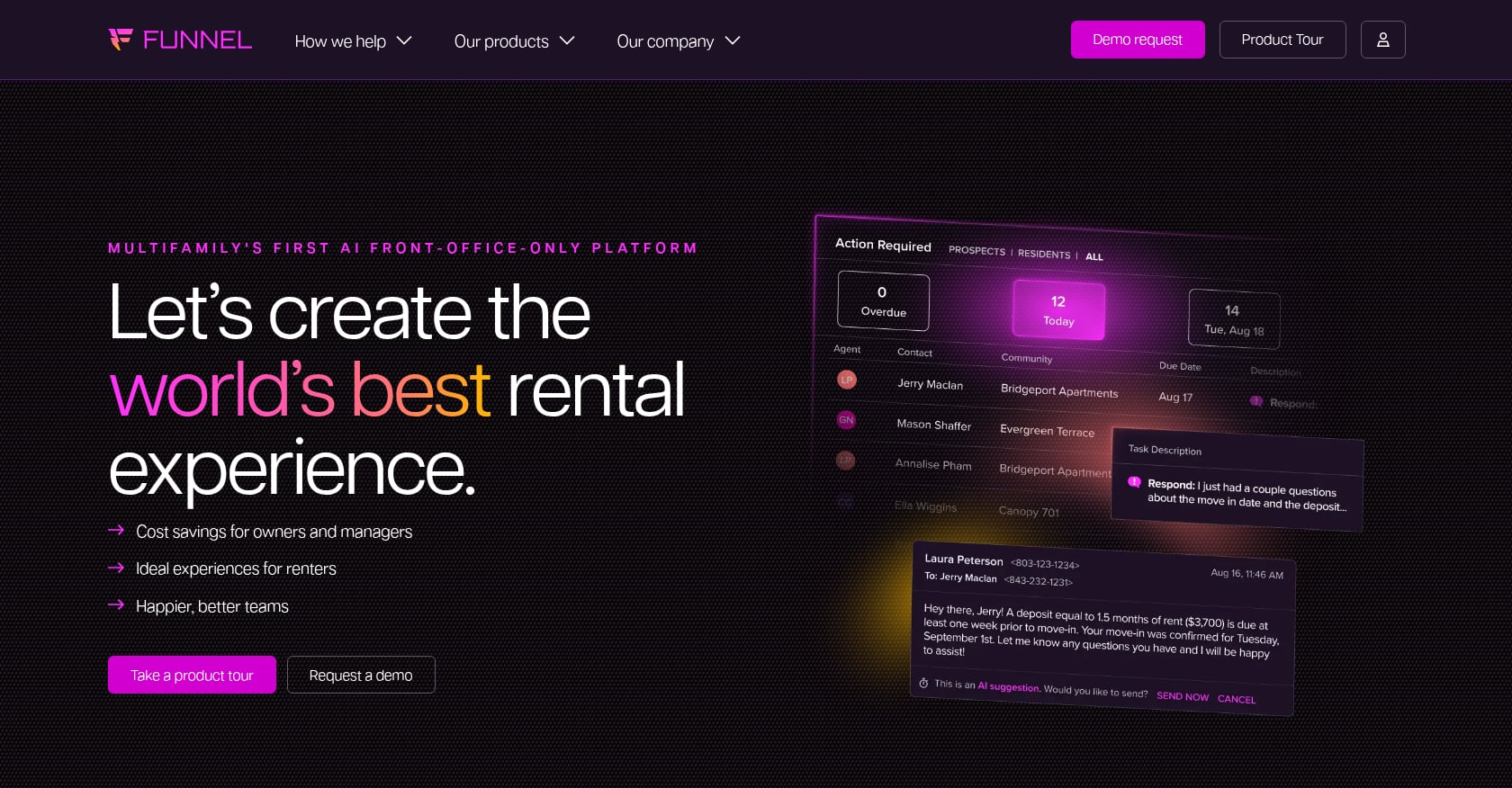
Best for: Large operators with 2,500+ units looking to centralize leasing operations around a single CRM and AI platform.
Funnel acquired LeaseHawk’s selected assets in April 2025 and rebuilt them as Fenix, a standalone AI product powered by Sierra’s conversational AI engine. If you visit leasehawk.com today, you land on funnelleasing.com. This consolidation matters because buyers should understand who owns what they’re purchasing.
Key features:
Resolution-based pricing model
Voice AI inherited from LeaseHawk’s heritage call scoring technology
CRM-native integration (Funnel’s own CRM)
Kane Realty case study showing 46% tour conversion rate vs. 19% without AI
Pricing: Third-party reports estimate $2 to $4 per unit per month. Funnel’s own FAQ suggests a floor of roughly 2,500 units, making this an enterprise play.
G2 rating: 4.3/5 from 250 reviews (largest review sample in this category).
Limitations:
If you don’t want Funnel’s CRM, you don’t really want Fenix. It’s not designed to sit on top of somebody else’s stack.
The 2,500-unit floor eliminates most small and mid-market operators
Voice AI quality inherits LeaseHawk’s older technology, now being rebuilt under Sierra’s engine
4. AppFolio Realm-X Leasing Performer
Best for: Existing AppFolio users who want voice AI leasing without adding another vendor to their stack.
AppFolio’s Realm-X Leasing Performer with Voice launched in June 2026 as an evolution of its earlier AI assistant, Lisa. The pitch is straightforward: an AI leasing agent that responds to every email, every text, and picks up every phone call, all within AppFolio’s ecosystem.
The adoption numbers are striking. In Q1 2026, AppFolio disclosed that over 99% of its customers use some form of AI-enabled functionality. And their 2026 benchmark survey found AI-adopting operators expect 31% portfolio growth versus 12% for non-adopters.
Key features:
Unified AI leasing across phone, SMS, and email
Native AppFolio integration (no third-party setup)
Claims 73% higher lead-to-showing conversion rates and 10 hours saved weekly
Agentic AI framework built more deeply into AppFolio than the previous Lisa version
Pricing: AI features are gated behind AppFolio’s Plus tier at $3 per unit per month with a reported minimum of $1,500 per month. For a 500-unit portfolio, that comes to $18,000 per year for the platform.
Limitations:
Voice capability launched June 2026, so there’s no meaningful track record for call quality yet
Only works within the AppFolio ecosystem
Previous version (Lisa) reportedly struggled with nuanced questions and context
If you’re not already on AppFolio, this isn’t an option
For AppFolio users weighing whether to go with Realm-X or add a specialist tool, this AppFolio AI integration guide breaks down the gaps and opportunities.
5. BetterBot
Best for: SMB and mid-market operators who need fast deployment without voice depth.
BetterBot is the “deploy it this week” option. It’s a guided automation layer that handles high-volume, low-complexity interactions at the top of the funnel: availability checks, amenity questions, tour booking. Their Customer Success team builds your automated leasing assistant in as little as three days with zero training required.
Key features:
Rapid three-day deployment
Chat and SMS automation for availability, amenities, and tour scheduling
Multiple PMS integrations
Low barrier to entry for smaller operators
Pricing: Third-party estimates put it at $1.50 to $3 per unit per month, though this could not be independently verified.
G2 rating: 4.4/5 from 4 reviews.
Real user perspective: One Revyse reviewer reported BetterBot saved each community an average of 31 hours per month and $700K in leasing dollars in 2021.
Limitations:
Not a voice-first solution. It’s lighter-weight chat and SMS with quicker deployment and lower cost, but no real phone conversation capability.
Limited depth for complex leasing questions or lead nurturing
Small review sample makes it hard to assess reliability at scale
6. ShowMojo (Mo)
Best for: Single-family and small multifamily operators already using ShowMojo for tour scheduling who want to add voice AI.
ShowMojo’s AI leasing agent, Mo, won the 2026 “Virtual Assistant of the Year” award from PropTech Breakthrough Awards. The platform claims it converts prospects to scheduled showings at 54% versus roughly 43% for competitors, and completed showings at 31% versus approximately 20%.
In September 2026, ShowMojo launched an AI Outbound Voice Leasing Agent, giving property managers both inbound and outbound voice coverage for the full leasing funnel.
Key features:
Award-winning AI assistant for tour scheduling
New outbound voice AI agent (September 2026 launch)
Free 30-day trial available
Strong scheduling and showing conversion metrics
Pricing: Free 30-day trial. Subscription pricing available on request.
Limitations:
Outbound voice just launched in September 2026 with no established track record
Still primarily a web chat and SMS platform
Not a full PMS integration play; best understood as a scheduling-first tool
Less suitable for large multifamily portfolios needing comprehensive leasing automation
7. Anyone Home
Best for: Operators who want a hybrid model combining AI automation with built-in human leasing support.
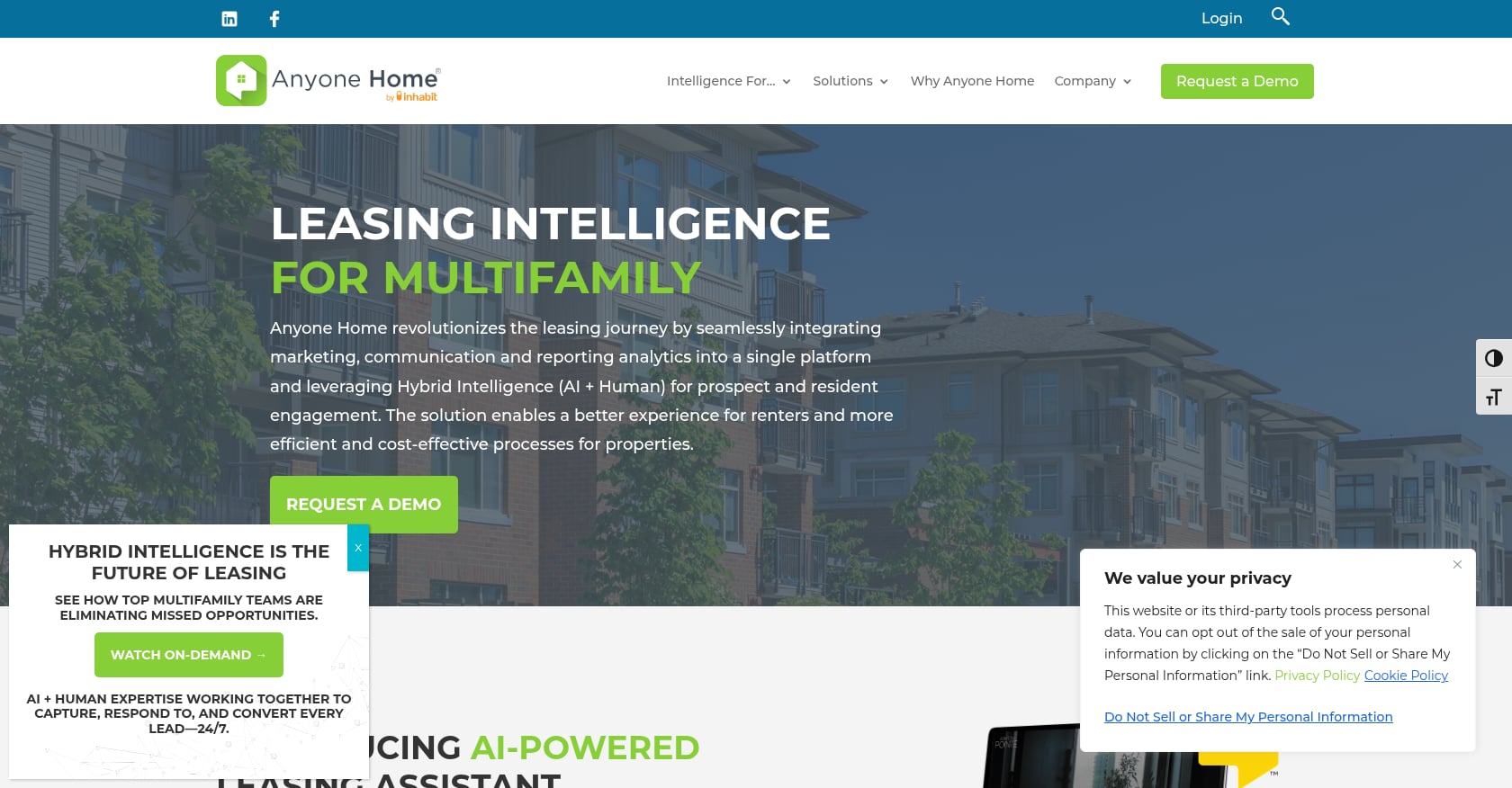
Anyone Home positions itself around “Hybrid Intelligence,” pairing AI with human leasing capabilities. The idea is that AI handles routine inquiries while humans step in for complex situations. In theory this is appealing. In practice, user reviews raise concerns.
Key features:
Hybrid AI plus human leasing model
Multi-channel coverage (phone, SMS, email, webchat)
Multiple PMS integrations
Pricing: Quote-based. No public pricing available.
G2 rating: 4.2/5 from 10 reviews.
Limitations:
G2 reviewers report integration slowness and overcomplicated metrics
System glitches mentioned in multiple reviews
Support response times reportedly stretch to a week or longer
Lower review scores than most competitors on this list
Real user perspective: Multiple G2 reviewers flagged support responsiveness as a concern, with one noting it “could take a week or longer to respond.” For a product built around the premise of always-available service, that’s a meaningful gap.
How to Choose: A Decision Framework
The voice AI leasing market splits along three axes: portfolio size, PMS stack, and channel priority. Here’s a quick routing guide.
By portfolio size:
Under 350 units on AppFolio: Start with Realm-X Leasing Performer. It’s bundled into your Plus tier, and there’s no additional vendor to manage.
350 to 2,500 units needing voice-first AI: Haven is the clearest fit. It’s built for this segment with deep PMS integration and genuine voice-first architecture.
2,500+ units centralizing operations: Funnel/Fenix AI or EliseAI, depending on whether you want CRM replacement (Funnel) or a standalone conversational layer (EliseAI).
Just need chat and SMS fast: BetterBot deploys in days and costs the least.
PMS-bundled vs. best-of-breed:
This is the fundamental strategic question. AppFolio now bundles voice AI, and the convenience is real. But bundled tools optimize for breadth, not depth. A specialist tool like Haven works with your PMS rather than replacing it, taking real operational actions through bi-directional integration.
For a broader view of how AI tools fit into your property management stack, see this guide on AI property management software.
Ownership matters too. Two frequently cited historical alternatives, Colleen AI and Knock CRM, no longer exist as independent products. Entrata acquired Colleen in June 2024, and RealPage bought Knock in 2022. Funnel now owns LeaseHawk. Before signing a contract, make sure you understand who owns the product and what that means for its roadmap.
10 Questions to Ask Before Buying Voice AI Leasing Software
Before signing a contract, ask the vendor:
Does the AI answer inbound phone calls in real time?
Can it access current unit availability, pricing, specials, and property information?
Can it schedule, reschedule, and cancel tours?
Does the PMS integration support write actions or only data retrieval?
What happens when the AI cannot answer a question?
Can calls be transferred to a human without making the prospect repeat the conversation?
Does the AI identify itself as AI at the beginning of the call?
Can managers review call recordings, transcripts, and AI decisions?
What are the implementation, integration, and onboarding fees?
What happens to the AI and PMS integration if the contract is terminated?
The last question is particularly important for property managers because changing leasing platforms can create operational and data-migration costs that are not reflected in the advertised monthly software price.
Fair Housing and Compliance: The Elephant in the Room
No other ranking article on voice AI leasing covers this adequately, and it’s arguably the highest-stakes consideration.
Fair housing organizations now use AI monitoring tools to test a property’s leasing AI remotely, anonymously, and at massive scale. They can run dozens of protected-class test inquiries against a live AI system in a single day. If your voice AI provides inconsistent information about availability, pricing, or amenities based on caller characteristics, the liability falls on you.
A 2025 Rently survey found that 74% of renters lose trust when AI isn’t disclosed during the leasing journey. Transparency is not optional. Your voice AI must identify itself as AI at the start of every call.
What to demand from any vendor:
Equal-service verification. The AI should respond identically to the same question regardless of caller accent, name, or demographic signals.
Disclosure protocols. The AI must identify itself as AI within the first few seconds of a conversation.
Escalation paths. Requests involving reasonable accommodations, assistance animals, income-source inquiries, or disability-related needs must route to a trained human.
Audit trails. Every call should be recorded and reviewable for compliance testing.
For a comprehensive breakdown of Fair Housing requirements for AI tools, read this AI compliance and Fair Housing guide.
The ROI Math Behind Voice AI Leasing
The cost economics are compelling once you lay them out. Human-led phone interactions cost approximately $12.00 each. Voice AI leasing agents handle roughly 80% of routine inbound inquiries autonomously, bringing the cost per interaction down to about $0.40. That’s a 97% reduction in cost per conversation.
But the bigger number comes from vacancy savings. Research from Zego found that tenant turnover costs include roughly $1,560 in lost rent, $1,200 in concessions, and $700 to $800 in repairs. It takes approximately 19 months to break even on a new resident. CallRail’s analysis shows that leaving a property empty for just five extra days at $1,800 per month translates to thousands lost annually.
The conversion side matters just as much. Digible, a property management analytics firm, reports that renters are 8x more likely to engage via text than email. And Nurture Boss data shows that increasing follow-ups to 10 per lead (versus the average 2 to 3) can drive a 125% increase in conversions. Voice AI handles this volume effortlessly, which humans simply cannot sustain across hundreds of units.
Organizations using AI in property management report 20 to 30% improvements in operational efficiency and save up to 10 hours per week. For a deeper dive into these numbers, see this AI call center alternative guide.
FAQ
What is voice AI leasing, and how is it different from a chatbot?
Voice AI leasing refers to AI systems that answer actual phone calls and carry on real-time spoken conversations with prospective renters. Chatbots handle text-based interactions on websites or via SMS. The distinction matters because phone inquiries tend to come from more serious prospects, and voice AI requires fundamentally different technology: speech recognition, natural language processing, and speech synthesis that works in real time with natural pauses and interruptions.
How much does voice AI for leasing cost?
Pricing varies widely. BetterBot reportedly starts around $1.50 to $3 per unit per month. EliseAI is estimated at $3 to $6 per unit per month with a $25,000 annual minimum. AppFolio bundles voice AI into its Plus tier at $3 per unit per month ($1,500 minimum). Haven uses quote-based pricing. Almost every vendor in this category requires contacting sales for an actual number, so treat any published estimate as approximate.
Does voice AI leasing comply with Fair Housing laws?
It can, but compliance depends entirely on implementation. The AI must provide consistent information regardless of caller demographics, disclose that it is AI at the start of the call, and route sensitive topics (accommodations, assistance animals, income-source questions) to trained humans. Fair housing testers are already using AI tools to audit leasing AI at scale, so vendors that can’t demonstrate equal-service verification pose real legal risk.
Can voice AI leasing agents integrate with my property management software?
Most platforms on this list integrate with major PMS systems, but the depth of integration varies. Some only read data (pulling availability, pricing). Others, like Haven, offer bi-directional integration that creates work orders, logs notes, and takes operational actions directly in your PMS. Always ask whether the integration is read-only or read-write before evaluating a vendor.
How long does it take to deploy a voice AI leasing tool?
Timelines range from three days (BetterBot for chat/SMS) to several weeks for voice-first platforms that require per-property configuration and QA. Haven, for example, involves a sales-led onboarding process with property-specific setup. ShowMojo offers a free 30-day trial for quicker evaluation. The right timeline depends on how much customization your portfolio requires.
Will prospects know they’re talking to AI?
They should. Beyond the ethical obligation, 74% of renters lose trust when AI involvement isn’t disclosed. Every reputable voice AI leasing vendor includes disclosure at the beginning of calls. The better question is whether the AI sounds natural enough that the disclosure doesn’t create friction. This is where listening to a live demo before buying matters.
What happens when the AI can’t handle a question?
Good voice AI leasing platforms have escalation protocols that route complex or sensitive inquiries to human team members. The key is whether this handoff happens smoothly (with context transferred) or abruptly (forcing the prospect to repeat everything). Ask vendors specifically how their escalation works and what percentage of calls currently require human intervention.
Is voice AI leasing only for large multifamily operators?
No, but the economics improve with scale. Operators with fewer than 350 units may find that PMS-bundled options (like AppFolio Realm-X) are sufficient. Mid-market operators in the 350 to 2,500 unit range benefit most from specialist platforms like Haven. Enterprise operators above 2,500 units tend toward EliseAI or Funnel. BetterBot and ShowMojo serve smaller portfolios with lighter-weight solutions.
Voice AI leasing is no longer a futuristic concept. It’s operational infrastructure that determines whether your properties capture revenue or lose it to the competitor who picked up the phone first. The vendors on this list represent the realistic options available in 2026, each suited to different portfolio sizes, PMS stacks, and operational priorities.
If phone calls are your highest-value leasing channel, and they almost certainly are, starting with a voice-first platform makes more sense than retrofitting voice onto a chat-first tool.
Explore Haven’s AI property management suite to see how voice-first leasing and maintenance AI work together.