Leasing AI vs Chatbots: 2026 Guide to Assistants & Agents
Leasing AI vs Chatbots: see how assistants and agents qualify leads, book tours, update your PMS, and boost conversions. Compare tiers now.

TL;DR
A leasing chatbot answers scripted questions on your property website. Leasing AI qualifies leads, schedules tours, updates your PMS, and follows up across phone, SMS, and email. Between those two extremes sits an AI leasing assistant that can hold real conversations but can’t take operational actions. Understanding this three-tier spectrum is the key to choosing the right technology for your portfolio.
Quick Takeaway: Leasing AI vs Chatbots
A leasing chatbot answers preset questions through scripted workflows on a website. Leasing AI assistants understand natural language, qualify renters, and automate follow-ups across SMS and email. AI leasing agents go further by taking operational actions like answering phone calls, updating your PMS, creating guest cards, and booking tours automatically.
For most multifamily operators in 2026:
- Chatbots are best for simple FAQ support
- AI assistants are best for conversational lead qualification
- AI leasing agents are best for full-funnel leasing automation
The biggest performance gains come from AI systems that can act inside operational software, not just respond in chat.
Leasing Chatbot vs AI Assistant vs AI Agent at a Glance
Feature | Leasing Chatbot | AI Leasing Assistant | AI Leasing Agent |
|---|---|---|---|
Website Chat | Yes | Yes | Yes |
SMS Support | No | Yes | Yes |
Phone Calls | No | Usually No | Yes |
PMS Integration | No | Partial | Full |
Lead Qualification | Basic | Advanced | Advanced + adaptive |
Tour Scheduling | Simple links | Real-time scheduling | Direct PMS booking |
Follow-Ups | Limited | Automated | Personalized multi-channel |
Conversation Memory | Minimal | Session-based | Persistent |
Works After Hours | Limited | Yes | Yes |
Best For | FAQs | Lead nurturing | Full leasing automation |
The Short Answer
Property managers hear “chatbot” and “leasing AI” used as if they mean the same thing. They don’t. A chatbot is a menu of preset answers bolted onto your website. Leasing AI is a system that understands what a prospect wants, qualifies them against your criteria, books a tour in your property management software, and follows up automatically if they go quiet. The gap between them is the difference between a FAQ widget and an operational teammate.
This guide breaks the technology into three clear tiers, compares them feature by feature, and gives you the data and evaluation criteria to make a confident decision.
Explore leasing AI tools to see how today’s options compare.
What Is a Leasing Chatbot?

A leasing chatbot is a rule-based or button-based tool that sits on a property website and answers preset questions. Visitors select from a menu of options, and the bot returns pre-written responses. Think of it as an interactive FAQ page that lives in a chat window.
How chatbots work
Chatbots follow predefined decision trees. A prospect clicks “What are your pet policies?” and the bot serves the scripted answer. Some chatbots add basic natural language processing so visitors can type a question instead of clicking a button, but the underlying logic remains rigid. The bot can only handle what it was programmed to handle.
There are two main types. Rule-based chatbots force users through a fixed workflow, which gets frustrating fast when a renter wants an answer that falls outside the script. NLP chatbots understand typed input slightly better but still can’t hold a real conversation or adapt to unexpected questions.
What chatbots can do
Answer common FAQs (pricing, pet policies, amenities)
Capture basic lead information (name, email, phone number)
Sometimes schedule a tour by linking to a calendar
What chatbots cannot do
Qualify leads based on custom criteria
Hold multi-turn conversations with context
Update records in your PMS or CRM
Handle phone calls or SMS
Follow up with prospects over days or weeks
Learn from past interactions
The real-world failure mode
Industry reporting from Propmodo highlights a problem no vendor glossary acknowledges: when a chatbot provides wrong information (incorrect pricing, missing pet restrictions, claiming availability that doesn’t exist) and the leasing office is closed, prospects have limited recourse. They either abandon the lead or show up for a scheduled tour only to discover the information was wrong. That erodes trust at the exact moment you need it most.
For a deeper look at leasing AI terminology, see our leasing AI glossary.
What Is an AI Leasing Assistant?
An AI leasing assistant sits one tier above a chatbot. It uses natural language processing and machine learning to understand what a prospect actually means, not just what button they clicked. These systems can hold multi-turn conversations, interpret complex questions, and personalize responses based on context.
How AI leasing assistants work
Instead of matching keywords to scripts, an AI assistant processes the intent behind a message. If a prospect writes “I need a two-bedroom that allows large dogs, and I’m moving in September,” the assistant understands three distinct requirements and responds to all of them in a single reply.
AI assistants use conversation memory, so they recall what a prospect said earlier in the chat or in a previous session. This continuity matters because leasing decisions happen over days or weeks, not in one sitting.
What AI assistants can do
Understand natural language across a range of question types
Qualify leads based on criteria you define
Schedule tours against real-time availability
Send personalized follow-ups via email or SMS
Learn and improve from interactions over time
What AI assistants typically cannot do
Take actions inside your PMS (create guest cards, update records)
Handle inbound phone calls
Dispatch vendors or coordinate maintenance workflows
Operate fully autonomously without human checkpoints
Read our full breakdown of AI leasing assistant features for a closer look at this category.
What Is an AI Leasing Agent (Agentic AI)?
This is the third and most advanced tier. An AI leasing agent doesn’t just respond. It acts. It takes input, processes it, and interacts with your operational systems to drive real-world outcomes.
The term “agentic AI” is showing up more often in vendor marketing, but the concept is straightforward. Unlike first-generation chatbots or conversational assistants, agentic AI systems diagnose issues, prioritize tasks, and execute multi-step workflows with limited supervision. As AppFolio’s CTO put it: a chatbot can tell you the occupancy rate at a property, while an AI agent can evaluate occupancy trends across a city and generate a strategy for improvement.
The agentic distinction
An AI leasing agent follows a loop: perceive, reason, act, evaluate. It perceives an inbound lead from Zillow. It reasons about whether that lead meets your qualification criteria. It acts by creating a guest card in your PMS, scheduling a tour, and sending a confirmation via SMS. Then it evaluates the outcome and adjusts its follow-up approach if the prospect doesn’t confirm.
What AI leasing agents can do
Everything an AI assistant can do, plus:
Create guest cards and update CRM records inside your PMS
Handle inbound and outbound phone calls
Capture leads from Zillow, Apartments.com, and other listing sites
Book tours directly in your calendar with real availability data
Execute multi-step follow-up sequences across phone, SMS, and email
Escalate complex situations to human team members with full context
Coordinate with maintenance and vendor workflows
Why voice matters here
Over 60% of property management inquiries still come by phone. Any comparison of leasing AI vs chatbots that ignores the voice channel is incomplete. Industry research suggests that unanswered calls reduce conversion rates by up to 40%. Chatbots don’t answer phones. Most AI assistants don’t either. Voice-capable AI agents represent the tier of technology that actually addresses where leasing teams need the most help.
To understand how AI agents differ from basic automation, see our guide on AI workers in property management.
Comparison Table: Chatbot vs. AI Leasing Assistant vs. AI Leasing Agent
This table is the fastest way to see where the three tiers diverge. When evaluating leasing AI vs chatbots, these are the feature rows that matter.
Capability | Leasing Chatbot | AI Leasing Assistant | AI Leasing Agent |
|---|---|---|---|
NLP capability | None or basic | Advanced | Advanced + contextual reasoning |
Channels | Website chat only | Chat, SMS, email | Phone, SMS, email, chat, listing sites |
PMS integration | None | Limited (read-only) | Full (read and write, creates records) |
Lead qualification | No | Yes, rule-based | Yes, dynamic and adaptive |
Tour scheduling | Basic (links to calendar) | Yes, real-time availability | Yes, books directly in PMS |
Follow-up automation | No | Yes, templated | Yes, personalized multi-step sequences |
Voice support | No | No | Yes |
Conversation memory | None | Session-level | Persistent across channels and sessions |
Compliance controls | Minimal | Moderate | Audit trails, escalation logic, guardrails |
Learning ability | None | Improves over time | Continuous learning with feedback loops |
The differences here aren’t incremental. A chatbot and an AI leasing agent are fundamentally different products solving different problems. One answers questions. The other runs part of your leasing operation.
For more on how AI tour scheduling works in practice, we break down the tools and workflows separately.
Which Option Is Best for Different Property Types?
Different portfolios require different levels of leasing automation. Choosing the wrong tier often leads to either overspending or operational bottlenecks.
Best Use Cases for Leasing Chatbots
Chatbots work best for:
Small portfolios
Low inquiry volume
Basic website FAQ support
Properties without centralized leasing teams
Budget-conscious operators testing automation
Best Use Cases for AI Leasing Assistants
AI assistants are ideal for:
Mid-sized multifamily portfolios
Teams struggling with follow-up consistency
Operators needing after-hours engagement
Companies focused on lead qualification improvements
Best Use Cases for AI Leasing Agents
AI leasing agents fit operators that need:
24/7 phone coverage
PMS automation
Centralized leasing operations
High lead volume management
Reduced staffing pressure
Cross-channel communication
Portfolio-wide automation
Properties with large after-hours call volume usually see the fastest ROI from voice-enabled AI leasing agents.
Leasing AI Adoption Statistics in 2026
AI adoption in property management rose from 21% to 44% in two years
72% of AI-assisted tours are scheduled after hours
AI-assisted leasing can double tour conversion rates
More than 60% of leasing inquiries still happen by phone
AI operators report response times dropping from hours to minutes
These trends explain why multifamily operators are shifting from basic chatbots toward operational AI leasing systems.
Why the Distinction Matters: Conversion Data
The leasing AI vs chatbots debate isn’t academic. The performance gap shows up directly in conversion rates and revenue.
Tour conversion rates. A Funnel Leasing study across 6,000 units found that prospects interacting with AI achieved a 46% tour conversion rate, compared to 19% from prospects who didn’t use AI. That’s not a marginal improvement. It’s more than double.
After-hours performance. RKW Residential found that 72% of property tours were scheduled after hours by AI, and the AI-assisted group saw a 50% boost in tour-to-lease conversions. This makes sense: prospects search for apartments in the evening when leasing offices are closed. A chatbot that says “call us Monday” loses those leads.
Response speed. Properties using AI leasing agents average response times of 2 to 4 minutes, compared to hours or days with manual follow-up. That speed translates to a 45% increase in lead-to-lease conversion, according to industry benchmarks from MMG Real Estate Advisors.
Operator-level impact. An EliseAI executive survey found that 77% of operators using AI report moderate to significant reductions in operating expenses, while 85% have seen measurable improvements in lead-to-lease conversion rates.
Adoption is accelerating. AI adoption in property management jumped from 21% to 34% in a single year, according to the 2025 AppFolio Benchmark Report. The 2026 report shows 44% of property managers now use AI in some capacity.
Chatbots improve availability. They put a widget on your site and answer basic questions at midnight. But only AI that takes action (qualifying leads, booking tours in your PMS, following up persistently) improves conversion. The data makes this distinction clear.
Fair Housing and Compliance Considerations
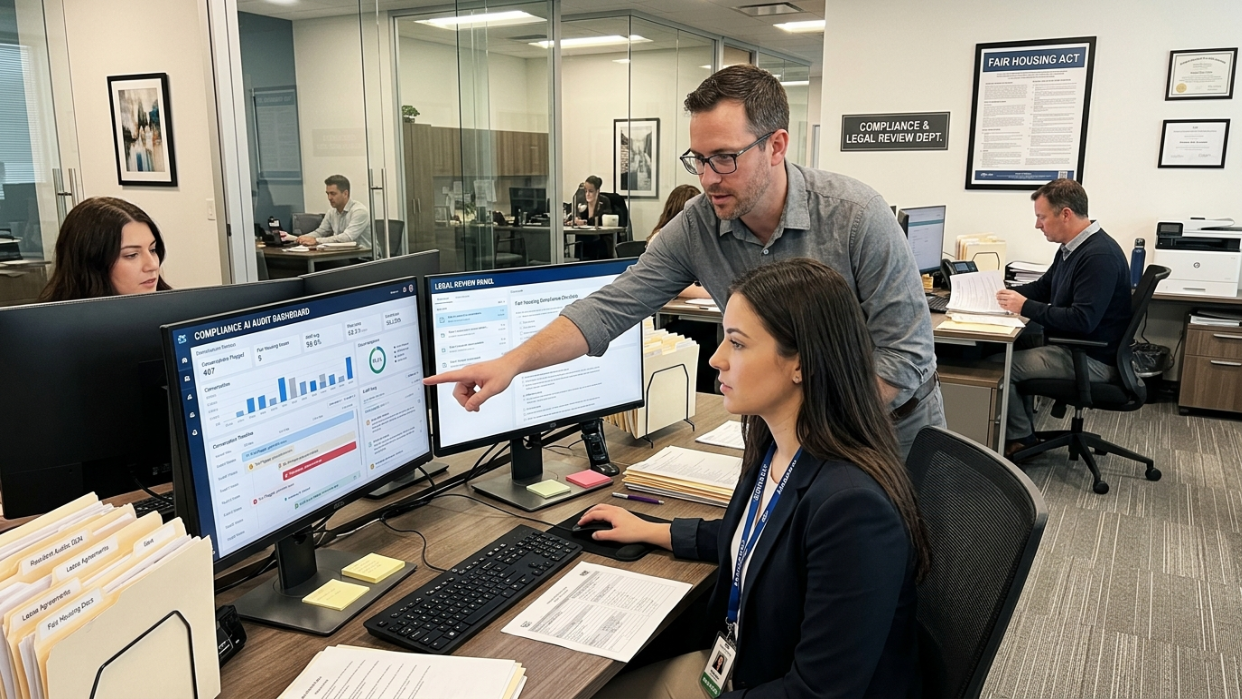
This is the gap that every competing glossary page ignores, and it’s arguably the most important dimension of the leasing AI vs chatbots comparison.
The compliance risk is real
In 2023, a private fair housing nonprofit sued Harbor Group Management after its AI leasing chatbot was found to systematically screen out Housing Choice Voucher holders. A single issue in an automated system can generate numerous problematic interactions in a short period, and legal exposure can develop more quickly than in traditional leasing environments.
Chatbots create documentation gaps
When a chatbot gives wrong pricing or fails to mention an accommodation option, there’s often no audit trail. The interaction happened, the prospect left, and nobody on your team knows what was said. That’s a compliance blind spot.
Fair housing practitioners at Spencer Fane note that many modern leasing chatbots combine scripted compliance guardrails with generative AI tools. Even where underlying policies are consistent, automated systems may produce responses that differ in tone, detail, or clarity. That variability is where legal risk lives.
More autonomy demands stronger guardrails
Here’s the counterintuitive point: sophisticated AI leasing agents are actually safer from a compliance standpoint than cheap chatbots, because they maintain complete conversation logs, enforce consistent responses, and include escalation logic for protected-class inquiries. The more a system acts without human review, the more important these controls become. But they also need to exist in the first place.
As one Multifamily Dive analysis put it: every AI vendor will tell you their system is compliant. What they usually mean is that they’ve injected a compliance instruction into the system prompt. That is not compliance. It’s a wishful instruction to a probabilistic engine.
ADA digital accessibility lawsuits surged 20% in 2025, approaching 5,000 filings. A chatbot that provides a different quality of service to someone using a screen reader is a liability.
For a comprehensive look at compliance requirements, read our fair housing compliance guide for AI.
How to Evaluate: Questions to Ask Before Choosing
Whether you’re comparing leasing AI vs chatbots for the first time or upgrading from one tier to the next, these questions cut through vendor marketing.
Does it handle phone calls, or only chat? If your prospects call (and most still do), a chat-only tool leaves your biggest channel uncovered. Ask vendors directly whether their system can answer, understand, and act on voice calls.
Can it create records inside your PMS? This is the line between an assistant and an agent. If the tool can’t create a guest card, update a lead status, or book a tour in your actual system of record, your team is still doing data entry manually.
Does it qualify leads with your criteria? Generic chatbots treat every visitor the same. AI that qualifies based on move-in date, income, pet situation, and unit preferences saves your team from chasing unqualified leads.
Can it follow up automatically over days or weeks? Most prospects don’t convert on the first interaction. If the system can’t nurture leads with personalized follow-ups across multiple channels, you’re losing the long tail. See our guide on AI lead follow-up for what effective nurturing looks like.
What compliance controls exist? Ask for specifics. Does the system log every conversation? Can you audit responses for fair housing language? Is there an escalation path for protected-class inquiries?
How does it escalate to humans? No AI system should operate without a clear handoff protocol. The best tools pass full conversation context to your leasing team so the prospect doesn’t have to repeat themselves.
What channels does it cover? Phone, SMS, email, website chat, and listing-site lead capture (Zillow, Apartments.com) represent the full spectrum. Most chatbots cover one. AI agents cover all of them.
Pros and Cons of Leasing Chatbots vs AI Leasing Agents
Leasing Chatbot Pros
Low cost
Fast setup
Simple FAQ automation
Minimal training required
Leasing Chatbot Cons
Poor handling of complex renter questions
No phone support
Limited personalization
Weak PMS integration
Higher risk of dead-end conversations
AI Leasing Agent Pros
Handles calls, SMS, email, and chat
Automates repetitive leasing workflows
Improves response speed
Maintains conversation history
Integrates with PMS and CRM systems
Supports portfolio scalability
AI Leasing Agent Cons
Higher upfront investment
Requires integration setup
Needs compliance oversight
Some workflows still require human review
The Cost Perspective
Leasing agents cost $40,000 to $55,000 annually plus benefits. A single agent covers one property during business hours. AI leasing agents cover every property in your portfolio, 24 hours a day, across every channel.
That doesn’t mean AI replaces your team. The 2026 AppFolio Benchmark Report found that 34% of AI adopters plan to increase headcount, not reduce it. The pattern is consistent: AI handles volume and repetitive tasks so human agents can focus on tours, relationship building, and complex negotiations.
Property management companies using AI agents report 60% to 80% automation rates for maintenance request triage, vendor coordination, and lease renewal workflows, according to industry consulting data. The operational savings compound across every property in a portfolio.
For a complete breakdown of how to calculate these returns, see our leasing AI ROI guide.
The Fragmentation Problem
Practitioners on industry forums and in Funnel Leasing’s own analysis consistently highlight a problem with chatbot-tier tools: they operate in silos. A chatbot-style AI often lacks deep contextual understanding of a renter’s needs and struggles with complex, multi-step processes. This leads to a fragmented experience where a renter interacts with a bot, then a leasing agent, then a property manager, with poor data transfer between each step.
That fragmentation isn’t just annoying for prospects. It creates operational overhead for your team, who has to piece together context from incomplete records. AI leasing agents that integrate with your PMS and maintain conversation history across channels eliminate this problem by design.
How to Choose the Right Leasing AI Platform
Choosing between a chatbot, assistant, or AI leasing agent depends on operational complexity more than property count alone.
Choose a Chatbot If
You only need website FAQ automation
Your leasing team handles all calls manually
You have low inquiry volume
Budget is the primary concern
Choose an AI Leasing Assistant If
You need conversational lead qualification
Your team struggles with follow-up consistency
You want SMS and email automation
You still prefer humans to handle calls
Choose an AI Leasing Agent If
Missed calls are hurting conversions
Your team spends hours on repetitive admin work
You need PMS automation
You want centralized leasing operations
You operate multiple properties
You need 24/7 lead response coverage
The more operational complexity you manage, the more valuable agentic AI becomes.
Bottom Line
The leasing AI vs chatbots distinction comes down to three tiers:
Leasing chatbots answer scripted questions on your website. They’re easy to install, cheap to run, and hit a ceiling fast. They don’t qualify leads, don’t handle calls, and don’t update your systems.
AI leasing assistants understand natural language and can hold real conversations across chat, SMS, and email. They qualify leads and schedule tours, but they typically can’t take actions inside your PMS.
AI leasing agents perceive, reason, act, and evaluate. They handle phone calls, create guest cards, book tours in your PMS, follow up across every channel, and maintain conversation continuity over weeks. They’re operational teammates, not widgets.
The right tier depends on your portfolio size, call volume, and how much manual work you want to eliminate. But the data is clear: the further up the spectrum you go, the better your conversion rates, response times, and operational efficiency.
Haven builds AI leasing agents at the third tier, with voice-first capabilities, PMS integration, and coverage across phone, SMS, email, and listing-site lead capture.
Book a demo with Haven to see an AI leasing agent in action.
Frequently Asked Questions
Is a leasing chatbot the same as leasing AI?
No. A chatbot follows scripts and decision trees to answer preset questions. Leasing AI uses natural language processing to understand intent, qualify leads, and (at the agent tier) take real actions inside your PMS. They share a chat interface but differ in capability the way a calculator differs from a spreadsheet.
Can a chatbot schedule tours?
Some chatbots link to an external calendar tool, but they can’t check real-time availability in your PMS or confirm the booking automatically. AI leasing agents schedule tours directly against live availability and send confirmations via SMS or email without human intervention.
What is agentic AI in property management?
Agentic AI refers to systems that don’t just respond to questions but take operational actions. In leasing, that means creating guest cards, updating lead statuses in your CRM, booking tours, dispatching follow-up sequences, and escalating complex situations to human team members with full context.
Do AI leasing tools handle phone calls?
Chatbots and most AI assistants do not. AI leasing agents with voice capabilities can answer inbound calls, understand the caller’s needs through natural conversation, qualify the lead, and schedule a tour, all without a human picking up the phone. This matters because the majority of leasing inquiries still come by phone.
How does leasing AI affect fair housing compliance?
AI systems that operate autonomously carry compliance risk if they lack proper guardrails. Chatbots can give inconsistent or incorrect information without logging it. AI agents with audit trails, consistent response logic, and escalation protocols for protected-class questions are generally safer, but every system needs regular compliance review. See our fair housing compliance guide for specifics.
What conversion improvements can property managers expect from leasing AI?
Published studies show significant gains. A 6,000-unit study found AI-assisted prospects converted tours at 46% compared to 19% without AI. RKW reported a 50% boost in tour-to-lease conversions with AI, and 72% of tours were scheduled after hours. Response times drop from hours to minutes, which alone drives meaningful conversion improvement.
How much does a leasing chatbot cost compared to an AI leasing agent?
Chatbots are generally cheaper upfront, sometimes free or under $100 per month. AI leasing agents carry higher monthly costs but replace or reduce reliance on human-staffed call centers and after-hours answering services. Given that a single leasing agent costs $40,000 to $55,000 per year plus benefits, the ROI math often favors AI quickly, especially across multi-property portfolios.
Should I start with a chatbot and upgrade later?
You can, but be aware of switching costs. Chatbots don’t collect the same depth of data, so you won’t have conversation history or lead qualification records to migrate. If your portfolio handles significant phone volume or you need PMS integration, starting at the AI assistant or agent tier saves you from paying twice.