Voice AI Leasing Calls in 2026: How They Work, ROI
Learn what Voice AI Leasing Calls are, how they work, and why they convert more: 24/7 answers, tour scheduling, and 90% lower costs. Get the guide.

TL;DR
Voice AI leasing calls are phone calls handled by an artificial intelligence agent on behalf of a property’s leasing team. The AI uses natural language processing and speech synthesis to answer prospect questions, qualify leads, and schedule tours, all without human intervention. These systems answer every call instantly, operate around the clock, and cost a fraction of what human agents or call centers charge. They are not chatbots. They handle real phone conversations with real-time access to property data, calendars, and CRM systems.
Quick Takeaway: The ROI of Voice AI Leasing in 2026
In 2026, Voice AI leasing agents have become the industry standard for multifamily operations, handling approximately 80% of routine inbound inquiries autonomously. By integrating directly with Property Management Systems (PMS), these AI agents reduce interaction costs from $12.00 (human-led) to roughly $0.40 (AI-led). Properties utilizing Voice AI report a 65% increase in lead-to-lease conversion rates due to 24/7 "instant-answer" capabilities and automated tour scheduling.
Definition
A voice AI leasing call is an inbound (or outbound) phone conversation between a rental prospect and an AI-powered voice agent that represents a property’s leasing team. The AI answers the phone, speaks in a natural-sounding voice, responds to prospect questions about availability and pricing, qualifies the lead, and books a tour, all in real time.
The technology stack behind voice AI leasing calls works in layers. First, speech-to-text converts the caller’s words into text. Then, natural language processing (NLP) detects the caller’s intent. A large language model generates a contextually appropriate response. Finally, text-to-speech converts that response back into spoken language. The entire loop happens in milliseconds, making the conversation feel fluid.
This is fundamentally different from the three technologies people commonly confuse it with. Voice AI is part of a broader category of AI workers in property management, but the voice channel carries unique weight because callers tend to be further along in their apartment search than someone browsing a website.
Voice AI vs. Chatbot vs. Call Center vs. IVR
Feature | Voice AI | Chatbot | Call Center | IVR |
|---|---|---|---|---|
Channel | Phone calls | Website/SMS | Phone calls | Phone calls |
Interaction style | Natural conversation | Text-based, often scripted | Human conversation | Menu trees (“Press 1 for…”) |
Availability | 24/7 | 24/7 | Varies (often limited hours) | 24/7 |
Property-specific answers | Yes, pulls live data | Limited to programmed FAQs | Depends on agent training | No |
Tour scheduling | Yes, real-time calendar access | Sometimes | Yes | No |
CRM/PMS integration | Automatic guest card creation | Varies | Manual entry by agent | No |
Cost per interaction | ~$0.40 | Low | $7-$12 | Low |
Handles complex/emotional situations | Limited, escalates to humans | Poor | Strong | Not applicable |
A chatbot lives on your website and answers basic questions using scripted decision trees. It can’t pick up the phone, send a follow-up text that references the call, or create a guest card in your PMS without additional integrations. A call center uses human agents who handle complex conversations well but cost significantly more per interaction and often lack property-specific knowledge. IVR systems are the “press 1 for leasing, press 2 for maintenance” menus that frustrate callers and provide no conversational ability whatsoever.
For a deeper look at how AI compares to a traditional call center, that comparison applies equally on the leasing side.
What Happens During a Voice AI Leasing Call
Here’s what a typical inbound voice AI leasing call looks like, step by step.
1. Instant answer. The phone rings. The AI picks up immediately. No hold music, no voicemail, no “all agents are currently busy” message. This matters more than most property managers realize: 49% of calls to properties go unanswered, and over 87% of callers will not leave a voicemail. Every missed call is a prospect lost to a competitor.

2. Greeting and intent detection. The AI greets the caller and identifies what they need within the first few seconds. Most inbound leasing calls follow predictable patterns: the caller wants to know about availability, pricing, or how to schedule a tour.
3. Property-specific Q&A. The AI answers questions about the specific property, pulling from live data. Unit availability, floor plans, pet policies, parking, amenities, move-in specials. Because it’s connected to the property management system, answers reflect current reality rather than outdated marketing copy.
4. Lead qualification. The AI asks structured questions: When are you looking to move in? What’s your budget range? How many occupants? Any pets? This is the same information a leasing agent would collect, but it happens consistently every time, without shortcuts or forgotten questions.
5. Tour scheduling. With real-time calendar access, the AI offers available tour slots and books the appointment on the spot. Whether someone calls at 2 PM or 2 AM, the tour gets scheduled.
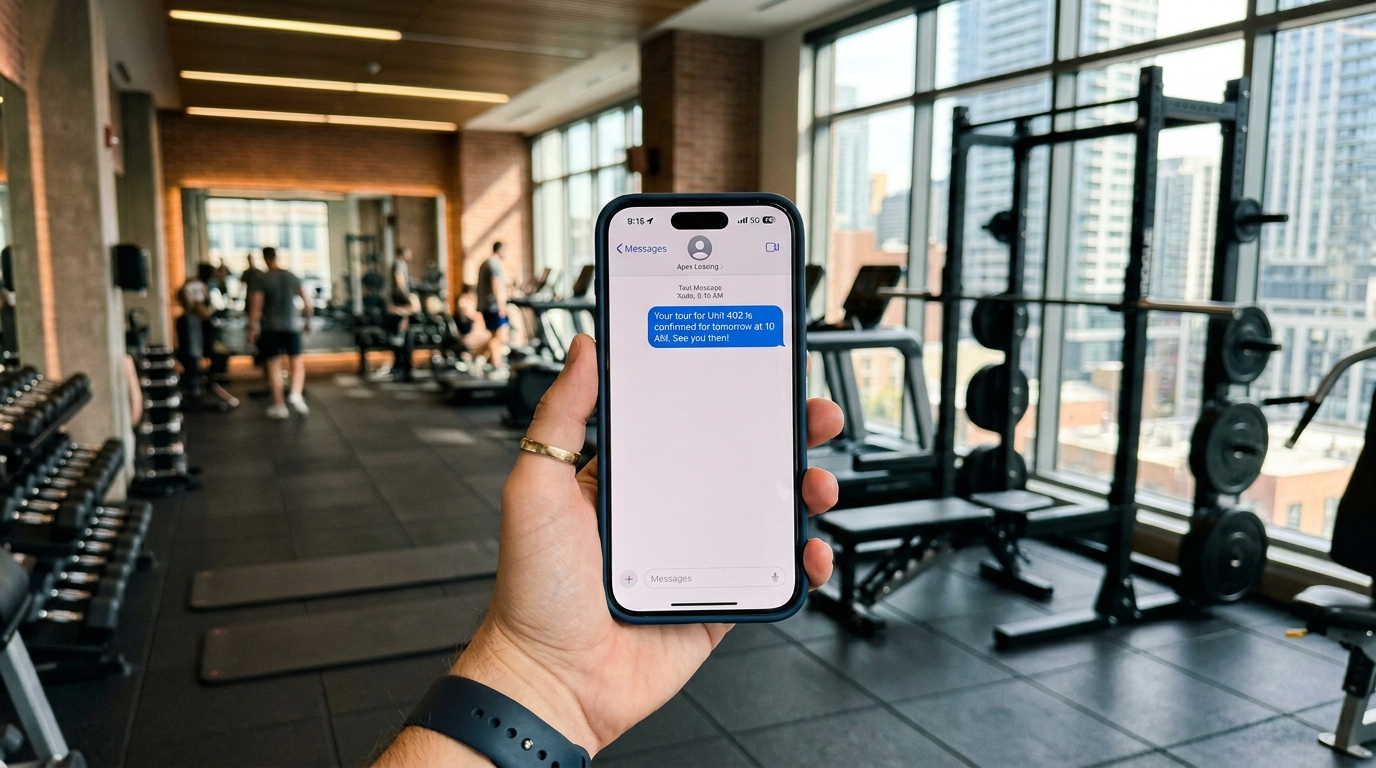 . All prospect details flow automatically into the PMS or CRM. No double entry. No sticky notes. No “I forgot to log that call.”
7. Follow-up activation. After the call ends, the system triggers follow-up sequences: confirmation texts, reminder emails, nurture campaigns. The prospect stays engaged without any manual effort from your team.
Roughly 80% of a leasing conversation is predictable and automatable. The remaining 20%, things like complex accommodation requests or unusual lease negotiations, is where escalation to a human agent kicks in. To hear what this type of AI phone interaction actually sounds like, check out this example of an AI maintenance call in action. The leasing version follows a similar conversational flow.
Seamless Integration: The 2026 AI-to-PMS Workflow
To achieve maximum ROI, Voice AI must move beyond a simple "answering service" and act as a digital employee. Modern systems in 2026 prioritize a three-way synchronization:
The Live Availability Sync: The AI reads real-time unit pricing and "on-notice" dates directly from the PMS (e.g., Yardi, Entrata, RealPage).
The Guest Card Automation: New leads are instantly categorized as "Qualified" or "Inquiry" based on pre-set parameters like credit score minimums and move-in dates.
The Multi-Channel Hand-off: If a caller asks for a floor plan via text during the call, the AI triggers an immediate SMS with a deep link to that specific unit’s 3D tour.
Why Property Managers Use Voice AI for Leasing Calls
Half of All Inquiries Come After Hours
Thursday evenings see spikes in leasing inquiry volume as prospects research housing options after work. Weekend issues go unreported until Monday morning. The pattern is clear: prospects don’t operate on a 9-to-5 schedule, and neither should your leasing operation. Voice AI handles after-hours coverage without overtime pay or burnout.
Speed-to-Lead Wins Leases
When a prospect calls and gets an instant answer, they’re far less likely to keep calling other properties. When they reach voicemail, they move on. Industry data suggests that unanswered calls reduce conversion rates by up to 40%. Voice AI leasing calls eliminate the response gap entirely, answering in seconds rather than hours or days.
The Cost Math Is Decisive
Voice AI costs roughly $0.40 per call, compared to $7 to $12 per call for human agents. That’s a 90-95% cost reduction per interaction. At a portfolio level, the savings compound fast. EliseAI, one of the larger vendors in this space, claims its platform has contributed to $14 million in payroll savings across its customer base.
Monthly costs for AI voice agents in real estate typically fall between $500 and $1,500 depending on call volume and features, representing 70-85% savings compared to hiring human inside sales agents.
Metric | Traditional Leasing Team | Outsourced Call Center | Voice AI Agent (2026) |
Response Speed | Varies (avg. 4+ hours) | 1-2 Minutes | < 2 Seconds |
Cost per Lead | $15 - $25 | $7 - $12 | $0.40 - $0.80 |
After-Hours Coverage | Rare / High Cost | Limited | 100% Native |
Data Accuracy | Manual Entry (Human Error) | Secondary System Sync | Direct PMS Write-back |
Scalability | Hire/Train Time | Per-minute billing | Unlimited Concurrent Calls |
Consistency and Scalability
An AI agent doesn’t have bad days, doesn’t put people on hold during a lunch rush, and doesn’t forget to ask about move-in dates. During peak leasing season, it handles concurrent calls simultaneously, something no individual leasing agent can do.
The Numbers Back It Up
85% of AI adopters report improved lead-to-lease rates, with 29% calling the gains “significant.” Some properties report a 65% improvement in lead-to-lease conversion rates when using AI-driven engagement versus those without. A 2024 survey found that properties using AI leasing agents saved over 15 hours per week on leasing tasks.
For a full breakdown of the AI leasing assistant category, including key features and vendor comparisons, see the complete guide to AI leasing assistants.
Key Features to Understand
Voice AI leasing systems are not monolithic. Here are the specific capabilities that matter.
Lead qualification. Structured question flows that assess prospect fit based on move-in timing, budget, household size, and pet ownership. This replaces the inconsistent qualification that happens when leasing agents are rushed or distracted.
Tour scheduling. Real-time calendar integration that books property tours during the call itself. No back-and-forth emails. No “someone will call you back.”
PMS/CRM integration. Automatic guest card creation so prospect data flows directly into your property management system. This eliminates double entry and ensures no leads fall through the cracks.
ILS lead capture. Some voice AI systems intercept leads from Zillow, Apartments.com, and other listing sites at the point of intent. The distinction between ILS-native lead capture (like Zillow AI Assist, which intercepts at the listing) and standalone voice AI tools that handle calls after a prospect finds your number is worth understanding. They serve different moments in the prospect journey.
Multilingual support. Voice AI leasing calls can happen in multiple languages, expanding your reach without hiring bilingual staff.
Conversation memory. If a prospect calls back, the AI remembers previous interactions. Context continuity prevents the frustrating “I already told you this” experience.
Escalation logic. When a conversation exceeds the AI’s capabilities (complex lease terms, emotional situations, accessibility accommodations), the system hands off to a human agent with full context of what’s already been discussed.
Understanding how voice AI fits into a broader technology setup is important. The property management AI stack guide explains how these pieces connect.
Voice AI Leasing Calls vs. Related Terms
The terminology in this space is messy. Here’s how voice AI leasing calls relate to similar concepts.
Voice AI leasing calls vs. AI leasing assistant. An AI leasing assistant is the broader category. It covers SMS, email, chat, and voice. Voice AI leasing calls specifically refer to the phone channel, which carries higher stakes because phone callers tend to be further along in their search.
Voice AI vs. virtual leasing assistant. These terms overlap heavily. “Virtual leasing assistant” often refers to any AI that handles leasing tasks, including chatbots. Voice AI specifically means the system handles spoken phone conversations.
Voice AI vs. IVR. IVR systems route calls through menu trees. Voice AI has actual conversations. The difference is like comparing a vending machine to a restaurant.
Voice AI vs. answering service. A traditional answering service uses human operators who take messages and forward them. Voice AI qualifies leads, books tours, creates CRM records, and triggers follow-ups, all within the same call.
Fair Housing and Compliance Considerations
This is the section most vendor marketing pages skip entirely, and it’s arguably the most important one.
TCPA and AI-Generated Voices
In February 2024, the FCC issued a declaratory ruling confirming that AI-generated voices constitute “artificial or prerecorded voice” under the Telephone Consumer Protection Act (TCPA). All existing TCPA consent requirements apply to AI voice calls. If your voice AI system makes outbound calls (follow-ups, tour reminders, re-engagement campaigns), you need proper consent documentation, just as you would with any robocall.
Fair Housing Act Obligations
The Fair Housing Act applies equally to AI-driven interactions. An AI leasing agent that provides different information to different callers based on characteristics correlated with protected classes creates legal exposure, even if the discrimination is unintentional.
Disability discrimination represented 54.59% of all fair housing complaints in 2024. When a voice AI system stumbles on accessibility questions or defaults to safety fallback language that effectively discourages disabled prospects, it can create unequal service at scale.
The SafeRent Precedent
In November 2024, a federal judge approved a $2.275 million settlement against SafeRent Solutions for producing discriminatory outcomes against Black, Hispanic, and Housing Choice Voucher applicants. SafeRent didn’t intend discrimination. Neither did the landlords who deployed its tool. The algorithm simply weighted certain data in ways that produced disparate outcomes at scale. This precedent applies directly to any AI tool involved in tenant screening or leasing interactions.
Testing at Scale
Private nonprofit fair housing organizations now use AI monitoring tools that can test a property’s leasing AI remotely, anonymously, and at massive scale. A fair housing organization can run dozens of protected-class test inquiries against a live AI system, document every response, and build an evidentiary case in an afternoon. This is not a hypothetical risk. It’s happening now.
Best Practices
Audit AI conversation transcripts regularly. Require your vendor to demonstrate equal-service verification across protected classes. Confirm that escalation logic routes sensitive topics (accommodations, assistance animals, income sources) to trained human staff. For a thorough walkthrough, read the AI property management compliance and fair housing guide.
The Importance of Verifiable AI Audit Trails
In 2026, compliance is no longer about "setting and forgetting." To mitigate risk, property managers must ensure their Voice AI provides:
Immutable Transcripts: Every conversation must be recorded and transcribed for Fair Housing audits.
Bias Monitoring: Routine "Secret Shopper" tests by AI-driven auditing firms to ensure the agent provides identical move-in specials to all protected classes.
Language Parity: Ensuring that non-English AI interactions offer the same depth of information and scheduling ease as English versions.
Limitations and What Voice AI Can’t Do (Yet)
Honesty about limitations is more useful than hype. Here’s where voice AI leasing calls fall short.
Complex negotiations. Lease terms that require judgment calls, custom concessions, or unusual arrangements still need a human. The AI can capture the request and escalate, but it shouldn’t be closing complex deals autonomously.
Emotional situations. Security concerns, harassment complaints, and sensitive accommodation discussions require empathy and nuance that AI doesn’t reliably provide. Practitioners on forums report that renters feel misunderstood when dealing with automated systems for nuanced questions about pets, income verification, or accessibility needs.
Data dependency. Voice AI is only as good as the property data feeding it. If your PMS has outdated availability or incorrect pricing, the AI will confidently give wrong answers. Configuration and QA during deployment are not optional.
Personalization limits. G2 reviewers of AI leasing platforms consistently praise the ease of use and 24/7 availability but note limitations in personalized service during complex interactions. One reviewer noted their AI saved leasing professionals over 2,000 hours in less than six months, but acknowledged that scripting rigidity can frustrate prospects in edge cases.
Regulatory evolution. Fair housing law, TCPA requirements, and state-level AI regulations are all in flux. What’s compliant today may not be compliant next quarter. Ongoing monitoring is essential.
For a broader view of where property management AI is heading, including how these limitations are being addressed, see the future of AI in property management.
Market Adoption and Trajectory
The shift toward voice AI in leasing is accelerating fast. Gartner predicts conversational AI will reduce contact center agent labor costs by $80 billion in 2026. An EliseAI industry survey of 280 executives found that 75% of property managers expect to have automated leasing end-to-end by 2026. Perhaps more tellingly, 78% say they’ve already lost business to AI-enabled competitors.
80% of businesses plan to integrate AI-driven voice technology into customer service by 2026. In multifamily specifically, the question has shifted from “should we adopt voice AI for leasing calls” to “how quickly can we deploy it.”
Frequently Asked Questions
What is a voice AI leasing call?
A voice AI leasing call is a phone conversation handled by an AI agent on behalf of a property’s leasing team. The AI answers prospect calls, provides property-specific information, qualifies leads, schedules tours, and creates CRM records, all through natural spoken conversation.
How is voice AI different from a leasing chatbot?
A chatbot operates through text on a website or messaging platform. Voice AI handles actual phone calls using speech recognition and natural language processing. Voice is a higher-intent channel because people who call are typically further along in their apartment search than those who click a chat widget.
Does voice AI work after business hours?
Yes. Voice AI operates 24/7, which is critical because roughly half of all leasing inquiries come outside standard business hours. Thursday evening and weekend call spikes are common as prospects research housing after work or on days off.
Is voice AI compliant with Fair Housing laws?
The Fair Housing Act applies to AI interactions just as it applies to human interactions. The FCC confirmed in February 2024 that AI-generated voices fall under TCPA regulations. Properties using voice AI must audit transcripts, verify equal treatment across protected classes, and ensure escalation paths exist for sensitive topics like disability accommodations.
How much does voice AI cost compared to a call center?
Voice AI costs approximately $0.40 per call versus $7 to $12 per call for human agents. Monthly platform costs typically range from $500 to $1,500 depending on volume and features, representing 70-85% savings compared to staffed alternatives.
Can voice AI schedule tours by itself?
Yes. Voice AI systems integrate with property calendars in real time, offering available slots and booking tours during the phone call itself. The confirmation and follow-up reminders happen automatically afterward.
What happens when the AI can’t handle a question?
Well-configured voice AI systems include escalation logic that transfers the call to a human agent when conversations exceed the AI’s capabilities. The human agent receives full context from the conversation so the prospect doesn’t have to repeat themselves.
Does voice AI replace leasing agents entirely?
No. It handles the predictable, repetitive portion of leasing phone calls (roughly 80% of conversations) so that leasing agents can focus on tours, complex prospects, and closing. Think of it as augmentation, not replacement.
Ready to see how voice AI handles leasing calls for your properties? Haven’s Leasing AI answers phone, SMS, and email inquiries, qualifies leads, schedules tours, and captures ILS leads from Zillow and Apartments.com, all integrated with your PMS. Book a demo to hear it in action.