Leasing AI FAQs: 2026 Glossary & Guide for Property Managers
Leasing AI FAQs 2026: Plain-English glossary covering assistants, PMS/CRM integrations, compliance, and ROI. Get answers and pick the right tool.

TL;DR
Leasing AI uses conversational artificial intelligence to answer renter inquiries, qualify leads, schedule tours, and nurture prospects across phone, SMS, email, and chat, all without requiring your team to be available 24/7. This glossary covers every term property managers need to understand when evaluating or deploying AI leasing tools, from foundational technology concepts to fair housing compliance risks. Response speed is the single biggest factor in leasing conversion, and AI closes that gap by replying in seconds rather than hours. Understanding these leasing AI FAQs will help you ask better questions, avoid costly mistakes, and make informed decisions.
Who This Guide Is For and How to Use It
This glossary is built for property managers, regional directors, and leasing teams who are evaluating AI leasing tools or already using one and need clarity on the terminology. Whether you’re preparing a pitch for leadership, comparing vendors, or trying to figure out what “agentic AI” actually means in a leasing context, this page is your reference.
Each section groups related terms, defines them in plain language, and follows up with practical FAQ-style answers grounded in real data and practitioner experience. You can read it straight through or jump to the section that matters most.
The timing matters. According to the 2026 AppFolio Benchmark Report, 44% of property managers are already using AI in their roles, and compliance risks are escalating fast. Getting the vocabulary right isn’t academic. It’s operational.
Explore Haven’s Leasing AI to see how these concepts work in practice.
AI and Technology Foundations
AI Leasing Assistant
Software that uses conversational AI to respond to renter inquiries, answer leasing questions, qualify leads, and schedule tours across channels like phone, SMS, email, and chat. Unlike basic automation, an AI leasing assistant understands context, remembers prior conversations, and takes actions inside your property management system. For a deeper breakdown, read our guide to AI leasing assistants.
Virtual Leasing Agent
Functionally similar to an AI leasing assistant. The term emphasizes the agent’s ability to handle inbound leasing inquiries through AI-powered conversations, answering availability questions, scheduling tours, and qualifying prospects around the clock. Some vendors use “virtual leasing agent” to signal that the tool operates autonomously rather than just assisting a human.
Natural Language Processing (NLP)
NLP is what allows AI to read, interpret, and respond to text and speech in a human-like way. Older chatbots rely on rigid decision trees, meaning they break when someone types a misspelling or asks a question in an unexpected way. NLP-powered systems understand intent, not just keywords. This is the core technology that separates modern AI leasing assistants from the scripted bots of five years ago.
Chatbot vs. AI Leasing Assistant

This distinction trips up more property managers than almost any other term in leasing AI FAQs. A chatbot is typically rule-based. It follows a pre-programmed script, can’t handle questions outside its decision tree, and doesn’t connect to your PMS to pull real-time data. An AI leasing assistant uses NLP and machine learning to understand freeform questions, provide property-specific answers (like current availability and pet policies), and take actions such as booking tours or creating guest cards. Chatbots can’t cross-sell or recommend alternative properties. AI assistants can.
Agentic AI
A term gaining traction in 2025 and 2026. Agentic AI refers to systems that can take independent actions within defined boundaries, not just respond to prompts. In leasing, this means the AI might research comparable listings, draft clause summaries, or run scenario comparisons on its own, then present options to a human for approval. Agentic AI augments rather than replaces. A leasing specialist still negotiates and approves final terms, but the AI accelerates the research and preparation.
Voice AI
AI that handles actual phone calls, not just text-based chat. This is a critical capability for leasing because phone calls remain one of the highest-intent lead channels. LeaseHawk reports that nearly 49% of phone calls to leasing offices go unanswered, and 87% of those callers won’t leave a voicemail. Voice AI picks up every call, answers common questions, and can schedule tours or transfer to a human when needed. You can hear what this sounds like with Haven’s live voice demo.
Conversation Memory and Continuity
The AI’s ability to remember what a prospect said in a previous interaction and pick up where things left off. If a renter called on Monday asking about two-bedroom units and texts on Wednesday about parking, the AI should connect both interactions into a single profile. Without conversation memory, every touchpoint feels like starting over, which frustrates prospects and wastes time.
Large Language Model (LLM)
The underlying AI architecture (think GPT, Claude, or similar) that powers natural language understanding and generation. LLMs are trained on massive datasets and can generate human-sounding text. In leasing, they’re fine-tuned on property-specific data so responses are accurate and relevant rather than generic.
FAQ: What’s the difference between a chatbot and an AI leasing assistant?
A chatbot follows a script. If a prospect asks something the script doesn’t cover, the chatbot either gives a wrong answer or hits a dead end. An AI leasing assistant understands natural language, pulls real-time data from your PMS (current availability, pricing, pet policies), and takes actions like booking tours. The practical difference is that chatbots can’t handle the messiness of real renter conversations, while AI assistants can.
FAQ: Does AI leasing actually sound human?
Modern voice AI sounds remarkably natural, especially systems trained specifically on property management conversations. Practitioners on Reddit report that tools like EliseAI work well for answering common questions (pet policies, parking, office hours) and booking tours, with the voice feature getting specific praise for handling basics when the office is closed. The technology has progressed well past the robotic text-to-speech of a few years ago.
The Leasing Funnel and Metrics
Speed-to-Lead
The time between when a prospect submits an inquiry and when they receive a first response. This is arguably the most important metric in leasing. According to Zillow’s research, responding within 1 to 2 minutes leads to a 40% chance of prospect engagement. Wait 30 minutes and that drops to 10%. At least half of multifamily leads come in after business hours, which means most properties are structurally slow without automation.
Lead-to-Lease Conversion
The percentage of inbound leads that result in a signed lease. Manual leasing workflows typically convert only 10 to 15 percent of leads. When properties automate inquiry response, lead qualification, and tour scheduling, conversion rates jump to 40 to 50 percent. Recent industry data from EliseAI shows that 56% of surveyed property managers saw moderate lead-to-lease uplift with AI, while 30% reported significant increases.
Guest Card
The digital lead record created in a PMS or CRM when a prospect first inquires about a property. AI leasing assistants can automatically create and populate guest cards with the prospect’s name, contact information, desired move-in date, unit preferences, and qualification details. This eliminates manual data entry and ensures no lead slips through the cracks.
Lead Qualification and Pre-Qualification
An AI assistant sorts through initial questions, determines what a prospect is looking for, and checks whether they meet basic requirements (income thresholds, credit minimums, occupancy limits). This means your human team doesn’t waste time on leads that aren’t a good fit. Pre-qualification also speeds up the process for qualified renters, giving them a better experience.
Tour Scheduling Automation
AI-driven calendar synchronization that lets prospects book property showings without human intervention. The AI checks availability against the leasing team’s calendar, offers time slots, confirms bookings, and sends reminders. Prospective renters using AI in their initial search process achieved a 46% tour conversion rate, compared to 19% from prospects not using AI, a 27-percentage-point gap.
Lead Nurturing
Automated follow-up sequences designed to re-engage prospects who inquired but haven’t yet committed. This might include personalized SMS messages about new availability, pricing changes, or upcoming open house events. Good AI nurturing feels like a helpful check-in, not spam.
Cost-per-Lease
The total marketing and operational spend divided by the number of signed leases. AI reduces cost-per-lease by handling more inquiries with fewer staff hours and by converting a higher percentage of existing leads. Case studies report time savings of up to 75% for common leasing tasks.
Leasing Funnel and Pipeline
The stages a prospect moves through from initial inquiry to signed lease: inquiry, qualification, tour, application, approval, lease signing. Understanding these stages helps you identify where prospects drop off and where AI can have the biggest impact.
For a full breakdown of the ROI picture, see our guide on AI property management benefits and ROI.
FAQ: How fast does AI respond compared to human staff?
AI responds in seconds. Human staff, on average, take hours, and that’s during business hours. After hours, the response might not come until the next morning. According to Zillow’s research, 71% of renters expect a reply within one day, and roughly a third expect a response within hours. AI doesn’t just meet those expectations. It exceeds them.
FAQ: What conversion rate improvements should I expect?
Results vary, but the benchmarks are consistent. Properties moving from manual-only workflows to AI-assisted leasing typically see conversion rates increase from the 10 to 15 percent range to 40 to 50 percent. Properties deploying AI also report 30 to 50 percent reduction in inbound calls and emails to leasing offices, along with 45% shorter vacancy periods.
Integration and Infrastructure
PMS (Property Management System)
The backend system where you manage units, tenants, leases, and financials. Common platforms include AppFolio, Yardi, and RealPage. AI leasing tools need to connect to your PMS to pull real-time availability, pricing, and unit details. Without this integration, the AI can’t give accurate answers.
CRM (Customer Relationship Management)
Software for tracking prospect interactions and managing the leasing pipeline. Some PMS platforms have built-in CRMs; others require a separate tool. AI leasing assistants should sync with your CRM so every conversation, tour booking, and qualification detail is captured automatically.
ILS (Internet Listing Service)
Platforms like Zillow and Apartments.com where rental listings are syndicated and leads originate. ILS platforms are the front door for most renter searches, making them a critical integration point for AI leasing tools.
ILS-Native vs. Standalone Assistant
ILS-native tools (like Zillow’s AI Assist) operate within the listing platform itself, capturing leads at the moment of highest interest. Standalone AI assistants operate independently on your website or through your own communication channels. ILS-native tools capture more initial momentum. Standalone tools give you more control over branding and conversation flow. The best approach often combines both.
API Integration
The technical connection between your AI leasing tool and your PMS, CRM, or ILS platforms. API (Application Programming Interface) integration allows systems to share data in real time without manual entry. Most modern AI leasing tools integrate via API with existing systems, meaning you don’t need to switch your PMS. To see which systems connect with Haven, visit our integrations page.
Warm Handoff
When a prospect needs to speak with a human, the AI passes along the full conversation history, the renter’s stated preferences, and any qualification data it has collected. A warm handoff converts. A cold transfer to someone who asks the prospect to repeat everything does not. This concept is missing from most vendor marketing, but practitioners consistently identify it as a make-or-break feature.
Multichannel Communication
Handling phone, SMS, email, and web chat from a single system. Renters don’t stick to one channel. Someone might call first, then text a follow-up question, then reply to an email. Multichannel communication means every interaction is captured in one place, regardless of channel.
Lead Syndication
The process of distributing rental listings across multiple ILS platforms and aggregating the resulting leads back into your system. AI leasing tools that connect directly to ILS platforms can capture and respond to syndicated leads without manual intervention.
For a broader view of how leasing AI fits into your tech ecosystem, read our property management AI stack guide.
FAQ: Do I need to switch my PMS to use AI leasing?
No. Most AI leasing tools integrate with your existing PMS through APIs. Haven, for example, integrates with systems like AppFolio to sync data, create records, and take actions directly inside your PMS. The goal is to add capability without forcing a system migration.
FAQ: How does AI connect to Zillow and Apartments.com?
AI leasing tools can capture leads from ILS platforms through direct integrations or lead syndication feeds. When a prospect inquires through Zillow or Apartments.com, the AI receives the lead, responds instantly, and creates a guest card in your PMS. The prospect gets an immediate answer instead of waiting for your team to check their inbox the next morning.
See Haven’s pricing to understand how these integrations are packaged.
Fair Housing, Compliance, and Risk
This section covers the leasing AI FAQs that most vendor pages skip entirely, and they’re the ones that carry the highest stakes.
Fair Housing Act
Federal law prohibiting discrimination in housing based on race, color, national origin, religion, sex, familial status, or disability. Every AI system involved in the leasing process must comply. This isn’t optional and it isn’t something you can delegate entirely to your vendor.
Disparate Impact
A legal concept where a policy or practice that appears neutral on its face produces discriminatory outcomes for a protected class. In 2024, a federal judge approved a $2.275 million settlement against SafeRent Solutions for producing discriminatory outcomes against Black, Hispanic, and Housing Choice Voucher applicants. The system wasn’t intentionally discriminatory. It just produced discriminatory results, and that was enough.
In leasing AI, disparate impact can emerge in subtle ways. If the AI responds more slowly to inquiries in certain languages, or if it screens out voucher holders by default, that creates a two-tiered service system. Under the Fair Housing Act, that’s disparate impact.
AI Bias
Systematic errors in AI outputs that produce unfair outcomes. Bias can enter through training data, model design, or the specific instructions a vendor gives the system. In 2023, a private fair housing nonprofit sued Harbor Group Management after its AI leasing chatbot systematically screened out Housing Choice Voucher holders. Every AI vendor will tell you their system is compliant. What they usually mean is that they’ve injected a compliance instruction into the system prompt. That is not compliance. It’s a wishful instruction to a probabilistic engine.
Source of Income Discrimination
Refusing to rent to someone because they pay with a housing voucher, Social Security, or another non-employment income source. Many state and local laws prohibit this. AI systems that screen out voucher holders (even unintentionally) create significant legal exposure.
Human-in-the-Loop
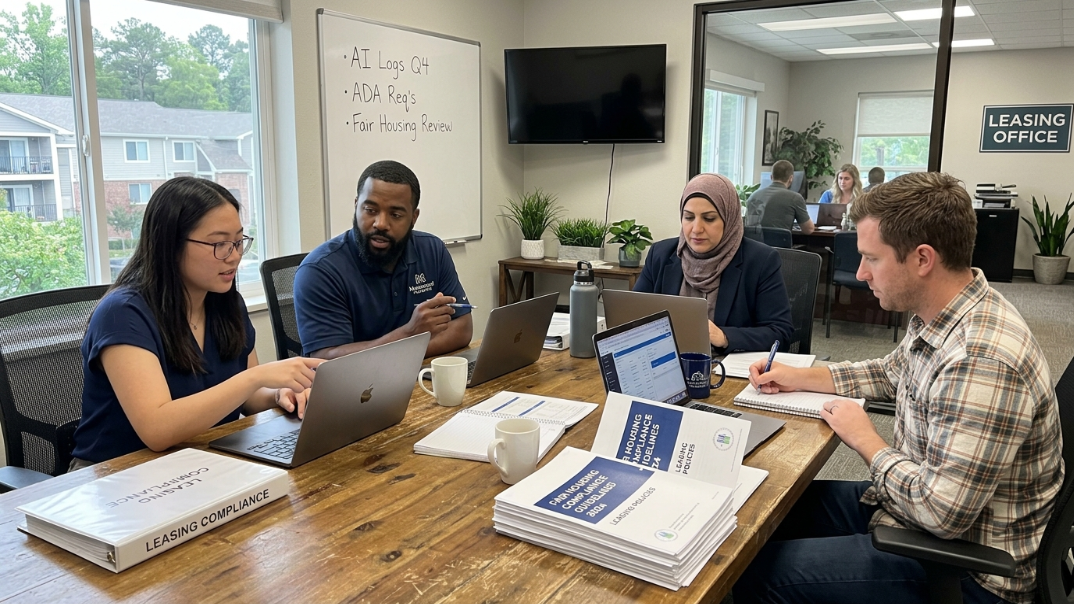
A process design where humans review, approve, or override AI decisions at critical points. For leasing, this means using human review at key milestones: initial offer terms, counter-offers, fair housing-sensitive questions, and final lease execution. A property management VP interviewed by Multifamily Housing Business noted that she won’t allow AI to handle questions about Fair Housing laws, affordable housing, or school information. When those questions come up, a human employee answers.
ADA Accessibility (Digital)
The requirement that digital tools, including AI chatbots and leasing portals, be accessible to people with disabilities. ADA digital accessibility lawsuits surged 20% in 2025, approaching 5,000 filings. AI-driven communication must be equitable and accessible for all residents, including those with visual impairments, limited digital literacy, or who speak languages not supported by the AI.
Audit Trail
A documented record of every AI interaction, decision, and data point, essential for defending against discrimination claims and demonstrating compliance. If a fair housing organization tests your AI and finds inconsistent treatment, you need records showing exactly what the system said, why, and what safeguards were in place.
For a deeper look at compliance, read our AI property management compliance guide.
FAQ: Is AI leasing Fair Housing compliant?
The honest answer: it depends entirely on how it’s implemented and monitored. No AI system is inherently compliant or non-compliant. Compliance is about testing, auditing, and designing human oversight into the workflow. Providers should assume that regulators and investigators will view AI vendors as extensions of the leasing function rather than independent actors. Private nonprofit fair housing organizations processed 74% of all housing discrimination complaints in 2024, and these organizations can test AI systems remotely and at scale. Don’t rely on your vendor’s compliance claims alone. Test the system yourself, document everything, and keep humans in the loop for sensitive topics.
FAQ: Who is liable if the AI says something discriminatory?
You are. Courts and regulators have consistently treated AI tools as extensions of the property owner or manager’s operations. The $2.275 million SafeRent settlement and the Harbor Group lawsuit both held the property-side entities responsible. Your vendor may share some liability depending on your contract, but the primary accountability rests with the entity that deploys the tool in the leasing process.
Implementation and Operations
Onboarding (AI)
The process of configuring, training, and deploying an AI leasing assistant for your specific properties. This includes uploading property data, setting conversation rules, defining escalation paths, and integrating with your PMS. Onboarding quality is the single best predictor of long-term success.
Practitioners on Reddit consistently reinforce this point. Multiple threads critique AppFolio’s Lisa, but the consistent theme isn’t that the AI itself is bad. It’s that teams deploy AI without updating their processes, escalation rules, and quality standards. Those teams tend to be disappointed.
Escalation Rules
Pre-defined triggers that cause the AI to transfer a conversation to a human. Examples include fair housing questions, complex lease negotiations, angry prospects, and any situation where the AI’s confidence in its response drops below a threshold. Good escalation rules are the difference between AI that helps and AI that creates problems.
QA (Quality Assurance)
Ongoing review of AI conversations to ensure accuracy, tone, and compliance. QA should happen regularly, not just during onboarding. Review a sample of conversations weekly, flag errors, and update the AI’s knowledge base accordingly. Reddit discussions about AI leasing tools usually circle back to one theme: the tools that work well are the ones where someone on the team is actively monitoring and tuning them.
Pilot Program
A limited deployment of AI leasing on a subset of properties before rolling out portfolio-wide. Pilots let you identify integration issues, test escalation rules, and measure results before committing fully. Start with 2 to 5 properties, run for 60 to 90 days, and compare metrics against your non-AI properties.
ROI (Return on Investment)
The financial return generated by your AI leasing tool relative to its cost. Common ROI metrics include reduction in vacancy days, increase in lead-to-lease conversion, decrease in cost-per-lease, and staff time saved. EliseAI reports $14 million in cumulative payroll savings across its customer base, with over 90% of prospect workflows automated. Smaller portfolios often see proportionally higher ROI because they have fewer staff to absorb the inquiry volume.
Human Escalation Path
The specific process a prospect follows when they need to reach a human being. Renters on Reddit have expressed frustration about being forced to interact with AI without a clear path to a human. The complaint isn’t about AI existing. It’s about AI being the only option. Properties that use AI without preserving accessible human channels risk alienating the very prospects they’re trying to convert.
See real examples of how property managers handle implementation in our case studies.
FAQ: Will AI replace my leasing team?
No. The data actually points in the opposite direction. Among AI adopters, 34% plan to increase headcount according to the 2026 AppFolio Benchmark Report. AI handles the repetitive, high-volume work (answering the same 20 questions, scheduling tours, following up with cold leads) so your team can focus on tours, relationship building, and closing leases. The 2026 consensus across practitioner communities is clear: AI has raised expectations for speed while simultaneously increasing demand for human connection. The companies winning right now use AI to accelerate the path to human connection, not replace it. For more on this, read our breakdown of common AI myths in property management.
FAQ: How long does implementation take?
Most AI leasing tools can be deployed within 2 to 4 weeks for a straightforward setup. The timeline depends on the number of properties, the complexity of your PMS integration, and how much customization you need for conversation flows and escalation rules. The onboarding period is where you should invest the most attention. Rushing it to save a week almost always costs more in the long run through missed leads and poor prospect experiences.
Emerging Concepts in Leasing AI
Lease Abstraction
Automatically extracting key terms, dates, clauses, and financial obligations from lease documents. This reduces the time spent manually reviewing PDFs and populates your system of record with structured data. As portfolios grow, lease abstraction becomes increasingly valuable for tracking renewal dates, rent escalation schedules, and compliance obligations.
Collections AI
AI that automates rent collection communications, payment reminders, and delinquency workflows. Still early, but growing fast as property managers look for ways to handle collections conversations at scale without adding staff.
Vendor AI
AI that manages vendor relationships, dispatch, and communication for maintenance and capital improvement projects. This extends the AI’s role beyond leasing into property operations.
Predictive Maintenance
Using AI to analyze equipment data, work order history, and environmental factors to predict when systems will fail before they actually do. Relevant to leasing because unresolved maintenance directly impacts tenant retention and renewal rates.
AI-Driven Rent Pricing
Dynamic pricing tools that use market data, occupancy rates, lease expiration schedules, and demand signals to recommend optimal rental rates. These tools are becoming more common as AI gets better at processing real-time market conditions.
For a forward-looking view of where these technologies are heading, read our piece on the future of AI in property management.
FAQ: What’s coming next in property management AI?
The trajectory is clear: AI is expanding from leasing and maintenance into every operational workflow. Collections AI, vendor coordination, predictive maintenance, and dynamic pricing are all in active development across the industry. One notable data point: 50% of Gen Z renters say they would be comfortable living at a property that’s entirely automated with no on-site humans, according to RealPage data. That doesn’t mean fully automated properties are imminent, but it signals where renter expectations are heading. The property managers who build AI fluency now will be best positioned as these tools mature.
Frequently Asked Questions About Leasing AI
What is leasing AI and why should property managers care?
Leasing AI refers to artificial intelligence tools designed to handle renter inquiries, qualify leads, schedule tours, and nurture prospects through the leasing funnel. Property managers should care because response speed is the single biggest factor in converting leads to leases, and AI responds in seconds. Properties without automation are structurally disadvantaged, especially after hours when at least half of all inquiries arrive.
How much does leasing AI cost?
Pricing varies by vendor, portfolio size, and feature set. Most vendors use a per-unit or per-property pricing model. The key metric isn’t cost alone but cost-per-lease, because even modest improvements in conversion rate can dramatically offset the subscription cost. Properties using AI report 30 to 50 percent reduction in inbound staff workload, which translates to significant operational savings.
Can AI handle phone calls or just text-based chat?
Modern AI leasing tools handle phone calls through voice AI, along with SMS, email, and web chat. Voice capability matters a lot because phone calls represent some of the highest-intent leads, and nearly half of those calls go unanswered at typical leasing offices. If you’re evaluating solutions, prioritize voice and SMS capability. Chat-only tools leave the most valuable leads on the table.
Is AI leasing only for large property management companies?
No. In practice, smaller communities often benefit the most because they have limited staff resources. A 50-unit property with one part-time leasing agent can’t answer calls at 9 PM or follow up with every lead within two minutes. AI fills that gap without requiring an additional hire. The ROI math tends to be compelling regardless of portfolio size.
What happens when the AI can’t answer a question?
A well-configured AI leasing assistant routes the conversation to a human through a warm handoff, passing along the full conversation history and any data collected. The prospect shouldn’t have to repeat themselves. The quality of this handoff process is one of the most important things to evaluate when comparing vendors.
How do I know if the AI is treating all prospects equally?
Regular auditing. Run test inquiries in different languages, with different income sources, and from different demographic profiles. Review conversation logs for inconsistencies in response time, tone, or information provided. Don’t rely solely on your vendor’s compliance claims. Private fair housing organizations processed 74% of all housing discrimination complaints in 2024, and they are increasingly testing AI systems as part of their investigations.
What should I look for when evaluating leasing AI vendors?
Focus on five areas: multichannel capability (phone, SMS, email, chat), PMS integration depth, conversation memory, fair housing safeguards, and the quality of human escalation paths. Implementation support and ongoing QA processes matter as much as the technology itself. Ask for references from properties similar to yours and test the system before committing.
How do I get started with leasing AI?
Start by auditing your current leasing metrics: average response time, lead-to-lease conversion rate, and missed call volume. These numbers establish your baseline and help you measure improvement. Then evaluate vendors against the criteria above, run a pilot on 2 to 5 properties, and expand based on results.
Book a demo with Haven to see how AI leasing works for your portfolio.