AI Collections ROI: 2026 Guide, Formula & Benchmarks
Understand AI Collections ROI in property management. Learn the formula, key KPIs, and 2026 benchmarks to cut delinquency and lift NOI. Get the guide.

TL;DR
AI collections ROI measures the financial return property managers get from using artificial intelligence to automate rent collection, delinquency outreach, and payment recovery. The formula accounts for recovered revenue, labor savings, and bad debt reduction against the cost of the AI tool. Industry data shows operators achieving 40% delinquency reductions, 85% fewer staff hours on collections, and per-unit returns of $15 or more per month.
AI collections ROI is the net financial and operational gain a property manager earns by deploying artificial intelligence to automate rent collection, delinquency outreach, and payment recovery, measured against the total cost of the AI tool. It captures not just dollars saved but dollars recovered faster, staff hours freed, and bad debt avoided.
This isn’t an abstract concept. With multifamily delinquency rates climbing to levels not seen in years and NOI under pressure from every direction, collections efficiency has become one of the most direct levers operators can pull. Understanding AI collections ROI is the first step toward building a business case that holds up under scrutiny.
Explore Haven’s AI property management suite
AI Collections ROI: Quick Answer
AI collections ROI measures how much additional financial value a property manager generates from automated rent collection compared with the cost of the AI system. Calculate it using:
AI Collections ROI (%) = [(Revenue Recovered + Labor Savings + Bad Debt Reduction) − AI Cost] ÷ AI Cost × 100
For example, if AI generates $360,000 in additional annual collections, saves $44,200 in labor, and costs $180,000 per year, the resulting ROI is 124.6% before accounting for additional bad-debt savings or cash-flow benefits.
The most important inputs are delinquency rate, recovered rent, bad debt, collections labor hours, AI software cost, and days to collect.
What Is AI Collections ROI?
AI collections ROI is the financial return a property management company generates from using artificial intelligence to automate rent collection, delinquency outreach, payment reminders, payment plans, and balance recovery. It compares recovered revenue, labor savings, and bad-debt reduction with the total cost of the AI collections system.
What AI Collections ROI Measures
The return on an AI collections investment spans five categories. Most operators make the mistake of tracking only one or two, which dramatically understates the true value.
Revenue recovered. This is the most obvious category: rent that gets collected sooner, or gets collected at all, because AI initiated outreach faster than a human team could. One critical insight from Colleen AI’s CEO puts this in stark terms: the chances of collecting on a delinquent account drop 16% every 30 days it remains outstanding. For larger balances, recovery rates can plummet from 40% to just 5%. Speed is the ROI argument.
Labor cost savings. Manual collections work, calling residents, sending follow-up texts, documenting payment plans, eats enormous amounts of staff time. AI handles the repetitive outreach and frees teams to focus on the small percentage of accounts that genuinely need human attention.
Bad debt reduction. Lower write-offs mean more revenue hitting the bottom line. This is distinct from recovered revenue because it measures accounts that never reach the point of being written off in the first place.
Cash velocity improvement. Getting rent 5 days faster doesn’t show up on most ROI spreadsheets, but it matters. Faster cash realization improves monthly cash flow, reduces reliance on credit lines, and directly lifts NOI.
Scalability gains. When one person can manage collections across 2,600 units (as one case study shows), the cost structure of your entire collections operation changes. This is where AI collections ROI compounds over time, as portfolios grow without proportional staffing increases.
For a broader look at how AI creates value across property operations, see this guide on AI property management benefits and ROI.
The ROI Formula
The standard formula adapted for collections:
ROI (%) = [(Additional Revenue Recovered + Labor Savings + Bad Debt Reduction) - AI Tool Cost] / AI Tool Cost × 100
A Worked Example
Consider a 1,000-unit portfolio with an average rent of $1,500 per month.
Pre-AI delinquency rate: 4%
Post-AI delinquency rate: 2% (a 200 basis point improvement, which is conservative based on published case studies)
Monthly rent at risk (pre-AI): 1,000 × $1,500 × 4% = $60,000
Monthly rent at risk (post-AI): 1,000 × $1,500 × 2% = $30,000
Additional monthly revenue recovered: $30,000
Annualized revenue recovery: $360,000
Add in labor savings. If AI handles 85% of collections conversations (a figure supported by multiple operator reports), and your team previously spent 40 hours per week on collections at a fully loaded cost of $25/hour, that’s roughly $44,200 per year in recaptured labor.
If the AI tool costs $15 per unit per month ($180,000/year for 1,000 units), the calculation looks like this:
ROI = [($360,000 + $44,200) - $180,000] / $180,000 × 100 = 124.6%
That doesn’t even factor in bad debt reduction or the NOI impact of faster cash collection. The real return is likely higher.
Understanding AI pricing benchmarks helps you plug accurate cost inputs into this formula.
What Counts as ROI?
Use three primary value components when calculating AI collections ROI:
ROI Component | What to Include | Example |
|---|---|---|
Revenue recovered | Additional rent and balances collected because of AI | $360,000 |
Labor savings | Reduced staff hours multiplied by fully loaded labor cost | $44,200 |
Bad debt reduction | Reduction in expected write-offs attributable to AI | $30,000 |
AI cost | Software, implementation, usage, and required integrations | $180,000 |
Important: Avoid counting the same recovered dollars twice. If a reduction in bad debt is already included in your recovered-revenue calculation, do not add it again as a separate benefit.
For a conservative business case, calculate ROI using only benefits that can be directly attributed to the AI deployment. Then create a second scenario that includes less certain benefits such as faster cash realization and management-time savings.
Key Metrics to Track
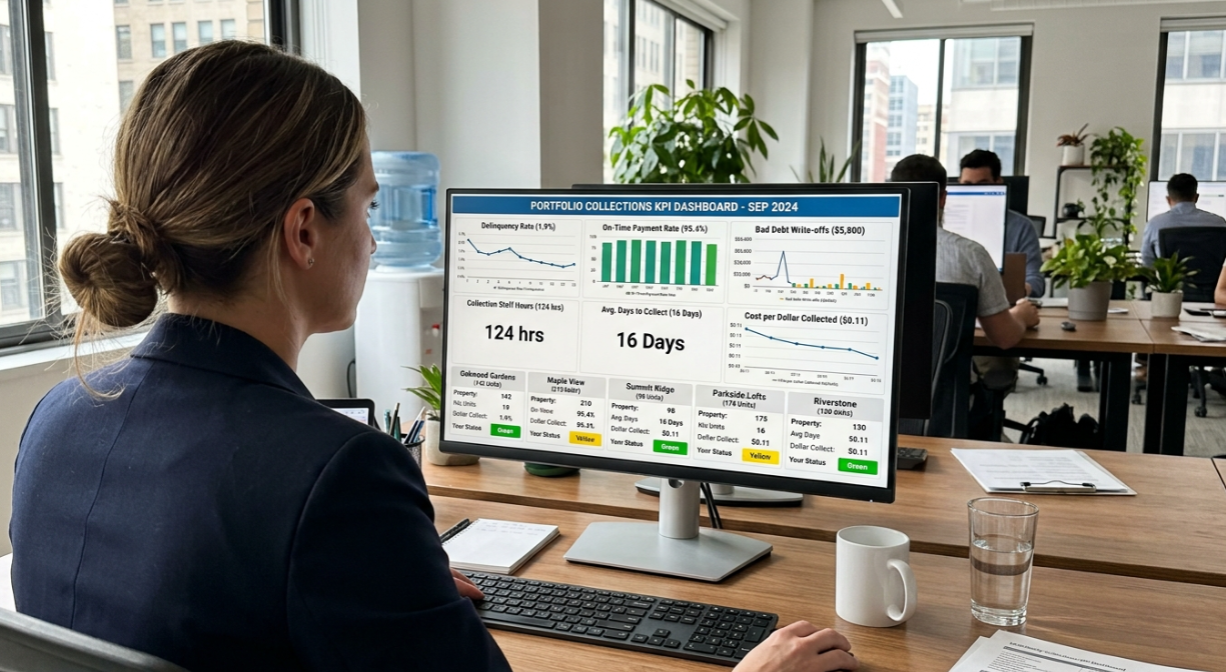
Before deploying any AI collections tool, establish baselines for these metrics. Without a before-and-after comparison, you’re guessing at ROI rather than measuring it.
Metric | What It Measures | Benchmark Range |
|---|---|---|
On-time payment rate | % of rent paid by due date | 15-25% improvement with automation (IREM benchmarks) |
Delinquency rate (30-day) | % of revenue overdue 30+ days | 200-600 bps improvement reported by operators |
Bad debt as % of revenue | Annual write-offs | Up to 40% reduction (multiple vendor datasets) |
Staff hours on collections | Manual labor per month | Up to 85% reduction |
Units per collections FTE | Scale efficiency | From 80-100 to 150-200+ units per person |
Days to collect | Average time from invoice to payment | Varies, but faster collection is the goal |
Cost per dollar collected | Efficiency of recovery spend | Should decline meaningfully after AI deployment |
The collections AI dashboard guide covers how to set up reporting around these KPIs.
Real-World Benchmarks and Case Studies
The most persuasive evidence for AI collections ROI comes from operators who’ve published their results.
Operator/Case Study | Portfolio/Scope | Reported Result | ROI Signal |
|---|---|---|---|
Flatz Living | 1,000+ units | 230-basis-point reduction in bad debt | ~$260,000 annualized savings |
Juniper Investment Group | Portfolio pilot | Delinquency decreased from 2.45% to 2.06% | ~$15/unit/month reported ROI |
PeakMade | Multifamily portfolio | AI handled 85%+ of delinquency conversations | 954 staff hours saved in one quarter |
Busboom Group | 2,600 units | 99% 30-day collections rate | Collections managed by one team member |
Unified Residential | Portfolio | Rent collection increased from 80% to 96% at one property | Significant short-term recovery improvement |
Summit Property Management | Portfolio | $3M in AI-powered collections over six months | Large-scale recovery evidence |
Delinquency Reduction
Flatz Living, an owner/operator with just over 1,000 units, drove a 230 basis point reduction in portfolio-wide bad debt rates. That translated to approximately $260,000 in annualized bad debt savings. Juniper Investment Group saw delinquency rates drop from 2.45% to 2.06% during their pilot. Asset Living communities reported a 600 basis point increase in on-time rent payments in Q2 2025, supported by over 130,000 personalized payment reminder messages.
Revenue Impact
Summit Property Management reported $3 million in AI-powered collections over a six-month period. One Unified Residential property jumped from 80% to 96% rent collection in just 30 days after deploying AI. Juniper’s results across their portfolio worked out to roughly $15 per unit per month in ROI, combining conversion improvements, operating expense reductions, and delinquency gains.
Labor Efficiency
PeakMade had AI handle over 85% of delinquency conversations, saving resident account managers 954 hours in a single quarter. Busboom Group achieved a 99% 30-day collections rate while consolidating operations to a single team member who spends just 2 hours per week on collections across 2,600 units. Unified Residential now manages rent collections for their entire portfolio with a three-person team, achieving better results than they previously did with 18 assistant managers.
The Asset Valuation Connection
Brookfield’s Snyder noted in a Bisnow interview that the pilot had a “huge impact not just on the reduction in delinquency, but on actually being able to get cash in the door faster.” She connected delinquency directly to asset valuation, a point that changes how operators should think about AI collections ROI. Every basis point of delinquency reduction doesn’t just improve cash flow. It flows through to NOI, and from there to property value at whatever cap rate the market applies.
How to Measure and Attribute AI Collections ROI
The biggest challenge in measuring AI collections ROI is proving that improved collections came from the technology rather than normal changes in resident payment behavior.
Use a consistent measurement framework:
Establish a baseline
Measure at least 60–90 days of pre-AI performance where possible. Record delinquency, bad debt, recovery rates, collections hours, days to collect, and cost per dollar collected.
Compare equivalent periods
Compare similar months or resident cohorts after implementation. Seasonal differences can make a simple month-over-month comparison misleading.
Separate AI-assisted collections from other collections
Track accounts touched by AI separately from accounts handled entirely by staff. This makes it easier to estimate incremental recovery.
Measure cohorts, not just portfolio averages
A portfolio-wide delinquency rate can hide important differences between properties, resident groups, or delinquency stages. Measure recovery by aging bucket, property, and account type.
Calculate incremental value
The most defensible ROI calculation asks:
How much additional money did the portfolio collect, how much labor did it avoid, and how much bad debt did it prevent compared with the expected result without AI?
This approach produces a more credible business case than simply comparing total collections before and after implementation.
AI Collections ROI Example: 1,000 Units
Assume a 1,000-unit portfolio with average monthly rent of $1,500.
Input | Before AI | After AI | Annual Impact |
|---|---|---|---|
Portfolio units | 1,000 | 1,000 | — |
Average monthly rent | $1,500 | $1,500 | — |
Delinquency rate | 4% | 2% | $360,000 less rent at risk |
Annual revenue recovered | — | — | $360,000 |
Collections labor savings | — | — | $44,200 |
AI software cost | — | — | $180,000 |
Net measurable benefit | — | — | $224,200 |
Using the basic ROI formula:
ROI = [($360,000 + $44,200) − $180,000] ÷ $180,000 × 100
AI collections ROI = 124.6%
This means the portfolio generates approximately $1.25 in net measurable value for every $1 spent on the AI system, before additional benefits such as bad-debt reduction or faster cash realization.
For investment decisions, operators should also calculate payback period, not just ROI.
Payback period = AI implementation cost ÷ monthly measurable benefit.
AI Collections ROI Calculator
Use these inputs to estimate the potential return of AI collections automation:
1. Portfolio units: ______
2. Average monthly rent: $______
3. Current delinquency rate: ______%
4. Expected delinquency rate after AI: ______%
5. Annual collections labor cost: $______
6. Expected labor savings: ______%
7. Expected annual bad-debt reduction: $______
8. Annual AI software and implementation cost: $______
Step 1: Calculate annual rent at risk
Units × Average Monthly Rent × Current Delinquency Rate × 12
Step 2: Calculate annual rent at risk after AI
Units × Average Monthly Rent × Expected Delinquency Rate × 12
Step 3: Calculate additional revenue recovered
Pre-AI Rent at Risk − Post-AI Rent at Risk
Step 4: Calculate labor savings
Annual Collections Labor Cost × Expected Labor Savings %
Step 5: Calculate net annual benefit
Revenue Recovered + Labor Savings + Bad Debt Reduction − AI Cost
Step 6: Calculate ROI
ROI (%) = Net Annual Benefit ÷ AI Cost × 100
Step 7: Calculate payback period
Payback Period = AI Cost ÷ Monthly Net Benefit
Use conservative, expected, and upside assumptions rather than relying on a single forecast.
What Does AI Collections Cost?
AI collections ROI depends heavily on the total cost of deployment, not just the advertised software subscription.
Include these costs in the ROI model:
Cost | Include in ROI? | Examples |
|---|---|---|
AI software subscription | Yes | Per-unit or platform fee |
Implementation | Yes | Setup and configuration |
PMS integration | Yes | Integration or API costs |
Messaging | Yes | SMS, email, voice, usage fees |
Payment processing | If incremental | Transaction-related costs |
Legal review | Yes | Initial compliance review |
Staff training | Yes | Implementation and training time |
Ongoing administration | Yes | Monitoring and workflow management |
Data cleanup | Yes | Initial PMS/account cleanup |
Reporting/analytics | If incremental | Additional reporting costs |
For a defensible ROI calculation, use total cost of ownership (TCO) rather than comparing recovered revenue with the software subscription alone.
How AI Collections ROI Changes by Portfolio Size
Portfolio size changes the economics of AI collections because software, implementation, and staffing costs do not scale at the same rate.
Portfolio Size | Primary ROI Driver | Main Challenge |
|---|---|---|
Under 500 units | Staff-time savings and faster recovery | Fixed implementation costs |
500–2,500 units | Labor efficiency + delinquency reduction | Consistent PMS data |
2,500–10,000 units | Revenue recovery + staffing scalability | Workflow standardization |
10,000+ units | Portfolio-wide recovery and operating leverage | Integration, governance, and compliance |
Smaller operators should focus on whether AI eliminates enough manual work to justify the fixed cost of implementation. Larger operators can usually model additional value from centralized collections, reduced staffing growth, and portfolio-wide delinquency improvements.
How AI Collections Tools Work

Understanding the mechanics helps operators evaluate whether a tool can actually deliver the ROI it promises. AI collections systems generally operate in a sequence of stages, all built on top of a property management system (PMS) integration.
Automated Payment Reminders
Multi-channel reminders (SMS, email, voice) are triggered by PMS data and personalized to each resident’s payment history. If someone consistently pays on the 3rd instead of the 1st, a well-configured AI won’t send unnecessary reminders. It only intervenes when the resident’s normal pattern breaks.
Delinquency Detection and Outreach
AI constantly scans resident accounts, identifying outstanding balances, even small fees that might otherwise be missed. Outreach is tailored based on the resident’s history and communication preferences.
Payment Plan Negotiation
Within parameters set by the operator, AI platforms can negotiate and document payment plans, then send payment links instantly during or after conversations. This removes one of the biggest bottlenecks in manual collections: getting a plan agreed to and documented before the momentum fades.
Escalation to Human Staff
The best tools know when to hand off. Complex hardship situations, legal disputes, or accounts that don’t respond to automated outreach get routed to human team members with full context. Operators using AI collections scripts can define exactly when and how these handoffs occur.
Post-Move-Out Recovery
Through PMS integration, AI automatically takes over residents’ move-out statements, analyzing financial behavior to personalize outreach for balance recovery. Given the time-decay problem (that 16% monthly drop in collection probability), automating this immediately after move-out is one of the highest-ROI applications.
For a deeper dive into the tools available, see this collections AI tools overview.
What Is a Good AI Collections ROI?
There is no universal AI collections ROI benchmark because returns depend on portfolio size, delinquency levels, average rent, staffing costs, bad-debt rates, and software pricing.
A useful way to evaluate an AI collections investment is to compare three scenarios:
Scenario | Delinquency Improvement | Labor Savings | ROI Interpretation |
|---|---|---|---|
Conservative | 100–200 bps | 20–40% | Tests whether the investment works under limited improvement |
Expected | 200–400 bps | 40–70% | Reasonable operating case to model |
Upside | 400–600+ bps | 70–85% | Tests potential results based on strong case-study performance |
These ranges should be treated as planning assumptions rather than guaranteed industry results. Published vendor and operator case studies can produce substantially different outcomes depending on portfolio characteristics and measurement methods.
The strongest business case is not simply the highest projected ROI. It is the scenario where the operator can clearly attribute revenue recovery, labor savings, and bad-debt reduction to the AI deployment.
Compliance Considerations
AI collections ROI calculations should include compliance costs. Ignoring them doesn’t make them disappear; it just means they show up later as legal risk.
Fair Housing Act
All automated communications must comply with the Fair Housing Act. AI-driven payment reminders and late notices need to be carefully managed to avoid unintended pressure or harassment. The system can’t treat residents differently based on protected characteristics, and since AI learns from data, there’s a real risk of embedded bias if the training data reflects historical disparities.
Accessibility Requirements
Over-reliance on automated digital tools could unintentionally exclude residents who require verbal communication due to visual impairments, speak languages not supported by the AI, or have limited digital literacy. Multi-language support and alternative communication channels aren’t optional, they’re legal requirements in many jurisdictions.
Human Oversight
AI should handle the volume; humans should handle the judgment calls. Escalation decisions, hardship evaluations, and legal proceedings require human review. The collections AI compliance guide covers FDCPA, TCPA, and Fair Housing requirements in detail.
Bias Audits
AI systems should be regularly audited to identify and correct biases that may influence outreach frequency, tone, or escalation timing. Transparency about how AI is used in collections is also critical for resident trust.
For a broader view of compliance in AI-powered property management, this Fair Housing compliance guide is worth reading.
Common Mistakes That Erode AI Collections ROI
Even the best tool underperforms when deployed poorly. These are the mistakes that shrink returns.
Deploying without baseline metrics. If you don’t know your current delinquency rate, bad debt percentage, or staff hours spent on collections, you can’t measure improvement. Establishing baselines is not a nice-to-have. It’s the foundation of every ROI calculation.
Poor PMS integration. AI collections tools are only as good as the data feeding them. Incomplete resident records, delayed ledger syncs, or missing contact information create gaps that the AI can’t bridge. This guide on PMS data quality explains what clean data looks like in practice.
Over-automating without escalation paths. Sending a resident their 15th automated reminder when they need a human conversation isn’t just ineffective, it’s a compliance risk. Every AI collections workflow needs clear escalation triggers.
Ignoring compliance setup costs. Legal review, bias auditing, accessibility testing, and staff training on the new system all cost money. Leaving them out of your ROI calculation makes the numbers look better on paper but exposes you to costs that will surface later.
Measuring only labor savings. Labor reduction is real and significant, but it’s usually the smaller part of the return. Revenue recovery and bad debt reduction are where the big numbers live. Operators who frame AI collections ROI purely as a staffing play are underselling the investment to their own leadership.
Market Adoption and What’s Next
According to AppFolio’s benchmark data, 21% of property management professionals currently use AI, and 28% more plan to adopt it. Resident communication, which includes collections outreach, is the most common use case.
The market is also consolidating. Colleen AI was acquired by Entrata in June 2024. Buzz was acquired by Pay Ready in March 2025. These acquisitions signal that AI collections capability is becoming a must-have feature in property management platforms rather than a standalone product.
For operators evaluating their options, the question isn’t whether AI collections will become standard. It’s whether you’ll adopt it while your delinquency rates are manageable or after they’ve already eroded your NOI.
See how Haven’s AI agents work across property operations
Frequently Asked Questions
What is a good AI collections ROI benchmark?
Property management companies implementing AI collections tools report operational cost reductions of 25-40% in the first year, with 3-5x returns on software investment when accounting for recovered revenue, labor savings, and bad debt reduction. A 200-600 basis point improvement in delinquency rates is a reasonable target based on published case studies.
How long does it take to see ROI from AI collections?
Some operators report measurable results within 30 days. Unified Residential jumped from 80% to 96% rent collection at one property in that timeframe. However, full portfolio-wide ROI typically takes 60-90 days to stabilize as the AI learns resident payment patterns and communication preferences.
Does AI collections replace human staff entirely?
No. AI handles the high-volume, repetitive outreach (typically 85% or more of conversations), freeing staff to focus on complex cases. Busboom Group runs collections across 2,600 units with one person spending 2 hours per week, but that person still exists to handle exceptions and escalations.
What compliance risks come with AI collections?
The primary risks involve Fair Housing Act violations, FDCPA restrictions on communication frequency and timing, TCPA rules around automated calls and texts, and accessibility requirements for residents with disabilities or limited English proficiency. Regular bias audits and human oversight are essential safeguards.
How do I calculate AI collections ROI for my portfolio?
Start by establishing baselines: current delinquency rate, bad debt write-offs, staff hours on collections, and average days to collect. After deploying AI, measure the same metrics and plug the deltas into the formula: ROI (%) = [(Revenue Recovered + Labor Savings + Bad Debt Reduction) - AI Tool Cost] / AI Tool Cost × 100.
What PMS integration is needed for AI collections to work?
AI collections tools need read and write access to your PMS, specifically resident ledgers, contact information, lease data, and payment history. Poor data quality is the most common reason AI collections underperforms. Clean, up-to-date records are non-negotiable.
Is AI collections ROI different for small vs. large portfolios?
The per-unit math works at any scale, but the absolute dollar returns are obviously larger for bigger portfolios. Smaller operators (under 500 units) may see a longer payback period because the fixed costs of implementation are spread across fewer units. That said, the labor efficiency gains can be proportionally larger for small teams where every hour matters more.