AI Collections Dashboard: 2026 Guide for Property Managers
Learn how an AI Collections Dashboard boosts rent recovery with real-time tracking, predictive risk scoring, and PMS sync—plus 2026 benchmarks.

TL;DR
An AI collections dashboard is a real-time visual interface that tracks rent collection performance, automates delinquency outreach, and uses predictive scoring to flag at-risk accounts before they become serious problems. It goes beyond a traditional PMS delinquency report by combining data visibility with automated action. With multifamily delinquencies at their highest since 2010, property managers are adopting these dashboards to protect NOI and reduce the manual burden of chasing late rent.
Explore Haven’s AI property management software to see how AI agents are reshaping property operations.
Quick Answer: Should Property Managers Use an AI Collections Dashboard?
An AI collections dashboard is worth implementing if your portfolio has:
Portfolio Signal | Recommendation |
|---|---|
Delinquency below 2% | Traditional PMS reporting may be sufficient |
Delinquency between 2% and 5% | Consider AI-assisted workflows |
Delinquency above 5% | AI collections software should be evaluated immediately |
More than 200 units | Automation usually delivers measurable ROI |
Multiple properties | Portfolio-wide dashboards become increasingly valuable |
Staff spending 5+ hours weekly on collections | Automation can significantly reduce administrative workload |
Takeaway:
An AI collections dashboard doesn't replace your property management software. It adds predictive analytics, automated communication, compliance tracking, and workflow automation to help property managers recover rent faster while reducing manual work.
AI Collections Dashboard Definition
AI collections dashboard: A software platform that combines real-time rent collection data, predictive delinquency scoring, automated resident outreach, and compliance tracking into a single interface that helps property managers identify and resolve late rent more efficiently.
What Is an AI Collections Dashboard?
An AI collections dashboard is a centralized interface that uses artificial intelligence to track, analyze, and act on rent collection data in real time. Think of it as the difference between a rearview mirror and a windshield. A traditional PMS delinquency report tells you who owes money. An AI collections dashboard tells you who owes money, why they’re likely behind, what outreach has already happened, when to escalate, and what outcome to expect based on behavioral patterns.
The core components break down into three layers:
Visibility layer. This is the data foundation: rent billed versus collected, delinquency aging buckets (current, 30, 60, 90+ days), outstanding balances at the resident and community level, and loss-to-lease tracking.
AI automation layer. This is where intelligence enters the picture. The system logs every interaction, adjusts communication tone based on payment history, assigns predictive risk scores that refresh nightly, and triggers outreach automatically when payments are missed.
Alerting and escalation layer. Instead of relying on someone to pull a report every Monday, the dashboard pushes notifications when collection rates drop below a threshold or when a specific account needs human intervention.
Who uses it? On-site teams use it to manage day-to-day follow-ups. Regional managers use it to compare performance across communities. Ownership groups use it to monitor portfolio-wide NOI impact.
For a deeper explanation of how AI fits into rent collection workflows, the Collections AI FAQ covers the broader concept in detail.
How an AI Collections Dashboard Works

Step 1: Import PMS Data
The dashboard pulls:
Resident balances
Payment histories
Lease information
Delinquency data
Step 2: Analyze Resident Risk
AI evaluates:
Previous payment behavior
Outstanding balances
Lease renewal history
Communication patterns
Step 3: Trigger Automated Outreach
The platform automatically sends:
Text messages
Emails
Voice reminders
Step 4: Escalate Delinquent Accounts
When thresholds are reached, the system can:
Recommend payment plans
Flag accounts
Notify managers
Prepare compliance documentation
Step 5: Measure Outcomes
Managers track:
Recovery rates
Collection rates
Days in arrears
NOI impact
Key Features of an AI Collections Dashboard
Not all dashboards are created equal. Here’s what separates a genuinely useful AI collections dashboard from a glorified spreadsheet with a login page.
Real-Time Delinquency Tracking
The dashboard displays aging buckets, typically current, 30-day, 60-day, and 90+ day categories, updated automatically from PMS charge and payment data. Some platforms offer views at the resident level (showing outstanding charges and age of bad debt), the lease level, and the community level (showing total collected and bad debt per property).
Automated Outreach Logging
Every text message, email, phone call, and payment reminder gets logged with timestamps. This matters for two reasons: operational visibility and legal protection. As one industry guide put it, “every communication should be automatically logged with timestamps. This protects both you and the tenant, and is essential if situations ever escalate to legal proceedings.”
For more on how AI logging works inside property management systems, see this guide on AI notes and PMS logging.
Predictive Risk Scoring
This is the feature that makes the “AI” part of the name earn its keep. The system analyzes payment timeliness over 12 months to establish baseline behavior, flags outstanding balance magnitude and frequency as financial stress indicators, and considers lease age and upcoming rent increases as transition risks. These risk scores refresh nightly and appear in the dashboard, enabling intervention before tenants actually miss due dates.
PMS Integration and Two-Way Sync
The best AI collections dashboards don’t create a separate data silo. They pull charge and payment data directly from your property management system and write actions back into it. One property technology advisor put it bluntly: “Choose AI that connects to your existing systems rather than creating new data silos. The best AI tools feed structured data back into your property management system and accounting platform, not into a separate dashboard you’ll check once a month.”
Data quality matters enormously here. If your PMS records are messy, the dashboard’s outputs will be too. This PMS data quality guide explains what to clean up before connecting AI tools.
Compliance and Audit Trail
Every delinquency action and resident communication must align with Fair Housing standards, applicable debt collection practices, and state-specific landlord-tenant requirements. A good AI collections dashboard builds this audit trail automatically, timestamping every automated notice and logging every escalation decision.
The collections AI compliance guide covers FDCPA, TCPA, and FHA considerations in more depth.
Multi-Channel Communication Tracking
Residents don’t all respond to the same channel. Some answer texts, some check email, some only pick up the phone. An AI collections dashboard tracks outreach across SMS, email, and voice, showing which channels produce responses for each resident and adjusting future attempts accordingly.
Collections Dashboard KPIs and Benchmarks
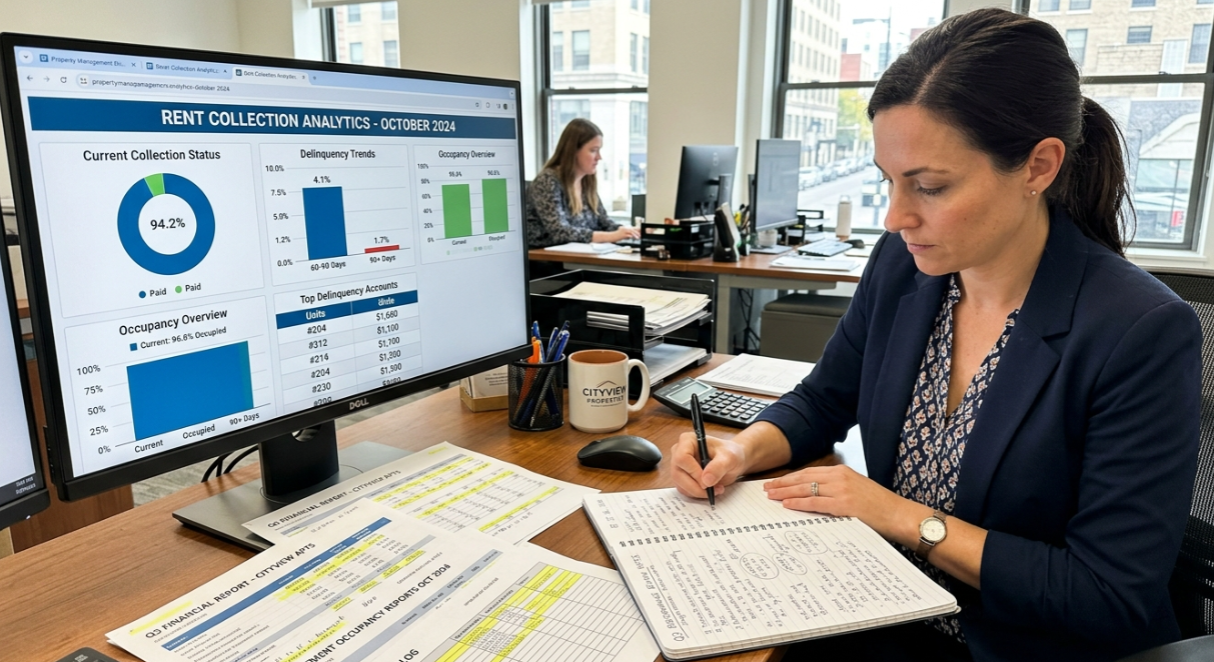
The line between a useful dashboard and a forgettable one is simpler than people realize. A forgettable dashboard displays data. A useful one answers questions. Here are the KPIs that answer the questions property managers actually care about.
KPI | How It’s Calculated | Benchmark |
|---|---|---|
Rent Collection Rate | Rent Collected / Rent Billed × 100 | Below 95% signals a process problem |
Delinquency Rate | Past-Due Rent / Total Rent Billed × 100 | Under 5% is healthy; over 10% needs immediate attention |
Recovery Rate | Total Amount Collected / Total Delinquent Debt × 100 | Higher is better; track month over month |
Aging Buckets | Breakdown of balances by current / 30 / 60 / 90+ days | Concentration in 60+ day buckets is a warning sign |
Average Days in Arrears | Mean number of days accounts remain past due | Compare before and after automation |
Promise-to-Pay Conversion | Residents who follow through on payment plans / Total commitments | Tracks whether payment arrangements actually work |
NOI Impact | Gross Rental Income minus Operating Expenses (excluding debt service and CapEx) | This is the number that anchors every property management financial dashboard |
The most important before-and-after metric when implementing an AI collections dashboard is average days in arrears. It tells you whether automation is actually speeding up resolution or just generating more messages.
AI Collections Dashboard vs. Traditional PMS Delinquency Report
This comparison is the core conceptual gap most property managers need filled. Here’s how the two stack up.
Dimension | Traditional PMS Report | AI Collections Dashboard |
|---|---|---|
Data freshness | Updated when someone pulls the report | Real-time, continuous |
Outreach tracking | Manual notes, if any | Every interaction logged automatically |
Risk identification | Reactive (account is already past due) | Predictive (flags risk before a missed payment) |
Follow-up execution | Staff must remember to call or email | Automated workflows trigger based on rules |
Communication tone | One-size-fits-all template | Adjusted based on payment history (friendly vs. firm) |
Escalation | Manager decides case by case | System recommends escalation based on thresholds |
Compliance trail | Scattered across email, notes, spreadsheets | Centralized, timestamped, auditable |
When is a traditional report sufficient? If you manage a small portfolio with low turnover, strong tenant relationships, and delinquency rates consistently under 2%, a PMS report plus personal follow-up may be enough. But as portfolios grow, the math changes quickly. Practitioners on BiggerPockets have noted that “with emotionally charged things such as collections, delinquency, and evictions, it’s even more important” to build systems and policies rather than relying on case-by-case judgment. Decision fatigue from dealing with tenant stories is a real burnout driver, and that’s exactly where AI dashboards remove the emotional overhead.
For a broader look at how AI changes the scaling equation, this guide to scaling property management with AI is worth reading.
How AI Improves Collections Outcomes
The theory sounds good. But does it work? The early results from operators who have deployed AI collections tools are striking.
Real-World Results
A Brookfield property saw its collection rate climb from 97.6% to 99.6% during a pilot program. That 2-percentage-point jump might sound small until you calculate what it means on a 500-unit community where average rent is $1,800. That’s roughly $18,000 per month recovered.
Asset Living reported a 600 basis point increase in on-time rent payments after deploying AI collections, sending over 130,000 personalized reminder messages in Q2 2025 alone. Peakmade had AI handle over 85% of delinquency conversations, saving 954 staff hours in a single quarter. And Zuma’s early customers reported achieving 100% rent collection in their first month with an 85% reduction in collections workload.
The Automated Workflow in Practice
A typical AI collections dashboard workflow looks like this:
Day 1 past due: Friendly payment reminder via text and email, personalized with the resident’s name and balance.
Day 3: Follow-up through the channel the resident has historically responded to. Tone remains conversational.
Day 7: Escalated message. Firmer language. Mention of late fees per lease terms.
Day 14: Payment plan offer generated automatically, based on the resident’s balance and history.
Day 30+: Dashboard flags account for human review. Suggests next steps, which might include legal notice drafting.
At every stage, the AI adjusts tone based on tenant payment history. A resident who has paid on time for 11 months and misses once gets a different message than someone with a pattern of late payments. This isn’t just good customer service; it’s better collections strategy.
The late rent AI reminders guide walks through how automated reminders reduce delinquency rates step by step.
Staff Time Savings
Labor costs represent 40 to 45% of revenue in property management. Every hour a site team spends making collection calls is an hour not spent on leasing, maintenance coordination, or resident retention. AI collections dashboards don’t eliminate the need for staff judgment, but they dramatically reduce the repetitive work that consumes most of the collections effort.
See how AI reduces call volume across property management operations, including collections-related inbound calls.
Example ROI of an AI Collections Dashboard
Portfolio Size | Average Rent | 1% Improvement in Collections | Annual Revenue Recovered |
|---|---|---|---|
100 units | $1,500 | $1,500/month | $18,000/year |
250 units | $1,700 | $4,250/month | $51,000/year |
500 units | $1,800 | $9,000/month | $108,000/year |
1,000 units | $2,000 | $20,000/month | $240,000/year |
Takeaway:
Even a 1% improvement in rent collections can recover six figures annually in larger multifamily portfolios.
Types of AI Collections Dashboards
Type | Best For | Limitation |
|---|---|---|
PMS-native dashboards | Small portfolios | Limited AI capabilities |
Third-party AI platforms | Mid-sized operators | Integration requirements |
Enterprise AI platforms | Large portfolios | Higher implementation costs |
Stand-alone analytics tools | Reporting | No automated outreach |
What to Look for When Evaluating AI Collections Dashboards
The market is moving fast. Roughly 75% of the multifamily industry is expected to be fully using AI automation by 2026. Here’s what to evaluate before choosing a platform.
PMS Integration Depth
Does the dashboard pull data from your PMS in real time, or does it rely on periodic exports? Two-way sync (reading charge data and writing back notes, payment plans, and escalation flags) is the standard to aim for. One-way data pulls create lag and force double entry.
Compliance Features
This is non-negotiable. All delinquency actions and resident communications must align with Fair Housing standards and applicable debt collection laws. Look for automatic audit trails, timestamped communication logs, and the ability to customize workflows per state or jurisdiction. Legal experts have warned that automating legal processes without proper guardrails could raise regulatory issues, so compliance features aren’t optional extras.
The Fair Housing compliance guide explains what property managers need to watch for when deploying AI.
Communication Channels
A dashboard that only sends emails will miss the residents who only respond to text. Look for SMS, email, and voice capability. Some platforms also support in-app messaging through resident portals.
Human-in-the-Loop Capability
Balanced advice from property technology consultants is clear on this point: “Use AI tools for data collection, but rely on human oversight for final decision-making. Automate routine tasks, such as rent reminders, but ensure tenants have access to real human support.” The best AI collections dashboards make it easy for staff to step in at any point, with full context from the automated interactions that preceded their involvement.
Customizable Workflows and Escalation Rules
Every property has different grace periods, fee structures, and legal timelines. A one-size-fits-all automation sequence won’t work. The dashboard should let you configure when reminders go out, what tone they use, when escalation triggers, and what thresholds prompt human review.
Reporting Granularity
Can you see data at the resident level, the lease level, the community level, and the portfolio level? All four views matter for different stakeholders. An on-site manager needs resident-level detail. A regional director needs community comparisons. An owner needs portfolio-wide NOI impact.
AI Collections Dashboard Implementation Timeline
Phase | Typical Timeline |
|---|---|
PMS integration | 1-2 weeks |
Data cleanup | 1-3 weeks |
Workflow configuration | 1 week |
Staff training | 1 week |
Optimization | 30-90 days |
Most property managers begin seeing measurable improvements within the first 30 days.
Why This Matters Right Now
The timing for AI collections dashboards isn’t theoretical. Multifamily delinquencies reached 1.37% in Q3 2025, the highest level since 2010, with serious delinquencies representing roughly $7.1 billion. Meanwhile, 1 in 10 US tenants reported being late on rent in 2025.
At the same time, an industry executive survey found that 77% of operators using AI have reduced operating expenses. Online payment platforms alone have been shown to improve on-time payments by up to 30%. When you add predictive risk scoring, automated follow-ups, and compliance-ready audit trails on top of that foundation, the ROI case becomes hard to ignore.
For a detailed breakdown of AI’s impact on property management economics, see this benefits, use cases, and ROI analysis.
Haven is building Collections AI as part of its expanding suite of AI agents for property management, alongside its existing Maintenance AI and Leasing AI products.
Related Terms
Collections AI: The broader category of artificial intelligence applied to rent collection workflows, including but not limited to dashboards.
Delinquency management: The process of tracking, communicating about, and resolving past-due rent balances.
Rent collection rate: The percentage of billed rent that is actually collected in a given period.
Aging report: A breakdown of outstanding balances by how long they’ve been past due.
Promise-to-pay tracking: Monitoring whether residents who agree to payment plans follow through on their commitments.
Net Operating Income (NOI): Gross rental income minus operating expenses, excluding debt service and capital expenditures. The core financial metric for property performance.
AI Collections Dashboard Evaluation Checklist
Before choosing a platform, verify that it offers:
Real-time PMS integration
Two-way data synchronization
Predictive delinquency scoring
Automated SMS reminders
Email automation
Voice communication
Audit trails
Fair Housing compliance tools
Custom workflows
Portfolio-level reporting
Human approval workflows
Resident-level reporting
Frequently Asked Questions
How is an AI collections dashboard different from the delinquency report in my PMS?
A PMS delinquency report is a static snapshot of who owes what. An AI collections dashboard adds automated outreach, predictive risk scoring, communication logging, and escalation triggers. It turns passive data into an active workflow tool that reduces manual follow-up.
What KPIs should I track first?
Start with rent collection rate and delinquency rate. If your collection rate drops below 95% or your delinquency rate exceeds 5%, you have a process problem that needs attention. From there, track average days in arrears before and after implementing automation to measure whether AI is actually speeding up resolution.
Does an AI collections dashboard replace my property management team?
No. It handles the repetitive, high-volume work (reminders, follow-ups, logging, risk scoring) so your team can focus on the cases that actually require human judgment. The best implementations keep humans in the loop for escalation decisions, payment plan negotiations, and any situation that could lead to legal action.
What about Fair Housing and debt collection compliance?
Any AI collections dashboard worth considering must build compliance into its workflow. That means automatic audit trails, timestamped communication logs, and the ability to customize messaging per jurisdiction. Automated outreach should align with Fair Housing standards, FDCPA requirements, and state-specific landlord-tenant laws.
Can an AI collections dashboard integrate with my existing PMS?
Most platforms are built to integrate with major property management systems through API connections. The key question is whether the integration supports two-way sync (reading data from and writing data back to your PMS) or only one-way data pulls. Two-way sync eliminates double entry and keeps your PMS as the single source of truth.
How quickly do property managers see results?
Early adopters have reported results within the first month. Some Zuma customers achieved 100% rent collection in month one, while Brookfield saw a 2-percentage-point collection rate improvement during a pilot. The speed of results depends on your starting delinquency rate, the quality of your PMS data, and how well your workflows are configured.
Is an AI collections dashboard worth it for small portfolios?
If you manage fewer than 50 units with minimal delinquency, a traditional approach may still work fine. But once you cross a few hundred units, or if your delinquency rate is climbing, the time savings and recovery improvements from an AI collections dashboard typically justify the investment. Labor is 40 to 45% of revenue in property management, so even modest automation gains compound quickly.
How much does an AI collections dashboard cost?
Pricing varies depending on portfolio size, integration requirements, and automation capabilities. Most vendors use per-unit pricing or portfolio-based subscription models.
What PMS platforms integrate with AI collections dashboards?
Many AI solutions integrate with major property management platforms through APIs, including enterprise and multifamily management systems.
Can AI collections dashboards automate payment plans?
Yes. Many platforms automatically recommend payment plans based on balance size, payment history, and delinquency severity.
What is the difference between collections AI and an AI collections dashboard?
Collections AI refers to the broader category of AI-powered rent collection tools. An AI collections dashboard is the interface property managers use to monitor and manage those tools.
Ready to see how AI agents can handle collections, maintenance, and leasing across your portfolio? Book a demo with Haven to explore the full platform.