AI Notes and Logging PMS: 2026 Guide for Property Managers
Learn how AI Notes and Logging PMS create real-time, compliance-ready records in your system. See workflows, audit trails, and best practices.

TL;DR
AI notes and logging in PMS refers to the automated creation of structured records (conversation summaries, work order details, audit trails) inside a property management system, without manual data entry. This capability eliminates fragmented notes, creates compliance-ready documentation for Fair Housing reviews, and gives every team member full context on every tenant interaction. It is quickly becoming the backbone of trustworthy AI in property management.
Property managers spend a surprising amount of their day on documentation. Taking a call, summarizing what happened, typing it into the PMS, then moving on to the next one. Multiply that across hundreds of units and thousands of interactions, and documentation becomes one of the biggest time sinks in the business.
AI notes and logging in PMS changes that equation entirely. Instead of relying on a human to remember the details and manually enter them, AI agents handle the interaction and write the records themselves, directly into the property management system.
This glossary guide breaks down what that means, how it works, and why it matters for compliance, operations, and your team’s sanity.
Book a demo to see how AI agents log interactions directly inside your PMS.
AI notes and logging in a property management system (PMS) automatically create structured records of tenant conversations, maintenance requests, leasing interactions, work orders, and AI actions directly inside the PMS. Unlike manual note-taking, AI logging creates searchable, time-stamped audit trails that improve operational efficiency, reduce double data entry, support Fair Housing documentation, and preserve the full history of every resident interaction.
In most modern AI property management platforms, the workflow follows five steps:
AI answers the call, text, email, or chat.
The conversation is summarized using natural language processing.
Important information (tenant, unit, issue, urgency) is extracted.
Structured records are written into PMS fields through an API.
Staff can immediately review complete documentation inside the PMS.
For property managers, AI logging serves as both an operational tool and a compliance safeguard by ensuring interactions are documented consistently without relying on manual data entry.
What “AI Notes” and “AI Logging” Mean in Property Management
These two terms are closely related but distinct.
AI Notes are structured text records that an AI agent writes into PMS fields after handling an interaction. Think of them as the digital equivalent of the notes a leasing agent would scribble after a phone call, except they’re created instantly, formatted consistently, and stored exactly where your team needs them. Examples include tenant notes, work order descriptions, CRM contact entries, and maintenance summaries.
AI Logging is the automatic recording of every AI action and interaction as a time-stamped audit trail within the PMS. This creates a chronological history of what happened, when it happened, and what decisions were made. Logging captures not just the content of a conversation but also the actions taken: work orders created, vendors dispatched, follow-ups scheduled.
Together, AI notes and logging PMS capabilities form the documentation layer that makes AI trustworthy and operationally useful. Without them, AI is a black box. With them, you get a complete, searchable record of every tenant interaction.
For a broader look at how AI connects to your property management system, see this guide on PMS integration.
Types of Records AI Creates in Your PMS
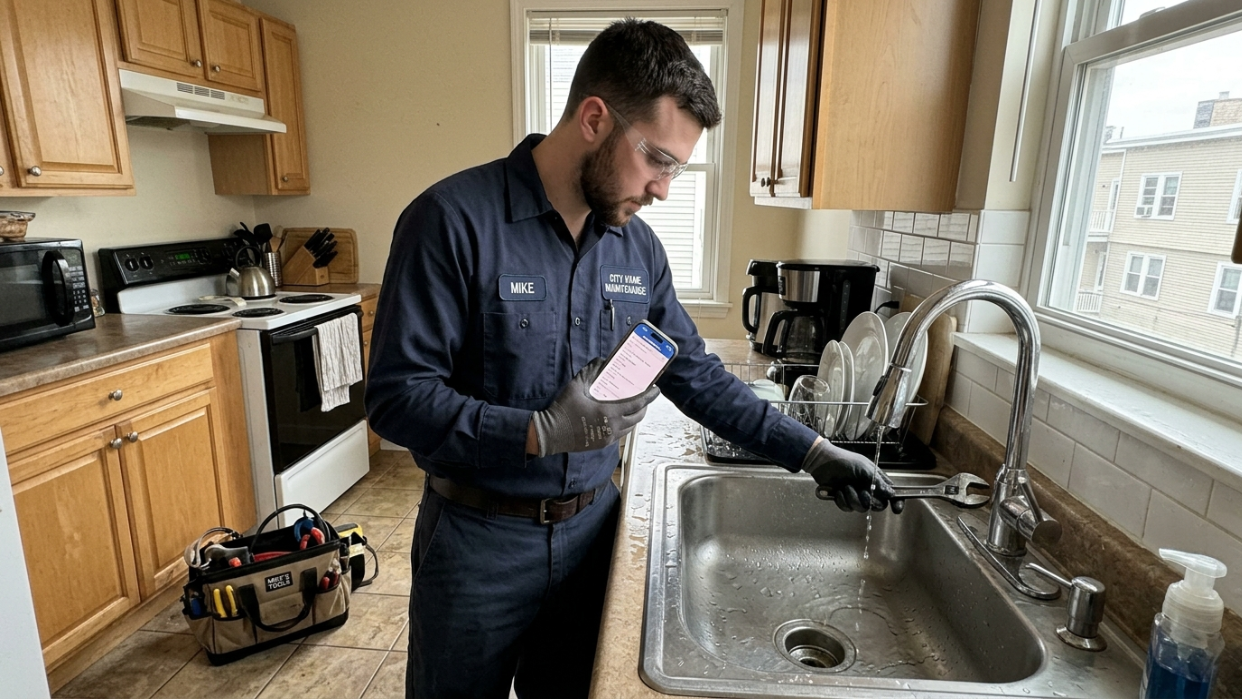
Not all AI-generated records are the same. Here’s a breakdown of what a well-integrated AI agent typically writes into a property management system:
Record Type | Example | Where It Lives in PMS |
|---|---|---|
Conversation transcripts and summaries | “Tenant reported dishwasher not draining. AI walked through reset steps. Issue persists. Work order created.” | Tenant notes / communication log |
Work order notes and descriptions | Issue category, urgency level, photos submitted, troubleshooting attempted | Work order record |
Call logs | Timestamp, duration, caller ID, call outcome | Activity history |
CRM / lead contact notes | Prospect asked about 2BR availability, income qualified, tour scheduled for Thursday | Lead record |
Vendor dispatch and follow-up logs | “ABC Plumbing dispatched at 9:15 PM. Confirmation received. Follow-up scheduled for 48 hours.” | Work order or vendor record |
Maintenance interaction histories | Full timeline from initial report through resolution | Tenant and unit records |
The specificity matters. AppFolio’s AI maintenance tools, for example, can diagnose and prioritize maintenance requests, detect issues via image, create work orders, and log summaries, all without a human touching the PMS.
For property managers running maintenance workflows, the work order logging alone can transform operations. Learn more about AI work order creation in AppFolio for a specific walkthrough.
Why Automated Logging Matters
Eliminating Double Data Entry
The core pain point is simple: a property manager takes a call, handles the issue, then has to open the PMS and type up what happened. That second step is where things fall apart. Notes get shortened, details get lost, and sometimes the entry just doesn’t happen because there are ten more calls waiting.
AI agents that write directly into the PMS eliminate this entirely. Tools like Whippy AI transcribe, summarize, and tag every interaction, then push structured data into the PMS/CRM. The result is that leasing and maintenance teams start each day with clean, organized lead and service pipelines instead of voicemails and fragmented notes.
Haven’s AI agents, for instance, create notes and update records directly in PMS systems after handling calls, texts, and emails. There’s no separate portal to check, no second system to update. The record is written the moment the interaction happens.
Creating a Compliance-Ready Audit Trail
This is where AI logging moves from “nice to have” to “essential.”
EliseAI creates audit-friendly records by automatically logging every single interaction. These detailed interaction histories provide a clear timeline of communications that can prove invaluable during compliance reviews. Operators can demonstrate that all applicants received the same information and opportunities, regardless of protected characteristics.
For property managers worried about Fair Housing exposure, automated logging is a powerful safeguard. Every prospect gets the same responses, and every response is documented. For a deeper look at how this applies to your operation, read the Fair Housing compliance guide.
Operational Continuity
When a tenant calls back about an ongoing issue, whoever picks up the phone (or whatever AI agent handles the call) needs full context. Without automated logging, that context lives in someone’s memory or in a hastily written sticky note.
With AI notes logged in the PMS, any team member can pick up where the last interaction left off. This is especially critical for after-hours maintenance, where over half of work orders are submitted outside business hours. AppFolio’s data shows their AI tool responds to residents in an average of six seconds, and every one of those interactions gets logged for the morning team to review.
Dispute Resolution and Owner Reporting
Logged AI interactions create an objective record that can resolve disputes. When a tenant claims they reported a leak three weeks ago, you can pull the exact transcript. When an owner asks why a vendor was dispatched at 2 AM, the log shows the emergency triage decision and the reasoning behind it.
Why AI Documentation Is Becoming Standard
Several trends are accelerating AI adoption across property management:
Trend | Operational Impact |
|---|---|
Growing maintenance request volume | More documentation workload |
Higher resident expectations | Faster responses required |
Labor shortages | Less time for manual notes |
Compliance requirements | Better audit trails needed |
Multi-channel communication | Harder to track conversations manually |
AI adoption | Automated documentation becomes practical |
How AI Notes Flow Into a PMS: The Technical Workflow

Understanding the data path helps property managers evaluate whether an AI tool’s logging is genuinely integrated or just surface-level.
Here’s the typical flow:
Tenant initiates contact. A phone call, text message, email, or chat comes in.
AI agent handles the interaction. The AI converses with the tenant, asks clarifying questions, and takes action (schedules a tour, creates a work order, provides troubleshooting steps).
Natural language processing extracts key data. The AI identifies the tenant name, unit number, issue type, urgency level, and any actions taken.
Structured data is written to PMS fields via API. The AI creates or updates records in the PMS: a new work order, an appended note on the tenant record, a logged timestamp, a vendor assignment.
Summary is pushed to the team. Staff sees a ready-to-review note in their PMS dashboard the next time they log in.
The critical step is number four. This is where the difference between true PMS integration and a bolt-on tool becomes apparent.
Integration Methods
There are three common ways AI tools write data into a PMS:
API integrations are the gold standard. The AI writes directly to PMS fields in real time through the PMS’s application programming interface. This is how Haven’s agents operate, creating work orders, assigning tickets, and writing notes directly inside the PMS without requiring system migrations.
Scheduled exports batch data and push it at set intervals (hourly, daily). This means there’s a delay between the AI interaction and the record appearing in the PMS. EliseAI’s AppFolio integration, for example, includes a scheduled export option.
Webhook syncs fall somewhere in between, triggering data pushes when specific events occur (a work order is created, a lead is qualified).
For property managers evaluating tools, real-time API integration provides the most reliable AI notes and logging PMS experience. To understand what access controls are needed, see the PMS permissions guide.
Examples of AI Logging Across Property Management Platforms
Platform | AI Logging Capability |
|---|---|
Haven | Direct PMS note creation and work order updates |
AppFolio | AI maintenance summaries and audit logs |
EliseAI | Resident communication history and leasing logs |
Whippy AI | Call summaries and CRM synchronization |
Automation vs. True AI Logging
Not all automated logging is created equal. There’s a meaningful distinction between rule-based automation and genuine AI, and it shows up clearly in the quality of notes.
PMS automation uses fixed rules to trigger predefined actions. “If checkout, send cleaning task.” True AI reads context, makes decisions, and adapts its behavior over time.
Here’s what that difference looks like in practice:
Rule-based log entry:
“Inbound call received at 9:04 PM. Duration: 3 minutes 22 seconds.”
AI-generated note:
“Tenant Jane Smith in Unit 204 reported a leak under the kitchen sink. AI triaged as non-emergency. Tenant confirmed no standing water. Work order #4521 created, categorized as plumbing, assigned to ABC Plumbing. Estimated response within 24 hours.”
The second version gives the morning team everything they need to take action. The first version tells them almost nothing.
Advanced AI logging also includes sentiment analysis. Some systems can detect whether a prospect is high-intent or just browsing, while automatically extracting key topics and providing structured notes. This saves hours of manual data entry and gives leasing teams better prioritization signals.
For more on how AI handles the full maintenance workflow (not just the logging), see the AI maintenance coordinator guide.
Manual Notes vs AI Notes vs AI Logging
Feature | Manual Notes | Basic Automation | AI Notes & Logging |
|---|---|---|---|
Requires employee typing | Yes | Sometimes | No |
Conversation summaries | Manual | No | Yes |
Structured PMS fields | Sometimes | Limited | Yes |
Work order creation | Manual | Rule-based | Intelligent |
Audit trail | Inconsistent | Partial | Complete |
Fair Housing documentation | Depends on staff | Limited | Consistent |
Searchable records | Often inconsistent | Limited | Yes |
Multi-channel support | Difficult | Limited | Yes |
Context from previous conversations | No | No | Yes |
Audit Trails and Compliance
Fair Housing Documentation
The Fair Housing Act requires property managers to treat all applicants and tenants consistently. Proving that consistency, especially across thousands of interactions, is nearly impossible with manual documentation. AI logging solves this by creating identical, structured records for every interaction.
Ensuring fair housing compliance means offering multiple communication channels, regularly auditing AI tools for potential bias, and training staff to override AI responses when necessary. The logging component is what makes those audits possible in the first place.
Beyond Fair Housing: Emerging Audit Requirements
The broader compliance world is moving toward requiring comprehensive AI audit trails. Three major frameworks (the EU AI Act, NIST AI RMF, and OWASP LLM Top 10) converge on one requirement: comprehensive, immutable audit logs.
NIST AI RMF 1.1, released in March 2026, is becoming the practical standard for US federal and enterprise contexts. While most US property managers don’t need to comply with the EU AI Act, the direction is clear. Organizations that build structured audit trails now will be ahead of whatever regulations come next.
A common discovery, according to compliance practitioners, is that organizations find out late that their systems generate no structured audit trail of AI-driven decisions. In property management specifically, AppFolio’s audit logs provide increased oversight with automatic record-keeping, making it easier to investigate mistakes and identify suspicious activity.
Common Problems with AI Logging (And How to Fix Them)
AI notes and logging PMS features aren’t perfect. Practitioners have identified real issues that property managers should be aware of before adopting.
Inaccurate or Misclassified Notes
This is the most common complaint. Practitioners in Facebook groups like APM Help report that AI-generated work orders sometimes get the issue description wrong. One example that comes up frequently: a vendor gets assigned a water heater repair only to find that the actual problem is with the property’s plumbing system.
The root cause is usually insufficient context. An AI agent that only processes the current conversation, without access to the unit’s maintenance history or the property’s known issues, is more likely to misclassify.
The fix is conversation memory. AI agents that retain context from prior interactions write better notes because they understand the full picture. Haven’s agents, for example, are built with memory and conversation continuity, meaning they can reference previous interactions when creating new records.
For more on this topic, see common maintenance AI mistakes and fixes.
Notes That Don’t Sync Reliably
Scheduled exports can fail silently. If the sync breaks, the PMS shows no record of interactions that actually happened. This is a trust-killer for teams trying to rely on AI.
Real-time API integrations are more reliable but require proper PMS permissions and access controls. Before deploying any AI logging tool, verify that write access is configured correctly and that failed syncs trigger alerts.
Over-Generic Summaries
Some AI tools produce summaries that are technically accurate but operationally useless. “Tenant called about a maintenance issue” doesn’t help anyone. Good AI logging should include the specific issue, location within the unit, urgency classification, troubleshooting steps attempted, and next actions taken.
Property-management-specific training models make a significant difference here. Generic language models don’t know that “water coming from the ceiling” should be flagged as urgent, or that a “beeping sound from the kitchen” likely means a smoke detector battery. Specialized AI understands these patterns and logs them appropriately.
Multichannel Fragmentation
If AI notes from phone calls go to one place and notes from text messages go to another, you haven’t solved the fragmentation problem. You’ve just automated it.
The best AI logging tools unify notes from phone, SMS, and email into a single PMS record per tenant. Haven’s agents handle all three channels and write everything to the same location in the PMS, so there’s one source of truth regardless of how the tenant reached out.
See how Haven logs every interaction in your PMS across all channels.
Questions to Ask Before Buying an AI Logging Solution
When evaluating AI logging software for your property management system, ask vendors the following:
Does the AI write directly into the PMS?
Some platforms only generate summaries that staff must manually copy into the PMS.
Is logging performed in real time?
Delayed synchronization can create operational gaps and missing documentation.
Can every communication channel be logged?
The system should consolidate:
Phone
SMS
Email
Chat
Resident portal messages
into one unified tenant timeline.
Can staff edit AI-generated notes?
Some organizations require edits while others require immutable audit records.
How are failed API syncs handled?
Ask whether the platform retries automatically and alerts administrators when records cannot be written.
What to Look For in an AI Tool’s Logging Capabilities
When evaluating AI notes and logging PMS capabilities, use this checklist:
Real-time sync: Does the AI write to the PMS immediately, or does it batch data on a schedule? Real-time is always preferable for operational accuracy.
Structured vs. unstructured notes: Does the AI create structured records with labeled fields (issue type, urgency, resolution), or does it dump raw text into a notes field? Structured notes are searchable and reportable.
PMS write access: Does the AI actually write into the PMS, or does it just generate notes that someone has to copy over? True integration means direct field-level access.
Audit trail immutability: Can logged records be altered after the fact, or are they locked once created? For compliance purposes, immutable logs are essential.
Multi-channel coverage: Does the tool log interactions from phone, SMS, email, and chat? Or only one channel? Property managers need complete coverage.
Conversation memory: Does the AI remember prior interactions when creating new notes? This directly affects note quality and accuracy.
Error handling: What happens when a sync fails? Does the system retry, alert staff, or silently drop the record?
Reporting and search: Can you pull up all AI-generated notes for a specific tenant, unit, or time period? This matters for dispute resolution and owner reporting.
The adoption numbers suggest property managers are moving quickly on this. More than 99% of AppFolio’s nearly 23,000 customers are now using some form of AI-powered tools, and AI actions are up 7x year-over-year. McKinsey estimates AI could generate $110 to $180 billion in value for real estate overall.
The Bottom Line
AI notes and logging in PMS is not a flashy feature. It’s the foundation that makes everything else work. Without reliable logging, AI-handled calls vanish into thin air, compliance becomes impossible to prove, and teams lose trust in the tools they’re supposed to rely on.
With proper logging, every call, text, and email becomes a permanent, structured, searchable record in the system of truth. No double entry. No lost context. No gaps in the audit trail.
The property managers who get the most out of AI aren’t just the ones with the fanciest chatbot. They’re the ones whose AI writes the receipts.
Book a demo with Haven to see how AI agents create notes, update records, and log every action directly in your PMS.
Common Misconceptions About AI Notes and Logging
AI records everything perfectly
No. Human review is still important, especially during implementation.
AI logging replaces property managers
No. AI documents interactions while staff continue making operational decisions.
Every PMS supports the same logging features
API capabilities differ significantly between PMS platforms.
Conversation transcripts are the same as AI notes
Not necessarily. AI notes summarize and structure conversations, while transcripts preserve every spoken word.
Frequently Asked Questions
What is AI logging in a property management system?
AI logging is the automatic recording of every action and interaction an AI agent takes, stored as a time-stamped entry in your PMS. This includes conversation summaries, work order creation events, vendor dispatches, and follow-up actions. It creates a chronological audit trail without requiring manual data entry.
Does AI logging help with Fair Housing compliance?
Yes. AI logging creates consistent, detailed records of every tenant and applicant interaction. During a compliance review, these records can demonstrate that all applicants received the same information and opportunities. This is much harder to prove with manual notes, which vary in detail and consistency from person to person.
What happens if AI notes are inaccurate?
Inaccurate notes are a real concern that practitioners regularly flag. The most common issue is misclassified work orders, where the AI assigns the wrong issue type. AI tools with conversation memory and property-specific training produce significantly more accurate notes because they understand context from prior interactions and know common issues for specific properties.
How do AI notes get into the PMS technically?
The AI agent processes the interaction using natural language processing, extracts key entities (tenant name, unit, issue type, urgency), and writes structured data to PMS fields through an API connection. This happens in real time with direct API integrations, or on a schedule with batch export methods.
Can AI log interactions from multiple channels in one place?
The best tools can. AI agents that handle phone calls, SMS, and email should write all notes to the same tenant or unit record in the PMS. This prevents the fragmentation problem where call notes end up in one place and text notes in another.
Is there a difference between automated logging and AI logging?
Yes, and it’s significant. Rule-based automation logs basic facts like “call received at 9:04 PM.” True AI logging creates structured notes with issue descriptions, urgency assessments, actions taken, and next steps. The operational value of the second type is dramatically higher.
What PMS systems support AI notes and logging?
Most major PMS platforms (AppFolio, Buildium, Yardi, RentManager) support some form of AI integration through APIs. The depth of logging capability depends on both the PMS’s API and the AI tool being used. Haven, for example, integrates with PMS systems to create work orders, assign tickets, and write notes directly.
Will AI audit trail requirements become mandatory?
The trend points in that direction. Major frameworks like NIST AI RMF 1.1 and the EU AI Act are converging on requirements for comprehensive AI audit logs. While US property managers don’t face explicit mandates yet, building structured logging practices now reduces future compliance risk.