AI Collections Scripts (2026): Property Manager's Guide
AI Collections Scripts automate rent outreach via SMS, email, and voice to boost on‑time payments—while meeting FDCPA and Fair Housing rules. See how.

TL;DR
AI collections scripts are dynamic conversation flows that AI agents follow when contacting residents about unpaid rent through SMS, email, and voice calls. Unlike static templates read by humans, these scripts adapt their tone, timing, and channel based on each resident’s payment history. They run a staged escalation from friendly pre-due reminders through formal delinquency notices, maintaining perfect compliance with FDCPA and Fair Housing requirements at every step. Properties using AI collections scripts report 30 to 50 percent reductions in bad debt expense and significant improvements in on-time payment rates.
Explore Haven’s AI property management platform to see how AI agents handle operations across the resident lifecycle.
Quick Answer: What Are AI Collections Scripts?
AI collections scripts are adaptive workflows that guide AI agents during rent collection conversations through SMS, email, and voice channels.
Unlike traditional collection templates, AI scripts personalize messages according to payment history, resident behavior, lease terms, delinquency stage, and communication preferences.
Most multifamily AI collection systems follow a six-stage process:
Stage | Timeline | Primary Goal |
|---|---|---|
Pre-due | 3-5 days before rent | Prevent late payments |
Due date | Day 0 | Confirm rent status |
Grace period | Days 3-5 | Notify residents of fees |
Early delinquency | Days 7-10 | Encourage payment |
Mid-delinquency | Days 14-21 | Offer solutions |
Late delinquency | Day 30+ | Establish payment plans |
Well-designed AI collections scripts can reduce bad debt by 30-50%, improve collection rates, shorten payment cycles, and reduce the administrative burden on onsite teams.
Key takeaway: AI collections scripts don't replace property managers. They automate repetitive outreach while humans continue handling disputes, hardship cases, and legal escalation.
AI Collections Scripts Definition
An AI collections script is a rule-based conversational workflow that automates rent collection communications across multiple channels while enforcing legal and regulatory requirements. These workflows personalize outreach based on resident behavior, payment history, delinquency status, and predefined escalation rules.
What Are AI Collections Scripts?
An AI collections script is the conversation logic an AI agent uses to contact residents about unpaid rent or outstanding balances. It governs what the agent says, when it says it, which channel it uses, and how it escalates when a resident doesn’t respond.
The word “script” is actually a bit misleading. Traditional collection scripts are flat documents, printed or pasted into a CRM, that human collectors read aloud during phone calls. AI collections scripts are different. They’re branching conversation flows that adjust in real time based on inputs like the resident’s payment history, how many days past due the balance is, whether the resident has responded to previous messages, and what channel they prefer.
Think of it this way: a traditional script is a recipe card. An AI collections script is a decision tree that can navigate hundreds of possible paths through a conversation, all while staying within compliance guardrails.
This distinction matters because traditional collection call centers struggle with consistency. Human collectors have bad days, forget steps, misunderstand regulations, or make judgment calls that create compliance risk. Training is expensive and turnover is high. AI collections scripts follow their programmed logic with absolute precision, no deviation, no improvisation, and no risk of a collector saying something inappropriate.
Why AI Collections Scripts Matter Right Now

The timing isn’t coincidental. Multifamily delinquency is climbing. The multifamily CMBS delinquency rate hit 7.23% in June 2026, up from 5.44% a year earlier, a 171 basis point increase. The industry average for multifamily properties sits between 4 and 8 percent.
To put that in dollar terms: for a 500-unit community with $1,500 average rent, every percentage point of delinquency represents $90,000 in annual revenue at risk.
Meanwhile, the average property manager spends 12 or more hours per month chasing late rent, and 18 to 25% of tenants still pay late. Onsite teams often struggle with delinquency conversations, not because they lack skill, but because they lack purpose-built tools and the bandwidth to follow up consistently across a growing portfolio.
Practitioners on Reddit’s property management forums echo this. A common theme is that managers who rely on manual follow-ups simply can’t maintain consistency across large portfolios. The problem isn’t that they don’t care. It’s that a busy Tuesday at the leasing office means Friday’s follow-up calls never happen.
This is the gap AI collections scripts fill. They treat delinquency as what it usually is: a communication and process problem, not purely a financial one.
AI Collections Scripts at a Glance
Feature | Traditional Collections | AI Collections |
|---|---|---|
Available after business hours | No | Yes |
SMS outreach | Limited | Yes |
Voice outreach | Yes | Yes |
Email automation | Limited | Yes |
Personalized messaging | Limited | Yes |
Payment plan automation | No | Yes |
Compliance enforcement | Manual | Automated |
Audit trails | Inconsistent | Complete |
Human intervention required | High | Moderate |
How AI Collections Scripts Work
Step 1: PMS Balance Monitoring
Everything starts with your property management system. The AI agent monitors resident ledgers and identifies accounts where rent is unpaid, approaching due, or past due. This PMS integration is what separates AI collections scripts from generic payment reminder tools. The agent knows the lease terms, the late fee structure, the resident’s payment history, and whether a balance is actually delinquent versus simply not yet posted.
Accurate PMS data quality is essential here. If the ledger data is wrong, the AI sends the wrong message.
Step 2: Staged Escalation
AI collections scripts follow a staged model that maps to the rent collection lifecycle. Based on research across multiple platforms and vendor implementations, the standard stages look like this:
Stage | Timing | Channel | Tone |
|---|---|---|---|
Pre-due reminder | 3-5 days before due date | SMS or email | Friendly, informational |
Due-date notification | Day of | SMS or email | Neutral, factual |
Grace period reminder | Day 3-5 | SMS with late fee disclosure | Slightly more direct |
Early delinquency outreach | Day 7-10 | SMS + email | Firm but helpful |
Mid-delinquency escalation | Day 14-21 | Voice call attempts begin | Formal, solution-oriented |
Late delinquency / payment plan offer | Day 30+ | Voice + SMS + email | Formal with options |
Pre-legal or human handoff | Day 45-60 | Human takes over | N/A |
The most commonly cited sequencing pattern across sources runs: first follow-up email, second follow-up email, third follow-up SMS, fourth follow-up phone call, fifth follow-up email, and a final postal letter for the most severe cases.
Step 3: Multichannel Orchestration
AI collections scripts don’t operate in a single channel. Modern platforms coordinate outreach through specialized agents: Voice AI places outbound calls and captures promise-to-pay commitments. Two-way SMS AI manages text conversations and delivers secure payment links. Email AI uses compliant templates and processes replies.
The channel matters because residents respond differently depending on how they’re contacted. A 25-year-old renter might ignore an email but respond to a text within minutes. A resident who’s been at the property for eight years might prefer a phone call. AI systems track these preferences and adjust.
Step 4: Personalization Logic
This is where AI collections scripts diverge most sharply from basic automation. Smart systems tailor communication to each resident’s actual payment behavior. If someone consistently pays on the 3rd instead of the 1st, the AI won’t send unnecessary reminders on the 1st, but it will intervene if that resident’s usual pattern breaks. 41% of tenants say automatic reminders are the single most helpful tool for avoiding late fees, so getting the timing right matters.
The personalization extends to tone. Early-stage messages for a resident who has paid on time for 36 consecutive months should sound very different from messages sent to a chronically late payer. AI scripts adjust this automatically.
How to Implement AI Collections Scripts
Implementing AI collections scripts typically follows five phases.
Phase 1: Audit Existing Collection Processes
Before introducing AI, property managers should document:
Current delinquency rates
Existing follow-up schedules
Collection channels
Average days to collect
Existing payment plan policies
Phase 2: Clean PMS Data
AI systems depend entirely on accurate ledger data.
Review:
Resident balances
Late fee rules
Lease terms
Payment posting procedures
Contact information
Phase 3: Configure Escalation Rules
Define:
Reminder schedules
Grace periods
Late fee triggers
Payment plan eligibility
Human handoff thresholds
Phase 4: Test Compliance Rules
Validate:
FDCPA requirements
Fair Housing policies
TCPA consent
Phase 5: Launch and Monitor
Track collection performance for at least 60 days before making workflow adjustments.
What an AI Collections Script Includes
Every individual message within an AI collections script should contain five core components:
Personalized salutation using the resident’s name and unit number
Clear identification of the balance including amount owed, original due date, and any late fees applied
Reason for the message stated plainly (“Your rent payment for July has not been received”)
Specific call to action with a payment link and a deadline
Required compliance disclosures appropriate to the stage and jurisdiction
For property managers familiar with AI leasing assistant scripts, the structure is similar: clear identification, specific purpose, defined next step, and compliance language baked in rather than bolted on.
Tone Calibration by Stage
The tone progression across stages is one of the most important design decisions in any AI collections script:
Pre-due (Day -3): “Hi Sarah, just a friendly reminder that your August rent of $1,450 is due on the 1st. Pay now using this link: [link]. Questions? Reply to this text anytime.”
Early delinquency (Day 7): “Sarah, your August rent balance of $1,450 plus a $50 late fee ($1,500 total) remains unpaid. Please submit payment by [date] to avoid further fees. Pay here: [link].”
Mid-delinquency (Day 21): “This is a formal notice regarding your past-due balance of $1,500 for Unit 204 at [Property Name]. Please contact our office or make a payment at [link] by [date] to discuss options.”
Payment Plan Scripts
At the 30-day mark, many AI systems can offer structured payment plans within predefined rules. The agent presents options (“Would you like to split your balance into two payments over the next 30 days?”), confirms the resident’s selection, and logs the agreement in the PMS. For a deeper look at how this works in practice, see this guide on AI payment plan outreach.
Dispute Handling and Human Escalation
Here’s a limitation that responsible operators don’t hide: AI collections scripts cannot handle genuine disputes, hardship counseling, or situations requiring human judgment. When a resident says “I already paid this” or “I’m going through a medical emergency,” the script must detect the situation and route it to a human immediately.
Mandatory human escalation triggers include debt disputes, validation requests, high-distress conversations, and any situation where the resident explicitly asks to speak with a person. This isn’t a failure of the technology. It’s a design feature. The AI handles the 80% of straightforward cases so that human staff can focus their time on the 20% that actually require empathy and judgment.
Compliance Requirements for AI Collections Scripts
Compliance isn’t a box to check. It’s the foundation that makes AI collections scripts viable in regulated environments. Three federal frameworks apply, and property managers need to understand all three.
FDCPA (Fair Debt Collection Practices Act)
The FDCPA governs how debt collectors communicate with consumers. For AI collections scripts, the key requirements include:
Mini-Miranda disclosures in initial communications (informing the resident the message is from a debt collector)
The 7-in-7 rule: no more than 7 call attempts within a 7-day period
Time-of-day restrictions: no calls before 8 AM or after 9 PM in the resident’s time zone
No intimidating, coercive, or misleading language
Residents’ right to dispute a debt, which the AI must acknowledge and escalate
AI scripts enforce these rules through script validation, attempt tracking, and timezone-aware scheduling. Unlike a human collector who might lose count of how many times they’ve called this week, the AI tracks every attempt automatically.
Fair Housing Act
This is where property-management-specific AI collections scripts diverge from generic debt collection tools. The Fair Housing Act requires landlords to treat tenants equally. That means you cannot send selective reminders to some tenants and not others, waive late fees inconsistently, or use different escalation processes without a documented, non-discriminatory reason.
AI-driven communication must also be equitable and accessible for all residents, including those with disabilities. Multiple language options, multiple payment channels, and consistent messaging across the entire portfolio aren’t just nice features. They’re legal requirements.
For a comprehensive breakdown, read Haven’s Fair Housing compliance guide.
TCPA (Telephone Consumer Protection Act)
The TCPA governs automated calls and text messages. Before an AI agent can send SMS reminders or place automated calls, the property must have documented consent from the resident. Most modern lease agreements include this consent language, but older leases may not.
The Audit Trail Advantage
One of the strongest compliance arguments for AI collections scripts is documentation. Every interaction is logged with timestamps, message content, channel used, and resident response. Every script version is tracked. Every call attempt is recorded and available for QA review.
This level of documentation is nearly impossible to maintain with manual processes. Having detailed logs of every AI interaction, version control of compliance scripts, and strict time fencing serves as evidence that the property maintains procedures designed to prevent violations. For more on how AI logging integrates with PMS records, that guide covers the mechanics.
AI Collections Scripts vs. Manual Collections
Factor | Manual Collections | AI Collections Scripts |
|---|---|---|
Consistency | Varies by staff member and day | Identical process every time |
Speed to first contact | Often 3-7 days after due date | Same day or pre-due |
Compliance risk | High (human error, forgotten disclosures) | Low (built into script logic) |
Scalability | Requires additional headcount | Handles thousands of accounts simultaneously |
Channel coverage | Usually phone + maybe email | SMS + email + voice, coordinated |
Staff time | 12+ hours/month per manager | 2 hours/week possible across large portfolios |
Documentation | Inconsistent notes in PMS | Complete audit trail |
Resident experience | Inconsistent, sometimes confrontational | Consistent, professional, and accessible |
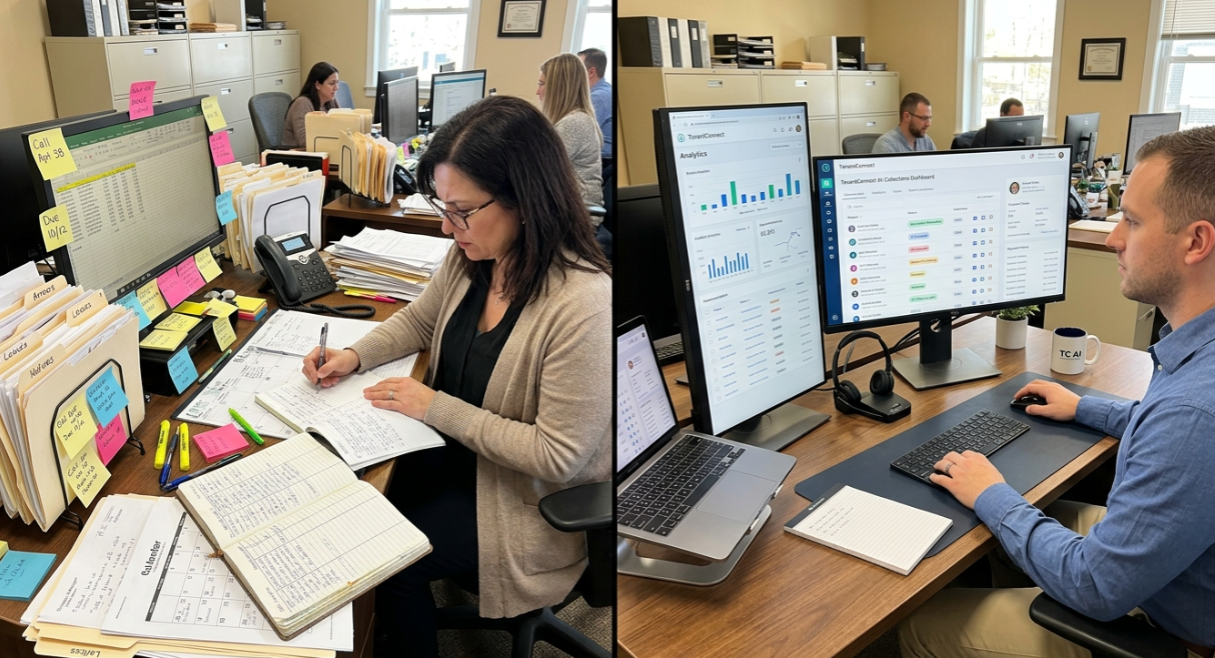
The critical difference between AI and manual collections is consistency. The AI does not skip a step because the leasing office had a busy Tuesday. It does not soften its tone because the staff member feels uncomfortable making a difficult call. It does not forget to follow up on Friday afternoon.
The numbers bear this out. In a Brookfield pilot, one building increased its collection rate from 97.6% to 99.6% and reached that level 14 days faster than without AI. Asset Living communities saw a 600 basis point increase in on-time rent payments after deploying AI collections, sending over 130,000 personalized payment reminder messages. The Busboom Group achieved a 99% 30-day collections rate while consolidating operations to a single team member spending just 2 hours per week on collections across 2,600 units.
For property managers considering the shift from call centers to AI, collections is often where the ROI argument is strongest.
Key Metrics to Track
Once AI collections scripts are deployed, these are the metrics that tell you whether they’re working:
Collection rate / on-time payment rate. The percentage of rent collected by the due date or within the grace period. This is the primary outcome metric. Industry benchmarks suggest AI-assisted properties should target 97%+ collection rates.
Days to collect. How many days past due, on average, before payment is received. AI scripts should compress this significantly. The Brookfield case showed a 14-day improvement.
Bad debt expense reduction. Properties using AI rent collection report 30 to 50 percent reductions in bad debt expense. Track this quarterly against your pre-AI baseline.
Human escalation rate. What percentage of delinquent accounts require human intervention? A well-tuned AI collections script should handle 70-80% of cases autonomously, escalating only genuine disputes and hardship situations.
Resident satisfaction and complaint rate. AI should reduce complaints, not increase them. Track maintenance satisfaction scores and resident survey data for any negative trends tied to collections communications.
Delinquency rate over time. Automated late notice sequences reduce delinquency by 41% per NAA data. Monitor your portfolio’s delinquency curve month over month.
Chances of collecting drop 16% every 30 days an account remains delinquent, with recovery rates falling from 40% to just 5% for larger balances. Speed matters, and it’s one of the strongest arguments for automated AI collections scripts that engage residents immediately rather than waiting for a staff member to get around to it.
When Should Property Managers Use AI Collections Scripts?
AI collections scripts deliver the greatest ROI in the following situations:
Scenario | AI Recommended? |
|---|---|
Under 50 units | Sometimes |
50-250 units | Yes |
250-500 units | Strongly recommended |
500+ units | Essential |
Multiple properties | Essential |
Limited onsite staff | Essential |
Properties experiencing any of the following should consider AI collections immediately:
Delinquency rates above 5%
More than 10 hours per month spent on collections
Inconsistent follow-up
Difficulty documenting collection activity
Resident complaints about communication
The Vendor Landscape
Several companies offer AI collections scripts purpose-built for multifamily property management:
EliseAI is deployed to over 1 million apartment units, with customers including Brookfield, Equity Residential, and Asset Living. Their delinquency product generated the 600 basis point improvement data cited above.
Colleen AI, founded in 2020 and acquired by Entrata in June 2024, focuses on rent collection and post-resident recovery.
Conduit offers AI reminders and voice calls specifically for rent collection workflows.
Haven currently offers Maintenance AI and Leasing AI with Collections AI on the product roadmap. For property managers already using Haven’s operational AI agents, this means collections will integrate into the same ecosystem that handles work orders, vendor dispatch, and leasing inquiries. You can explore the Collections AI roadmap for details on what’s coming.
When evaluating vendors, the questions that matter most are: Does it integrate with your PMS? Does it support all three channels (SMS, email, voice)? Does it enforce FDCPA, Fair Housing, and TCPA compliance automatically? And does it provide a complete audit trail?
Frequently Asked Questions
Do AI collections scripts replace human staff entirely?
No. AI handles the routine, high-volume outreach (reminders, follow-ups, payment link delivery) while humans manage disputes, hardship conversations, and legal escalation. The goal is to free staff from the repetitive 80% so they can focus on situations that genuinely require judgment and empathy.
Can AI actually negotiate payment plans with residents?
Yes, within predefined rules. An AI agent can present payment plan options, confirm the resident’s selection, calculate split amounts, and log the agreement. What it cannot do is create custom arrangements outside the parameters set by the property manager. Any request that falls outside approved rules gets escalated to a human.
Is using AI collections scripts legal under the Fair Housing Act?
Yes, and in many ways AI makes Fair Housing compliance easier. Because every resident receives the same escalation sequence, the same tone, and the same options at each stage, there’s no risk of inconsistent treatment. The key requirement is that AI-driven communication must be accessible for all residents, including those with disabilities or limited English proficiency. Read more in our collections AI compliance guide.
What PMS integrations matter for AI collections?
At minimum, the AI needs read access to resident ledgers (to know who owes what) and write access to log notes, payment plans, and communication records. Payment posting integration, where the AI can confirm payments in real time, prevents embarrassing situations where a resident who paid yesterday gets a delinquency notice today.
What happens when a resident disputes the balance?
The AI detects dispute language (“I already paid,” “this charge is wrong,” “I need to talk to someone”) and immediately escalates to a human team member. The AI cannot resolve disputes or make judgment calls about contested charges. This is a compliance requirement under the FDCPA, and it’s one of the clearest boundaries in any well-designed AI collections script.
How quickly do AI collections scripts show results?
Based on published case studies, properties typically see measurable improvement within the first 30 to 60 days. The Brookfield pilot showed collection rate improvements within the first month, and the speed-to-collect metric (days from due date to payment) tends to improve almost immediately because the AI initiates contact on day one rather than day seven.
Are AI collections scripts only for large portfolios?
They work at any scale, but the ROI argument gets stronger as unit count grows. A property manager with 50 units might spend a manageable amount of time on manual follow-ups. A manager overseeing 500 or 2,600 units (like the Busboom Group case) physically cannot maintain consistent follow-up without automation. For guidance on scaling property management with AI, that guide covers the broader operational picture.
AI collections scripts represent one of the clearest applications of AI in property management: a repetitive, high-stakes, compliance-heavy process where consistency matters more than creativity. The technology is already proving itself across portfolios of every size.
See how Haven’s AI agents work across the full resident lifecycle, from leasing through maintenance and beyond.