AI for Affordable Housing Leasing: 2026 Complete Glossary
Learn AI for Affordable Housing Leasing in 2026: key terms, compliance risks, and tools for LIHTC/Section 8. Get the complete, practical glossary.

TL;DR
AI for affordable housing leasing refers to AI tools that handle prospect communication, lead qualification, waitlist management, and income pre-screening within the compliance-heavy world of LIHTC, Section 8, and HUD programs. Ninety-one percent of affordable housing operators now use AI, but most deploy it only for leasing and communication, not compliance tasks. This glossary defines every term property managers encounter when evaluating these tools, from AMI bucket automation to Fair Housing chatbot risk.
What Is AI for Affordable Housing Leasing?
AI for affordable housing leasing is software that automates leasing communication, waitlist management, lead qualification, tour scheduling, and income pre-screening for LIHTC, Section 8, and HUD-regulated properties.
Unlike market-rate leasing AI, affordable housing AI must operate within strict compliance rules involving AMI limits, voucher handling, Fair Housing protections, and audit trail requirements.
The most common use cases include:
24/7 leasing communication
Waitlist automation
AI phone answering
Income pre-screening
Multi-channel lead follow-up
CRM and PMS integrations
Compliance-safe prospect communication
The biggest risk is Fair Housing liability if the AI improperly handles voucher holders, protected classes, or eligibility decisions.
Introduction: Why Affordable Housing Leasing Needs Its Own AI Vocabulary
Affordable housing leasing is not market-rate leasing with a discount. The workflows are fundamentally different. Where a market-rate leasing agent moves a prospect from inquiry to tour to signed lease, an affordable housing leasing team navigates income verification, AMI calculations, waitlist priority, voucher documentation, and a regulatory framework that can revoke tax credits over a spreadsheet error.
AI is flooding into this space. According to a 2026 survey of 162 affordable portfolio executives, 91% of affordable housing operators have deployed AI, matching market-rate adoption rates. But the deployment is lopsided: nearly all of it sits in leasing and communication, not compliance. That gap creates risk.
This glossary exists because property managers, compliance officers, and operators evaluating AI for affordable housing leasing need a single reference that bridges two knowledge domains. One is AI automation terminology. The other is the regulatory vocabulary of LIHTC, Section 8, and HUD programs. Understanding both is a prerequisite for making good decisions about which tools to trust with your portfolio.
For a broader look at how AI agents work in property management, see this guide to AI workers in the industry.
Workflow Area | Market-Rate Leasing | Affordable Housing Leasing |
|---|---|---|
Income Qualification | Must earn enough | Must stay below AMI limits |
Availability | Immediate leasing focus | Waitlist management focus |
Compliance Risk | Moderate | Extremely high |
Documentation | Basic application docs | Extensive income verification |
Voucher Handling | Rare | Common |
Recertifications | Minimal | Ongoing |
Audit Requirements | Limited | Extensive |
AI Risk Exposure | Lower | Higher due to Fair Housing implications |
This table can rank independently for comparison queries.
Affordable Housing AI Glossary Index
AI Leasing Terms
AI Leasing Assistant
Conversational AI
Voice AI
NLP
Lead Qualification
ILS Lead Capture
Tour Scheduling Automation
Lead Nurturing
CRM Integration
Affordable Housing Compliance Terms
LIHTC
AMI
Section 8
Housing Choice Vouchers
HUD
EIV
Income Certification
PBV
Waitlist Management
Compliance Audit Trail
AI Risk and Fair Housing Terms
Disparate Impact
Algorithmic Bias
Human-in-the-Loop
Digital Redlining
Pre-Approved Response Protocols
Tenant Screening AI
Technical Infrastructure Terms
PMS
API Integration
Multi-Channel Communication
Conversation Memory
SOC 2 Compliance
Encryption
Operations and ROI Terms
OpEx Reduction
Lead-to-Lease Conversion
Vacancy Cost
Call Center Replacement
Staff Augmentation
Core AI Leasing Terms
AI Leasing Assistant
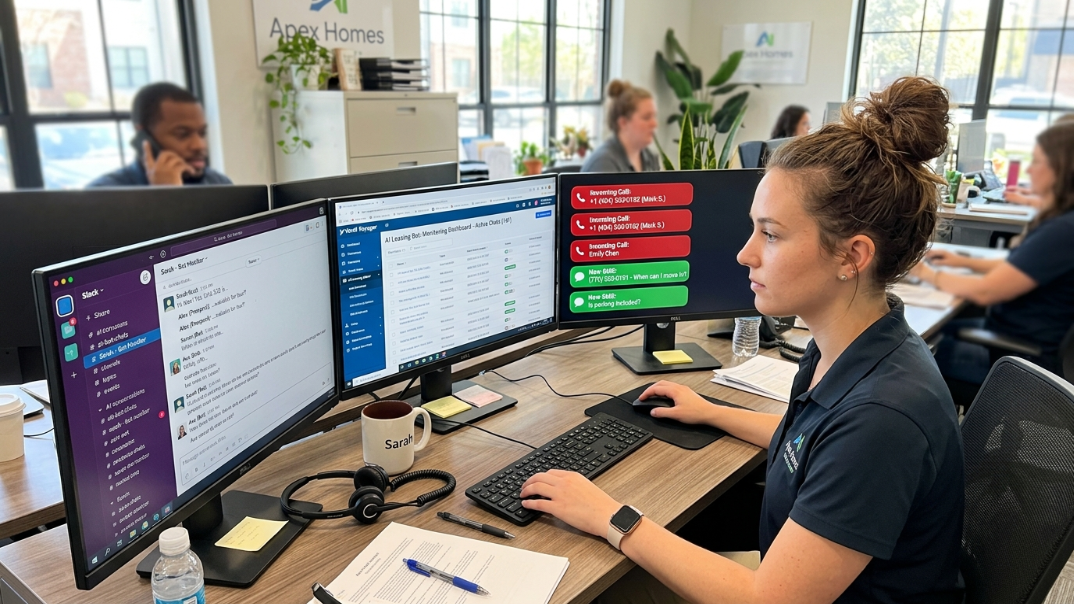
An AI leasing assistant is software that handles prospect inquiries across phone, SMS, email, and webchat without human intervention. Unlike a simple autoresponder, a true AI leasing assistant can qualify leads, answer property-specific questions, schedule tours, and follow up with prospects over time. In the affordable housing context, this means the AI must also handle income-related questions, waitlist additions, and compliance-sensitive topics.
Why it matters for affordable housing: Onsite teams at affordable communities are often overwhelmed by call volume from prospects who may not qualify. As one affordable housing AI vendor notes, most affordable onsite teams can’t get back to all leads, and some don’t answer the phone at all. An AI leasing assistant handles that volume 24/7 while keeping qualified prospects engaged.
Response speed is critical. According to Zillow’s research cited by NAA, responding within 1-2 minutes leads to a 40% chance of prospect engagement. Waiting 30 minutes drops that to 10%.
For a deeper look at features and vendors, read more about AI leasing assistants.
Conversational AI vs. Rule-Based Chatbot
A rule-based chatbot follows pre-programmed decision trees. If a prospect asks something outside the script, it fails. Conversational AI uses natural language processing to understand intent, handle unexpected questions, and maintain context across a conversation.
This distinction matters enormously in affordable housing. A rule-based chatbot might answer “Do you have two-bedroom units?” but choke on “I get paid every other Friday and also have a part-time gig, how do I apply?” Conversational AI can adapt its questions based on how prospects describe their income, whether hourly, salaried, or from gig work.
Voice AI
Voice AI handles phone-based leasing inquiries using spoken conversation rather than text. It answers calls, asks qualifying questions, and can transfer to a human when needed. For affordable housing, where many applicants prefer or need phone interaction over digital channels, voice AI fills a critical gap, especially after hours.
Explore Haven’s voice demo to hear how AI handles a leasing inquiry by phone.
Natural Language Processing (NLP)
The technology that allows AI to understand human language, including slang, incomplete sentences, and varied phrasing. NLP is what enables an AI leasing assistant to parse “I make $17/hr but my hours change every week” and ask the right follow-up questions rather than returning an error.
Lead Qualification (Affordable Context)
In market-rate leasing, lead qualification means determining whether a prospect can afford the rent and is ready to move. In affordable housing, it’s income-gated in the opposite direction: the prospect must earn below a specific threshold (set by AMI limits) to qualify. AI lead qualification for affordable housing must ask the right income questions early without creating Fair Housing risk by asking about protected characteristics.
ILS Lead Capture
ILS stands for Internet Listing Service, platforms like Zillow and Apartments.com where rental listings appear. AI leasing tools capture leads from these platforms automatically, ensuring no inquiry sits unanswered. For affordable properties where demand far exceeds supply, ILS lead capture helps operators manage the flood of inquiries systematically rather than losing qualified applicants in an overflowing inbox.
Tour Scheduling Automation
AI that books property tours directly into a leasing calendar without staff involvement. The AI confirms the appointment, sends reminders, and reschedules when needed. In affordable housing, tour scheduling automation is less about urgency (units often have waitlists) and more about efficiently processing the high volume of interested prospects.
Lead Nurturing
The automated process of staying in touch with prospects who aren’t ready to lease immediately or who are on a waitlist. AI sends follow-ups via text or email at scheduled intervals, keeping the property top of mind. For affordable housing, where waitlists can stretch months or years, lead nurturing prevents qualified applicants from disappearing before a unit opens.
CRM Integration
CRM (Customer Relationship Management) integration means the AI leasing tool connects to your existing contact and lead management system. Every interaction the AI has with a prospect, from the first inquiry to waitlist updates, flows into the CRM automatically. No double-entry, no lost records.
Affordable Housing Program and Compliance Terms
LIHTC (Low-Income Housing Tax Credit)
The largest source of affordable housing financing in the United States. LIHTC properties must lease to tenants earning below specific income thresholds and maintain compliance for 15-30 years to retain their tax credits. AI for affordable housing leasing must work within these constraints, and mistakes carry severe consequences.
A real-world example illustrates the stakes: during a 500-unit LIHTC lease-up, a leasing agent used a spreadsheet to annualize income, mistakenly multiplying bi-weekly pay by 24 instead of 26 for dozens of applicants. This placed multiple families in the wrong AMI bucket, a critical compliance failure that jeopardized the property’s tax credits.
AMI (Area Median Income)
AMI is the midpoint household income for a specific geographic area, published annually by HUD. Affordable housing programs use AMI percentages (30%, 50%, 60%, 80%) to define income eligibility. A “60% AMI unit” means the tenant’s household income cannot exceed 60% of the area median.
AI tools that assist with affordable housing leasing need to calculate whether a prospect’s reported income falls within the correct AMI bucket, accounting for household size, income type, and the latest published AMI figures for that county.
Section 8 / Housing Choice Vouchers
A federal program where HUD subsidizes rent for low-income tenants through vouchers. Tenants pay roughly 30% of their income, and the voucher covers the rest up to a set limit. AI leasing tools must handle voucher holders correctly, both in how they communicate with prospects and in how they process applications. Getting this wrong can result in lawsuits. In 2023, a property rental company and its AI vendor were sued for using a chatbot that automatically rejected applicants with Housing Choice Vouchers.
HUD (U.S. Department of Housing and Urban Development)
The federal agency that oversees affordable housing programs, publishes AMI figures, administers Section 8, and enforces Fair Housing law. In May 2024, HUD announced new guidelines applying Fair Housing provisions to tenant screening processes and AI-powered advertising platforms. Any AI tool touching affordable housing leasing must operate within HUD’s regulatory framework.
EIV (Enterprise Income Verification)
A HUD web-based system that provides income and employment data for tenants in certain HUD-assisted programs. Property managers use EIV to verify that tenants’ reported income matches federal records. AI tools serving affordable housing should integrate with or at least account for EIV data, though most current AI leasing products focus on front-end communication rather than back-end verification.
Income Certification and Recertification
Income certification is the process of verifying a tenant’s income at move-in to confirm eligibility. Recertification happens annually (or more frequently, depending on the program) to ensure continued compliance. This is the most paper-heavy, error-prone part of affordable housing management. AI can assist by pre-screening income during the leasing conversation and organizing documentation, but the final certification typically requires human review.
PBV (Project-Based Voucher)
Unlike tenant-based Housing Choice Vouchers (which follow the tenant), Project-Based Vouchers are attached to specific units. When a PBV tenant moves out, the voucher stays with the property. AI leasing tools need to understand this distinction because PBV properties have different waitlist and tenant selection processes.
Waitlist Management

Affordable housing often operates with waitlists rather than immediate availability. AI waitlist management adds qualified prospects to a waitlist when no units are available, suggests sister communities with openings, and notifies prospects when their position comes up. This is a workflow that barely exists in market-rate leasing but is central to affordable housing AI.
Centralized Leasing Model
An operational structure where leasing functions are handled by a centralized team (often remote) rather than individual onsite staff at each property. AI enables centralized leasing by handling the initial prospect communication across an entire portfolio. The 2026 EliseAI survey found that 55% of affordable operators have meaningfully restructured or fully centralized their onsite teams around AI, outpacing market-rate operators by 10 percentage points.
Compliance Audit Trail
A chronological record of every communication and action taken during the leasing process. For affordable housing, this record proves that all applicants received the same information and opportunities, which is essential during compliance reviews. AI creates these trails automatically by logging every interaction across every channel, a significant improvement over manual processes where notes are inconsistent or missing.
For guidance on building a property management AI stack that supports compliance requirements, that guide covers the infrastructure side.
AI and Compliance Intersection Terms
This section covers the highest-risk, most misunderstood area of AI for affordable housing leasing. These are the terms that keep compliance officers up at night.
Fair Housing Act (AI Context)
The Fair Housing Act prohibits discrimination in housing based on race, color, religion, sex, national origin, familial status, or disability. When AI handles leasing inquiries, the property owner is responsible for everything the AI says. Providers should assume that regulators and investigators will view AI vendors as extensions of the leasing function rather than independent actors, according to legal analysis from Spencer Fane.
Practitioners are cautious. One VP of marketing at an affordable housing management firm told Multi-Housing News that when prospects ask about Fair Housing, affordable housing specifics, or school information, a human employee answers, not AI. That caution reflects how seriously operators take these risks.
Disparate Impact
A legal doctrine where a policy or practice that appears neutral on its face violates the Fair Housing Act because it disproportionately harms a protected group. In the AI context, an algorithm doesn’t need to explicitly discriminate to create liability. If an AI screening tool or chatbot systematically treats voucher holders differently, and voucher holders are disproportionately minority households, that’s a disparate impact claim.
The SafeRent case illustrates this directly: the company settled a class action brought by 400 low-income, minority housing voucher holders, paying over $2.2 million and modifying its tenant scoring algorithm.
Algorithmic Bias
Systematic errors in AI outputs that create unfair outcomes for certain groups. In affordable housing leasing, algorithmic bias can emerge from training data (if the AI learned from historically biased leasing decisions), from proxy variables (zip code as a stand-in for race), or from flawed income calculation logic. The GAO has warned that there would be a problem if AI didn’t recognize problematic search terms related to race, ethnicity, gender, or other protected classes.
For more on compliance considerations when deploying AI in property management, this compliance and fair housing guide covers the broader picture.
Human-in-the-Loop
A system design where AI handles routine tasks but routes sensitive decisions to a human for review. In affordable housing leasing, human-in-the-loop is essential for income certification, eligibility determination, and any situation where Fair Housing risk is elevated. AI pre-screens and organizes; a trained compliance officer makes the final call.
This is not optional. It’s the safety mechanism that separates responsible AI deployment from liability exposure.
Digital Redlining
The modern equivalent of historical redlining, where AI systems effectively exclude certain populations from housing opportunities through algorithmic means. This can happen if AI advertising tools target or exclude specific demographics, if chatbots provide different information based on language patterns associated with certain groups, or if tenant screening algorithms penalize characteristics correlated with race or national origin.
Pre-Approved Response Protocols
Standardized, legally reviewed responses that an AI leasing assistant uses for sensitive topics. Instead of generating answers on the fly about Fair Housing, income requirements, or voucher acceptance, the AI pulls from a library of pre-approved statements created by the property’s legal team. This standardization is one of AI’s genuine advantages over human leasing agents, who might improvise poorly under pressure.
Tenant Screening AI vs. Leasing AI
These are different tools with different risk profiles. Leasing AI handles prospect communication, lead qualification, and tour scheduling. Tenant screening AI evaluates applicants based on credit, criminal history, rental history, and income to make accept/reject recommendations. Tenant screening AI carries far higher legal risk because it directly affects housing access decisions. The Harbor Group/PERQ lawsuit involved an AI chatbot that crossed from leasing communication into screening territory by automatically rejecting voucher applicants.
Technical Infrastructure Terms
PMS (Property Management System)
The central software platform (AppFolio, RealPage, Yardi, Buildium, etc.) where property managers track units, tenants, leases, work orders, and accounting. Every AI leasing tool must integrate with your PMS to be useful.
PMS Integration
The technical connection between AI leasing tools and your property management system. For affordable housing, PMS integration is more critical than in market-rate because income data, voucher information, unit set-asides, and compliance records all live in the PMS. If the AI can’t read from and write to the PMS, staff end up re-entering data manually, which defeats the purpose.
Most leasing teams rely on PMS features for intake, but as practitioners have noted, those modules struggle with diverse income documentation common in affordable housing. They can’t accurately parse photos of handwritten pay stubs or calculate projected annual income from inconsistent gig work payments.
Check which PMS integrations are available before evaluating any AI leasing tool.
Multi-Channel Communication
The ability of an AI leasing assistant to handle inquiries across phone, SMS, email, and webchat from a single system. Prospects reach out through whatever channel is convenient for them, and the AI maintains a unified record. For affordable housing, where applicant populations may have varying technology access, multi-channel support matters more than in market-rate settings.
Conversation Memory and Continuity
The AI’s ability to remember previous interactions with a prospect and pick up where the conversation left off. If a prospect called last week about a two-bedroom waitlist and texts today asking for an update, the AI should know the full history. Without conversation memory, every interaction starts from scratch, frustrating prospects and wasting time.
API Integration
API (Application Programming Interface) is the technical mechanism that allows two software systems to exchange data. When an AI leasing tool has an API integration with your PMS, it can automatically create records, update lead status, and sync prospect information without manual intervention.
Data Privacy (SOC 2, Encryption)
Security standards that govern how AI tools handle sensitive tenant data. SOC 2 is an auditing framework that verifies a company’s controls for data security, availability, and confidentiality. Encryption protects data both in transit (while being sent) and at rest (while stored). For affordable housing, where AI handles income documentation, Social Security numbers, and voucher information, data privacy is non-negotiable.
The 2026 EliseAI survey found that 44% of affordable operators cite data privacy and compliance concerns as their top barrier to scaling AI. That number reflects a healthy caution, not irrational fear.
To understand Haven’s approach to data protection, visit the security page.
Common Mistakes Operators Make When Deploying AI for Affordable Housing Leasing
Treating Market-Rate AI Like Affordable Housing AI
Many operators deploy generic leasing AI without configuring it for LIHTC, vouchers, or AMI-based qualification workflows. This creates compliance gaps immediately.
Allowing AI to Make Eligibility Decisions
AI should assist with organization and communication, not make final qualification decisions independently.
Weak PMS Integrations
Shallow integrations force staff to manually re-enter data, increasing operational errors and reducing ROI.
No Human Escalation Path
Sensitive topics such as disability accommodations, voucher questions, and Fair Housing concerns should escalate to trained staff.
Failing to Audit AI Conversations
Operators should regularly review chatbot and voice AI transcripts for Fair Housing consistency and compliance drift.
ROI and Operational Terms
OpEx Reduction
Operating expense reduction, the measurable decrease in costs from deploying AI. In affordable housing, 58% of operators report moderate or significant OpEx reductions from AI, outperforming market-rate peers where only 51% report the same. The savings come primarily from reduced call center costs, fewer missed leads, and less staff overtime.
After-Hours Responsiveness
The ability to handle prospect and resident inquiries outside business hours. This is where AI has its most dramatic impact in affordable housing. 81% of affordable operators report meaningful improvements in after-hours responsiveness after deploying AI. For communities where many residents work shift schedules, evening and weekend availability is essential.
For a related look at how AI handles after-hours scenarios on the maintenance side, see this guide to 24/7 maintenance request intake.
Lead-to-Lease Conversion
The percentage of initial inquiries that result in signed leases. AI improves this metric primarily through speed (responding in seconds rather than hours) and persistence (automated follow-ups that would otherwise fall through the cracks). In affordable housing, the conversion funnel is longer due to income verification and waitlists, so consistent follow-up matters even more.
Vacancy Cost
The revenue lost for every day a unit sits unoccupied. Even in high-demand affordable housing markets, vacancies happen during turnovers, and each vacant day costs the portfolio. AI accelerates the leasing pipeline by qualifying waitlisted prospects before a unit opens, so the next tenant is ready to move in sooner.
Call Center Replacement
Using AI to handle the volume of calls that would otherwise require a staffed call center. For affordable properties receiving hundreds of inquiries daily (many from prospects who won’t qualify), AI triages calls, answers common questions, and escalates complex cases, at a fraction of call center costs.
Staff Augmentation vs. Replacement
A key distinction in how operators frame AI adoption. Staff augmentation means AI handles routine tasks so human staff can focus on higher-value work (compliance reviews, resident relationships, complex cases). Staff replacement means eliminating positions entirely. Most affordable housing operators, and the practitioners discussing AI on forums, describe their AI strategy as augmentation, though the 2026 data showing 55% of affordable operators restructuring teams suggests the line is blurring.
For more AI property management statistics on adoption rates and ROI benchmarks, that resource compiles the latest data.
What AI Can and Cannot Safely Automate in Affordable Housing
Task | Safe for AI Automation? | Human Review Required? |
|---|---|---|
Answering leasing inquiries | Yes | No |
Tour scheduling | Yes | No |
Waitlist updates | Yes | No |
Basic income pre-screening | Yes | Recommended |
Voucher inquiry handling | Partial | Yes |
Final eligibility decisions | No | Yes |
Income certification | Partial | Yes |
Fair Housing escalation issues | No | Yes |
Disability accommodation requests | No | Yes |
Applicant denial decisions | No | Yes |
This is highly snippet-friendly.
How to Evaluate AI for Affordable Housing Leasing
Knowing the terminology is the first step. Choosing the right tool is the next. Here are the questions affordable housing operators should ask before signing a contract with any AI leasing vendor.
Compliance questions:
Does the AI handle Fair Housing-sensitive topics with pre-approved responses, or does it generate answers on the fly?
Can the system produce a complete audit trail for every prospect interaction?
How does the AI handle Housing Choice Voucher inquiries? (Ask for a demo of this specific scenario.)
Is there a human-in-the-loop mechanism for income eligibility decisions?
Technical questions:
Which property management systems does the tool integrate with, and how deep is that integration?
Can the AI handle multi-channel communication (phone, SMS, email, webchat)?
What data encryption and privacy standards does the vendor meet? Is the platform SOC 2 compliant?
Operational questions:
How does the tool manage waitlists when no units are available?
Can the AI suggest sister communities within the same portfolio?
What reporting is available for lead-to-lease conversion and response time metrics?
Legal questions:
Who is liable if the AI produces a discriminatory response?
Has the vendor been through any Fair Housing testing or audits?
Can the system be configured to escalate specific topic categories (disability accommodations, voucher questions, school district inquiries) to a human?
The Housing Authority of the City of Los Angeles, managing roughly 500 employees in its Section 8 program, chose to prioritize human call center interactions over chatbots, according to Shelterforce. That’s a legitimate choice. The right answer depends on your portfolio’s size, compliance capacity, and risk tolerance.
For operators ready to explore AI leasing tools that integrate with existing property management systems, book a demo to see how the technology handles real leasing scenarios.
Key Takeaways
Affordable housing AI is fundamentally different from market-rate leasing AI because it must support compliance workflows.
AI should assist with communication and organization, not final eligibility decisions.
Fair Housing liability still applies when AI handles leasing conversations.
Human-in-the-loop review is critical for income certification and voucher-related decisions.
Waitlist management is one of the highest-ROI AI use cases for affordable housing operators.
PMS integration depth matters more than surface-level automation features.
The safest AI systems use pre-approved responses for sensitive Fair Housing topics.
Frequently Asked Questions
Is AI for affordable housing leasing different from market-rate AI leasing tools?
Yes, significantly. Affordable housing leasing involves income verification, AMI calculations, waitlist management, voucher handling, and compliance documentation that don’t exist in market-rate workflows. An AI tool built only for market-rate leasing will miss these critical workflows, and using one without affordable-specific configuration creates compliance risk.
Can AI handle income verification for LIHTC properties?
AI can assist with income pre-screening during initial conversations, adapting questions based on whether a prospect reports hourly, salaried, or gig income. However, final income certification for LIHTC compliance should involve human review. The risk of miscalculation (like the bi-weekly vs. semi-monthly error that placed families in wrong AMI buckets) is too consequential for full automation today.
Does using an AI leasing chatbot create Fair Housing liability?
Yes. Property owners are responsible for everything their AI says to prospects, just as they would be for a human leasing agent’s statements. Fair Housing testing organizations can now test AI chatbots remotely and anonymously, lowering the barrier to enforcement actions. The key mitigation is using pre-approved response protocols for sensitive topics and maintaining human-in-the-loop processes.
What percentage of affordable housing operators currently use AI?
As of 2026, 91% of affordable housing operators have deployed some form of AI, primarily in leasing communication and lead management. 72% are increasing their AI budgets by 10% or more year over year.
How does AI handle waitlists for affordable housing?
AI leasing assistants can add qualified prospects to waitlists when no units are available, suggest sister communities with openings, send automated updates on waitlist position, and notify prospects when their position comes up. This is one of the highest-value use cases for AI in affordable housing because manual waitlist management is labor-intensive and error-prone.
What is the biggest risk of deploying AI in affordable housing leasing?
The biggest risk is deploying AI that makes or influences eligibility decisions without proper compliance safeguards. The 2023 Harbor Group/PERQ lawsuit, where a chatbot automatically rejected Housing Choice Voucher holders, shows how AI can create immediate legal exposure. The fix is clear guardrails: AI handles communication and pre-screening, humans handle eligibility determinations.
Should affordable housing operators replace their leasing staff with AI?
Most operators frame AI as staff augmentation rather than replacement. AI handles the high volume of routine inquiries (many from unqualified prospects) so leasing staff can focus on compliance, in-person interactions, and complex cases. That said, 55% of affordable operators have restructured their onsite teams around AI, which suggests that team sizes and roles are changing even if positions aren’t being eliminated entirely.
What should I look for in PMS integration for affordable housing AI?
The integration needs to go beyond basic lead capture. For affordable housing, the AI should be able to read unit set-asides and income limits from the PMS, sync waitlist data, and log every interaction for compliance audit trails. Ask vendors specifically about the depth of their integration with your PMS, not just whether they connect to it.
Can AI legally deny affordable housing applicants?
AI should not independently deny applicants for affordable housing. Final eligibility and denial decisions should involve trained human review to reduce Fair Housing and disparate impact risk.
Is AI allowed under HUD regulations?
HUD does not prohibit AI use in leasing or property management, but Fair Housing laws still apply to AI-driven decisions and communications.
What is the safest way to use AI in affordable housing leasing?
The safest approach is using AI for communication, waitlist management, scheduling, and administrative workflows while keeping human review for compliance-sensitive decisions.
Can AI calculate AMI eligibility?
AI can assist with preliminary AMI calculations and income pre-screening, but final eligibility determinations should be verified by compliance staff.