7 Best Multi-Language Property Management AI Tools (2026)
Compare 7 Multi-Language Property Management AI tools in 2026—voice vs. text, languages, and PMS integrations. Find the right fit for your tenants.

TL;DR
Multi-language property management AI tools help property managers communicate with tenants and prospects in languages other than English across phone, SMS, email, chat, and tenant portals. The most important differences between platforms are not just the number of languages supported, but whether multilingual capability works for voice, leasing, maintenance, PMS actions, and human escalation. In this 2026 comparison, Haven is focused on voice-first maintenance and leasing automation, EliseAI offers broad multilingual coverage for larger multifamily operators, AppFolio Realm-X is designed for AppFolio users, MagicDoor combines multilingual tenant communication with an AI-native PMS, STAN AI supports 130+ languages, Buildium Lumina AI provides more limited written translation capabilities, and Property Answer AI focuses on English/Spanish voice support.
What Is Multi-Language Property Management AI?
Multi-language property management AI is software that communicates with tenants and prospects in multiple languages and can automate property management workflows such as leasing inquiries, maintenance requests, rent reminders, and resident support. The most capable platforms go beyond translation by handling multilingual voice calls, understanding property-specific information, creating or updating work orders, scheduling tours, and escalating complex requests to human staff.
Why Multi-Language AI Matters in Property Management
Nearly 29.6 million people in the US are classified as having limited English proficiency (LEP), with Spanish speakers accounting for over 16 million of them. HUD estimates that 9% of the total population falls into the LEP category. These aren’t abstract numbers. They represent real tenants calling about burst pipes at 2 a.m. or trying to schedule apartment tours.
As one industry leader put it in Multi-Housing News: “Occupancy follows trust, and trust follows comprehension.” If a tenant can’t explain their maintenance emergency, or a prospect can’t ask questions about a unit, both sides lose.
The fair housing angle sharpens this further. While LEP individuals aren’t a protected class under the Fair Housing Act, HUD guidance makes clear that language-based policies often overlap with national origin protections. Selectively denying service based on language, or providing worse service to LEP tenants, creates real legal exposure.
Multi-language property management AI can help reduce communication gaps by giving tenants more consistent access to information in their preferred language. However, AI translation should not be treated as a substitute for fair-housing policies, human review, or legal compliance procedures. Property managers should test translations, define escalation rules, and maintain human oversight for sensitive housing, legal, payment, and accommodation issues.
Explore multi-language AI property management software
How We Evaluated Multi-Language Property Management AI Tools
We evaluated these platforms based on the factors that matter most when multilingual communication becomes part of daily property management operations:
Evaluation factor | What we looked at |
|---|---|
Language coverage | Number of supported languages and whether coverage applies to voice, text, or both |
Voice AI | Whether tenants can have real-time multilingual phone conversations |
Tenant communication | SMS, email, chat, portal, WhatsApp, and other communication channels |
Maintenance automation | Request intake, emergency triage, work-order creation, vendor coordination, and follow-up |
Leasing automation | Lead qualification, questions, follow-up, and tour scheduling |
PMS integration | Whether the platform connects to an existing property management system |
Human escalation | How complex or sensitive conversations are transferred to staff |
Portfolio fit | Whether the platform is designed for small operators, mid-market firms, multifamily, SFR, or associations |
Pricing transparency | Whether pricing is public, bundled, per-unit, per-property, or quote-based |
Language quality | Whether multilingual capability appears to support actual workflows rather than simple message translation |
Language count alone does not determine which tool is the best fit. A platform supporting 20 languages with reliable voice, maintenance, and PMS automation may be more useful to a property manager than one supporting 100 languages only through basic text translation.
Multi-Language Property Management AI Tools Compared
Tool | Multilingual capability | Voice AI | Text / SMS | PMS integration | Best fit |
|---|---|---|---|---|---|
Haven | Multi-language voice and text | Yes | Yes | AppFolio + other integrations | Voice-first maintenance and leasing |
EliseAI | Broad multilingual voice and written communication | Yes | Yes | Yardi, AppFolio, RealPage, Entrata and others | Large multifamily operators |
AppFolio Realm-X | Multiple languages including Spanish and French | Available capabilities vary by Performer | Yes | Native AppFolio | Existing AppFolio users |
MagicDoor | Multilingual tenant communication | Text-first | Yes | Built-in PMS | Growing property management companies |
STAN AI | 130+ languages claimed by vendor | Yes | Yes | Vantaca, AppFolio and others | HOA and community associations |
Buildium Lumina AI | English, Spanish, and French for supported writing/translation features | No | Written communication | Native Buildium | Buildium users needing basic translation |
Property Answer AI | English and Spanish voice support | Yes | Limited compared with broader platforms | AppFolio, Buildium, Yardi and others | English/Spanish property management teams |
Important: Language counts, integrations, AI capabilities, and pricing can change. Confirm the currently supported languages and workflows with each vendor before purchasing.
How language counts should be interpreted: Vendor-reported language totals are not always directly comparable. One platform may count languages available for text translation, while another may count languages supported for voice conversations or broader AI workflows. Treat published language counts as a starting point and verify the exact language, channel, and workflow you need during a vendor demo.
Which Multi-Language Property Management AI Tool Should You Choose?
The right choice depends on your PMS, tenant languages, communication channels, and portfolio type:
Choose Haven if multilingual phone conversations, maintenance intake, leasing, and PMS actions are priorities.
Choose EliseAI if you operate a large multifamily portfolio and need broad multilingual coverage across resident and leasing workflows.
Choose AppFolio Realm-X if your company already runs on AppFolio and you want AI capabilities built into the existing platform.
Choose MagicDoor if you want multilingual tenant communication combined with an AI-native property management platform.
Choose STAN AI if you manage HOAs or community associations and need very broad language coverage.
Choose Buildium Lumina AI if you already use Buildium and primarily need AI-assisted written communication and basic translation.
Choose Property Answer AI if your primary requirement is English/Spanish AI phone answering for property management.
Before choosing, verify that the vendor supports the specific language, channel, PMS workflow, and escalation process your team actually needs.
The 7 Best Multi-Language Property Management AI Tools
1. Haven
Best for: Property managers running 350+ units who need voice-first, multi-language AI that takes real actions inside their PMS.
Haven builds AI agents purpose-built for property management, with multi-language support spanning phone calls, SMS, and email. Unlike tools that only translate text, Haven’s voice agents handle live conversations with tenants in their native language, then execute real operational tasks like creating work orders or dispatching vendors.
Key features:
24/7 maintenance request intake with emergency triage
Automatic work order creation and updates directly in PMS
Vendor dispatch from preferred vendor lists
Leasing lead qualification and tour scheduling
Zillow and Apartments.com lead capture
Conversation memory and continuity across interactions
Multi-language support across voice, SMS, and email channels
Haven integrates with PMS platforms including AppFolio, taking actions like creating work orders and assigning tickets without staff intervention. The product was designed around the specific workflows property managers actually use, not generic chatbot frameworks.
Pricing: Custom, sales-led. A demo is required to get started.
Tradeoffs:
No transparent pricing on the website
No self-serve onboarding; requires configuration and QA during deployment
Implementation depends on PMS data quality
Haven is Y Combinator-backed and recognized as a Top 50 AI Startup in Real Estate. Matt Luke of Luke Properties (360+ units) uses Haven AI agents for both maintenance and leasing workflows, as discussed on the Peter Lohmann podcast.
You can hear what an AI maintenance call sounds like to get a sense of how the voice experience works in practice.
See Haven’s Maintenance AI in action
2. EliseAI
Best for: Large multifamily portfolios needing the widest language coverage across the full resident lifecycle.
EliseAI is the most established conversational AI in multifamily property management. Its multi-language capabilities are extensive: 51 written languages and 34 spoken languages for both inbound and outbound voice conversations.
The translation process works by detecting the contact’s language, translating their message into English for comprehension models, generating a response, and translating it back. This happens in real time across SMS, email, chat, and voice calls.
Key features:
Leasing, maintenance, renewals, and delinquency automation
Over 1.5 million customer interactions per year
90% of prospect workflows automated
AI-powered translation for maintenance technicians, expanding the available labor pool regardless of language barriers
Reported $14 million in aggregate payroll savings for clients
That workforce expansion angle is worth highlighting. EliseAI’s translation capabilities let management companies hire skilled maintenance technicians who don’t speak English fluently, effectively removing language as a hiring barrier. As their documentation notes, this “significantly expands the available labor pool” for technical roles.
Pricing: Custom, quote-based. Practitioners report typical costs of $200–500 per property per month for multifamily operators.
Tradeoffs:
Oriented toward multifamily; less suited for single-family or scattered-site operators
Some users report limited customization, with responses feeling too rigid for complex questions
Sales-led process with no self-serve option
For a detailed breakdown of how Haven and EliseAI compare, see Haven vs. EliseAI.
3. AppFolio Realm-X
Best for: Teams already on AppFolio who want multi-language AI without adding a third-party tool.
AppFolio’s Realm-X platform includes AI “Performers” for leasing and maintenance that communicate with prospects and residents in multiple languages, including Spanish and French. Because it’s native to the AppFolio PMS, there’s no integration work required.
Key features:
Leasing Performer answers every prospect phone call, including after hours
Schedules showings by phone in multiple languages
AppFolio reports an average 35% increase in showings booked
Maintenance Performer communicates with residents in multiple languages for timely, accurate responses
One practitioner quoted in AppFolio’s AI report said: “When it comes to our English-speaking managers who don’t speak Spanish and need to communicate with their Spanish-speaking residents, it’s been highly effective in helping them.”
Pricing: Bundled with AppFolio subscription. No standalone Realm-X purchase available.
Tradeoffs:
Locked to the AppFolio ecosystem entirely
Third-party AI agents may still fill gaps around voice calls, SMS intake, and deeper multi-language support
Specific supported language count is not publicly documented beyond Spanish and French
If you’re an AppFolio user exploring AI options beyond the native tools, the AppFolio AI integration guide covers where third-party agents add value.
4. MagicDoor
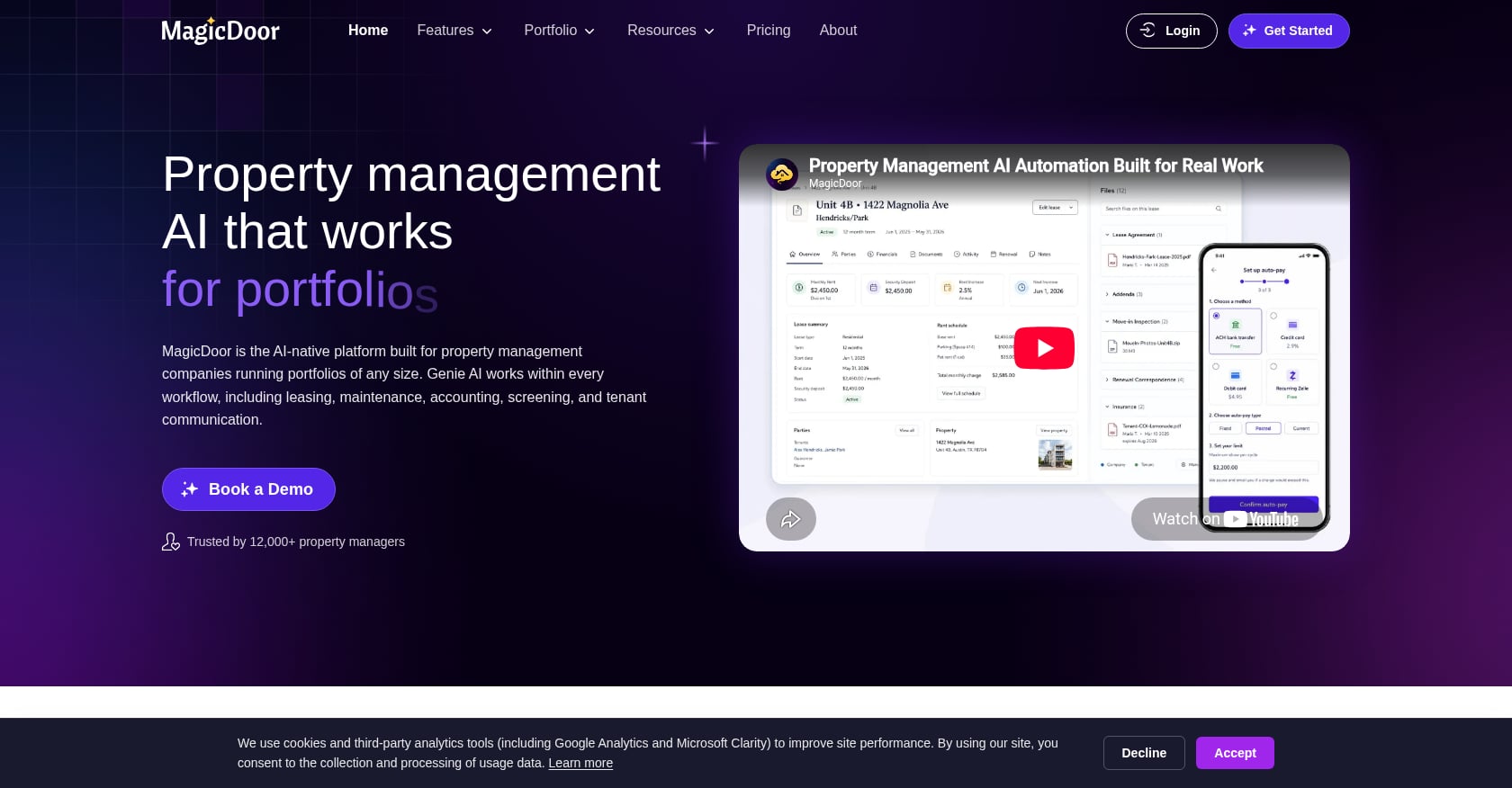
Best for: Growing PM companies (50+ leases) that want multilingual baked into the full platform, not bolted on.
MagicDoor takes a different approach: it’s an AI-native property management platform where multi-language support is included on every pricing tier through its Genie AI system. The translation happens in real time across SMS, the tenant portal, and maintenance workflows.
Key features:
Tenants text the building number in their native language; the message arrives in staff inboxes in English
Localized lease documents, late notices, rent reminders, and renewal letters in each tenant’s preferred language
Conversation history stays threaded with original and translated versions side by side for compliance and audit
No app download required for tenants
The compliance thread is smart design. Having both the original message and the English translation stored together creates a clean audit trail, which matters for fair housing documentation.
Pricing: Contact sales. Multilingual features included at every tier.
Tradeoffs:
Newer platform, less established than AppFolio or Buildium
Requires switching PMS entirely (it is the PMS)
No multilingual voice AI; text-first only
5. STAN AI
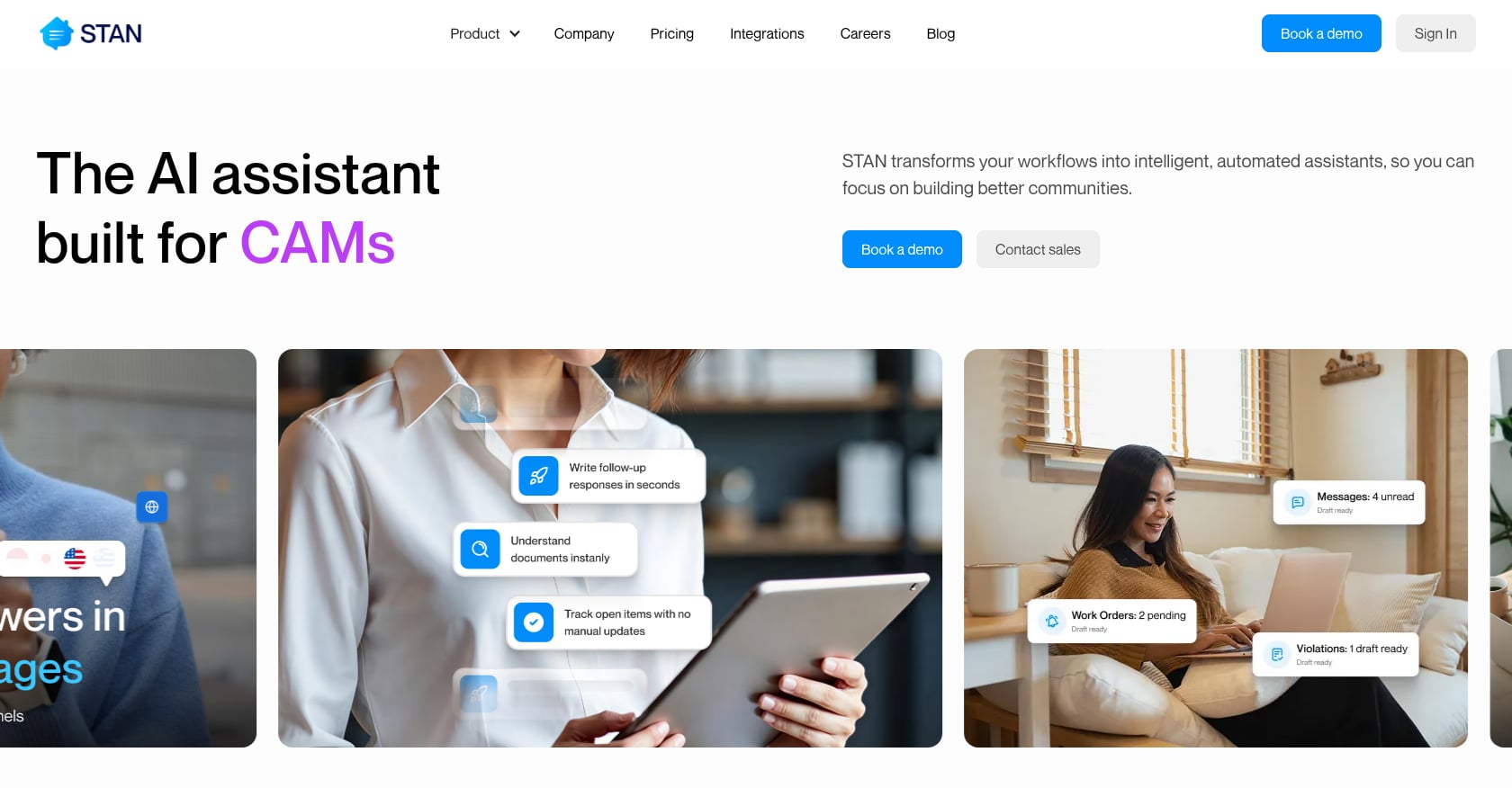
Best for: HOA and community association managers with diverse resident populations.
STAN AI supports over 130 languages, making it the broadest in raw language count on this list. Its TURBO V2 language model offers multilingual and multimodal support across a wide range of channels.
Key features:
Deploys to email, SMS, phone, WhatsApp, Facebook, Instagram, and webchat
Automates resident communications, maintenance requests, and administrative workflows
24/7 support with scheduling for amenities, lease reminders, and service requests
Integrates with PMS platforms including Vantaca and AppFolio
Pricing: Contact sales.
Tradeoffs:
Strongest in HOA and condo management, less focused on multifamily rental leasing workflows
PMS integration depth varies by platform
130+ language claim is impressive, but quality and contextual accuracy across all of them isn’t independently verified
6. Buildium (Lumina AI)
Best for: Buildium users who need basic translation for written communications and don’t require real-time multilingual voice or SMS.
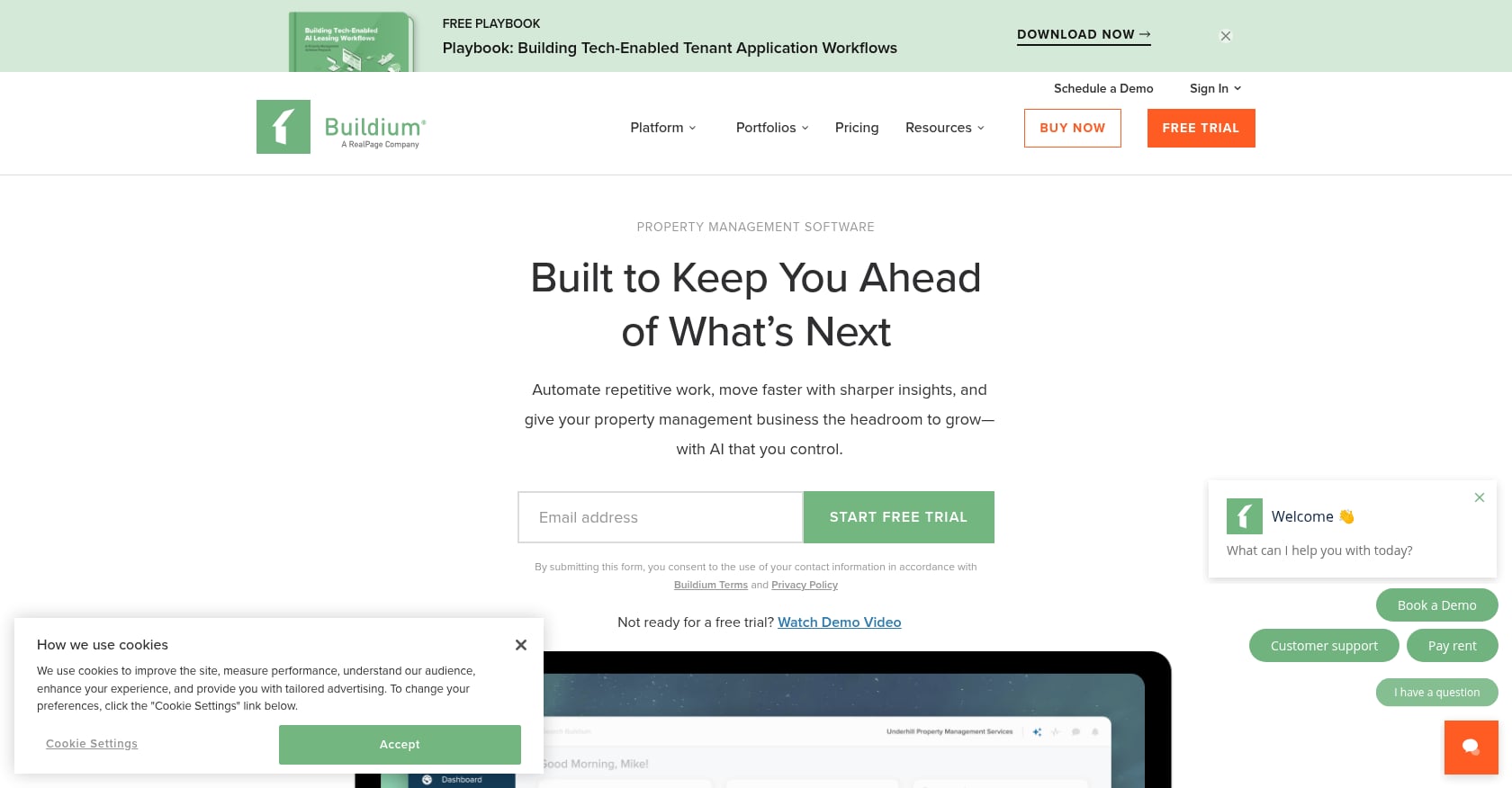
Buildium’s Lumina AI suite includes a “Write with AI” feature that drafts emails, text messages, announcements, and templates with translation support. The catch: it only covers three languages (English, Spanish, and French).
Key features:
AI-assisted drafting for written communications with translation
Bill scanning and internal workflow automation
Native to the Buildium platform
Pricing: Buildium starts at $62/month. Meaningful third-party AI integration requires the Premium plan at $400/month for Open API access.
Tradeoffs:
Only 3 languages supported
No conversational AI for phone calls, SMS, or after-hours coverage
Translation is limited to written templates, not real-time conversation
Requires third-party tools for any multilingual voice or SMS capability
For Buildium users who want deeper multi-language AI capabilities, the Buildium AI integration guide explains how third-party agents can fill the gaps.
7. Property Answer AI
Best for: Property managers who need a bilingual English/Spanish AI answering service with broad PMS integration.
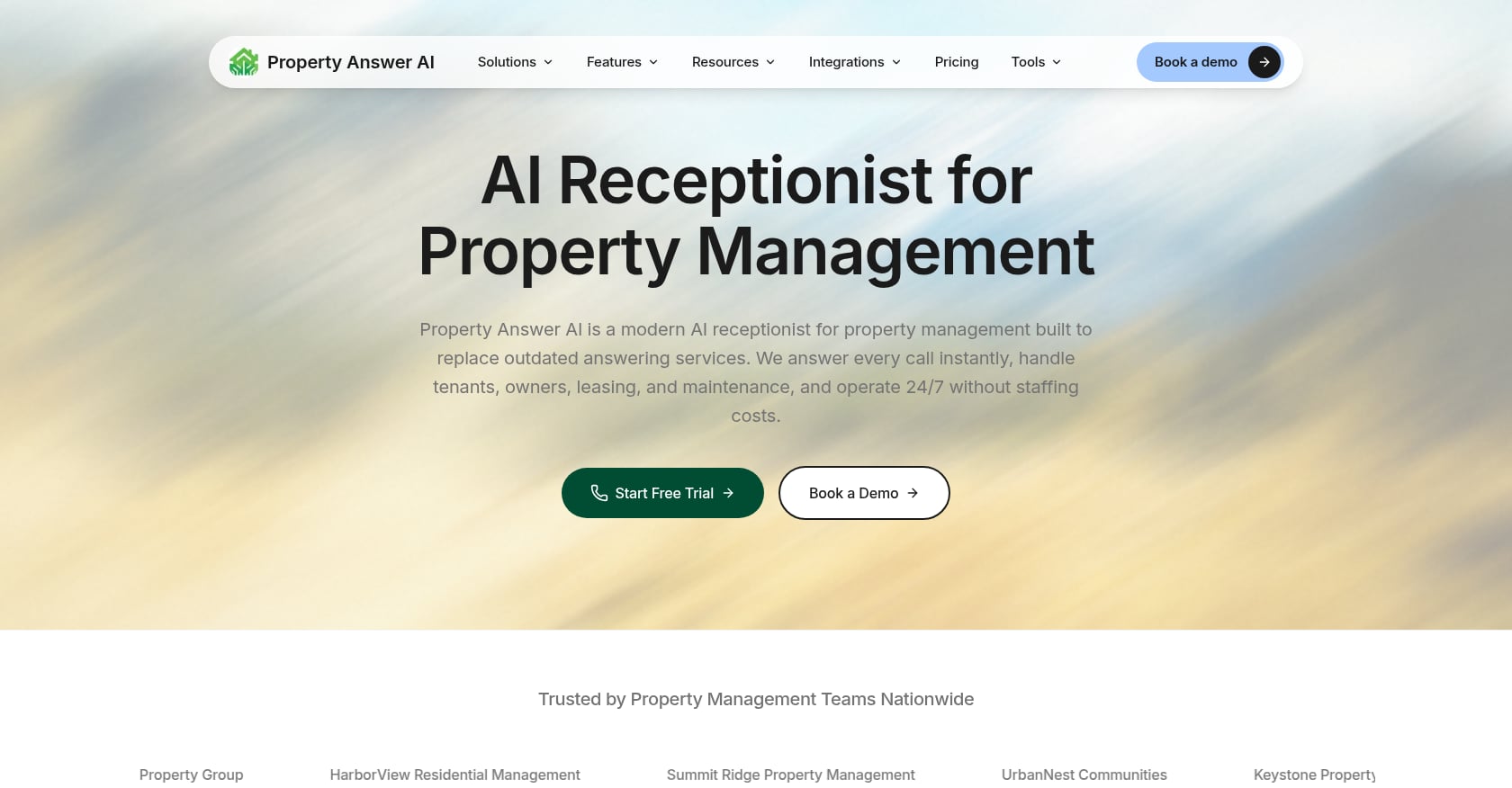
Property Answer AI is an AI receptionist built specifically for property management, with Spanish as its core second language. It’s a focused tool rather than a broad multilingual platform.
Key features:
24/7 AI receptionist with intelligent call routing
Spanish-language voice support
AI leasing assistant and maintenance request intake with emergency escalation
Integrates with AppFolio, Buildium, Rent Manager, Propertyware, Yardi, and Calendly
Connects to 5,000+ tools via Zapier
Pricing: Contact sales.
Tradeoffs:
Limited to Spanish as the only additional language
Newer and less established than most alternatives on this list
Not suitable for portfolios with tenants speaking Vietnamese, Chinese, or other LEP languages
More Languages Does Not Always Mean Better Multilingual AI
A high language count is useful, but it should not be the only metric used to evaluate property management AI. Vendors may count languages differently, and a language may be available for text but not voice, or for translation but not full property-management workflows.
Before choosing a platform, ask five questions:
Is the language supported for voice conversations?
Is it supported for inbound and outbound communication?
Can the AI understand property-management terminology in that language?
Can the AI complete PMS actions after the conversation?
Can a human staff member take over without losing the conversation history?
For example, a tenant may describe a plumbing emergency using regional terminology or a phrase that does not translate literally into English. The important test is whether the AI correctly identifies the maintenance issue, determines its urgency, gathers the required information, and routes the request according to the property's rules.
When evaluating vendors, test the actual languages your tenants use rather than relying only on a published language-count figure.
Voice vs. Text: Why This Distinction Matters
Most tools that claim “multilingual support” only mean text translation. That’s a problem. Phone calls remain the dominant channel for maintenance emergencies and after-hours requests. A tenant with a flooded kitchen at midnight isn’t going to type a message in a portal.
Only a handful of the tools covered here handle multilingual voice calls: Haven, EliseAI, AppFolio Realm-X, STAN AI, and Property Answer AI (Spanish only). MagicDoor and Buildium are text-first.
This distinction should be a primary filter in your evaluation. If your tenants call when something goes wrong (and they do), text-only multilingual support leaves a critical gap. As one practitioner guide from RentPilot noted, multilingual AI is “a configuration and quality challenge, not a technology one.” The underlying language models are capable. The question is whether the tool is set up for real-time voice conversations with proper vocabulary, tone, and escalation rules in each language.
For more on how voice AI works in property management, the voice AI glossary guide breaks down the architecture.
Traditional answering services charge premiums for bilingual staff. Leading AI platforms now include multilingual support across 50+ languages at no per-language surcharge, which fundamentally changes the economics of serving diverse tenant populations.
Why PMS Integration Matters for Multilingual Property Management AI
Translation by itself does not automate property management. The larger productivity gain comes when the AI can turn a multilingual conversation into an action inside the property's existing systems.
For example:
Tenant calls in Spanish → AI identifies the issue → AI gathers details → AI determines urgency → AI creates or updates the work order → staff receives the relevant information → tenant receives a response in Spanish.
That workflow is fundamentally different from simply translating a Spanish message into English.
When evaluating a vendor, ask whether the AI can:
Create and update work orders
Read tenant and lease information
Schedule tours
Update lead records
Add notes to resident records
Route emergencies
Assign vendors
Trigger follow-up messages
Preserve the original language and translated conversation
Transfer the conversation to a human with full context
Also confirm whether the integration is read-only or bidirectional. A vendor appearing on a PMS integration list does not necessarily mean the AI can write changes back into the PMS.
Fair Housing and LEP Compliance
HUD’s Office of General Counsel has issued guidance on how the Fair Housing Act applies to housing providers’ treatment of LEP individuals. The key points property managers need to understand:
LEP is not a protected class. But there’s a tight correlation between limited English proficiency and national origin, which is a protected class. If a property management company applies language-related policies selectively, or uses LEP as a pretext for unequal treatment, that violates the Fair Housing Act.
Multi-language AI reduces this exposure. When an AI agent responds to every tenant in their native language with the same speed and accuracy, there’s no selective treatment to challenge. Every call gets answered. Every maintenance request gets triaged. Every leasing inquiry gets a response. Language doesn’t become a bottleneck or a source of inconsistency.
This is one of the strongest arguments for multi-language property management AI beyond simple convenience. It creates a consistent, documented communication trail regardless of tenant language, which is exactly what you want if a fair housing complaint ever surfaces.
For a deeper look at how AI intersects with fair housing obligations, read the fair housing compliance guide.
How to Choose the Right Multi-Language AI Tool
Start with four questions:
1. What languages do your tenants actually speak? If 90% of your non-English speakers are Spanish-speaking, Property Answer AI or AppFolio Realm-X might suffice. If you manage properties in neighborhoods with Vietnamese, Chinese, Arabic, or Haitian Creole speakers, you need a tool with broader coverage like EliseAI or STAN AI.
2. Do you need multilingual voice, or is text enough? For portfolios where phone calls drive most maintenance requests and after-hours emergencies, text-only translation is insufficient. Haven, EliseAI, and AppFolio Realm-X handle multilingual voice. MagicDoor and Buildium do not.
3. Do you need multilingual leasing, maintenance, or both? Some tools focus on leasing conversations while others emphasize maintenance workflows. Haven and EliseAI cover both. Identify where the communication breakdown hurts most and start there.
4. Does it integrate with your PMS? The best multilingual AI in the world doesn’t help if it can’t create work orders in AppFolio or pull lease data from Yardi. Check integration depth, not just whether your PMS name appears on a partner page. Read the PMS integration best practices guide before evaluating vendors.
See how Haven integrates with your PMS
Multi-Language Property Management AI Buying Checklist
Before signing a contract, ask each vendor these questions:
Language coverage
Which languages are supported today?
Which languages work for voice?
Are inbound and outbound conversations supported?
Are regional accents and common property-management terms supported?
AI capabilities
Can the AI handle maintenance requests?
Can it handle leasing inquiries?
Can it schedule tours?
Can it create work orders?
Can it read property and tenant data?
PMS integration
Which PMS platforms are supported?
Is the integration read-only or bidirectional?
Can the AI create and update records?
What happens when PMS data is missing or incorrect?
Human escalation
Can staff take over a conversation?
Is the full conversation history preserved?
Can escalation rules be configured by issue type?
Can emergency requests bypass normal workflows?
Compliance and security
How are calls and messages stored?
Are transcripts retained?
Can administrators control access to resident information?
How does the vendor handle sensitive resident data?
What human review options are available?
Pricing
Is pricing per unit, property, user, conversation, or channel?
Are multilingual capabilities included?
Are phone minutes charged separately?
Are setup, integration, or implementation fees charged?
Is there a minimum portfolio size?
The best test is to run a real-world pilot using the languages, PMS workflows, and maintenance scenarios your team handles most often.
FAQ
Does multi-language property management AI work for voice calls, or only text?
It depends on the tool. Haven, EliseAI, AppFolio Realm-X, and STAN AI support multilingual voice calls. MagicDoor and Buildium Lumina AI only handle text-based translation. Property Answer AI supports voice but only in Spanish. Since phone calls dominate maintenance emergencies and after-hours requests, voice capability is a critical differentiator.
How many languages do most multi-language property management AI tools support?
The range is wide. STAN AI claims 130+ languages, EliseAI supports 51 written and 34 spoken languages, and Buildium covers just three (English, Spanish, French). The number matters less than whether the tool supports the specific languages your tenants speak, and whether that support extends to voice, not just chat.
Is multi-language AI required for fair housing compliance?
Not explicitly. LEP individuals aren’t a protected class under the Fair Housing Act. However, HUD guidance highlights the close link between limited English proficiency and national origin, which is protected. Inconsistent treatment of LEP tenants can trigger fair housing violations. Multi-language AI helps by treating every tenant identically regardless of language.
Can multi-language AI replace bilingual staff entirely?
For routine communications like maintenance intake, leasing inquiries, and rent reminders, yes. AI handles these consistently and at scale. But complex situations (legal disputes, sensitive resident issues, nuanced negotiations) still benefit from human judgment. The practical approach is using AI for the 60–80% of routine interactions and reserving staff for escalations.
How does real-time AI translation actually work in property management tools?
Most tools follow a similar process: auto-detect the tenant’s language, translate their message into English, run it through comprehension and response models, then translate the reply back. EliseAI and MagicDoor both use this architecture. The key quality factor isn’t the translation itself, which modern LLMs handle well, but the property management context: correct terminology for maintenance issues, appropriate tone, and proper escalation rules per language.
Do I need to switch PMS to get multi-language AI?
Not necessarily. Haven and EliseAI integrate with existing PMS platforms like AppFolio, Yardi, and others. MagicDoor is the exception: it is a PMS, so adopting it means migrating your entire system. AppFolio Realm-X and Buildium Lumina are native to their respective platforms, so they work only if you’re already on those systems.
What’s the typical cost of multi-language property management AI?
Pricing varies significantly. Buildium starts at $62/month but only includes basic text translation in three languages. EliseAI typically runs $200–500 per property per month. Haven and most others require a demo for custom pricing. The cost comparison that matters is multi-language AI versus traditional bilingual answering services, which charge per-language premiums that add up quickly across a portfolio.