Voice AI Property Management: Complete 2026 Glossary
Voice AI Property Management glossary for 2026: maintenance intake, emergency triage, PMS integrations, and 24/7 coverage. Get the essentials.

TL;DR
Voice AI in property management refers to conversational AI systems that answer live phone calls from tenants and prospects, hold natural conversations, and take real actions inside your property management software. It handles maintenance intake, leasing inquiries, emergency triage, vendor dispatch, and tour scheduling around the clock. Unlike IVR phone trees or basic answering services, purpose-built voice AI agents read and write data in your PMS, turning every call into an operational outcome rather than just a message.
Property management runs on phone calls. Maintenance emergencies at 2 a.m., leasing inquiries during lunch breaks, vendor coordination between site visits. A modern property management firm fielding 30 to 80 inbound calls per day can’t afford to let them go to voicemail, yet studies show 49 to 60% of calls to multifamily properties go unanswered, and 85% of those callers never call back.
Voice AI is the technology filling that gap. This glossary breaks down every term you need to understand it, organized by function, so you can evaluate the category with confidence.
Explore Haven’s AI property management software to see how voice AI works in practice.
Direct Answer:
Voice AI in property management is an AI-powered phone system that can speak with tenants, prospects, owners, and vendors, understand their requests, and take actions inside property management software. Unlike an IVR or traditional answering service, a property-management voice AI agent can use PMS data to create work orders, answer leasing questions, schedule tours, triage maintenance calls, send messages, and escalate emergencies to a human.
The most important capability to evaluate is PMS integration. A voice AI system that only answers calls or records messages provides communication support; a system with bi-directional PMS integration can read property data and write completed actions back into the PMS.
Voice AI Property Management Glossary at a Glance
Term | Simple Definition |
|---|---|
Voice AI | AI software that understands and responds to spoken conversations. |
Voice AI Agent | An AI system that handles phone conversations and performs tasks based on them. |
Conversational AI | AI designed to communicate through natural back-and-forth dialogue. |
NLP | Technology that helps AI understand human language and intent. |
Speech-to-Text | Converts spoken language into text the AI can process. |
Text-to-Speech | Converts AI-generated text into spoken audio. |
IVR | A menu-based phone system using prompts such as “Press 1 for leasing.” |
PMS | Property management software used to manage residents, units, leases, maintenance, and operations. |
PMS Integration | A connection between the AI system and property management software. |
Bi-Directional Integration | An integration that allows the AI to both read and write PMS data. |
Maintenance Intake | Collecting information from a resident about a maintenance problem. |
Emergency Triage | Determining whether a call requires immediate escalation. |
Work Order Automation | Automatically creating a maintenance work order from a conversation. |
Vendor Dispatch | Assigning and notifying a vendor about a maintenance request. |
After-Hours Coverage | Handling calls outside normal property-management office hours. |
Tour Scheduling | Automatically booking property tours through voice conversations. |
Lead Qualification | Collecting information to determine whether a prospect fits leasing criteria. |
Speed-to-Lead | The time between receiving a prospect inquiry and responding to it. |
Call Containment | The percentage of calls resolved without human intervention. |
First-Call Resolution | The percentage of calls resolved during the initial interaction. |
Warm Transfer | Transferring a caller to a human while preserving conversation context. |
Call Transcription | Converting a recorded conversation into searchable text. |
Fair Housing Guardrails | Rules designed to reduce discriminatory behavior in automated leasing interactions. |
TCPA Compliance | Compliance with U.S. rules governing certain automated calls and text messages. |
AI-to-Human Handoff | The process of transferring an AI conversation to a human employee. |
What Is Voice AI in Property Management?
Voice AI in property management is a conversational AI system that handles live phone calls with tenants, prospects, and vendors using natural language processing. It picks up inbound calls, understands what the caller needs through actual conversation, and takes action: creating work orders, booking tours, escalating emergencies, or dispatching vendors.
The key distinction is between conversation and action. A traditional answering service takes a message. An IVR phone tree routes you through menus. A basic AI transcription tool converts voicemail to text. A purpose-built voice AI agent does something with the information it gathers. It writes a work order into AppFolio. It schedules a tour in your calendar. It texts the on-call plumber. That “action gap” is what separates voice AI property management tools from everything that came before.
As one evaluation framework from Voicetta put it: “Tenants don’t object to AI in the abstract. They object to bad calls. A fast, accurate, professional conversation usually goes unnoticed. A slow, confused one feels worse than a missed call.” The conversational quality of modern voice AI has reached the point where callers often don’t realize they’re speaking with an AI system.
The global voice AI agents market is expected to reach $47.5 billion by 2034, up from $2.4 billion in 2024, and property management is one of its fastest-moving verticals.
The Technology
Voice AI Agent
A voice AI agent is the core product in this category. It’s software that answers phone calls, speaks in natural language, understands caller intent, and takes operational actions based on the conversation. Think of it as a trained leasing agent or maintenance coordinator who never sleeps, never calls in sick, and handles multiple calls simultaneously.
In property management, voice AI agents are typically trained on property-specific data: unit details, lease terms, maintenance protocols, vendor lists, and emergency procedures. This property-specific training is what makes them useful rather than generic.
AI Agent vs. Chatbot
A chatbot primarily provides information through a conversational interface, while an AI agent can use tools, access business systems, and perform actions on a user's behalf.
In property management, a chatbot might answer a question about office hours. A voice AI agent could answer the same question and then schedule a tour, create a maintenance request, update a resident record, or transfer the caller to an employee.
The practical distinction is action capability. When evaluating a property-management AI agent, ask what actions it can complete rather than simply how naturally it can talk.
Natural Language Processing (NLP)
NLP is the underlying technology that lets a voice AI agent understand human speech, including its messiness. Tenants don’t call and say “I’d like to submit a maintenance request for a plumbing issue in unit 4B.” They say “My toilet’s been running all night and it’s driving me crazy.” NLP parses that into structured data: issue type (plumbing), urgency (non-emergency), unit (identified from the caller’s phone number or verbal confirmation), and sentiment (frustrated).
In the property management context, NLP must handle accents, background noise, emotional callers describing emergencies, and the specialized vocabulary of building systems. Purpose-built platforms train their NLP models on thousands of real property management calls, not generic customer service transcripts.
Large Language Model (LLM)
A large language model (LLM) is the AI model that generates and interprets natural-language responses. In a voice AI property management system, the LLM helps interpret what a caller says, determine the caller's intent, generate an appropriate response, and decide what information or action is needed next.
The LLM is not the entire voice AI system. A production voice agent typically combines several components, including speech recognition, an LLM, text-to-speech, business rules, integrations, authentication, and escalation logic.
For property management, the distinction matters because a general-purpose LLM may understand language but does not automatically know a property's availability, maintenance procedures, vendor list, lease information, or emergency protocols. Those capabilities come from the system's knowledge base, integrations, and configured workflows.
Conversational AI vs. IVR
IVR (Interactive Voice Response) is the “press 1 for leasing, press 2 for maintenance” system most callers hate. It’s a decision tree, not a conversation. If the caller’s need doesn’t match a menu option, they’re stuck.
Conversational AI holds an actual back-and-forth dialogue. The caller states their need in their own words, the AI asks clarifying questions, and the conversation flows naturally. This distinction matters because caller satisfaction and completion rates are dramatically higher with conversational AI. An IVR system forces the caller to adapt to the technology. Voice AI adapts to the caller.
Speech-to-Text and Text-to-Speech
These are the two conversion layers in any voice AI system. Speech-to-text (STT) converts the caller’s spoken words into text that the AI can process. Text-to-speech (TTS) converts the AI’s response back into spoken audio. The quality of both directly affects the caller experience. Modern TTS voices sound remarkably natural, with appropriate pausing, intonation, and even filler words that make the conversation feel human.
Conversation Memory and Continuity
This refers to the AI’s ability to remember context across interactions. If a tenant called yesterday about a leaky faucet and calls today to check on the status, a voice AI agent with conversation memory knows the history. It doesn’t ask the tenant to repeat everything. It can say “I see we have an open work order for the kitchen faucet in your unit. The plumber is scheduled for Thursday.”
This capability depends heavily on PMS integration. The AI pulls historical data from the property management system and uses it to provide contextual, personalized responses. Without it, every call starts from scratch.
For a deeper look at how AI maintains context and logs interactions, see this guide on AI notes and logging in property management systems.
AI Knowledge Base
An AI knowledge base is the collection of property-specific information that an AI system uses to answer questions and complete workflows accurately. It can include property amenities, office hours, parking rules, pet policies, application requirements, maintenance procedures, leasing information, community policies, and emergency instructions.
A knowledge base is different from PMS integration. The knowledge base provides information the AI has been configured to use, while a PMS integration allows the AI to retrieve or update live operational data.
For example, an AI may use its knowledge base to explain a property's pet policy while querying the PMS to determine whether a specific unit is currently available.
What Makes a Property Management Voice AI Agent Different?
A property-management voice AI agent differs from a generic phone bot because it combines conversational AI with property-specific knowledge, business rules, PMS or CRM integrations, and operational workflows.
The core capabilities to look for are:
Natural-language phone conversations
Property-specific knowledge
Resident and prospect identification
PMS and CRM integration
Work-order creation
Tour scheduling
Emergency escalation
Vendor routing
Human handoff
Call transcription and logging
Configurable business rules
Security and access controls
The key evaluation question is simple: Can the system only talk, or can it safely complete the next step in the property-management workflow?
Property Management Workflows
This is where voice AI property management gets practical. These are the specific tasks that voice AI handles on a daily basis.
Maintenance Intake
Maintenance intake is the process of collecting work order details from a tenant by voice. The AI identifies who’s calling, confirms the unit, asks what the issue is, determines urgency, and gathers enough detail for a technician to act. A good maintenance intake conversation captures the same information a skilled property manager would: location of the issue within the unit, when it started, whether it’s affecting habitability, and whether the tenant has attempted any troubleshooting.
One property manager interviewed by Vellum’s research team described her daily reality: “She spends half her day just fielding calls and entering work orders, and the other half catching up on the work she couldn’t do while she was on the phone.” Voice AI eliminates that bottleneck entirely.
Haven’s Maintenance AI handles this workflow end-to-end, from intake through work order creation and vendor dispatch.
Maintenance Intent Detection
Maintenance intent detection is the process of identifying what a resident needs from their description of a problem. The AI converts an unstructured conversation into structured information such as issue type, location, urgency, symptoms, and requested action.
For example, a resident might say, “There's water coming through the ceiling in the bedroom.” The AI can identify the likely maintenance category, ask follow-up questions, determine whether the situation meets the property's emergency criteria, and route the request according to configured procedures.
Intent detection should support human-defined escalation rules rather than replace them, especially for safety-related maintenance issues.
Emergency Triage and Escalation Logic
This is the safety-critical function in any voice AI property management system. When a tenant calls about a gas leak, a flood, or a fire, the AI must recognize the emergency and act immediately, not schedule a callback for the next business day.
Emergency triage uses predefined rules to classify call urgency. A broken garbage disposal is a routine maintenance request. A broken water heater in January is urgent. A gas smell is an emergency requiring immediate human escalation. The AI routes each category differently: routine requests become work orders, urgent issues get prioritized, and true emergencies trigger an immediate warm transfer to an on-call technician or emergency services.
Practitioners emphasize getting this right from day one. Deployment guidance from Famulor recommends that teams “define escalation crisply: who handles which emergency? Hard-code phone numbers and on-call windows, not voicemail.” There’s no room for ambiguity when someone’s safety is at stake. For a deeper breakdown, read about emergency maintenance triage protocols.
AI Call Routing
AI call routing is the process of determining where a call should go based on the caller's identity, intent, urgency, property, or requested service.
For example, a leasing inquiry may remain with the AI, a routine maintenance request may become a work order, and an emergency maintenance issue may be transferred to an on-call employee.
Effective routing combines AI intent detection with predefined business rules. The AI should not be the only layer deciding how safety-critical calls are handled.
Work Order Creation (AI-to-PMS)
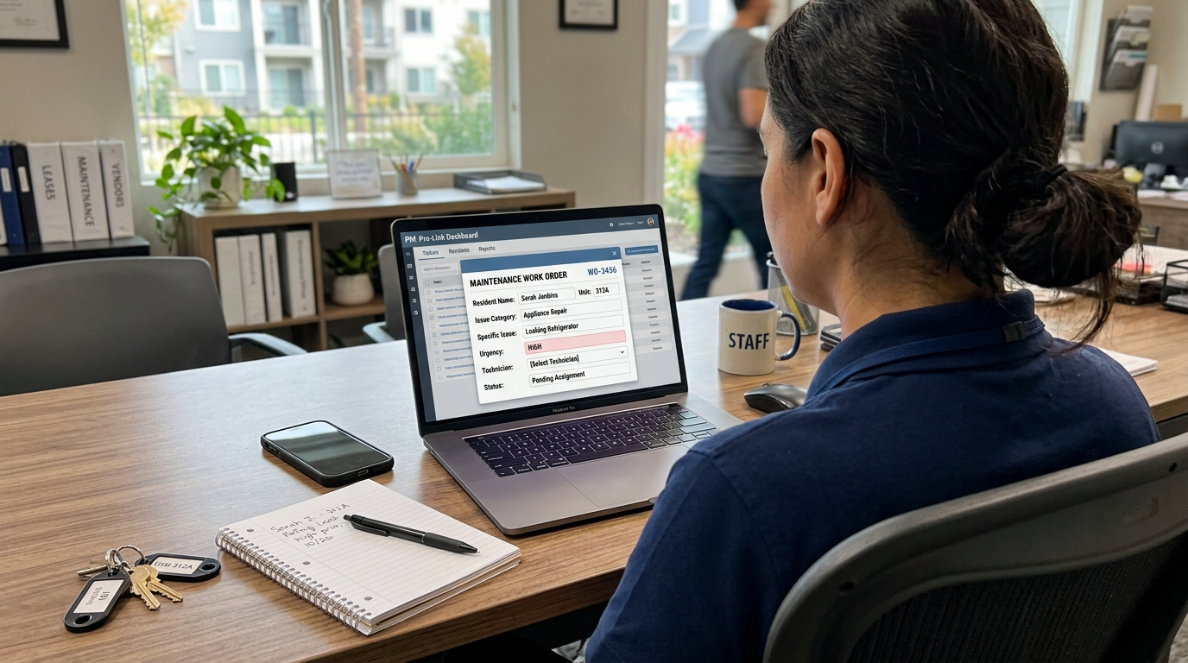
This is where voice AI crosses the line from answering service to operational tool. After completing a maintenance intake call, the AI writes a structured work order directly into your property management software. Not a summary email. Not a note for someone to process later. An actual work order with the tenant’s name, unit number, issue category, urgency level, and description, created in real time while the call is still wrapping up.
This capability requires bi-directional PMS integration (more on that below). The AI reads from the PMS to confirm tenant and unit details, then writes back the new work order. The result is zero data entry for your staff and zero delay between the call and the work order appearing in the system.
Vendor Dispatch
Vendor dispatch takes work order creation one step further. After creating the work order, the AI automatically assigns it to the appropriate vendor from your preferred vendor list and notifies them. If the plumbing issue requires your contracted plumber, the AI identifies the right vendor, checks availability based on your dispatch rules, and sends the assignment.
This saves the step where a property manager reviews the work order, looks up the vendor, and manually makes the assignment. For after-hours calls especially, vendor dispatch means a technician can be on the way before your office opens in the morning. Learn more about how vendor dispatch automation works in practice.
After-Hours Coverage
After-hours coverage is the single biggest driver of voice AI adoption in property management. It’s also the use case with the clearest ROI. Emergencies don’t wait for business hours, and the cost of missed after-hours calls ranges from tenant dissatisfaction to legal liability.
Traditional after-hours solutions include answering services (expensive per minute, no PMS access, inconsistent quality) or on-call staff (burnout, overtime costs, single point of failure). Voice AI provides 24/7 coverage at a fraction of the cost, with consistent quality and full PMS integration on every call.
Haven’s after-hours answering service is purpose-built for this use case, combining voice AI with emergency escalation and PMS write-back.
Tour Scheduling
For leasing teams, tour scheduling by voice is a high-value capability. When a prospect calls to ask about availability, the voice AI can check current vacancies in the PMS, answer questions about pricing and amenities, qualify the prospect, and book a tour, all in a single call. The tour shows up on the leasing agent’s calendar without any manual entry.
Lead Qualification (by Voice)
Lead qualification happens during the same leasing call. The AI asks screening questions (move-in date, number of occupants, pets, budget) and captures the answers as structured data in the PMS or CRM. This means your leasing team starts their day with pre-qualified leads rather than a stack of voicemails to return.
ILS Lead Capture
ILS stands for Internet Listing Service, the platforms where renters search for apartments: Zillow, Apartments.com, Realtor.com, and others. Voice AI agents can capture and respond to leads from these platforms automatically. When a prospect submits an inquiry through Zillow, the AI can call or text them within seconds, answer their questions, and schedule a tour.
This matters because of a metric called speed-to-lead. Research consistently shows that the first property to respond to an inquiry wins the tour. As one leasing AI provider put it: “The showing you never got to give doesn’t show up anywhere as a loss. It just never happened.” That invisible loss is the real cost of slow leasing coverage.
Haven’s Leasing AI handles ILS lead capture from Zillow and Apartments.com, responding to inquiries in seconds rather than hours.
Integration and Infrastructure
API Integration
An API integration connects a voice AI platform with another software system so the two systems can exchange information or trigger actions. In property management, APIs can connect voice AI with PMS platforms, CRMs, calendars, communication systems, vendor-management tools, and other operational software.
The important question is not simply whether a vendor “integrates” with a PMS. Ask what the integration can actually do. A read-only integration may allow an AI to retrieve tenant or unit information, while a read-write integration may allow it to create work orders, update records, schedule appointments, or add notes.
PMS Integration (Bi-Directional)
This is the single most important technical capability in voice AI property management. Bi-directional means the AI can both read from and write to your property management software. Reading means pulling up tenant records, unit details, lease dates, and open work orders during a call. Writing means creating new records, guest cards, work orders, and notes after the call.
Practitioners on forums and in deployment guides consistently identify PMS integration as the make-or-break factor. Without it, “the AI is just an answering service with a different voice.” Property management runs on PMS platforms like AppFolio, Yardi, RealPage, Buildium, Entrata, and Rent Manager. Any voice AI that can’t connect to these systems can’t take meaningful action.
For AppFolio users specifically, this guide to AppFolio AI integration covers how read-write access works.
CRM Sync
CRM sync is the leasing equivalent of PMS integration. When the AI qualifies a prospect and books a tour, that data needs to flow into your CRM (or your PMS’s built-in CRM) as a guest card or lead record. Without CRM sync, your leasing team has to manually enter prospect information that the AI already collected.
Multichannel Communication (Voice + SMS + Email)
Modern voice AI property management platforms don’t just handle phone calls. They operate across voice, SMS, and email from a single system. A tenant might call about a maintenance issue, receive a text confirmation with the work order number, and get an email when the vendor is scheduled. A prospect might get a text follow-up after a leasing call, then an email with virtual tour links.
Multichannel matters because tenants and prospects communicate on their preferred channels. A system that only handles voice misses the 70% of interactions that happen via text and email.
Warm Transfer and Human Escalation
A warm transfer is when the AI hands a call to a real person with full context. The human doesn’t start from zero because the AI passes along everything it’s gathered: who’s calling, what they need, what’s already been discussed, and why escalation was triggered. This is the opposite of a cold transfer, where the caller gets dumped into a queue and has to repeat everything.
The best voice AI systems follow an 80/20 model: the AI handles roughly 80% of routine calls independently, while the 20% that require human judgment, sensitivity, or authority get warm-transferred to the right person. A 500-unit multifamily operator reduced after-hours call escalations by 67% using voice AI to triage maintenance requests, meaning only genuine emergencies reached the on-call team.
Call Transcription and Logging
Every voice AI call produces a full transcript and structured summary. These get stored in the PMS or a connected system, creating an automatic audit trail. This is valuable for three reasons: accountability (you can review any call), training (you can identify patterns in tenant issues), and legal protection (you have documentation of every interaction, including maintenance requests that carry habitability implications).
Resident Verification and Caller Authentication
Resident verification is the process of confirming that a caller is authorized to access or change information associated with a property, unit, lease, or account.
Voice AI systems may use information such as phone numbers, names, unit numbers, account details, one-time verification codes, or other configured authentication methods.
This matters because a voice AI system with PMS access may be able to retrieve sensitive resident information or initiate operational actions. The authentication process should therefore match the sensitivity of the requested information or action.
Performance and Evaluation Metrics
Speed-to-Lead
Speed-to-lead measures how quickly you respond to a new leasing inquiry. Industry data shows that responding within five minutes versus thirty minutes can mean the difference between booking a tour and losing the prospect to another property. Voice AI responds in seconds, which is why operators report a 20% increase in lead-to-tour conversions after adoption.
First-Call Resolution
First-call resolution (FCR) measures the percentage of calls resolved without requiring a callback or transfer. High FCR means tenants get answers and actions on their first call. Voice AI achieves high FCR for routine matters (maintenance intake, tour scheduling, status checks) because it has real-time access to PMS data.
Call Containment Rate
Call containment rate measures how many calls the AI handles completely without human involvement. A purpose-built voice AI property management system typically achieves 70 to 85% containment. The remaining calls escalate to humans. A higher containment rate doesn’t always mean better service; it means the AI is handling the right calls independently and escalating the right calls to people.
Missed Call Rate
The metric that started it all. Property management companies have some of the highest missed call rates across any industry, over 60% in many cases. Small property management businesses lose over $21,000 annually from missed calls. A single missed leasing inquiry can represent $1,000 to $30,000 in lost rental income over the lease term, depending on the property type and market. Voice AI reduces missed call rates to near zero because the AI is always available.
For more on measuring AI performance, see this guide to AI KPIs and benchmarks for property managers.
AI-to-Human Handoff Rate
This measures how often the AI transfers calls to a human agent. It’s the inverse of containment rate. A handoff rate of 15 to 30% is typical and healthy. If it’s too low, the AI might be handling calls it shouldn’t. If it’s too high, the AI isn’t trained well enough or lacks sufficient PMS access to resolve calls independently.
Compliance and Governance

Compliance doesn’t get enough attention in voice AI property management discussions. Most glossaries and guides treat it as a footnote. It shouldn’t be. These are terms with real legal consequences.
Fair Housing Guardrails
Fair Housing guardrails are the rules built into voice AI systems to prevent discriminatory outcomes. HUD’s 2023 guidance holds property managers liable for discriminatory outcomes from third-party AI tools. The most common compliance failures aren’t dramatic acts of intentional discrimination. They’re automation patterns that create unequal outcomes at scale. For example, a system that answers pricing questions instantly but delays accessibility inquiries until a human agent becomes available creates unequal service access.
A purpose-built voice AI property management platform addresses this by treating all inquiry types with equal responsiveness and by avoiding questions or language that could violate Fair Housing laws. As one deployment guide warned: “Fair Housing guardrails, topic boundaries, escalation logic, none of that comes pre-built. You’re making design decisions that have real legal consequences.”
For a comprehensive look at this topic, read the AI and Fair Housing compliance guide.
TCPA Compliance
The Telephone Consumer Protection Act (TCPA) is a federal law regulating telemarketing calls, auto-dialed calls, prerecorded calls, and text messages. Violations carry penalties of $500 to $1,500 per message. Voice AI systems that send automated texts to prospects or make outbound voice calls must comply with TCPA consent requirements. This means obtaining proper consent before automated outreach, maintaining do-not-call lists, and providing opt-out mechanisms.
Habitability Response Requirements
Fair Housing gets most of the attention, but habitability is equally significant. Most states require landlords to respond to habitability issues within legally defined timeframes. When a resident calls about a sewage backup or heating failure, they’re not just making a service request. They’re creating a legal record. Voice AI that timestamps the call, transcribes it, creates a work order, and dispatches a vendor within minutes provides documentation that the property manager responded promptly, which is exactly what you need if the situation ever becomes a legal matter.
Disparate Impact (in AI Context)
Disparate impact occurs when a policy or practice that appears neutral on its face disproportionately affects a protected class. In the voice AI context, this could mean an AI system that systematically provides slower service to non-native English speakers, or that routes certain callers to voicemail more frequently based on patterns correlated with protected characteristics. Testing for disparate impact requires analyzing call handling data across demographic groups.
Data Security (API/PMS)
When a voice AI system reads and writes data to your PMS, it’s handling sensitive tenant information: names, phone numbers, unit numbers, lease terms, and payment history. API security, encryption in transit and at rest, access controls, and data retention policies all matter. Ask any vendor about SOC 2 compliance, data encryption standards, and whether call recordings are stored in HIPAA-adjacent security environments.
Voice AI vs. Traditional Alternatives
Understanding the differences between voice AI and older solutions is critical for making the right choice.
Feature | IVR / Phone Tree | Traditional Answering Service | Basic AI Transcription | Purpose-Built Voice AI Agent |
|---|---|---|---|---|
Interaction type | Menu-driven | Human reads script | Voicemail to text | Natural conversation |
PMS integration | None | None | None | Bi-directional read/write |
Work order creation | No | No | No | Yes, automatic |
Vendor dispatch | No | No | No | Yes, automatic |
Tour scheduling | No | Manual (sometimes) | No | Yes, automatic |
Emergency triage | Basic routing | Script-dependent | No | AI-powered with escalation |
Cost model | Low fixed cost | Per minute ($0.75-$1.50+) | Low fixed cost | Per unit or flat monthly |
Consistency | Perfect (but rigid) | Variable by operator | N/A | Consistent |
Scalability | Unlimited | Limited by staffing | Unlimited | Unlimited |
Available 24/7 | Yes | Usually | Yes | Yes |
The pattern is clear. Budget tools that just transcribe voicemails are a different category entirely from AI agents that take operational actions. If your primary need is reducing the manual work of processing calls and creating records, only purpose-built voice AI closes that loop.
For a more detailed comparison, see this breakdown of answering services vs. AI for property management.
Key Statistics at a Glance
These numbers frame why voice AI property management adoption is accelerating:
AI adoption among property managers increased from 21% in 2024 to 34% in 2025, with 82% of real estate agents now using AI tools and 68% saving 1+ hour per week.
Missed call cost: Small property management businesses lose over $21,000 annually from missed calls. A single missed leasing inquiry can represent $1,000 to $30,000 in lost rental income.
Turnover cost: Total turnover cost runs approximately $3,872 per resident according to Zego’s Resident Experience Management survey.
Cost reduction: Companies report 35 to 50% reduction in customer service operations costs, with 3-year ROI between 331% and 391%.
Market growth: The global voice AI agents market is projected to reach $47.5 billion by 2034, growing at a 34.8% CAGR.
Contact center savings: Gartner projects that contact centers will save $80 billion in 2026 from conversational AI alone.
Frequently Asked Questions
Can voice AI handle emergency maintenance calls?
Yes, and this is one of its most important functions. Purpose-built voice AI property management systems use emergency triage logic to identify life-safety issues (gas leaks, flooding, fire, no heat in winter) and immediately escalate them. The best systems warm-transfer emergency calls to an on-call technician with full context, rather than just taking a message. The AI also creates an emergency work order in the PMS simultaneously, ensuring documentation from the first moment.
Will tenants know they’re talking to AI?
Most won’t, unless told. Modern voice AI sounds natural enough that callers typically don’t notice a difference. That said, some jurisdictions and company policies require disclosure. The more important question is whether tenants care. Evidence from practitioners suggests they care about getting their issue resolved quickly, not about who (or what) resolves it. To hear what a real AI maintenance call sounds like, check out this AI maintenance call example.
Does voice AI replace my leasing team or maintenance staff?
No. Voice AI handles the repetitive, high-volume calls that consume your team’s time: basic leasing inquiries, routine maintenance intake, status checks, tour scheduling, and after-hours coverage. Your team focuses on the work that requires human judgment, such as complex resident issues, property inspections, vendor negotiations, and relationship building. The 80/20 model applies: AI handles 80% of routine calls so your people can focus on the 20% that matter most.
What PMS systems does voice AI integrate with?
The major platforms include AppFolio, Yardi, RealPage, Buildium, Entrata, and Rent Manager. Integration depth varies by vendor. Some only read data from the PMS. Others offer full bi-directional integration with read and write capabilities. The write side is what matters most, because that’s where work orders get created, guest cards get populated, and tours get scheduled without manual entry.
Is voice AI Fair Housing compliant?
Voice AI is a tool, and like any tool, its compliance depends on how it’s configured. A well-built system applies consistent treatment to every caller regardless of protected class characteristics. It avoids steering, doesn’t ask prohibited questions, and handles all inquiry types with equal responsiveness. HUD holds property managers responsible for outcomes from third-party AI tools, so choosing a vendor that builds Fair Housing guardrails into the product, not as an afterthought, is essential.
How long does it take to deploy voice AI?
Deployment timelines vary. Some vendors advertise setup in as little as 24 hours. More thorough implementations that include PMS integration, property-specific training, emergency protocol configuration, and testing typically take one to four weeks. Practitioners recommend spending time upfront curating your knowledge base (property FAQs, maintenance protocols, leasing criteria) because, as one deployment guide put it, “it saves weeks of flow complexity later.”
What does voice AI cost compared to a call center?
Traditional answering services charge $0.75 to $1.50+ per minute, which adds up fast across hundreds of monthly calls. Call centers with property management training are even more expensive. Voice AI typically uses a flat monthly fee or per-unit pricing model, making costs predictable and usually 35 to 50% lower than human-staffed alternatives. For a detailed cost comparison, read this AI call center pricing guide.
Getting Started with Voice AI Property Management
The category is moving fast. AI adoption among property managers jumped from 21% to 34% in a single year, and purpose-built solutions are now available for portfolios of every size. The operators who move early capture the benefits first: lower costs, faster leasing response times, better after-hours coverage, and staff freed from repetitive phone work.
The most important thing to evaluate is whether a voice AI system takes action in your PMS or just takes messages. That distinction determines whether you’re buying a better answering service or a genuine operational upgrade.
See how Haven’s AI agents work across maintenance, leasing, and after-hours workflows, with bi-directional PMS integration and vendor dispatch built in.