Scaling Property Management Operations in 2026: 5 Keys
Learn how scaling property management operations drives operating leverage with SOPs, automation, and AI. See the 2026 playbook to grow profitably.

TL;DR
Scaling property management operations means growing your portfolio without proportionally increasing costs or headcount. It’s not the same as growth. Most firms hit their first operational ceiling between 80 and 150 doors, where manual processes start breaking. The path through these ceilings involves standardized workflows, automation of repetitive tasks, and increasingly AI agents that take real actions inside your property management software. Firms with mature automation can manage 200+ doors per employee, compared to 60-80 with traditional workflows.
Quick Answer: How Do You Scale Property Management Operations?
Property management operations scale when a company adds units faster than it adds operating costs, employees, and administrative workload. The most effective approach is to standardize core workflows, centralize data in a property management system, automate repetitive tasks, use AI for routine operational decisions, and hire specialists only where human judgment is required. Track doors per employee, cost to serve, maintenance response time, leasing speed, delinquency, and renewal rates as the portfolio grows.
Key Takeaways
Standardize before you automate. Automation amplifies a process, so inefficient workflows should be fixed before they are automated.
Automate repetitive work before hiring additional staff. Maintenance intake, leasing responses, payment reminders, reporting, and routine communication are strong candidates.
Measure scalability using productivity metrics, not headcount alone. Doors per FTE and cost to serve show whether operational leverage is actually improving.
Maintenance is usually one of the first major bottlenecks. High request volume, vendor coordination, emergency calls, and follow-up create significant administrative workload.
AI is most valuable when it can take actions, not simply generate responses. The strongest use cases connect directly to the PMS and execute defined workflows.
Scaling does not necessarily mean maximizing door count. Some operators may achieve better profitability by optimizing an existing portfolio rather than pursuing unlimited growth.
What Scaling Property Management Operations Actually Means
Scaling is not growth. That distinction matters more than anything else in this article.
Growth means adding more doors, which usually means adding more people, more costs, and more complexity at roughly the same rate. You manage 100 units with 2 people, so you manage 200 units with 4 people. Revenue doubles. Costs double. Margin stays flat or shrinks.
Scaling property management operations means something different: expanding the number of units you manage without a proportional increase in resources. You manage 100 units with 2 people, then you manage 200 units with 2.5 people. Revenue doubles. Costs go up modestly. Margin expands.
This is what the industry calls operating leverage, and it’s the entire game for property management companies trying to build sustainable businesses.
The US property management services market was valued at $84.73 billion in 2025 and is projected to reach $106.58 billion by 2031. Of the roughly 304,000 PM businesses in the United States, 47% manage between 50 and 499 units. That means nearly half the industry is sitting right in the zone where scaling becomes the central operational challenge.
For a deeper look at how AI fits into this picture, see our guide to AI-powered scaling.
Why Scaling Matters Now
Three forces are converging to make scaling property management operations urgent rather than optional.
Rising costs with flat margins. According to Buildium’s 2026 industry report, 93% of property management companies reported expense increases. Labor, insurance, and materials costs keep climbing. If your cost structure scales linearly with your door count, these increases eat you alive.
Tenant expectations have shifted permanently. Tenants expect instant responses, 24/7 availability, and digital-first communication. Meeting those expectations at 50 doors is manageable. Meeting them at 200 doors with the same team and the same processes is not.
AI adoption is creating a two-tier industry. Firms that have broadly adopted AI expect an average portfolio growth of 31% in 2026, nearly triple the 12% growth anticipated by those yet to implement the technology. That gap will widen. Companies that don’t figure out how to scale efficiently will lose market share to those that do.
The Standardize → Automate → Delegate → Measure Framework
A scalable property management operation can be built using four sequential steps:
1. Standardize: Define the correct process and document it.
2. Automate: Remove repetitive manual steps that follow predictable rules.
3. Delegate: Assign judgment-heavy or relationship-driven work to the appropriate employee or specialist.
4. Measure: Track whether the workflow is improving cost, speed, quality, and capacity.
The sequence matters. Automating a broken process simply makes the broken process happen faster. Delegating an undocumented process creates inconsistent results. Measuring only revenue and door count can hide deteriorating service quality.
A scalable workflow should therefore answer four questions: What is the standard process? What can technology execute? What requires human judgment? Which metric proves the workflow is working?
The Five Stages of Scaling
Multiple sources across the industry identify consistent breakpoints where operations tend to buckle. No single competitor article maps these into a clear stage model, but the pattern is unmistakable when you pull the data together.
Stage | Approx. Portfolio | Primary Challenge | What Usually Breaks | Main Solution |
|---|---|---|---|---|
Founder-Led | 0–80 doors | Founder dependency | Tribal knowledge | Document SOPs |
First Ceiling | 80–150 doors | Task volume | Maintenance and communication | Basic automation |
Systems Required | 150–350 doors | Workflow complexity | Approvals and coordination | Standardized workflows |
Operational Leverage | 350–800 doors | Organizational complexity | Generalist roles | Specialization + automation |
Scale or Optimize | 800+ doors | Management complexity | Oversight and financial controls | Organizational design |
Important: These door-count ranges are operating benchmarks, not universal thresholds. Portfolio type, geography, unit complexity, turnover, staffing model, and technology adoption can move the operational ceiling significantly.
Stage 1: Founder-Led (0 to 80 Doors)
The founder handles everything, or close to it. Tenant calls, maintenance coordination, leasing, owner reports. This works because the founder’s personal relationships and institutional knowledge cover for the lack of systems. There’s no process documentation because the process lives in one person’s head.
This stage feels efficient. It’s not. It’s fragile.
Stage 2: First Ceiling (80 to 150 Doors)
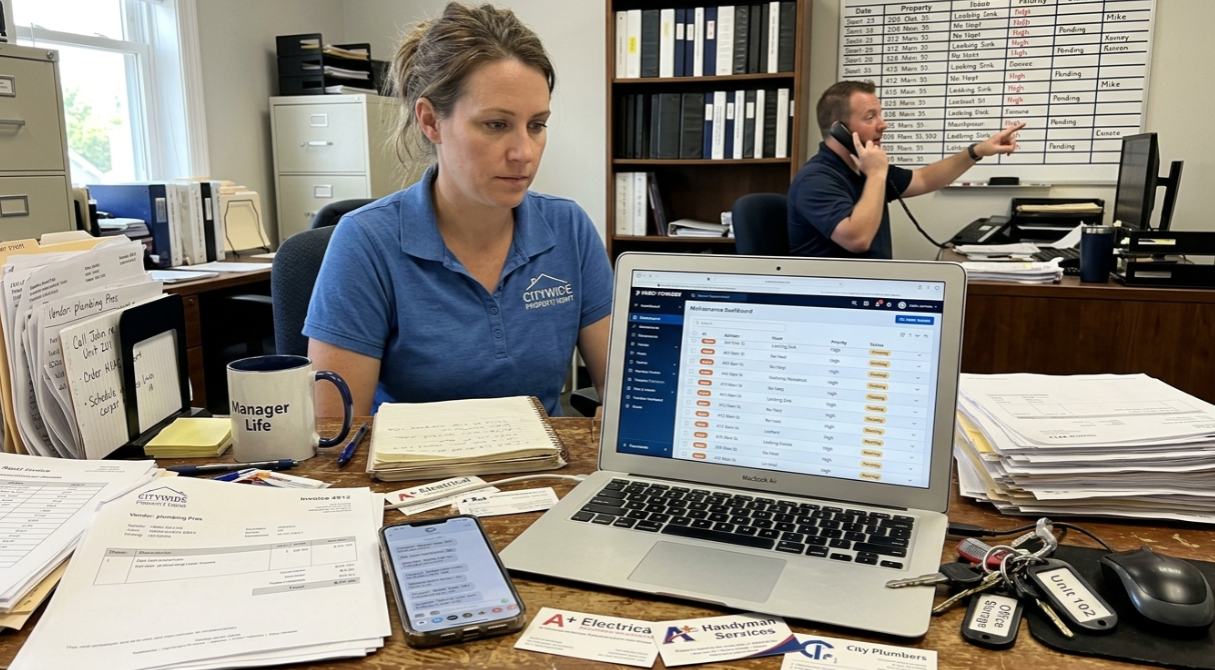
This is where most independent property management firms hit their first wall. The team that ran 50 units smoothly suddenly feels buried at 120. One PM consultant with 14 years of experience put it simply: “Somewhere around 200 to 250 doors, growth hits a wall. Operations don’t scale.” But practitioners on Reddit and PM forums consistently report the strain starting earlier, often around 80 to 100 doors.
What breaks first is almost always maintenance. The volume of requests outpaces the team’s ability to triage, coordinate vendors, and follow up. After-hours calls go unanswered. Response times slip. Tenant satisfaction drops.
This is the stage where an AI maintenance coordinator can make the biggest relative impact, handling intake, triage, and vendor dispatch before the team needs to double in size.
Stage 3: Systems Required (150 to 350 Doors)
At this stage, the problem isn’t people. It’s workflow design. As one operator from Veyra Group observed, “The growth path from 50 to 200 doors is rarely a hiring problem. It is a workflow design problem dressed up as a hiring problem.”
What worked informally at smaller scale, things like verbal maintenance approvals, ad hoc vendor selection, manual rent collection follow-ups, becomes a chokepoint. Around 150 units, communication requires more effort, approvals take longer, and things fall through the cracks.
The solution isn’t just hiring. It’s building repeatable, documented processes and then automating the repetitive parts. What’s needed at 200 units isn’t more of the same. It’s a different operating model, one where the process itself carries the intelligence rather than relying on specific people to carry it in their heads.
Stage 4: Operational Leverage (350 to 800 Doors)
Specialist roles emerge. Instead of generalist property managers handling everything, you have dedicated leasing coordinators, maintenance managers, and financial analysts. Each team member gets focused and proficient in their domain.
This is also where technology investments start compounding. A well-integrated PMS, automated communication workflows, and AI agents working across maintenance and leasing create the kind of leverage where adding 50 doors barely registers as additional work.
Stage 5: Scale or Optimize (800+ Doors)
Here’s a contrarian point worth acknowledging: not every PM company should scale to 5,000 doors. Contributors on the PMAssist Substack argue that the “sweet spot” for a PM company is between 400 and 800 doors, and that the common advice “if you’re not growing, you’re dying” is, in their words, “garbage.”
Beyond 800 doors, complexity increases sharply. You need regional managers, more sophisticated financial controls, and an organizational structure that looks more like a corporation than a small business. Some operators are better served by optimizing profitability at a sustainable size rather than chasing door count for its own sake.
How Do You Know Your Property Management Company Is Ready to Scale?
A property management company is ready to scale when its core operations can handle additional units without depending on the owner to personally supervise every task. Before adding another large batch of doors, evaluate whether the business has repeatable workflows, clean property and tenant data, documented responsibilities, measurable service levels, and enough operational capacity to absorb additional volume.
Signs You Are Ready to Scale
Core workflows are documented and followed consistently.
Maintenance requests have defined intake, triage, escalation, and completion procedures.
Leasing inquiries are answered within a defined service-level target.
Owner reporting follows a standardized schedule.
Rent collection and delinquency follow-up are systematized.
Employees know who owns each operational task.
The owner is no longer required to approve routine decisions.
The PMS is the central source of operational data.
Key metrics are tracked consistently.
New properties can be onboarded using a repeatable process.
Signs You Should Fix Operations Before Adding More Doors
If the business already has unresolved maintenance backlogs, inconsistent owner communication, manual accounting processes, poor data quality, excessive employee overtime, or an owner who remains the primary escalation point, adding more units may amplify the existing problems.
The goal is not to eliminate every operational problem before growing. The goal is to make sure the problems that will multiply with every new door have already been systematized.
Area | Not Ready | Partially Ready | Ready |
|---|---|---|---|
SOPs | Processes live in people's heads | Some workflows documented | Core workflows documented |
Maintenance | Mostly manual | Some automation | Automated intake + escalation |
Leasing | Manual follow-up | Templates/CRM | Automated qualification + scheduling |
Accounting | Spreadsheet-heavy | PMS-based | Centralized and automated |
Owner communication | Ad hoc | Scheduled reports | Standardized reporting |
Staffing | Generalists doing everything | Some specialization | Roles clearly defined |
Data | Multiple sources | Mostly centralized | PMS is source of truth |
KPIs | Infrequent | Monthly | Weekly/daily operational tracking |
Owner dependency | High | Moderate | Low |
Rule of thumb: If several “Not Ready” items involve workflows that will increase directly with every new door, fix those systems before aggressively expanding the portfolio.
Bottleneck | Why It Appears | Scaling Warning Sign | First Intervention |
|---|---|---|---|
Maintenance | Request volume increases | Growing backlog | Automate intake and triage |
Leasing | More leads and turnover | Slow response times | Automated lead response |
Approvals | More decisions require escalation | Work waiting for approval | Define approval thresholds |
Owner communication | More reporting relationships | Repeated questions | Standardized reporting |
Accounting | More accounts and transactions | Reconciliation delays | PMS + accounting automation |
Compliance | More markets and properties | Missed requirements | Centralized compliance workflows |
What Breaks First: Common Scaling Bottlenecks
When property management companies try to scale, the failures tend to follow a predictable pattern. Recognizing which bottleneck you’re hitting helps you apply the right solution.
1. Maintenance request overload. This is the most common and most damaging bottleneck. As portfolios expand, manual processes become the constraint. Vendor coordination becomes inconsistent, and service quality varies from property to property. After-hours calls are the most fragile point, where missed emergency calls create liability and tenant churn simultaneously. Many operators address this with an after-hours answering service, but increasingly the solution involves AI that can actually triage and dispatch rather than just take messages.
2. Leasing response time decay. At small scale, every inquiry gets a quick personal response. At 150+ doors with regular turnover, leads sit for hours or days. Among operators using AI-powered leasing tools, 85% have seen measurable improvements in lead-to-lease conversion rates. Speed matters more than polish.
3. Approval chokepoints. The approval chain that worked informally at small scale becomes a traffic jam. Maintenance authorizations, budget exceptions, lease concessions, anything requiring a decision from above the property manager level, starts to slow down. The team loses time waiting.
4. The owner-as-bottleneck syndrome. Every hour spent inside the operation is time taken away from leading it. Instead of focusing on growth, hiring strategy, and system development, owners stay tied to execution. The business can grow only as much as the owner can personally support. This is probably the hardest bottleneck to fix because it requires the owner to change their own behavior.
5. Financial complexity. Cash flow management that was straightforward at 50 doors becomes genuinely difficult at 200. Multiple owner accounts, varying fee structures, maintenance reserves, and trust accounting requirements create an accounting workload that can overwhelm teams without proper systems.
6. Compliance sprawl. Compliance is hard enough in a single market. Expanding into other markets means managing different laws and ordinances in each one. Fair housing, local habitability standards, security deposit rules, and eviction procedures all vary. Every new market multiplies the compliance burden.
Key Metrics for Measuring Scalability
You can’t scale what you don’t measure. These are the metrics that separate operators who are scaling from those who are just growing (and slowly drowning).
Doors Per Employee
The most-cited benchmark for residential property management is 50 doors per employee, based on AppFolio’s industry data. But that number deserves context:
Small independent firms with traditional workflows: 60 to 80 doors per FTE
Firms with strong systems and basic automation: 100 to 150 doors per FTE
Firms with mature operations, automated communication, and tight vendor processes: 200+ doors per FTE
The gap between 60 and 200 is the scaling opportunity. It’s also the difference between a company that needs 10 employees to manage 800 doors versus one that needs 4.
For more data on how AI specifically affects these numbers, see the benefits and ROI of AI in property management.
Cost to Serve Per Unit
Track your total operational cost divided by units managed. As you scale, this number should decrease. If it stays flat or increases, you’re growing without scaling.
Maintenance Cost Per Unit
The industry target is $800 to $1,500 per year per unit depending on property class. Tracking this helps you identify when vendor costs are drifting or when deferred maintenance is creating a backlog.
Other Critical KPIs
Average days to lease: Should decrease or hold steady as you add doors
Delinquency rate: Should not increase with portfolio size
Renewal rate: A proxy for tenant satisfaction and operational quality
Lead response time: The canary in the coal mine for leasing bottlenecks
Ancillary revenue per door: Indicates whether you’re maximizing revenue beyond base management fees
Track doors-per-employee monthly once you pass 100 units. It’s a cleaner growth metric than headcount alone, and it reveals whether your operational investments are actually working.
What Enables Scaling: The Core Levers
SOPs and Standardization
You cannot scale property management operations without standardization. Full stop. Technology makes it possible to create repeatable, reliable processes that keep quality high even when your team is hundreds of miles away from a unit. But the technology only works if the underlying processes are documented and enforced.
The best operators write SOPs for everything: move-in inspections, maintenance triage protocols, lease renewal workflows, owner reporting cadences. These SOPs become the operating system that new hires plug into, rather than relying on tribal knowledge.
Cloud-Based PMS as the Foundation
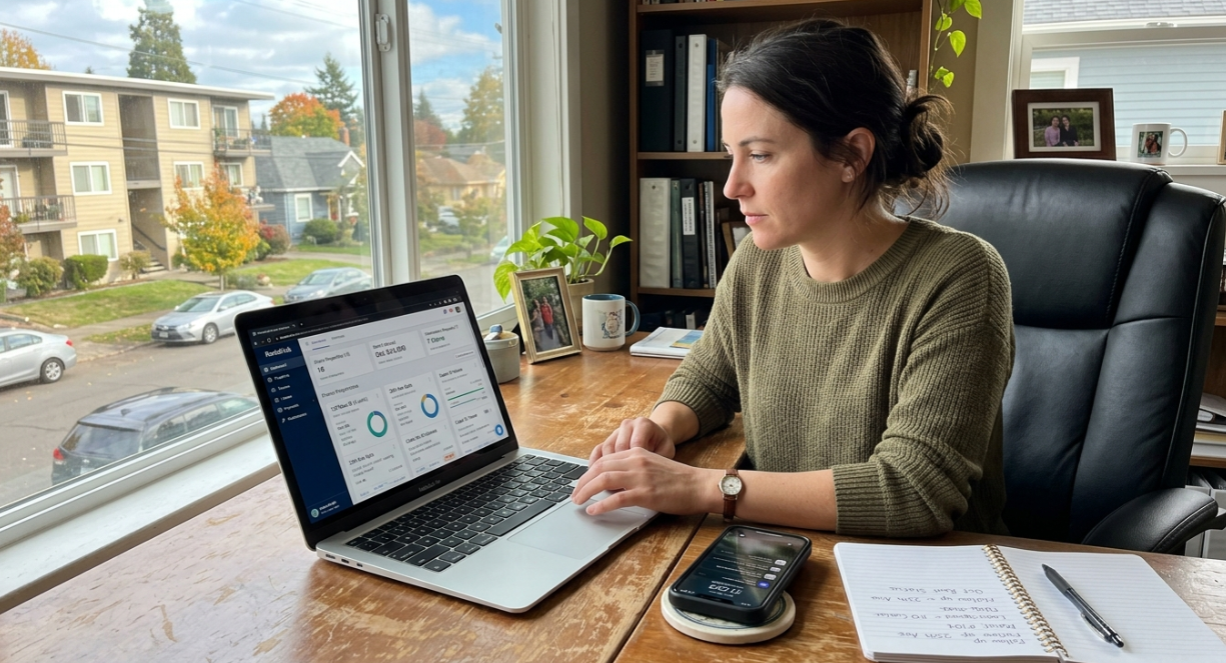
The heart of any scalable property management operation is a powerful, cloud-based property management system. It’s your central command center and the single source of truth for everything from rent payments to maintenance tickets. When all your data lives in one accessible hub, your team can manage units from anywhere.
But a PMS alone isn’t enough. According to one survey, 78% of property managers report that they cannot yet rely on the AI features in their legacy property management software. The PMS provides the data infrastructure. Purpose-built tools provide the automation and intelligence layer on top.
Automation: The Force Multiplier
The hire-versus-automate decision should be made workflow by workflow. Automate repetition. Hire for judgment. Never reverse those two.
Automate first when the bottleneck is repetitive task volume: maintenance coordination, routine tenant messages, owner reporting. Hire when the bottleneck is relationship management, business development, or judgment-heavy decisions that can’t be systematized.
Automation typically reduces the need for additional hires by 30 to 50 percent during growth phases. That’s not about replacing people. It’s about making each person dramatically more productive.
VPM Solutions, which specializes in virtual staffing for property managers, notes that a single dedicated VA typically supports 75 to 150 doors depending on turnover rate, maintenance volume, and software workflow complexity. Portfolios above 150 doors often benefit from two VAs with divided responsibilities. But even virtual staffing follows a linear cost curve. Automation is what bends that curve.
For operators evaluating their options, the comparison between AI and traditional call centers is particularly instructive for understanding where automation delivers the biggest ROI.
AI Agents: The 2025-2026 Frontier
AI adoption in property management jumped from 20% in 2024 to 58% in 2025, according to Buildium’s 2026 report. But here’s the critical gap: only 8% of companies had fully automated any process. Most companies have adopted AI in name only, using it for basic chatbot responses or email drafting without connecting it to actual operational workflows.
The difference between AI that answers questions and AI that takes actions is the difference between a chatbot and an operational teammate. Action-taking AI can create work orders inside your PMS, dispatch vendors from your preferred vendor list, follow up with tenants after work completion, and handle the entire maintenance intake workflow without human intervention for routine issues.
Among operators already using AI management tools, 77% report moderate to significant reductions in operating expenses. Morgan Stanley projects that AI adoption could unlock $34 billion in efficiency gains for real estate by 2030, with 37% of tasks able to be automated.
The use cases that are production-ready today include:
Maintenance triage and dispatch: AI handles intake via phone, SMS, or email, detects emergencies, creates work orders, and coordinates vendors
Leasing inquiry response: AI qualifies leads, answers property questions, and schedules tours within seconds of initial contact
Delinquency outreach: Automated follow-up sequences for late payments before accounts reach collections
Renewal nurture: Proactive tenant outreach before lease expiration
Owner reporting: Automated generation and distribution of financial and operational reports
What’s important: AI adoption is driving, rather than replacing, human talent. Among AI adopters, 34% plan to increase headcount to support their operations, compared to 25% of non-users. By automating manual workflows, operators are shifting their focus to relationship-driven work (resident engagement, owner relationships) that directly impacts retention and NOI.
Explore Haven’s AI property management software to see how action-taking AI agents handle these workflows in practice.
Specialist Hiring at the Right Time
Scaling property management operations isn’t about never hiring. It’s about hiring for the right reasons at the right time. Specialized roles for leasing, maintenance coordination, and financial management ensure each team member is focused and proficient. When growing from hundreds to thousands of units, specialists maintain high levels of performance that generalists cannot.
The decision framework is simple. If the work is repetitive and rule-based, automate it. If it requires relationship building, strategic thinking, or nuanced judgment, hire for it. Most operators get in trouble because they hire to solve automation problems, which just adds cost without adding leverage.
The “Sweet Spot” Debate
Not all property management companies should pursue infinite growth. The PMAssist community makes a compelling case that the optimal range sits between 400 and 800 doors for many independent operators. At this size, you have enough scale to support proper systems and specialist roles, but you’re not dealing with the organizational complexity that comes with 2,000+ doors.
This is a legitimate strategic choice. Scaling property management operations can mean optimizing for maximum profitability at a sustainable portfolio size rather than relentlessly chasing door count. A firm managing 600 doors with excellent margins, high tenant satisfaction, and low owner churn is arguably in a better position than a firm managing 1,500 doors with razor-thin margins and constant staff turnover.
The key is to be intentional. Whether you’re scaling to 300 doors or 3,000, the operational principles are the same: standardize, automate, measure, and invest in the right people for the right work.
Getting Started: A Practical Implementation Path
For operators currently feeling the strain, here’s a prioritized approach:
If you’re at 50 to 100 doors: Document your top 10 workflows. Get your PMS data clean. Start tracking doors-per-employee and cost-to-serve monthly.
If you’re at 100 to 200 doors: Automate maintenance intake and vendor dispatch first, it’s the highest-volume, most repetitive workflow. Implement a leasing AI to eliminate lead response delays. Build your SOP library.
If you’re at 200 to 500 doors: Evaluate your entire tech stack for integration gaps. Add specialist roles where judgment is required. Implement AI across maintenance, leasing, and collections workflows. Track all KPIs weekly, not monthly.
If you’re at 500+ doors: Focus on organizational design. Regional structure, escalation hierarchies, and advanced financial controls become the priority. AI and automation should be handling most routine operational work by this point.
For a detailed walkthrough on implementation timelines, see this AI implementation guide for property managers.
Related Terms
Operating leverage: The ability to increase revenue faster than costs, the fundamental goal of scaling
Doors per FTE: The primary efficiency metric for property management scalability
PMS integration: Connecting automation and AI tools to your property management system so data flows without manual re-entry
Work order automation: Automatic creation, assignment, and tracking of maintenance work orders
Cost to serve: Total operational cost divided by units managed
Labor efficiency ratio (LER): Revenue per employee, a broader measure of team productivity
NOI (Net Operating Income): The financial outcome that scaling operations is ultimately designed to improve
Frequently Asked Questions
What is the difference between scaling and growth in property management?
Growth means adding more doors, usually with a proportional increase in staff and costs. Scaling means adding more doors without proportionally increasing costs. A company that doubles its portfolio and doubles its staff has grown. A company that doubles its portfolio while increasing staff by 25% has scaled. The distinction matters because growth without scaling eventually leads to margin compression and operational breakdown.
At what door count do property management operations typically start breaking?
Most firms hit their first significant operational ceiling between 80 and 150 doors. The workflows and informal processes that worked at 50 doors start failing at this range. A second, often more severe ceiling appears around 200 to 250 doors, where the entire operating model usually needs to change. These aren’t hard cutoffs; they vary based on property type, geographic concentration, and existing systems.
How many doors should one property manager handle?
The industry baseline is roughly 50 doors per employee. Firms with strong systems and basic automation reach 100 to 150 doors per FTE. Firms with mature operations and AI-driven automation can exceed 200 doors per FTE. The right number depends on your portfolio mix, with single-family scattered-site portfolios being more labor-intensive per door than concentrated multifamily.
Should I hire or automate when scaling?
Make the decision workflow by workflow. Automate when the bottleneck is repetitive task volume, things like maintenance coordination, routine tenant messages, and report generation. Hire when the bottleneck requires human judgment, relationship management, or strategic thinking. The most common mistake is hiring to solve automation problems, which adds cost without creating leverage. Automation typically reduces the need for additional hires by 30 to 50 percent during growth phases.
What should I automate first when scaling property management operations?
Maintenance intake and coordination. It’s the highest-volume repetitive workflow in most portfolios, and it’s the first thing that breaks as you add doors. After maintenance, focus on leasing response automation (lead qualification and tour scheduling) and then collections follow-up. These three workflows account for the majority of repetitive operational work.
Is AI in property management actually reliable enough to use?
It depends on the tool. According to AppFolio’s own survey data, 78% of respondents reported they could not yet rely on the AI features in their legacy PMS. However, purpose-built AI agents designed specifically for property management workflows, those that can create work orders, dispatch vendors, and handle full conversation flows, are showing strong results. Among operators using dedicated AI tools, 77% report moderate to significant reductions in operating expenses.
What is the ideal size for a property management company?
There’s no single answer, and the PMAssist community makes a strong case that the sweet spot is 400 to 800 doors for many independent operators. At this size you have enough scale to support proper systems and specialist roles, but you avoid the organizational complexity of very large portfolios. The right size depends on your market, your goals, and whether you’re optimizing for growth, profitability, or lifestyle.