Vendor AI Roadmap 2026: 6-Phase Guide for Property Managers
Vendor AI Roadmap for property managers: a 6-phase plan covering intake, dispatch, follow-ups, invoices, compliance, and KPIs. Start optimizing now.

TL;DR
A vendor AI roadmap is a staged plan for using artificial intelligence to automate maintenance vendor workflows in property management, from intake and dispatch to follow-ups, invoices, compliance, and scorecards. The term also gets confused with “your PMS vendor’s AI roadmap,” which is a separate question about whether to wait for native AI features. This guide defines both meanings, provides a six-phase maturity model, and explains the data, controls, and KPIs needed before automating vendor coordination.
Quick Answer
A vendor AI roadmap is a phased plan for introducing artificial intelligence into vendor management workflows without losing human oversight. Most property managers begin by automating maintenance intake, emergency triage, and vendor dispatch before expanding into follow-ups, invoice reviews, compliance monitoring, vendor scorecards, and procurement. The most successful implementations improve data quality first, automate only low-risk tasks initially, and require human approval for expensive work orders, legal exceptions, and owner-sensitive decisions.
Key Takeaways
Vendor AI is much broader than automated dispatch.
Clean vendor data is required before AI automation.
Start with maintenance intake and dispatch before expanding.
Human approval should remain for expensive, legal, and compliance-sensitive decisions.
Track KPIs before every expansion phase.
Your PMS should remain the system of record while AI acts as an operational layer.
Vendor AI Roadmap Definition
A vendor AI roadmap is a staged operating plan for automating vendor-related workflows in property management using artificial intelligence. It defines which vendor tasks AI handles today, which tasks need human approval, what PMS and vendor data must be in place, what controls protect against errors, and which metrics determine whether the system is ready to expand.
In plain English: it is the plan for moving from “AI helps us route maintenance calls” to “AI helps us coordinate vendors, check compliance, update tenants, flag invoice problems, and show which vendors actually perform well.”
Two meanings float around this term, and they are different:
Vendor AI roadmap = the plan for deploying AI that manages your property management vendors.
Vendor’s AI roadmap = the future AI features promised by your PMS or software vendor (AppFolio, Buildium, Yardi, RealPage, etc.).
This article focuses on the first meaning. It also addresses the second in a later section, because the “wait for the vendor or act now” question comes up constantly.
A vendor AI roadmap should answer four questions: What can AI do today? What data does it need? Where does a human approve? What metric unlocks the next phase?
See how Haven’s AI maintenance coordinator works
Who This Guide Is For
This guide is designed for:
Property management companies
Maintenance coordinators
Operations managers
Multifamily operators
Single-family rental portfolios
HOA management companies
Build-to-rent operators
Facilities management teams
PropTech leaders evaluating AI
This increases relevance for multiple search intents.
Why Property Managers Care About Vendor AI
Vendor coordination is one of the most time-consuming, error-prone, and financially exposed workflows in property management. It touches resident experience, maintenance cost, owner approvals, vendor capacity, and PMS records all at once.
According to AppFolio and NAA research, property management professionals spend 42% of their week on routine operational work and another 24% on reactive tasks. That means roughly two-thirds of the typical workweek goes toward keeping operations running rather than growing the business. A large share of that operational drag comes from maintenance vendor coordination: dispatching, following up, updating tenants, chasing compliance documents, reviewing invoices, and logging notes.
The financial stakes are significant. Lessen’s 2025 SFR benchmark report, covering more than 680,000 work orders and $470 million in spend, found that repair and maintenance accounts for 5% to 15% of rental income and costs $1,000 to $3,100 per home annually. Every slow dispatch, missed follow-up, or duplicate truck roll chips away at NOI.
Speed matters too. Hemlane analyzed 193,000+ maintenance requests and found the median rental repair closes in 13.1 days, but the slowest 25% take more than 38 days and the worst 10% stretch past 115 days. Coordinated repairs resolved at a 10.1-day median versus 14.7 days for self-managed repairs, a 31% improvement. The biggest gaps appeared in vendor-sourcing-heavy categories like locksmith, electrical, and handywork.
A vendor AI roadmap addresses these problems systematically. It starts with the highest-pain, lowest-risk tasks and expands only when the data, rules, and controls are ready.
What a Vendor AI Roadmap Includes
The scope is broader than most property managers expect. Vendor AI is not just “auto-dispatch.” A full vendor AI roadmap covers:
Maintenance intake and issue classification. AI captures the tenant’s problem, asks clarifying questions, and detects urgency.
Preferred vendor selection. AI picks the right vendor based on trade, location, availability, compliance status, owner rules, historical performance, and budget thresholds.
Dispatch with context. AI sends the vendor a complete work-order summary, not just an address and a category.
Tenant and vendor scheduling. AI coordinates appointment windows, sends reminders, and confirms access.
Follow-up and status tracking. AI checks in with the vendor, updates the tenant, escalates no-shows, and prevents stale work orders.
PMS updates. Every action gets logged: notes, photos, status changes, completion confirmations.
NTE and owner approval triggers. AI flags work that exceeds not-to-exceed thresholds or requires owner sign-off.
Invoice review. AI compares invoices against the work order, NTE limits, contract rates, and completion notes.
Vendor scorecards. AI tracks response time, first-time fix rate, callback rate, cost variance, and tenant satisfaction.
Compliance monitoring. AI checks COI expirations, license status, W-9s, and owner-specific requirements.
Bidding and contract governance. For larger jobs, AI supports RFPs, bid comparison, contract summaries, and renewal alerts.
NetVendor defines vendor lifecycle management as covering seven stages: sourcing, credentialing and onboarding, compliance verification, work authorization and dispatch, procurement and bidding, contract management, and renewal or termination. A good vendor AI roadmap maps AI capabilities to each of these stages, not just the middle one.
What Vendor AI Should Not Do Without Controls
Not everything should be automated freely. A vendor AI roadmap should explicitly exclude certain actions from full automation:
Auto-approving high-dollar work without human review
Dispatching vendors with expired insurance or missing licenses
Choosing the lowest bid without factoring in quality, compliance, and SLA history
Making tenant screening decisions (HUD has issued guidance confirming the Fair Housing Act applies to AI-driven screening)
Running algorithmic rent pricing without legal review
Replacing human judgment on habitability, safety, legal disputes, or owner exceptions
For more on how to set these boundaries, see this guide on AI escalation rules for maintenance workflows.
Vendor Dispatch Is Only Phase One
The most common mistake in vendor AI planning is treating dispatch as the finish line. It is the starting line.
Practitioners on Reddit consistently point to the “follow-up loop” as where maintenance operations actually break down. In one property management thread, a commenter described the bottleneck as vendor check-ins, tenant updates, reminders, scheduling, and stale work orders, not the work-order record itself. Another operator in the same thread said a 659-unit portfolio had two maintenance coordinators handling vendor assignments, estimates above NTE thresholds, and weekly vendor payments.
In a separate thread, one user said AppFolio’s Assisted Maintenance was worth evaluating for AI-powered triage and categorization but “struggles” with vendor relationship management. Another described a DIY setup connected to email, RingCentral, and AppFolio that created text groups with tenants and vendors and kept “nudging both sides until the issue was fixed.”
The takeaway is straightforward: a vendor AI roadmap should not stop at “create work order and dispatch.” The value is in keeping the work order moving after dispatch, preventing no-shows from becoming silent failures, updating tenants before they call back, and logging everything so the maintenance coordinator does not have to reconstruct the timeline manually.
For a closer look at how the dispatch step works, see this overview of AI vendor dispatch in property management.
Phase | Primary Goal | Human Oversight | Expected Benefit |
|---|---|---|---|
Phase 0 | Clean vendor data | High | Better AI accuracy |
Phase 1 | Intake & triage | Medium | Faster work order creation |
Phase 2 | Vendor dispatch | Medium | Reduced response time |
Phase 3 | Follow-ups | Low | Fewer stale work orders |
Phase 4 | Invoice review | High | Lower invoice errors |
Phase 5 | Vendor scorecards | Medium | Better vendor selection |
Phase 6 | Procurement | High | Improved vendor governance |
The Vendor AI Roadmap Maturity Model

A practical vendor AI roadmap follows six phases. Each phase builds on the one before it. Skipping phases, especially Phase 0, is how automation projects fail.
Phase 0: Vendor Data Foundation
Before AI touches anything, the vendor master has to be clean. This is not optional.
Practitioners on Reddit still ask whether to track vendors in spreadsheets, PMS modules, CRM tools, or procedure binders. In one thread, a new property manager asked how others track HVAC techs, cleaners, rates, contacts, and service history. Replies ranged from COI tracking modules to old-school binders. A handyman vendor in the same thread praised tools that let vendors accept appointments, schedule, message, and invoice through the app.
If your vendor data is wrong, vendor AI only dispatches the wrong person faster.
The vendor master should include, at minimum: vendor name, trade categories, service area, business hours and after-hours availability, emergency eligibility, COI expiration dates, license numbers, W-9 status, rate cards, NTE thresholds, owner-specific restrictions, PMS vendor ID, preferred communication channel, backup vendor ranking, and 12 to 24 months of work-order and invoice history.
For guidance on preparing PMS data for AI, read about data quality requirements for AI systems.
Phase 1: AI-Assisted Intake and Triage
AI captures the maintenance issue, asks clarifying questions, detects urgency, and creates a structured PMS work order with the right category, priority, and notes.
The best first categories are high-volume and high-urgency: plumbing leaks, no heat, lockouts, electrical safety, appliance failures, HVAC. Property Meld’s 2025 annual report found that operators using AI-powered intake received work-order descriptions with 99.94% accuracy, and those operators saw a 90% increase in repairs completed within 24 hours.
Haven’s current Maintenance AI supports this phase: 24/7 maintenance request intake, issue triage with emergency detection, PMS work-order creation and updates, and tenant troubleshooting.
Phase 2: Guarded Vendor Dispatch
AI recommends or dispatches the right vendor based on a defined set of rules: trade match, property or market, emergency status, preferred vendor list ranking, availability, compliance status, NTE limit, owner approval requirements, and backup vendor order.
The key word is “guarded.” Auto-dispatch should only apply to pre-approved categories and vendors with current compliance documents. High-cost jobs, non-preferred vendors, expired credentials, and habitability edge cases require human review.
For details on how routing logic works, see this overview of AI vendor routing.
Phase 3: Follow-Up and Status Automation
This is where vendor AI earns trust, not by creating a ticket, but by preventing the ticket from going stale.
AI confirms vendor acceptance. Sends tenant appointment windows. Reminds both sides before the visit. Detects no-response or no-show events. Escalates if the vendor misses the SLA. Asks the tenant whether the issue is resolved. Logs notes, photos, and completion status in the PMS.
The follow-up loop is where maintenance coordination typically breaks down, and where vendor AI delivers the most measurable time savings per work order.
Phase 4: Invoice and NTE Controls
AI compares invoice data against the work order, NTE limit, contract terms, and completion notes. It extracts invoice fields, flags amounts over NTE, detects duplicate charges, compares labor and material line items to expected ranges, suggests GL coding, and routes exceptions to human approval.
Property Meld’s vendor cost report, analyzing 2.2 million work orders, found meaningful regional differences in average invoice amounts: $259 in Canada, $245 in the Pacific region, and $243 in the Northeast, versus $197 in the Midwest. This is why vendor AI needs geography- and trade-specific benchmarks instead of one national average.
AI should recommend, flag, and route. It should not release payments without explicit approval unless the rules are unambiguous and the dollar amount is low.
Phase 5: Vendor Scorecards and Performance Routing
AI tracks vendor quality over time and uses that data to inform future assignments.
Key metrics include response time, time to completion, first-time fix rate, callback rate, cost variance against NTE, tenant satisfaction, documentation completeness, no-show rate, and compliance status.
A good vendor AI roadmap moves vendor selection away from habit and toward evidence. But the evidence has to include quality, not just price. A cheap vendor with repeat visits can cost more than a higher-rate vendor who solves the issue once.
Phase 6: Procurement, Bidding, and Contract Governance
For larger or recurring jobs, AI generates scope from work-order history, invites qualified vendors, normalizes bids, compares against historical and regional costs, summarizes contract terms, tracks renewal dates, and triggers rebid discipline.
NetVendor’s 2026 announcement that it added AI enhancements across sourcing, bidding, contracts, and compliance signals that the vendor AI category is moving beyond dispatch into full lifecycle governance. Humans should still make final vendor awards, especially for capital work and owner-sensitive decisions.
Common Vendor AI Roadmap Mistakes
Many AI projects fail because organizations automate before documenting their maintenance workflows. The most common mistakes include:
Automating poor-quality vendor data
Skipping governance rules
Dispatching vendors without compliance verification
Measuring AI activity instead of business outcomes
Ignoring exception handling
Trying to automate every workflow at once
Launching without baseline KPIs
Treating AI as a replacement instead of an assistant
Should You Wait for Your PMS Vendor’s AI Roadmap?
This is the second meaning of “vendor AI roadmap,” and it surfaces in nearly every property management AI conversation: should you wait for AppFolio, Buildium, Yardi, or RealPage to ship native AI features, or should you act now?
The short answer: do not wait passively, but do not ignore your PMS either.
Keep the PMS as the system of record. Evaluate whether a focused AI layer can close a workflow gap sooner than the native roadmap. Waiting makes sense when the PMS feature is already live, deeply integrated, and solves the specific workflow you need. Waiting is risky when the problem is costing staff hours today and the vendor roadmap has no committed date, no API detail, or no exception-handling design.
A LinkedIn post from Qventus noted that 74% of surveyed health system technology leaders identified reliance on their EHR vendor’s AI roadmap as a top obstacle to AI strategy. Healthcare is not property management, but the same pattern applies: core-system vendors often move slower than urgent workflow gaps demand.
Practitioners on Reddit reinforce this point. In one thread about property management software, a user said they would not onboard a new PMS without affordable API access because AI agents work best with an API. Others complained that some platforms treat API access as a premium tier, making automation harder for smaller teams.
Here is a decision framework:
Situation | Recommendation |
|---|---|
Native PMS feature handles your exact workflow today | Use the native feature first |
Native feature handles intake but not follow-ups, no-shows, or invoice exceptions | Consider a specialized AI layer |
Your vendor list is incomplete or compliance data is missing | Fix data before automating anything |
Your PMS has no affordable API or integration path | Budget for integration work or choose tools with existing integrations |
The use case involves tenant screening or rent pricing | Keep human review, legal review, and full audit trails |
The practical middle path is not “replace the PMS” or “wait forever.” It is a governed AI layer that works with the PMS as the system of record. For a step-by-step timeline, see this AI implementation guide for property managers.
Explore Haven’s AI property management platform
Should You Deploy Vendor AI?
Yes, if:
Vendor coordination consumes several hours daily.
Your PMS supports API integrations.
Your vendor records are complete.
You already have documented maintenance procedures.
Staff regularly handle repetitive dispatch and follow-up work.
Wait first, if:
Vendor data is incomplete.
Compliance records are outdated.
Maintenance processes are undocumented.
There are no approval workflows.
What Data You Need Before Vendor AI Works
A vendor AI roadmap has a hidden prerequisite: integration access. If the AI cannot read and write PMS records reliably, the system becomes another inbox instead of an operating layer.
Beyond PMS integration, you need structured vendor data and documented workflows.
Vendor master fields:
Legal vendor name and DBA
Trade categories
License numbers and expiration dates
COI expiration dates
W-9 / TIN status
Service area
Business hours and after-hours availability
Emergency eligibility
Preferred properties and excluded properties
Rate cards and trip fees
NTE thresholds
Owner-specific restrictions
PMS vendor ID
Communication channel preference
Backup vendor priority ranking
SLA targets
12 to 24 months of work-order and invoice history
Tenant satisfaction and follow-up outcomes
Workflow documents:
Emergency rules and escalation policy
Owner approval thresholds
Vendor escalation scripts
Tenant follow-up scripts
No-show procedure
Invoice exception policy
Compliance block rules
Human override and approval paths
Without these inputs, AI is guessing. With them, AI is executing documented policy at scale.
KPIs to Track in a Vendor AI Roadmap
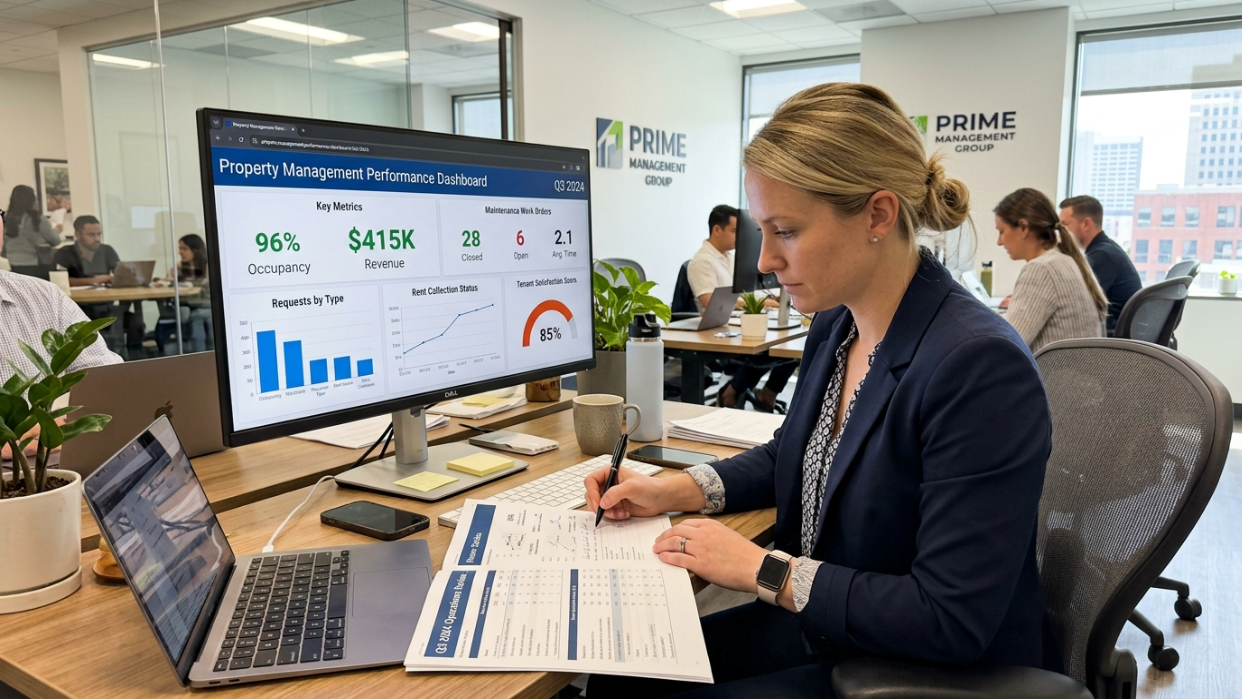
A vendor AI roadmap needs measurement at every phase. Without KPIs, there is no way to know whether the system should scale, get revised, or get shut down.
Operational KPIs:
Time from request to first response
Time from request to vendor assignment
Vendor acceptance time
Time to schedule and time to complete
Percentage of stale work orders (no update for 48+ hours)
Work orders completed within 24 hours
First-time fix rate and callback rate
Vendor no-show rate
Manual touches per work order
After-hours calls resolved without staff involvement
Financial KPIs:
Average and median invoice by trade
Cost variance against NTE
Duplicate invoices flagged
Repeat visits per work order
Staff hours per work order
Answering service or call-center cost reduction
Compliance KPIs:
Vendors dispatched with valid COI
Expired document rate
Missing W-9 or license rate
Contract renewal alerts resolved on time
Audit trail completeness for AI-dispatched work orders
Risks and Guardrails
A vendor AI roadmap is not just about what AI can do. It is equally about what AI should not do, or should only do with human approval.
A LinkedIn practitioner discussing Haven’s maintenance coordination capabilities commented that the long-term test is whether AI can handle exceptions: tenants describing problems incorrectly, vendors no-showing, expired credentials discovered after dispatch. That observation points to a critical principle: test exceptions before you scale.
Exception tests every vendor AI system should pass before expanding:
Tenant describes a leak vaguely
Tenant is unreachable for scheduling
Vendor no-shows
Vendor has an expired COI
Work exceeds NTE
Owner approval is required
A duplicate work order already exists
Vendor invoice does not match completion notes
Emergency is misclassified as routine
Routine issue is misclassified as emergency
On the governance side, the regulatory direction is clear. HUD confirmed that the Fair Housing Act applies to AI-driven tenant screening. The DOJ’s 2024 civil antitrust lawsuit against RealPage alleged that algorithmic pricing using competitively sensitive data violates the Sherman Act. While vendor dispatch is a different workflow, the broader message applies: “the software did it” is not a safe governance position in housing.
NIST’s AI Risk Management Framework offers a useful anchor for thinking about trustworthiness in AI systems, including the concepts of valid, reliable, safe, and explainable outputs. Every AI action that affects residents, vendors, or owners should be auditable.
For more on logging and audit trail design, see this guide on AI notes and PMS logging.
What AI can automate vs. what needs human approval:
Roadmap stage | AI can handle | Human should approve |
|---|---|---|
Intake | Classify issue, detect urgency, create work order | Ambiguous emergencies, habitability edge cases |
Dispatch | Recommend preferred vendor, send work order, update PMS | Non-preferred vendor, expired compliance, high-dollar jobs |
Follow-up | Reminders, tenant updates, no-response alerts | Escalations, angry tenants, owner-sensitive issues |
Invoice | Extract fields, match to work order, flag over-NTE | Payment approval, disputed charges |
Scorecards | Track response, completion, callbacks, cost variance | Vendor termination, preferred-list changes |
Bidding | Draft scope, normalize bids, summarize terms | Final vendor award, contract approval |
Example Vendor AI Roadmap: 500-Unit Portfolio
Here is what a practical vendor AI roadmap looks like for a mid-size portfolio.
Month 1: Foundation
Audit and clean vendor master data for all active vendors. Define emergency categories and escalation rules. Confirm NTE thresholds by property and owner. Verify PMS integration permissions (read and write access). Baseline current KPIs: request-to-response time, median completion time, stale work-order count, average invoice by trade, manual touches per work order, and after-hours call volume.
Month 2: Pilot
Deploy AI intake and triage for after-hours plumbing and HVAC calls. Allow AI to create work orders, recommend vendors from the preferred list, and dispatch to pre-approved vendors with current compliance documents. Require human review for over-NTE work, missing compliance, and non-preferred vendors. Log every AI action in PMS notes. QA call transcripts and dispatch messages weekly.
Month 3: Expand Follow-Up
Add automated tenant and vendor follow-up messages. Add stale work-order escalation alerts. Add completion confirmation from tenants. Add invoice exception flags for over-NTE and duplicate charges. Build a vendor scorecard dashboard. Review ROI and failure cases. Decide: scale, revise, or stop.
Quarter 2: Deepen Controls
Expand dispatch to all maintenance categories. Add invoice review automation with human approval for flagged items. Build vendor scorecards into dispatch logic so higher-performing vendors get priority.
Quarter 3: Lifecycle Governance
Add bid leveling for large or recurring jobs. Add contract renewal alerts. Add compliance monitoring with automated alerts for expiring COIs and licenses.
FAQ
What is a vendor AI roadmap?
A vendor AI roadmap is a staged plan for using AI to automate vendor-related property management workflows. It starts with maintenance intake and dispatch and expands into follow-up, invoice review, vendor scorecards, compliance monitoring, bidding, and contract governance.
Is vendor AI the same as vendor dispatch automation?
No. Vendor dispatch is an early phase. A complete vendor AI roadmap also covers follow-up coordination, invoice matching, NTE controls, performance scorecards, compliance checks, bid management, and contract lifecycle governance.
What should property managers automate first?
Start with after-hours maintenance intake, emergency triage, PMS work-order creation, and preferred-vendor dispatch for a few well-defined categories like plumbing and HVAC. This is high-volume, high-pain, and easier to control than complex procurement or payment workflows.
Should AI automatically dispatch vendors?
Only for pre-approved categories and vendors with current compliance documents. High-cost jobs, non-preferred vendors, expired credentials, and habitability edge cases should require human review.
Should I wait for my PMS vendor’s AI roadmap?
Wait if the native feature is already live, integrated, and solves the exact workflow you need. Do not wait passively if the gap is costing staff hours now and the roadmap has no committed date. Keep the PMS as the system of record and evaluate AI layers that can read and write PMS data reliably.
What are the biggest risks of vendor AI?
Dispatching vendors with expired insurance, choosing vendors purely by price, letting work orders go stale after dispatch, auto-approving high-dollar invoices, and failing to log AI actions for auditability. Every vendor AI roadmap needs explicit guardrails for each of these risks.
How do I measure vendor AI ROI?
Track request-to-response time, vendor assignment speed, completion time, stale work-order reduction, first-time fix rate, callback rate, average invoice by trade, cost variance against NTE, tenant satisfaction, compliance blocks, and manual touches eliminated per work order.
Haven’s Maintenance AI already supports 24/7 intake, emergency triage, PMS work orders, preferred-vendor dispatch, and post-work follow-ups. Vendor AI is a natural next layer for deeper vendor lifecycle automation.