AI Change Management Property Management: 2026 Guide
AI Change Management Property Management guide for 2026. Close the adoption gap with ADKAR, Kotter, Fair Housing, and KPI tracking. Learn how.

TL;DR
AI change management in property management is the structured process of getting your leasing agents, maintenance coordinators, and property managers to actually adopt and trust new AI tools. Technology accounts for only 20% of AI transformation failures; the other 80% comes down to people and processes. With 89% of operators now using AI to some degree but only 34% feeling they’ve fully deployed it, the gap between “having AI” and “using AI well” is the defining challenge for property management companies in 2026.
Explore AI property management software
Quick Answer: What Is AI Change Management in Property Management?
AI change management in property management is the process of preparing employees, workflows, data, and policies for the adoption of AI. A practical approach is to start with one high-impact workflow, involve the employees who use it, define human oversight, train the team, measure adoption and business results, and continuously improve the workflow before expanding AI across the portfolio.
What Is AI Change Management?
AI change management is the structured practice of preparing an organization’s people, processes, and culture for AI transformation. It covers everything from initial communication about why AI is being introduced, to training staff on new workflows, to reinforcing new habits long after launch day.
This is different from simply buying software and handing out logins. Research consistently shows that technology accounts for only 20% of AI transformation failures, while the remaining 80% are organizational: poor communication, inadequate training, unclear roles, and cultural resistance.
In property management specifically, AI change management means preparing leasing agents to work alongside AI lead qualification, training maintenance coordinators to shift from answering every call to handling exceptions, and helping regional managers interpret AI-generated reports instead of relying solely on gut instinct.
How It Differs from Traditional Change Management
Traditional change management assumes you’re moving from Point A to a stable Point B. You roll out new software, train people, and the system works the same way a year later.
AI change management doesn’t work that way. AI systems learn, adapt, and improve over time. The “end state” keeps shifting. A maintenance triage AI that handles 60% of calls accurately in month one might handle 85% by month six, which means staff roles and workflows need to evolve continuously.
There’s another key difference. Traditional software is deterministic: same input, same output, every time. AI systems are probabilistic. They make judgment calls. That requires a fundamentally different kind of organizational trust and a much stronger feedback loop between the humans overseeing the system and the AI making recommendations.
What Does AI Change Management Actually Change?
AI change management changes more than the software employees use. It can change who performs a task, when a task is performed, which decisions require human approval, and how performance is measured.
Before introducing AI, document the current workflow. Then define the future workflow with AI in place.
Area | Before AI | After AI |
|---|---|---|
Lead response | Agent manually responds to every inquiry | AI handles initial responses and qualification |
Maintenance intake | Coordinator answers calls and enters requests | AI collects information and creates structured work orders |
Scheduling | Staff manually coordinate appointments | AI schedules routine appointments within defined rules |
Follow-up | Employees remember or manually schedule follow-ups | AI triggers routine follow-up workflows |
Reporting | Managers request and compile reports | AI summarizes operational data for review |
Exceptions | Employees handle everything manually | AI escalates defined exceptions to a human |
The objective is not to remove humans from the process. It is to redesign the workflow so employees spend less time on repetitive work and more time on decisions, relationships, exceptions, and tasks that require judgment.
Why Property Managers Need AI Change Management
The numbers tell a clear story: adoption is surging, but real deployment lags far behind.
AI adoption in property management jumped from 20% in 2024 to 58% in 2025, according to FacilGo and Buildium data. By 2026, 89% of operators have introduced AI to some degree, but only 34% feel they have fully deployed it. Perhaps most revealing: only 8% of teams have fully automated even one workflow.
That gap between “we have AI” and “AI is actually working for us” is exactly what change management closes.
The Performance Divide Is Real
Companies that get AI adoption right aren’t just marginally ahead. They’re pulling away from competitors. Firms that have broadly adopted AI expect an average portfolio growth of 31% in 2026, nearly triple the 12% growth anticipated by those that haven’t implemented the technology, per AppFolio’s 2026 Benchmark Report.
The operational gains are equally stark. 77% of operators using AI report moderate to significant reductions in operating expenses, while 85% have seen measurable improvements in lead-to-lease conversion rates. And 78% of respondents in the same survey admitted they’ve already lost new business opportunities to AI-enabled competitors.
For a deeper look at how AI creates measurable returns, see this guide on AI property management benefits and ROI.
Staff Fears Are the Biggest Obstacle
Numbers aside, the human reality is messier. 82% of property management professionals expect AI to replace several traditional roles by 2026. That fear doesn’t stay abstract. Practitioners on Reddit and industry forums describe employees who delay using new tools, work around them, or quietly revert to old processes. A Fast Company investigation found that across industries, employees are actively sabotaging or refusing to use AI tools their companies are investing heavily in.
Jennifer Panegasser, director of property accounting at NAI Hiffman, described her team’s experience bluntly in an interview with Bisnow: “It was a really tough adoption, because at that point, you had to teach this AI system what you needed from it. It felt like it was a lot more work as you were adjusting things and correcting it.”
That early friction is real. And without a structured change management approach, many teams never push past it.
Common Barriers to AI Adoption in Property Management
Understanding the specific obstacles helps you plan around them rather than being surprised by them.
Staff Resistance and Job Security Fears
This is the most emotionally charged barrier. Leasing agents worry they’ll be replaced by chatbots. Maintenance coordinators wonder if AI triage means their phones will stop ringing (and their hours will get cut). Office staff see automation and assume layoffs are next.
Here’s the counterintuitive truth: AI-adopting firms are actually hiring more, not less. AppFolio’s 2026 data shows 34% of AI adopters plan to increase headcount, compared to just 25% of non-users. One contributor on the PM Assist Substack put it plainly: “Virtually every role in this business is repetitive, administrative, or process-driven. The safest roles right now are those that are driven by human connection.”
Change management should address this head-on. People need to hear, with evidence, that AI is shifting their work toward higher-value tasks rather than eliminating their positions. This piece on reducing property manager burnout with AI covers how that shift typically plays out.
Data Quality and Fragmented Systems
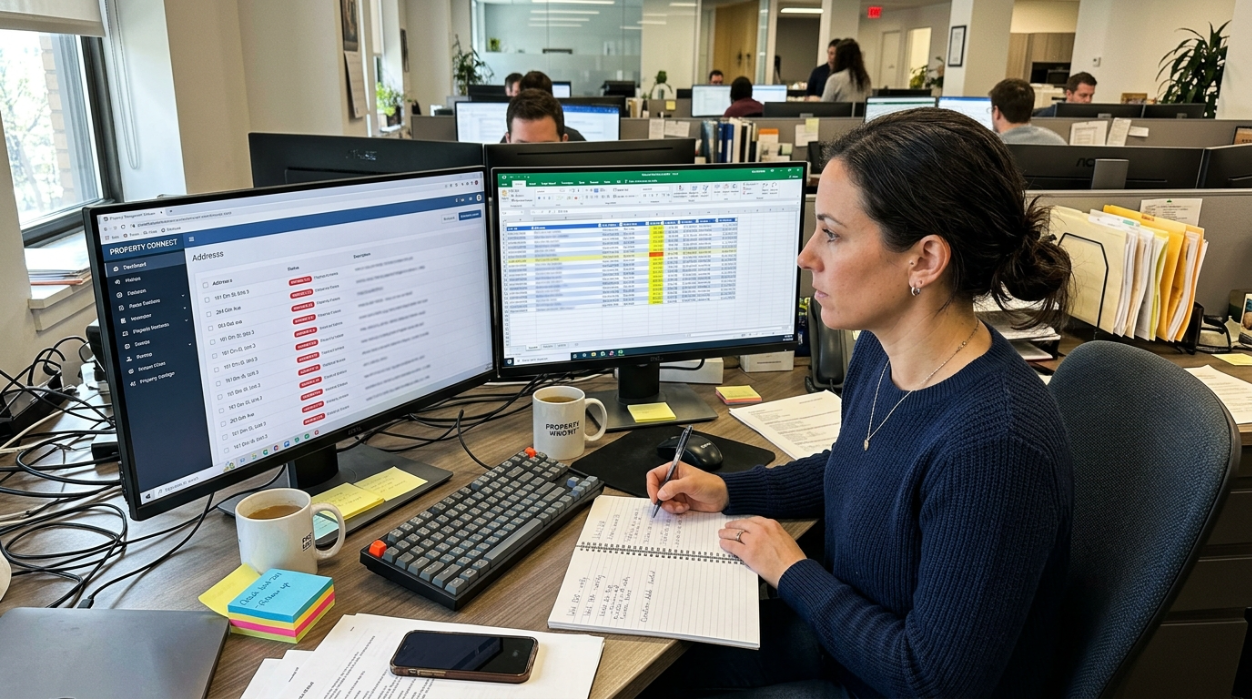
AI tools are only as good as the data they can access. If your PMS has incomplete unit records, outdated vendor lists, or inconsistent tenant contact information, any AI layered on top will produce unreliable results. A Dealpath survey of institutional investors found that 36% cited fragmented data as a top barrier to AI adoption. Getting PMS data quality right before or during an AI rollout is a foundational change management step, not an afterthought.
Fair Housing and Compliance Risks
This barrier deserves special attention because the stakes are uniquely high in property management. HUD’s 2023 guidance holds property managers liable for discriminatory outcomes from third-party AI tools, regardless of whether the vendor built in Fair Housing protections.
That means compliance is an operational standard your organization must build and maintain, not a feature you can outsource. Staff need training on what Fair Housing obligations persist regardless of an AI’s recommendation, how to recognize when automated output may reflect bias, and how to escalate concerns. For a deeper treatment of this topic, see this Fair Housing compliance guide for AI in property management.
Security and Privacy Concerns
Four in 10 property managers (41%) say they’re concerned about security and data breaches, and 33% aren’t using AI specifically because of those concerns, according to ApartmentAdvisor. When tenant PII (personally identifiable information) flows through AI systems, those concerns are legitimate. Change management must include clear data governance policies and transparent communication about how tenant data is handled.
Budget and Resource Constraints
Smaller operators face an obvious squeeze. A Dealpath survey found 39% of respondents cited budget constraints as a top barrier. Gartner recommends budgeting 15 to 25% of total AI project costs specifically for change management activities, including training, communication, and process redesign. Many companies allocate zero.
AI Change Management Framework for Property Management
A practical AI change-management process can be organized into nine stages:
Assess → Prioritize → Map → Assign → Prepare → Pilot → Measure → Reinforce → Scale
Step 1: Assess AI Readiness
Evaluate your current technology stack, data quality, employee readiness, leadership support, compliance requirements, and operational processes.
Ask:
Does the AI tool integrate with the existing PMS?
Is the underlying property data accurate?
Which employees will be affected?
Which tasks are repetitive enough to automate?
Which decisions require human judgment?
What compliance risks exist?
Who owns the AI workflow after launch?
Step 2: Choose One High-Impact Workflow
Start with one workflow rather than attempting to transform the entire organization.
Good starting points include:
After-hours maintenance intake
Leasing lead response
Tour scheduling
Resident communication
Work-order routing
Invoice processing
Document summarization
Routine reporting
Choose a workflow with measurable volume, clear inputs and outputs, and a meaningful operational problem.
Step 3: Map the Current Workflow
Document what employees do today before introducing automation.
Record:
Trigger
Employee action
System used
Decision point
Handoff
Approval
Exception
Final outcome
This prevents the company from simply automating a poorly designed process.
Step 4: Define Human and AI Responsibilities
For every automated step, determine whether AI can:
Recommend
Draft
Execute
Escalate
Never perform independently
The higher the consequence of an error, the stronger the human review requirement should be.
Step 5: Prepare Employees
Explain why the change is happening, what will change in each role, what will remain human-owned, and how performance expectations will change.
Do not make the first communication about software features. Make it about the operational problem being solved.
Step 6: Pilot the Workflow
Launch with a limited group, property, region, or workflow.
During the pilot, track both AI performance and employee behavior. A technically successful pilot can still fail if employees avoid the system or create workarounds.
Step 7: Measure Adoption and Business Results
Track whether employees actually use the new workflow and whether it improves the intended business outcome.
Measure adoption separately from ROI. A tool cannot produce ROI if employees are not using it.
Step 8: Reinforce the New Process
Managers should reference the new workflow in meetings, review its metrics, recognize successful adoption, and address recurring problems.
If leadership continues operating as if the old workflow exists, employees will usually follow the old process.
Step 9: Scale Across the Portfolio
Only expand after the pilot demonstrates acceptable performance, adoption, compliance, and business value.
Document the playbook before rolling the workflow to additional properties.
Key Change Management Frameworks Applied to Property Management
The ADKAR Model
The most widely referenced framework in AI change management content is Prosci’s ADKAR model. It tracks whether individual employees have made the shift a change initiative requires, moving through five stages: Awareness, Desire, Knowledge, Ability, and Reinforcement.
Prosci’s benchmarking research, drawn from more than 10,800 contributors across 25 years, finds that organizations with excellent change management are seven times more likely to meet their project objectives. Here’s what each stage looks like when applied to AI change management in property management:
Awareness: “Why are we adding AI to maintenance intake?” Staff need to understand the business problem being solved. Maybe it’s missed after-hours calls, or rising call center costs, or tenant satisfaction scores that are dropping because response times are too slow. Be specific.
Desire: “This handles the 2 AM pipe-burst calls so you don’t have to.” Connect the change to something each employee personally cares about. For maintenance coordinators, that might mean no more overnight on-call shifts. For leasing agents, it could mean more pre-qualified leads walking into tours.
Knowledge: Training on how the AI actually works within the PMS. How does a voice AI create a work order? What does the leasing AI do with a Zillow lead? Staff need to understand the mechanics, not just receive a login.
Ability: A supervised ramp-up period where staff use the AI on real tasks with support. This is where Jennifer Panegasser’s “tough adoption” happened at NAI Hiffman. The early phase feels like more work because it is more work. Teams need to know that’s expected and temporary.
Reinforcement: Track metrics, celebrate wins, and course-correct. When a maintenance AI reduces average response time from 4 hours to 12 minutes, share that number. When a leasing AI books 30 tours that agents didn’t have to coordinate, make it visible.
Kotter’s 8-Step Model
John Kotter’s framework is another useful lens, particularly for larger organizations. It emphasizes creating urgency (the competitive data above is powerful here), building a guiding coalition of champions across departments, and anchoring changes in the company culture so they stick. For property management companies with multiple regional offices, Kotter’s emphasis on empowering broad-based action, removing structural barriers rather than relying on top-down mandates, is especially relevant.
The Gartner Warning
Gartner’s 2024 AI Adoption Report found that 50% of enterprise AI project failures were attributable to change management failures rather than technical ones. The most common failure modes: employees not trained on how to use AI effectively (35%), employees actively avoiding AI due to job security fears (28%), and managers not reinforcing AI use in daily workflows (22%).
That last point matters more than people realize. If regional managers keep asking for the same reports they got before AI, or if they never reference AI-generated insights in team meetings, on-site staff will quickly conclude that AI adoption is optional.
30/60/90-Day AI Change Management Plan
A 90-day rollout gives property management companies enough time to prepare employees, test the workflow, identify problems, and establish measurable adoption before scaling.
Timeline | Primary Objective | Key Actions | Success Indicators |
|---|---|---|---|
Days 1–30 | Prepare | Select workflow, map current process, identify stakeholders, establish baseline metrics, define AI/human responsibilities, communicate the change | Employees understand the purpose and baseline metrics are documented |
Days 31–60 | Pilot | Train staff, launch limited pilot, review AI outputs, document errors, collect employee feedback, refine workflows | Employees consistently use the workflow and error rates are within acceptable limits |
Days 61–90 | Reinforce | Review performance, resolve recurring issues, update SOPs, train managers, establish ongoing reporting, prepare expansion plan | Adoption is stable and the workflow demonstrates measurable operational value |
What to Do During the First 30 Days
The first month should focus on preparation rather than maximizing automation. Establish a baseline for response times, employee workload, error rates, customer satisfaction, and other relevant metrics before changing the workflow.
What to Do During Days 31–60
The second month is the supervised pilot. Employees should have an easy way to flag incorrect AI outputs, unusual resident requests, compliance concerns, and workflow failures.
What to Do During Days 61–90
The third month should focus on reinforcement. Update the SOP, clarify ownership, review the metrics with managers, and decide whether the workflow is ready to expand.
Do not scale simply because the technology works. Scale when the technology, employees, workflow, and controls work together reliably.
AI Change Management Best Practices for Property Management Teams
These recommendations synthesize what works across the top-performing property management companies that have navigated AI adoption successfully.
Start with One High-Pain-Point Workflow
Don’t try to automate leasing, maintenance, collections, and vendor management simultaneously. Pick the workflow that causes the most daily frustration. For many operators, that’s after-hours maintenance calls, a process that’s already painful, expensive (if using a call center), and clearly improved by AI.
See a practical AI implementation timeline for how to phase this rollout.
Pick Tools That Integrate with Your Existing PMS
Forcing a system migration alongside an AI rollout is a recipe for change fatigue. The best outcomes happen when AI tools plug into the property management software your team already knows, creating work orders, updating tenant records, and logging notes in the system of record.
Explore Haven’s maintenance AI to see how PMS-integrated AI handles this without requiring system changes.
Involve On-Site Staff Early
Too many AI rollouts are designed in the corporate office and dropped on leasing teams with a one-hour webinar. The property managers and maintenance coordinators who will use these tools daily should be part of planning. Their feedback on edge cases, common tenant complaints, and vendor quirks makes the AI more effective and gives them ownership of the outcome.
Frame AI as Team Augmentation, Not Replacement
Use the data. AI-adopting firms are hiring more staff, not fewer. Share the AppFolio benchmark numbers showing that 34% of AI adopters plan to increase headcount. Show how leasing agents at AI-enabled properties spend less time answering repetitive phone calls and more time giving tours and closing leases. The narrative of AI as a call center alternative rather than a staff replacement resonates strongly with teams.
Build Compliance into the Rollout from Day One
Don’t treat Fair Housing training as a post-launch add-on. Before any AI tool touches a leasing workflow, your team should understand how the system handles protected-class information, what audit trails exist, and what their responsibilities are when an automated recommendation doesn’t look right.
Track Measurable Outcomes
Define success before you launch. Common metrics for property management AI include call response time, work-order completion speed, lead-to-lease conversion rate, tenant satisfaction scores, and operating expense reductions. Share these metrics regularly and transparently with the team.
Plan for Ongoing Iteration
AI change management doesn’t end on launch day. The system will improve over time, which means workflows and staff roles will continue evolving. Build quarterly reviews into your plan where the team discusses what’s working, what’s not, and what should change.
What AI Change Management Looks Like in Practice

Maintenance AI Rollout
Here’s a typical scenario. A property management company with 1,200 units is spending $8,000 per month on an after-hours call center. Response times average 4 hours. Tenant satisfaction scores are declining.
The company introduces a maintenance AI that handles after-hours calls via voice, triages emergencies from routine requests, creates work orders directly in the PMS, dispatches vendors from the company’s preferred vendor list, and follows up with tenants after work is completed.
The change management process looks like this:
Weeks 1-2: Leadership communicates the “why” to all on-site teams. Not “we’re cutting costs” but “tenants are waiting 4 hours for help at 2 AM, and you’re getting complaints about it.”
Weeks 3-4: Maintenance coordinators participate in configuring the AI, reviewing triage rules, vendor lists, and escalation protocols. They’re the experts here.
Weeks 5-8: Supervised launch. The AI handles calls, but coordinators review every work order the next morning. They flag errors and refine the system.
Month 3: The team reviews metrics. Response time is down to 12 minutes. False emergency escalations have dropped by 70%. Coordinators now spend their mornings on vendor relationship management and preventive maintenance planning instead of returning overnight voicemails.
For a detailed look at how this AI-to-human handoff works, read about AI maintenance coordinator workflows.
Leasing AI Rollout
A similar pattern applies to leasing. A multifamily operator is losing leads because the leasing office can’t answer calls during evenings and weekends. By the time an agent calls back Monday morning, prospects have already toured a competitor’s property.
The company implements leasing AI that answers inbound inquiries within seconds across phone, SMS, and email, qualifies leads, schedules tours, and captures leads from listing sites like Zillow and Apartments.com.
The change management challenge here is different. Leasing agents may feel threatened because lead handling is core to their identity. The reframe is critical: AI handles the repetitive qualification calls so agents can focus on tours, relationship building, and closing. The best leasing teams using AI don’t answer fewer calls; they close more leases.
Related Terms
AI adoption refers to the broader process of introducing AI tools into an organization. Change management is the discipline that determines whether adoption succeeds or stalls.
PMS integration means connecting AI tools to property management software like AppFolio or Buildium so that data flows automatically between systems. Strong PMS integration reduces change friction because staff don’t need to learn a new system. Learn more about PMS integration best practices.
Agentic AI describes AI that takes actions (creates work orders, dispatches vendors, schedules tours) rather than just making suggestions. Agentic AI requires more robust change management because it’s actually doing work, not just recommending it.
Fair Housing compliance covers federal and state laws governing non-discrimination in housing, now extending to algorithmic tools used in tenant screening and leasing.
AI governance refers to the policies an organization puts in place for monitoring AI behavior, reviewing automated decisions, and assigning accountability when things go wrong.
AI Change Management Checklist for Property Management
Before launching an AI workflow, confirm that you have:
Strategy
Defined the business problem
Selected one initial workflow
Established measurable success criteria
Documented the expected business outcome
People
Identified every employee affected
Explained why the change is happening
Documented how responsibilities will change
Identified employee champions
Created role-specific training
Workflow
Documented the current process
Defined the future AI-assisted process
Identified exceptions
Defined human approval points
Created escalation procedures
Technology
Confirmed PMS integration
Reviewed data quality
Tested AI accuracy
Established access controls
Documented vendor responsibilities
Compliance
Reviewed Fair Housing implications
Defined acceptable data use
Established privacy and security requirements
Created an AI incident process
Assigned governance ownership
Measurement
Established a pre-AI baseline
Defined adoption metrics
Defined operational KPIs
Defined customer/resident metrics
Defined financial metrics
Launch
Completed employee training
Started with a limited pilot
Created an employee feedback channel
Reviewed AI outputs
Documented errors and corrections
Scale
Confirmed the pilot met success criteria
Updated SOPs
Trained managers
Created a repeatable rollout playbook
Scheduled ongoing quarterly reviews
Frequently Asked Questions
What’s the difference between AI change management and regular change management?
Traditional change management assumes a stable end state: you implement the system, train people, and move on. AI change management is continuous because AI systems learn and improve over time. The workflows, staff roles, and oversight processes need to evolve along with the AI. The probabilistic nature of AI (it makes judgment calls, not just calculations) also requires building organizational trust in a way that deterministic software doesn’t.
How long does AI change management take in property management?
For a single workflow like maintenance intake or leasing inquiries, expect 8 to 12 weeks from initial communication through supervised launch to steady-state operations. Full portfolio rollouts across multiple workflows typically take 6 to 12 months. The key insight is that “done” is the wrong word. AI change management shifts into ongoing optimization rather than ending at a fixed point.
What’s the biggest risk of skipping change management when deploying AI?
Wasted investment. Gartner found that 50% of enterprise AI project failures stem from change management failures. In property management terms, that means your team reverts to answering calls manually, your leasing agents ignore the AI-qualified leads in their inbox, and the tool you’re paying for sits unused. You don’t just lose the subscription cost; you lose the competitive advantage the tool was supposed to deliver.
Does AI replace property management jobs?
The data says no, at least not in aggregate. AI-adopting firms are 36% more likely to increase headcount than non-adopters. What AI does replace is specific tasks: answering routine calls, re-entering data between systems, sending follow-up reminders. The roles themselves shift toward higher-value work like vendor relationship management, complex tenant issues, and portfolio strategy. 60% of operators have already created entirely new AI-focused positions that didn’t exist two years ago.
How should small property management companies approach AI change management?
Start smaller and move faster. Small operators don’t need a formal change management office or an ADKAR workshop. They need a clear “why,” one high-impact workflow to automate first, a tool that integrates with their existing PMS, and a 30-day check-in to see what’s working. The advantage small companies have is that communication is faster and buy-in is easier to build when the whole team fits in one room.
What role does compliance play in AI change management for property management?
A central one. HUD holds property managers liable for discriminatory outcomes from third-party AI tools. That means every AI rollout touching leasing or tenant screening must include Fair Housing training, bias monitoring, and clear escalation procedures. Compliance isn’t something you add after launch; it’s built into the change plan from day one.
AI change management in property management isn’t optional, and it isn’t a one-time project. It’s the ongoing work of aligning your people and processes with tools that are themselves evolving. The companies that treat change management as seriously as they treat the technology selection are the ones pulling ahead.