AI for Asset Managers: 2026 Real Estate Workflows Guide
AI for Asset Managers in real estate: automate leasing, maintenance, reporting, and risk with PMS-integrated agents. See 2026 workflows and KPIs.

TL;DR
AI for asset managers in real estate refers to software that connects portfolio data to operational workflows, helping teams act faster on leasing, maintenance, reporting, and risk. The practical value comes not from analysis alone but from AI that can complete work inside property management systems. Most operators should start with high-volume, high-friction workflows like after-hours maintenance intake and leasing lead follow-up before expanding to portfolio analytics or lease abstraction.
What Is AI for Real Estate Asset Managers?
AI for real estate asset managers is software that uses property, leasing, maintenance, lease, financial, and portfolio data to automate workflows, identify risks, generate analysis, and take approved actions. The highest-value starting points are usually high-volume, repeatable workflows such as leasing lead follow-up, maintenance intake, work-order creation, vendor coordination, reporting, and lease abstraction. The best systems connect directly to the property management system (PMS), maintain an audit trail, and keep humans responsible for legal, financial, Fair Housing, and other high-risk decisions.
What Can AI Do for Real Estate Asset Managers?
AI can support real estate asset managers across the operating lifecycle, from leasing and maintenance to reporting, document analysis, risk monitoring, and portfolio oversight.
AI workflow | What AI does | Asset management impact |
|---|---|---|
Leasing lead follow-up | Responds to inquiries, qualifies prospects, schedules tours, and follows up | Faster response and better visibility into leasing activity |
Maintenance intake | Answers calls/messages, gathers details, identifies urgency, and creates work orders | Faster response and fewer manual handoffs |
Vendor coordination | Routes approved jobs and sends updates | Less coordination work and better workflow visibility |
Portfolio reporting | Summarizes operating data and drafts variance commentary | Less reporting preparation time |
Lease abstraction | Extracts dates, rent terms, options, escalations, and obligations | Faster document review and structured lease data |
Risk monitoring | Flags exceptions, missing records, unusual activity, and upcoming deadlines | Earlier identification of operational risks |
Resident communication | Handles routine questions and status updates | More consistent communication outside business hours |
Data analysis | Answers questions across property and portfolio data | Faster access to operating insights |
The key distinction is between AI that provides information and AI that completes work. A chatbot that answers a maintenance question is useful. An AI agent that receives the request, creates the work order, applies escalation rules, dispatches an approved vendor, and updates the resident is performing an operational workflow.
What AI for Asset Managers Means in Real Estate
AI for asset managers is the use of artificial intelligence to help real estate teams analyze property and portfolio data, automate routine workflows, surface risks, and take actions that improve asset performance.
The term covers a range of tools and capabilities. At the simple end, AI can summarize lease documents, draft owner reports, or answer basic tenant questions. At the more advanced end, AI agents connect to property management systems, CRMs, email, phone, and SMS to create work orders, dispatch vendors, qualify leasing leads, schedule tours, and follow up with residents, all without waiting for a human to copy information between systems.
AI for Asset Management vs. General Generative AI
AI for asset management is broader than using ChatGPT to summarize documents or write reports. The defining characteristic is connection to real estate operating data and workflows.
An asset management AI system may read information from a property management system, CRM, accounting platform, lease database, email, phone, or maintenance system. Depending on its permissions, it can then summarize information, identify exceptions, create records, trigger follow-ups, route work, or escalate issues to a human.
That creates three practical levels of AI adoption:
AI assistance: drafts, summarizes, extracts, and answers questions.
AI intelligence: analyzes portfolio data and identifies patterns, exceptions, and risks.
AI automation: performs approved actions across connected systems.
For asset managers, the greatest operational value generally comes when AI moves beyond producing an answer and can safely complete the next step in the workflow.
Why This Matters Now
AI adoption in real estate has moved past the experimental stage. JLL’s 2025 Global Real Estate Technology Survey found that 88% of real estate investors had already started piloting AI, with an average of five use cases running across their operations. Budget commitment is real too: 87% of companies were increasing technology budgets specifically because of AI.
But adoption does not equal readiness. The same JLL survey found that over 60% of organizations remained strategically, organizationally, and technically unprepared to scale AI beyond pilots. That gap between “we’re trying AI” and “AI is changing our operations” is exactly where most property management companies sit today.
Meanwhile, property teams are stretched thin. A 2025 NAA/AppFolio survey of nearly 2,000 real estate professionals found that leaders spend 66% of their time on routine operational and reactive work. Only a third goes to stakeholder engagement and strategic performance. AI for asset managers is most useful when it targets that imbalance directly, freeing people to focus on the work that actually requires human judgment.
Asset Manager vs. Property Manager: Where the Roles Overlap
Historically, these were distinct jobs. IREM defines a property manager as responsible for the physical property, day-to-day operations, tenant relations, financial operations, and market positioning. An asset manager, by contrast, has traditionally supervised real estate at the investment level: business plans, capital allocation, hold/sell/refinance decisions, and investor reporting.
In practice, the line has blurred. A Virginia Tech/IREM study noted that both roles increasingly share the goal of driving value, and property-level operations are a major input into asset performance. When a leasing lead goes unanswered for two days, that is a property management failure and an asset management problem. When a maintenance issue festers because no work order was created, it damages both the resident relationship and the asset’s NOI.
This overlap matters because it means property management AI is inherently relevant to asset managers. The daily operational data, leasing velocity, maintenance cycle times, tenant satisfaction, vendor costs, and vacancy trends, all flow upward into asset performance.
Focus area | Asset management lens | Property management lens | Where AI serves both |
|---|---|---|---|
Leasing | Occupancy targets, rent growth, concession strategy | Responding to leads, tours, applications | Lead capture, qualification, tour scheduling, response analytics |
Maintenance | Expense control, asset condition, retention | Intake, triage, vendor dispatch, work orders | Emergency detection, work-order automation, cycle-time tracking |
Reporting | NOI, budget variance, investor updates | Owner statements, task status, issue logs | Data summaries, variance narratives, exception alerts |
Risk | Compliance, fraud, insurance, capex planning | Documentation, screening process, safety | Audit trails, escalation rules, document checks |
How AI for Asset Managers Works: The Real Estate AI Stack
The most useful way to think about AI in real estate operations is as three connected layers, plus human oversight.
The Real Estate AI Stack
Layer | Purpose | Examples |
|---|---|---|
Systems of record | Store authoritative property and financial information | PMS, CRM, accounting, lease database |
Data and integration layer | Move information between systems | APIs, integrations, data warehouses |
AI intelligence | Analyze, summarize, extract, classify, and detect patterns | Portfolio Q&A, lease abstraction, anomaly detection |
AI action layer | Complete approved operational tasks | Work orders, lead follow-up, vendor routing |
Human oversight | Approve, override, escalate, and govern decisions | Compliance, legal review, financial decisions |
The stack matters because AI is only as useful as the data and permissions surrounding it. A sophisticated language model connected to incomplete property records may produce a polished answer that is operationally wrong. Conversely, a narrower AI system with reliable PMS data and clearly defined workflows can produce measurable operational improvements.
System of record. This is the authoritative database where property, tenant, lease, work-order, vendor, and accounting data lives. For most operators, that means a PMS like AppFolio, Yardi, Buildium, or RentManager, plus a CRM and possibly a separate accounting system. AI that cannot read from and write to these systems is fundamentally limited.
System of intelligence. This is where AI reads, summarizes, flags anomalies, and turns messy data into insight. Think portfolio Q&A, lease abstraction, risk alerts, variance explanations, and market summaries. Useful, but insufficient on its own.
System of action. This is where AI performs approved operational tasks inside existing workflows. It creates work orders, routes maintenance issues, schedules tours, updates PMS notes, follows up with tenants, and dispatches vendors. This layer is what separates an AI tool that helps you think from one that actually reduces your team’s workload.
Human oversight. People set policies, approve high-risk actions, audit outputs, handle exceptions, and make strategic calls. Fair Housing review, vendor exceptions, rent changes, legal decisions, capex plans, and hold/sell/refinance choices should stay with humans.
A practitioner on Reddit captured this dynamic well. In r/CommercialRealEstate, a user described AI as useful for first-pass lease review, draft abstracts, cleaning operating expense exports, and stress-testing assumptions, but weak for legal conclusions or final numbers without human review. The right metaphor: AI is a tireless junior analyst for preparation and pattern detection, not the investment committee.
Common AI Workflows for Real Estate Asset Managers
Direct Answer: How Does AI Improve Real Estate Leasing?
AI improves real estate leasing by responding to inquiries faster, qualifying prospects, scheduling tours, capturing leads across channels, and continuing follow-up when prospects do not immediately respond. For asset managers, the important KPI is not simply the number of conversations handled by AI. It is whether the workflow improves measurable outcomes such as response time, tour conversion, application volume, and lease conversion.
Leasing AI
Leasing is one of the clearest AI use cases for asset managers because speed matters. Buildium’s lead management research identifies a typical apartment lead-to-lease conversion benchmark of 10% to 30%, with a common 10:4:1 ratio: ten leads produce four tours and one signed lease. Responding within five minutes meaningfully improves conversion odds.
The problem is that most property teams cannot respond to every Zillow inquiry, missed call, or after-hours email within five minutes. AI leasing agents handle phone, SMS, and email inquiries, answer availability and qualification questions, schedule tours, capture listing-site leads, and follow up with prospects who do not book immediately.
For teams losing prospects to slow response, Haven’s Leasing AI handles inquiries across phone, SMS, and email, qualifies leads, schedules tours, and captures leads from Zillow and Apartments.com automatically.
For deeper guidance on speeding up prospect engagement, see this guide on AI lead follow-up for leasing.
Maintenance AI
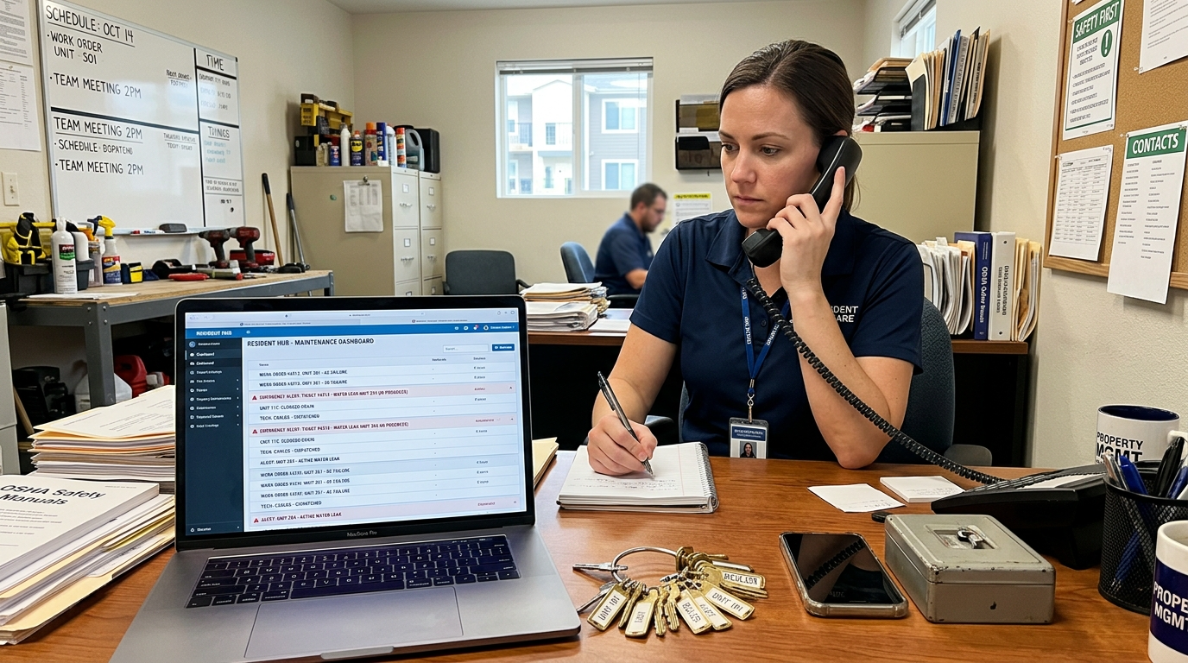
Maintenance is where AI can have the most direct impact on both resident experience and asset performance. AppFolio’s 2025 Renter Preferences Report, surveying 2,002 U.S. renters, found that tenants satisfied with maintenance were 71% more likely to plan to renew. And 86% of renters satisfied with maintenance communication were also satisfied with their property manager overall.
AI maintenance systems can provide 24/7 intake, triage issues by severity, detect emergencies (leaks, no heat, electrical hazards), create work orders directly in the PMS, dispatch vendors from preferred lists, send status updates to residents, and follow up after completion.
But practitioners on Reddit warn that the details matter. One post in r/PropertyManagement described an AI chatbot deployed across a 700+ unit community. The bot failed to create actual work orders in the PMS and redirected frustrated residents to the leasing office, increasing staff workload instead of reducing it. The lesson: an AI assistant that cannot complete the workflow is not automation. It is another inbox.
Another Reddit commenter noted that AI-assisted maintenance can work well for intake, categorization, and vendor routing, but struggles when preferred vendors, rate agreements, and the vendor database are not carefully configured. Maintenance AI is only as good as the data behind it.
Haven’s Maintenance AI is designed to handle 24/7 intake, emergency triage, PMS work-order creation, vendor dispatch from preferred vendor lists, and post-work follow-ups.
For teams setting up escalation protocols, this guide on AI escalation rules for maintenance covers the key considerations.
Portfolio Reporting and Owner Updates
Asset managers spend significant time assembling monthly and quarterly reports. AI can summarize property performance, draft variance commentary, flag anomalies, and help assemble owner updates faster.
In r/CommercialRealEstate, users report using AI to summarize rent rolls, operating statements, and broker packages, then drafting variance explanations for review. The time savings are real, but practitioners emphasize that financial data must be validated before sending. AI can draft the narrative, but someone needs to check the numbers.
For more on this workflow, see the guide on AI and owner reporting for property managers.
Lease Abstraction and Document Intelligence
Lease abstraction, extracting key terms like dates, rent steps, renewal options, escalations, and maintenance responsibilities from lease documents, is one of the highest-ROI use cases for AI in commercial and mixed-portfolio real estate.
LinkedIn practitioners in the CRE AI space emphasize that operationalizing lease data is not just extraction. It requires governance, validation logic, audit trails, and PMS integration. Lease structures vary enough that human validation remains critical. AI can dramatically speed up the initial extraction, but the output needs source-document traceability so reviewers can verify each field.
Risk Monitoring and Compliance Support
AI can flag missing documents, unusual charges, delinquency patterns, expiring leases, open work orders, or inconsistent records. This kind of continuous monitoring is valuable because it turns slow-moving risks into visible, assignable tasks.
However, AI should not independently make housing decisions. HUD issued 2024 guidance confirming that the Fair Housing Act applies to tenant screening and housing advertising even when AI, algorithms, or automated tools are used. Housing providers remain responsible for avoiding discriminatory outcomes.
For a deeper look at compliance considerations, see this guide on AI and Fair Housing in property management.
Predictive Maintenance vs. Maintenance Triage
These are different things, and the distinction matters. Predictive maintenance uses equipment data, sensors, inspections, or historical work-order patterns to forecast failures before they happen. Deloitte’s research suggests predictive maintenance can reduce planning time by 20% to 50% and increase equipment uptime by 10% to 20% in industrial contexts.
Maintenance triage, by contrast, is about classifying and routing tenant-reported issues as they come in. Both are useful. But for most residential property managers, maintenance triage (handling the incoming volume of requests faster and more accurately) delivers value sooner than sensor-based predictive systems.
AI Agents, Copilots, and Chatbots: What Is the Difference?
These terms get thrown around interchangeably, but they describe meaningfully different capabilities.
Term | What it does | Real estate example |
|---|---|---|
Chatbot | Answers questions in a chat interface | A website bot answers “Do you have 2-bedrooms?” |
Copilot | Helps a human draft, summarize, or analyze | Drafts an owner update or lease abstract for review |
AI agent | Takes multi-step action inside connected systems | Receives a maintenance call, creates a work order, dispatches a vendor, updates the tenant |
Agentic AI | Plans and completes workflows with less step-by-step prompting | Manages lead follow-up until a tour is scheduled or a human takeover is needed |
PwC/ULI’s Emerging Trends in Real Estate 2026 describes this shift: the industry is moving from conversational AI toward agents that can perceive, decide, assign tasks, oversee completion, and flag problems. These agents often sit as an integration layer above existing PMS platforms instead of replacing them.
A chatbot that only responds is not the same as an AI agent that completes property management work. For asset managers evaluating AI tools, the question is not “Does it use AI?” but “Can it safely act inside the workflows that matter?”
Benefits of AI for Real Estate Asset Managers
Faster response to revenue and resident events. Leasing leads, maintenance requests, and tenant complaints all lose value when they sit unaddressed. AI shortens the time between signal and action. When a Zillow lead comes in at 9 p.m. and gets a qualified response in seconds instead of the next business day, that is a direct impact on occupancy and revenue.
More current property data. When AI updates PMS records, work orders, notes, and lead statuses in real time, asset managers get better portfolio visibility. Stale data is one of the most common complaints from asset managers overseeing multiple properties.
Less time on repetitive work. AI reduces manual intake, routing, drafting, summarizing, and follow-up. The NAA/AppFolio finding that 66% of time goes to routine and reactive work is exactly the category AI targets.
Better exception management. Good AI helps humans see what needs attention: emergency calls, stalled leads, unusual expenses, lease dates approaching, vendor delays, or resident dissatisfaction. Instead of reviewing every transaction, managers focus on the ones that actually require judgment.
Scalable operations without proportional headcount. AI can help teams manage more doors, leads, calls, and work orders without adding back-office staff at the same rate. PwC/ULI predicts that AI agents will enable property managers to oversee larger portfolios from centralized offices while maintaining compliance across channels and languages.
For a broader look at measurable outcomes, see this overview of AI property management benefits and ROI.
Risks and Guardrails
AI That Does Not Complete the Workflow Creates More Work
The Reddit maintenance chatbot story is worth repeating because it illustrates a common failure pattern. When residents believe they submitted a maintenance request but no work order exists in the PMS, staff inherit a worse problem: angry tenants, missing records, and no audit trail. AI that talks but does not act is not reducing work. It is moving confusion from one channel to another.
Bad Data Creates Bad Automation
Vendor dispatch, emergency triage, portfolio reporting, and leasing follow-up all depend on clean property, resident, vendor, and lease data. If vendor records are incomplete or preferred vendor rules are not configured, AI will route jobs incorrectly or not at all. Data quality is a prerequisite, not an afterthought.
For guidance on getting your PMS data ready, see this guide on AI data quality for property managers.
AI Can Annoy Prospects and Residents
Practitioners on Reddit report cases where AI leasing assistants misunderstood simple questions and over-contacted prospects, creating frustration instead of better service. AI needs cadence controls, conversation memory, clear escalation to humans, and the ability to recognize when it should stop talking.
High-Stakes Decisions Require Human Review
AI can help prepare screening, rent, legal, and compliance workflows, but humans need to own the final policy and decision. HUD’s 2024 guidance makes clear that housing providers are responsible for discriminatory outcomes even when using third-party AI tools. The FTC and CFPB have also examined how algorithms affect tenant screening accuracy and fairness.
Demos Show Happy Paths
One Reddit operator who demoed every major property management platform in 2025 warned that vendors tend to overemphasize AI and ease of use while underselling implementation costs. Their advice: ask the vendor to show how AI handles a nuanced tenant communication, a plain-language custom report, and three things the platform does not do well. If they cannot show the ugly workflow, that tells you something.
How to Calculate AI ROI for Real Estate Asset Management

AI ROI should be measured against the workflow being automated, not against the number of AI conversations or tasks completed.
A basic AI ROI calculation is:
AI ROI = (Annual value created − Annual AI cost) ÷ Annual AI cost × 100
Annual value created can include:
Staff hours eliminated or reassigned
Reduced overtime
Faster lead response
Additional tours or applications
Reduced vacancy or lost leasing opportunities
Faster maintenance coordination
Reduced vendor coordination time
Lower reporting preparation costs
Reduced data-entry errors
Faster identification of operational exceptions
Example
If an AI system costs $30,000 per year and the operator estimates $70,000 in annual labor savings and incremental operational value:
AI ROI = ($70,000 − $30,000) ÷ $30,000 × 100 = 133%
This is only an illustrative calculation. Operators should use their own baseline labor costs, workflow volumes, conversion rates, vacancy economics, vendor costs, and implementation expenses.
Measure Before and After
Before deployment, record the baseline for the workflow. Then compare:
Metric | Before AI | After AI |
|---|---|---|
Average lead response time | Baseline | Actual |
Lead-to-tour conversion | Baseline | Actual |
Maintenance response time | Baseline | Actual |
Work-order creation accuracy | Baseline | Actual |
Reporting preparation hours | Baseline | Actual |
Vendor dispatch time | Baseline | Actual |
Escalation accuracy | Baseline | Actual |
Staff hours per property | Baseline | Actual |
The objective is to demonstrate measurable operational improvement rather than simply prove that employees are using an AI tool.
What to Automate First
Not every workflow is equally ready for AI. This prioritization framework helps asset managers focus.
Priority | Workflow | Why it comes first | Risk level |
|---|---|---|---|
1 | After-hours maintenance intake | High volume, clear pain, resident satisfaction impact | Medium (emergency escalation must be accurate) |
2 | Leasing lead capture and follow-up | Speed-to-lead affects tours and occupancy | Low to medium |
3 | Work-order creation and status updates | Reduces data entry and keeps tenants informed | Medium |
4 | Vendor dispatch from approved rules | Saves coordination time | Medium to high (vendor list must be clean) |
5 | Owner and portfolio reporting summaries | Reduces monthly reporting burden | Medium (financial data needs validation) |
6 | Lease abstraction and document extraction | High value for CRE and mixed portfolios | Medium to high (needs audit trail) |
7 | Rent-setting, screening, legal conclusions | High-stakes decisions | High (requires policy, compliance, legal review) |
The pattern: start where volume is high, the task is well-defined, and the consequences of a mistake are manageable. Save complex judgment calls for later, after you have built trust in the system and established clear human-oversight protocols.
Why PMS Integration Matters for Real Estate AI
A property management system is often the operational system of record for property, unit, resident, lease, maintenance, vendor, and financial information. AI becomes substantially more useful when it can securely access the information it needs and write approved actions back into the systems where staff already work.
Read vs. Write Integration
There is an important difference between an AI system that can read PMS information and one that can write approved changes.
Read access can support:
Portfolio questions
Lease searches
Property information
Reporting
Resident history
Maintenance history
Write access can support:
Creating work orders
Updating notes
Changing task status
Recording communications
Creating follow-up tasks
Updating lead records
For each integration, asset managers should ask exactly what permissions exist, which actions require approval, how errors are handled, and whether every AI action is logged.
How to Evaluate AI Tools for Asset Management
Before You Buy
Ask these questions of any vendor:
Does it integrate with your system of record? If it cannot read and write to your PMS or CRM, it will create another manual step rather than eliminating one.
Does it create an audit trail? You need to know what the AI did, why, when, and whether a human was involved.
Does it respect escalation rules? Emergency maintenance, Fair Housing questions, legal issues, and vendor exceptions should not be left to uncontrolled automation.
Can humans override it? Good AI reduces work without removing accountability.
Does it work in the channels your residents actually use? For property management, that usually means phone, SMS, and email, not just web chat.
Can the vendor show a messy scenario, not just the happy path?
During Rollout
Start with one high-friction workflow. Run in supervised mode first. Review false positives and false negatives in triage. Track tenant complaints about AI interactions. Measure record accuracy in the PMS, not just call deflection. Keep a human fallback visible and accessible.
For a detailed look at tracking the right numbers, see this guide on AI KPIs for property management.
KPIs to Measure AI for Asset Managers
Workflow | KPI | Why it matters |
|---|---|---|
Leasing | Speed-to-lead | Faster responses improve tour booking rates |
Leasing | Lead-to-tour conversion | Shows whether AI creates real leasing activity |
Leasing | Lead source ROI | Guides spend allocation across Zillow, Apartments.com, SEO, and referrals |
Maintenance | Time to first response | Directly affects resident satisfaction |
Maintenance | Emergency escalation accuracy | Prevents life-safety and property-damage failures |
Maintenance | Work-order creation accuracy | Measures whether AI updates the PMS correctly |
Maintenance | Average days to complete | Tracks operational impact beyond intake |
Vendor ops | Dispatch time | How quickly work moves from request to action |
Vendor ops | Preferred vendor compliance | Ensures AI follows negotiated relationships |
Reporting | Monthly report prep time | Measures back-office savings |
Portfolio | Data freshness | Shows whether reports reflect current reality |
Compliance | Escalation/audit completeness | Confirms sensitive actions are documented |
Resident experience | Renewal intent | Links operational workflows to asset value |
Related Glossary Terms
AI agent. An AI system that completes multi-step tasks by reading from and writing to connected systems. In property management, an AI agent might answer a maintenance call, classify the issue, create a work order, dispatch a vendor, and follow up with the resident.
AI copilot. A tool that assists a human by drafting, summarizing, or recommending. A copilot usually does not own the full workflow.
Chatbot. A conversational tool that answers questions. Not necessarily integrated with property systems or able to take action.
PMS integration. A connection between AI software and a property management system. This matters because the PMS is the system of record for units, residents, leases, work orders, vendors, and owner reporting.
Maintenance triage. The process of understanding a maintenance issue, classifying its urgency, collecting details, and routing it to the right person or vendor.
Emergency maintenance detection. AI or rules-based logic that identifies urgent issues such as leaks, no heat, electrical hazards, flooding, or life-safety risks.
Work-order automation. Software that creates, updates, assigns, or closes work orders with less manual data entry.
Vendor dispatch automation. AI that sends jobs to approved vendors based on issue type, property, location, and preferred vendor rules.
Lease abstraction. AI-assisted extraction of key terms from lease documents, including dates, rent, options, escalations, and obligations.
Human-in-the-loop. A process where humans review, approve, or override AI outputs, especially for legal, financial, or compliance decisions.
Audit trail. A record of what the AI did, when, what data it used, and whether a human reviewed or approved the action.
Fair Housing guardrails. Policies, escalation rules, and review processes that help ensure AI communications and decisions comply with Fair Housing requirements.
Conversation memory. An AI system’s ability to remember relevant context across interactions, such as prior maintenance issues, lead preferences, or tenant communication history.
FAQs
What is AI for asset managers in real estate?
AI for asset managers refers to software that helps real estate teams analyze property and portfolio data, automate operational workflows (leasing, maintenance, reporting, vendor coordination), surface risks, and take actions that protect asset performance. It is not a single tool but a category that spans everything from lease abstraction to voice-based maintenance triage.
Can AI replace asset managers?
No. AI can dramatically reduce preparation time, data entry, follow-up, and routine analysis. But strategic decisions, owner relationships, compliance oversight, legal review, capex planning, and hold/sell/refinance calls remain human responsibilities. As one CRE practitioner on Reddit put it, AI is useful for first-pass review and pattern detection, but it is not the investment committee.
What should asset managers automate first?
Start with high-volume workflows where speed and consistency have a clear business impact. After-hours maintenance intake and leasing lead follow-up are the most common starting points because they directly affect resident satisfaction, occupancy, and NOI. Avoid starting with high-stakes decisions like screening or rent-setting, which require documented policies and legal review.
What is the difference between an AI chatbot and an AI agent?
A chatbot answers questions. An AI agent can act. In property management, that distinction is critical. A chatbot might tell a tenant “We received your request.” An AI agent receives the call, classifies the issue, creates a work order in the PMS, dispatches the preferred vendor, and sends the tenant a confirmation with a timeline. The value comes from completed workflows, not conversations.
What data does AI need to work well in property management?
Unit data, availability, pricing, resident records, lease terms, maintenance history, vendor lists with preferred relationships and rate agreements, emergency escalation rules, owner reporting templates, and clear standard operating procedures. Incomplete or inaccurate data leads to bad automation.
Is AI for asset managers the same as property management AI?
They overlap significantly. Asset management AI tends to focus more on portfolio analytics, investment performance, and reporting. Property management AI focuses more on daily operations. But because leasing delays, maintenance failures, and poor communication directly impact asset performance, the two categories are increasingly intertwined. A property manager using AI effectively is, in many ways, fulfilling an asset management function.
Moving From Insight to Action
AI for asset managers works best when it closes the gap between knowing something and doing something about it. A leasing lead that gets a qualified response in seconds instead of hours. A maintenance emergency that triggers a work order and vendor dispatch at 2 a.m. without anyone waking up. An owner report that takes 20 minutes to review instead of two hours to assemble.
The technology is ready for these workflows. The question is whether the data, the processes, and the human oversight are in place to support it.
If your highest-friction workflows are maintenance intake, emergency triage, leasing calls, or lead follow-up, Haven’s AI agents are built for those property management workflows, with PMS integration, voice-first communication, and the ability to take real operational actions without forcing a system migration.