AI for Student Housing Leasing: 2026 Operator Glossary
Master AI for Student Housing Leasing with a complete 2026 glossary of core terms, workflows, and ROI metrics. Learn how to boost pre-leasing—read now.

TL;DR
AI for student housing leasing refers to the suite of artificial intelligence tools built to handle the unique pressures of leasing beds at student properties, where compressed academic calendars, by-the-bed pricing, and guarantor workflows make generic multifamily software inadequate. This glossary covers every term student housing operators encounter when evaluating AI leasing technology, organized by workflow stage from lead capture through renewal. With over 22 million students enrolled in U.S. post-secondary institutions and national pre-leasing velocity accelerating each year, understanding these concepts is no longer optional.
Student housing leasing operates under a set of constraints that no other rental segment shares. The majority of a property’s annual revenue gets decided in a window of just a few weeks during late winter and early spring. Prospective tenants search, inquire, tour, apply, and sign leases in that narrow burst. A leasing team sized for average annual volume will be overwhelmed during peak weeks, and every unanswered inquiry is a bed that stays empty for an entire academic year.
That is the core problem AI solves in this space. Not AI in the abstract, but AI tuned to the specific operational rhythms of student housing.
This glossary defines the terms you will encounter when evaluating, implementing, or managing AI leasing technology for student properties. Each entry explains what the term means, why it matters specifically for student housing, and how AI addresses it in practice.
What Is AI for Student Housing Leasing?
AI for student housing leasing is software that automates leasing workflows for student properties, including lead response, tour scheduling, bed-level inventory management, guarantor communication, and lease follow-up across SMS, email, phone, and chat.
Unlike traditional multifamily leasing software, student housing AI is specifically designed for:
by-the-bed leasing,
academic calendar leasing cycles,
roommate and cohort matching,
guarantor workflows,
high-volume peak-season inquiries,
and student-preferred communication channels like text messaging.
The primary goal of AI leasing technology is to increase pre-leasing velocity, improve lead-to-lease conversion rates, reduce staffing pressure during peak season, and minimize vacancy loss.
Common capabilities include:
Capability | Why It Matters in Student Housing |
|---|---|
24/7 lead response | Students often inquire after hours |
Bed-level inventory tracking | Student leasing happens by bed, not just unit |
Guarantor automation | Most student renters require co-signers |
Tour scheduling | Peak season creates scheduling bottlenecks |
Automated follow-up | Students compare multiple properties quickly |
PMS integration | Prevents manual data entry and lost leads |
Key Takeaways
Student housing leasing AI differs from conventional multifamily AI because it must support by-the-bed leasing and guarantor workflows.
Speed-to-lead is one of the most important leasing metrics in student housing because prospects compare multiple properties simultaneously.
AI leasing systems help operators handle seasonal inquiry spikes without dramatically increasing staffing.
Fair Housing compliance and bias auditing are becoming critical evaluation criteria for AI leasing vendors.
PMS integration depth determines whether an AI system actually reduces operational workload.
The biggest operational gains typically occur during peak pre-leasing season.
Core Concepts
AI Leasing Assistant
A software agent that handles leasing inquiries, qualifies leads, schedules tours, and nurtures prospects through phone, SMS, email, or chat, often without human intervention. Unlike a simple chatbot that follows a rigid script, a true AI leasing assistant uses natural language processing to understand varied questions and respond contextually.
Why this matters for student housing: During peak leasing season, a single property might receive hundreds of inquiries per day. Research shows that 35% of leads are lost without 24/7 automated response. Students tend to inquire evenings and weekends (up to 30% of student housing inquiries happen after business hours), which means a human-only team misses a significant share of demand. An AI leasing assistant absorbs that volume around the clock. One large operator reported that its AI tool handles between 95 and 97 percent of all inbound email and chat messages without staff involvement.
For a deeper look at capabilities and vendor options, see our AI leasing assistant guide.
Agentic AI
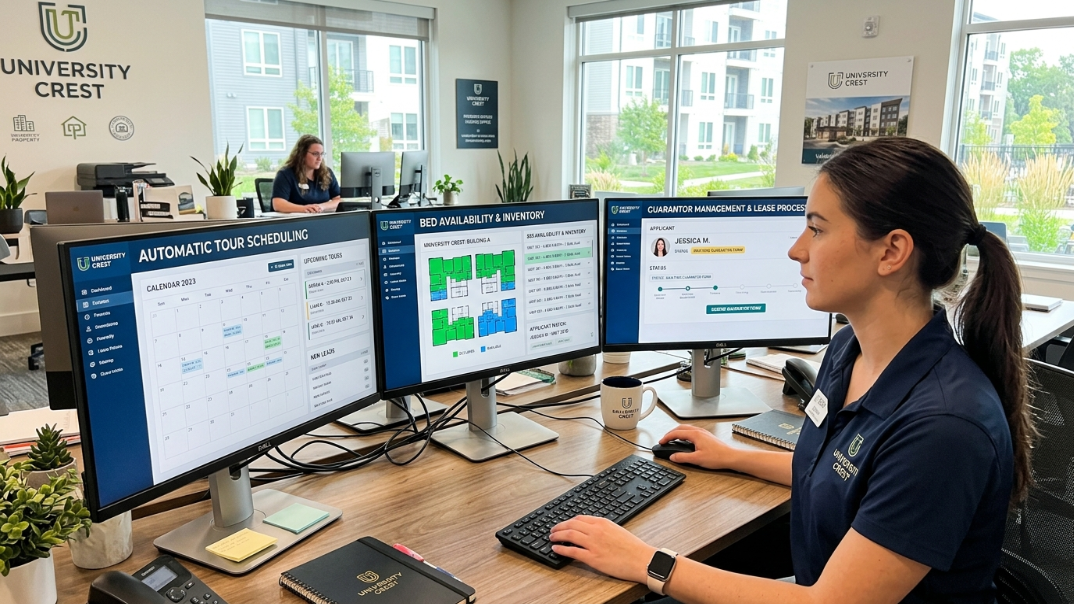
The next evolution beyond generative AI and rule-based bots. Where a chatbot reacts to prompts and a generative AI model produces text, agentic AI takes independent actions: it can check bed availability, create a lease application, schedule a tour, and follow up three days later, all without a human triggering each step. As JLL’s Mendowa Martin put it, agentic AI “operates more like a virtual leasing agent with a brain and a memory.”
Gartner projects that about a third of enterprise software applications will use agentic AI by 2028, up from roughly 1% today. Companies like Yardi, Funnel, EliseAI, and AppFolio are all developing or releasing agentic AI systems for multifamily.
In practice: For student housing, agentic AI means the system doesn’t just answer a prospect’s question about a 4-bed unit. It checks which beds are available, confirms the prospect’s move-in date aligns with the academic calendar, sends guarantor paperwork to a parent, and creates the lead record in the PMS, all in one interaction.
Learn more about this shift in our guide on AI workers in property management.
Natural Language Processing (NLP)
The branch of AI that enables software to understand human language, not just keywords but intent, context, and nuance. In a leasing context, NLP is what allows an AI assistant to interpret “Do you have any spots open for fall?” as a question about bed availability for the upcoming academic year.
Why this matters for student housing: Student inquiries come with slang, abbreviations, and terminology that differs from conventional renter language. Phrases like “looking for a spot near campus,” “need a room for spring semester,” or “my roommate backed out” all require contextual understanding. NLP-powered systems also support multilingual capabilities. Most international student housing platforms now include AI chatbots that respond in a tenant’s preferred language, reducing communication errors around lease terms and payment deadlines.
PMS Integration (Property Management System)
The connection between an AI leasing tool and the property’s core operational software (AppFolio, Yardi, RealPage, Entrata, etc.). True PMS integration means the AI can read data from and write data to the system, creating work orders, updating lead records, syncing availability, and logging conversations without manual re-entry.
In practice: A student inquires about a bed at 11 PM. The AI checks real-time availability in the PMS, qualifies the lead, schedules a tour for the next morning, and logs the interaction. The leasing team sees the complete record when they arrive at the office. No copy-pasting. No lost context. For operators evaluating integration depth, Haven’s integrations page shows how AI agents connect directly to PMS systems.
CRM (Customer Relationship Management)
In leasing, a CRM tracks every prospect interaction from first inquiry through signed lease. AI-powered CRMs automate follow-up sequences, score leads by engagement level, and flag prospects who are closest to signing.
ILS (Internet Listing Service)
Platforms like Zillow, Apartments.com, and Rent.com where properties list available units. For student housing, ILS lead capture automation is critical because these platforms generate a large share of initial inquiries. AI tools that integrate directly with ILS platforms can capture leads instantly rather than waiting for a staff member to check a dashboard.
Student Housing-Specific Terms
These are the terms that separate student housing from conventional multifamily. If an AI tool doesn’t handle these concepts natively, it wasn’t built for your operation.
By-the-Bed Leasing
A lease structure where each occupant signs an individual lease for their bed, rather than the entire unit being leased to one party. When one roommate moves out mid-lease, you don’t lose revenue on the entire unit. You re-lease that individual bed while other leases continue unaffected.
Why this matters: By-the-bed leasing is fundamental to student housing economics, yet most generic PM software treats it as an afterthought or doesn’t support it at all. AI leasing tools built for student housing must handle per-bed pricing, individual lease terms, and bed-level inventory visibility. EliseAI, for example, explicitly advertises that it “handles per-bed pricing, semester-long leases, student-specific income criteria, and guarantor policies.”
Bed-Level Inventory Management
Tracking availability, pricing, and lease status at the individual bed level rather than the unit level. A 4-bedroom unit might have three beds leased through August and one available for spring, and the system needs to reflect that in real time.
Pre-Leasing / Pre-Leasing Velocity
Pre-leasing measures the percentage of beds leased for the upcoming academic year before the current lease cycle ends. Pre-leasing velocity tracks how fast those commitments accumulate. National pre-leasing reached an estimated 52.3% as of January for the 2026-2027 cycle, pointing to another strong start.
Why this matters: Velocity is the leading indicator of whether a property will hit target occupancy. AI accelerates pre-leasing velocity by responding to early-season inquiries instantly, nurturing prospects who aren’t ready to commit, and converting leads during the narrow window when decisions happen.
Academic Calendar Lease Cycle
The leasing timeline dictated by the academic year. Unlike conventional multifamily where leases start and end throughout the year, student housing concentrates the majority of activity into a predictable but compressed period. Late winter and early spring is when prospects search, and summer is when mass turnover happens.
No other asset class experiences this level of operational intensity on such a predictable cycle. AI tools need to scale up during peak weeks and handle the communication bottlenecks that come with thousands of coordinated notices, renewals, and move-in instructions.
Peak Leasing Season
The weeks (typically February through April) when student housing operators receive the highest volume of inquiries and sign the most leases. A leasing team that performs adequately the rest of the year will be overwhelmed during this period.
How AI handles this: One operator case study showed AI handled leads overnight, raising lease conversions by 33% and improving lead response speeds by 26%. AI-scheduled tours lifted lead-to-tour rates by 53%. These gains are most pronounced during peak season when human staff simply cannot keep pace with volume.
Turnover Season
The summer period when outgoing tenants move out and incoming tenants move in, often within days of each other. Student housing turnover is uniquely compressed: an entire building’s worth of residents might change over in a two-week window. AI helps by automating move-out inspections scheduling, coordinating maintenance and cleaning between tenants, and managing move-in communications at scale.
For properties handling high turnover maintenance volume, our guide on emergency maintenance triage covers how AI prioritizes urgent issues during chaotic periods.
Guarantor / Co-Signer Workflow
Most student tenants require a parent or guardian to co-sign the lease. This creates a dual communication stream: the student is the primary prospect, but the guarantor needs separate documentation, financial verification, and signature collection. AI systems designed for student housing automate guarantor outreach, send documents to the right party, and track completion without the leasing team manually managing two contacts per bed.
Purpose-Built Student Accommodation (PBSA)
Housing specifically designed and built for students, typically near a university campus. PBSA properties feature shared common areas, furnished units, bed-level leasing, and amenities oriented toward student life. The U.S. student housing market reached 95.1% occupancy across Yardi 200 universities for the 2025-2026 academic year, with average asking rent per bed hitting $1,017.
Cohort / Group Leasing
When a group of friends wants to lease together, often selecting specific beds within the same unit. AI tools that support group leasing can handle multiple linked applications, match roommate preferences to available configurations, and process the group as a single workflow rather than four separate transactions.
Student Housing AI vs Conventional Multifamily AI
Feature | Student Housing AI | Conventional Multifamily AI |
|---|---|---|
Leasing Structure | By-the-bed leasing | Whole-unit leasing |
Peak Leasing Window | Highly compressed seasonal cycle | Year-round |
Guarantor Handling | Essential workflow | Less common |
Roommate Matching | Frequently required | Rare |
Inventory Tracking | Bed-level | Unit-level |
Communication Style | SMS-heavy, fast response expectations | More balanced |
Lease Timing | Academic-calendar driven | Flexible move-in dates |
Turnover Volume | Extremely concentrated | Distributed |
Pricing Structure | Per-bed pricing | Per-unit pricing |
Lead Urgency | Very high during pre-leasing | More consistent year-round |
How AI Fits Into the Student Housing Leasing Workflow
AI leasing technology touches nearly every stage of the student housing leasing lifecycle.
A typical workflow looks like this:
Leasing Stage | AI Function |
|---|---|
Initial Inquiry | Responds instantly via SMS, chat, email, or phone |
Lead Qualification | Verifies move-in timing, student status, and pricing fit |
Tour Scheduling | Books tours automatically |
Follow-Up | Sends reminders and nurture campaigns |
Application Support | Assists with documentation and questions |
Guarantor Collection | Sends co-signer forms and tracks completion |
Lease Execution | Coordinates signatures and reminders |
Move-In Preparation | Automates communication and scheduling |
Renewal Outreach | Identifies and nurtures renewal opportunities |
For student housing operators, the value comes from compressing response times during the narrow pre-leasing window where most annual occupancy decisions are made.
Lead Management and Conversion Terms
Lead Capture Automation
The process of automatically pulling prospect information from ILS platforms, website forms, and social media inquiries into the CRM without manual entry. For student housing, this is especially important during peak season when dozens of leads might arrive simultaneously from Zillow, Apartments.com, and the property website.
Lead Qualification / Pre-Qualification
Automated screening of prospects against operator-defined criteria: student enrollment verification, income thresholds (or guarantor income thresholds), move-in date alignment with the academic calendar, and pet policies. AI handles this in real time during the initial conversation rather than requiring a staff member to review each application manually.
Lead-to-Lease Conversion Rate
The percentage of initial inquiries that result in a signed lease. In student housing, this metric is compressed into a shorter timeline than conventional multifamily. A prospect who inquires in March and doesn’t hear back for 48 hours will likely sign elsewhere. AI dramatically improves conversion rates by eliminating response delays. One operator saw AI involvement in scheduling more than 60,000 tours from 83,000 prospect engagements.
Speed-to-Lead
The time between a prospect’s first inquiry and the property’s first response. This is arguably the most important metric in student housing leasing. Students shopping for fall housing are comparing multiple properties simultaneously. The first property to respond meaningfully often wins the lease. AI responds in seconds, day or night.
Tour Scheduling Automation
AI that books self-guided, virtual, or in-person tours directly from a leasing conversation without human coordination. The system checks calendar availability, sends confirmation and reminders, and can reschedule if needed.
Omnichannel Communication
Handling prospect and tenant conversations across phone, SMS, email, and chat from a single system. Students communicate differently than other renter demographics, often preferring text messages. An effective AI leasing system meets prospects on whatever channel they prefer.
Ready to see how AI handles leasing inquiries across channels? Book a demo to see it in action.
Lead Nurturing / Automated Follow-Up
Systematic outreach to prospects who inquired but haven’t yet signed. AI follow-up sequences might include a check-in text three days after a tour, a pricing update when a preferred unit becomes available, or a reminder as a lease deadline approaches. In student housing, timing these messages around registration deadlines and financial aid disbursement dates makes them significantly more effective.
Listing Syndication
Automatically distributing property listings across multiple ILS platforms and keeping pricing, availability, and photos synchronized. When a bed is leased, syndication tools update the listing everywhere simultaneously.
Operations and Compliance Terms
Fair Housing Act Compliance
Federal law prohibiting discrimination in housing based on race, color, national origin, religion, sex, familial status, or disability. In the context of AI leasing, this takes on new urgency because automated systems interact with thousands of prospects at scale, and any discriminatory pattern, even an unintentional one, gets amplified.
This is the compliance issue most operators underestimate. In 2023, a private fair housing nonprofit sued Harbor Group Management after its AI leasing chatbot was found to systematically screen out Housing Choice Voucher holders. In August 2024, the DOJ sued RealPage for antitrust violations related to its AI pricing algorithm. Private nonprofit fair housing organizations processed 74% of all housing discrimination complaints in 2024 and now have AI monitoring tools that can test a property’s leasing chatbot remotely, anonymously, and at scale.
For a broader look at compliance considerations, read our AI property management compliance guide.
Disparate Impact
A legal concept where a policy or practice that appears neutral on its face disproportionately affects a protected class. In AI leasing, disparate impact can occur if the system’s qualification criteria, response patterns, or pricing algorithms inadvertently disadvantage certain groups. Because AI operates at volume, even small biases compound into statistically significant patterns that regulators and fair housing testers can detect.
Human-in-the-Loop
A design principle where the AI system automatically escalates certain interactions to a human staff member. This is critical for Fair Housing compliance. Some operators program their AI to transfer any conversation that touches on disability accommodations, voucher acceptance, school quality questions, or affordable housing programs. Cortland’s AI assistant, for example, will not answer questions that could have Fair Housing implications, handing those to a human instead.
Bias Audit
A systematic review of an AI system’s outputs to identify discriminatory patterns. This includes testing whether response quality, speed, or content varies based on prospect names, languages, or other characteristics that might correlate with protected classes. ADA digital accessibility lawsuits surged 20% in 2025, approaching 5,000 filings, making proactive auditing increasingly important.
For operators worried about AI missteps, our article on AI property management myths addresses common hesitations around compliance and control.
Conversation Memory / Continuity
The AI’s ability to retain context from previous interactions with the same prospect. If a student called last week about a 2-bed unit near the engineering building, sent a text today asking about pricing, and emails tomorrow to schedule a tour, the AI should treat all three as one continuous conversation rather than three separate inquiries. This is a hallmark of more advanced AI systems and is essential for the extended decision-making timeline in student housing, where a prospect might first inquire in January and not sign until April.
Work Order Automation
AI that receives maintenance requests, triages them by urgency, creates work orders in the PMS, and dispatches vendors from a preferred list. During turnover season, student housing properties face a wall of maintenance needs. AI triage ensures emergencies get immediate attention while routine requests are queued efficiently.
Vendor Dispatch
Automated assignment of maintenance tasks to approved vendors based on issue type, vendor availability, and property rules. The AI creates the work order, notifies the vendor, and follows up after completion.
Metrics and ROI Terms
Occupancy Rate
The percentage of available beds that are leased and occupied at a given time. Student housing occupancy follows a different rhythm than conventional multifamily: it peaks at the start of the academic year and may dip during summer sessions. The national average stands at 91.6% with an average asking rent of $1,017 per bed.
Cost-per-Lease
The total marketing, staffing, and technology cost divided by the number of signed leases. AI reduces cost-per-lease by automating the most labor-intensive parts of the leasing process. Industry estimates suggest AI can reduce operational costs by approximately 30% while lifting tenant satisfaction by roughly 20%.
Lease-Up Velocity
How quickly a new or renovated property reaches stabilized occupancy. For student housing, lease-up velocity is constrained by the academic calendar. Miss the spring leasing window and the property may sit partially vacant for an entire academic year. AI compresses the time from first inquiry to signed lease, which directly accelerates lease-up.
Vacancy Loss
Revenue lost from unleased beds. In student housing, vacancy loss is particularly painful because it’s binary: a bed either generates 12 months of revenue or sits empty for a full academic year. There’s no “re-leasing in October” the way a conventional apartment might fill a mid-year vacancy.
NOI (Net Operating Income) Impact
The bottom-line effect of AI on property financials. AI improves NOI through two channels: increasing revenue (faster leasing, higher occupancy, fewer missed leads) and decreasing expenses (fewer staff hours, lower call center costs, reduced marketing spend per lease). Breeden Co.'s Christine Gustafson captured the practical reality when she said, “This AI has taken the burden off our onsite teams.”
For detailed benchmarks on how operators measure AI returns, our AI property management ROI guide breaks down the numbers.
Predictive Analytics for Student Housing Demand
Using historical data (enrollment trends, pre-leasing velocity, inquiry patterns) to forecast demand and optimize pricing. With over 22 million students enrolled in U.S. post-secondary institutions and enrollment patterns shifting by region, predictive models help operators adjust pricing and marketing spend before peak season rather than reacting after beds sit empty.
The Bottom Line for Student Housing Operators
The biggest risk with AI for student housing leasing isn’t the technology failing. It’s deploying generic multifamily tools that don’t handle by-the-bed inventory, guarantor workflows, or academic calendar timing. Practitioners consistently report that the gap between student-housing-specific AI and repurposed conventional tools shows up most painfully during peak season, exactly when the stakes are highest.
Cortland’s CX Officer Mike Gomes noted that the “universe of questions” at the prospect stage is “relatively limited,” which makes AI highly effective for initial interactions. The challenge is making sure your AI understands the specific universe of student housing questions, not just generic apartment queries.
If you manage student housing and want to see how AI handles the leasing workflow from inquiry through signed lease, book a demo with Haven to see AI leasing agents in action.
Major AI Leasing Platforms Used in Student Housing
The student housing AI leasing market includes both multifamily platforms adapting to student workflows and systems designed specifically for student operations.
Common categories include:
Vendor Type | Typical Focus |
|---|---|
Multifamily AI Platforms | Enterprise automation across conventional multifamily and student portfolios |
Student Housing Specialists | By-the-bed leasing and guarantor workflows |
CRM-Centered Platforms | Lead nurturing and communication automation |
PMS-Native AI Tools | Deep operational integrations |
Conversational AI Vendors | AI voice, SMS, and chatbot automation |
When evaluating vendors, operators should prioritize:
PMS integration depth,
Fair Housing controls,
conversation memory,
guarantor automation,
and bed-level inventory support.
How to Evaluate AI Leasing Software for Student Housing
Operators evaluating AI leasing platforms should assess:
Bed-level inventory support
PMS integration depth
Guarantor workflow automation
Omnichannel communication capabilities
Fair Housing escalation controls
Reporting and analytics visibility
Conversation memory across channels
Peak-season scalability
The best systems are designed specifically around student housing operational realities rather than adapted from conventional multifamily workflows.
Frequently Asked Questions
How is AI for student housing leasing different from regular multifamily AI?
Student housing AI must handle by-the-bed pricing, individual bed-level inventory tracking, guarantor co-signer workflows, academic calendar lease cycles, and cohort/group leasing. Generic multifamily AI tools typically operate at the unit level and assume year-round leasing activity, which doesn’t match student housing operations.
Can AI leasing tools handle Fair Housing compliance?
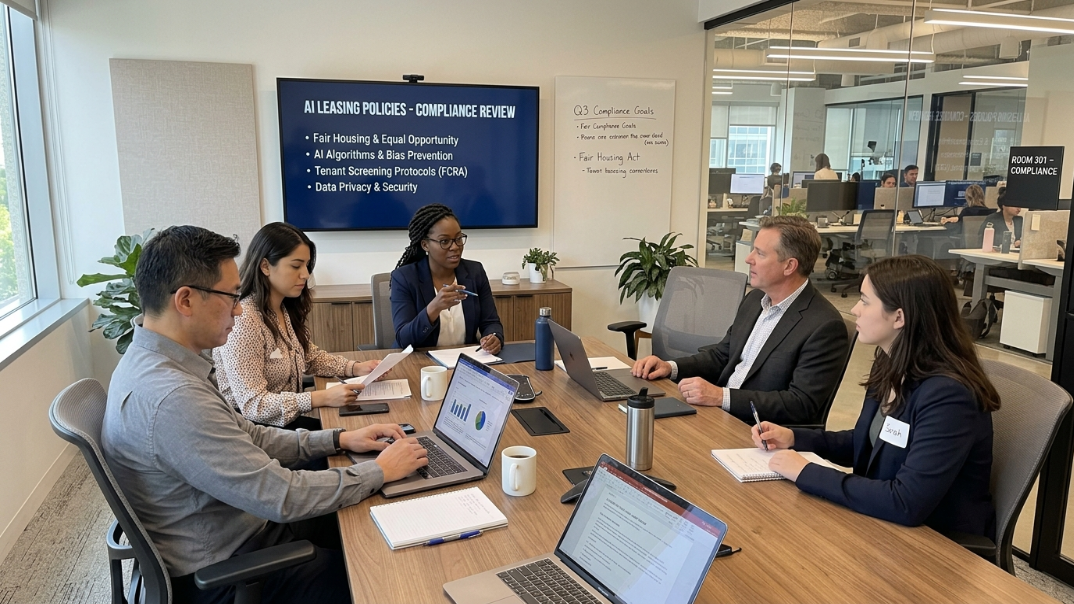
AI can be designed with Fair Housing guardrails, such as refusing to answer questions about school quality or voucher acceptance and escalating those to human staff. However, operators remain legally responsible for their AI’s outputs. Regular bias audits and human-in-the-loop protocols are essential, especially since fair housing organizations now use AI to test chatbots remotely and at scale.
What kind of conversion improvements can student housing operators expect from AI?
Published case studies show AI-handled leads raising lease conversions by 33%, improving response speeds by 26%, and lifting lead-to-tour rates by 53%. Results vary by property, but the biggest gains come during peak season when human teams are most overwhelmed.
Do students actually engage with AI leasing assistants?
Yes. Up to 30% of student housing inquiries happen after business hours when students are free from classes and jobs. AI meets them when they’re actively searching. One operator reported its AI engaged with 83,000 prospects and helped schedule more than 60,000 tours, suggesting strong prospect willingness to interact with AI systems.
How does AI handle the guarantor workflow in student housing?
AI systems built for student housing can identify when a guarantor is required based on the prospect’s income or student status, send separate documentation to the parent or co-signer, track completion, and follow up if signatures are outstanding, all without the leasing team managing dual contacts manually.
What should I look for when evaluating AI leasing tools for student housing?
Prioritize bed-level inventory support, PMS integration depth (does it read and write to your system?), after-hours availability, guarantor workflow automation, Fair Housing compliance features, and conversation memory across channels. If a vendor can’t demonstrate these capabilities specifically for student housing, it’s a repurposed conventional tool.
How quickly can AI for student housing leasing be implemented?
Implementation timelines vary by vendor and portfolio size, but most systems require configuration for property-specific rules, PMS integration setup, and quality assurance testing. The goal is to be fully operational before peak leasing season begins, so starting the evaluation process in fall gives adequate runway for a spring deployment.