AI Training for Property Management Staff: 2026 Guide
AI training property management staff done right in 2026: role-based workflows, compliance guardrails, and ROI metrics. Get the step-by-step guide.

TL;DR
AI training for property management staff is the structured process of teaching leasing agents, maintenance coordinators, and property managers how to use AI tools in their daily workflows. It also includes configuring the AI system itself with property-specific data. With 54% of real estate organizations offering zero AI training, the gap between firms that invest in training and those that don’t is becoming the single biggest predictor of whether AI adoption succeeds or fails.
Quick Answer: How Do You Train Property Management Staff on AI?
AI training for property management staff should combine role-specific tool training, hands-on workflow practice, AI configuration, compliance education, and ongoing support. Start by identifying the workflows AI will change, train each role on its specific use cases, establish human-review and escalation rules, practice with real scenarios, and measure adoption, accuracy, time savings, and staff confidence over the first 90 days.
The property management industry hit a tipping point. AI adoption jumped from 20% in 2024 to 58% in 2025, according to Buildium’s 2026 State of the Property Management Industry Report. But here’s the uncomfortable truth buried in that headline number: just 8% of firms have managed to fully automate any workflows.
The bottleneck isn’t the technology. It’s training.
AI training for property management staff has become the deciding factor between companies that get real value from their AI investments and those that waste them. This guide breaks down what that training actually involves, who needs it, and what happens when you skip it.
Explore Haven’s AI property management tools to see how purpose-built AI agents simplify the training curve for PM teams.
What “AI Training” Actually Means in Property Management
At its core, AI training for property management staff refers to the structured process of educating team members on how to effectively use AI-powered tools within their daily operations. This includes tool-specific onboarding, workflow redesign, compliance guardrails, and ongoing skill development.
But there’s an important distinction that most industry coverage misses. “AI training” in property management has two dimensions:
Training your staff to use AI tools. This is what most people picture: walkthroughs, practice sessions, compliance education, and workflow integration. A leasing agent learning how to review AI-qualified leads. A maintenance coordinator understanding how the AI triages emergency requests.
Training the AI system itself. This means feeding the AI your property-specific data, including SOPs, vendor lists, property details, escalation rules, and communication preferences, so it performs accurately in your environment. Without this step, even the best-trained staff will be working with an AI that doesn’t know your properties.
Both dimensions must happen at the same time. Training staff on a poorly configured system breeds frustration. Configuring a great system that staff don’t understand breeds abandonment.
For a deeper look at getting your data ready, see this guide on data quality and PMS integration.
Why AI Training Has Become a Top Priority
The Training Gap Is Enormous
An MRI Software 2026 survey of nearly 600 commercial real estate professionals found that 54% of organizations offer no AI training at all, even as adoption accelerates. Meanwhile, AppFolio’s Property Manager Benchmark Report found that 63% of property management leaders identify staff training on new technology and AI as a top operational challenge.
That gap creates a strange situation: companies are buying AI tools, then leaving employees to figure them out alone. This pattern isn’t unique to property management. Cross-industry data from eMarketer shows that nearly half (49%) of C-suite members admit employees have been left to learn generative AI on their own.
The Trust Divide
There’s a telling disconnect between how executives and on-site staff feel about AI. Survey data from MRI Software shows that property-level staff report meaningfully higher trust concerns about AI outputs than executives do, 22% versus 3%.
That’s not a resistance problem. It’s a communication and training problem. Executives who selected the tool understand its purpose and limitations. On-site staff who were handed the tool without context naturally question its reliability.
The ROI Connection
The primary ROI destroyer in AI implementation is deploying tools without training. Firms that skip structured onboarding see tool adoption rates below 20% within six months, effectively wasting their entire investment.
By contrast, organizations that train staff properly report a 20 to 30% improvement in operational efficiency, AI-driven reduction in lease administration errors by up to 42%, and time savings of up to 10 hours per week per property manager.
The stakes are competitive, too. Firms that have broadly adopted AI expect an average portfolio growth of 31% in 2026, nearly triple the 12% anticipated by non-adopters. And contrary to the replacement narrative, 34% of AI adopters plan to increase headcount, compared to just 25% of non-users.
For a full breakdown of the benefits and ROI case, read AI property management benefits and ROI.
The 90-Day AI Training Framework for Property Management Teams
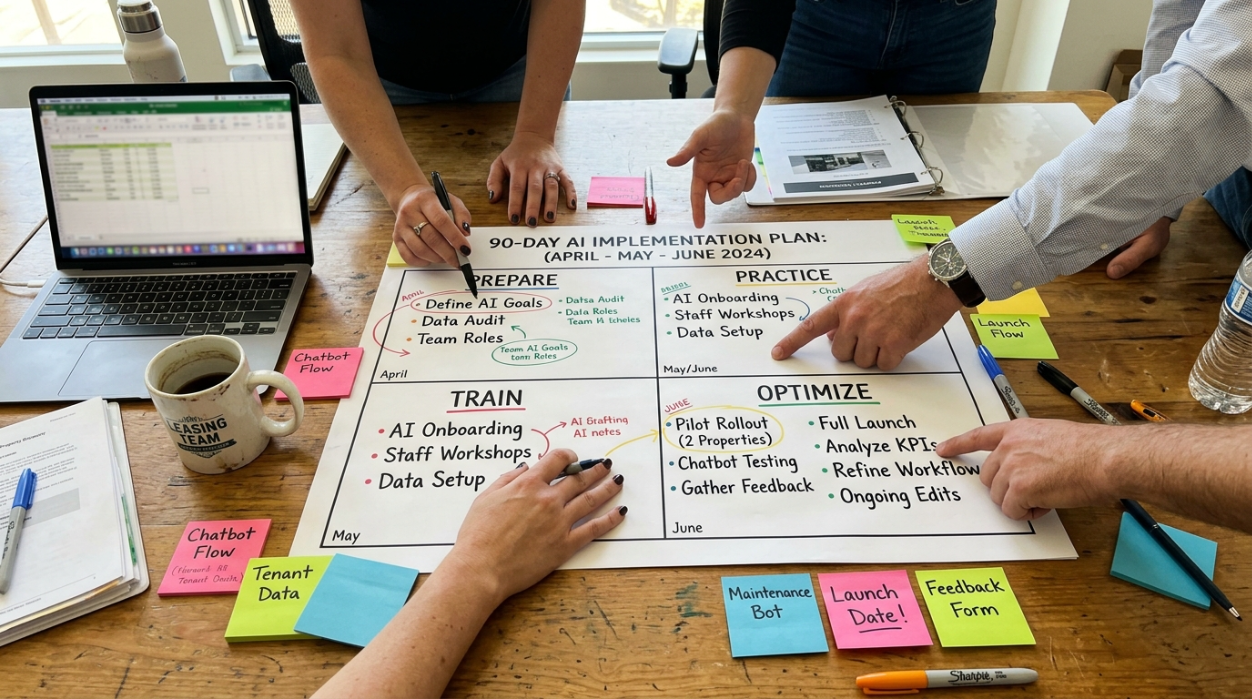
A successful AI training program should not be treated as a single workshop. Property management teams need an initial orientation, role-specific practice, supervised use, and ongoing optimization. A 90-day rollout gives employees enough time to learn the tool, encounter edge cases, and build reliable habits.
Phase | Timeline | Primary Goal | What Staff Learn |
|---|---|---|---|
Phase 1: Prepare | Days 1–14 | Build understanding | Why AI is being introduced, which workflows will change, compliance rules, data handling, and human-review requirements |
Phase 2: Train | Days 15–30 | Build basic proficiency | Role-specific workflows, tool navigation, prompts or instructions, AI outputs, escalation procedures |
Phase 3: Practice | Days 31–60 | Build confidence | Real property scenarios, exceptions, incorrect AI outputs, tenant communications, PMS workflows, and human overrides |
Phase 4: Optimize | Days 61–90 | Build reliable habits | Performance review, workflow adjustments, refresher training, staff feedback, and adoption tracking |
Days 1–14: Prepare Before Employees Use AI
Start by defining what the AI system is expected to do and what it must not do. Document the workflows affected by AI, identify the employees responsible for reviewing outputs, and establish escalation rules before rollout.
Staff should understand:
Why the company is introducing AI
Which tasks AI will handle or assist with
Which decisions remain the responsibility of employees
What information can and cannot be entered into the system
When an AI-generated response requires human review
How errors and unusual cases should be reported
Days 15–30: Train by Role
Move from general education into hands-on training based on each employee's responsibilities.
A leasing agent might practice AI-assisted lead qualification, follow-up, and tour scheduling. A maintenance coordinator might practice request classification, work-order creation, and emergency escalation. Property managers should focus on oversight, exception handling, reporting, and quality assurance.
Days 31–60: Practice Real Scenarios
Training should move beyond demonstrations. Employees should work through realistic situations involving incomplete information, incorrect AI recommendations, unusual tenant requests, emergency maintenance issues, and communication that requires human judgment.
The objective is not to teach employees to accept AI outputs automatically. It is to teach them when AI is useful, when it needs review, and when a person should take over.
Days 61–90: Measure and Optimize
After employees have used the system in daily work, review adoption and performance data. Identify workflows where employees avoid the tool, frequently override its recommendations, or require additional assistance.
Use those findings to create targeted refresher training rather than repeating the original training session.
What Success Looks Like After 90 Days
By the end of the initial training cycle, employees should be able to use the AI system independently for approved workflows, recognize situations that require human intervention, follow the organization's AI and Fair Housing policies, and report problems through a defined escalation process.
What AI Training Covers, by Role
What Should Each Property Management Role Learn?
AI training should be customized according to the employee's daily responsibilities. The objective is not to make every employee an AI expert. It is to teach each role how to use AI safely and effectively within the workflows they already own.
Role | Core AI Skills | Workflows to Practice | Human Oversight |
|---|---|---|---|
Leasing Agents | AI-assisted communication, lead qualification, scheduling, response review | Lead intake, follow-ups, tour scheduling, prospect questions | Review sensitive or unusual communications and Fair Housing-related situations |
Maintenance Coordinators | AI triage, work-order automation, escalation rules | Maintenance intake, issue classification, vendor coordination, resident updates | Review emergencies, ambiguous requests, and safety-related issues |
Administrative Staff | AI-assisted data entry, document processing, summaries, reporting | Document organization, lease summaries, data entry, recurring reports | Verify important records and extracted information |
Property Managers | AI oversight, exception handling, analytics, workflow management | Portfolio reporting, escalations, quality assurance, performance monitoring | Make final operational and policy decisions |
Regional Managers | AI governance, adoption measurement, cross-property consistency | Multi-property reporting, performance comparison, workflow standards | Review policy exceptions and organizational-level risks |
Maintenance Managers | Workflow automation, technician coordination, AI quality control | Work-order routing, recurring maintenance, vendor workflows | Review complex repairs, emergencies, and vendor decisions |
Leadership | ROI measurement, governance, adoption strategy | AI performance reviews, investment decisions, policy development | Establish acceptable use, risk tolerance, and accountability |
The Most Important Skill: Knowing When Not to Use AI
Property management employees should not be trained simply to maximize AI usage. They should learn to identify situations where human judgment is more appropriate.
Examples include sensitive resident disputes, emergencies, unclear Fair Housing situations, complex lease interpretations, unusual financial circumstances, and cases where the AI produces conflicting or incomplete information.
The goal is controlled adoption: employees should know which tasks AI can accelerate, which outputs require verification, and which decisions should remain with a qualified human.
One of the biggest mistakes companies make is running a single, generic training session for their entire team. A leasing agent and a maintenance coordinator use AI differently. Their training should reflect that.
Role-Specific Training Breakdown
Role | AI Training Focus Areas |
|---|---|
Leasing Agents | Lead qualification workflows, AI-assisted tour scheduling, CRM integration, follow-up automation, Fair Housing guardrails for AI-generated communications |
Maintenance Coordinators | Work order creation and triage, emergency escalation protocols, vendor dispatch, tenant troubleshooting, follow-up workflows |
Admin/Office Staff | Communication drafting, data entry automation, reporting dashboards, document organization, lease term summaries |
Property Managers/Leadership | Oversight and QA processes, compliance monitoring, ROI tracking, exception review, team adoption coaching |
This role-specific approach aligns with what practitioners across the industry are finding. Analysis from MRI Software notes that leasing agents generally welcome automation for repetitive, low-value tasks (after-hours inquiries, initial lead qualification, routine follow-ups) while wanting to retain ownership of tours, negotiations, and resident relationships. Framing AI as handling the worst aspects of the job produces far smoother adoption.
If you’re considering AI for your leasing team specifically, Haven’s Leasing AI handles phone, SMS, and email inquiries, lead qualification, and tour scheduling across channels.
For maintenance teams, the training focus shifts to understanding how AI triages requests and when human judgment is required. To hear what that actually sounds like in practice, listen to an AI maintenance call example.
PMS Integration Training
Every role’s training must include how AI tools interact with your property management software. Whether you’re on AppFolio, Buildium, or another platform, staff need to understand how data flows between systems. That means knowing where AI-generated work orders appear, how notes get logged, and what happens when the integration encounters an error.
This is where property management-specific AI tools have a significant advantage over generic AI. Purpose-built tools come pre-configured for PM workflows, which shortens the learning curve considerably. For details on PMS integration specifics, see the PMS integration best practices guide.
Common AI Training Mistakes
Based on what operators and consultants report, these are the patterns that sink AI training programs in property management:
1. Skipping the “Why”
Jumping straight to feature walkthroughs without explaining what problem AI solves for each role. Staff need context before clicks. Jennifer Panegasser of NAI Hiffman described her team’s early AI adoption as “a really tough adoption,” noting initial hesitance stemmed partly from uncertainty about where the technology was heading. Her company piloted an AI invoicing tool for about two years before seeing comfort levels rise.
2. Training Only the Happy Path
This is a critical and under-discussed mistake. Staff need the most confidence in exactly the moments when AI gets something wrong or flags an edge case. Training should include what to do when the AI misclassifies a maintenance request, generates an inappropriate response, or produces output that doesn’t match your property’s policies.
As one industry analysis put it: readiness is a function of training, not time. You can’t just wait for staff to get comfortable. You have to prepare them for the messy scenarios.
3. One-Size-Fits-All Sessions
Running a single training session for all roles, as covered above, misses the mark. Leasing agents and maintenance coordinators face different AI interactions daily.
4. Assuming the Tool Is Intuitive
Even well-designed AI tools require training. The interface might be simple, but understanding the AI’s decision-making logic, its limitations, and when to override it requires structured education.
5. No Ongoing Support
AI training isn’t a one-time event. Designating an internal “AI champion” or ambassador, someone who supports peers during and after rollout, dramatically improves sustained adoption. This person doesn’t need to be a tech expert. They need to be trusted by the team and comfortable asking questions.
For guidance on planning your rollout timeline and avoiding these pitfalls, check the AI implementation timeline guide.
AI Training and Fair Housing Compliance
This is the section most AI training programs gloss over, and it’s the one that carries the most legal risk.
HUD guidance extends Fair Housing liability to AI tools. If your AI screening system discriminates, or if AI-generated communications contain language that violates Fair Housing rules, your company is responsible. Not the vendor. You.
AI-specific Fair Housing compliance training should cover:
Bias awareness. Staff should understand that AI models can reflect biases present in their training data. If a lead qualification AI appears to screen out prospects from protected classes at disproportionate rates, staff need to know how to flag it.
Override protocols. When should a staff member override an AI recommendation? Training must define these triggers clearly. An AI might score a prospect low based on incomplete data, for example, and the leasing agent needs to know they have both the authority and the obligation to apply human judgment.
Documentation requirements. AI-assisted decisions should be documented. If a prospect is denied and AI played any role in the screening, your team needs a paper trail showing what the AI recommended and what the human decided.
Disclosure procedures. Depending on your jurisdiction and the type of AI interaction, tenants may need to be informed they’re interacting with an AI system.
For a comprehensive walkthrough of these requirements, read the AI compliance and Fair Housing guide.
The Augmentation Framing: Why It Matters for Training
The most successful AI training programs in property management share a common framing: augmentation, not replacement.
A PM executive interviewed on the Six Peas podcast highlighted that forward-thinking firms use AI specifically to “offload staff from tedious work so they can focus on human interactions with residents.” Meanwhile, practitioner analysis from the PM Assist newsletter argues that training should prioritize teaching staff to add value where AI can’t, specifically in conflict resolution, complex judgment calls, and relationship management.
This framing matters because it directly addresses the trust gap. When staff believe AI threatens their job, training becomes adversarial. When they understand AI handles the parts of their job they dislike (data entry, after-hours calls, repetitive follow-ups), training becomes welcome.
The numbers back this up. AI adopters are more likely to increase headcount, not reduce it. The firms scaling fastest are using AI to handle volume while humans handle complexity.
For strategies on reducing burnout through AI, this guide covers how operators are rethinking workload distribution.
Measuring AI Training Effectiveness

You can’t manage what you don’t measure. Here are the key metrics for evaluating whether your AI training program for property management staff is working:
Adoption rate. What percentage of your team is actively using the AI tool daily? If it’s below 50% after 90 days, your training likely has gaps. Remember, firms that skip structured onboarding see usage drop below 20% in six months.
Time savings per workflow. AppFolio reported that property managers using its AI-assisted tools reduced email drafting time by up to 11.9 hours per week. Track specific workflows (maintenance request intake, lead follow-up, reporting) and compare pre- and post-training time expenditures.
Error and escalation rates. Are AI-handled tasks generating more or fewer escalations than manual processes did? A well-trained team paired with a properly configured AI should see escalation rates decline over time.
Tenant satisfaction scores. Compare satisfaction surveys before and after AI implementation. If scores drop, the issue is usually training (staff aren’t using the tool well) or configuration (the AI isn’t calibrated to your properties), not the technology itself.
Staff confidence surveys. Periodically ask your team how comfortable they feel using AI tools and where they need more support. This directly addresses the trust gap and gives you data on where to focus refresher training.
Related Terms
AI onboarding (PM context): The initial setup and orientation period when a new AI tool is deployed, covering system configuration, data integration, and team training.
Change management: The structured approach to planning, implementing, and managing changes to processes and systems within a property management organization. AI training is a subset of change management.
AI adoption rate: The percentage of a team actively using AI tools in daily work. The industry-wide figure jumped from 20% to 58% between 2024 and 2025.
Workflow automation: Using AI to handle repetitive tasks (maintenance triage, lead qualification, tenant communication) that previously required manual effort. For a broader look, explore property management automation software.
AI champion / AI ambassador: An internal team member designated to support peers during AI rollout and serve as a go-to resource for questions and troubleshooting.
PMS integration training: Teaching staff how AI tools interact with property management software so data flows correctly between systems.
Agentic AI: AI systems that can take actions autonomously, such as creating work orders, dispatching vendors, or sending follow-up communications, rather than just generating text or recommendations.
Ready to see how a property management-specific AI agent works in practice? Book a demo with Haven to explore AI agents built for maintenance and leasing workflows, with onboarding designed to get your team productive fast.
Frequently Asked Questions
How long does it take to train property management staff on AI tools?
Most teams reach basic proficiency within two to four weeks, but full confidence takes longer. The initial training period covers tool walkthroughs and core workflows. The following 60 to 90 days are where habits form and edge cases surface. Ongoing refresher sessions should continue quarterly. See the AI implementation timeline guide for a detailed rollout schedule.
Does AI training for property management staff require technical expertise?
No. Modern property management AI tools are designed for operators, not developers. Training focuses on workflow integration, compliance awareness, and exception handling, not coding or system administration. The most important skill isn’t technical. It’s knowing when to trust the AI and when to override it.
What’s the cost of not training staff on AI?
Firms that skip structured AI training see tool adoption rates below 20% within six months, which means the money spent on the AI tool is essentially wasted. Beyond the direct cost, untrained teams create compliance risk, inconsistent tenant experiences, and staff frustration that accelerates turnover.
Should AI training happen before or after the AI tool is deployed?
Both. Pre-deployment training should cover the “why” (what problem AI solves, how roles will change) and basic compliance requirements. Post-deployment training should focus on hands-on practice with the actual tool, using real property data. The two phases are complementary, not interchangeable.
How is AI training different from regular software training?
Traditional software training teaches staff how to use a static tool with predictable outputs. AI training adds layers: understanding probabilistic outputs, recognizing when AI is wrong, knowing compliance guardrails, and building judgment about when human intervention is necessary. The tool changes behavior based on inputs, which means staff need to understand the logic, not just the buttons.
What role does Fair Housing play in AI training for property management?
A central one. HUD guidance makes property managers liable for discriminatory outcomes from AI tools. Every AI training program should include bias awareness, override protocols, documentation requirements, and disclosure procedures. This isn’t optional, it’s a legal obligation.
Can smaller property management companies afford AI training?
Yes. AI training doesn’t require expensive consultants or weeks of downtime. Many property management-specific AI tools include onboarding and training as part of their implementation process. The real cost question isn’t whether you can afford training. It’s whether you can afford the wasted investment and compliance risk of skipping it.