AI Vendor Performance Scoring: 2026 Best Practices
Discover how AI Vendor Performance Scoring boosts compliance and CSAT while cutting costs 15–25%. Learn 2026 KPIs, weighting, and automation.

TL;DR
AI vendor performance scoring uses data from every completed work order to generate a continuously updated score for each maintenance vendor, covering speed, quality, cost accuracy, and tenant satisfaction. It replaces gut-feel decisions and neglected spreadsheets with automated, weighted scoring that feeds directly into dispatch routing. Property managers who track six or more vendor KPIs can reduce contractor costs by 15 to 25% within 12 months, while those who skip scoring overpay by an estimated 18 to 24% annually.
Quick Answer: How AI Vendor Performance Scoring Works
AI vendor performance scoring automatically evaluates maintenance contractors after every completed work order.
The system analyzes six core metrics:
- Response time
- SLA compliance
- First-time fix rate
- Cost accuracy
- Inspection pass rate
- Resident satisfaction
Each metric receives a weighted score based on the type of maintenance request.
Emergency repairs emphasize speed, while turnover projects emphasize quality and cost control.
Those scores immediately influence future dispatch decisions.
Most property managers begin seeing measurable results within 12 months:
Outcome | Typical Improvement |
|---|---|
Contractor cost reduction | 15% to 25% |
Vendor coordination time | 60% to 70% |
Invoice overruns | Reduced by 12% to 18% |
Dispatch decision speed | Real-time |
The biggest advantage is that AI creates a continuous feedback loop. Every completed job improves the next vendor assignment.
AI Vendor Performance Scoring Definition
AI vendor performance scoring is a maintenance management system that continuously evaluates contractors using work-order data, invoices, inspections, SLA compliance, and resident feedback.
Instead of relying on quarterly reviews, AI updates vendor scores after every completed job and uses those scores to influence future dispatch decisions.
What Is AI Vendor Performance Scoring?
AI vendor performance scoring is a system that automatically collects data from work orders, inspections, invoices, and tenant feedback, then applies weighted algorithms to produce a composite performance score for every vendor in a property manager’s network. That score updates in real time after each completed job.
The concept is simple: instead of waiting until contract renewal to ask “how did this vendor do?”, the system answers that question continuously.
This matters because the traditional approach, where site managers rely on personal relationships and quarterly spreadsheet reviews, consistently fails at scale. A vendor excelling at one property and failing at another goes undetected because no one aggregates performance data across sites. By the time a problem surfaces, it’s already cost you.
One important distinction upfront: AI vendor performance scoring is about operational delivery (did the vendor show up on time, fix the problem, and charge what they quoted?). It is not vendor risk scoring, which evaluates insurance status, financial stability, and compliance. The two complement each other, but they measure different things.
Explore AI-powered maintenance coordination to see how automated scoring connects to vendor dispatch.
How AI Vendor Scoring Works: The Feedback Loop
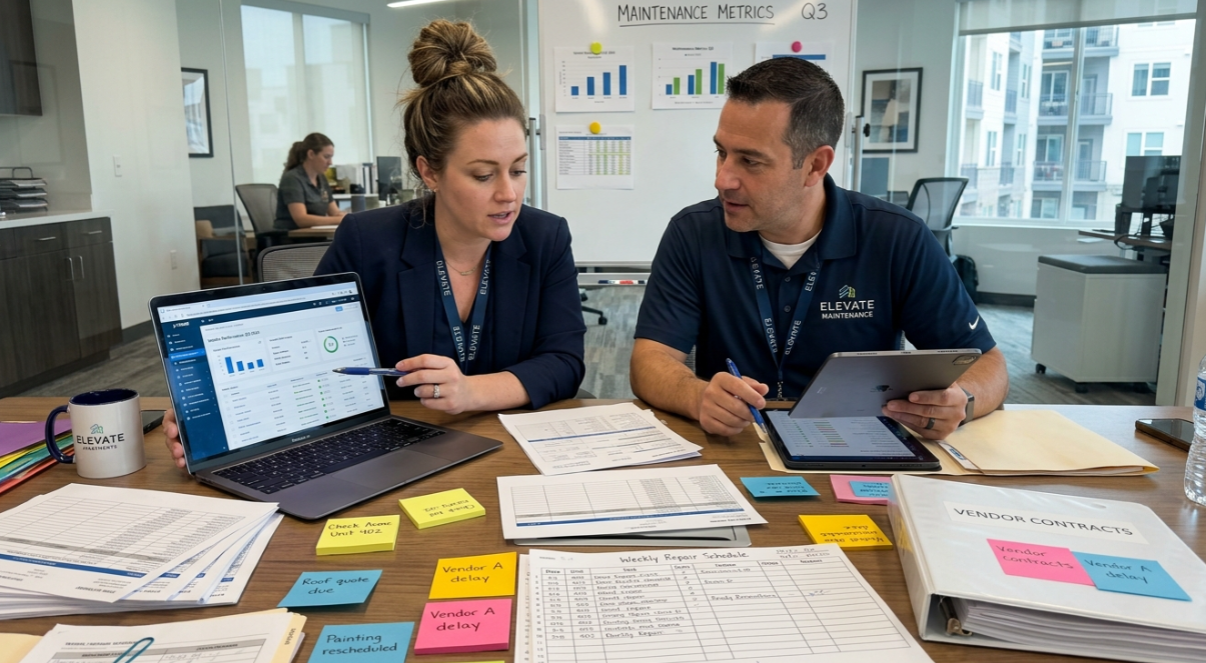
Most guides describe vendor scoring as a measurement exercise. That misses the point. The real value is the feedback loop, where each vendor’s score automatically shapes the next dispatch decision. Here’s how it flows:
Step 1: Data Collection
Every work order generates structured data: response time, number of trips to resolve the issue, final invoice versus original quote, inspection results, and tenant satisfaction ratings. The AI scoring engine pulls this directly from your property management system. The quality of these scores depends entirely on clean PMS data, which is why AI data quality practices matter so much.
Step 2: Weighted Algorithm
Not all metrics carry the same weight, and this is where AI scoring separates itself from simple averages. For emergency repairs, speed to respond might be weighted at 40% of the total score. For routine turnover work, cost accuracy and quality might each carry 35%. The system adjusts these weights based on the job type and asset criticality.
Advanced systems also segment vendors by trade category. An HVAC contractor gets scored on metrics relevant to mechanical systems (response to critical failures, seasonal readiness, repeat call rates) rather than being lumped in with a general handyman. This trade-specific approach prevents misleading comparisons.
Step 3: Composite Score
Each vendor receives a single, unified number that reflects their overall performance. Think of it as a credit score for contractors: one number that summarizes a complex set of behaviors.
Step 4: Automated Actions
This is where the loop closes. Vendors who fall below a defined threshold can be automatically removed from active dispatch routing, flagged for contract review, or placed on a performance improvement watch list. Vendors who consistently outperform can earn priority routing.
A practical example: if a Tier 1 HVAC vendor consistently misses the 2-hour emergency response window, they lose Tier 1 status. If a Tier 2 plumber hits 95% on-time arrival for six months, they earn an upgrade. The AI system automates this tiering so it isn’t dependent on a coordinator’s memory.
For deeper detail on how AI handles the dispatch side of this loop, see this guide on AI vendor dispatch.
Step 5: Next Work Order
The updated scores feed into the next dispatch decision. The system selects from a preferred vendor list based on trade, proximity, availability, price, and past performance. Then the cycle repeats. Each dispatch decision is better than the last because it’s informed by every previous outcome.
This is the concept that AI maintenance coordinators are built around: not just creating work orders, but closing the loop between vendor performance and future routing.
Core Metrics in an AI Vendor Score
The best AI scoring systems track five to six metrics. Practitioners consistently warn against “metric creep,” where tracking 15 or 20 KPIs creates a system so complex that nobody actually uses it. As one vendor management practitioner put it: if a process takes more than 20 minutes to manage, it’s too complicated. A lean scorecard that your team actually updates is far more valuable than a complex one that eventually gets ignored.
Here are the metrics that matter most, along with industry benchmarks:
Response Time (SLA Compliance)
Average time from work order dispatch to on-site arrival, compared against committed SLA windows for each job type. Property Meld’s 2025 benchmarks show an average 0.5-hour acceptance time, 6.2-hour scheduling time, and 6.9-day repair completion time across the industry.
For more on setting and enforcing these windows, read about AI vendor SLA best practices.
First-Time Fix Rate (FTFR)
The percentage of vendor visits that resolve the issue in one trip. The formula is straightforward: (vendor visits requiring one trip / total vendor visits) × 100. A strong first-time fix rate for residential maintenance vendors is 75 to 85%. Rates below 60% typically indicate poor diagnosis, inadequate preparation, or mismatched trade skills. Below 70% signals a competency issue or parts availability problem that needs investigation.
For reference, Lula’s vetted vendor network reports an 80% one-trip resolution rate across 350,000+ properties.
Cost Accuracy (Invoice vs. Quote)
How often final invoices match original quotes. This metric flags vendors who habitually underquote to win jobs, then inflate costs at completion. Even a 10% average overrun across hundreds of work orders adds up to tens of thousands of dollars annually.
Quality / Inspection Pass Rate
The percentage of completed work orders that pass post-job inspection without flagged deficiencies. This connects directly to asset condition outcomes and long-term capital expenditure planning.
Resident Satisfaction (CSAT)
Average rating of maintenance responsiveness from tenant surveys. The target is 4.5 out of 5.0 or higher. Scores below 4.0 correlate with reduced lease renewal rates, which means poor vendor performance doesn’t just cost you in maintenance dollars, it costs you in turnover. Post-completion follow-ups with tenants are what generate these scores, so they need to happen consistently.
The Benchmark That Should Worry You
According to IFMA/APQC data cited by OxMaint, facilities monitoring fewer than four vendor KPIs overpay by 12 to 18% compared to peers running six or more. The takeaway is clear: measuring more (up to a point) saves real money.
The 6-Metric Vendor Performance Framework
KPI | Formula | Target |
|---|---|---|
Response Time | Arrival time ÷ SLA target | 90%+ compliance |
First-Time Fix Rate | Single-trip jobs ÷ total jobs | 75% to 85% |
Cost Accuracy | Invoice ÷ original estimate | Less than 10% variance |
Inspection Pass Rate | Passed inspections ÷ total inspections | 95%+ |
Resident Satisfaction | Average tenant rating | 4.5/5.0+ |
Work Completion | Completed jobs ÷ assigned jobs | 95%+ |
Tracking more than six metrics rarely improves outcomes and often creates unnecessary administrative complexity.
AI Scoring vs. Manual Vendor Scorecards
Manual vendor scorecards have been around for decades. They work, to a point. Here’s where they fall short compared to AI-powered scoring:
Update frequency. Manual scorecards get reviewed quarterly at best, annually at worst. AI scoring updates after every single job completion, which means you catch performance drops in days, not months.
Objectivity. Spreadsheet-based reviews depend on whoever fills them out. Site managers tend to favor vendors they know personally, not necessarily the ones who deliver the best results. AI scoring pulls from structured data, removing that bias from the equation.
Scale. A property manager with 10 vendors can track performance in a spreadsheet. A portfolio manager with 200 vendors across 50 properties cannot. AI scoring scales without additional labor.
Automation. Manual scorecards are measurement tools. They tell you a vendor underperformed, but they don’t do anything about it. AI scoring triggers actions: routing changes, alerts, watch lists.
That said, manual scorecards still make sense for very small portfolios with two or three vendors. If you manage 20 units and have a plumber you’ve worked with for 15 years, a spreadsheet is fine. The inflection point comes when you’re managing enough vendors and properties that no single person can hold the full picture in their head.
For organizations making this transition, an AI property management platform can handle both the scoring and the dispatch actions in one system.
The Cost of Not Scoring Vendors

The financial argument for AI vendor performance scoring is stark.
The Overpay Problem
Property managers overpay 18 to 24% annually when contracts go untracked, SLAs go unmeasured, and invoices go unverified. For a 200-unit property spending $400,000 annually on contracted maintenance, that’s $72,000 to $96,000 lost every year to inefficient vendor management alone. Meanwhile, a Deloitte report found that more than 60% of organizations say poor vendor visibility leads to unexpected costs and delays.
The NYCHA Case: What Happens at Scale Without Scoring
The most dramatic illustration comes from New York City. In 2022 and 2023, the New York City Housing Authority (NYCHA) spent $135.6 million on apartment repairs costing less than $50,000 each, yet it did not formally evaluate the work of these vendors. The NYC Comptroller’s audit found inadequate controls over payments. Nearly half of sampled purchase orders lacked evidence that the contracted work was actually performed.
Perhaps most telling: 93% of residents who were asked about vendor performance stated they were never asked by NYCHA to rate their satisfaction with work performed in their apartment.
The Comptroller proposed a new resident feedback tool modeled on Yelp-style reviews that would generate vendor scorecards to hold contractors accountable. This is exactly the kind of system that AI vendor performance scoring automates from day one.
The Upside
Portfolios that track vendor KPIs reduce contractor costs by 15 to 25% within 12 months, according to OxMaint’s analysis. And the administrative savings are significant too: property managers spend roughly 20 hours per week on vendor coordination with manual tracking. With automated vendor management, that drops to 6 to 8 hours, a 60 to 70% reduction in admin time.
Practical Tips for Getting Started
Start with Five to Six Metrics
The metrics outlined above (response time, FTFR, cost accuracy, inspection pass rate, CSAT, and SLA compliance) are enough. You can always add more later. What matters initially is that data flows cleanly from your PMS into the scoring system.
Weight by Urgency and Trade
Don’t give every metric equal weight for every job type. Emergency work should heavily weight response time. Turnover work should weight quality and cost accuracy. HVAC contractors need different scoring criteria than painting crews. Configure these weights before you go live.
Set Clear Thresholds
Define what happens at each score level. For example: vendors scoring above 90 get priority routing. Vendors between 70 and 90 stay active but receive monthly reviews. Vendors below 70 get suspended from dispatch and placed on a performance improvement plan. Without these thresholds, scores are just numbers. With them, they drive action.
For a framework on what happens when scores trigger escalations, see AI escalation rules for maintenance.
Establish Review Cadence
Monthly reviews for high-volume vendors (those handling 10+ work orders per month). Quarterly reviews for lower-volume or specialty vendors. Annual reviews tied to contract renewal decisions.
Connect Scoring to Dispatch
Scoring without dispatch integration is like grading students but never using the grades to determine class placement. The entire point is the feedback loop. Make sure your AI scoring system connects to your vendor dispatch automation so that scores influence which vendor gets the next call.
Sample AI Vendor Tiering Model
Vendor Score | Classification | Dispatch Action |
|---|---|---|
90–100 | Preferred Vendor | Priority routing |
80–89 | Approved Vendor | Standard routing |
70–79 | Review Required | Monthly monitoring |
Below 70 | Restricted Vendor | Dispatch suspended |
The scoring model should define actions before implementation begins. Otherwise, vendor scores become informational rather than operational.
Watch for Bias and Explainability
AI scoring should inform human decisions, not replace them entirely. Two risks to monitor: first, the black box problem, where “the AI said so” is not a legal or ethical defense. You need to be able to explain the basis of any score. Second, bias amplification, where AI trained on historical data may replicate historical biases (for example, if a vendor was previously favored due to a personal relationship, the historical data may reflect inflated performance). For more on navigating these concerns, read about compliance considerations for AI in property management.
Don’t Let the Scorecard Collect Dust
Vendor scorecards fail when they sit in a spreadsheet that nobody touches until renewal season. The operator problem isn’t KPI selection. It’s governance. Assign ownership, set calendar reminders, and tie scorecard reviews to real decisions about vendor retention and routing.
How to Implement AI Vendor Performance Scoring in 90 Days
Days 1–30: Standardize Your Data
Define work-order categories.
Standardize vendor trade classifications.
Verify invoice formatting.
Establish SLA targets.
Days 31–60: Build the Scoring Model
Select six KPIs.
Define scoring weights.
Configure performance thresholds.
Create vendor tiers.
Days 61–90: Automate Dispatch
Connect scoring to dispatch.
Enable automated routing.
Configure vendor alerts.
Launch monthly performance reviews.
AI Vendor Scoring for Scattered-Site and Multi-Property Portfolios
AI vendor performance scoring becomes most valuable when you’re managing vendors across multiple properties or scattered sites. The fundamental challenge is visibility: a vendor excelling at one property and failing at another goes undetected when each site manager operates independently.
AI scoring aggregates performance data across every site into a single dashboard. A portfolio manager can instantly see that Vendor A averages a 92 score across downtown properties but drops to 68 in suburban locations, suggesting a geographic coverage problem rather than a competency issue.
This cross-portfolio visibility is what transforms vendor management from reactive (replacing vendors after major failures) to proactive (identifying patterns before they become costly).
Explore how AI coordinates maintenance across multi-property portfolios.
AI Vendor Scorecard Template
Property managers can use the following scorecard as a starting point.
Metric | Weight | Score |
|---|---|---|
Response Time | 25% | |
First-Time Fix Rate | 20% | |
Cost Accuracy | 15% | |
Inspection Pass Rate | 20% | |
Resident Satisfaction | 20% | |
Total | 100% |
Weights should be adjusted according to the trade category and maintenance priority.
AI Vendor Performance Scoring Best Practices for 2026
Use Continuous Scoring Instead of Quarterly Reviews
Vendor scores should update after every completed work order.
Integrate Scoring With Dispatch
Performance data should automatically influence vendor selection.
Segment Vendors by Trade
HVAC vendors should not be evaluated using the same scoring model as landscapers or painters.
Collect Resident Feedback Automatically
Tenant surveys should be triggered immediately after job completion.
Prioritize Explainable AI
Property managers should always be able to identify the metrics that contributed to a vendor score.
Monitor Data Quality
AI scoring is only as reliable as the data flowing into the property management system.
FAQ
What is AI vendor performance scoring?
AI vendor performance scoring is a system that automatically collects data from work orders, inspections, invoices, and tenant feedback, then uses weighted algorithms to produce a continuously updated composite score for each maintenance vendor. It replaces manual spreadsheet tracking with real-time, objective performance measurement.
What metrics does an AI vendor scorecard track?
The most important metrics are SLA response time, first-time fix rate (target: 75 to 85%), cost accuracy (invoice vs. quote), inspection pass rate, and resident satisfaction scores (target: 4.5/5.0 or higher). Most practitioners recommend tracking five to six metrics to avoid unnecessary complexity.
How does AI scoring differ from a manual vendor scorecard?
Manual scorecards update quarterly or annually, depend on subjective input, and don’t trigger automated actions. AI scoring updates after every job, pulls data directly from your PMS, adjusts weights by job type and trade, and can automatically reroute dispatch, flag underperformers, or promote high performers.
Can AI vendor scoring work for small portfolios?
Yes, though the ROI increases with portfolio size. For very small operations (under 50 units with two or three vendors), a manual scorecard may suffice. Once you’re managing 100+ units or working with more than five vendors, the administrative savings and accuracy improvements of AI scoring become significant.
How does AI vendor scoring connect to dispatch?
Scores feed directly into dispatch routing. When a new work order is created, the system selects vendors from a preferred list based on trade, proximity, availability, price, and past performance score. This creates a continuous improvement loop where each dispatch decision is informed by every previous outcome.
What happens when a vendor’s score drops below threshold?
Depending on your configuration, the system can automatically remove the vendor from active dispatch, flag them for a performance improvement review, downgrade their tier status, or alert a property manager for manual follow-up. The key is defining these thresholds before going live.
Does AI vendor scoring eliminate human judgment?
No. AI scoring should inform decisions, not replace them. Managers still need to interpret context (a vendor’s score may drop during peak season due to volume, not incompetence) and ensure that scoring criteria are fair and explainable. “The AI said so” is never sufficient justification for a vendor termination.
How long does it take to see results from AI vendor scoring?
Most portfolios that implement structured KPI tracking see contractor cost reductions of 15 to 25% within the first 12 months. Administrative time for vendor coordination typically drops 60 to 70% once automation replaces manual tracking.
How many KPIs should a vendor scorecard include?
Most experts recommend tracking five to six metrics. Tracking too many KPIs increases administrative complexity without significantly improving decision-making.
What is a good vendor performance score?
Most organizations consider 90 or above excellent, 80 to 89 acceptable, 70 to 79 concerning, and anything below 70 grounds for a formal review.
Can AI predict vendor failures?
Yes. Modern AI systems can identify performance trends before they become operational problems by analyzing declining response times, falling satisfaction scores, increasing invoice overruns, and repeated service calls.