Vendor Dispatch Automation: 8 Best Tools For 2026 Guide
Vendor Dispatch Automation in 2026: Compare 8 tools, see AI agents vs PMS modules, pricing, and use cases for property managers. Explore picks.

TL;DR
Vendor dispatch automation eliminates the phone-tag, missed calls, and manual coordination that slow down maintenance operations. This guide compares eight tools across four distinct categories: AI agent layers, maintenance-first platforms, PMS-native modules, and outsourced coordination services. The most important question when choosing is whether you want to dispatch from your own preferred vendor lists or hand that control to someone else’s network. For property managers running 350+ units who want AI that acts directly inside their PMS using their own vendors, Haven Maintenance AI is the top pick.
Vendor dispatch automation uses AI or workflow software to automatically receive maintenance requests, assign the best vendor, notify contractors, schedule work, and update work orders without manual phone calls or emails. The best solution depends on whether you want to keep your own vendor network, integrate with your existing property management system (PMS), or outsource dispatch entirely. For large property managers that want AI operating inside their PMS while keeping their preferred vendors, AI agent platforms generally provide the highest level of automation.
Key Takeaways
AI dispatch reduces manual coordination and after-hours phone calls.
There are four major categories of vendor dispatch software—not all solve the same problem.
Keeping your existing vendors gives you greater quality control.
Outsourced vendor networks reduce management effort but reduce vendor control.
Voice-first AI is becoming the biggest differentiator in 2026.
Integration depth with your PMS is often more important than the number of features.
Companies above roughly 300–400 units typically see the largest ROI.
What Vendor Dispatch Automation Actually Means in 2026
Vendor dispatch automation is the process of getting the right vendor to the right unit without a human playing phone-tag. At its simplest, it replaces the manual cycle of receiving a maintenance request, figuring out which vendor to call, reaching that vendor, confirming availability, and updating the work order. At its most advanced, it involves AI that triages issues, selects vendors based on contextual judgment, dispatches automatically, and follows up after the job is done.
The term gets thrown around loosely, but there are actually four distinct approaches on the market right now:
AI agent layers sit on top of your existing PMS, take calls and messages, triage issues, and dispatch vendors from your preferred lists. They create and update work orders directly in your system.
Maintenance-first SaaS platforms provide dedicated maintenance workflow tools with vendor coordination, analytics, and scheduling built in.
PMS-native modules are dispatch features bundled into your existing property management software, typically rules-based (if plumbing, then vendor X).
Outsourced coordination services handle the entire dispatch process but use their own vendor networks rather than yours.
That distinction matters more than most buyers realize. Understanding how AI maintenance coordination works is the first step toward picking the right approach.
Why does this matter now? The property management industry is facing a convergence of pressures. Vacancies hit a record 6.9% in 2025, making tenant retention more important than ever. The construction industry needs an estimated 349,000 net new workers in 2026 just to meet demand, according to the Associated Builders and Contractors. And 60% of multifamily operators are planning or actively implementing centralized maintenance operations, per the 20for20 Report.
Meanwhile, the math on manual dispatch is brutal. For a 450-unit portfolio, at the industry average of 0.4 work orders per unit per month (NMHC 2024 Survey), that’s 180 work orders monthly, each requiring intake, vendor coordination, scheduling, and status tracking. Companies scaling to 400-600 doors per property manager in 2026 are doing it with AI maintenance triage, while those stuck on manual processes top out at 150-200 doors per person.
Explore Haven’s AI maintenance coordinator to see how AI-powered dispatch works in practice.
AI Dispatch vs Traditional Dispatch
Feature | Manual Dispatch | Rules-Based Dispatch | AI Dispatch |
|---|---|---|---|
Phone calls required | Yes | Sometimes | No |
Vendor selection | Manual | Fixed rules | Context-aware |
Emergency detection | Manual | Limited | Automatic |
After-hours support | Staff required | Limited | 24/7 |
Tenant communication | Manual | Partial | Automatic |
Vendor follow-up | Manual | Limited | Automatic |
Work order updates | Manual | Partial | Automatic |
How Vendor Dispatch Automation Works
Most vendor dispatch platforms follow a similar workflow, although the amount of automation varies significantly.
Tenant submits a maintenance request.
AI or software categorizes the issue.
The request is prioritized by severity.
A work order is created.
The system identifies an appropriate vendor.
The vendor receives the request.
Availability is confirmed.
The tenant receives scheduling updates.
Completion status is tracked.
The work order is automatically closed.
Simple systems automate only steps 4–6, while AI-powered platforms automate nearly every step of the process.
At-a-Glance Comparison Table
Tool | Type | Starting Price | Uses Your Vendors | Voice-First Intake | PMS Integration | Best For |
|---|---|---|---|---|---|---|
Haven Maintenance AI | AI agent layer | Contact for demo | Yes (preferred lists) | Yes | AppFolio, Buildium | 350+ units, AI-first operations |
AppFolio Smart Maintenance | PMS-native AI | $1/unit/mo ($298 min) | Partial (Lula fallback) | Yes (call center) | Native | AppFolio-committed shops |
Property Meld | Maintenance SaaS | Contact for quote | Yes | No | AppFolio, Buildium, others | Analytics-driven teams |
Lula | Outsourced network | No subscription; per-job | No (their network) | No | AppFolio, Buildium, others | Fully outsourced maintenance |
Latchel | Outsourced coordination | Subscription by unit count | No (their network) | Yes (human + AI) | Various | Small landlords, after-hours |
Buildium | All-in-one PMS | $55/mo flat | Yes | No | Native | Small portfolios under 500 units |
NetVendor | Compliance platform | Contact for quote | Yes (credentialed network) | No | Yardi, RealPage, AppFolio, others | Enterprise compliance-first |
LeadSimple | Workflow automation | Contact for quote | Yes | No | Various | Custom workflow builders |
Who Needs Vendor Dispatch Automation?
Vendor dispatch automation provides the greatest return for organizations that:
Property management companies
Multifamily operators
Build-to-Rent operators
Student housing managers
HOA management companies
Commercial property managers
Facility management companies
Vacation rental operators with maintenance teams
Small landlords managing fewer than 25 properties often benefit less because maintenance volume is relatively low.
1. Haven Maintenance AI
Best for: Property managers with 350+ units who want AI agents that take action inside their PMS using their own preferred vendors.
Pricing: Contact for demo. Sales-led onboarding.
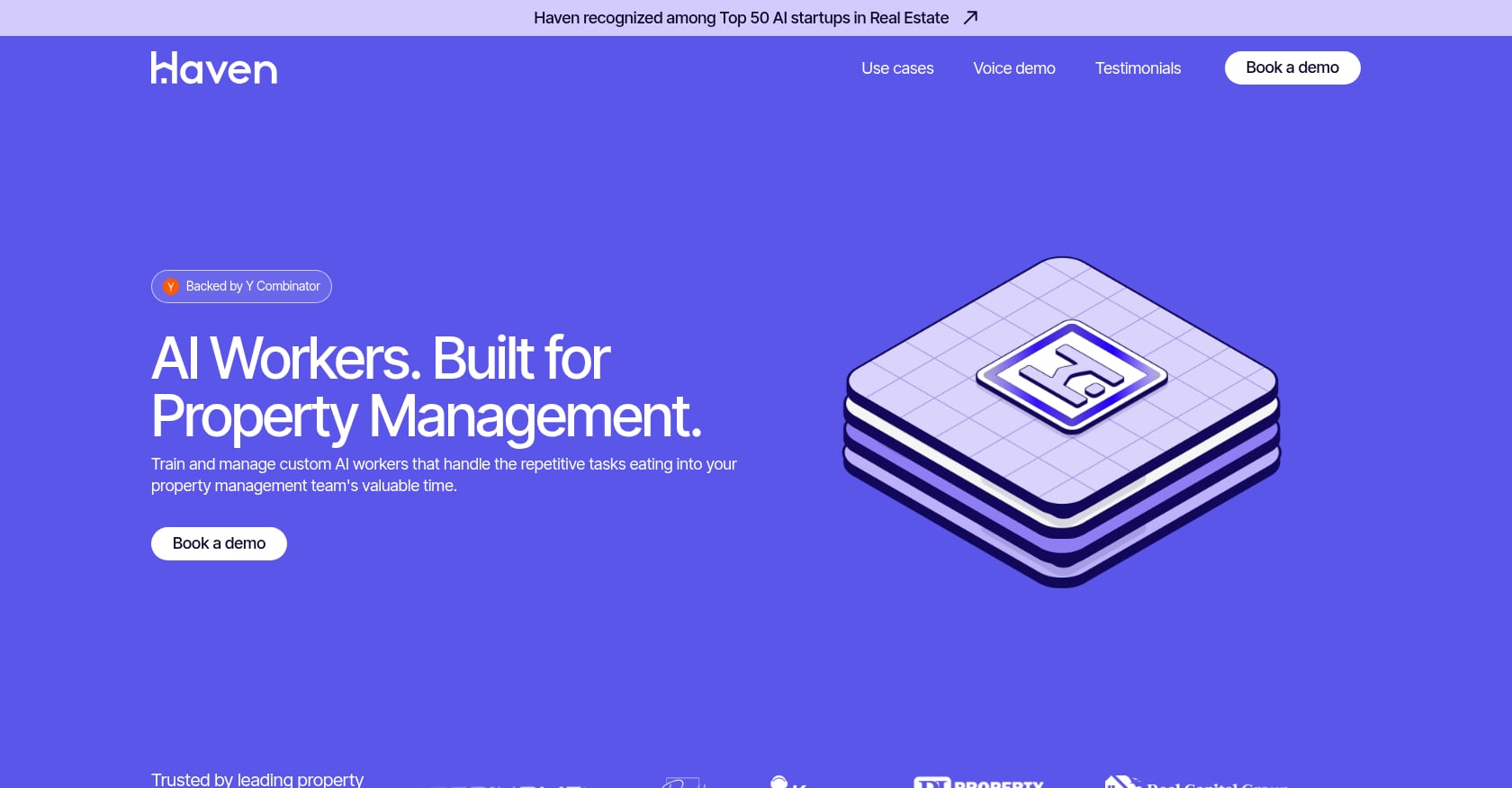
Haven’s Maintenance AI is purpose-built for vendor dispatch automation in property management. It operates as an AI agent layer on top of your existing PMS (with particular depth in AppFolio), handling phone calls, SMS, and email around the clock.
Key features:
24/7 maintenance request intake with emergency detection and triage
Automatic work order creation and updates directly inside your PMS
Vendor dispatch from your preferred vendor lists, not a third-party network
Post-work-order follow-ups with tenants
Tenant troubleshooting and outreach before unnecessary dispatches
Voice-first design across phone, SMS, and email channels
Conversation memory and operational continuity across interactions
The critical differentiator here is the combination of “uses your vendors” and “acts inside your PMS.” Unlike outsourced services that route jobs through their own contractor pool, Haven dispatches from the vendor relationships you’ve already built. And unlike basic rules-based PMS modules that route plumbing to vendor X regardless of context, Haven’s AI can triage, troubleshoot, and make contextual vendor selections.
Haven is Y Combinator backed and recognized as a Top 50 AI Startup in Real Estate by Commercial Observer. Customer references include Luke Properties (360+ units), Real Capital Group, Alguna, and Rentor.com. In a podcast interview, Matt Luke of Luke Properties discussed using Haven AI agents named “Serena” and “Max” to handle maintenance operations.
Tradeoffs:
No public pricing; requires a sales conversation
No self-serve onboarding, so implementation takes some setup
Depends on PMS data quality for optimal performance
Requires configuration and QA during deployment
Book a demo with Haven to see how AI dispatch works with your vendor lists.
2. AppFolio Smart Maintenance
Best for: Mid-size portfolios (200 to 2,000 units) already committed to the AppFolio ecosystem.
Pricing: Starts at $1 per unit per month with a $298 monthly minimum.
AppFolio’s Smart Maintenance bundles automated scheduling, billing, image-based diagnosis, and vendor dispatch into a single PMS-native product. It’s the most advanced dispatch feature built directly into a major property management system.
Key features:
Mobile app for receiving maintenance requests, issuing work orders, and tracking progress
Default rules to automatically dispatch pre-approved vendors
Image-based diagnosis for common maintenance issues
Fallback to the Lula Vendor Network when regular technicians aren’t available
According to AppFolio’s data from NAA Apartmentalize 2025, users save an average of 10 hours weekly on tasks when using its AI tools
Tradeoffs:
The Lula fallback means you’re sometimes relying on vendors outside your preferred list. Several property managers in online forums have noted that Lula vendors sometimes receive little context about work orders assigned to them, leading to job rejections or incomplete repairs.
Practitioners on Reddit and review sites report that Smart Maintenance works well for straightforward requests but struggles with complex, multi-system issues.
Notable gaps around voice-first intake depth, troubleshooting, and vendor context compared to dedicated AI agent solutions.
You’re locked into AppFolio’s ecosystem.
If you’re already using AppFolio, it’s worth understanding the broader AppFolio maintenance automation picture before deciding whether native features are enough or whether an AI layer on top would close the gaps.
3. Property Meld
Best for: Teams that manage in-house or preferred vendors and want advanced analytics and workflow visibility.
Pricing: No publicly available pricing. Contact vendor directly. Year-long contracts reported by users.
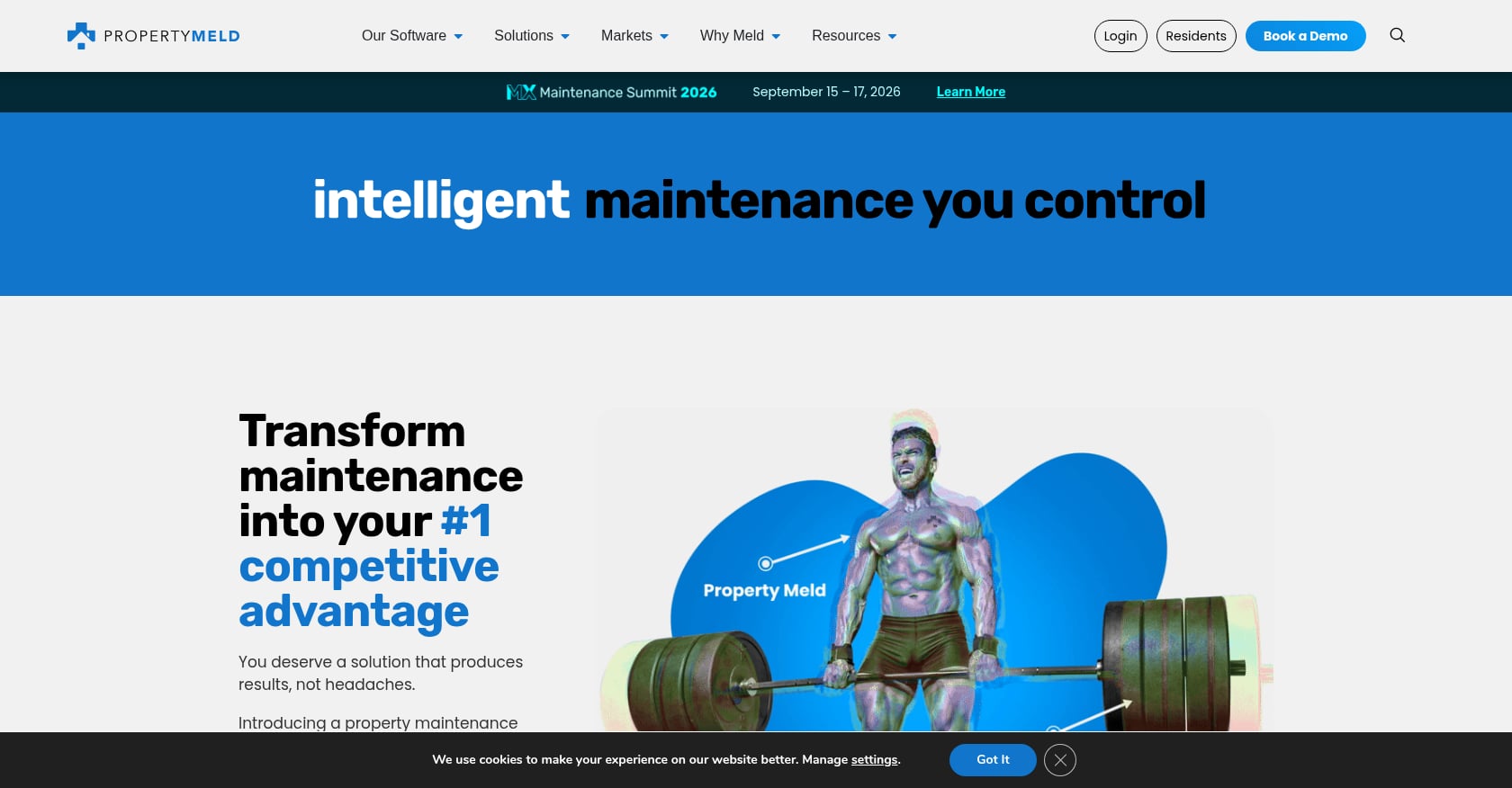
Property Meld is a dedicated maintenance platform that automates triage, scheduling, and dispatching while giving property managers granular visibility into vendor performance. Its Vendor Nexus marketplace connects managers with vetted vendors when their preferred list falls short.
Key features:
Direct vendor-to-tenant scheduling, eliminating middleman delays
Vendor performance benchmarking: average 0.5-hour acceptance time, 6.2-hour scheduling time, 1.2-day scheduling lead time, and 6.9-day repair completion time (2025 averages)
Detailed analytics and documentation across the maintenance lifecycle
Vendor Nexus marketplace for sourcing vetted vendors
User perspectives:
One Capterra reviewer noted their team “was able to handle 3x more tickets than before with this software.” On the other side, a reviewer stated it “doesn’t integrate well with AppFolio,” and another said they were “misled during the sales process” about Buildium billing sync capabilities, describing features that simply weren’t available yet. A vendor user noted the platform “makes it difficult to communicate with our property manager clients” and “adds extra steps.”
Tradeoffs:
PMS integration depth varies significantly by platform
Vendor-side user experience receives mixed reviews
In-house maintenance side of the platform is less developed
Year-long contracts limit flexibility
4. Lula
Best for: Property managers who want to fully outsource vendor sourcing and dispatch without subscription costs, accepting they’ll use Lula’s vendor pool.
Pricing: No subscription fees. Per-job model with flat-rate pricing, shared between service providers and property owners.
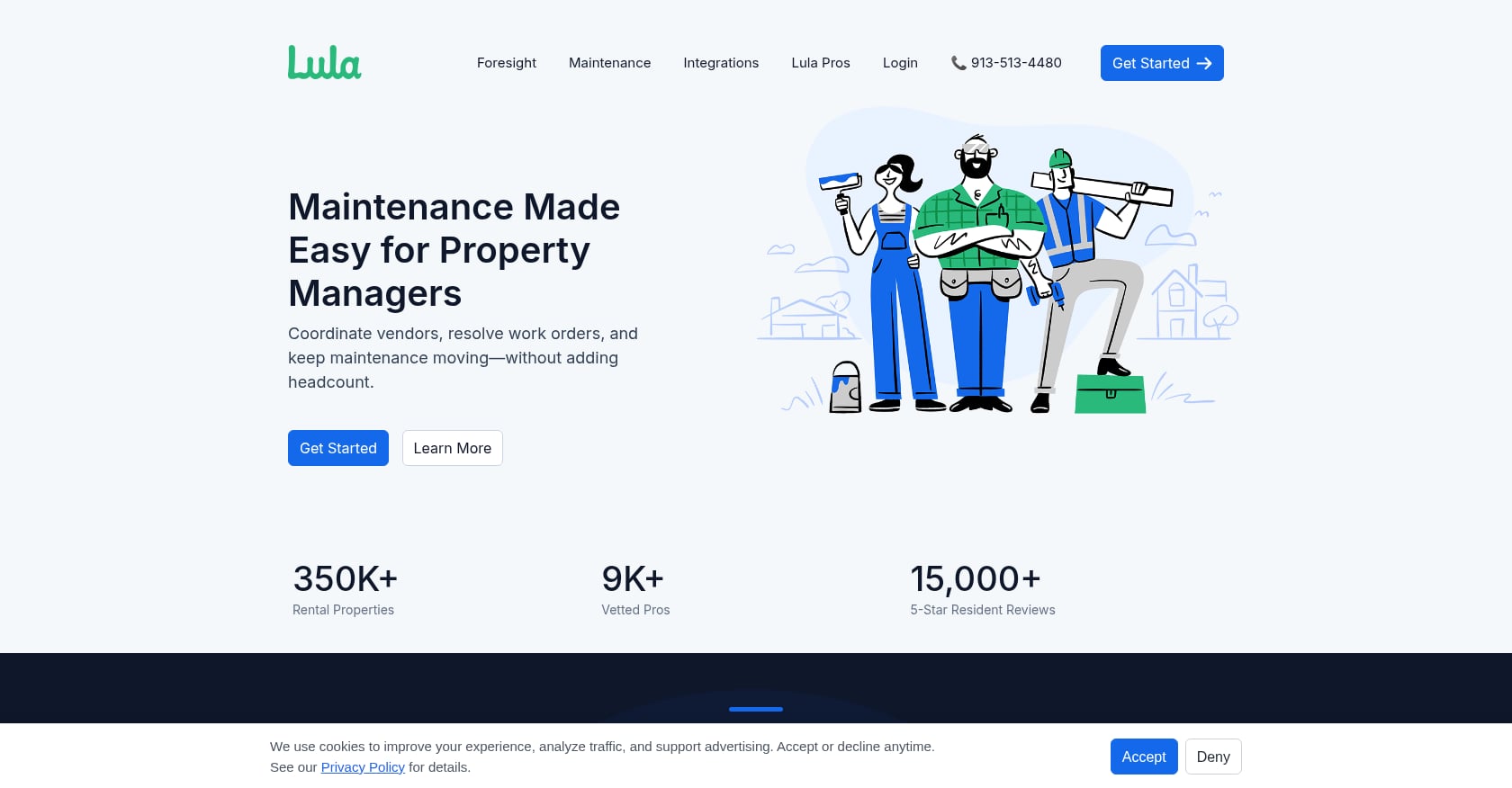
Lula operates on a fundamentally different model than the other tools here. Rather than helping you dispatch your vendors more efficiently, Lula replaces your vendor network with theirs. They handle intake, vendor assignment, scheduling, billing, compliance, and follow-up end to end.
Key features:
Network of 9,000+ vetted, licensed, and insured service professionals
Supports over 350,000 rental properties
80% of jobs resolved on the first trip with average 3.8-day turnaround (per Lula’s data)
Integrates with AppFolio, Buildium, Rent Manager, Rentvine, and Property Meld
Tradeoffs:
You lose control over vendor relationships. This is the biggest consideration.
BBB reviews reveal significant quality concerns. One reviewer described “a complete and utter lack of” communication: “They provide no updates, no follow-ups, and no proactive outreach.”
A contractor reviewer noted Lula “offer[s] pay that is well below my usual rates, require[s] a lot of extra paperwork,” which helps explain quality inconsistencies.
Per-job costs can add up quickly for high-volume portfolios.
The vendor network quality issue isn’t unique to Lula. It’s the core tradeoff of any outsourced dispatch model. When you hand vendor selection to a third party, you’re betting their quality control matches what you’d demand from your own preferred contractors.
5. Latchel
Best for: Small landlords and property managers who need after-hours coverage and are willing to delegate communication and scheduling.
Pricing: Subscription-based, tiered by unit count and service level. Available through TurboTenant at $149/year.
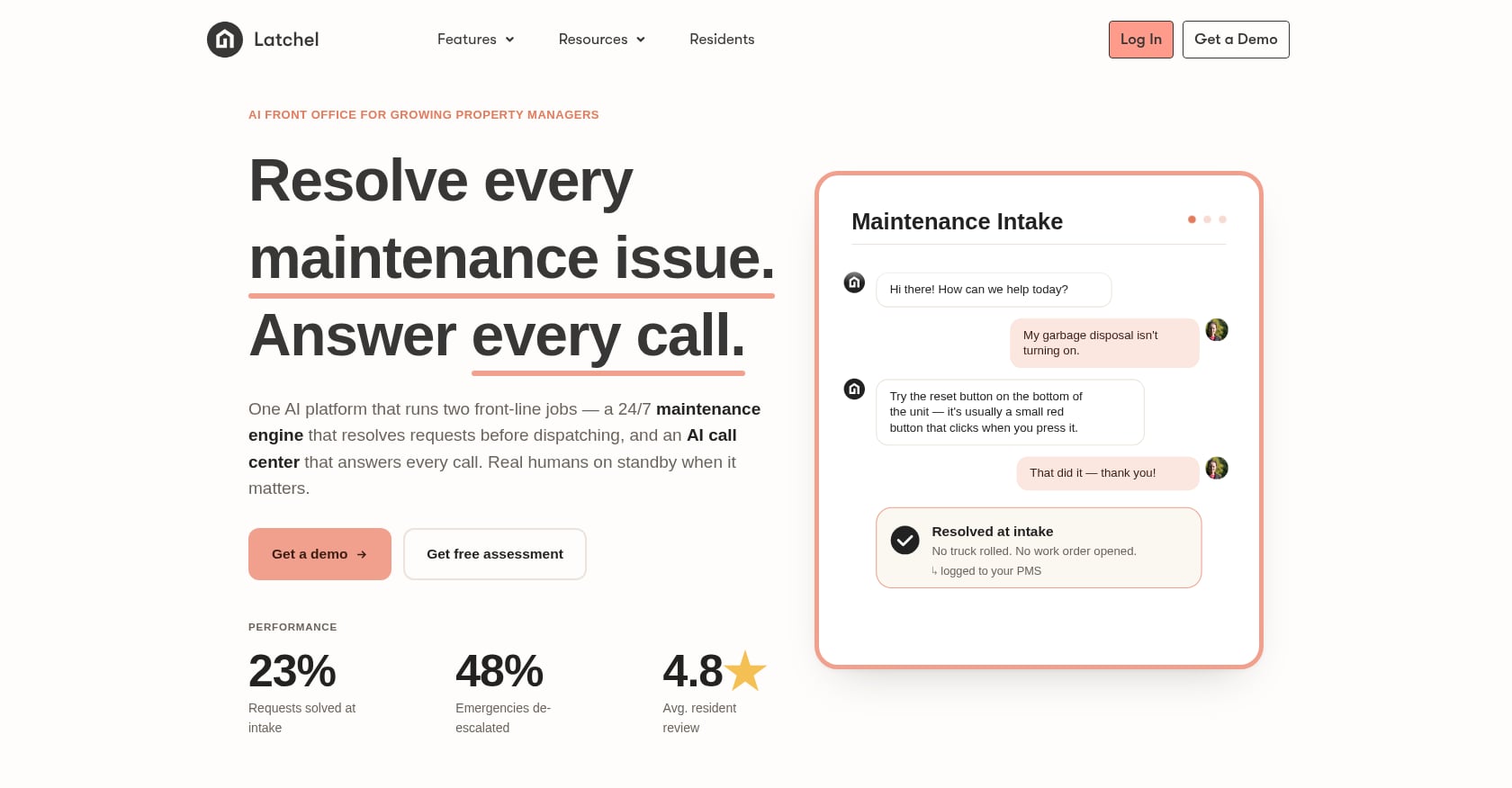
Latchel positions itself as a maintenance coordination service where residents report issues directly and Latchel handles troubleshooting, vendor dispatch, and resident communication. Property managers stay informed through updates and reports. The platform combines human agents (residents can talk to a real person in 15 seconds) with AI for a hybrid approach.
Key features:
Human + AI intake model
Property managers using Latchel average 4.8 out of 5 stars in resident reviews (per Latchel’s data)
Affordable entry point for small portfolios
Handles after-hours maintenance intake and dispatch
Tradeoffs:
Reviews are polarized. One reviewer called it a “complete waste of time and money,” noting “they’ve added more work instead of automating this process for me.”
A BBB reviewer stated they were “pretty convinced Latchel is just an auto-response generator with outsourced support” after three months without a single maintenance request properly handled.
Uses its own external contractors, so quality varies.
Complex repairs or specialized vendor selection still require direct property manager oversight.
6. Buildium
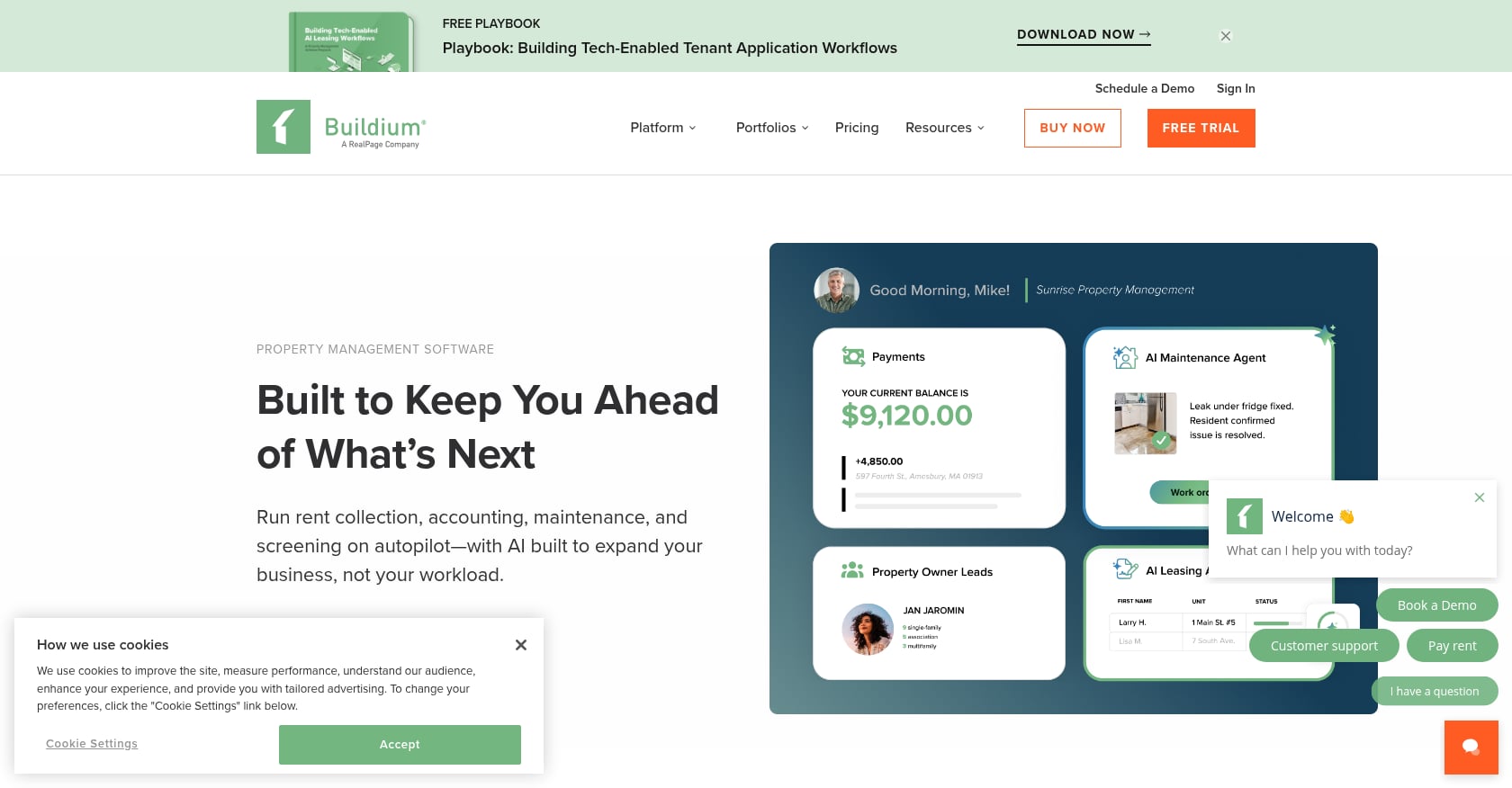
Best for: Smaller portfolios (50 to 500 units) with straightforward vendor coordination needs.
Pricing: Starts at $55/month. Three tiers: Essential (~$58/mo), Growth (~$183/mo), Premium (~$375/mo). Flat monthly fees tied to door count, unlike AppFolio’s per-unit model.
Buildium is an all-in-one PMS that happens to include a vendor dispatch module rather than being built around it. According to Buildium’s 2025 customer satisfaction survey, 52% of users rate their vendor management features as “adequate but not advanced.” The platform excels at accounting and tenant management but treats vendor coordination as a secondary feature.
Key features:
Online resident request submissions with photo uploads
Vendor coordination and work order assignment
Full work order lifecycle tracking
Strong accounting integration
Tradeoffs:
Lacks AI categorization, automated bidding, or predictive analytics for vendor dispatch
Pricing concerns appear repeatedly, with multiple G2 reviewers noting Buildium can be expensive for smaller landlords
No voice-first intake
Vendor dispatch is basic compared to dedicated solutions
If you’re on Buildium and want more advanced vendor dispatch automation, Haven’s Buildium integration adds an AI agent layer on top of your existing setup without requiring a platform migration.
7. NetVendor
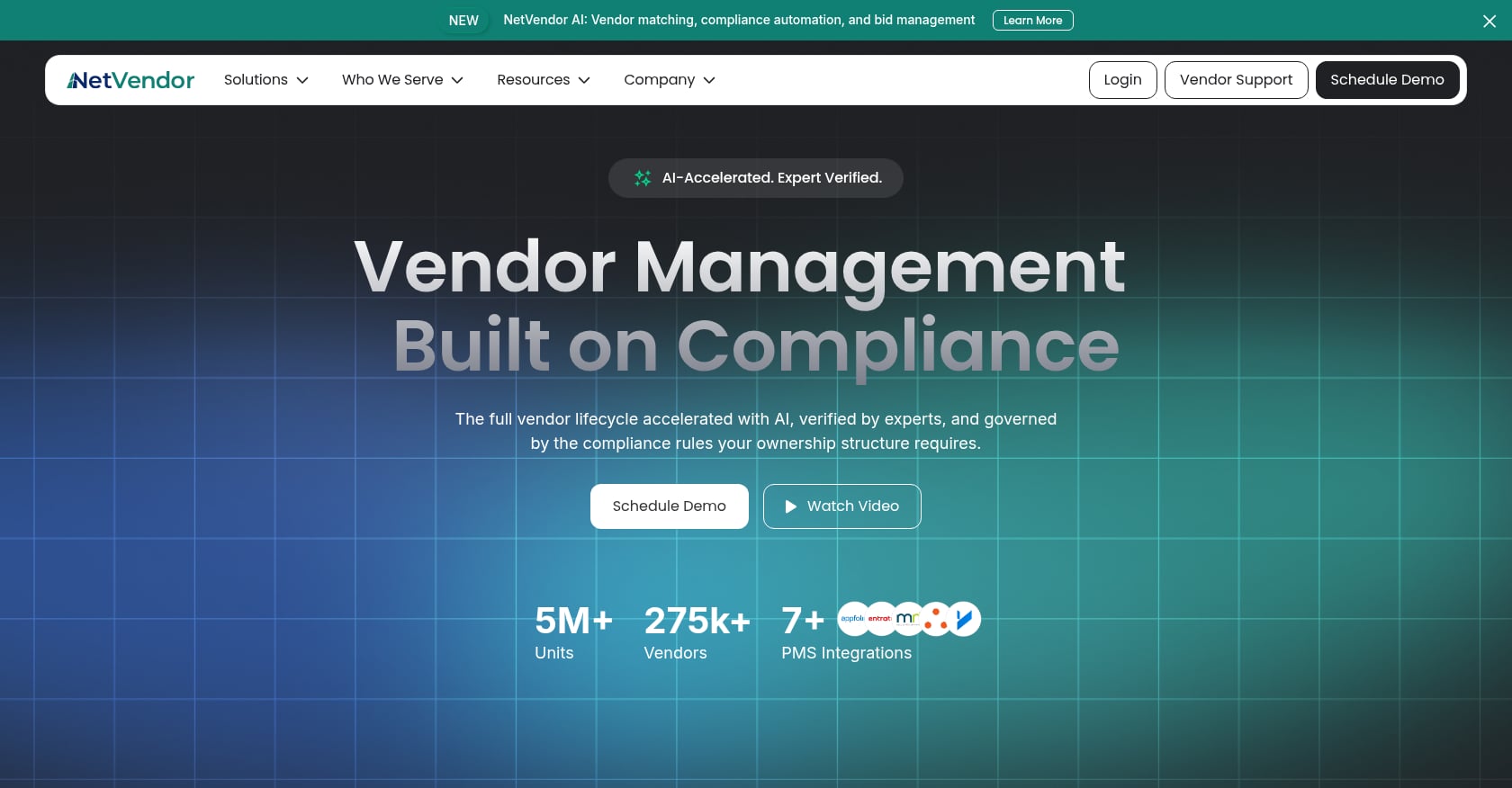
Best for: Enterprise multifamily operators where vendor compliance risk is the primary concern, not dispatch speed.
Pricing: Contact for quote.
NetVendor occupies a unique position in the vendor dispatch automation space. Rather than focusing on speed or convenience, it focuses on ensuring only compliant, insured, and credentialed vendors receive dispatch. This is a compliance-first approach to vendor lifecycle management.
Key features:
AI-driven document processing combined with licensed compliance specialists
Network of more than 100,000 credentialed vendors
Integrates with Yardi, RealPage, AppFolio, Entrata, MRI, and ResMan
Compliance status visible at the point of dispatch
When Berger Communities implemented lifecycle-level vendor controls across 60 multifamily communities, they achieved 99% risk reduction and 100% automated compliance
Tradeoffs:
Not designed for speed-of-dispatch optimization
Enterprise-focused, likely overkill for smaller portfolios
Doesn’t handle tenant intake or troubleshooting
Compliance is the value proposition, not workflow automation
8. LeadSimple
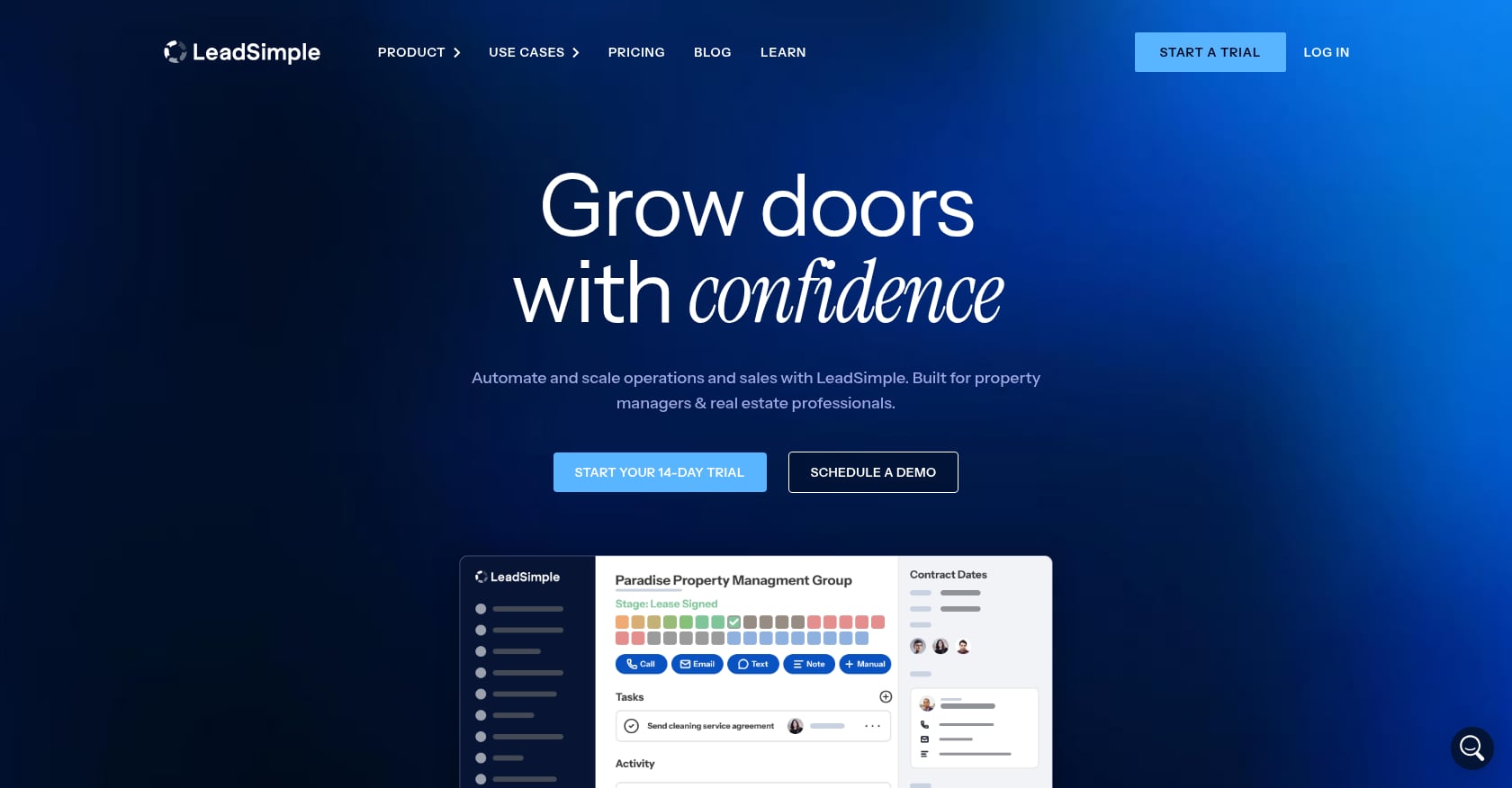
Best for: Property management companies that want to build custom dispatch workflows from scratch rather than use a pre-built solution.
Pricing: Contact for quote.
LeadSimple takes a process-automation approach. Instead of giving you a pre-configured dispatch tool, it lets you build multi-step workflows with triggers, branching logic, and dependencies. You can configure it to collect resident requests, prioritize severity, dispatch vendors, and keep stakeholders informed automatically.
Key features:
Multi-step workflow builder with branching logic
Purpose-built automations for property management (maintenance, renewals, delinquencies, make-readies)
Customizable trigger-based vendor dispatch
Stakeholder notification automation
Tradeoffs:
Requires significant setup time and ongoing configuration
No AI triage or contextual vendor selection
No voice-first intake
You need internal capacity to build and maintain workflows
Better suited for teams with a process-engineering mindset
How to Choose the Right Vendor Dispatch Automation Tool
The right tool depends on three factors more than anything else.
Factor 1: Do you want to use your own vendors or an outsourced network?
This is the single most consequential decision. Outsourced services like Lula and Latchel handle dispatch end to end, but BBB reviews and practitioner forums consistently surface quality concerns when you lose control over vendor selection. If your vendor relationships are a competitive advantage (and for most experienced PMs, they are), prioritize tools that dispatch from your preferred vendor lists: Haven, Property Meld, Buildium, or LeadSimple.
Factor 2: Portfolio size matters.
For portfolios under 150 units, Buildium or Latchel may provide enough dispatch capability without overcomplicating your stack. Between 150 and 500 units, Property Meld’s analytics or AppFolio’s native tools start making more sense. Above 350 to 500 units, the economics of AI-powered dispatch automation become compelling. Companies scaling property management with AI are reaching 400 to 600 doors per property manager, roughly triple the manual ceiling.
Factor 3: Is voice-first intake a requirement?
Most maintenance requests still come in by phone, especially emergencies. If handling phone calls matters, your options narrow to Haven (AI voice), AppFolio (call center integration), or Latchel (human + AI). Property Meld, Buildium, Lula, and LeadSimple don’t offer voice-first intake.
The After-Hours Question
Emergency situations at 2 AM create pressure to dispatch whoever is available fastest. Organizations without a pre-qualified emergency vendor pool frequently end up using unvetted contractors. This is where automated vendor dispatch delivers the most immediate ROI. Practitioners in Reddit’s r/PropertyManagement community frequently describe on-call rotations as the breaking point that drives them to search for alternatives. Understanding AI escalation rules for maintenance is critical for getting emergency dispatch right.
The Speed-Retention Connection
Here’s a number worth remembering: companies with sub-1-hour dispatch times retain 12% more tenants annually than those with 4+ hour dispatch times, according to the RentCafe 2025 Operational Report. At an average turnover cost of $3,500 per unit, that 12% retention improvement translates to roughly $21,000 in savings per 500 units. Automated dispatch doesn’t just save staff time. It directly impacts your bottom line through retention.
Addressing the AI Accuracy Concern
It’s worth acknowledging that 40% of property managers cite accuracy concerns as the number one barrier to AI adoption, per a 2025 Retell AI survey. That skepticism is healthy. The question isn’t whether AI dispatch is perfect. It’s whether it’s more consistent than a burned-out property manager at 2 AM juggling three emergencies on a cell phone. For routine requests, automated dispatch with AI-powered triage consistently outperforms manual processes, achieving 82% first-time resolution compared to 58% for manual dispatch, according to Buildium’s 2024 data.
See how Haven’s AI agents handle dispatch across your entire maintenance workflow.
Common Features to Look For
Not all vendor dispatch software includes the same capabilities. When evaluating solutions, compare these features:
Feature | Why It Matters |
|---|---|
AI triage | Reduces unnecessary dispatches |
Voice intake | Handles phone emergencies |
SMS support | Improves tenant response rates |
Vendor scheduling | Eliminates manual coordination |
Preferred vendor support | Maintains contractor relationships |
PMS integration | Avoids duplicate work |
Emergency routing | Prioritizes urgent issues |
Vendor performance tracking | Improves accountability |
Compliance verification | Reduces legal risk |
Automated follow-up | Increases completion rates |
Estimated Cost Comparison
Portfolio Size | Manual Dispatch | Basic PMS | AI Dispatch |
|---|---|---|---|
100 Units | Low | Low | Moderate |
300 Units | Moderate | Moderate | Moderate |
500 Units | High | Moderate | Lower per work order |
1,000 Units | Very High | High | Lowest per work order |
FAQ
What is vendor dispatch automation?
Vendor dispatch automation is the use of software or AI to automatically assign, notify, and coordinate vendors for maintenance work orders without requiring manual phone calls, texts, or emails from a property manager. It covers everything from receiving a tenant’s maintenance request to selecting the right vendor, confirming availability, and tracking job completion.
How much does vendor dispatch automation cost?
Costs vary widely by approach. Buildium starts at $55/month flat. AppFolio charges $1 per unit per month with a $298 minimum. Lula charges per job with no subscription. Latchel offers subscription tiers by unit count. Haven and Property Meld require contacting sales for pricing. The “cost” also includes what you save: at 180 work orders per month for a 450-unit portfolio, even saving 10 minutes of coordination per order reclaims 30 hours monthly.
Can AI dispatch vendors after hours?
Yes, and this is where AI-powered dispatch delivers the most value. Tools like Haven Maintenance AI handle phone calls, triage emergencies, and dispatch vendors from preferred lists 24/7 without requiring staff to be on call. Latchel also provides after-hours coverage through its human + AI model. PMS-native tools like AppFolio can process requests submitted through portals after hours, but voice-first intake capability varies.
Does automated dispatch work with my PMS?
Most tools integrate with major PMS platforms, but integration depth varies significantly. Haven integrates with AppFolio and Buildium with direct work order creation. AppFolio Smart Maintenance is native. Property Meld connects to AppFolio, Buildium, and others, though users report inconsistent integration quality. Lula integrates with AppFolio, Buildium, Rent Manager, and Rentvine. Check whether the integration is read-write (creates and updates work orders) or read-only (just pulls data).
What’s the difference between AI dispatch and rules-based dispatch?
Rules-based dispatch follows simple if-then logic: if the issue is plumbing, assign vendor X. AI dispatch goes further by triaging the issue, troubleshooting with the tenant to confirm what’s actually needed, selecting vendors based on contextual factors (availability, proximity, past performance), and adapting when the first-choice vendor isn’t available. The distinction matters most for complex or ambiguous maintenance requests.
Should I use my own vendors or an outsourced vendor network?
If your vendor relationships are strong and you’ve invested in vetting reliable contractors, use your own. Outsourced networks (Lula, Latchel) trade convenience for control, and BBB reviews consistently show quality concerns when property managers can’t influence vendor selection. Tools like Haven, Property Meld, and Buildium let you dispatch from your own preferred lists.
How many work orders should I expect per unit?
The industry benchmark is approximately 0.4 work orders per unit per month, according to the NMHC 2024 Survey. For a 500-unit portfolio, that’s 200 work orders monthly, each needing intake, dispatch, coordination, and follow-up. This volume is exactly why vendor dispatch automation pays for itself quickly at scale.
Is vendor dispatch automation worth it for small portfolios?
For portfolios under 50 units, the ROI is harder to justify unless after-hours coverage is a specific pain point. Between 50 and 150 units, tools like Buildium or Latchel can help. Above 150 units, the time savings from automated maintenance workflows compound fast enough that most teams see clear returns within the first few months.