AppFolio Work Orders AI: 2026 Complete Glossary & Guide
AppFolio Work Orders AI in 2026: a clear glossary from Smart Maintenance to Realm-X, key features, gaps, and when third-party tools help.

TL;DR
AppFolio work orders AI has evolved from basic Smart Maintenance (automated call intake and vendor assignment) to Realm-X Maintenance Performer, an agentic AI that analyzes photos, communicates in multiple languages, and creates prioritized work orders independently. Property managers report saving 10 to 12.5 hours per week with these tools. This glossary defines every key term, explains what each feature actually does, and covers when native AI is enough versus when third-party AI agents fill critical gaps.
AppFolio’s AI maintenance ecosystem has changed fast. In the span of two years, the platform moved from Smart Maintenance (a rules-based triage system) to Realm-X Performers (autonomous AI agents that can diagnose issues from photos). The branding has multiplied just as quickly: Smart Maintenance, Realm-X, Performers, Flows, Assistant, Stack.
If you manage properties on AppFolio and you’re trying to figure out what all of this means for your daily work order workflow, this glossary is for you. Each term below is defined in plain language, with practical context on how it affects operations. For a broader primer on maintenance AI terminology, that companion guide covers concepts that apply across any PMS platform.
If you’re evaluating AI options for maintenance operations, explore Haven’s Maintenance AI to see how voice-first agents handle intake, triage, and work order creation inside AppFolio and other PMS platforms.
What is AppFolio Work Orders AI?
AppFolio Work Orders AI is a set of automation and agentic AI tools inside AppFolio that automatically create, triage, and manage maintenance work orders from tenant requests. It uses Smart Maintenance (rule-based automation) and Realm-X Maintenance Performer (agentic AI) to turn calls, texts, portal submissions, and even photos into structured work orders without manual entry from property managers.
In short: it replaces manual maintenance coordination by automatically turning tenant requests into prioritized, vendor-assigned work orders.
Work Orders in AppFolio: The Baseline
A work order in AppFolio is the fundamental record for any maintenance task. It tracks a single repair or maintenance request from the moment it’s reported through completion. Work orders cover everything from a broken garbage disposal in Unit 204 to a parking lot light replacement in a common area.
How work orders get created
There are three paths:
Tenant-initiated. A resident submits a request through the AppFolio online portal or calls a maintenance line.
Manager-created. A property manager manually enters the work order after an inspection, owner request, or internal observation.
AI-generated. Smart Maintenance or the Realm-X Maintenance Performer creates the work order automatically based on a tenant interaction.
Key data fields
AppFolio’s work order records include PropertyId, UnitId, Status (such as “completed” or “in progress”), JobDescription, AssignedUsers, PermissionToEnter, and Priority (for example, “urgent”). These fields matter because they determine how downstream automation, whether native AI or third-party tools, routes and prioritizes requests.
Work order types
Resident Request: Tenant-reported issues like leaks, HVAC failures, or appliance breakdowns.
Internal: Manager or owner-initiated tasks such as preventive maintenance or code compliance repairs.
Unit Turn: Make-ready tasks triggered when a lease ends and a unit needs preparation for the next tenant.
Why this matters operationally
A typical 300-unit portfolio generates 30 to 50 maintenance requests per week. Without automation, that volume requires a full-time maintenance coordinator just for triage and dispatch. That reality is why AppFolio work orders AI features exist in the first place: to compress the intake-to-resolution cycle.
For a deeper look at the KPIs that matter when measuring your maintenance operation, see this guide on maintenance AI benchmarks.
End-to-End AppFolio Work Order AI Workflow
This is how AppFolio AI typically processes a maintenance request from start to finish:
Step-by-Step Flow
Tenant submits request (call, portal, SMS, or photo upload)
AI system interprets issue (Smart Maintenance or Realm-X Performer)
Issue is classified (urgency + category detection)
Work order is generated automatically
Vendor is assigned based on rules or AI routing
Follow-up messages are sent to tenant
Job completion is logged and updated in AppFolio
Smart Maintenance: AppFolio’s First-Generation AI
Smart Maintenance was AppFolio’s first real attempt at automating the maintenance intake process. It provides a 24/7 maintenance call service that logs tenant requests and automatically assigns vendors based on pre-set rules.
How the 4-step flow works
Tenant submits a request via the maintenance hotline or online portal.
The system triages the request, determining urgency and issue category.
Auto-assignment routes the work order to a vendor from the property manager’s pre-configured vendor list.
Resolution and notification. The vendor handles the repair, and the system notifies the property manager.
Under the hood, Smart Maintenance uses named entity recognition (NER) and summarization models to extract issue details from tenant descriptions. It then generates a concise issue summary that populates the work order’s job description field.
What works well
The 24/7 call handling is genuinely valuable. Donna Smith, President of Enclave Property Management (managing over 4,500 units), described it this way: “Smart Maintenance monitors all work orders that come in, day or night, to see if it’s an emergency. Then, the system contacts our preferred vendors. So ultimately, Smart Maintenance can take that work order and handle the situation without contacting anyone on our team.”
For teams drowning in after-hours maintenance calls, that alone is a significant improvement.
Known limitations
Practitioners have been vocal about Smart Maintenance’s shortcomings, and understanding these gaps is important for anyone evaluating AppFolio work orders AI capabilities.
Vendor context problems. Many property managers report that vendors receive little to no context about the work orders assigned to them. This leads to rejected jobs or incomplete repairs because the technician shows up without understanding the actual problem.
Misdiagnosis. Because the system relies on automated troubleshooting scripts, work orders sometimes get created for the wrong issue type. A vendor might be assigned a water heater repair when the real problem is in the plumbing system.
Unnecessary work orders. Unlike a human maintenance coordinator, Smart Maintenance does limited troubleshooting before escalating. A leaky faucet that a tenant could fix by tightening a handle becomes a dispatched vendor visit.
Cost shifting, not savings. Some property managers expected Smart Maintenance to reduce maintenance costs directly. In practice, it often shifts the coordination workload rather than eliminating it. The AI handles intake, but someone still has to clean up misrouted orders and manage vendor relationships.
Pricing concerns. Some users have reported that Smart Maintenance pricing is unpredictable, and a few have switched to third-party alternatives like Property Meld for more transparent value.
These are not edge cases. They represent a pattern that shows up repeatedly in common maintenance AI mistakes and in practitioner forums. The takeaway is not that Smart Maintenance is bad, but that it works best when property managers treat it as an intake tool rather than a full maintenance coordinator replacement.
Realm-X Maintenance Performer: The Agentic AI Upgrade
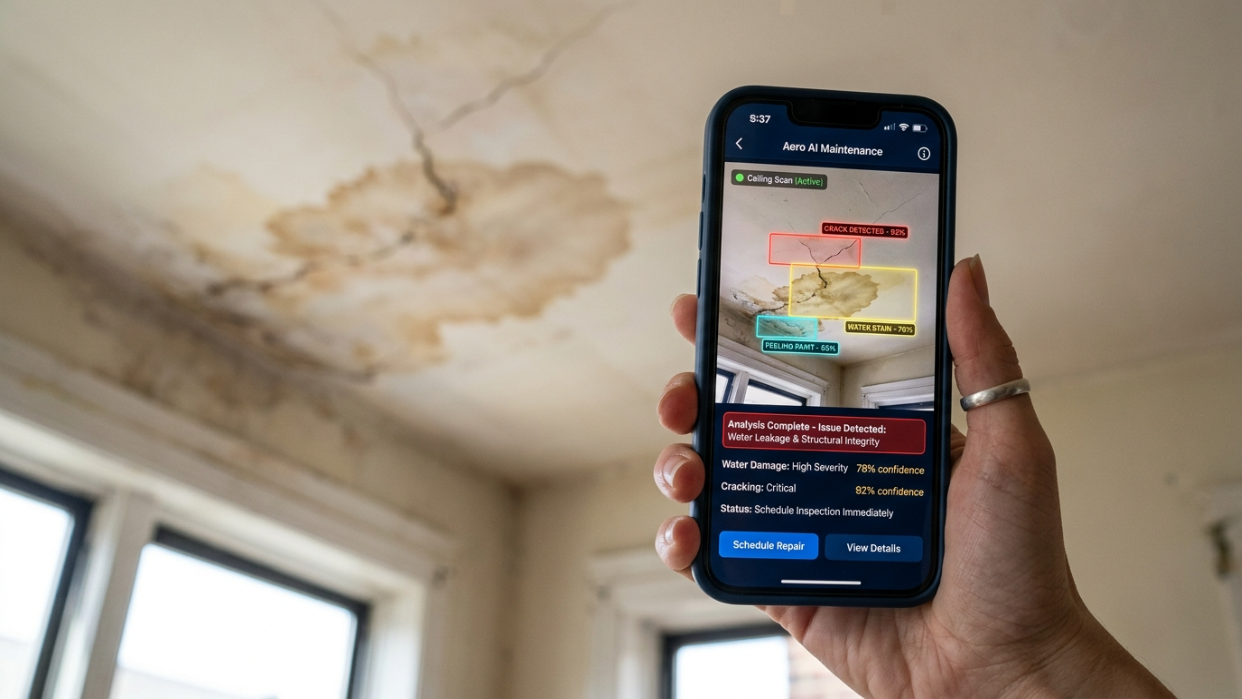
Announced at NAA Apartmentalize 2025, the Realm-X Maintenance Performer represents a fundamentally different approach to AppFolio work orders AI. Where Smart Maintenance follows scripted rules, the Maintenance Performer operates as an autonomous agent.
What “agentic” means here
An agentic AI system can take actions independently without a human triggering each step. In the Realm-X context, the Maintenance Performer self-sufficiently diagnoses and prioritizes resident maintenance requests. It can detect issues via image analysis, create work orders, and log summaries, all without a property manager intervening.
Key capabilities
Image-based diagnostics. Tenants can attach photos to their maintenance requests. The Performer analyzes these images to identify the issue, often catching details that text descriptions miss. A photo of a water stain on a ceiling tells the AI more than “there’s a leak.”
Multi-language communication. The system communicates with residents in multiple languages in real time, which matters for portfolios with diverse tenant populations.
Autonomous triage. The Performer asks follow-up questions, prioritizes emergencies, and dispatches work to the right technician without waiting for manager input.
Vendor network fallback. When regular technicians aren’t available, the Maintenance Performer can dispatch from the Lula Vendor Network to automate vendor outsourcing entirely.
Smart Maintenance vs Realm-X Maintenance Performer
Feature | Smart Maintenance | Realm-X Maintenance Performer |
|---|---|---|
Type | Rule-based automation | Agentic AI system |
Decision-making | Pre-set logic | Autonomous reasoning |
Photo analysis | No | Yes |
Follow-up questions | Limited | Dynamic, conversational |
Vendor dispatch | Rule-based | AI-optimized + fallback networks |
Language support | Basic | Multi-language real-time |
Human involvement | Required for edge cases | Minimal for routine tasks |
Key takeaway: Smart Maintenance automates intake. Realm-X automates decision-making.
How it differs from Smart Maintenance
Think of Smart Maintenance as a receptionist that takes a message and passes it along. The Realm-X Maintenance Performer is closer to a junior maintenance coordinator that can actually think through the problem, ask clarifying questions, look at a photo, and route the job intelligently.
The progression from rule-based triage to agentic AI is significant for anyone thinking about their broader property management AI stack.
Reported results
AppFolio’s own data shows promising numbers. Users of Realm-X report saving an average of 10 hours weekly on tasks, with updated figures from October 2025 showing 12.5 hours per week saved across communications, reporting, and training. And 95% of users report seeing benefits within a few weeks of adoption.
For broader context, the 2025 AppFolio Property Management Benchmark Report found that AI tool adoption among operators jumped from 21% to 34% between 2024 and 2025, while 75% of respondents ranked operational efficiency as their top challenge for the fourth year running. Those numbers explain why the push toward AI in work orders is accelerating.
Realm-X Flows: The Workflow Automation Engine
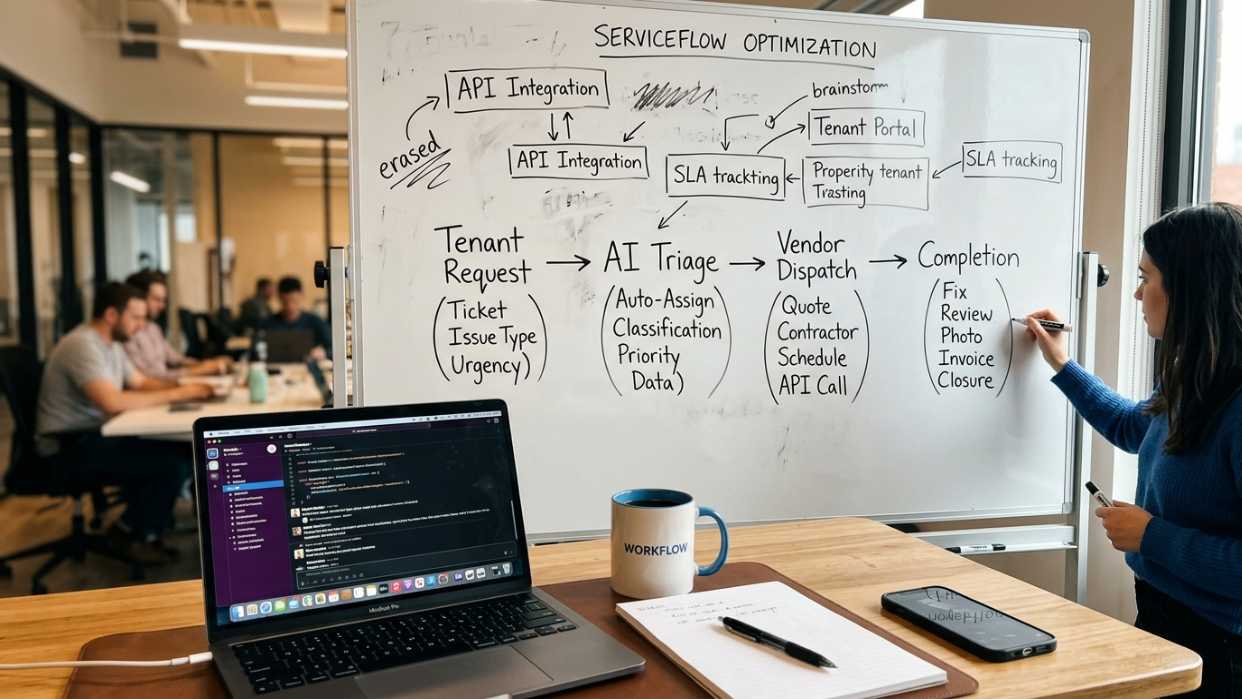
Realm-X Flows is AppFolio’s workflow automation layer that executes multi-step processes based on triggers you define. If Performers are the workers, Flows are the assembly line that connects them.
How it works
You set up a trigger (for example, “a new work order is created with priority: urgent”), and Flows executes a sequence of actions: notify the on-call technician, text the tenant with an ETA, flag the work order for manager review, and schedule a follow-up check 48 hours later.
Performers integrate into Flows for end-to-end workflow orchestration. So the Maintenance Performer creates the work order, and a Flow handles everything that happens next.
Reported impact on operations
The numbers here are striking. Realm-X Flows users report a 1.2-day average reduction in unit turn time and a 73% higher lead-to-showing conversion rate (relevant for leasing-side Flows). On the maintenance and retention side, renewal rates increase by 20% and net operating income improves by 2.8% on average after implementing Flows.
That unit turn improvement alone matters for maintenance teams. A 1.2-day reduction across even 50 annual unit turns translates to 60 fewer vacancy days per year.
Benefits of AppFolio Work Orders AI
AppFolio’s AI-driven maintenance system improves operations in several measurable ways:
Operational Efficiency
Reduces manual triage workload by up to 70%
Cuts maintenance coordination time by 10–12.5 hours per week per manager
Faster Resolution Times
Automated routing reduces vendor assignment delays
Emergency issues are flagged instantly
Better Tenant Experience
Faster response times for maintenance requests
Real-time updates via SMS and portal messaging
Fewer missed or misrouted requests
Improved Portfolio Scalability
Enables small teams to manage larger property portfolios
Reduces dependency on dedicated maintenance coordinators
Realm-X Assistant: The Conversational Co-Pilot
The Realm-X Assistant is accessible from anywhere inside AppFolio and lets you query your data using natural language prompts. No code, no menu navigation.
Work order examples
“Show me assigned work orders with no activity over the past five days.”
“Which units have had more than three maintenance requests this quarter?”
“List all open work orders assigned to [Vendor Name].”
The Assistant doesn’t replace the Maintenance Performer or Flows. It’s a read and query layer that helps managers stay on top of operations without digging through dashboards. Think of it as a search bar that actually understands what you’re asking.
AppFolio Stack: The Integration Marketplace
AppFolio Stack is AppFolio’s marketplace for third-party integrations. It’s relevant to the AppFolio work orders AI conversation because it’s how external tools connect to your maintenance data.
Notable maintenance integrations
Property Meld. Partnered with AppFolio since June 2022, it syncs properties, units, owners, vendors, residents, work orders, and invoices in real time. Positioned as a specialist maintenance coordination platform.
Lula. Operates within the Stack for vendor dispatch automation. The Realm-X Maintenance Performer can dispatch directly to the Lula Vendor Network.
HappyCo. Turns project plans into work orders within AppFolio and provides a consolidated Tasks dashboard for managing work orders regardless of origin.
API tier restrictions (important caveat)
Here’s something most AppFolio marketing pages don’t mention: the open API is only available on the Max plan. If you’re on a lower tier, third-party tools that need deep API access to read and write work order data may be limited in what they can do. This is a real constraint for mid-size operators evaluating third-party AI options.
For a fuller picture of how AI tools integrate with property management systems, including AppFolio, that page covers what to look for in PMS connectivity.
Limitations of AppFolio Work Orders AI
Despite improvements, AppFolio’s AI systems still have operational limitations:
1. Vendor Context Gaps
Vendors may receive incomplete job details, leading to inefficiencies or repeat visits.
2. Over-Automation of Simple Issues
Some minor maintenance tasks are escalated unnecessarily, increasing costs.
3. Misclassification of Issues
AI may incorrectly categorize complex maintenance problems.
4. Limited Cross-System Intelligence
Native AI works best inside AppFolio but is less effective across multiple PMS platforms.
Bottom line: AI reduces workload but does not eliminate the need for human oversight.
Native AI vs. Third-Party AI: When AppFolio’s Built-In Tools Aren’t Enough
AppFolio’s positioning is clear: AI should be foundational, not bolted on. And there’s truth to that. Native AI has inherent advantages, including tighter data access, no sync delays, and a unified interface.
But native PMS work order modules are typically built to record that a job happened, not to coordinate the work itself. Vendor dispatch, technician routing, real-time status updates, parts approval workflows, and cross-channel resident communication tend to be thin or absent in native tools. This is the gap where third-party AI fills in.
When AppFolio’s native AI is probably enough
Your portfolio is under 500 units with straightforward maintenance needs.
You have a small, stable vendor list that doesn’t change often.
Most of your tenants submit requests through the online portal (not phone calls).
You’re on the Max plan and can configure Flows to handle your specific workflows.
When you likely need more
You receive a high volume of phone calls, especially after hours, and need voice-first intake that goes beyond a portal submission form.
Your vendors need richer context than what auto-generated work orders provide (detailed troubleshooting notes, photo analysis shared directly to the vendor).
You manage scattered-site properties across multiple systems and need AI that coordinates across PMS platforms, not just within AppFolio.
You want conversation memory, meaning an AI that remembers a tenant called yesterday about the same issue and connects the dots.
The 2025 AppFolio Renter Preferences Survey found that 44% of unsatisfied renters reported maintenance issues taking weeks or months to resolve instead of hours or days. That dissatisfaction often stems from the coordination layer, which is exactly where voice-first AI agents that operate across phone, SMS, and email add the most value.
Book a demo with Haven to see how AI agents handle the full maintenance lifecycle, from voice intake through work order creation and vendor dispatch, inside systems like AppFolio.
The Evolution of AppFolio Work Orders AI: A Timeline
Understanding where things stand is easier with a clear progression:
Period | Feature | What It Does |
|---|---|---|
2022-2023 | Smart Maintenance | 24/7 call intake, NER-based triage, rule-based vendor auto-assignment |
2024 | Realm-X Assistant | Natural language queries against AppFolio data, including work orders |
2024-2025 | Realm-X Flows | Trigger-based workflow automation connecting multiple AI actions |
June 2025 | Realm-X Maintenance Performer | Agentic AI with image analysis, multi-language support, autonomous work order creation and vendor dispatch |
Each layer builds on the previous one. Smart Maintenance handles intake. The Performer handles diagnosis. Flows handle orchestration. The Assistant handles visibility. Together, they form AppFolio’s current AI maintenance stack.
No other page on the web maps this progression clearly, which is partly why the terminology confuses property managers evaluating these tools.
The Role Shift: What AI Means for Maintenance Coordinators
With the Maintenance Performer and Smart Maintenance both active, the maintenance coordinator role doesn’t disappear. It changes. The AI handles intake, routing, and billing documentation. The human handles vendor relationships, capital project oversight, and quality control on completed work.
This shift is worth planning for. Property managers who treat AI as a replacement for coordination staff tend to get burned by the edge cases (emergency escalations the AI can’t handle, vendor disputes, warranty claims). Those who treat it as an amplifier, letting AI handle the first 80% of routine requests so humans can focus on the 20% that requires judgment, see the best results.
For practical advice on navigating this transition, the maintenance AI implementation guide covers key terms and ROI frameworks.
Future of AppFolio Work Orders AI
AppFolio’s maintenance AI is moving toward a fully autonomous system where:
Work orders are created from voice, text, or image inputs automatically
AI agents proactively detect maintenance issues
Vendor dispatch becomes fully automated
Maintenance systems shift from reactive to predictive maintenance
Frequently Asked Questions
What is AppFolio Smart Maintenance, and how does it relate to work orders?
Smart Maintenance is AppFolio’s automated maintenance intake system. It accepts tenant requests via phone or portal, triages them using NLP models, and creates work orders with auto-assigned vendors based on rules you configure. It was AppFolio’s first AI layer for work orders, now supplemented by the Realm-X Maintenance Performer.
What is the Realm-X Maintenance Performer?
The Realm-X Maintenance Performer is AppFolio’s agentic AI agent for maintenance, announced in June 2025. Unlike Smart Maintenance’s rule-based approach, the Performer can independently analyze photos, ask residents follow-up questions in multiple languages, diagnose issues, prioritize emergencies, create work orders, and dispatch vendors, all without human intervention.
How much time does AppFolio work orders AI actually save?
AppFolio reports that Realm-X users save an average of 10 to 12.5 hours per week, and 95% of users see benefits within the first few weeks. The specific savings depend on portfolio size, request volume, and how much of the workflow you automate through Flows.
Can third-party AI tools create work orders inside AppFolio?
Yes, through AppFolio Stack integrations and the AppFolio API. However, full API access requires the Max plan. Tools like Property Meld, HappyCo, and Haven integrate with AppFolio to read and write work order data, though the depth of integration depends on your plan tier and the specific tool.
What are the main complaints about AppFolio’s AI for maintenance?
The most common practitioner complaints focus on poor vendor context (vendors don’t get enough detail to complete the job), misdiagnosis (wrong issue type assigned), unnecessary work order creation (issues that could have been troubleshot over the phone), and unpredictable pricing for Smart Maintenance. These issues don’t make the system unusable, but they mean it works best with active human oversight.
What is the difference between Realm-X Flows and the Realm-X Assistant?
Flows is a workflow automation engine that executes multi-step processes based on triggers (for example, auto-notifying a vendor when an urgent work order is created). The Assistant is a conversational interface for querying your AppFolio data using natural language prompts. Flows does things automatically. The Assistant answers questions on demand.
When should a property manager consider third-party AI instead of (or alongside) AppFolio’s native tools?
Consider third-party AI when you need voice-first intake (handling phone calls, not just portal submissions), deeper vendor coordination across multiple systems, cross-channel communication (phone, SMS, and email from a single AI), or conversation memory that tracks ongoing issues across interactions. AppFolio’s native AI excels within its own platform but is thinner on these coordination and communication layers.
Does AppFolio work orders AI support emergency detection?
Yes. Both Smart Maintenance and the Realm-X Maintenance Performer include emergency detection. The Performer is more capable here because it can analyze images (like a photo of standing water) and ask follow-up questions to determine severity. For a deeper look at how emergency triage works in AI systems, see this guide on emergency maintenance triage.