Voice AI Maintenance: 2026 Glossary & Property Guide
Voice AI Maintenance for property managers: automate 24/7 call intake, triage emergencies, create work orders, cut costs up to 25%. Learn more.

TL;DR: What Is Voice AI Maintenance?
Voice AI maintenance is the use of conversational AI to handle property maintenance requests by phone, including intake, troubleshooting, urgency classification, work-order creation, escalation, vendor coordination, and follow-up. Unlike a basic AI answering service that only takes messages, a maintenance-focused voice AI system can connect to a property management system (PMS) and trigger actions such as creating or updating work orders.
The most important capabilities to evaluate are emergency detection, PMS integration, work-order automation, tenant troubleshooting, vendor dispatch, human escalation, conversation history, and auditability.
Voice AI does not replace property managers. It automates repetitive communication and coordination so maintenance teams can focus on emergencies, complex repairs, vendor management, resident issues, and decisions that require human judgment.
For property managers, the key question is not simply whether a product can answer calls. It is whether the system can safely turn a tenant conversation into the correct maintenance action while preserving human oversight and compliance controls.
Voice AI Maintenance Definition
Voice AI maintenance is a property-management technology that uses conversational artificial intelligence to receive tenant maintenance requests, gather information about the problem, determine urgency, perform approved troubleshooting, create or update work orders, escalate emergencies, coordinate vendors, and communicate status updates.
The defining characteristic is actionability. A voice AI system that only answers calls and sends transcripts is an AI answering service. A system that can interact with the PMS and execute approved maintenance workflows is a maintenance automation platform.
Voice AI Maintenance vs. AI Answering Services
The terms voice AI, AI answering service, AI maintenance, and maintenance automation are related but do not describe exactly the same capability.
Technology | Primary function | Creates work orders | Troubleshoots | Dispatches vendors | Human escalation |
|---|---|---|---|---|---|
AI answering service | Answers and routes calls | Usually no | Limited | No | Usually |
Voice AI agent | Conducts automated conversations | Sometimes | Sometimes | Sometimes | Yes |
AI maintenance intake | Captures and classifies maintenance requests | Usually | Often | Sometimes | Yes |
Maintenance automation platform | Automates the full maintenance workflow | Yes | Yes | Yes | Yes |
Property management AI | Automates multiple property-management workflows | Depends on platform | Depends on platform | Depends on platform | Usually |
The simplest distinction
Voice AI describes how the system communicates. Maintenance automation describes what the system does.
A voice AI agent can answer a phone call without performing any maintenance workflow. Conversely, a maintenance automation platform may use voice, SMS, email, portals, or other channels.
For property managers, the important evaluation question is therefore not “Does it have voice AI?” but “Which maintenance actions can the system actually perform?”
Core Concepts
Voice AI Maintenance
The use of conversational AI voice agents to automate the full property maintenance workflow: answering tenant calls, capturing issue details, classifying urgency, creating work orders in a property management system (PMS), dispatching vendors, and following up after completion.
This is not a single feature. It’s an automated process chain where each step connects to the next without human intervention for routine issues. The distinction matters because many products claim “voice AI” when they only handle one piece, usually the call answering.
A mid-size property management company handles 200 to 300 maintenance requests per month. What previously required a maintenance coordinator spending 15 to 20 minutes per request now happens in seconds with voice AI maintenance systems.
Maintenance Triage (AI-Powered)
The automated classification of incoming maintenance requests by urgency level. When a tenant calls about a problem, AI assigns the request an urgency score (typically Emergency, Urgent, or Routine) and tags details like the unit location, equipment type, and problem description from the tenant’s free-form description.
Why this matters financially: roughly 32% of repair costs tie back to emergency maintenance, things like burst pipes, HVAC failures, and electrical hazards. A small fraction of total tickets drives a third of the spending. Accurate triage separates the burst pipe at 2 AM from the dripping faucet that can wait until Monday, and routes each one accordingly.
For a deeper breakdown, see our emergency maintenance triage guide.
Emergency Detection
A sub-function of voice AI maintenance where the system identifies life-safety situations during a tenant call. Flooding, gas leaks, no heat in winter, electrical hazards, lockouts. When the AI detects emergency-level urgency, it immediately transfers the call to an on-call technician or sends an escalation alert.
Detection typically combines keyword triggers (“flooding,” “smoke,” “no heat”) with contextual reasoning. A tenant saying “water everywhere” triggers a different response than “small drip under the sink.” The 2025 and 2026 generation of voice AI models handle this contextual distinction far better than earlier versions, which relied almost entirely on keyword matching.
Companies report response times dropping from approximately 4.6 days to under 18 hours when AI triage and emergency detection are deployed. One study found AI voice agents handled 99% of after-hours calls instantly, where previously 30% to 40% of calls went unanswered.
Work Order Automation
The system’s ability to create a complete work order inside your PMS during the call itself. The AI initiates a direct API call to your property management software, creates a new work order, populates all necessary fields (unit, issue category, description, urgency level, tenant contact info), and provides the tenant with a work order number before they hang up.
This is the action layer, the difference between a system that takes messages and one that takes action. Without work order automation, someone on your team still has to read a transcript and manually enter data. With it, the work order exists in your PMS by the time the call ends.
Learn how this works step by step in our AI maintenance coordinator guide.
PMS Integration

The bi-directional data connection between a voice AI agent and your property management system (AppFolio, Yardi, Buildium, and others). “Bi-directional” is the key word. The AI needs to both read data from the PMS (to verify tenant identity, look up unit details, check open work orders) and write data back (to create work orders, update statuses, add notes).
Without PMS integration, a voice AI agent can talk but cannot act. It becomes a glorified answering machine. The most valuable integrations let the agent read live availability, verify tenant records, and create work orders directly without manual re-entry.
Vendor Dispatch Automation
AI-driven assignment of maintenance tasks to contractors from a preferred vendor list. The system selects a vendor based on trade specialty (plumber vs. electrician vs. HVAC tech), availability, geographic proximity, and sometimes performance history.
In practice, this means a tenant calls at 11 PM about a burst pipe, the AI creates the work order, and the system automatically contacts the plumber you’ve pre-approved for emergency plumbing jobs at that property. No one on your team needs to wake up, check a spreadsheet, and make calls.
For more on building this workflow, see our vendor dispatch automation guide.
After-Hours Coverage
Maintenance requests come in at any time. Pipes don’t wait for business hours to burst. Voice AI provides continuous inbound coverage without human staff, replacing traditional answering services or voicemail.
The cost difference is significant. Voice AI costs roughly $0.40 per call, compared to $7 to $12 per call for human agents, a 90 to 95% cost reduction per interaction. And unlike a human answering service, voice AI can simultaneously create work orders, dispatch vendors, and follow up, not just take a message.
See Haven’s after-hours solution for property management teams.
Tenant Troubleshooting (AI-Guided)
Voice AI walks tenants through basic diagnostic or self-fix steps before dispatching a vendor. “Is the disposal switch turned on?” “Have you checked the circuit breaker?” “Is the water shutoff valve under the sink closed?”
This is a major cost-reduction lever. At Latchel, 30% of maintenance requests are resolved through troubleshooting over the phone without dispatching a vendor. That’s nearly one in three calls that avoids a technician visit entirely. For a portfolio handling 250 requests per month, that’s 75 vendor dispatches eliminated.
Escalation Rules
Predefined logic that determines when and how a voice AI agent transfers control to a human. This covers emergency thresholds (gas leak = immediate transfer), caller type identification (owner vs. tenant vs. vendor), time-of-day routing, and situations where the AI lacks confidence in its classification.
Good escalation rules are what separate a helpful AI system from a liability. The AI confirms the resident’s name, property, unit, callback number, issue category, location of the problem, visible damage, and safety risk. When any of these signals cross a threshold, the system transfers to the right person.
Our escalation rules glossary covers how to configure these properly.
Conversation Memory and Continuity
The AI’s ability to retain context across multiple interactions with the same tenant. If a tenant called Tuesday about a leaking ceiling and calls back Thursday asking for a status update, the AI should know about the existing work order without making the tenant explain everything again.
This solves the “explain it again” problem that plagues traditional answering services and even some early AI systems. It also reduces errors from duplicate work orders created when the system doesn’t recognize a follow-up call about an existing issue.
Call Containment
Call containment is the percentage of inbound calls that a voice AI system handles without requiring transfer to a human agent.
A high containment rate can indicate that the AI handles routine requests effectively, but it should not be treated as a standalone measure of quality. For maintenance operations, an appropriately escalated emergency is a successful outcome even though it lowers the containment rate.
Maintenance Deflection
Maintenance deflection is the percentage of requests resolved through approved troubleshooting or other automated workflows without requiring a vendor visit.
Deflection should be measured carefully. A request should only count as successfully deflected when the underlying maintenance issue is actually resolved or appropriately closed, not simply because a tenant stopped responding.
Call Containment Rate vs. Resolution Rate
These metrics measure different things. Call containment measures whether a human was needed during the interaction. Resolution rate measures whether the underlying maintenance problem was actually resolved.
A system can have high call containment but poor resolution if it successfully handles calls without successfully solving the maintenance issues reported.
Human-in-the-Loop
Human-in-the-loop means a person remains available to review, approve, intervene in, or take over AI-driven maintenance workflows.
Common examples include emergency escalation, high-cost repair approval, ambiguous maintenance classifications, resident disputes, and situations where the AI has insufficient information to act safely.
AI Confidence Score
An AI confidence score represents the system's estimated confidence in its interpretation or classification of a request.
Confidence thresholds can be used as one input into escalation rules. For example, a low-confidence classification may trigger human review rather than automatic vendor dispatch.
Confidence should not be treated as proof that an AI decision is correct.
Audit Trail
An audit trail is the chronological record of actions taken during an automated maintenance workflow.
A useful audit trail can include the original call or transcript, tenant verification, classification, troubleshooting steps, work-order creation, escalation events, vendor communications, approvals, and status changes.
Knowledge Base
A knowledge base is the collection of property-specific information that an AI system uses when answering questions or guiding troubleshooting.
For maintenance, this can include equipment information, approved troubleshooting procedures, emergency definitions, property rules, vendor instructions, and escalation contacts.
API Integration
An API integration allows two software systems to exchange information and trigger actions.
In voice AI maintenance, an API can allow the AI system to retrieve tenant or property information from a PMS and create or update work orders after a call.
AI Maintenance Automation
AI maintenance automation is the broader use of artificial intelligence to automate maintenance intake, troubleshooting, scheduling, dispatch, communication, follow-up, and administrative tasks.
Voice AI is one interface for maintenance automation. Other interfaces include SMS, email, resident portals, mobile applications, and web chat.
Supporting Concepts
Message-Taker vs. Action-Taker
This is the single most important distinction for anyone evaluating voice AI maintenance tools. Most “answering service” voice AI products are message-takers: they answer the call, transcribe what the tenant says, and send a summary to your team. Someone still has to read that summary, enter the work order, and assign the vendor.
An action-taker creates work orders in your PMS, dispatches vendors from your preferred lists, schedules follow-ups, and updates tenant records automatically. The difference in operational impact is enormous. A message-taker saves you from answering the phone. An action-taker saves you from the 15 to 20 minutes of downstream work that follows every call.
When evaluating any voice AI maintenance product, ask one question: “Does it write to my PMS, or just write to an inbox?”
Voice Latency (in AI Agents)
The time delay between when a tenant finishes speaking and when the AI responds. Measured in milliseconds, this is what makes or breaks the conversational experience.
Practitioners on forums and Substack emphasize that early-generation voice AI felt “robotic” and created tenant frustration. The 2025 and 2026 generation has closed this gap significantly, with the best systems achieving 250 to 300 milliseconds end-to-end response time. For context, natural human conversation typically has 200 to 300ms gaps between turns. At 250ms, the AI feels conversational. At 800ms or more, it feels like talking to an automated phone tree.
Multichannel Communication (Voice + SMS + Email)
Voice AI maintenance isn’t limited to phone calls. Modern systems communicate with tenants across voice, SMS, and email from a single platform. A tenant might call to report an issue, receive a work order confirmation via SMS, and get a follow-up completion survey by email.
The multichannel approach matters because tenant communication preferences vary. Some tenants will never call. Others will never check email. Covering all three channels from one system ensures consistent data and eliminates the gaps where requests get lost between platforms.
Predictive Maintenance (vs. Reactive)
A broader AI capability where IoT sensors and historical data predict equipment failures before they happen. AI systems equipped with IoT sensors and machine learning algorithms can monitor HVAC performance, water heater health, and electrical systems in real time.
This is distinct from voice AI maintenance, which is primarily reactive (handling requests after a problem occurs). But the two are increasingly connected. A predictive maintenance system might flag that a water heater is likely to fail within 30 days, and the voice AI system can proactively contact the tenant to schedule a replacement before it bursts.
Fair Housing Compliance in AI Maintenance
Consistent treatment of maintenance requests across tenants is a fair housing issue. If an AI system responds faster to certain properties, escalates differently based on tenant demographics, or applies troubleshooting scripts inconsistently, that creates legal exposure.
Standardizing what’s said and when it’s escalated helps apply policy evenly, which is vital for fair housing diligence. Recording consent, explicit human escalation workflows, and audit trails are mandatory for any voice AI deployment in property management.
For a full compliance framework, read our fair housing and AI guide.
Habitability Obligations and AI
State and local habitability laws require landlords to maintain rental properties in livable condition and respond to maintenance issues within reasonable timeframes. These legal obligations don’t transfer to software. If your AI system fails to escalate a heating failure in January or loses a request about mold, you’re liable, not the AI vendor.
This concept matters because of a real enforcement action (see the compliance section below) where a property management company faced state attorney general action partly because its AI platform contributed to maintenance delays.
Call Abandonment Rate
The percentage of tenant calls that end before the issue is resolved, either because the tenant hangs up during hold time or the system fails to connect them. Traditional property management operations see 30% to 40% of after-hours calls go unanswered. Voice AI maintenance systems reduce this to near zero because the AI answers instantly, 24/7.
First-Time Fix Rate
The percentage of maintenance issues resolved on the first vendor visit. Voice AI improves this metric indirectly by capturing more detailed issue descriptions, attaching photos (via SMS follow-up), and matching the right trade specialty to the job. When a plumber shows up already knowing it’s a specific valve type in a specific location, they’re more likely to have the right parts and complete the repair in one trip.
What Can Voice AI Maintenance Actually Do?
Voice AI can automate many repetitive maintenance communication and coordination tasks, but its capabilities depend on the specific platform, integrations, workflow rules, and human escalation design.
Voice AI can typically:
Answer maintenance calls 24/7
Identify the property and tenant
Capture the maintenance problem
Ask follow-up questions
Classify urgency
Provide approved troubleshooting instructions
Create or update work orders
Send SMS confirmations
Notify staff or vendors
Escalate emergencies
Follow up on open requests
Maintain conversation history
Record workflow events for auditing
Voice AI should not automatically:
Make unsupported diagnoses
Decide that a potential life-safety emergency is harmless
Override property-specific maintenance policies
Approve unlimited repair spending
Replace required human inspections
Make legal determinations
Ignore a tenant who requests human assistance
Treat an uncertain classification as a confirmed diagnosis
The safest implementation uses automation for predictable workflows and human oversight for situations involving uncertainty, safety, legal obligations, high-cost decisions, or resident disputes.
How Voice AI Maintenance Works
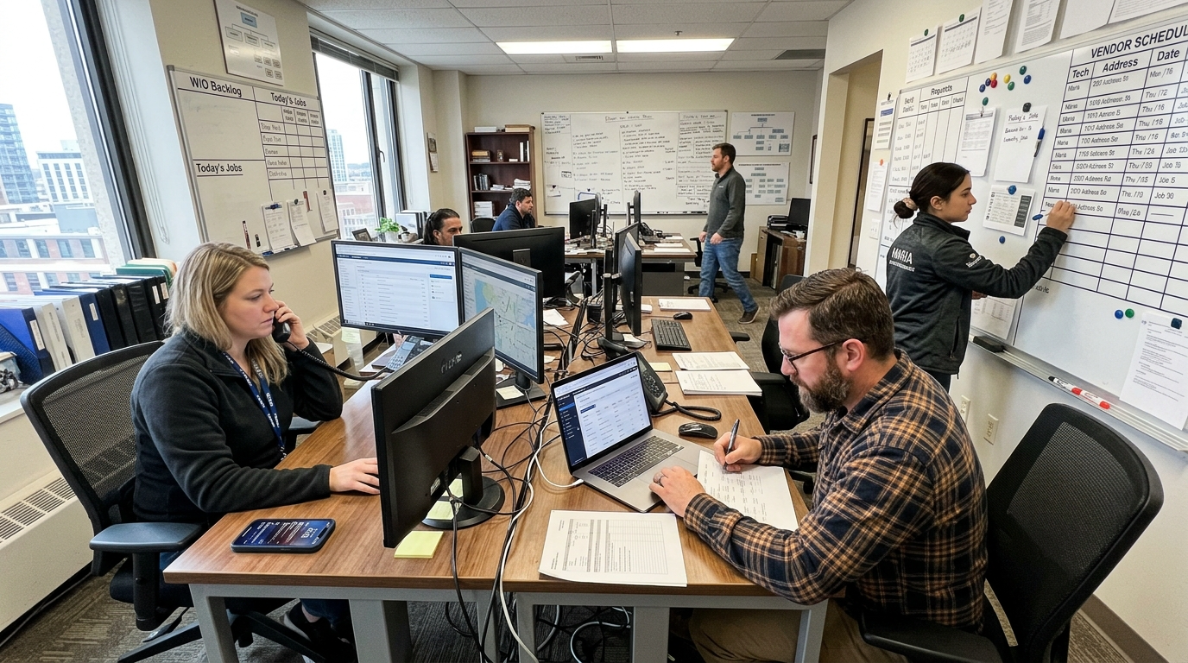
The end-to-end workflow follows a consistent pattern across implementations:
Tenant calls. The AI answers immediately, regardless of time of day.
Identity verification. The AI confirms the tenant’s name, property, and unit number by cross-referencing PMS records.
Issue capture. The AI asks targeted questions about the problem: location, description, visible damage, safety risk, and whether the tenant needs immediate instructions.
Urgency classification. Based on the tenant’s responses, the AI assigns an urgency level (Emergency, Urgent, or Routine).
Work order creation. The AI creates a work order in the PMS via API, populating all fields and generating a work order number.
Vendor dispatch. For urgent or emergency issues, the AI contacts the appropriate vendor from the preferred list.
Tenant confirmation. The tenant receives their work order number and expected next steps before the call ends.
Follow-up. After work completion, the AI contacts the tenant to confirm resolution and capture satisfaction feedback.
What previously required a coordinator, a phone, a spreadsheet, and 15 to 20 minutes now happens in seconds. For a detailed walkthrough, see our AI maintenance coordinator page.
Key Metrics and Benchmarks
These are the numbers that matter when evaluating voice AI maintenance systems:
Cost per call: Voice AI runs roughly $0.40 per call vs. $7 to $12 for human agents. Companies using voice AI report 3-year ROI between 331% and 391%.
Call handling capacity: AI voice agents handle 70% of routine inbound calls without human intervention. Property managers report up to 70% reduction in call handling time.
Response time: Companies report response times dropping from approximately 4.6 days to under 18 hours when AI triage is deployed.
Troubleshooting deflection: About 30% of maintenance requests can be resolved through AI-guided troubleshooting without dispatching a vendor.
Maintenance cost reduction: Companies adopting AI for property maintenance see overall cost reduction of up to 30% and maintenance-specific savings of 25%.
Tenant satisfaction and retention: AI platforms reduce response times from hours to seconds, leading to resident satisfaction rising as much as 30% and driving a 10% increase in renewal rates. At scale, that translates to roughly $4,000 saved per unit by reducing turnover caused by poor communication.
Customer satisfaction with AI: Satisfaction with AI voice agents now reaches 72%, up from 53% three years ago, closing the gap with human agent satisfaction.
Compliance and Risk
The Home365 Cautionary Case
In what appears to be the first state attorney general enforcement action linking AI to maintenance failures, Pennsylvania AG Dave Sunday announced a settlement with Home365, LLC, a Las Vegas-based property management company. The company used an AI-based platform to manage operations, and consumers complained that the platform was responsible for delays in addressing maintenance needs and the leasing of unsafe housing.
Under the settlement, Home365 paid $45,000, including $30,000 in consumer restitution. The AG’s office stated explicitly: “it is imperative that those choosing to use this new technology ensure it is working effectively.”
The lesson is clear. AI is powerful, but habitability obligations don’t transfer to software. Deploying voice AI maintenance without proper escalation paths, human oversight, and habitability compliance creates real legal and financial exposure. None of the competing glossaries or guides on this topic cover this case, but every property manager considering voice AI maintenance should know about it.
Recording Consent
Voice AI systems record calls. Depending on your state, you may need one-party or two-party consent. The AI should disclose recording at the start of every call, and your system should log that disclosure. Failing to do this creates exposure under state wiretapping laws.
Human Escalation Requirements
Every voice AI maintenance deployment needs clearly defined paths to a human. The system must recognize when it’s out of its depth (ambiguous emergencies, distressed callers, situations it can’t classify) and transfer immediately. An AI that handles 70% of calls is valuable. An AI that stubbornly tries to handle 100% is dangerous.
For a comprehensive look at AI compliance in property management, including fair housing, recording consent, and escalation design, we’ve published a dedicated guide.
Common Voice AI Maintenance Mistakes
Treating voice AI as an answering service
If the system only collects messages, staff may still perform the same downstream work manually. Evaluate whether the platform actually connects conversations to work orders, dispatch, and follow-up.
Automating emergency decisions without escalation
Emergency workflows require conservative rules and reliable human escalation. The system should have explicit procedures for ambiguous or high-risk situations.
Using generic troubleshooting scripts
Maintenance procedures often depend on the property, equipment, lease rules, and approved operating procedures. Generic advice can be inappropriate.
Measuring calls instead of outcomes
A large number of automated calls does not necessarily mean maintenance operations improved. Track resolution, repeat contacts, dispatches, response time, and resident outcomes.
Launching without failure procedures
PMS outages, vendor non-response, poor caller recognition, integration failures, and incorrect classifications can happen. Every deployment needs a documented fallback.
Giving the AI too much authority too early
Start with clearly defined workflows and limited permissions. Expand automation after testing shows that the system handles the relevant scenarios reliably.
Forgetting repeat calls
A tenant who calls twice about the same leak should not necessarily generate two unrelated work orders. Conversation history and open-work-order detection can help prevent duplicate workflows.
Ignoring the resident's preference for a human
Automation should include a clear path to human assistance. For some situations, the best AI outcome is recognizing that a person should take over.
Key Takeaway
The value of voice AI maintenance is not simply answering more tenant calls. The value comes from connecting a conversation to the correct maintenance action.
A strong system can capture the issue, classify urgency, troubleshoot approved problems, create or update work orders, coordinate vendors, communicate with residents, and escalate situations that require human judgment.
When evaluating a platform, prioritize PMS integration, emergency escalation, human oversight, auditability, troubleshooting controls, vendor workflows, and measurable maintenance outcomes over voice quality alone.
Frequently Asked Questions
What is voice AI maintenance?
Voice AI maintenance is the use of conversational AI voice agents to automate property maintenance workflows. This includes answering tenant calls 24/7, capturing maintenance request details, classifying urgency, creating work orders in a property management system, dispatching vendors, and following up with tenants after completion.
How does voice AI create work orders automatically?
The AI initiates a direct API call to your property management system during the tenant conversation. It creates a new work order, populates fields like unit number, issue description, urgency level, and tenant contact information, then provides the tenant with a work order number before the call ends.
Can voice AI detect maintenance emergencies?
Yes. Modern voice AI maintenance systems use a combination of keyword detection and contextual reasoning to identify life-safety situations like flooding, gas leaks, no heat, and electrical hazards. When an emergency is detected, the system immediately escalates to an on-call technician or sends an alert to the designated emergency contact.
Does voice AI replace property managers?
No. Voice AI handles the repetitive intake, triage, and coordination tasks that consume staff time, but property managers remain essential for complex decision-making, vendor relationships, owner communication, and situations that require human judgment. The goal is to eliminate the manual work, not the manager.
What PMS systems does voice AI integrate with?
The most common integrations are with AppFolio, Yardi, and Buildium. The critical factor is whether the integration supports both read and write access, meaning the AI can look up tenant records and create work orders, not just pull data. Check whether any system you’re evaluating offers full PMS integration with your specific platform.
How much does voice AI maintenance cost compared to a human answering service?
Voice AI costs roughly $0.40 per call compared to $7 to $12 per call for human agents. Companies report a 3-year ROI between 331% and 391%. The cost advantage grows with call volume because AI scales without adding headcount.
Is voice AI maintenance compliant with fair housing laws?
It can be, but compliance depends entirely on implementation. The AI must apply the same scripts, urgency thresholds, and escalation rules to every tenant regardless of protected characteristics. Standardized responses actually help with compliance by ensuring consistent treatment across all maintenance requests.