AI and PMS Error Handling: 15 Errors & Fixes (2026)
Learn how AI and PMS Error Handling prevents duplicates, silent failures, and sync lag—2026 glossary of 15 errors + vendor checklist.

TL;DR
AI and PMS error handling refers to the safeguards, fallback mechanisms, and monitoring systems that determine what happens when an AI tool fails to read from or write to your property management system. Poor error handling leads to duplicate work orders, stale leasing data, missed maintenance requests, and hours of manual reconciliation. This glossary defines the 15 critical error types property managers encounter and provides a vendor evaluation checklist to help you avoid the worst failures.
AI and PMS error handling is the process of detecting, preventing, and recovering from failures that occur when an AI platform exchanges data with a property management system (PMS). Effective error handling prevents lost maintenance requests, duplicate work orders, stale leasing information, and failed API integrations by using retry logic, audit logs, validation rules, human escalation, and automated recovery mechanisms.
The most important capabilities include:
- API error detection
- Write-back verification
- Idempotency protection
- Retry with exponential backoff
- Graceful degradation
- Human escalation
- Audit logging
- Authentication monitoring
- Two-way synchronization
- Rate-limit handling
For property managers, strong AI-PMS error handling directly improves maintenance response times, tenant satisfaction, operational reliability, and reporting accuracy.
What Is AI and PMS Error Handling?
Every time an AI tool communicates with your PMS (whether that’s AppFolio, Yardi, Buildium, or another platform), something can go wrong. The API might be down. The data format might be wrong. The sync might be delayed. A work order might get created twice, or not at all.
AI and PMS error handling is the collection of processes that govern what happens during those failures. It covers how the system detects problems, what it does next (retry, escalate, queue for manual processing), and how it keeps your team informed.
This matters more than most property managers realize. Generic software error handling is about user experience. In property management, the stakes are operational: a tenant’s burst pipe at 2 AM, a prospect who shows up for a unit that was rented three hours ago, a vendor dispatched to the wrong address. These aren’t abstract technical problems. They’re tenant complaints, BBB filings, and owner trust erosion.
The core challenge is that AI is supposed to eliminate manual data entry errors, but AI-PMS integrations introduce an entirely new class of errors. API failures, sync lag, data validation mismatches, and silent failures all create operational risk that didn’t exist when your team was entering everything by hand.
For a broader look at how AI maintenance coordination works in practice, including how these systems should function when everything goes right, that context helps frame what can go wrong.
Book a demo with Haven to see how AI agents handle PMS write-backs and error scenarios in real time.
AI-PMS Error Types at a Glance
Error Type | Typical Cause | Operational Impact | Best Fix |
|---|---|---|---|
API Error | Server unavailable | Failed requests | Retry with backoff |
Authentication Failure | Expired token | Integration stops | Renew credentials |
Data Validation Error | Incorrect data format | PMS rejects request | Fix mappings |
Write-back Failure | API interruption | Missing work orders | Queue + retry |
Sync Lag | Slow synchronization | Outdated leasing data | Shorter sync intervals |
Rate Limiting | Too many API requests | Partial failures | Exponential backoff |
Silent Failure | Missing monitoring | Lost requests | Audit logs + alerts |
Duplicate Writes | Missing idempotency | Duplicate work orders | Idempotency keys |
Key Takeaways
AI-PMS integrations fail in predictable ways that can be prevented with proper safeguards.
Silent failures are the highest operational risk because no one knows an error occurred.
Write-back verification is more important than simple API connectivity.
Retry logic should only be used for temporary errors—not authentication or validation failures.
Every AI vendor should provide audit logs and configurable human escalation paths.
The best integrations prioritize operational continuity over perfect uptime.
Key Terms Glossary
The following 15 terms represent the most important concepts in AI and PMS error handling. Each definition is grounded in property management operations, not abstract software engineering.
API Error (4xx / 5xx)

Definition: A standardized error response from a PMS server when an AI’s request fails.
4xx errors mean the AI sent a bad request. A 400 error (“Bad Request”) might fire when AppFolio rejects a work order because a required field is missing. A 403 error (“Forbidden”) means the AI doesn’t have permission to perform that action.
5xx errors mean the PMS server itself is having problems. A 500 error (“Internal Server Error”) or 503 (“Service Unavailable”) indicates Yardi or AppFolio is down, overloaded, or undergoing maintenance.
Why it matters: The distinction determines the correct response. A 400 error requires fixing the data. A 503 error requires waiting and retrying. AI tools that treat all errors the same will either waste time retrying unfixable requests or give up too easily on temporary outages. For deeper detail on how AppFolio’s API works with AI tools, including permission requirements, that glossary covers the specifics.
Sync Lag
Definition: The delay between when data changes in one system and when that change appears in another.
This is one of the most common sources of AI-PMS errors in property management. Some integrations sync in near-real-time. Others don’t. Aptly, for example, syncs with AppFolio every 3 hours during the day and overnight, meaning it’s far from real-time.
Example: A leasing AI tells a prospect a unit is available for $2,100 based on a morning data export. By 2:00 PM, the unit was rented via the main office for $2,250. The prospect arrives for a tour, feels bait-and-switched, and files a complaint.
Why it matters: The recommended minimum sync frequency is every 15 minutes for time-sensitive operations like leasing and maintenance. Anything slower creates a window where the AI is working with stale data and making promises your team can’t keep. For more on AppFolio maintenance automation and how sync timing affects work order flows, that guide goes deeper.
Write-Back Failure
Definition: When the AI captures data (a maintenance request, a lease inquiry, a tenant complaint) but fails to push it into the PMS.
The result: the request exists only in the AI system. It’s invisible to your property management team. Nobody assigns it. Nobody follows up. The tenant calls back three days later, furious.
Why it matters: Write-back failures are the single biggest operational risk in AI-PMS integration. If the AI can’t create a valid work order ID before dispatching a vendor, you get data gaps that cause duplicates, missed follow-ups, and broken owner reporting. A useful metric to track: percentage of AI-intake calls with complete PMS write-back. If that number isn’t close to 100%, you have a problem. Learn more about how AI work order creation should work in AppFolio.
Idempotency
Definition: A safeguard ensuring that if the same API request is sent multiple times (due to retries, network issues, or timeouts), only one record is created.
In PMS terms: the AI must check whether a work order already exists before creating a new one. Without idempotency, a single maintenance call can generate two, three, or more duplicate work orders, each potentially triggering separate vendor dispatches.
Why it matters: Duplicate work orders aren’t just annoying. They waste vendor time, inflate maintenance costs, and corrupt your reporting data. Good AI tools implement idempotency keys, unique identifiers attached to each request so the PMS knows to ignore duplicates.
Graceful Degradation
Definition: The system drops to reduced functionality instead of failing completely.
If the PMS API goes down at midnight and a tenant calls about a broken heater, graceful degradation means the AI still captures the request, triages the emergency, and queues the work order for creation once the API recovers. The alternative: the call goes nowhere, the request is lost, and the tenant wakes up in a freezing apartment with no record of ever calling.
Why it matters: The key principle is maintaining the ability to complete the business process even when AI components fail. Queue for manual processing rather than losing the work. This is the difference between a minor inconvenience and a liability issue.
Human Escalation / Fallback
Definition: Automatic routing to a human when the AI can’t complete a task with sufficient confidence.
Escalation triggers include confidence scores below defined thresholds, multiple failed attempts to complete a task, detection of high-stakes decisions (like potential emergencies), and explicit requests from callers who want to speak to a person.
Why it matters: In property management, failed escalation during an emergency is the worst-case scenario. If a tenant reports a gas leak and the AI can’t reach the PMS or the on-call maintenance tech, the system needs a reliable fallback path. For a detailed look at how emergency maintenance triage should work, including escalation design, that guide is essential reading.
Data Validation Error
Definition: When the AI’s output doesn’t match the PMS’s required format, and the PMS rejects the request.
Common examples: a unit ID in the wrong format, a missing property code, an invalid maintenance category, or a phone number with too many digits. The AI captured the information correctly from the tenant but translated it into a format the PMS can’t accept.
Why it matters: Data validation errors are configuration problems. They don’t resolve themselves. Retrying the same malformed request will fail every time. The correct response is to flag the error, alert your team, and fix the mapping between the AI’s data model and the PMS’s requirements.
Two-Way Sync (Bidirectional Integration)
Definition: Data flows both from PMS to AI and from AI to PMS.
Two-way sync is critical for work order status updates, tenant information changes, and rent adjustments. Without it, the AI might create a work order but never learn that maintenance marked it complete, leading to unnecessary follow-up calls to tenants.
Why it matters: Many PMS platforms only offer one-way data flow. AppFolio, for instance, provides one-way data export via REST API, which limits bidirectional integrations and real-time synchronization. This is a structural constraint, not a bug, and it shapes how errors propagate through your integration stack. Haven’s Buildium partnership is one example of how PMS-specific partnerships address this gap.
Rate Limiting (429 Error)
Definition: The PMS API rejects requests because the AI is sending too many too fast.
This typically surfaces during batch operations: processing 50 work orders at once, syncing a large tenant database, or running end-of-month reporting. The PMS says “slow down” by returning a 429 status code.
Why it matters: Without proper handling, rate limiting can cause work orders to silently fail in the middle of a batch. Good AI tools detect 429 responses and space out their requests automatically using backoff strategies rather than crashing or skipping records.
Authentication Failure (401/403)
Definition: The AI loses its valid credentials to access the PMS.
Common causes: expired API tokens, plan-tier changes (AppFolio’s Core plan doesn’t include API read access; the Plus plan is required at minimum), credential rotation without updating the AI integration, or permission changes made by an admin who didn’t know the AI relied on that access.
Why it matters: Authentication failures break everything. No read access means the AI works with no data. No write access means captured requests go nowhere. And because these failures often happen silently (no one watches API logs at 3 AM), they can persist for hours or days before someone notices.
Silent Failure
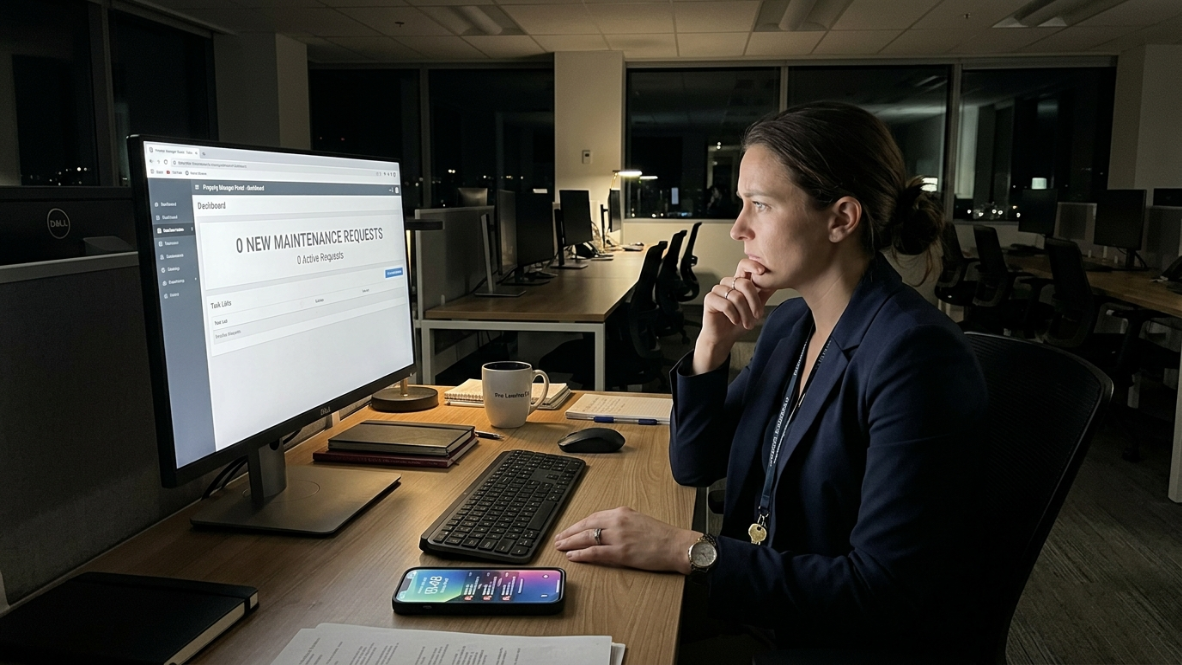
Definition: An error that happens without any alert to your team.
This is the most dangerous type of AI-PMS error. The AI captures a maintenance call. The PMS write-back fails. No work order is created. No notification is sent. Nobody knows until the tenant calls back angry, or worse, until a small problem becomes an expensive one.
Practitioners on Reddit regularly discuss the frustration of data wrangling and the lack of reliable reporting when systems don’t communicate properly. Silent failures are often the root cause, but they’re invisible by definition. You can’t troubleshoot what you don’t know happened.
Why it matters: Silent failures erode trust in your AI system without leaving fingerprints. The only defense is comprehensive audit logging (see below) and proactive monitoring dashboards that flag anomalies, like a sudden drop in work order creation volume.
For more on common maintenance AI mistakes and how to catch silent failures before tenants do, that guide offers practical fixes.
Circuit Breaker Pattern
Definition: After a set number of consecutive failures, the system stops sending requests to the PMS temporarily, letting the server recover before trying again.
Think of it like an electrical circuit breaker. If the PMS returns five 500 errors in a row, the AI “opens the circuit” and stops making calls for a defined cool-down period. After that period, it sends a test request. If the test succeeds, normal operations resume.
Why it matters: Without a circuit breaker, the AI keeps hammering a struggling PMS server, potentially making the outage worse and creating a cascade of failed requests that all need cleanup later.
Retry with Exponential Backoff
Definition: When an API call fails, the system waits progressively longer before trying again (1 second, 2 seconds, 4 seconds, 8 seconds, and so on).
The critical nuance: not everything should be retried. Authentication failures (401), permission errors (403), and data validation errors (400) indicate configuration problems that retrying won’t fix. Retry logic should only apply to transient errors like server timeouts or 503 responses.
Why it matters: Naive retry logic (try again immediately, over and over) overwhelms the PMS and generates duplicate records. Exponential backoff gives the server breathing room while still ensuring the request eventually goes through.
Audit Trail / Error Logging
Definition: A complete record of every API call, its result, and any errors encountered.
Routine monitoring is essential to catch data mismatches, sync failures, and logic breaks. Good integrations provide diagnostic dashboards that show what was sent, what failed, and why. Many middleware platforms and PMS APIs include this capability natively.
Why it matters: Audit trails are your only way to diagnose silent failures, prove compliance, and hold vendors accountable. Without them, troubleshooting becomes guesswork. One technical integration documented in industry discussions sets up CloudWatch alarms that trigger PagerDuty alerts if the API’s error rate exceeds 2% or latency surpasses 1 second.
For a guide on how AI notes and logging should work inside your PMS, that resource covers the operational side.
Escalation Tier
Definition: Defined levels of error response severity that determine how the system reacts.
A common three-tier model:
Tier 1: The AI self-corrects. It retries a transient error, reformats a data field, or uses cached data temporarily.
Tier 2: The AI flags a team member. A work order couldn’t be created, but the request is queued and a notification is sent.
Tier 3: The AI blocks the action and alerts on-call staff immediately. An emergency maintenance call came in, the PMS is unreachable, and a human must intervene.
Why it matters: Without defined escalation tiers, every error is treated with the same urgency (or the same indifference). A missing apartment number gets the same response as a gas leak report that failed to dispatch. Tiered escalation ensures your team’s attention goes where it matters most.
How to Diagnose AI-PMS Integration Errors
Use this checklist when troubleshooting an integration issue:
If no data reaches the PMS
→ Check authentication
→ Verify API permissions
→ Review error logs
If duplicate work orders appear
→ Inspect idempotency settings
→ Review retry logic
→ Check timeout handling
If tenants receive outdated information
→ Measure sync frequency
→ Verify webhook delivery
→ Review cache settings
If no alerts are generated
→ Test monitoring dashboards
→ Verify notification rules
→ Audit escalation workflows
Common AI-PMS Error Scenarios in Property Management
The following table maps real scenarios property managers encounter to their underlying error types, consequences, and correct system responses.
Scenario | Error Type | What Goes Wrong | How Good Systems Handle It |
|---|---|---|---|
AI creates work order, but PMS is down | Write-back failure / 5xx error | Request exists only in AI. PM team never sees it. | Queue the request. Retry with backoff. Alert team if unresolved after 15 minutes. |
Same maintenance call generates two work orders | Missing idempotency | Vendor dispatched twice. Double billing. Confused tenant. | Idempotency key prevents duplicate creation. System checks for existing records before writing. |
Leasing AI quotes wrong rent amount | Sync lag | Prospect arrives expecting $2,100, actual rent is $2,250. BBB complaint. | Sync at minimum 15-minute intervals. Display “pricing subject to confirmation” disclaimer. |
Vendor dispatched to wrong property | Data validation error | AI created ticket from unverified caller without confirming unit. | Require unit verification before work order creation. Validate unit ID against PMS records. |
AI integration stops working after plan change | Authentication failure (401/403) | All API calls fail. No data flows in either direction. | Monitor for auth failures. Alert admin immediately. Don’t degrade silently. |
50 work orders processed at month-end, half fail | Rate limiting (429) | Incomplete batch. Missing records in PMS. Broken owner reports. | Detect 429 responses. Apply exponential backoff. Process remaining records after cool-down. |
Tenant reports gas leak at 2 AM, AI can’t reach PMS | Escalation failure + write-back failure | No work order, no vendor dispatch, no record of emergency. | Graceful degradation: capture request, bypass PMS, call emergency contact directly. |
Work order created but status never updates | One-way sync limitation | AI doesn’t know work is complete. Sends unnecessary follow-ups. Tenant gets annoyed. | Two-way sync or polling mechanism to check work order status periodically. |
Each of these scenarios costs real time and money. Research from operational efficiency studies suggests property managers spend roughly 14 minutes per maintenance request on manual coordination. When AI-PMS errors force rework, that number multiplies, with some teams reporting 10 to 15 hours per month of manual data reconciliation per leasing agent due to poor sync.
See how Haven handles PMS integration across maintenance and leasing workflows.
KPIs to Measure AI-PMS Error Handling
Track these metrics monthly to monitor integration health.
KPI | Target |
|---|---|
Successful PMS write-back rate | 99%+ |
Duplicate work orders | Less than 0.5% |
API error rate | Less than 2% |
Average sync delay | Under 15 minutes |
Authentication failures | Zero |
Mean recovery time | Under 10 minutes |
Human escalation rate | Below 10% after AI optimization |
Maintenance request loss | Zero |
PMS-Specific Error Handling Considerations
Not all PMS platforms create the same error-handling challenges. Understanding your platform’s constraints is a prerequisite for evaluating any AI vendor.
AppFolio offers REST API access but only on the Plus plan (the Core plan doesn’t include API read access). Even with API access, AppFolio’s approach places the burden of developing and supporting integrations on the third-party solution provider. The result, as industry observers have noted, is that many integrations are error-filled, require manual workarounds, and create poor tech support experiences. For a detailed look at PMS API read and write access, including what different plans allow, that guide covers the technical reality.
Yardi requires careful attention to retry logic, backoff strategies, and idempotency keys to handle its batch posting semantics. Product entitlements, licensing, API cost concerns, and accounting posting rules all create additional error surfaces that AI tools must navigate. For teams evaluating Yardi AI integration readiness, that glossary walks through the preparation steps.
Buildium is developing its integration ecosystem, but the landscape of available API connections is still maturing compared to AppFolio and Yardi.
The general best practice applies across all platforms: use audit trails, error logs, and batch processing reports to monitor integration performance. Many middleware platforms and APIs include diagnostic dashboards showing what was sent, what failed, and why.
What to Ask Your AI Vendor About Error Handling
Most AI vendors for property management talk about features. Few talk about what happens when those features fail. Here are five questions that separate vendors with real error handling from those hoping nothing goes wrong.
1. What happens when the PMS API is down?
You want to hear: “We queue requests and retry with exponential backoff. Your team gets notified if the outage lasts more than X minutes. No data is lost.” Red flag: a blank stare or “that doesn’t really happen.”
2. How do you prevent duplicate work orders?
You want to hear: “We use idempotency keys” or “We check for existing records before creating new ones.” Red flag: “Our system is very reliable” without explaining the mechanism.
3. What’s your sync frequency and latency?
You want a specific number. Every 5 minutes? Every 15? Real-time via webhooks? If the answer is “we sync periodically” without a number, push harder. A 3-hour sync interval is unacceptable for maintenance or leasing operations.
4. Do you log all API interactions? Can I see the logs?
You want: “Yes, and here’s our dashboard.” Without accessible logs, you can’t diagnose problems, can’t audit performance, and can’t hold the vendor accountable when things break.
5. What triggers a human escalation?
You want defined criteria: confidence thresholds, failed attempt counts, emergency detection, caller requests. If escalation rules aren’t configurable, the AI is making decisions about when to involve your team without your input.
Bonus red flag: Vendors who suggest using CSV exports or web scraping instead of a direct API connection to your PMS. That’s not integration. That’s a workaround pretending to be a solution.
AI Vendor Error Handling Evaluation Checklist
Capability | Minimum Requirement |
|---|---|
Write-back confirmation | Yes |
Audit logs | Yes |
Human escalation | Configurable |
Retry logic | Exponential backoff |
Duplicate protection | Idempotency |
API monitoring | Real-time |
Authentication alerts | Automatic |
Sync frequency | Under 15 minutes |
Dashboard | Included |
Error notifications | Email and SMS |
Why AI and PMS Error Handling Matters for Your Operations
AI adoption in property management nearly doubled from 21% in 2024 to 34% in 2025, according to industry surveys. As more teams deploy AI tools for maintenance intake, leasing, and tenant communication, the integration layer between AI and PMS becomes the operational backbone.
When that backbone is strong, teams see real results. One early AI deployment reported that only 1% of conversations required human processing, meaning 99% of interactions were handled end-to-end by the AI writing directly to the PMS. But reaching that level takes time. Realistic expectations are around 80% automation in the first month, improving to 95% or higher as the AI learns from exceptions and corrections.
When the backbone is weak, errors compound at scale. Each manual transfer creates an opportunity for error, delay, or lost information. Operations teams at large portfolios handle this process dozens of times monthly, and the cumulative cost shows up in onboarding mistakes, mismatched records, and delayed move-ins.
Strong AI and PMS error handling connects directly to the KPIs that matter: maintenance response time, tenant satisfaction scores, owner reporting accuracy, and staff hours spent on data reconciliation instead of relationship-building.
The property managers who ask the hard questions about error handling before signing a contract are the ones who avoid the painful surprises after deployment.
Book a demo with Haven to see how AI-PMS error handling works in a system built specifically for property management operations.
Frequently Asked Questions
What is the most dangerous type of AI-PMS error?
Silent failures. These are errors where the AI captures a tenant request but the PMS write-back fails without any alert. No work order is created, no notification is sent, and nobody knows until the tenant calls back or the problem escalates. Comprehensive audit logging and anomaly detection are the only reliable defenses.
How often should my AI tool sync with my PMS?
For time-sensitive operations like maintenance intake and leasing inquiries, sync should occur at least every 15 minutes. Some AI tools sync only every few hours, which creates dangerous windows where the AI is working with stale data, quoting wrong rents or showing units that are already leased.
Can AI-PMS errors create legal or compliance risks?
Yes. If an AI leasing tool provides inconsistent information to prospects because of sync lag or data validation errors, it could create fair housing concerns. If emergency maintenance requests are lost due to write-back failures, that creates liability exposure. Proper error handling isn’t just an operational preference; it’s a risk management requirement.
What should I do if my PMS plan doesn’t include API access?
Some PMS platforms gate API access behind higher-tier plans. AppFolio’s Core plan, for example, doesn’t include API read access. Without API access, no AI tool can integrate properly. Before evaluating AI vendors, confirm that your PMS plan supports the level of API access the integration requires.
How do I know if my AI vendor handles duplicate work orders properly?
Ask specifically about idempotency. The vendor should be able to explain how their system prevents the same request from creating multiple work orders, whether that’s through idempotency keys, duplicate-checking logic, or both. Then ask to see it in action during a demo.
Is 100% automation realistic for AI-PMS integrations?
Not immediately. Realistic expectations are around 80% automation in the first month, improving to 95% or higher over time as the AI learns from exceptions and your team fine-tunes configurations. The remaining percentage should be handled through well-designed human escalation paths, not dropped.
What’s the difference between graceful degradation and a system crash?
A system crash means the AI stops functioning entirely when the PMS API is unavailable. Graceful degradation means the AI continues capturing requests, triaging emergencies, and queuing work orders for manual processing or later retry. The business process continues even when parts of the technology stack fail.
How can I monitor AI-PMS error rates for my portfolio?
Track two key metrics: the percentage of AI-intake calls with complete PMS write-back, and the number of duplicate work orders created per month. Industry benchmarks suggest targeting less than a 2% API error rate. Most robust integrations provide diagnostic dashboards where you can review what was sent, what failed, and why.