10 AI Mistakes Property Management Teams Make (2026)
Discover the top AI mistakes property management teams make in 2026—PMS integration, data quality, compliance—and learn fast fixes. Read the guide.

AI adoption in property management jumped from 20% to 58% in a single year, according to Buildium’s 2026 Industry Report. Yet only 8% of teams have fully automated even one workflow. That gap tells the whole story: property managers are buying AI tools, but most implementations are failing to deliver. This article covers the ten most common AI mistakes in property management, with dollar costs, real-world examples, and specific fixes for each.
The most common AI mistakes in property management are poor PMS integration, weak data quality, inadequate staff training, missing human oversight, generic AI tools, compliance gaps, and deploying too many workflows at once. Successful AI implementation starts with one measurable workflow, clean operational data, two-way system integration, clear human escalation, and continuous performance monitoring.
TL;DR: The 10 Biggest AI Mistakes in Property Management
AI in property management works best when it is integrated into existing workflows, trained on reliable operational data, supervised by people, and measured against business outcomes. The biggest implementation mistakes are:
Deploying AI without two-way PMS integration
Skipping diagnostic triage before maintenance dispatch
Ignoring Fair Housing and accessibility risks
Connecting AI to inaccurate or inconsistent PMS data
Treating AI as a set-and-forget system
Launching AI without role-specific staff training
Using generic AI where property-management-specific systems are needed
Allowing AI or algorithms to make unsupervised pricing decisions
Deploying too many AI tools or workflows simultaneously
Measuring activity instead of operational outcomes
The safest rollout is usually narrow and measurable: choose one workflow, establish a baseline, train the team, keep a human escalation path, measure results for several weeks, and expand only after the workflow performs reliably.
At-a-Glance: 10 AI Mistakes in Property Management
# | AI Mistake | Risk | Business Impact | Quick Fix |
|---|---|---|---|---|
1 | No true PMS integration | High | Manual data entry and stale records | Require two-way read/write integration |
2 | Skipping maintenance triage | High | Unnecessary vendor dispatches and repeat visits | Require diagnostic questions before dispatch |
3 | Ignoring Fair Housing compliance | Critical | Discrimination, legal and reputational risk | Add audits and human escalation |
4 | Feeding AI dirty data | High | Incorrect recommendations and unreliable outputs | Clean and standardize PMS data |
5 | Set-and-forget deployment | High | Errors persist without detection | Assign an AI owner and review KPIs |
6 | Failing to train staff | Medium-High | Low adoption and workarounds | Provide role-specific training |
7 | Using generic AI for specialized workflows | High | Hallucinations and context errors | Use domain-specific systems where appropriate |
8 | Unsupervised rent pricing | Critical | Antitrust and compliance exposure | Keep humans involved in pricing decisions |
9 | Deploying too many tools at once | Medium-High | Tool sprawl and adoption problems | Roll out one workflow at a time |
10 | Tracking the wrong metrics | Medium | ROI becomes difficult to prove | Measure operational outcomes |
What Should AI Handle in Property Management?
AI should handle repetitive, rules-based, high-volume tasks where the expected outcome can be clearly defined and monitored. It should not automatically make high-risk decisions when the underlying data is uncertain or when a mistake could create legal, financial, or resident-safety consequences.
AI Is Well Suited For | Human Review Should Remain Involved |
|---|---|
Answering routine leasing questions | Tenant screening decisions |
Collecting maintenance information | Emergency safety decisions |
Summarizing resident communications | Lease exceptions |
Routing maintenance requests | Fair Housing-sensitive decisions |
Drafting property descriptions | Final rent-setting decisions |
Scheduling tours | Eviction-related decisions |
Creating internal summaries | Legal or compliance interpretations |
Flagging operational patterns | Resident disputes |
Sending routine reminders | Sensitive resident communications |
The practical rule is simple: automate the workflow, not the accountability.
For property management teams, the highest-value AI deployments usually remove repetitive work while preserving human approval at the points where judgment, compliance, or resident safety matters.
1. Deploying AI Without True PMS Integration
Best understood as: The difference between AI that talks and AI that acts.
A property manager installs an AI chatbot for leasing inquiries. The bot answers questions, captures lead info, even schedules tours. But it can’t write any of that back into AppFolio or Yardi. Someone on the team still has to manually create the guest card, update the unit status, and log the notes. The AI added a tool without reducing work.
This is the most common AI mistake in property management, and it’s almost always a one-way integration problem. The AI can read data from your PMS, but it can’t write back to it. That creates data silos where your chatbot knows one thing, your maintenance platform knows another, and your PMS has an incomplete picture of both.
Practitioners on Reddit frequently report that AI tools “hallucinate” unit availability or quote wrong rental prices because the chatbot pulls from a cached data feed rather than live PMS records. When a leasing CRM, a maintenance platform, and a PMS each define fields differently, an AI system layered on top doesn’t get a unified resident profile. It gets three partial ones.
The fix: Before signing any contract, verify that the AI tool has two-way API access to your PMS. It should be able to create work orders, update guest cards, and log notes directly inside your system of record. For a deeper breakdown, read this PMS error handling glossary.
What to Verify Before Buying an AI Integration
Ask the vendor whether its AI can perform each of these actions inside your property management system:
Read current unit availability
Read current resident and lease information
Create maintenance work orders
Update work-order status
Add notes to resident records
Create or update leasing leads
Record conversations and outcomes
Trigger workflows based on PMS events
Write completed actions back to the PMS
A useful test is to ask the vendor to demonstrate one complete workflow live. For example: resident reports a maintenance issue → AI collects diagnostic information → work order is created → preferred vendor is selected → status is updated → resident communication is logged.
If the AI stops at "generate a recommendation," the workflow may still depend on manual work.
2. Skipping the Diagnostic-First Layer in Maintenance AI
Best understood as: Dispatching a $250 electrician when the tenant needed to flip a breaker.
Picture this: A tenant texts “power out in kitchen” at 9:00 PM. The AI reads “power” and “out,” classifies it as an electrical emergency, and dispatches an after-hours electrician. The electrician arrives, finds a tripped GFCI outlet, presses the reset button, and leaves. The property manager gets a $250 after-hours service bill for a problem that could have been solved with one question.
This scenario plays out constantly. Property maintenance industry data indicates that more than 30% of maintenance requests can require multiple visits when the initial intake lacks enough information. The exact cost varies by property, geography, vendor rates, emergency fees, and portfolio size, but unnecessary dispatches can quickly turn a preventable intake problem into a recurring operating expense.
The root cause isn’t AI itself. It’s AI configured to skip the diagnostic step. Without a troubleshooting layer, the system goes straight from “tenant reported problem” to “vendor dispatched.”
The fix: Implement a diagnostic-first workflow where the AI must ask 3 to 4 specific troubleshooting questions before triggering vendor notification. For a kitchen power outage, that means asking “Is the GFCI button popped on any outlet?” before calling an electrician. For more on getting this right, see this maintenance AI mistakes guide.
Haven’s Maintenance AI runs emergency detection, guided troubleshooting, and PMS work order creation as a single integrated workflow, using your preferred vendor lists for dispatch.
3. Ignoring Fair Housing Compliance Risks
Best understood as: “The AI wrote it” is not a legal defense.
AI tools in leasing and tenant communication introduce compliance risks that many property managers underestimate. The biggest ones: disparate impact from biased training data, proxy variables that effectively discriminate by protected class, digital steering through personalized recommendations, and two-tiered service quality when chatbot escalation delays affect some residents more than others.
Fair housing violations can result in federal fines, civil lawsuits, license suspension, and reputational damage. The legal system does not care whether a human or an algorithm made the discriminatory decision.
There’s also an accessibility dimension that gets overlooked. AI-driven communication must be equitable for all residents, including those with disabilities. Over-reliance on automated digital tools can unintentionally exclude residents who require verbal communication due to visual impairments, speak languages not supported by the AI, or have limited digital literacy. One property manager on a LinkedIn thread noted that their elderly residents simply stopped reporting maintenance issues after the company switched to a text-only AI intake system.
The fix: AI systems should be audited regularly to identify and correct biases. Residents need clear understanding of how AI is used in their interactions. Human oversight must remain part of every workflow, especially for decisions about tenant screening, lease terms, and communication. Read Haven’s Fair Housing compliance guide for a detailed breakdown of what to audit and when.
AI Fair Housing and Accessibility Audit Checklist
Before deploying AI in a resident-facing property management workflow, check:
Does the AI apply the same rules to comparable applicants and residents?
Can staff review or override an AI recommendation?
Are protected-class proxies excluded from decision-making?
Are automated responses monitored for discriminatory language or steering?
Is there a clear escalation path to a human?
Can residents reach a human when an automated workflow cannot resolve their issue?
Does the system support residents who cannot or do not want to use a digital-only channel?
Are AI decisions and significant interactions logged for later review?
Does the vendor explain what data the system uses and how it is processed?
Is the workflow reviewed periodically for inconsistent outcomes?
The goal is not to eliminate automation. It is to make sure automation does not remove accountability.
4. Feeding AI Dirty Data (Garbage In, Garbage Out)

Best understood as: Your AI is only as smart as your PMS records.
An AI-powered pricing tool recommends rental rates based on your market data. But if half your unit records still list the old floor plans, three tenants are duplicated under different spellings of their names, and your maintenance history lives in a spreadsheet someone started in 2019, the recommendations will be wrong. Not slightly wrong. Confidently, specifically wrong.
Data quality is the most common cause of AI implementation timeline overruns in property management. The issues are predictable: inconsistent tenant records, unstructured lease data, spreadsheet-based maintenance history, and integration complexity across multiple software systems.
The fix: Audit and clean your PMS data before connecting any AI tool. Standardize naming conventions. Deduplicate records. Verify that critical fields (unit numbers, tenant contact info, vendor lists, lease dates) are current and consistent. This isn’t glamorous work, but it determines whether your AI investment pays off or creates new problems. For a step-by-step process, see this data quality guide for PMS.
PMS Data Readiness Checklist Before Connecting AI
Before an AI system starts reading or acting on PMS data, verify that:
Unit numbers are standardized
Property and building names are consistent
Resident records are deduplicated
Lease dates are current
Contact information is current
Unit availability reflects current status
Vendor records are complete
Preferred-vendor rules are documented
Maintenance categories are standardized
Historical records are labeled consistently
Required fields are not routinely left blank
AI does not eliminate bad data. It can make bad data easier to act on at scale. Cleaning the system of record before automation therefore reduces the chance that inaccurate information becomes an automated decision.
5. Treating AI as Set and Forget
Best understood as: The most expensive way to waste a software subscription.
Deploying AI without ongoing oversight is one of the costliest AI mistakes in property management. Operators invest in a platform, complete the technical setup, and then expect results to follow on autopilot. They rarely do.
A founder post-mortem from Thesis Driven captures the core dynamic perfectly: when a human employee makes a mistake, the manager resolves it and the error reflects on the employee. When the AI makes a mistake, the error reflects on the decision to use AI at all. This asymmetric attribution means a single uncaught failure can derail adoption across your entire organization.
The numbers confirm this. AppFolio’s 2026 Benchmark Report found that 78% of respondents cannot yet rely on the AI features in their legacy property management software. The trust gap is real, and it widens every time an unsupervised AI tool makes an avoidable error.
The fix: Assign an internal AI owner. This person doesn’t need to be technical, but they need to review outputs weekly, track KPIs (time-to-triage, emergency misclassification rate, avoided truck rolls), and escalate patterns of errors. Start with one property, run for 2 to 4 weeks, then scale. For a framework on the metrics that matter, see this guide on AI KPIs and benchmarks.
What Does an AI Owner Do?
An AI owner is responsible for making sure the system continues to produce useful and safe results after implementation.
Their responsibilities can include:
Reviewing AI errors each week
Monitoring workflow KPIs
Collecting staff feedback
Escalating compliance issues
Reviewing unusual or low-confidence outputs
Coordinating with the software vendor
Updating workflow rules when operations change
Deciding whether a pilot is ready to scale
The AI owner does not necessarily need to be an IT specialist. They need enough operational knowledge to recognize when an AI output is incorrect, risky, or inconsistent with company policy.
6. Not Training Your Team (and Losing Buy-In)
Best understood as: AI adoption fails at the human layer, not the software layer.
If your team doesn’t understand how AI tools work, or worse, feels threatened by them, adoption collapses. CRM adoption failure runs 40 to 60 percent industry-wide, and AI inherits the same change-management challenges. Staff training gaps and change resistance remain the top internal obstacles to tech rollout across mid-size operators.
Practitioners in property management forums consistently report the same pattern: management announces a new AI tool, staff gets a 30-minute demo, and then everyone goes back to doing things the old way because nobody explained how the AI fits into their specific daily workflow. A leasing agent needs to understand something very different from what a regional manager needs to know.
The fix: Run role-specific training sessions. Explain what the AI handles and, just as importantly, what it doesn’t. Create feedback loops so staff can flag AI errors without feeling like they’re undermining a management decision. Make it clear that the AI is there to handle the repetitive volume so your team can focus on the relationship-driven work that actually requires a human. Haven’s guide on AI training for property management staff walks through this in detail.
A Simple AI Training Framework for Property Management Teams
Train employees on three things:
1. What AI does
Show the exact tasks the system performs and where it fits into the existing workflow.
2. What AI does not do
Define the situations that require human review, escalation, or approval.
3. What employees should do when AI is wrong
Give staff a simple process for correcting errors, reporting failures, and escalating unusual cases.
A 30-minute product demonstration is not the same as workflow training. Employees need to understand how the AI changes their actual daily responsibilities, not just how the software interface works.
7. Using Generic AI Instead of Property-Management-Specific Tools
Best understood as: ChatGPT doesn’t know your lease terms, your vendor list, or your local ordinances.
AI has struggled in multifamily property management largely because most tools were built for generic use cases and retrofitted into a highly specific, regulation-heavy industry. Multifamily operations involve layered resident interactions, compliance requirements, dynamic pricing, and real-time maintenance coordination. Off-the-shelf AI handles none of this well out of the box.
The hallucination risk is real and quantifiable. The New York Times reported that newer and “smarter” AI models actually have higher error rates on certain tasks. The hallucination risk is real, but benchmark results should not be treated as a universal error rate for every AI workflow. For example, OpenAI's published evaluations for its o3 model reported a 33% hallucination rate on PersonQA and a 51% hallucination rate on SimpleQA. These are specific benchmark results, not a prediction that the model will produce incorrect information 33% or 51% of the time in property management operations.
For property managers, the more important question is whether the AI is grounded in authoritative property data, constrained by workflow rules, and subject to human review when the consequences of an incorrect answer are significant.
The AI property management companies finding success have done so by staying narrow. EliseAI focused on leasing, where the impact hits revenue directly. The pattern is clear: specificity beats generality.
The fix: Choose AI tools trained specifically on property management workflows, with domain-specific models, conversation memory, and operational continuity. A tool that understands the difference between a maintenance emergency and a cosmetic complaint, or that knows your preferred vendor for HVAC in building 3, will outperform a generic model every time.
See how Haven’s leasing AI handles lead qualification, tour scheduling, and follow-up with property-management-specific training.
8. Letting AI Handle Rent Pricing Without Adequate Supervision
Best understood as: Automating a pricing decision without understanding the data, rules, or legal implications behind the recommendation.
Algorithmic rent pricing deserves special scrutiny because pricing systems can create antitrust and compliance risks when they rely on competitors' competitively sensitive information or use rules that align pricing decisions across competing landlords.
The U.S. Department of Justice's RealPage litigation and related enforcement actions have made algorithmic coordination in rental housing an active regulatory issue. The DOJ has pursued settlements and proposed consent decrees addressing the sharing of competitively sensitive information and the use of algorithmic pricing systems.
The important lesson for property managers is not that every pricing algorithm is unlawful. It is that operators need to understand what data enters the system, how recommendations are generated, what controls exist around pricing decisions, and whether humans remain accountable for the final decision.
How to Reduce Algorithmic Pricing Risk
Before using an AI or algorithmic pricing platform, ask:
What data sources does the system use?
Does it use competitors' non-public or competitively sensitive information?
Can the vendor explain the major factors influencing recommendations?
Can property managers override recommendations?
Are pricing changes logged and reviewable?
Does the vendor provide compliance documentation?
Has legal counsel reviewed the system where appropriate?
For high-impact pricing decisions, AI should support decision-making rather than eliminate human accountability.
9. Deploying Too Many Tools at Once
Best understood as: Tool sprawl kills adoption faster than bad technology does.
A property management company installs a website chatbot, a CRM AI assistant, and an automated maintenance triage system in the same month. Three weeks later, the leasing team is still checking DMs manually (sometimes going 24 to 48 hours without responding) because nobody had time to learn all three tools at once.
This is common. Industry data shows that 45% of operators plan to consolidate their tech stacks, a direct reaction to tool sprawl.
The Thesis Driven newsletter documented a cautionary example: less than a year after launching an AI property management tool called Atria, the company shut it down. At its peak, the software was running across roughly 400 units. The system worked. They couldn’t get it to scale. The reasons had nothing to do with the technology and everything to do with introducing AI into an already-overwhelmed operational environment.
The fix: Sequence your rollout. Start with one high-impact workflow (after-hours maintenance triage is usually the best starting point), prove ROI over 2 to 4 weeks, then expand to the next workflow. For a detailed rollout plan, see this AI implementation timeline.
A Better AI Rollout Sequence
Use a sequence like this:
Phase 1: Identify one workflow
Choose a repetitive process with measurable volume and relatively clear rules.
Phase 2: Establish a baseline
Record current response time, labor time, error rate, cost, or other relevant performance measures.
Phase 3: Run a controlled pilot
Deploy the AI to one property, team, or workflow rather than the entire portfolio.
Phase 4: Review exceptions
Look specifically for incorrect outputs, escalation failures, staff workarounds, and resident complaints.
Phase 5: Measure ROI
Compare the AI-assisted workflow with the original baseline.
Phase 6: Expand
Only scale the workflow after it consistently meets your operational and compliance requirements.
AppFolio's 2026 benchmark research reports that 45% of operators plan to consolidate their technology stacks, reinforcing the broader shift away from disconnected tools toward more unified workflows.
10. Forgetting to Measure What Actually Matters
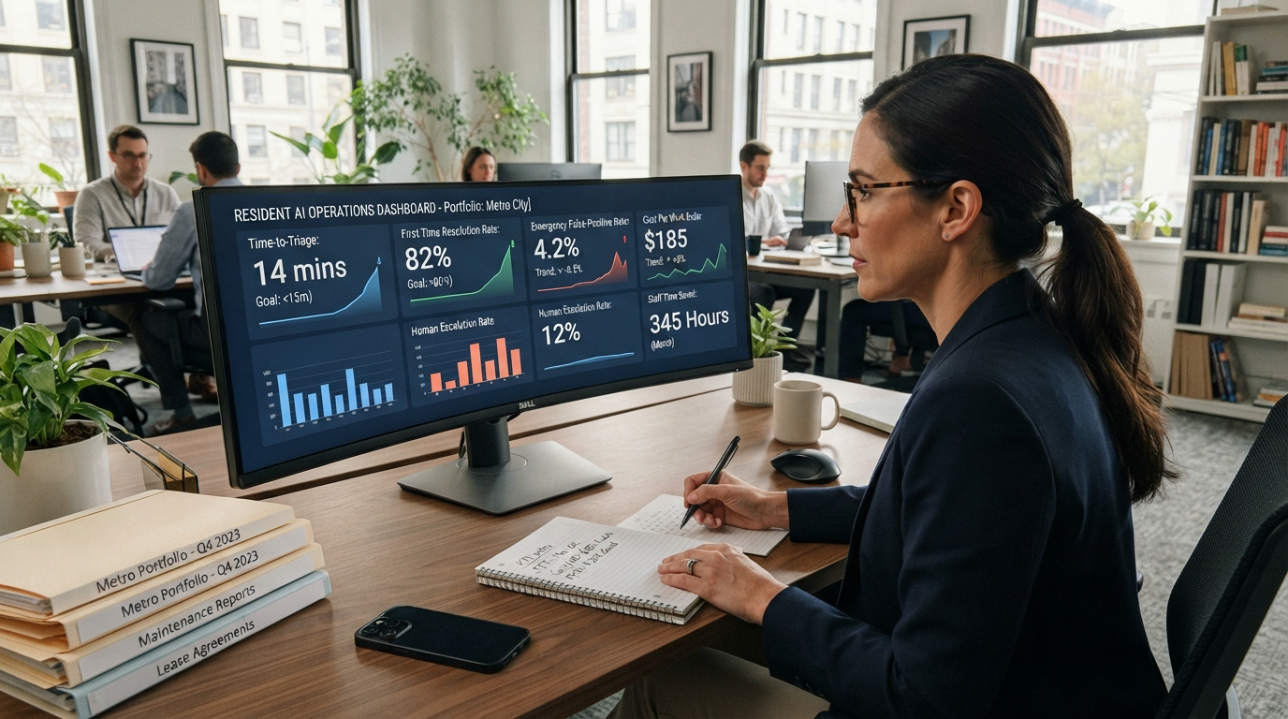
Best understood as: “We answered 500 calls” means nothing if 50 of them were misclassified emergencies.
Most operators track vanity metrics. Calls answered. Messages sent. Tickets created. These numbers feel productive but don’t tell you whether the AI is actually improving operations or just generating activity.
The metrics that matter are operational outcomes: emergency misclassification rate (both false positives and false negatives), avoided truck rolls, time-to-triage, after-hours spend per unit, and vendor SLA adherence.
The payoff for tracking the right things is significant. Among operators already using AI tools, 77% report moderate to significant reductions in operating expenses, and 85% have seen measurable improvements in lead-to-lease conversion rates. Organizations using AI in property management report 20 to 30% improvements in operational efficiency and up to 42% reduction in lease administration errors. But these numbers only emerge if you’re actually measuring them.
The fix: Build a simple dashboard with five to seven operational KPIs. Review it weekly. Compare AI-assisted outcomes against your baseline from before implementation. If you can’t show a clear before-and-after improvement within 60 days, something in your setup needs to change.
AI Property Management KPIs to Track
KPI | What It Measures | Why It Matters |
|---|---|---|
Time-to-triage | How quickly a request is classified | Shows whether AI improves response speed |
First-time resolution rate | Requests resolved without repeat visits | Measures maintenance effectiveness |
Emergency false-positive rate | Routine requests incorrectly classified as emergencies | Identifies unnecessary escalation |
Emergency false-negative rate | Emergencies incorrectly classified as routine | Critical safety metric |
Cost per work order | Average operational cost of a request | Connects AI to financial performance |
Human escalation rate | Percentage requiring staff intervention | Shows where AI still needs support |
AI correction rate | Outputs requiring employee correction | Measures reliability |
Response time | Time from inquiry to response | Measures resident/prospect service |
Lead-to-lease conversion | Qualified leads that become leases | Connects leasing AI to revenue |
Staff time saved | Hours removed from repetitive work | Measures productivity impact |
The exact KPIs should vary by workflow. A leasing chatbot and a maintenance-triage system should not be judged using the same success criteria.
How to Evaluate AI Tools Before You Buy
Before signing with any AI vendor, run through this checklist:
Two-way PMS integration: Can the tool read from and write back to your PMS? Does it create work orders, update records, and log notes automatically?
Diagnostic triage: Does the maintenance AI ask troubleshooting questions before dispatching a vendor?
Fair Housing compliance: Are there guardrails for tenant-facing communications? Is there a clear human escalation path?
PM-specific training: Was the model trained on property management data, or is it a generic LLM with a property management skin?
Reporting and KPIs: Does the platform track operational outcomes, not just activity metrics?
Sequenced onboarding: Does the vendor support a phased rollout, or do they push a big-bang deployment?
Book a demo with Haven to see how purpose-built AI handles maintenance triage, leasing automation, and PMS integration in a single platform.
Frequently Asked Questions
What are the most common AI mistakes in property management?
The most frequent mistakes are deploying AI without proper PMS integration, skipping diagnostic triage for maintenance requests, ignoring Fair Housing compliance, and treating AI as a set-and-forget solution. Each of these creates operational inefficiencies, legal risks, or both. The root cause is almost always rushing implementation without adequate planning, data preparation, or staff training.
How much do AI implementation mistakes cost property managers?
Costs vary by mistake type. Poor maintenance triage alone wastes $3,000 to $7,000 per year in unnecessary vendor dispatch fees, with each avoidable truck roll costing $200 to $300. Unsupervised algorithmic rent pricing carries legal exposure in the hundreds of millions, as the RealPage settlements demonstrate. Failed adoption due to poor change management wastes the entire software investment.
How do I know if my AI tool is properly integrated with my PMS?
Test whether the AI can both read data from and write data back to your PMS in real time. If it can pull unit availability but can’t create a work order or update a guest card inside your system, you have a one-way integration. That means someone on your team is still doing manual data entry, which defeats the purpose.
Can AI in property management violate Fair Housing laws?
Yes. AI tools can produce discriminatory outcomes through biased training data, proxy variables that correlate with protected classes, or unequal service quality (for example, if chatbot delays disproportionately affect certain resident groups). Property managers are legally responsible for the outputs of the tools they use, regardless of whether a human or algorithm made the decision.
Should property managers use generic AI tools like ChatGPT for operations?
Generic AI models hallucinate at rates as high as 33% on benchmark tests. When applied to lease terms, local regulations, vendor dispatch, or tenant communications, those error rates create real operational and legal risk. Property-management-specific AI tools trained on domain data consistently outperform generic alternatives for PM workflows.
How long should an AI pilot run before scaling to the full portfolio?
Two to four weeks on a single property or workflow is a reasonable pilot period. This gives you enough data to measure key operational outcomes (time-to-triage, emergency misclassification rate, avoided truck rolls) and catch errors before they scale across your portfolio.