AI SLAs in Property Management: 2026 Best Practices
Your 2026 AI SLAs property management guide to uptime, accuracy, latency, escalation, penalties, and compliance. Get benchmarks and a checklist.

TL;DR
An AI SLA in property management is a contractual agreement that defines measurable performance requirements for an AI system, including uptime, latency, accuracy, emergency escalation, work-order creation, model changes, and human fallback procedures. Unlike a traditional SaaS SLA, an AI SLA must address performance failures that can occur while the system remains technically online, such as incorrect maintenance triage, hallucinated leasing information, model degradation, and unsafe escalation decisions.
The most important AI SLA terms for property managers are:
Uptime: Define a minimum availability target and exclusions.
Latency: Set P95 or P99 response-time targets rather than relying on averages.
Accuracy: Measure accuracy separately for leasing, maintenance triage, emergency detection, and other high-risk workflows.
Emergency escalation: Define the maximum time allowed to identify and escalate life-safety issues to a human.
Work-order accuracy: Measure whether the AI creates complete and correctly categorized work orders in the PMS.
Model changes: Require advance notice, regression testing, and rollback procedures for material model changes.
Human fallback: Define what happens when the AI cannot safely complete a task.
Remedies: Specify service credits, corrective actions, enhanced monitoring, and termination rights for repeated or material breaches.
The key principle is simple: an AI SLA should measure business-critical outcomes, not just whether the software is online.
What Is an AI SLA in Property Management?
An AI SLA (Service Level Agreement) in property management is a contractual commitment from an AI vendor that defines measurable performance standards, the methods for tracking those standards, and the consequences when the vendor falls short.
That last part matters most. A promise without penalties is a suggestion.
Property management teams handle 200+ tenant inquiries per week on average. Missing a single call can cost a lease worth $15,000+ annually. When AI handles those calls, texts, and emails around the clock, the SLA is what separates a reliable system from an expensive liability.
If you’re evaluating AI tools for maintenance or leasing workflows, Haven’s Maintenance AI is built for exactly these use cases, with 24/7 intake, emergency triage, and PMS integration.
What Should an AI Property Management SLA Include?
A property management AI SLA should define more than system uptime. It should specify the performance standards, measurement methods, escalation procedures, vendor responsibilities, and remedies that apply when an AI system fails.
At minimum, an AI property management SLA should address these eight areas:
SLA Component | What the Contract Should Define |
|---|---|
Availability | Minimum uptime, downtime calculation, exclusions, and maintenance windows |
Latency | P95 or P99 response-time targets for voice, messaging, and API workflows |
Accuracy | How AI accuracy is measured for each critical workflow |
Emergency escalation | Maximum time to identify and notify a human about a life-safety issue |
Workflow completion | Successful work-order creation, routing, scheduling, and other PMS actions |
Model changes | Advance notice, regression testing, version tracking, and rollback procedures |
Human fallback | When and how interactions are transferred to a human |
Remedies | Service credits, corrective actions, enhanced monitoring, and termination rights |
The contract should also identify who owns the monitoring data, how performance disputes are resolved, and whether the property manager can independently audit SLA performance.
The Most Important Principle
Do not evaluate an AI vendor SLA solely by asking, “How much uptime do you guarantee?”
A system can maintain 99.9% uptime while still producing incorrect answers, misclassifying maintenance emergencies, creating incomplete work orders, or failing to escalate a tenant to a human.
For property management, the SLA should therefore connect technical performance to operational outcomes.
Why AI SLAs Are Different from Traditional SaaS SLAs
A traditional property management software SLA is mostly about uptime. Can you log in? Can you pull reports? If the system goes down, you get a credit on your next invoice.
AI SLAs must cover far more ground. A traditional PMS either works or it doesn’t. An AI system can be technically “up” while producing wrong answers, misclassifying emergencies, or responding to tenants in ways that violate Fair Housing requirements. The system is running. It’s just running badly, and nobody notices until a tenant files a complaint or a pipe bursts.
This is why AI vendor SLAs need to address accuracy, latency, escalation speed, model change notification, and hallucination guardrails on top of standard availability metrics. As one practitioner on Hacker News put it: “Most AI vendors commit to uptime but say nothing about inference speed.” That gap between what’s promised and what’s measured is where property managers get burned.
SLA vs. SLO vs. SLI: The Three-Layer Framework
These three terms get used interchangeably, but they sit at different layers of the same system. Understanding the distinction is essential for evaluating any AI vendor contract.
SLI (Service Level Indicator)
The SLI is what you actually measure. It’s a raw metric, a number pulled from system logs or monitoring tools.
Property management examples:
Percentage of time the voice AI system is available
Average seconds to generate a response to a tenant call
Percentage of maintenance requests correctly triaged by urgency level
Work order creation success rate in the PMS
SLO (Service Level Objective)
The SLO is the internal target the vendor sets for that metric. It’s aspirational, the standard the engineering team tries to hit every month.
Example: “We aim for 99.95% uptime on our voice AI system.”
SLA (Service Level Agreement)
The SLA is the contractual promise with money attached. It’s always set slightly below the SLO, because breaching an SLA triggers financial penalties or service credits.
Example: “We guarantee 99.9% uptime. If we miss it, you receive a 10% credit on your monthly invoice.”
The critical insight: because breaching an SLA costs money and trust, internal SLOs should always be stricter than external SLAs. The vendor’s own alarm should fire before the contractual one does. If a vendor’s SLA and SLO are the same number, they’re either overcommitting or running without internal safety margins.
For a deeper look at how these metrics translate to AI performance benchmarks, that guide covers KPIs specific to property management operations.
Core AI SLA Metrics for Property Management
Every AI SLA should define specific metrics with numeric targets. Here’s what each one means and what “good” looks like.
Uptime / Availability
What it measures: The percentage of time the AI system is operational and accessible.
The industry standard is 99.9%, which sounds impressive until you do the math. That’s approximately 8.8 hours of downtime per year. For context, Google’s Vertex AI Gemini Online Inference provides a 99.5% Monthly Uptime SLO, with financial credits of 10% for availability between 99.0% and 99.5%, 25% for 95.0% to 99.0%, and 50% for anything below 95%.
For a 24/7 AI system handling emergency maintenance calls, even 99.9% uptime means real gaps. A sewage backup reported during one of those 8.8 hours goes unanswered. Redundancy and fallback plans, like automatic routing to an on-call human, matter as much as the uptime number itself.
What to demand: 99.9% minimum uptime with a defined fallback protocol for outages. Ask whether the SLA distinguishes between planned and unplanned downtime.
Latency (P95 Targets)
What it measures: How quickly the AI responds, measured at the 95th percentile (P95), meaning 95% of all interactions complete within this time.
A platform that is technically up but returning responses in 30 seconds is not meeting operational requirements. For voice AI, where tenants expect near-instant replies, sub-second latency is the bar. For API-based integrations with your PMS, P95 latency under 300 milliseconds is a reasonable starting point.
Why P95 matters more than averages: An average latency of 500ms might mean that most calls are fine but 5% of tenants wait 10+ seconds. The P95 target catches those worst-case experiences that averages hide.
AI Accuracy Rate
What it measures: The percentage of AI outputs that are factually correct and contextually appropriate.
An AI with a 95% accuracy rate is generally considered reliable for straightforward tasks like FAQ handling and basic leasing inquiries. For complex property management tasks like maintenance triage, where the system must distinguish between a nuisance drip and an emergency pipe burst, a reasonable resolution rate target falls between 65% and 80%.
What to demand: Separate accuracy targets for different task categories. A single accuracy number across all interactions masks poor performance in high-stakes scenarios.
Maintenance Resolution Rate
What it measures: The percentage of maintenance requests the AI successfully resolves without human intervention, from initial intake through work order creation and vendor dispatch.
This is where the AI SLA connects to the physical world. The AI might acknowledge a request in under a second, but if it fails to create the work order correctly or dispatches the wrong vendor, the resolution failed.
What to demand: A resolution rate target between 65% and 80% for standard maintenance, with a separate (lower) target for complex or multi-step issues. The contract should define what counts as “resolved.”
ASR (Automatic Speech Recognition) Accuracy
What it measures: How correctly the voice AI transcribes spoken tenant requests into text.
ASR accuracy is unique to AI voice services. It fluctuates with accent variation, background noise, and domain-specific terminology. A tenant saying “HVAC model number XR-15” or describing a “p-trap leak” presents different challenges than standard conversational speech.
What to demand: The contract should define the test corpus scope (what accents and terminology are included), measurement frequency, and what happens when targets are missed. For more detail on how voice quality gets monitored, the guide on AI call recordings and QA covers audit workflows.
Work Order Creation Success Rate
What it measures: The percentage of valid maintenance requests that result in a correctly formed work order in your PMS, with the right property, unit, category, priority, and description populated.
This is the metric that determines whether the AI is actually doing operational work or just generating text. A beautifully worded response to a tenant means nothing if the work order in AppFolio is blank or miscategorized.
Emergency Escalation Time
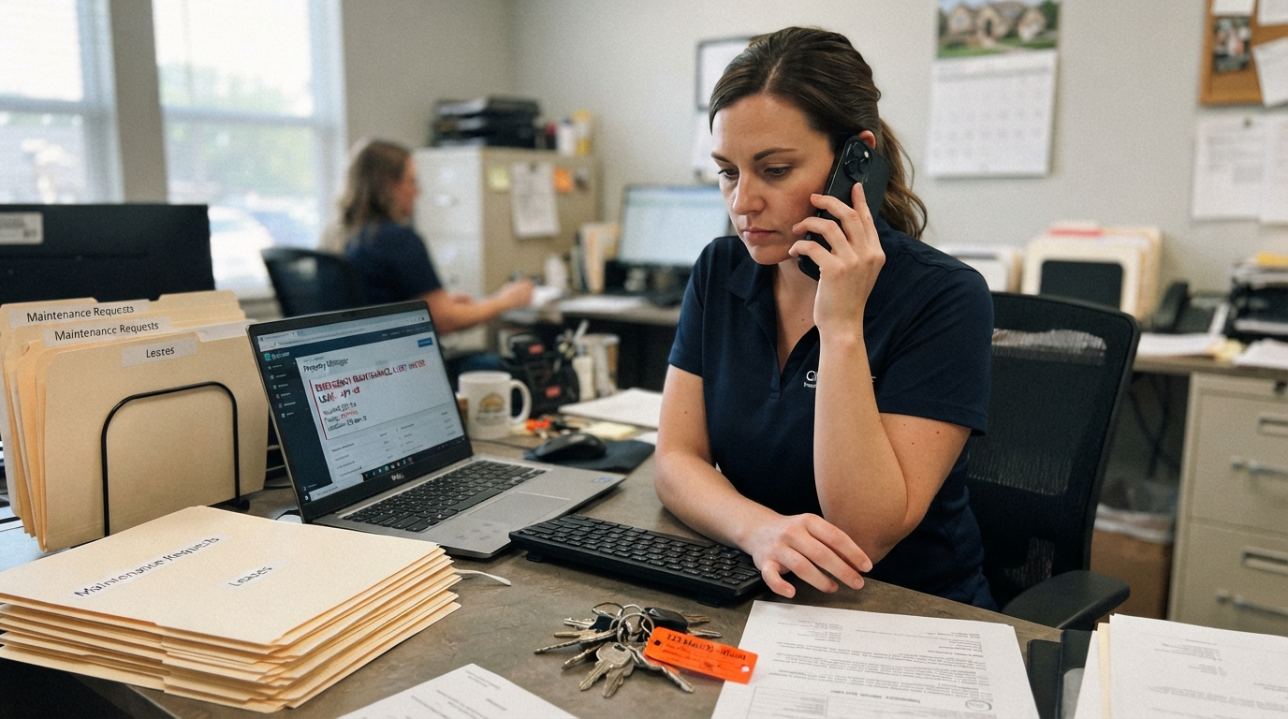
What it measures: How quickly the AI identifies a life-safety or emergency situation and routes it to a human.
This is non-negotiable. A gas leak, a fire, a flood, these cannot wait in a queue. The SLA should specify a maximum time from the tenant’s first words to a live human being notified, typically measured in seconds, not minutes.
Model Update Notification
What it measures: How much advance notice the vendor gives before changing the underlying AI model.
Model changes can break workflows without warning. A vendor swaps to a newer language model and suddenly the AI classifies “water stain on ceiling” as cosmetic instead of urgent. The SLA should require advance notification (typically 14 to 30 days), regression testing obligations, and a rollback option if the update degrades performance.
Recommended AI SLA Targets for Property Management
There is no universal AI SLA standard for property management. The appropriate threshold depends on the workflow, risk level, architecture, and whether the AI is handling voice, messaging, or backend automation.
The following ranges can be used as a contract-negotiation starting point, not as universal industry standards:
Metric | Lower-Risk Workflow | High-Risk Workflow | What to Contractually Define |
|---|---|---|---|
Availability | 99.9%+ | 99.9%+ with human fallback | Measurement period, exclusions, maintenance windows |
Voice response latency | Define P95 target | Define stricter P95/P99 target | What part of the interaction is measured |
API latency | Define P95 target | Define stricter target for critical workflows | Request-to-response measurement |
AI accuracy | Task-specific target | Higher threshold for high-risk tasks | Test set, sampling method, error classification |
Emergency escalation | Seconds | Seconds with immediate human notification | Start/end points and escalation path |
Work-order creation | 95%+ starting benchmark | Higher target for critical fields | Required fields and validation rules |
Model-change notice | 14–30 days | 30+ days for material changes | Definition of material change |
Human fallback | Required | Immediate for defined critical scenarios | Trigger conditions and routing |
SLA reporting | Monthly | Real-time for critical events | Customer dashboard and audit rights |
These numbers should not be presented as universal industry standards. Instead, use them as starting points for negotiating a vendor-specific SLA based on the operational and legal risk of each workflow.
How to Measure AI SLA Performance
An AI SLA is only enforceable if the parties agree on how performance is measured.
Before signing the contract, define the measurement formula, data source, reporting frequency, exclusions, and dispute process for every important metric.
Uptime
Define exactly what counts as downtime.
For example:
Availability = (total measurement time − qualifying downtime) ÷ total measurement time × 100
The contract should also specify whether planned maintenance, third-party outages, customer configuration errors, and network failures are excluded.
Latency
Specify whether latency is measured at P50, P95, or P99.
For customer-facing AI, P95 is often more informative than an average because it shows how slow the experience becomes for the slower portion of interactions.
The contract should define the start and end points. For example, an API latency measurement might run from receipt of a valid request to delivery of the response, while a voice-AI measurement may require a different definition.
Accuracy
Never define AI accuracy as a single percentage without defining the test.
The SLA should specify:
the test dataset or sampling method;
the task being evaluated;
what constitutes a correct answer;
what constitutes a critical error;
how often testing occurs;
who performs the evaluation;
how disputed results are handled.
Accuracy should also be segmented by workflow. A vendor might achieve high accuracy on routine FAQ questions while performing materially worse on emergency maintenance triage.
Emergency Escalation
Define the clock precisely.
For example:
Escalation time = timestamp of qualifying emergency detection → timestamp of successful human notification
The SLA should state what counts as successful notification. A failed SMS or unanswered phone call should not automatically count as a successful escalation.
Work-Order Creation
Measure whether the AI successfully creates a usable work order rather than simply whether an API call succeeds.
Required fields might include:
property;
unit;
issue category;
priority;
tenant description;
contact information;
emergency indicator;
timestamp.
A successful API transaction that creates an incomplete or incorrectly categorized work order should not automatically count as a successful workflow.
SLA Reporting
Require the vendor to provide recurring reports showing actual performance against contractual targets.
For critical workflows, property managers should consider requiring access to event-level logs or dashboards rather than relying exclusively on vendor-generated monthly summaries.
Maintenance SLA Response Time Standards
AI SLAs don’t exist in isolation. They sit on top of physical maintenance response standards that tenants and regulators already expect.
Here’s how the two layers connect:
Urgency Level | Physical Response Standard | AI’s Role |
|---|---|---|
Emergency (fire, flood, gas leak, no heat in winter) | On-site within 2-4 hours | Detect emergency in seconds, escalate to human immediately, dispatch vendor |
Urgent (broken A/C in summer, water leak, no hot water) | Acknowledged within 24 hours, addressed within 24-48 hours | Triage correctly, create work order, dispatch vendor from preferred list |
Routine (cosmetic damage, minor appliance issue, non-critical repair) | Acknowledged within 24 hours, completed within 3-7 days | Create work order, schedule vendor, send tenant confirmation and follow-up |
The data supports these standards. Responding to maintenance requests within 24 hours correlates with 12% higher tenant retention. Delays beyond 48 to 72 hours significantly increase the risk of tenant move-out, costing approximately $3,500 per turnover. And 67% of non-renewing tenants cite slow maintenance response as a factor in their decision.
As Breasy CEO Ben Souva noted, “Response time is table stakes. Resolution time is where property managers win or lose.”
Property management organizations that establish written SLAs with contractors report 45% fewer service disputes and 50% higher tenant satisfaction scores. When AI handles the intake layer, the entire chain speeds up, but only if the AI SLA guarantees fast, accurate triage. For a detailed look at how AI maintenance coordination works end-to-end, from intake through vendor dispatch, that page walks through the full workflow.
Service Credits vs. Actual Business Cost
Every property manager evaluating AI vendor contracts needs to understand this: service credits are a discount on a future bill. They are not compensation for the damage caused by the failure.
Here’s a concrete example. Your AI vendor has a $2,000/month contract. They miss their uptime SLA and owe you a 10% credit. You receive $200 off next month’s invoice.
Meanwhile, the outage caused:
A flooded apartment from an unreported pipe burst: $8,000 in damage
Two lost leases from prospects who couldn’t reach anyone: $30,000 in annual revenue
A habitability complaint filed with the city: legal costs TBD
A $200 credit doesn’t cover any of that.
This gap between service credits and actual business exposure is why AI SLAs in property management matter so much more than in most industries. The AI vendor doesn’t get the lawsuit. You do.
AI-Specific Risks Your SLA Must Address
These are the failure modes that traditional SaaS SLAs were never designed to cover.
Silent Degradation
Unlike traditional software that either works or crashes, AI can silently get worse. The system stays online, response times look normal, but accuracy drops. The model starts miscategorizing urgent requests as routine. Tenants get wrong information about lease terms.
This happens because models degrade over time as contexts shift and new patterns emerge that the training data didn’t anticipate. Static governance plans become obsolete quickly.
What the SLA should include: Continuous accuracy monitoring with defined thresholds that trigger alerts, plus a commitment to periodic performance audits. For deeper context on how these failures get caught and corrected, the AI and PMS error handling glossary is a useful companion piece.
Hallucinations
Large language models can generate fluent, convincing responses that are factually wrong. An AI leasing agent might quote a rent amount that doesn’t exist, promise an amenity the property doesn’t have, or give legal advice it has no business giving.
As one AI engineering practitioner put it: “Hallucinations are not a defect to fix; they are a property to manage. Use grounding to prevent the most common ones, guardrails to catch the obvious ones, escalation to handle the high-stakes ones, and observability to catch drift before customers do.”
What the SLA should include: Defined hallucination guardrails, grounding requirements (the AI must reference verified property data), and escalation protocols for high-stakes topics like lease terms, security deposits, and habitability issues.
Model Changes Breaking Workflows
A vendor updates their underlying model and your carefully configured workflows break. Maintenance categories shift. Escalation logic changes. The AI that perfectly handled after-hours emergency calls last week now routes them to a voicemail box.
What the SLA should include: Minimum notification periods for model updates, regression testing requirements, and a rollback option if performance degrades. The strongest AI SLAs don’t pretend the agent will always succeed. They define what happens when it doesn’t.
Accuracy vs. Process Compliance
Final answer quality is not enough. If the AI reached a correct answer by calling a tool it should never have touched, or accessed tenant data it shouldn’t have, the workflow still violated policy.
What the SLA should include: Process compliance requirements, not just outcome accuracy. The contract should reference defined states (accepted, retrieving, tool_calling, awaiting_approval, queued, completed, failed, escalated) so there’s something concrete to audit against.
Understanding AI escalation rules in detail helps define what those states look like in practice.
Fair Housing and Habitability Compliance
The Fair Housing Act applies to AI leasing tools the same way it applies to human leasing agents. Property managers are liable for discriminatory outcomes produced by their AI systems, even when those outcomes are unintentional and the tool is operated by a third-party vendor.
This isn’t hypothetical. AI systems are built on data, and if that data contains inherent biases, the AI may unintentionally perpetuate discrimination. This is particularly concerning in areas such as resident screening, maintenance prioritization, and customer service.
An AI that handles leasing inquiries inconsistently, whether due to model drift, accent recognition failures, or biased training data, creates discrimination exposure that no service credit will cover. If the voice AI struggles to understand certain accents and those tenants receive worse service, that’s a Fair Housing problem, regardless of intent.
On the habitability side, most states require landlords to respond to habitability issues within a legally defined timeframe. A resident who calls to report a sewage backup, a heating failure in winter, or a mold issue isn’t just making a service request. They’re creating a legal record. How your AI system responds to that communication matters.
For a thorough walkthrough of these obligations, the Fair Housing compliance guide covers what property managers need to know.
If your AI handles leasing inquiries, Haven’s Leasing AI is purpose-built for compliant tenant communication across phone, SMS, and email.
The Home365 Cautionary Tale
This case makes the stakes concrete.
In 2024, Pennsylvania Attorney General Dave Sunday announced a settlement with Home365, LLC, a Las Vegas-based property management company that used an AI-based platform to assist its operations. The settlement alleged that the company failed to timely address Pennsylvania tenants’ maintenance needs and failed to return tenant security deposits.
Consumers complained that the AI platform was responsible for delays in addressing issues like water leaks, sewage problems, and structural defects. Some tenants reported not receiving required utilities like heat and water.
Under the terms of the settlement, Home365 paid $45,000 to the Office of Attorney General, including $30,000 in consumer restitution and $15,000 in costs.
The takeaway: when AI fails to perform and there’s no contractual accountability, property managers bear the regulatory and legal risk. Home365’s AI vendor didn’t pay the settlement. Home365 did.
Red Flags in AI Vendor SLAs
When you’re reviewing an AI vendor’s contract, watch for these warning signs:
Vague uptime claims with no latency commitment. “99.9% uptime” means nothing if the system takes 30 seconds to respond. Push for P95 latency targets alongside availability numbers.
No accuracy metrics. If the SLA covers uptime but says nothing about how often the AI gets things right, the vendor is avoiding accountability for the thing that matters most.
No model change notification requirements. Any vendor that reserves the right to change models without advance notice is asking you to accept uncontrolled risk.
No escalation protocol. What happens when the AI fails? If the answer isn’t specific (defined states, timeframes, human fallback procedures), it’s not a real SLA.
No peak vs. off-peak distinction. Most SLAs don’t distinguish between 2 PM on a Tuesday and 2 AM on a Saturday. Property managers should ask whether they do, since after-hours is when tenant calls are most likely to be emergencies and when failures are most costly.
Service credits as the only remedy. If the maximum penalty for catastrophic failure is 50% off next month’s bill, the SLA doesn’t create meaningful accountability.
No data quality requirements. As one practitioner noted, “AI platforms are genuinely useful once you have clean data and structured processes underneath them. Without that foundation, you are automating chaos.” If the vendor accepts no responsibility for outcomes when data quality is poor, understand how AI data quality affects your setup.
What Counts as an AI SLA Breach?
An AI SLA breach occurs when a vendor fails to meet a contractual performance requirement under the measurement and exclusion rules defined in the agreement.
Examples can include:
monthly availability falling below the contractual threshold;
P95 latency exceeding the agreed target;
emergency escalation exceeding the maximum response time;
work-order creation falling below the agreed success rate;
required AI accuracy falling below the contractual threshold;
failure to provide required SLA reports;
failure to provide advance notice of a material model change;
failure to follow the agreed human-fallback procedure.
Not every AI error is automatically an SLA breach. The contract should define the difference between an isolated error, a measurable performance failure, a critical incident, and a repeated breach.
Critical Incidents Should Be Treated Differently
For high-risk property-management workflows, consider defining critical incidents separately.
A critical incident might include:
failure to escalate a qualifying life-safety emergency;
unauthorized access to protected tenant information;
a material system failure affecting emergency communications;
repeated incorrect routing of qualifying emergency maintenance requests;
a material compliance failure.
The contract should specify the notification deadline, investigation process, corrective-action requirements, and escalation path for these events.
Negotiation Checklist: Questions to Ask AI Vendors Before Signing
Use these questions to evaluate whether an AI vendor’s SLA actually protects your operations:
What specific metrics does the SLA cover? Uptime alone is insufficient. Ask for accuracy, latency, escalation time, and resolution rate targets.
How is accuracy measured, and how often? Request the methodology, test corpus, and measurement frequency. Annual audits are not enough for a system that changes monthly.
What happens when the AI misclassifies an emergency? The answer should include a specific escalation path with defined timeframes, not a general statement about “continuous improvement.”
What advance notice do you provide before model updates? Look for 14 to 30 days minimum, plus regression testing obligations and a rollback option.
Do you offer peak vs. off-peak SLA tiers? After-hours performance is where property management AI earns its keep. The SLA should reflect that.
What’s the maximum financial exposure if you breach the SLA? If it’s capped at a percentage of your monthly invoice, understand that this won’t come close to covering your actual losses.
How do you monitor for silent degradation? The vendor should have automated accuracy monitoring, not just uptime dashboards.
What are your Fair Housing compliance guardrails? For any AI handling leasing inquiries, this is non-negotiable. The vendor should be able to explain their bias testing and mitigation approach.
Can I audit the AI’s performance against SLA targets independently? If the vendor controls all the measurement and reporting, there’s an obvious conflict of interest.
What happens when the SLA is breached repeatedly? One month of service credits is a slap on the wrist. Look for escalation clauses: automatic credits for first breach, enhanced monitoring for second, and contract termination rights for third.
Note that 74% of businesses struggle to clearly define and communicate SLAs. Going into vendor conversations with these specific questions puts you ahead of most buyers.
Sample AI Property Management SLA Clause
The following example illustrates how a property manager could structure an AI SLA. It is a starting framework, not legal advice, and should be adapted to the vendor, workflow, jurisdiction, and risk level.
Example: AI Performance and Escalation Clause
Availability: Vendor will maintain the covered AI service at the availability level specified in the applicable SLA schedule. The agreement will define qualifying downtime, planned maintenance, excluded events, and the method used to calculate monthly availability.
Latency: Vendor will maintain the agreed response-time target for covered workflows, measured at the specified percentile and using the measurement points defined in the SLA schedule.
Accuracy: Vendor will maintain the agreed performance threshold for each designated AI workflow. Accuracy will be measured using the agreed evaluation methodology, test set, sampling frequency, and error classification.
Emergency Escalation: For interactions classified as qualifying emergencies, the system must initiate the agreed human escalation procedure within the contractual response time. The SLA will define what constitutes successful notification and the fallback procedure when the first escalation attempt fails.
Work-Order Creation: A maintenance interaction will count as successfully processed only when the required work-order fields are correctly populated in the designated property management system.
Model Changes: Vendor will provide advance notice of material model or workflow changes, conduct agreed regression testing, and maintain a rollback or mitigation procedure when a material update causes performance to fall below the agreed threshold.
Human Fallback: Vendor will maintain the agreed fallback procedure for service outages, uncertain AI responses, defined high-risk interactions, and emergency scenarios.
Reporting: Vendor will provide performance reports at the agreed frequency and provide sufficient supporting data for the customer to verify compliance with the SLA.
Remedies: The agreement will specify service credits and other contractual remedies for missed targets, including enhanced monitoring, corrective-action requirements, and termination rights where defined breach thresholds are reached.
The Industry Context: Why This Matters Now
AI adoption in property management is accelerating. Usage jumped from 21% to 34% in just one year, and AI adopters forecast 31% portfolio growth in 2026 compared to 12% for non-users. At the same time, 78% of survey respondents report that they cannot yet rely on the AI features in their legacy property management software.
That gap between adoption speed and reliability is exactly where AI SLAs become critical. Companies that adopt AI solutions for property maintenance see cost reductions of up to 30%, but those savings evaporate if the AI creates legal exposure or drives tenant turnover through poor performance.
The property managers who will benefit most from AI are the ones who demand accountability upfront, before signing a contract, not after a failure forces them to.
To see what accountable AI property management software looks like in practice, Haven offers demos tailored to your portfolio size and workflows.
AI Property Management SLA Buyer Checklist
Before signing an AI vendor agreement, confirm that the contract answers each of these questions:
Performance
Is uptime defined mathematically?
Is the availability target appropriate for a 24/7 property-management workflow?
Are P95 or P99 latency targets included?
Are accuracy targets defined by workflow?
Is emergency escalation measured in seconds or another clearly defined unit?
Is work-order creation measured for accuracy, not merely API success?
AI Change Management
Does the vendor provide advance notice of material model changes?
Is regression testing required?
Is rollback or mitigation available?
Are major model versions documented?
Safety and Compliance
Are emergency situations automatically escalated?
Is there a human fallback?
Are high-risk leasing or housing decisions subject to human review?
Are relevant AI outputs and actions logged?
Are Fair Housing risks addressed where applicable?
Contract Enforcement
Are SLA breaches clearly defined?
Are service credits automatic or must the customer request them?
Are corrective-action requirements included?
Are repeated-breach escalation provisions included?
Does the customer have termination rights for material or repeated failures?
Can the customer independently verify SLA measurements?
If several of these answers are “no,” the vendor agreement may provide less protection than its headline uptime percentage suggests.
Frequently Asked Questions
What is an AI SLA in property management?
An AI SLA is a contractual agreement between a property manager and an AI vendor that defines measurable performance standards (uptime, accuracy, latency, escalation speed), how those standards are monitored, and the financial consequences when the vendor fails to meet them. It’s distinct from traditional software SLAs because it must cover AI-specific risks like hallucinations, model drift, and silent degradation.
How does an AI SLA differ from a regular SaaS SLA?
A regular SaaS SLA primarily covers uptime, meaning whether the system is accessible. An AI SLA must also guarantee accuracy (is the AI giving correct answers?), latency (how fast does it respond?), escalation speed (how quickly does it route emergencies to humans?), and model stability (will a vendor update break your workflows?). Traditional software either works or crashes. AI can be “up” while performing badly.
What uptime should I expect from an AI property management vendor?
The industry standard is 99.9%, which translates to about 8.8 hours of downtime per year. For reference, Google’s Vertex AI offers a 99.5% SLO. For property management AI handling emergency calls 24/7, insist on 99.9% minimum with a defined fallback protocol (automatic routing to a live human) during any outage.
Are service credits enough to protect my business if the AI fails?
No. Service credits are a discount on your next invoice, typically 10% to 50% of one month’s fee. They are not cash refunds and they don’t come close to covering real losses like property damage from unreported emergencies, lost leases, or regulatory penalties. The Home365 settlement cost $45,000, far exceeding what any service credit would offset.
Can I be held liable for my AI vendor’s Fair Housing violations?
Yes. The Fair Housing Act holds property managers liable for discriminatory outcomes produced by their AI systems, even when those outcomes are unintentional and the tool is operated by a third-party vendor. If your AI leasing assistant treats prospects inconsistently due to accent recognition failures or biased training data, you bear the legal risk.
What AI SLA metrics matter most for maintenance operations?
The five most critical metrics are: emergency escalation time (seconds to route life-safety issues to humans), accuracy rate (correct triage and categorization), work order creation success rate (correctly formed orders in your PMS), latency (sub-second for voice, under 300ms for API), and uptime (99.9% minimum). Resolution rate, measuring end-to-end outcomes rather than just intake, is where the real operational value shows up.
How often should AI SLA performance be measured?
Monthly at minimum, with real-time monitoring for critical metrics like emergency escalation time and uptime. Annual reviews are completely insufficient for AI systems that can degrade over weeks. Ask vendors for dashboard access so you can track performance independently rather than relying solely on vendor-generated reports.
What should I do if my AI vendor repeatedly misses SLA targets?
Your contract should include escalation clauses for repeated breaches. A reasonable structure: automatic service credits for first breach, mandatory performance review and enhanced monitoring for second breach, and contract termination rights for third breach within a defined period. SLAs without enforcement mechanisms are just suggestions.