AI Vendor Onboarding: 2026 Guide and 7-Step Playbook
AI Vendor Onboarding in property management. Automate compliance, cut cycle times by 50-80%, sync to your PMS, and implement AI fast.

TL;DR
AI vendor onboarding has two meanings in property management: using AI to automate the process of onboarding maintenance and service vendors into your portfolio, or implementing an AI vendor’s product into your operations. Both matter. AI-powered vendor onboarding cuts cycle times by 50 to 80 percent, reduces email back-and-forth by up to 80 percent, and turns compliance from a one-time checkbox into a continuously enforced system. Getting either version wrong creates compounding problems across your portfolio.
Quick Answer: What Is AI Vendor Onboarding?
AI vendor onboarding in property management is the use of AI and automated workflows to collect, validate, approve, and continuously monitor vendor information before and after a vendor is authorized to work. It can automate COI and W-9 collection, license verification, compliance checks, duplicate detection, vendor approval, and PMS synchronization. The term can also mean implementing an AI vendor's software into a property management operation.
What Is AI Vendor Onboarding in Property Management?
AI vendor onboarding has two related meanings, but property managers usually encounter the term in one of two contexts.
1. Using AI to onboard property management vendors
This is the primary meaning for property management teams. AI automates the collection, extraction, validation, approval, and monitoring of vendor information such as certificates of insurance, W-9 forms, trade licenses, background checks, and service-area details.
The goal is to move vendors from “submitted” to “approved and dispatch-ready” without requiring staff to manually chase documents, enter data, and check compliance across multiple systems.
2. Onboarding an AI vendor into your property management operation
This refers to implementing an AI software provider. The work typically includes connecting the AI platform to your PMS, importing or cleaning vendor data, configuring workflows, establishing escalation rules, testing integrations, and training employees.
These are separate workflows. The first uses AI to onboard your maintenance and service vendors. The second is the process of deploying an AI product inside your company.
For property management SEO and operational purposes, the first meaning should be treated as the primary definition of AI vendor onboarding.
If you’re evaluating AI tools for your portfolio, Haven’s Maintenance AI handles vendor dispatch from preferred vendor lists as part of its maintenance workflow.
AI Vendor Onboarding Meaning | Who Is Being Onboarded? | Main Purpose | Typical Tasks |
|---|---|---|---|
Vendor onboarding with AI | Maintenance and service vendors | Approve vendors for work | COI collection, W-9s, licenses, compliance, screening |
AI vendor implementation | AI software provider | Deploy AI into operations | PMS integration, configuration, data migration, training |
Ongoing vendor compliance | Existing vendors | Keep vendors eligible | Insurance renewals, license checks, re-verification |
AI-powered dispatch | Approved vendors | Assign maintenance work | Vendor matching, availability, service area, compliance |
How AI Changes Vendor Onboarding in Property Management
The Old Process
Before automation, vendor onboarding looked something like this: a maintenance coordinator emails a new HVAC vendor asking for their COI, W-9, and trade license. The vendor sends back a blurry PDF three days later. The coordinator manually checks whether insurance minimums meet the ownership group’s requirements, enters the data into the PMS, and files the documents somewhere, maybe a shared drive, maybe a desk drawer. Multiply this by dozens of vendors and multiple ownership groups, each with different insurance thresholds and background check requirements.
The process breaks not at one property but across the portfolio. As one vendor compliance platform explains, “for portfolios operating across multiple ownership groups, onboarding is more than a single approval workflow. Each ownership group may carry different insurance thresholds, background check requirements, or vendor eligibility standards. Without a standardized process, compliance gaps compound across all properties that share a vendor.”
The New Process
AI-powered vendor onboarding replaces the manual chain with structured, automated workflows:
Self-service portals with intelligent forms. Instead of email chains, vendors submit their own information through portals that adapt to vendor type, validate inputs as they’re entered, and guide the vendor through exactly what’s required. This alone eliminates most of the back-and-forth that bogs down manual onboarding.
Automated document validation. AI extracts vendor data from various document formats, pre-populates forms, and validates tax IDs against government databases. It uses fuzzy matching and machine learning to detect duplicate vendor records despite name variations or formatting differences.
Compliance screening at onboarding. AI automatically runs vendors through required compliance screens, checking against global sanctions lists (OFAC and others), politically exposed persons databases, and watchlists, then flags hits for human review.
PMS synchronization. Once a vendor is approved, their compliance status flows automatically into your PMS (whether that’s Yardi, Entrata, RealPage, or AppFolio), giving property teams real-time visibility without duplicate data entry. For more on how AI integrates with your PMS, including read-write access considerations, it’s worth understanding the technical foundations.
The Numbers
The impact is significant. AI-powered onboarding reduces cycle times by 50 to 80 percent, with some organizations seeing a 400 percent increase in onboarding speed. Average onboarding time in procurement has dropped from 45 to 18 days with digital document validation. Teams report up to 80 percent fewer email exchanges once structured automation is in place.
Onboarding Is Not a One-Time Event
This is the insight most property managers miss. Vendor compliance doesn’t end at approval. It’s a continuous lifecycle. Insurance policies expire. Licenses lapse. A vendor who was fully compliant six months ago may not be today.
The best AI vendor onboarding systems set automated reminders 60, 30, and 7 days before policy expirations, ensuring renewals are collected and validated before coverage lapses. As one compliance-focused platform puts it, “compliance often fails during the job, not at onboarding.” Understanding vendor SLA best practices helps property managers keep vendors accountable beyond initial approval.
What Does AI Automate in Vendor Onboarding?

AI can automate different parts of vendor onboarding depending on the platform, integrations, and compliance requirements.
Document collection
Automated workflows can request required documents, send reminders, identify missing files, and route submissions to the appropriate review queue.
Document extraction
AI-powered document processing can extract information from certificates of insurance, tax forms, licenses, and other vendor documents without requiring staff to manually retype every field.
Compliance validation
The system can compare extracted information against predefined requirements such as insurance limits, expiration dates, required coverage types, licenses, and ownership-group rules.
Duplicate detection
AI and matching algorithms can identify potential duplicate vendor records when the same company appears under slightly different names, addresses, phone numbers, or email addresses.
Vendor classification
Vendors can be categorized by trade, geography, service type, property, and other attributes so downstream systems can use the information for routing and dispatch.
PMS synchronization
Approved vendor information can be synchronized with the property management system when the AI platform supports the necessary integration and write permissions.
Ongoing monitoring
After approval, automated workflows can monitor expiration dates and trigger renewal requests or human review when compliance information changes.
Vendor Onboarding vs. Vendor Compliance: What's the Difference?
Vendor onboarding is the process of getting a vendor approved for the first time. Vendor compliance management is the ongoing process of ensuring that the vendor remains eligible to work.
Process | Primary Question | Examples |
|---|---|---|
Vendor onboarding | Can this vendor be approved? | Collect COI, W-9, licenses, screening |
Vendor compliance | Is this vendor still eligible? | Track expirations, renewals, policy changes |
Vendor performance management | Is this vendor performing well? | Response time, completion time, quality, SLA compliance |
Vendor dispatch | Which approved vendor should receive the work? | Trade, location, availability, compliance |
This distinction matters because approval does not permanently establish compliance. Insurance policies expire, licenses change, vendor information becomes outdated, and ownership requirements can change.
An effective AI vendor onboarding system therefore becomes part of a broader vendor lifecycle management process rather than a one-time intake workflow.
7-Step AI Vendor Onboarding Process
Here’s the step-by-step workflow for a property management company using AI to onboard vendors:
Step | Process | AI's Role | Human Role |
|---|---|---|---|
1 | Define requirements | Apply property-specific rules | Set requirements |
2 | Collect information | Automate requests and reminders | Resolve unusual cases |
3 | Validate documents | Extract and compare data | Review exceptions |
4 | Screen vendors | Automate screening | Investigate potential matches |
5 | Vet performance | Organize vendor attributes | Approve quality/capacity |
6 | Sync with PMS | Update approved records | Confirm integration |
7 | Monitor compliance | Track expirations and changes | Handle escalations |
Step 1: Define compliance requirements by property. Before any vendor enters the workflow, establish the insurance minimums, coverage types, and credentialing standards for each property or ownership group. Different owners have different thresholds, and the system needs to know which rules apply where.
Step 2: Vendor submits information. The vendor receives a link to a self-service portal. Intelligent forms adapt based on the vendor’s trade category (plumbing, electrical, HVAC, general maintenance) and request only the documents relevant to that category.
Step 3: AI validates documents. The system extracts data from uploaded COIs, W-9s, and licenses. It checks insurance amounts against the property’s requirements, verifies tax IDs, and flags any discrepancies or missing information immediately, rather than days later via email.
Step 4: Compliance screening. The vendor is automatically screened against sanctions lists, denied-party databases, and any portfolio-specific exclusion criteria.
Step 5: Performance vetting. Compliance determines eligibility, but vetting determines whether the vendor can actually do the work at the level you need. This step assesses capacity, expertise, response time commitments, and service area coverage.
Step 6: PMS sync and preferred vendor list placement. The approved vendor’s data, including compliance status, trade categories, service areas, and SLAs, syncs to your PMS. They’re now on your preferred vendor list and eligible for dispatch.
Step 7: Ongoing monitoring. The system tracks expiration dates and compliance status continuously, triggering re-verification workflows before any lapse occurs.
What Should AI Not Decide Alone?
AI vendor onboarding should automate repetitive verification and workflow tasks, but property managers should define where human approval is required.
Human review is particularly important for:
Potential sanctions or watchlist matches
Conflicting vendor identity information
Unclear or unusual insurance documentation
Exceptions to ownership-group requirements
Expired or disputed credentials
Vendors with incomplete documentation
High-risk trades or services
Significant changes to an approved vendor's information
The strongest implementation is not “AI makes every decision.” It is a controlled workflow in which AI handles routine processing, identifies exceptions, and escalates decisions that require judgment.
Before deploying an AI vendor onboarding system, define the approval thresholds, escalation rules, audit requirements, and actions the system is permitted to take automatically.
The Connection to Vendor Dispatch
Clean onboarding is what makes automated vendor dispatch possible. When a maintenance request comes in at 2 AM, an AI maintenance coordinator needs to pull from a vendor list that’s accurate and current. If onboarding data is incomplete or outdated, the AI dispatches the wrong vendor, or no vendor at all. Garbage in, garbage out.
This is why AI vendor onboarding isn’t just an administrative function. It’s the foundation that vendor dispatch automation depends on.
Real-World Frustrations That AI Solves
The pain of fragmented vendor management is real. One vendor left a review on Trustpilot about their experience with a major property management platform: “I hate everything about this platform but current issue is that as a vendor, they offer zero help to us. If we need to update any company info, we have to reach out to 17 management companies and ask them to update the portal. If work order notifications are not coming in, I have to reach out to 17 managers and ask them to issue a support ticket.”
This illustrates the core problem AI vendor onboarding solves. When vendor identity is fragmented across multiple property management clients, every data update becomes a manual, multi-party process. A centralized, AI-powered onboarding system gives the vendor one place to update their information, and that update propagates everywhere it needs to go.
Onboarding an AI Vendor for Your Property Management Company
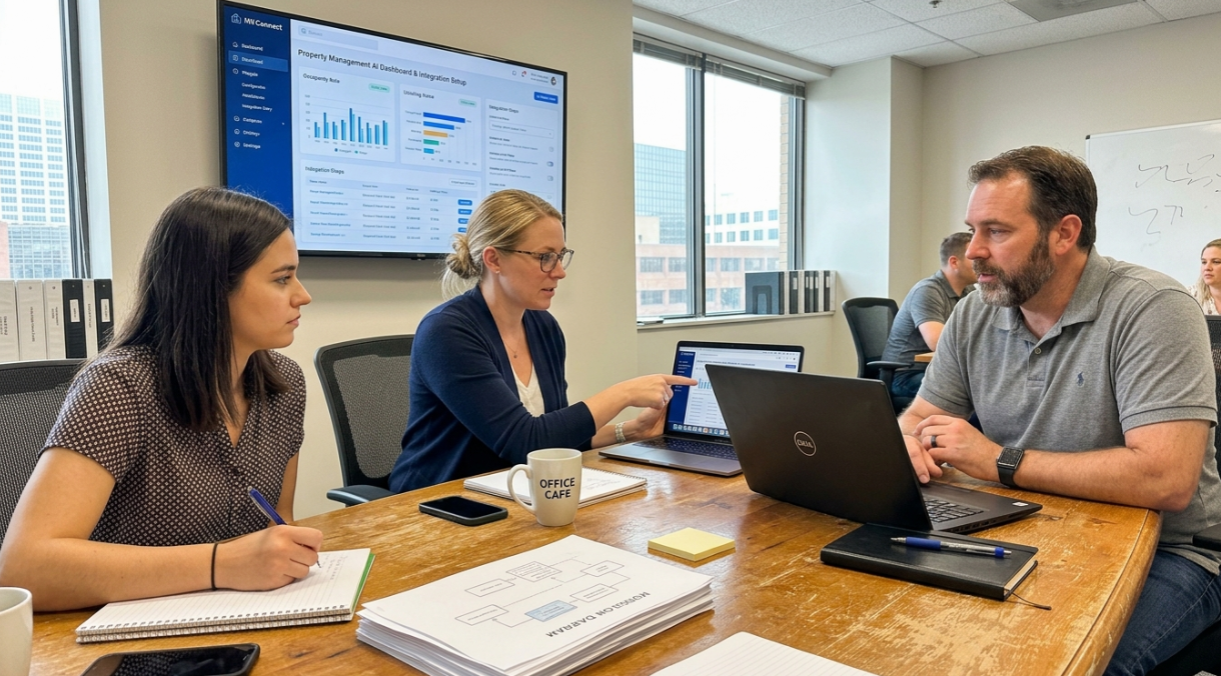
Now for the second meaning: you’ve decided to bring an AI tool into your operations, and you need to implement it. This process has its own challenges and failure modes.
Typical Timeline
For property management AI tools, onboarding typically takes one to two weeks for straightforward portfolios. More complex setups (scattered-site portfolios, multiple PMS platforms, custom workflow requirements) can take two to four weeks. Haven, for example, uses a sales-led onboarding process with hands-on configuration rather than self-serve setup, ensuring the system is tailored to each property manager’s specific workflows.
For a detailed breakdown of what to expect, the AI implementation timeline guide covers the phases from initial setup through full deployment.
Data Quality Is the Hidden Prerequisite
AI is only as good as the data you feed it. If your vendor records are incomplete, outdated, or inconsistent across systems, automation will produce inaccurate results. Before onboarding any AI vendor, audit your existing data. Are vendor contact details current? Are trade categories assigned correctly? Are COI expiration dates tracked?
Property managers who skip this step consistently report frustration with their AI tools, not because the tools don’t work, but because the underlying data doesn’t support automation. For a practical walkthrough, see this guide on data quality in your PMS.
Common Pitfalls
A McKinsey study found that 61 percent of AI customer service projects fail to deliver projected cost savings in year one. The failure factors are instructive:
Outdated knowledge bases (43 percent). If your AI tool is working from stale information, it makes bad decisions.
Unclear escalation rules (31 percent). Without defined rules for when AI should hand off to a human, edge cases fall through the cracks.
Over-reliance on default configuration (26 percent). Using the vendor’s out-of-the-box settings without customizing for your portfolio’s specific needs.
Practitioners on Capterra echo this. One reviewer reported that “the onboarding process is way more complex than it was made to appear when talking to the sales team. We were prepared, but the directions and process are not always clear.” The lesson: ask hard questions during evaluation, and don’t assume the demo reflects the implementation experience.
What to Ask When Evaluating an AI Vendor
Before committing, get clarity on these points:
PMS integration depth. Does the tool read and write to your PMS, or just read? Can it create work orders, update vendor status, and sync notes? Understanding AI and PMS error handling matters here.
Vendor list handling. How does the AI access and manage your preferred vendor list? Can it respect ownership-group-specific vendor preferences?
Compliance approach. Does the tool enforce compliance continuously or just at the point of onboarding?
Escalation rules. How are edge cases handled? What triggers a human handoff?
Configuration support. Is onboarding self-serve or guided? Given the 61 percent failure rate with default configurations, guided onboarding has clear advantages.
Looking for an AI platform built specifically for property management? Explore Haven’s AI property management software to see how it handles maintenance, leasing, and vendor workflows.
Why AI Vendor Onboarding Matters
Compliance Risk Compounds
A single vendor with lapsed insurance working across 30 properties creates liability exposure at every one of those properties. Manual tracking doesn’t scale. By the time someone notices the lapse, the vendor may have already completed work at multiple sites without valid coverage. AI vendor onboarding systems catch these gaps before they become problems.
For property managers thinking about insurance and maintenance risk, the vendor onboarding process is the first line of defense.
AI Dispatch Depends on Clean Vendor Data
An AI maintenance coordinator can only be as effective as the vendor data it works from. If your preferred vendor list is outdated, if compliance statuses haven’t been refreshed, if service areas are inaccurate, automated dispatch breaks down. Proper AI vendor onboarding ensures the data layer is solid before you build automation on top of it.
The Shift to Agentic AI
The broader technology trend is worth noting. Gartner projects that 40 percent of enterprise applications will use task-specific AI agents by end of 2026. In property management, this means AI agents that don’t just analyze data but take real operational actions inside your PMS: creating work orders, dispatching vendors, syncing compliance status, and following up with tenants.
AI vendor onboarding is the prerequisite for all of it. You can’t have an AI agent dispatch a vendor if that vendor hasn’t been properly onboarded, validated, and integrated into your systems. New protocols like Anthropic’s MCP and emerging agent-to-agent communication standards are accelerating this shift, and property management is not immune to it.
The ROI Case
Beyond risk reduction, the efficiency gains are substantial. Teams that automate vendor onboarding report saving 10 or more hours per week on administrative tasks. When you factor in faster vendor activation, fewer compliance lapses, and reduced email overhead, the ROI from AI in property management compounds quickly.
Related Terms
Vendor dispatch automation: The process of automatically assigning maintenance work to the right vendor based on trade category, availability, location, and compliance status.
Preferred vendor list: A curated list of pre-approved vendors, organized by trade and service area, that AI uses to route maintenance requests.
PMS integration: The connection between AI tools and your property management system that enables data to flow both ways without manual re-entry.
Vendor compliance management: The ongoing monitoring and enforcement of vendor insurance, licensing, and credentialing requirements across a portfolio.
AI maintenance coordinator: An AI system that handles the full maintenance lifecycle, from tenant request intake through vendor dispatch and follow-up.
Frequently Asked Questions
What is AI vendor onboarding in property management?
AI vendor onboarding refers to using artificial intelligence to automate the process of collecting, validating, and approving vendor information before they can work across your portfolio. It includes document extraction from COIs and W-9s, automated compliance screening, duplicate detection, and direct synchronization with your property management system. The term can also refer to the process of implementing an AI vendor’s product into your operations.
How long does AI vendor onboarding take?
For onboarding vendors into your portfolio using AI tools, the process can be reduced from weeks to days. Average onboarding times have dropped from 45 to 18 days with digital validation. For onboarding an AI product into your property management company, typical timelines range from one to four weeks depending on portfolio size and complexity.
What documents are required for vendor onboarding in property management?
The standard checklist includes certificates of insurance (COI) meeting property-specific minimums, W-9 tax forms, trade-specific licenses, background check results, proof of workers’ compensation coverage, and any ownership-group-specific credentialing requirements. AI systems adapt the required document list based on vendor type and the properties they’ll serve.
Why do AI implementations fail in property management?
Research shows 61 percent of AI customer service projects miss their cost savings targets in year one. The main causes are outdated knowledge bases (43 percent of failures), unclear escalation rules (31 percent), and relying on default configurations instead of customizing for your specific portfolio (26 percent). Poor data quality in your PMS is another common culprit.
How does AI vendor onboarding connect to vendor dispatch?
Vendor onboarding feeds directly into your preferred vendor list. When a maintenance request arrives, AI dispatch systems pull from this list to assign the right vendor based on trade, location, availability, and compliance status. If the onboarding data is incomplete or stale, dispatch fails. Clean onboarding is the foundation automated dispatch depends on.
Is vendor onboarding a one-time process?
No. Onboarding approval is not permanent. Insurance policies expire, licenses lapse, and compliance requirements change. AI vendor onboarding systems set automated reminders before policy expirations and trigger re-verification workflows. The best systems treat compliance as a continuous lifecycle rather than a one-time checkpoint.
What should I look for when choosing an AI vendor for property management?
Focus on PMS integration depth (read and write access, not just read), how the tool handles your preferred vendor list, whether compliance monitoring is continuous, how escalation rules work, and whether onboarding is guided or self-serve. Ask for references from property managers with similar portfolio sizes and structures.
Ready to see how AI handles maintenance coordination and vendor dispatch for your portfolio? Book a demo with Haven to explore the full workflow.